Trump, Venezuela, and the Dog that caught the car

Seems like I been down this way before
Is there any truth in that, señor?
Bob Dylan, Señor (Tales of Yankee Power)

In That Howling Infinite’s recent interest in Venezuela is less about Venezuela itself than about a familiar American habit resurfacing in a new theatre. We have seen this pattern before – in Iraq, in Afghanistan, in Libya – each intervention launched with confident rhetoric, elastic legal reasoning, and the quietly held belief that regimes, once struck, will obligingly collapse into something better. The names change; the logic does not. Venezuela now feels like the latest rehearsal space for a drama that has not yet finished running elsewhere.

This is where the US’ old Monroe Doctrine returns, not as doctrine so much as reflex. A Monroe Redux: stripped of 19th-century solemnity, repurposed for a world of drones, covert action, and press-conference deterrence. The Western Hemisphere is once again imagined as a special moral jurisdiction, even as the Middle East – long the cockpit of American intervention – appears exhausted, over-militarized, and politically unrewarding. Latin America, by contrast, offers proximity, asymmetry, and deniability. The geography has changed; the instincts have not.

This preoccupation also intersects with a longstanding fascination with the lessons of historian Barbara Tuchman’s acclaimed The March of Folly. Tuchman’s insight was not that governments lack information, but that they persist in policies demonstrably failing by their own stated objectives. Vietnam, later memorably described as “chaos without a compass,” remains the archetype: motion mistaken for strategy, escalation substituting for purpose. Iraq was folly recast as liberation; Afghanistan, folly prolonged as nation-building; Libya, folly laundered through humanitarian language. Iran hovers perpetually as folly-in-waiting, the regime-change itch that never quite gets scratched, yet never entirely disappears.

Viewed through this lens, Venezuela appears less as an isolated crisis than as a familiar historical rhyme. A little bombing here, a little bluster there; symbolic strikes presented as prudence, restraint marketed as strategy. It is not yet tragedy—history rarely announces itself so obligingly – but it carries the unmistakable scent of policies drifting, of a compass quietly returned to the drawer.

Tuchman’s opus is often misread as a study of stupidity. It is nothing of the sort. She was writing about persistence – about the peculiar ability of governments to continue down a path long after its internal logic has collapsed, armed with information but imprisoned by momentum. Vietnam was not born of ignorance but of escalation mistaken for purpose. Reading the accounts of Trump’s Venezuelan operation – no longer merely a “dock strike” but a full-blooded decapitation raid – one hears that same low, familiar hum: motion without destination, force without horizon.

A leap in the dark 

Everyone knew something like this was coming. Few expected it to be so clean. A president seized, command structures stunned, Caracas rattled just enough to demonstrate omnipotence without visibly levelling the city. From a tactical standpoint, it was impressive – the sort of operation that flatters planners and tempts presidents into believing that history, this time, might behave itself. But history rarely does. Leadership can be removed; regimes, less so. Chavismo survived Chávez’s death and Maduro’s long decay. Movements, unlike men, do not collapse neatly when the head is severed. They mutate. They harden. They endure.

This is where the metaphor shifts and darkens. The United States now looks less like a chess grandmaster and more like the proverbial dog that finally caught the car – triumphant, panting, and unsure what to do next. Decapitation creates ownership. Once you have removed the figurehead, ambiguity evaporates. The question is no longer whether Washington is intervening, but what exactly it intends to build, sustain, or suppress in the vacuum it has helped create.

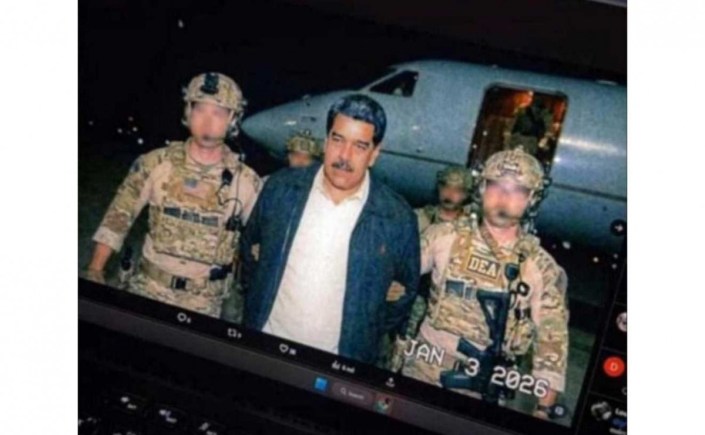
A week ago, US action might have been interpreted as calibrated escalation: signalling without war, pressure without conquest, violence as message rather than mission. That logic may have held when the strike was offshore, symbolic, plausibly deniable as a prelude rather than a crossing. It is harder to sustain once the president of a sovereign state has been bundled onto a ship and flown north in handcuffs. Symbolism has consequences. At some point, signalling becomes authorship.

The deeper assumption underlying both phases – the demonstrative strike and the decapitation raid – is the same one that has haunted American foreign policy for decades: that limited, spectacular violence produces rational political outcomes. That elites defect under pressure rather than close ranks. That populations blame their rulers rather than the foreign power violating their sovereignty. That humiliation weakens movements rather than mythologising them. This faith survived Iraq, limped through Afghanistan, and still stalks Washington like an unkillable ghost.

What reads in Washington as restraint reads elsewhere as undeclared war. What Beltway strategists describe as “calibrated” looks, from Caracas – or Beijing, Moscow, Tehran, each of whom have form – like arbitrariness dressed up as doctrine. In his most recent foreign policy forays, Trump has fired missiles into Nigeria and sent special forces into Venezuela. He cannot wield enough influence to get his way with major powers, so he targets smaller ones. The White House spins this as a demonstration of American strength, but those who rule in Moscow and Beijing will not be fooled. Nor should anyone else. Whilst ostensibly demonstrating American strength, it also highlights its weakness. Today it is Venezuela; tomorrow it might be somewhere else entirely. The pattern is not coherence but surprise. Power exercised as theatre.

Trump’s foreign policy has always oscillated between maximalist rhetoric and minimalist follow-through. He threatens fire and fury, then settles for a crater and a press conference. He speaks the language of conquest while practising the art of nuisance. Yet Venezuela marks a subtle shift. This is no longer nuisance alone. By removing Maduro, Trump has crossed from menace into management, whether he wants the responsibility or not. Chaos, once unleashed, has a habit of demanding supervision.

The international reaction follows a script so familiar it almost performs itself. International law is solemnly invoked by states that otherwise treat it as optional décor. Yanqui imperialism is dusted off and waved aloft. Blood for oil, regime change, darkest chapters, dangerous precedents –  all the old tropes re-emerge, not because they are always wrong, but because they are always available. France, China, Russia, the EU condemn the breach while sidestepping the harder question: what is to be done now that a criminalised, hollowed-out regime has been removed not by its people, but by force?

Latin America splits along its habitual fault lines. Argentina’s Milei cheers liberty’s advance. Brazil’s Lula warns, with weary accuracy, that violence justified as justice tends to metastasise into instability. Neighbouring Colombia braces for refugees. Cuba mutters “state terrorism.” The region remembers – perhaps too well – that external interventions rarely end where their authors imagine.

What is most striking, though, is how little this seems to disturb the American political bloodstream. The legal basis for seizing a foreign head of state is treated as a technicality. Congressional war powers hover faintly in the background. The risk of retaliation, miscalculation, or long-term entanglement is acknowledged, then politely ignored. The old muscle memory of American power keeps flexing, long after the strategic rationale has atrophied.

And so Tuchman returns, not as a moralist but as a diagnostician. Folly is not recklessness; it is normalisation. It is the steady acceptance of contradiction as policy. Trump’s Venezuela adventure now embodies this perfectly: escalation without ownership, ownership without vision, action without explanation. Each move can be defended in isolation. Together, they form a strategy that cannot quite say what it is for.

Hovering over all of this – absurdly, yet tellingly – is the mirage of the Nobel Peace Prize so coveted by President Trump. The prize is not awarded for the mere absence of war, but for the construction of peace: treaties, frameworks, institutions that reduce violence rather than rebrand it. Bombing here, abducting there, tearing up agreements while demanding credit for not starting new wars is not peace-making; it is anti-diplomacy. Peace defined negatively, as something that has not yet collapsed.

One imagines the Nobel Committee reading this Venezuelan episode with a raised eyebrow: sovereignty breached as messaging, escalation choreographed like a reality-show arc, regime change gestured at but not owned. Peace prizes are not usually awarded for keeping one’s options open.

In the end, Trump’s Venezuelan jiggery-pokery is fascinating for the same reason Vietnam remains endlessly analysed. It shows how great powers drift — not because they are blind, but because they cannot quite decide what they are looking for. Chaos without a compass is not the absence of movement. It is movement mistaken for purpose. And history, as Tuchman patiently reminds us, is unforgiving toward those who confuse the two.

Wrong way, go back? 

Soon after the American militarily impressive operation, The Atlantic published an cautionary opinion piece by staff writer Colin Friedersdorf arguing that Trump has effectively launched a regime-change war against Venezuela without constitutional authority, democratic consent, or a plausible plan for what comes next. The core charge is not primarily strategic incompetence but constitutional betrayal.

He contrasts Trump’s actions with past presidents who, whatever their later failures, at least sought congressional authorisation before waging major wars. Roosevelt after Pearl Harbor and George W. Bush before Afghanistan and Iraq are invoked not as moral exemplars but as constitutional ones: they recognised that the power to initiate war belongs to Congress, and that legitimacy flows—however imperfectly—from public consent. Trump, by contrast, has dispensed with permission altogether.

Friedersdorf dismisses the administration’s legal justifications as threadbare. Labeling Maduro a “narcoterrorist” or pointing to a US indictment does not, he argues, amount to lawful grounds for war against a sovereign state. These are prosecutorial claims masquerading as casus belli, not a substitute for authorisation under domestic or international law.

Strategically, the article warns that toppling Maduro would be the easy part. Venezuela is already riddled with armed groups, including Colombian militants who use its territory as a base for smuggling and mining. Removing the regime risks unleashing forces that would not “go quietly,” echoing Iraq and Libya more than any clean counter-narcotics success.

Friedersdorf argues that Trump is uniquely unfitted for a regime-change war for several interlocking reasons, combining personal disposition, governance style, and historical patterns of behaviour. Unlike previous presidents who sought congressional authorisation—Roosevelt after Pearl Harbor, George W. Bush before Afghanistan and Iraq – Trump bypassed the Constitution entirely. For Friedersdorf, this is not merely a procedural violation; it signals a reckless disregard for the legal and democratic frameworks that constrain American war-making, a disregard which has tangible consequences when planning complex military operations overseas.

Second, Trump’s track record of self-interest and transactional politics undermines confidence in his strategic judgment. Friedersdorf points to a “lifelong pattern” in which Trump has pursued personal, familial, or financial gain, sometimes at the expense of institutional norms or public welfare. A regime-change war in a resource-rich country like Venezuela, Friedersdorf suggests, is exactly the kind of environment in which such temptations could manifest: the conflation of national interest with personal enrichment. Unlike professional soldiers or presidents with experience in foreign policy and national security, Trump’s incentives are highly idiosyncratic, making the outcomes of a war unpredictable and potentially self-serving.

Third, Friedersdorf questions Trump’s capacity for sustained leadership and operational management in a conflict that, by its nature, requires patience, coordination, and political nuance. Toppling Maduro may be “easy” in the sense of a tactical strike, but the aftermath – stabilising Venezuela, managing humanitarian fallout, and navigating regional politics – requires sustained commitment. Friedersdorf doubts that Trump possesses the temperament, patience, or skill to oversee such a complex and prolonged effort. The concern is that he could declare victory prematurely, mismanage occupation or transition, or escalate in ways that deepen instability rather than resolve it.

Finally, Friedersdorf critiques the political myopia and disregard for public opinion in Trump’s approach. Polls reportedly showed a majority of Americans opposed to military intervention in Venezuela, yet Trump proceeded unilaterally. In Friedersdorf’s assessment, this combination—constitutional bypass, personal opportunism, lack of leadership discipline, and political insensitivity—makes Trump not just ill-prepared, but dangerously mismatched to the responsibilities of a regime-change war, with risks to both American legitimacy and Venezuelan stability.

In short, Friedersdorf sees Trump as uniquely unfit because the personal, constitutional, and strategic factors that would constrain a conventional president are either absent or inverted in him, making a complex foreign intervention unusually perilous. And, even if the intervention were to improve Venezuelans’ lives – a possibility Friedersdorf does not dismiss outright – it would still represent a violation of American democratic norms.

The concluding warning is blunt: by choosing war despite public opposition and without congressional approval, Trump has shown contempt for both the Constitution and the electorate. If Congress does not assert its authority now, Friedersdorf fears this episode will become precedent – another step toward endless wars of choice launched by executive whim, not collective decision.

In short, the article frames Venezuela not merely as a foreign-policy gamble, but as a constitutional crisis in miniature – one that exposes how fragile America’s war-making restraints have become when a president decides they are inconvenient.

What happens now?

Everyone knew something like this was coming; perhaps fewer expected it to be executed with such clinical speed. The pre-dawn abduction of Nicolás Maduro by US forces is less a surprise than a punctuation mark — a moment where long-signalled intent finally hardened into action. A foreign head of state removed in two hours. Mission theatrically accomplished. Endgame conspicuously absent.

It is challenging, but not impossible, for American forces to amass massive military hardware, materiel and personnel offshore, bombard a small neighbour and send special forces into its capital. It is much harder for an American president to control what happens in the aftermath. This explains why global leaders are so cautious about this operation. No major European leaders have endorsed the use of force to bring down the Venezuelan government.

The real test for Trump is what comes next. He has been rightly critical of the US invasion of Iraq, and his MAGA movement favours “America First” rather than “regime change” overseas, but now he pursues a regime change of his own, with only a vague assurance that he and his lieutenants will run Venezuela for an unspecified time. The objective has a strategic element, in trying to slow the flow of drugs into America, but most of it is nakedly commercial. While other presidents might not have said this out loud, Trump is direct: he wants US control of the Venezuelan oil fields, with US oil companies investing and making money, so that oil production will increase.

In an opinion piece published in the Sydney Morning Hearal on 5th June, Robert Muggah, co-founder of the Igarapé Institute think tank and a fellow at Princeton University, usefully lays out five post-Maduro scenarios, though what binds them is not optimism but ambiguity. The first – Trump declares victory and walks away – would be the most American of outcomes: maximum disruption, minimum follow-through. Chavismo, minus its latest avatar, shuffles on; Washington expends enormous leverage only to abandon it; the refugees keep coming. The dog catches the car, looks briefly triumphant, and then isn’t quite sure what to do next.

The second scenario – a popular uprising washing away Chavismo – flatters liberal intuition but ignores institutional rot. Venezuela’s civic muscle has atrophied after years of repression, criminalisation, and mass emigration. Armed colectivos remain invested in chaos. What sounds like democratic renewal risks becoming a weak interim regime, punctuated by violence, oil-sector infighting, and amnesty wars.

Scenario three is the familiar regime-change fantasy: escalate, sanction, manage an election, install a friendly opposition figure, promise reconstruction. The problem, as ever, is legitimacy. A government midwifed too visibly by Washington inherits the original sin of imperial sponsorship. Chavismo’s anti-imperial narrative – long threadbare –  would suddenly acquire fresh oxygen, while external actors queue up to meddle by proxy. Another low-grade insurgency beckons.

The fourth option – US custodianship – is the one Trump has effectively name-checked: trusteeship without the label. Stabilise the bureaucracy, revive oil production, choreograph elections, dangle sanctions relief, keep troops nearby “just in case”. It is administratively coherent and politically radioactive. It risks converting a crisis of governance into a crisis of sovereignty, hardening nationalist resistance and validating the very mythology the intervention claims to dismantle.

Which leaves the fifth, and perhaps most honest, outcome: managed instability. No clean victory, no decisive collapse. A weakened Chavista elite, a divided opposition, fragmented security actors, and a US that calibrates pressure without appetite for occupation. A low-boil conflict, indefinitely deferred resolution, limbo as policy.

Hovering over all this is Monroe Doctrine 2.0 – a message not just to Caracas but to Havana, Managua, Bogotá, Panama, even further afield. This was less about Maduro than about signalling who gets to set terms in the hemisphere, and who doesn’t. A muscular reminder that alignment matters, and misalignment carries costs.

For Venezuelans themselves, the prognosis is bleakly familiar: another external intervention, another promise of order, another season of uncertainty. The screw tightens, the rhetoric soars, the moral justifications proliferate – and ordinary people remain suspended between liberation narratives and lived precarity.

History suggests this is not an ending but a prologue. The question, as always, is whether anyone involved is genuinely prepared to live with the consequences of what they’ve just begun.

See also in In That Howling InfiniteTales of Yankee Power … at play in America’s backyard, Tales of Yankee power … Why Venezuela, and why now?, Marco Rubio’s Venezuelan bargain and the original  Tales of Yankee Power

Caveat emptor

It is worth recalling, in this context, what ultimately happened to Muammar Gaddafi and Saddam Hussein – two leaders who, in different ways, became objects of Western fixation and regime-change temptation. Saddam was toppled by overwhelming force, hunted down, tried under a hastily constructed legal order, and hanged; the state he ruled collapsed with him, unleashing sectarian violence and regional instability that still reverberate. Gaddafi, having abandoned his weapons programmes in the hope of rehabilitation, was nevertheless pursued once the opportunity arose, cornered during a NATO-backed intervention, and killed by a mob in a Libyan drainage culvert. Libya followed him into fragmentation, militia rule, and proxy warfare.

In neither case did the removal of the strongman deliver the orderly political transformation that had been implicitly promised. What followed was not liberal democracy but vacuum – power without legitimacy, violence without direction. These episodes linger in the strategic memory not merely as moral tales but as practical ones: regime change is easy to threaten, harder to execute, and almost impossible to control once unleashed.
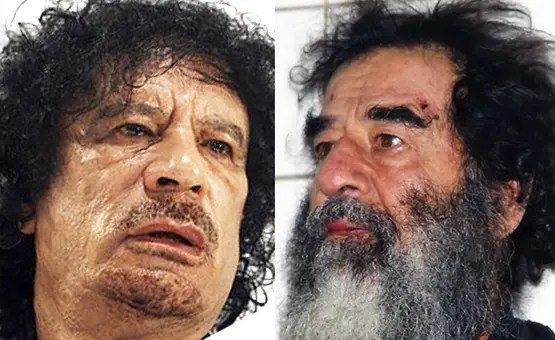

Muammar Gadaffi and Saddam Hussein in captivity

Tales of Yankee Power … at play in America’s backyard

Señor, señor
Can you tell me where we’re headin’?
Lincoln County Road or Armageddon?
Seems like I been down this way before
Is there any truth in that, señor?

This story does not relate to Bob Dylan’s cryptic and nihilistic Señor (Tales of Yankee Power), from Street Legal (1978). As for the meaning of his song, well, that’s pretty hard to fathom. A cowboy fever dream, perhaps; one of those strange illusions you channel in the early morning between sleeping and waking, more about mood than meaning.

Rather, these tales refer to the United States’ troubled and troublesome historical and contemporary relationship with its Central and Latin American neighbours – and particularly, to its current crusade against Venezuela’s autocratic president Nicolás Maduro. And it is less about Venezuela than about the US itself – an empire in all but name struggling to recover its own reflection in the shifting mirror of history. The restless ghost of Manifest Destiny is still pacing the corridors of the West Wing and the State Department. The “tales of Yankee power” keep repeating because the empire cannot imagine itself without them. Each show of force, each threat of “covert operations” is a reassurance ritual, a way of proving that the old muscles still work. But as with all empires in decline, the performance reveals more fragility than strength. The Monroe Doctrine once kept others out; the Neo-Monroe Doctrine may exist only to convince America that it is still in.

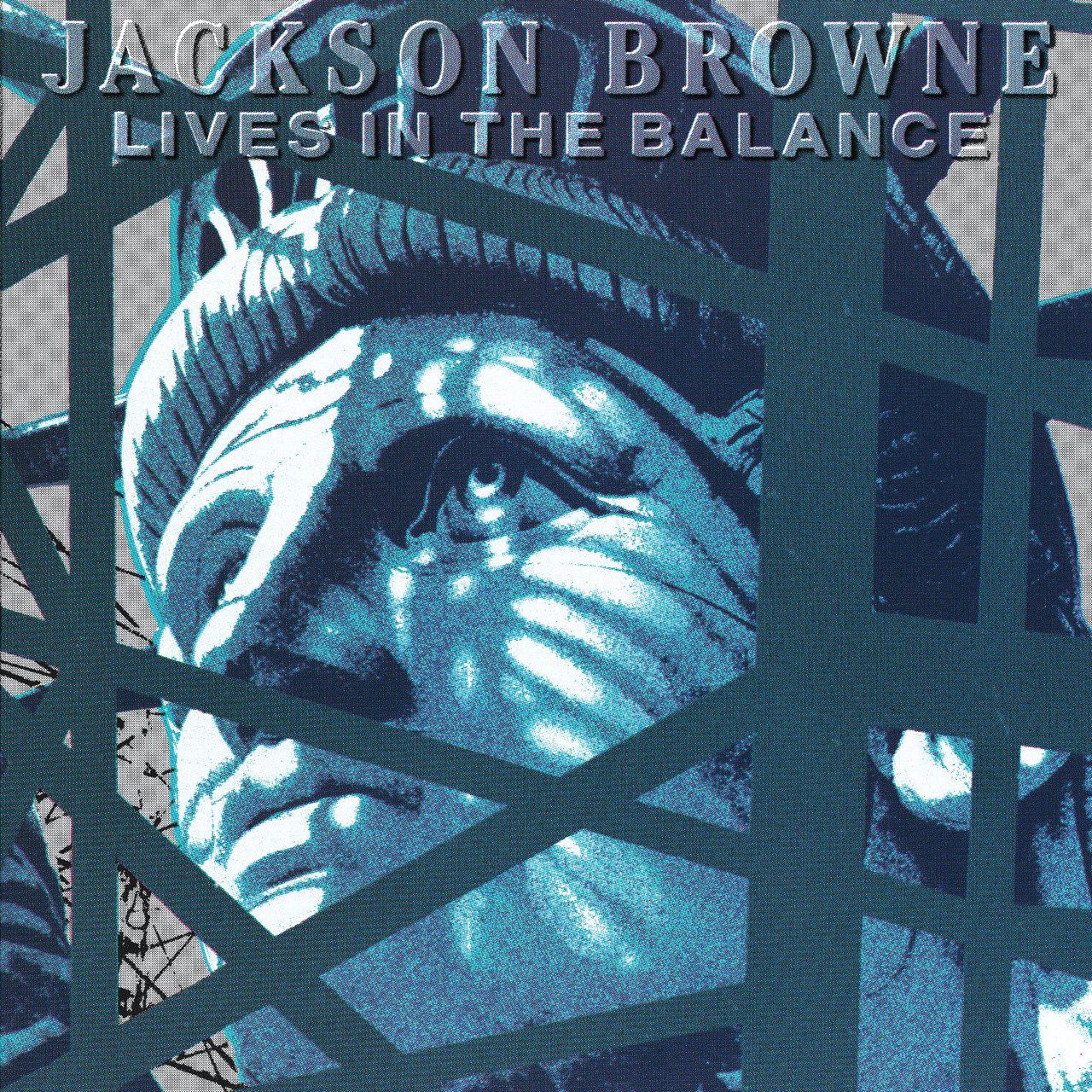
In That Howling Infinite has walked this road before in a 2017 post also entitled Tales of Yankee Power, a feature on American songwriter Jackson Browne‘s1986 album Lives in the Balance. At the time critics reckoned that its contemporary content, the USA’s bloody meddling in Central America, limited its appeal and long-term significance. And yet, here in the early twentieth first century, where the wars of the Arab Dissolution dragged the world into its vortex, and Vladimir Putin’s invasion of Ukraine ended seventy five years of Pax Europa, the Great Power politics and proxy wars that taxed intellectual and actual imaginations in that seemingly distant decade jump back into the frame like some dystopian jack in the box. As Mark Twain noted, “history doesn’t repeat itself, but it does rhyme”.

Eight years after the original Tales of Yankee Power, the story hasn’t ended – it’s simply changed key. The Uncle Sam is still abroad, still restless, still convinced the hemisphere cannot manage without his supervision. Only the script has been updated: what was once called the Monroe Doctrine is now “neo”; what was once the “war on communism” is now the “war on drugs”. But the music is familiar – and derivative: in this sad world, whenever Uncle Sam (or Comrade Ivan for that matter) plays his hand, something wicked this ways comes. As Canadian songwriter Bruce Cockburn, who also condemned the North’s intervention in the politics of the South once sang, “Little spots on the horizon into gunboats grow … Whatever’s coming, there’s no place else to go, waiting for the moon to show”.

Donald Trump’s Neo-Monroe Doctrine 

Yanqui wake up
Don’t you see what you’re doing
Trying to be the Pharoah of the West bringing nothing but ruin
Better start swimming
Before you begin to drown
All those petty tyrants in your pocket gonna weigh you down

Bruce Cockburn, Yanqui Go Home (1984)

Which brings us to American journalist John Masko’s insightful analysis of Trump’s Latin American policy in a recent Unherd article.  It is sharp and well-informed, particularly his framing of the “Neo-Monroe Doctrine” as the ideological scaffolding for Washington’s renewed interest in its southern backyard. Yet, like most American commentators, he skips over a crucial subplot – namely, the role of the United States itself in creating the very chaos it now claims to correct. Venezuela’s “descent into shambles,” as he calls it, did not occur in a geopolitical vacuum. Sanctions, economic strangulation, and decades of covert interference were not incidental background noise but deliberate acts of policy – the slow throttling of a regime that refused to align with the hegemon’s economic and political script. Without that context, the narrative too easily morphs into a morality play about Latin American incompetence, when in truth, it’s an old imperial story of cause, consequence, and selective amnesia.

Masko’s central thesis – that Trump has revived the Roosevelt Corollary to the Monroe Doctrine – is persuasive. In Trump’s mind, security begins at home and radiates outward; when weak or corrupt neighbours threaten that security, they must be coerced or replaced. The author rightly traces this logic back to Roosevelt’s 1904 declaration that the US would “police” the Western Hemisphere, supposedly without territorial ambition but with the clear intent of monopolising intervention. From Cuba to the Dominican Republic, Guatemala to Chile, the Corollary became the moral fig leaf for American coups, invasions, and corporate extractions. Trump, Masko argues, sees himself as restoring that prerogative – a hemispheric sheriff cleaning up the neighbourhood after decades of liberal hand-wringing.

There is, however, a deeper irony in Masko’s framing. He presents Trump’s military buildup around Venezuela – F-35s in Puerto Rico, B-52s off the coast, CIA “covert” operations loudly proclaimed on television – as a return to historical normalcy, a reassertion of superpower swagger. But this conveniently ignores that America never really stopped intervening. From Plan Colombia to the Contra wars, from IMF leverage to trade sanctions, the methods simply evolved. The empire modernised; the mission never changed.

Masko paints Venezuela as a nation hollowed out by corruption, its military loyal only through fear and patronage, its once-mighty oil industry captured by criminal syndicates and foreign proxies. He’s not wrong — but he omits the pressure points that made reform or recovery almost impossible: the freezing of foreign assets, oil export bans, and a sanctions regime designed to collapse the economy under the banner of “democracy promotion.” The result is a country starving under siege, then blamed for its own starvation. It is the oldest of imperial tricks: break it, then call it broken.

The author is also curiously incurious about the demand side of America’s perpetual Latin drug war. He notes Trump’s pretext of “narco-trafficking” but fails to mention that the real market for those drugs lies not in Caracas or Bogotá, but in Chicago and Miami. As long as there is insatiable appetite and profit north of the Rio Grande, cartels will thrive no matter how many “suspect vessels” are blown out of the Caribbean. America’s own prohibitionary puritanism – the same logic that gave birth to Al Capone – continues to nourish the problem it claims to fight.

Masko’s analysis of Trump’s strategy does capture one key insight: the re-militarisation of hemispheric policy as a form of domestic theatre. Trump’s “Neo-Monroe Doctrine” is less about Venezuela per se and more about a symbolic restoration of dominance. It is the same playbook that guided the 1989 invasion of Panama, when Noriega — once Washington’s man in the canal zone – became inconvenient and was duly removed under the banner of anti-narcotics and democracy. The echo is unmistakable. Venezuela today serves as both scapegoat and proving ground: a chance for Trump to replay history, cast himself as the avenger of American sovereignty, and perhaps even seize a few oil fields in the process – though that, as always, is to be disavowed in polite company.

What Masko misses, perhaps by design, is the wider economic and ideological dimension. To call this merely an attempt to “seize Venezuelan oil” is too simple – Trump’s doctrine is more performative than acquisitive. It is about reasserting that the Western Hemisphere remains, in practice if not in name, America’s exclusive zone of influence, a region where Chinese investment and Russian advisors are not just economic competitors but existential affronts. In that sense, the “Neo-Monroe Doctrine” is less a new foreign policy than a nostalgic hallucination: the dream of a hemisphere restored to its “natural order,” where Washington’s word is law and the rest are junior partners or failed states.

And yet, the danger lies precisely in that nostalgia. Venezuela’s collapse – accelerated by sanctions and corruption alike – has left it a tinderbox of criminal fiefdoms and shattered institutions. Push too hard and you get not regime change but fragmentation. The military Masko describes as Maduro’s bulwark could just as easily splinter, leaving behind a patchwork of armed enclaves and foreign proxies – a Caribbean Libya with oil rigs.

Trump, Masko concludes, is signalling not just to Caracas but to the continent: the Roosevelt Corollary is back. America will once again “help its friends and hamper its foes.” Perhaps so. But the hemisphere has changed; the hegemon’s writ is no longer automatic. China, once a distant abstraction, now bankrolls half the region’s infrastructure. Russia, Iran, and Turkey are present in the margins. The Monroe Doctrine may have been written to keep Europeans out of America’s backyard, but the world has since moved into the neighbourhood.

What emerges, finally, from Masko’s piece is a portrait not of a coherent strategy but of imperial muscle memory –  the reflex to intervene dressed up as rediscovered purpose. Trump’s “Neo-Monroe Doctrine” is at once a geopolitical manoeuvre and a campaign slogan: Make Latin America Great Again, or at least make it obedient again. The tragedy, as always, is that ordinary Venezuelans – impoverished, exiled, and exhausted – will pay the price for another American morality play performed for domestic applause.

  Trump is coming for Venezuela

John Masko, Unherd 24 October

America’s foreign policy appears to have been turned upside down. In the Middle East and Far East, which have consumed most of America’s defence planning energy over the last few decades, trade wars and diplomatic negotiations have replaced shows of military power. Meanwhile, the US is stockpiling both materiel and manpower off the shores of South America to a degree unseen in many decades.

As of this week, the US had positioned 10 F-35 fighter jets in Puerto Rico, along with three MQ-9 reaper drones. More than 4,500 Marines and sailors have taken up residence at US Southern Command in Miami, Florida. Last week, President Trump publicly announced that he was authorising CIA covert operations in Venezuela, and a group of B-52 bombers flew near Venezuela’s coast. More than five suspected drug ships, some originating in Venezuela, have been interdicted and destroyed by US forces over recent weeks.

To many in the foreign policy establishment, Trump’s fixation on squeezing Venezuelan dictator Nicolás Maduro has been an enigma. He has justified the buildup on the grounds that Maduro’s regime harbours drug producers and distributors. But when Maduro has tried to satisfy Trump — even accepting planeloads of deported Venezuelan nationals from America — Trump has rebuffed him and redoubled US pressure. Perplexed analysts are asking: what exactly is Trump trying to achieve, if nothing Maduro can offer will please him? Where can this lead except to war or a humiliating walk-back?

This reveals a fundamental misunderstanding between the Trump administration and the foreign policy establishment. Rather than focusing on the near-term risks of war in Venezuela, Trump is asking a higher-order question: What is the point of being a superpower if you can’t stop your neighbours from sneaking deadly drugs and unapproved migrants across your borders?

In Trump’s understanding, security begins at home, and then extends to the near-abroad. When weak or corrupt leaders nearby threaten the stability of the US, they must be either forced to change their behaviour, or they must be replaced. This has not been US policy for several decades, but for most of the 20th century, it was. The name of this policy was the Roosevelt Corollary to the Monroe Doctrine. What Trump is signalling in Venezuela is that the Roosevelt Corollary is back.

President Theodore Roosevelt announced the Corollary in 1904 in his Annual Address to Congress. Since the presidency of James Monroe a century earlier, it had been American policy to oppose any new colonisation or subjugation of lands in the Western Hemisphere by European powers. Monroe’s policy did not, however, provide a road map for when European countries sent ships into America’s backyard to collect debts or fight wars, as occurred during the British, Italian and German blockade of Venezuela in 1902. Determined to keep European warships out of America’s near-abroad, Roosevelt declared that US policy would be to have a monopoly over policing power in the Western seas. He further declared that it was no longer the sole purpose of the Monroe Doctrine to keep Europe out of our near-abroad; the doctrine would also now be used to protect American interests more generally. He explained: “It is always possible that wrong actions toward this nation or toward citizens of this nation… may result in our having to take action to protect our rights; but such action will not be taken with a view to territorial aggression, and it will be taken at all only with extreme reluctance.”

During the ensuing decades, the Roosevelt Corollary was periodically called upon to reestablish order in Latin American war zones and to prevent the accession of regimes dedicated to, in Roosevelt’s words, “wronging” the US. The Corollary underlay the brief US occupation of Cuba, from 1906-1909, after the Spanish-American War, two occupations of the chronically unstable Dominican Republic, and support for the Contras against the Sandinistas in Nicaragua. It also inspired the CIA-supported overthrows of Guatemalan President Jacobo Árbenz following his nationalisation of United Fruit Company lands, and of Chilean President Salvador Allende as he led that country’s mining-based economy into ruin. It was also behind America’s futile efforts — through an embargo, assassination attempts, and the failed Bay of Pigs invasion — to topple Cuban communist dictator Fidel Castro.

America’s failure to overthrow Castro, coupled with the relative untouchability of many Soviet-allied Latin regimes during the Cold War period, caused the Roosevelt Corollary to fall into disuse. The liberal internationalist order that followed the Cold War further discouraged the use of hard power to overthrow regimes hostile to American interests. But in 2025, the Trump Administration seems determined to bring it back.

Within the Roosevelt Corollary (or, as I’ve been told it’s referred to within the administration, “Neo-Monroe Doctrine”) framework, some of Trump’s harder-to-figure foreign policy actions begin to make more sense. One of these is the appointment of Cuban-American Florida Senator Marco Rubio as Secretary of State, which was perplexing alongside Trump’s more provocative foreign policy nominations of Pete Hegseth and Tulsi Gabbard. But when one considers Rubio’s knowledge of Latin America and his hawkish record on Latin American dictators in the context of the Roosevelt Corollary agenda, he fits perfectly.

Then there are Trump’s recent actions toward Argentina and Colombia, both of which would have seemed peculiarly drastic in past administrations, but represent a return to a Rooseveltian approach to doing business. For Argentine President Javier Milei, a libertarian friend of the US who faces a fiscal crunch at home, Trump recently structured a $40 billion loan package and floated a huge purchase of Argentine beef, much to the chagrin of American cattle ranchers. Colombian socialist President Gustavo Petro, on the other hand, faced a cutoff of all American aid (Colombia has received $14 billion in aid since 2000) due to his failure to address Colombian drug trafficking. In a Rooseveltian world, the President wields plenty of carrots and a big stick.

“What Trump is signalling in Venezuela is that the Roosevelt Corollary is back.”

In order to understand how Trump’s Roosevelt Corollary framework applies to Venezuela, we must first consider the state of the country today. Maduro’s Venezuela is a shambles by every possible metric: aside from its ruler’s personal security. Owing to a combination of mismanagement and corruption, Venezuela, once the wealthiest nation in Latin America, is now an economic basket case. Its economy is projected to contract by 3% this year, and inflation is at 682%. Venezuelan oil exports — the foundation of its economy — have declined by two thirds since 2012. As living standards and safety across the country have plummeted, nearly 30% of Venezuelans have left over the last 10 years, mostly for neighbouring Colombia, but many for the US (both legally and illegally).

Even with a hostile third of the country now gone, Maduro still received fewer votes for president than opposition candidate Edmundo González in last year’s election. While international organisations urged him to accept defeat, he declared victory and began a third term in office. Opposition leader María Corina Machado, whose exit polling efforts demonstrated that Maduro’s reelection was rigged, was awarded the Nobel Peace Prize for her efforts to fight the regime.

Yet while Maduro may be the world’s least legitimate leader, his position within Venezuela is still secure. As centuries of Latin American history have shown, military loyalty is the single most important requisite for regime security in the region. And while Maduro may have little else, he has that. As the Wall Street Journal has shown, Maduro has successfully “surrounded himself with a fortress of lieutenants whose fortunes and future are tied to his”. He has done this by imprisoning or exiling the disloyal, while encouraging the loyal to accept patronage jobs in state-run companies or payoffs from drug-traffickers to allow their shipments to pass. The result is a military that is just as fearful for the personal ramifications of regime failure as Maduro is himself. And in case Maduro’s reign of blackmail were to fail, there are Cuban counterintelligence officials and other paid spies installed in the ranks to detect any hint of insurrection. According to Edward Rodríguez, a defected former Venezuelan army colonel, snitching is richly rewarded with “jobs, money, cars and even homes” in a country where much of the population cannot consistently afford food.

With the government preoccupied by personal security and self-enrichment, it will surprise few that much of the official territory of Venezuela (precisely how much is unknown) is no longer under government control. Much of western Venezuela is controlled by Colombian drug-running and human-trafficking organisations like the National Liberation Army. And much of southern Venezuela is given over to feuding megabandas or organised crime rings — most infamously the gang Tren de Aragua, recently designated a foreign terrorist organisation by the US. The megabandashave outposts in Venezuela’s major cities, and all around the world, including in the US. One reason for Venezuela’s declining exports is that large parts of its major extractive industries — particularly mining — have been taken over by criminal enterprises whose activities occur off the books. These organisations control territory in the Orinoco Mining Arc in Venezuela’s southeast, where many of their mines are located.

Since Trump’s pressure campaign, Maduro has pumped out propaganda to recruit a citizen militia that can bolster the country’s depleted military. According to the Wall Street Journal, “on state television, radio and social media, announcers are telling Venezuelans that the U.S. is a rapacious Nazi-like state that wants to dig its claws into the country’s oil wealth but that the Venezuelan military, the National Bolivarian Armed Forces, are positioning to repel any invasion”. Maduro’s army currently numbers about 125,000 — a combination of military regulars and new recruits, so many of whom are above typical military age that they have been dubbed a “Dad’s Army” in the British press. According to recent reporting, the army is underfed, under-resourced, and has suffered from a significant brain-drain due to Maduro’s loyalty tests. Maduro reportedly also plans, in the event of invasion, on having the support of Colombia’s National Liberation Army — the least it can do for Caracas’ salutary neglect of its drug and human smuggling (whether before or after he delivers to Trump his proof that there’s no drug trafficking in Venezuela, one can only guess).

For the US, this all adds up to a puzzle: the Maduro regime’s continued existence directly hurts American interests, but the regime has hollowed out Venezuelan society and institutions to such a degree that regime change will probably result in further chaos, and very possibly a civil war — outcomes that also hurt American interests.

Trump has likely still concluded that regime change would help the US, but that to be effective, the muscle behind it will need to come from inside Venezuela itself. His military buildup is therefore an effort to pressure fence-sitters inside Venezuela’s military and underground political opposition (a group that still includes Machado herself) to provide that muscle. Perhaps if military brass begins to see that the Maduro regime’s days are numbered, their calculus on how best to preserve their own lives and careers will shift. There is also an outside chance that a skirmish with US forces, and a glimpse of the untenability of his position, might convince Maduro to resign or flee.

For the time being, direct covert action against Maduro’s person seems to be off the table. Ironically, we know this because of Trump’s highly irregular decision to broadcast his authorisation of CIA covert action to the world — meaning it would no longer be, well, covert. Trump’s threat of covert action, rather, functions as a nuclear bomb of psychological warfare, ensuring that every night for the foreseeable future, Maduro dreams of exploding cigars. Far more likely is covert action that assists in forming and resourcing opposition parties or militias, as the US has done in past Latin American revolutions. Conventional military strikes on Venezuela are possible but would need to be provoked. Conventional forces could also be deployed in ungoverned spaces against drug-traffickers, further underlining the impotence of the Maduro regime.

Where the Trump-Maduro standoff goes from here is hard to know. But the reasoning behind the buildup is abundantly clear, and it goes far beyond Venezuela’s drug distribution or human trafficking. It is a signal to the world, and to Latin America in particular, that American policy toward the Americas has changed. More precisely, it’s changed back from a policy of salutary neglect to an active posture in which American interests are stridently defended. As in the days of the Roosevelt Corollary, America will help its friends and hamper its foes. If a Latin American regime harms American interests, and regime change will improve the situation, America will not hesitate to affect its overthrow.

Venezuela resonates particularly with the original purpose of the Monroe Doctrine, which was to preclude European incursion into American waters. Venezuela is a long-term strategic partner of China, which relies heavily on Venezuelan oil and offers economic and political support to Venezuela internationally. Even as Venezuela has descended into ruin over the last few years, it has continued to serve as a beachhead for Chinese influence in America’s backyard. Just as President Monroe’s original doctrine intended to keep hostile foreign interference far away from American waters, President Trump’s updated Monroe Doctrine can do the same for America’s 21st-century threats.

Trump is likely gambling on the fact that Maduro’s fall would be universally popular. The rest of the world has watched in horror over the last several decades as Maduro and predecessor Hugo Chávez plunged their country into poverty and chaos. This means that if US pressure results in Maduro’s overthrow, Trump’s new Roosevelt Corollary will start out in the win column in the court of international public opinion. Whether the US stays in that column as it addresses challenges in Colombia, Peru and Argentina, only time will tell.


John Masko is a journalist based in Boston, specialising in business and international politics.

Tales of Yankee Power

When Jackson Browne released Lives in the Balance in 1986, critics reckoned that its contemporary content, the USA’s bloody meddling in Central America, limited its appeal and long-term significance. And yet, here in the early twentieth first century, with the wars of the Arab Dissolution dragging the world into its vortex, the Great Power politics and proxy wars that taxed intellectual and actual imaginations in that seemingly distant decade jump back into the frame like some dystopian jack in the box. As Mark Twain noted, “history doesn’t repeat itself, but it does rhyme”.

Lives in the Balance was certainly a record for and of its times. Months before the Iran-contra scandal broke, Browne sang “I want to know who the men in the shadows are, I want to hear somebody asking them why. They can be counted on to tell us who our enemies are but they’re never the ones to fight or to die”. After the “arms for hostages” deals hit the news, increased public awareness of the US’ secret and dirty war in Nicaragua inspired him to produce a video for the title track well after the album had passed its sales peak.

Lives in the Balance

The album’s other songs sustained the assault. Soldier of Plenty condemns America’s paternalism towards its poor Latin neighbours. Lawless Avenues, with poignant Spanish lyrics by Browne and Warren Zevon’s old friend and collaborator, Jorge Calderón, takes us down the mean streets of Latino Los Angeles before sending its young anti-hero off to die in America’s wars. In the driving and ironic For America, Browne regrets his prior indifference and qualifies his conflicted patriotism: “I have prayed for America; I was made for America; it’s in my blood and in my bones. By the dawn’s early light! by all I know is right, we’re going to reap what we have sown”. in Til I Go Down, he sings “I’m not gonna shut my eyes, I’ve already seen the lies on the faces of the men of war leading people to the killing floor”. This song aptly plays out the end credits of the harrowing academy award winning The Panama Deception  which documents the US’ invasion of that unfortunate country.

Browne was not the first mainstream singer and songwriter to address America’s long and troublesome relationship with its Latin American neighbours. In his 1983 Stealing Fire and 1984 World of Wonders, Canadian Bruce Cockburn gave us the tragically beautiful Nicaragua and Santiago Dawn and the visceral If I Had a Rocket Launcher. On The Trouble With Normal (1983), there is Tropic Moon, with its cinematic imagery, and the lyrically deceptive Waiting For The Moon. The theme is the same as Browne’s – the North’s intervention in the politics of the South – particularly when comes to financing and arming rogue militias and warlords, and pliable, vicious and corrupt dictators: “Yanqui wake up, don’t you see what you’re doing, trying to be the Pharoah of the West bringing nothing but ruin…You’re my friend but I say Yanqui go home!”

World of Wonders

In this sad world, whenever Uncle Sam (or Uncle Ivan for that matter) plays his hand, something wicked this ways comes: “Little spots on the horizon into gunboats grow – waiting for the moon to show. Might be a party, might be a war when those faceless sailors come ashore. Whatever’s coming, there’s no place else to go, waiting for the moon to show”.

Cockburn’s poetic muse trumps Browne’s agit-prop. These lines from Tropic Moon are nonpareil: “Away from the river, away from the smoke of the burning, fearful survivors, subject of government directives. One sad guitar note echoes off the wall of the jungle. Seen from the air they’re just targets with nowhere to run to”. And: “the light through the wire mesh plays on the president’s pistol like the gleam of bead of sweat in the flow of a candle”.

Very little has changed since Browne and Cockburn sang their Tales of Yankee Power. “But who are the ones that we call our friends? These governments killing their own? Or the people who finally can’t take anymore, and they pick up a gun or a brick or a stone. And there are lives in the balance; there are people under fire; there are children at the cannons; and there is blood on the wire”. And if you were one of those people, why wouldn’t you say “If I had a rocket launcher, I would retaliate!“  As Cockburn sings in Santiago Dawn, “military thugs with their dogs and clubs spreading through the poblacion, hunting whoever has a voice, sure that everyone will run. They come in strong but its not that long before they know its not that easy to leave. To keep a million homeless down takes more than a strong arm up your sleeve”.

From Petrograd to Palestine, the story-line endures. The eighties were also the years of Russia’s Afghan quagmire, which led, ideologically if not geographically to the Chechen pogroms; and of a decade of bloodletting in Lebanon and in what in reality was the First Gulf War, that between Iran and Iraq. The Berlin Wall fell a few years before the events that drove these records, inspiring an outpouring of optimism as the countries of Eastern Europe broke free of the Soviet thrall. But this was not the Kumbaya moment that dreamers yearn for. Ensuing decades have seen a cartography of carnage: Bali and Beslan, Gaza and Grozny, Kabul and Kigali, Manhattan and Mogadishu, Sarajevo and Srebrenica.

We witness the anatomy of the new world economy in which millions of souls are on the move and everything can be traded for value. Bombs and babies, girls and guns, dollars, drugs and more besides. False prophets and bad dreams, broken promises and forlorn hopes, obscured visions and false horizons. “Many have perished, and more most surely will” – a line taken from WH Auden’s often overlooked masterpiece The Age of Anxiety, a meditation on a world in transition between the wreckage of The Second World War and foreboding for the impending armed peace that was itself to endure for another forty five years.

It is sadly ironic that our present world is passing through another time of uneasy transition, between the fixed certainties of great power rivalry and the intractable and bloody asymmetrical conflicts of today.

Paul Hemphill, November 2015 © All rights reserved

Postscript

The other day, I was listening to Dire Straits’ excellent 1985 album Brothers in Arms, and was reminded that several of the songs thereon refer, albeit obliquely, to the “bush wars” of Central America, and possibly also, to the US and Soviet Union’s proxy wars in Southern Africa and Afghanistan. There is Ride Across the River, with its Latino mood, and the beautiful and haunting title track. And there is The Man’s Too Strong, a powerful indictment of the cult of “the big man” that plagues countries all over the world. How often have these tyrants “re-written history with my armies and my crooks. Invented memories. I did burn all the books”. And how often too have they been tolerated, supported and bankrolled by Uncle Sam and Comrade Ivan.

Somewhere In Syria

Author’s Note:

This post is very much a companion piece to my recent post, Allende’s Desk and Osama’s Pyjamas, another tale of Yankee power, and its subject matter echoes that of A Brief History of the Rise and the Fall of the Westand my poem  E Lucevan le Stelle.

Its story does not relate to Bob Dylan’s cryptic and nihilistic Señor (Tales of Yankee Power), from Street Legal (1978), played here by bluegrass wiz Tim O’Brien. As for the meaning of the Bobster’s song, well, that’s pretty hard to fathom. A cowboy fever dream, perhaps; one of those strange illusions you channel in the early morning between sleeping and waking, more about mood than meaning. Perhaps it deserves a post of its own one find day.

Listen to Lives in the Balance in full be clicking on the blue text. Amid the its hard-hitting political commentary sits In the Shape of a Heart, considered to be one of Browne’s finest love songs. Yet this too might be regarded as controversial with regard to what it may or may not imply about the doomed relationship it describes. But like “the ruby she wore on the chain around her neck”, it is a finely cut gem.