How’s your ebb tide? Do you sign on the dotted lion? Is your tea nature Orpheus Rocker? Who is Charlie Charm Puck in ‘Waltzing Matilda’
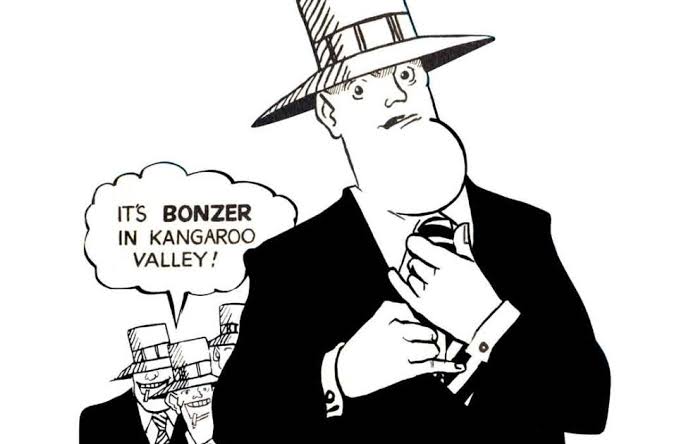
Back in London in the early seventies, when Earl’s Court in Kensington was such a mecca for itinerant Australians that it was known in London and in Australia as Kangaroo Valley, I was acquainted with many expatriate and transient Aussies. Indeed, I married one I’d met at the School of Oriental and African Studies where we were both studying.
Breaking free of the cultural confines of their conservative country, many young Aussies overcame historian Geoffrey Blainey called “the tyranny of distance” by flying across it or joining the famous Hippie Trail from Southeast Asia to what many still referred to as “The Old Country”. Some became household names, including actor Barry Humphries, writer Clive James, art critic Robert Hughes, journalists John Pilger, lawyer Geoffrey Robertson, fashion designer Jenny Kee and sociologist Germaine Greer, and bands like The Easy Beats and The Bee Gees, who were actually Poms returning home, and the Seekers. By far the most controversial were the editors of Oz Magazine, Richard Neville, Richard Walsh and Martin Sharpe, the defendants in the infamous Oz Trial of 1970, at the time, the longest obscenity trial in British legal history, and the first time that an obscenity charge was combined with the charge of conspiring to corrupt public morals. See The Australians who set 60s Britain swinging
Most, however, were just ordinary folk, and they were so ubiquitous in London that they were often the butt of jokes (mostly good natured) and comedies, as personified in the cringeworthy uber-Coker Barry McKenzie which featured in Nicholas Garland’s comic strip in the satirical magazine Private Eye and Bruce Beresford’s dubious directorial debut, The Adventures of Barry McKenzie.
I was fascinated and highly amused by the Aussie’s accents and their many hilarious colloquialisms, including “I’m as dry as a dingo’s conger” and “flat out as a lizard drinking”. To assist my communication with these antipodean strangers, I purchased a little lexicon assembled by Professor Afferbeck Lauder of the University of Sinny. I was assured that this was exactly how Strine was spoke by dinkum Strayans.
When I emigrated DownUnder a few years later, I found that very few natives spoke proper Strine – though there was The Paul Hogan Show – that the Australian accent was perpetually evolving due to the country’s exposure to outside cultural influences – especially American and British – and its increasing multiculturalism.
Rereading Let Stalk Strine recently, I found was a little like opening a time capsule or deciphering a text of Chaucerian English, though vagrant traces of the old vernacular linger still in such “Australianisms” as nukelar, envimint, gomint, and, of course, Straya. But even the use of words such as these is not widespread, and usually confined to interviews with National Party politicians and Pauline Hanson.
The book is still available, and although air fridge Strines and new Strines no longer speak the lingo, it is picture of the strine wire flife half a century ago.
Here are some of my personal favourites. They’re still pretty grouse after all these years.
There’s “baked necks” and “egg nishner”, “garbled mince” and “nairm semmitch”, the public speaking opener “laze and gem…”, and the nursery rhyme Chair Congeal. There’s idioms like “fitwer smeeide” and “fiwers youide”, translated as “if I were you, I would” and “if I were you, I’d…” as in “fitwer smeeide leave him. He saw-way sonn the grog” and “fiwers youide leave him anode goan livener unit”. And there’s the prefix didjerie as in “didgerie dabout it in the piper” and “ didgerie lee meenit or were you kidding”, and, of course, “he plays the didgerie do real good”.
My personal favourite, relevant, apt even, to this day is “Aorta”.
To quote the author, it is “the personification of the benevolently paternal welfare state to which all Strines – being fiercely independent and individualistic- appeal for help and comfort in moments of frustration and anguish. The following are typical examples of such appeals. They reveal the innate reasonableness and sense of justice which all Strines possess to such a marked degree: “Aorta build another arber bridge. An aorta stop half these cars from cummer ninner the city – so a fella can get twerk on time”. “Aorta have more buses. An aorta mikey smaller so they don’t take up half the road. An aorta put more seats in ‘em so you do a tester stand all the time. An aorta put more room in ‘em. You can tardily move in ‘em air so cradled. Aorta do summing about it.”
For more on Australia in In That Howling Infinite, see Down Under
Flashing for the warriors whose strength is not to fight Flashing for the refugees on the unarmed road of flight An’ for each an’ ev’ry underdog soldier in the night An’ we gazed upon the chimes of freedom flashing
Bob Dylan, Chimes of Freedom
Hear the cry in the tropic night, should be the cry of love but it’s a cry of fright Some people never see the light till it shines through bullet holes
Bruce Cockburn, Tropic Moon
When Freedom Comesis a tribute to Robert Fisk (1946-2020), indomitable, veteran British journalist and longtime resident of Beirut, who could say without exaggeration “I walk among the conquered, I walk among the dead” in “the battlegrounds and graveyards” of “long forgotten armies and long forgotten wars”. It’s all there, in his grim tombstone of a book, The Great War forCivilization (a book I would highly recommend to anyone wanting to know more about the history of the Middle East in the twentieth century – but it takes stamina – at near in 1,300 pages – and a strong stomach – its stories are harrowing).
The theme, alas, is timeless, and the lyrics, applicable to any of what Rudyard called the “savage wars of peace” being waged all across our planet, yesterday, today and tomorrow – and indeed any life-or-death battle in the name of the illusive phantom of liberty and against those intent on either denying it to us or depriving us of it. “When freedom runs through dogs and guns, and broken glass” could describe Parisand Chicago in 1968orKristallnacht in 1938. If it is about any struggle in particular, it is about the Palestinians and their endless, a fruitless yearning for their lost land. Ironically, should this ever be realized, freedom is probably the last thing they will enjoy. They like others before them will be helpless in the face of vested interest, corruption, and brute force, at the mercy of the ‘powers that be’ and the dead hand of history.
The mercenaries and the robber bands, the warlords and the big men, az zu’ama’, are the ones who successfully “storm the palace, seize the crown”. To the victors go the spoils – the people are but pawns in their game.
In 2005, on the occasion of the publication of his book, Fisk addressed a packed auditorium in Sydney’s Macquarie University. Answering a question from the audience regarding the prospects for democracy in the Middle East, he replied:
“Freedom must crawl over broken glass”
Freedom Comes
… all wars come to an end. And that’s where history restarts. Robert Fisk
There goes the freedom fighter,
There blows the dragon’s breath.
There stands the sole survivor;
The time-worn shibboleth.
The zealots’ creed, the bold shahid,
Give me my daily bread
I walk amongst the conquered
I walk amongst the dead
Here comes the rocket launcher,
There runs the bullets path,
The revolution’s father,
The hero psychopath.
The wanting seed, the aching need
Fulfill the devil’s pact,
The incremental balancing
Between the thought and act.
The long-forgotten army
In the long-forgotten war.
Marching to a homeland.
We’ve never seen before.
We feel the wind that blows so cold amidst
The leaves of grass.
When freedom comes to beating drums
She crawls on broken glass
There rides the mercenary,
Here roams the robber band.
In flies the emissary
With claims upon our land.
The lesser breed with savage speed
Is slaughtered where he stands.
His elemental fantasy
Felled by a foreign hand.
The long-forgotten army
In the long-forgotten war.
Marching to a homeland.
We’ve never seen before.
We feel the wind that blows so cold amidst
The leaves of grass.
When freedom comes to beating drums
She crawls on broken glass.
Thy kingdom come, thy will be done
On heaven and on earth,
And each shall make his sacrifice,
And each shall know his worth.
In stockade and on barricade
The song will now be heard
The incandescent energy
Gives substance to the word.
Missionaries, soldiers,
Ambassadors ride through
The battlegrounds and graveyards
And the fields our fathers knew.
Through testament and sacrament,
The prophecy shall pass.
When freedom runs through clubs and guns,
She crawls on broken glass.
The long-forgotten army
In the long-forgotten war.
Marching to a homeland.
We’ve never seen before.
We feel the wind that blows so cold amidst
The leaves of grass.
When freedom comes to beating drums
She crawls on broken glass
When freedom comes to beating drums
She crawls on broken glass
Back in the last century, before ANZAC Day became the secular Christmas that it has become, before marketing people and populist politicians saw its commercial and political potential, before the fatal shore became a crowded place of annual pilgrimage, my Turkish friend, the late Naim Mehmet Turfan, gave me a grainy picture of a Turkish soldier at Gelibolu carrying a large howitzer shell on his back. Then there was this great film by Australian director Peter Weir, starring young Mel Gibson and Mark Lee. There were these images of small boats approaching a dark and alien shore, of Light Horsemen sadly farewelling their Walers as they embarked as infantry, and of the doomed Colonel Barton humming along to a gramophone recording of Bizet’s beautiful duet from The Pearl Fishers, ‘Au fond du temple saint’ before joining his men in the forlorn hope of The Nek …
At the heart of the Anzac Day remembrance is the Australian and New Zealand Army Corps’ role the Dardanelles campaign of 1915-16, Winston Churchill’s grandiose and ill-conceived plan to take the Ottoman Empire out of the war by seizing the strategic strait between the Black Sea and the Mediterranean, thereby threatening Istanbul, the Ottoman capital. It was a military failure. From the initial seaborne assault to the evacuation, it lasted eight months and cost 114,000 lives with 230,000 wounded.
In 1915, Australians greeted the landings at Gallipoli with unbridled enthusiasm as a nation-making event. But it wasn’t long before they were counting the dreadful cost. More than 8000 Australians died during the Gallipoli campaign. As a loyal member of the British Empire, Australia eventually sent 330,000 men overseas to fight for the King. Volunteers all, not all of them white men – despite the authorities’ policy of recruiting only Australians of Anglo-Celtic stock, their ranks included many indigenous, Chinese and others. By the time the war ended in 1918, 60,000 of them were dead. As the late historian Ken Inglis once pointed out: “If we count as family a person’s parents, children, siblings, aunts and uncles and cousins, then every second Australian family was bereaved by the war.
Gallipoli is cited as the crucible of Australian nationhood, but the Anzacs’ part in the doomed campaign was but a sideshow of the wider campaign. Although it is celebrated in Australian song and story, it was the Ottomans’ most significant victory in the war that was to destroy the seven-hundred-year-old Ottoman Empire secure the reputation of its most successful general Mustafa Kemal, who as Ataturk, became the founder of modern Turkey.
Some thirty-four thousand British soldiers died on the peninsula, including 3,400 Irishmen who are remembered In The Foggy Dew, one of the most lyrical and poignant of the Irish rebel songs: Right proudly high over Dublin town, they hung out the flag of war. ‘Twas better to die ‘neath that Irish sky than at Suvla or at Sud el Bar…Twas England bade our Wild Geese go that small nations might be free, But their lonely graves are by Suvla’s waves or the fringe of the grey North Sea.
Ten thousand Frenchmen perished too, many of these being “colonial” troops from West and North Africa. Australia lost near on ten thousand and New Zealand three. Some 1,400 Indian soldiers perished for the King Emperor. Fifty seven thousand allied soldiers died, and seventy five thousand were wounded. The Ottoman army lost fifty seven thousand men, and one hundred and seven thousand were wounded (although these figures are probably much higher). An overlooked fact is that some two thirds of the “Turkish” solders in Kemal’s division were actually Arabs from present day Syrian and Palestine. Gallipoli was indeed a multicultural microcosm of a world at war.
Whilst the flower of antipodean youth is said to have perished on Gallipoli’s fatal shore, this was just the overture. Anzac troops were dispatched to the Western Front, and between 1919 and 1918, 45,000 Aussies died there and 124,000 were wounded.
Once upon a war, the Dardanelles Campaign of 1915-16 was a sideshow to the bigger theatres of the Eastern and Western Fronts. To some, it was a reminder that they could not stomach Winston Churchill for this was said to be his greatest stuff up in a career replete with such (although they would admit that he more than exonerated himself his and Britain’s Finest Hour). For many Australians and New Zealanders, it was a national baptism of fire, of youthful sacrifice on the altar of Empire. And notwithstanding the military defeat and retreat, the folly and foolhardiness, in the harrowing adversity and heroism, lay the bones of a young country’s enduring creation myth.
Former soldier James Brown, Anzac’s Long Shadow
Official war historian Charles Beanwent ashore at Anzac Cove on 25 April, more than 5 hours after the first troops. Here is his first dispatch (it was not published in Australia until 13th May):
It was eighteen minutes past four on the morning of Sunday, 25th April, when the first boat grounded. So far not a shot had been fired by the enemy. Colonel McLagan’s orders to his brigade were that shots, if possible, were not to be fired till daybreak, but the business was to be carried through with the bayonet. The men leapt into the water, and the first of them had just reached the beach when fire was opened on them from the trenches on the foothills which rise immediately from the beach. The landing place consists of a small bay about half-a-mile from point to point with two much larger bays north and south. The country rather resembles the Hawkesbury River country in New South Wales, the hills rising immediately from the sea to 600 feet [183m]. To the north these ridges cluster to a summit nearly 1,000 feet [305m] high. Further northward the ranges become even higher. The summit just mentioned sends out a series of long ridges running south-westward, with steep gullies between them, very much like the hills and gullies about the north of Sydney, covered with low scrub very similar to a dwarfed gum tree scrub. The chief difference is that there are no big trees, but many precipices and sheer slopes of gravel. One ridge comes down to the sea at the small bay above mentioned and ends in two knolls about 100 feet [30m] high, one at each point of the bay.
It was from these that fire was first opened on the troops as they landed. Bullets struck fireworks out of the stones along the beach. The men did not wait to be hit, but wherever they landed they simply rushed straight up the steep slopes. Other small boats which had cast off from the warships and steam launches which towed them, were digging for the beach with oars. These occupied the attention of the Turks in the trenches, and almost before the Turks had time to collect their senses, the first boatloads were well up towards the trenches. Few Turks awaited the bayonet. It is said that one huge Queenslander swung his rifle by the muzzle, and, after braining one Turk, caught another and flung him over his shoulder. I do not know if this story is true, but when we landed some hours later, there was said to have been a dead Turk on the beach with his head smashed in. It is impossible to say which battalion landed first, because several landed together. The Turks in the trenches facing the landing had run, but those on the other flank and on the ridges and gullies still kept up a fire upon the boats coming in shore, and that portion of the covering force which landed last came under a heavy fire before it reached the beach. The Turks had a machine gun in the valley on our left, and this seems to have been turned on to the boats containing part of the Twelfth Battalion. Three of these boats are still lying on the beach some way before they could be rescued. Two stretcher-bearers of the Second Battalion who went along the beach during the day to effect a rescue were both shot by the Turks. Finally, a party waited for dark, and crept along the beach, rescuing nine men who had been in the boats two days, afraid to move for fear of attracting fire. The work of the stretcher-bearers all through a week of hard fighting has been beyond all praise.
On 27th July 2024, the Australian published extracts from a recently published biography of Henry Koba Freame, adventurer, soldier, orchardist and interpreter. It provides such a stirring account of the landing of Australian soldiers at what is now Anzac Cove on 25th April 2015 and the subsequent Gallipoli campaign that it was worth republishing below. But first, a brief summary of Freame’s eventful life.
The road to Gallipoli
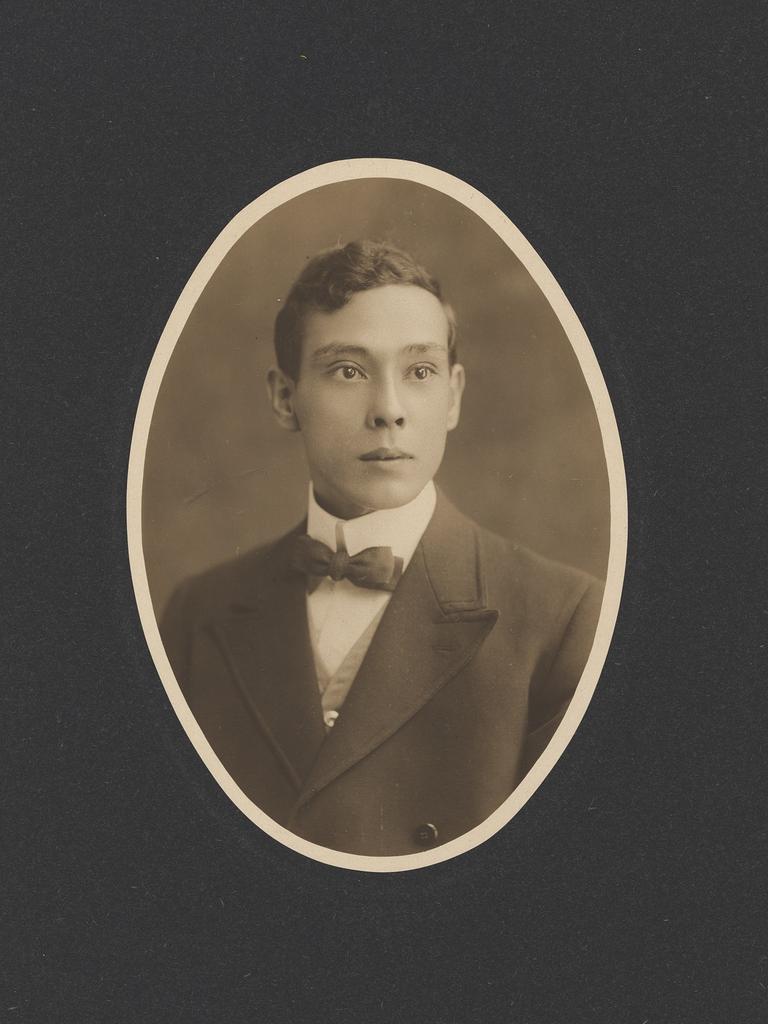
Wykeham Henry Koba Freame is believed to have been born on 28 February 1885 at Osaka, Japan, though on his enlistment in the Australian Imperial Force he gave his birthplace as Kitscoty, Canada. He was the son of Henry Freame, sometime teacher of English at the Kai-sei Gakko in Japan, and a Japanese woman, Shizu, née Kitagawa. As he was fluent in Japanese and spoke English with an accent it is likely that he was brought up in Japan. In 1906 he was a merchant seaman and on 19 July of that year married Edith May Soppitt at St John’s Anglican Church, Middlesbrough, England.
Freame probably came to Australia in 1911 and on enlisting in the A.I.F. on 28 August 1914 described himself as a horse-breaker of Glen Innes, New South Wales. Posted to the 1st Battalion as a private, he embarked for Egypt on the troopship Afric on 18 October and was promoted lance corporal on 7 January 1915. On 25 April he landed at Anzac and after three days of heavy fighting was promoted sergeant. He was awarded one of the A.I.F.’s first Distinguished Conduct Medals for ‘displaying the utmost gallantry in taking water to the firing-line although twice hit by snipers’. He was mentioned in dispatches for his work at Monash Valley in June when Charles Bean described him as ‘probably the most trusted scout at Anzac’.
Having served in the Hottentot rising of 1904-06 in German East Africa and in the Mexican wars, Freame was an accomplished scout before joining the A.I.F. He had an uncanny sense of direction and would wriggle like an eel deep into no man’s land, and at night even into enemy trenches, to pick up information. His dark complexion and peculiar intonation of speech had led his companions to believe that he was Mexican—an impression which he reinforced at Anzac where, in cowboy fashion, he carried two revolvers in holsters on his belt, another in a holster under his armpit and a bowie knife in his boot pocket. On 15 August he was wounded during operations at Lone Pine and was evacuated to Australia. He was discharged as medically unfit on 20 November 1916.
Freame settled on the Kentucky estate in New England, New South Wales, when the estate was subdivided for a soldier settlement scheme, and was appointed government storekeeper. He eventually acquired a Kentucky block and was a successful orchardist. His wife died in 1939 and on 16 August 1940 he married Harriett Elizabeth Brainwood, nurse and divorced petitioner, at St John’s Anglican Church, Milson’s Point, Sydney. With the outbreak of World War II he offered his services to the Australian Military Forces and in December 1939 was planted among the Japanese community in Sydney as an agent by military intelligence. In September 1940 he was appointed as an interpreter on the staff of the first Australian legation to Tokyo.
Early in April 1941, however, Freame returned to Australia because of ill health and was admitted to North Sydney Hospital suffering from a severe throat condition which greatly impaired his speech. He died on 27 May and was buried in Northern Suburbs cemetery with Anglican rites. His death certificate records the cause of death as cancer though Freame himself and later his wife alleged that he had been the victim of a garrotting in Japan. He considered that the attack was the consequence of the injudicious wording of the announcement in the Australian press of his posting to Tokyo. He had been described as employed by the Defence Department at a time when he was telling his Japanese acquaintances another story. Extant evidence provides no definite clarification of the circumstances of his death, though the claim of garrotting was investigated, and rejected, at the time.
Harry Freame in 1915 before departing for Gallipoli
In the years after World War I, Harry Freame had a legitimate claim to be considered the most famous Anzac soldier to have landed at Gallipoli. Born in Japan and raised as a Samurai, he was the recipient of the first Distinguished Conduct Medal to be awarded to an Australian soldier for his efforts in those first bloody days of Gallipoli, and his name was legend among the Australian troops who had fought that tragic battle. As the landing turned into trench warfare, the troops knew Harry risked his neck each night to venture out into no-man’s land and map the Turkish defences.
Harry was on personal terms with the key Anzac commanders, and in the postwar years generals would visit him and reminisce about the war. Australia’s official war historian for World War I, Charles Bean, who first met Harry in June 1915, was fascinated by Harry his whole life. The Australian public came to know Harry through the newspapers of the day that splashed his wartime exploits of courage and daring across their pages.
What became of him?
Harry Freame’s boots hit the sands of Anzac Cove at around 7.40am on April 25, 1915. He was part of D Company, 1st Battalion. By the time they landed, Anzac Beach, as it came to be known, was already strewn with the broken and bloodied bodies of the men and pack animals that had come before them on that infamous morning.
It wasn’t Harry’s first sight of the region – he had sailed this way before – and it wasn’t his first taste of war.
There is a picture of Harry taken before the landing, most likely in Egypt. In it he is in full uniform, flat-brimmed hat, a bandana tied around his neck, wire clippers and binoculars attached to his belt. He holds his Lee–Enfield full wood .303 rifle by the barrel, the butt resting on the ground. He is looking slightly downwards at the camera. There is none of the naive merriment so often seen in the pictures of young Australian soldiers who had mistaken war for a great boys’ own adventure. But nor is there any fear in those eyes. Harry knew what he was in for, and he was ready for it.
As he waded through the waist-high water towards the sand, Harry carried in his pack three days’ rations and an extra 150 rounds of ammunition. He would have heeded the warning of Lieutenant General William Birdwood, the British officer in overall command of the ANZAC (Australian and New Zealand Army Corps) forces, who had advised the troops prior to landing to drink as much water as they could, as once ashore supply of food and water could not be guaranteed for at least three days.
The landing itself had been rehearsed as much as possible on the nearby Greek islands, under conditions nothing like what Harry and the rest of the Anzacs would soon face, but as the 1st Battalion’s official war diary records, “we knew very little of the actual plans for the attack – in fact, the whole thing seemed to be rather in the air, and so it proved”.
All that the officers of the 1st Battalion knew was that the 3rd Brigade was to land first and rush the enemy positions. When Harry and D Company landed on Anzac Beach, they had no idea what success, if any, the 3rd Brigade had had. Judging by the dead and dying who littered the beach, staining the Aegean waters red, and the enemy bullets and shells that whistled around their heads and whipped the waves to foam, it could be easily believed that none of the 3rd Brigade had survived that hellfire of a dawn.
Harry at age the age of 24
■ ■ ■
Harry’s battalion formed up just north of Anzac Beach, in the shadow of Ari Burnu, sheltered from the murderous fire being poured down upon the landing from the peaks of Gaba Tepe, and waited for orders. When the orders came, they “were very vague”, alluding to nothing more than the need for the battalion to reinforce the firing line. But to reinforce a firing line, you needed to first find the firing line, and when the men looked up towards the imposing ridges and valleys that confronted them, there was no firing line.
The ridges above the beaches were crawling with pockets of men, some engaged in isolated fights, hand-to-hand combat wherein they lived or died by the thrust of their bayonets or the quickness of their wits.
Recalling that bloody morning, poet John Masefield wrote:
“All over the broken hills there were isolated fights to the death, men falling into gullies and being bayoneted, sudden duels, point blank, where men crawling through the scrub met each other and life went to the quicker finger, heroic deaths, where some half section which had lost touch were caught by ten times their strength and charged and died.
“No man of our side knew that cracked and fissured jungle. Men broke through it on to machine guns, or showed up on a crest and were blown to pieces, or leaped down from it into some sap or trench, to catch the bombs flung at them and hurl them at the thrower.
“Going as they did, up cliffs, through scrub, over ground … they passed many hidden Turks, who were thus left to shoot them in the back or to fire down at the boats, from perhaps only fifty yards away.”
■ ■ ■
The firing line, a concept easily imagined in the safety of an officer’s headquarters, was non-existent on the actual field of battle. On that first morning there was just a mad rush for high ground, up the forbidding slopes and into the ridges and valleys that held not only Turkish and German and Syrian troops and gunners but also the hope of cover and survival.
A primeval need to push further and further inland gripped the soldiers, in the hope that there, beyond the next valley, the next ridge, lay safety.
By 10am, with clothes still heavy with sea water after the landing and many of their rifles jammed with sand, now useful only for bayonet thrusts and charges, Harry and what elements of D Company were able to be formed up left the beach and set off for the ridges. Coming upon officers from the 3rd Battalion, D Company was redirected to the hill known as Baby 700, where reinforcements were urgently needed.
Through dense, waist-high scrub of gorse-like bushes and along the dried-up water courses littered with boulders, the men forged ahead uphill, legs heavy but the words of the commanding officers to advance, advance, advance running through their heads. Many of the men of D Company who fought their way up towards Baby 700 that clear bright morning would etch their names into the history of the Anzacs and the 1st Battalion: Major FJ Kindon, second-in-command of 1st Battalion; Major Blair Swannell, commanding officer of D Company; Captain Harold Jacobs, second-in-command of D Company; Lieutenant Geoffrey Street; and Captain Alfred Shout, the man who would leave Gallipoli the most decorated soldier of all, though sadly not with his life. And beside Shout, as was so often the case in the blood-soaked months that followed, in lock step, there was Lance Corporal Harry Freame.
Strategically important, Baby 700 had been the focus of intense fighting all morning, with remnants of the Australian 9th, 11th and 12th battalions all joining the battle as the Turkish troops advanced and retreated in a series of intense skirmishes conducted under the continuous hail of shrapnel fire from unseen Turkish positions. The approaches to Baby 700 were complicated by folds of ridges and valleys, and in these the Australian men became detached from their companies and lost until they could connect up with other Australian soldiers, sometimes from their own company, sometimes not.
Freame at his final Anzac Day march, in 1940.
By 11am, Harry and D Company had reached The Nek, a thin strip of ridge that connected to Baby 700. The area was being held by Captain Lalor and men of the 12th Battalion. Lalor was the grandson of Peter Lalor, the man who had led the revolt at Eureka. With him on that morning on the approaches to Baby 700, Lalor carried a magnificent sword, said to be the one used by his grandfather at that famous stockade. Swords had been prohibited to be carried during the landing, but Lalor had disregarded the order.
Across The Nek on the slopes of Baby 700, Turkish troops were gathering. Joining up with Lalor’s group, the newly arrived men of D Company formed up and charged the Turkish troops, driving them back into a gully before advancing up Baby 700.
After reaching the summit, D Company started to dig into that hardscrabble ground. The Turkish troops they had driven before them had retreated, but only to a previously unseen trench, and from here they poured heavy fire on the entrenching D Company. It was here that D Company’s commander, Major Blair Swannell, was killed on that first morning, shot dead just as he had earlier predicted he would be to his mates aboard the Minnewaska in the predawn fog before the landing.
Against the fierce Turkish assault, the Australians had only their rifles (when they worked), bayonets and pistols. The naval guns offered no support, as those manning them were afraid of firing on their own troops in the complicated mess of invaders and invaded that swarmed the hills of the peninsula.
A few artillery guns had been brought ashore at midday but were then ordered to be sent back out to the boats. Other commanders had refused to allow their guns to be landed, such was the chaos on the beaches, and it wasn’t until dusk that the first artillery guns came into action in support of the Australian troops.
The Australian firing line on Baby 700 could not hold, and over the course of the morning the Australian troops moved over the summit only to be thrown back by vicious counterattacks no fewer than five times.
In the midst of the fighting, there was Harry Freame, moving from position to position, scouting the ground and enemy positions, running messages between commanding officers.
At one point Harry and a small group of men drove a contingent of Turkish troops from a trench. But having gained the trench they found they were then held in place by persistent enemy fire. The men hadn’t heeded the words of Lieutenant General Birdwood, and who could blame them, and they were out of water, exhausted and near death. Without water they felt that they would soon perish or be forced to surrender.
Harry called for volunteers to brave the bullets and shrapnel and go for water. None raised a hand or spoke a word, so over the side of the trench he went, collecting water bottles from those who would never thirst again, fallen soldiers whose twisted repose could never be mistaken for the sleeping, a last look, a last thought of home or their best girl held fast in a glassy eye like a butterfly trapped in amber.
When Harry returned, he brought not only precious water but food and pickaxes for the grateful men.
All day the fighting raged on Baby 700, with ground taken then lost, the attackers and counterattackers continually changing roles, the air perfumed with the smell of the wild thyme that had been lashed by the bullets and shrapnel bursts. And as the day stretched on, still the men had no idea where the firing line was, only supposing that it was somewhere ahead of them, always somewhere over the next ridge, and that they must get to it. And if they could not advance, then at all costs they tried to hold on to whatever patch of land they had come to stop on.
At around 4.30pm, as D Company, reinforced now with New Zealand troops, fought to hold the right side of the Baby 700 slope, a massive Turkish counterattack was launched that peeled the Australians off the slope. Alfred Shout, who had been with Lalor when he was killed, had earlier left Harry and fourteen men at The Nek with orders to hold it no matter what. The small group came under intense fire and before long only nine men were left, and by the time Shout returned, retreating from Baby 700, only Harry and one other man held the position. The rest lay dead or dying about them. Shout ordered them both to follow him in retreat towards the beach.
After regrouping on the beach, Shout and Harry then set about rounding up men from various battalions, a combination of the stragglers and shirkers, the lost and the shell-shocked. Harry collected around two hundred men and led them back up the slopes to reinforce the New Zealand troops who were holding Walker’s Ridge, a key position leading back to Baby 700, which was by now firmly in Turkish hands.
■ ■ ■
Recording the efforts of Lance Corporal Harry Freame on that chaotic first day at Anzac Cove, official war correspondent Charles Bean wrote:
“With such fighters as Lieutenant A.J. Shout, Lieutenant G.A. Street and Lieutenant Jacobs, all of his own battalion, he and others held vital positions in that constantly moving and changing fight but none was so ubiquitous as he, now holding a key position on The Nek leading to Baby 700, now finding for his commander the scattered parts of his battalion.”
As night fell on the evening of April 25, the fighting abated only somewhat; rifle fire and shrapnel bursts echoed through the night. At around midnight, Lieutenant General Birdwood sent an urgent message to his commander-in-chief, Sir Ian Hamilton, urging an immediate evacuation of the peninsula. Hamilton, from the comfort of the HMS Queen Elizabeth, was having none of it, advising Birdwood that he had “got through the difficult business and you have only to dig, dig, dig until you are safe”.
Freame with his stepsister in 1898.
The following morning, April 26, the hills of the peninsula rang with the sounds of shovels, digging, digging, digging. Those not digging or engaged in holding a position were out scouring the ravines and hillsides for the wounded and missing, and it was while thus engaged that Harry came across a detachment of men under the command of Captain Harold Jacobs sheltering in a trench at Quinn’s Post. The men had had no water to drink and were in a desperate state. Harry offered to go for water and without a second thought braved the enemy fire that came in from unseen snipers and dashed back down the valley from where he had just come. He soon returned with the promised water, allowing the position to be held.
Realising that Lieutenant-Colonel Leonard Dobbin, the company commander, would need information on Captain Jacobs’ position and situation, Harry was again up and over the side of the trench, making his way back down the valley to where Lieutenant-Colonel Dobbin was located. As Harry approached Dobbin’s trench, he was heard to yell out, ‘All right!’ Arriving, he delivered his message to Dobbin. Mission accomplished, it was only then that Harry revealed that on the descent he’d been struck twice by snipers’ bullets, once through the fingers of the left hand and once through the left arm.
For the duration of the fighting at Gallipoli, Quinn’s Post remained the Anzacs’ most advanced position and the key to their defensive positions. It would never have been held if not for the bravery of Harry Freame.
Charles Bean later noted that very few men received decorations for the deeds performed at the Anzac Cove landings. But when the recommendations came out, the name Harry Freame was first among them. His citation read: “Has displayed the utmost gallantry in taking water to the firing line, though twice hit by sniper fire.” Harry’s commanding officer further reported: “Since I have assumed command of the Brigade, Serjeant Freame has almost daily performed some action worthy of recognition in the shape of carrying out night reconnaissance, conveying messages through dangerous zones etc etc. He is a fine fearless soldier who I strongly recommend for recognition.”
■ ■ ■
The recommendation was heeded and Harry, for his work over those first days of Gallipoli, was awarded the Distinguished Conduct Medal. Writing both publicly and privately years after the war, Bean offered the view that Harry should have been awarded the Victoria Cross and that the only reason he wasn’t awarded the VC was because, “Australian commanders hesitated to set up for that hallowed decoration any standard short of the impossible. I think that it is safe to say but for that Harry would have been awarded the highest decoration”.
When I set out to write this book, I wanted to discover why we had forgotten Harry Freame. Why, when our schoolchildren learn of the history of the Anzacs, do they learn more about a donkey than a man who was known at the time as the Marvel of Gallipoli? And I wanted to know why the Australian government covered up their role in the death of Harry Freame, why the man Charles Bean described as probably the most trusted scout at Gallipoli was never believed when he said, “They got me”.
This is an extract from The Bravest Scout At Gallipoli by Ryan Butta (Affirm Press) out now.
In 2014, English author and academic Katherine Rundell published an entertaining article in the London Review of Books entitled Fashionable Gore. It served recently as the primarily source and backdrop for a podcast in the highly addictive podcast The Rest is History. The hosts, historians Tom Holland and Dominic Sandbrook, specialist in ancient and modern history respectively, have a jolly good time discussing the legacy of English fin de siècle author Henry Rider Haggard, and particularly, his hugely popular adventure yarn King Solomon’s Mines.
Rundell writes: “King Solomon’s Mines is a very Victorian fable of endurance but it’s also a glorious romp, if you don’t mind your romps racist, sexist and tin-eared … It would be surprising if any white man born in 1856 had written non-racist, non-sexist fiction, whether it was set in Africa or not … You make a choice with Haggard: if you suspend not just disbelief but politics, logic and taste, the rewards are very real”. She first encountered the novel as a liberal-minded, educated adult when she could judge a book on its merits and its shortcomings. I was a pubescent early teen when it was recommended to us schoolboys by our English teacher, and was soon hooked on the adventure, the exotic settings and, especially the violence – and quickly moved on to its sequel, Alan Quartermain, follow up and
I republish Fashionable Gore below. It’s a very good read. Here is The Tom and Dom Show. But read on …
As a young man, in January 1879, Henry Rider Haggard walked the field of Isandlwana in present day in Kwa-Zulu Natal Province, South Africa just days after the battle in which a Zulu army totally destroyed – indeed, massacred – a British army. He was fascinated by and enamoured with Africa, the “dark continent” of myth and story. Having spent but a few weeks in the African bush, I fully under it – though I was accustomed to Australia’s big sky, the “vision splendid of the western plains extended” (that’s the “banjo”), the eldritch aura of Uluru, and the primeval magic of the coastal rain forest, we too succumbed to its spell.
To Henry, Africa was the “heart of darkness”, and yet also, a Garden of Eden, the home of the “noble savage” where a white Englishman, freed of the bonds of straightened Victorian Britain, could walk unexplored and uncharted lands, encounter many wonders, and in “proving” himself and testing his mettle, find himself and weigh his own worth.
You could say King Solomon’s Mines, his third of many adventure novels, could be said to have launched a thousand clichés and I’ve used a swag of them just then …
It all started with a bet …
Henry did not bide long in Africa, though long enough to be involved in the annexation of the Boer state of the Transvaal after the first Boer War in 1881, one of the triggers for the second and greater Boer War in 1899. He’d returned to England by 1885 when his elder brother pledged him five bob if the he could write a book half as good as Robert Lewis Stevenson’s hugely popular pirate jaunt “Treasure Island”.
By the end of the year, he had penned a novel that would become the foundational text of the lost world literary genre. King Solomon’s Mines was one of the first English adventure novels set in Africa, a story brimming with treasure, bravery and romance, and featuring all-action hero and big game hunter (naturally) Allan Quartermain and his conflicted band of British brothers (Scots and English to be precise – Stevenson, and before him, Sir Walter Scott
It was a romantic and what we call today white supremacist, man’s world of Britishness and brotherhood, martial prowess and manliness (or as Tom and Tom jest, “men in tight trousers”) in which the plucky British adventurer bested beast and barbarian and laughed in the face of fear. A “boy’s own” universe indeed, which I and my school chums lapped up with vicarious pubescent relish in the early sixties. All this “derring-do” is now dismissed as an outdated and anachronistic perspective of earlier generations, and what I perceived early on in my coming of age, as old-school Englishness. It was, of course, of its times. It lacked none of the sardonic ‘seventies irony of George McDonald Fraser’s celebrated Flashman comi-tragic adventures in which the eponymous antihero, the unreconstructed villain of Thomas Hughes’ Victorian yarn Tom Brown’s Schooldays, roves and rogers his way through the wars of the nineteenth century, somehow managing to escape by the skin of his teeth from one military disaster after another, including Custer’s famous “Last Stand” at Little Big Horn, the Charge of the Light Brigade, and the last stand of the 44th Foot at Gandamak during the disastrous First Afghan War of 1842.
In his turn-of-the-century prudish, Henry would never have let Quartermain and his pals go forth in such amours and priapic array as the nineteen seventies unchained and unzipped Harry Flashman. Though he shyly dallied with the picaresque – like Fraser, his few female characters were either portrayed as drop-dead gorgeous and dangerous or as plug-ugly and dangerous. But he views womenfolk with an almost schoolboy insouciance and deflection. Rundell observes that “the noble native woman always dies in Haggard – Quatermain feels ‘bound to say … that I consider her removal a fortunate occurrence, since, otherwise, complications would have been sure to ensue’, whilst she and the podcast pals chuckle over the male protagonists’ “euphoric homosociality”, taking great pleasure in quoting at length the following mellifluous piece of Victorian soft porn from King Solomon’s Mines:
I am impotent even before its memory. Straight before us, rose two enormous mountains, the like of which are not, I believe, to be seen in Africa, if indeed there are any other such in the world, measuring each of them at least fifteen thousand feet in height, standing not more than a dozen miles apart, linked together by a precipitous cliff of rock, and towering in awful white solemnity straight into the sky. These mountains placed thus, like the pillars of a gigantic gateway, are shaped after the fashion of a woman’s breasts, and at times the mists and shadows beneath them take the form of a recumbent woman, veiled mysteriously in sleep. Their bases swell gently from the plain, looking at that distance perfectly round and smooth; and upon the top of each is a vast hillock covered with snow, exactly corresponding to the nipple on the female breast. The stretch of cliff that connects them appears to be some thousands of feet in height, and perfectly precipitous, and on each flank of them, so far as the eye can reach, extend similar lines of cliff, broken only here and there by flat table-topped mountains, something like the world-famed one at Cape Town; a formation, by the way, that is very common in Africa. To describe the comprehensive grandeur of that view is beyond my powers.
Much to my surprise and mirth, I’ve learnt that Shebas Breasts actually do exist.
Sheba’s Breasts Ezulwini Valley Swaziland
Rundell wrote of the titular character of She, Rider Haggard’s follow up adventure yarn, “she was wise and beautiful beyond imagining: a sultry multilingual virgin, wish-fulfillment made flesh … and even more than King Solomon’s Mines, it’s a book out of which obsessions and anxieties leak”. More into power than sex, she was, of course, the original “She Who Must Be Obeyed”. A Hammer horror film version released in 1965 starring pneumatic Bond siren Ursula Andress was an international success and notwithstanding the dusty demise of Ayesha, led to a 1968 sequel, The Vengeance of She, with another femme fatale from Mitteleuropa, Olinka Berova, in the title role. Neither film has aged well, though both ladies are still with us today.
Ursula Andress as Ayesha
Rider Haggard’s work, particularly King Solomon’s Mines and She, would would inspire authors from the late nineteenth century to the early twenty first. His literary legacy can be tracked from his contemporaries and pen pals Conan Doyle and Rudyard Kipling, both of whom were to visit South Africa during the Boer War, including the former’s Lost World and Kipling’s Gunga Din and Kim, through early twentieth century early Irish Republican Army “martyr” Erskine Childers’ Riddle of the Sands, John Buchan’s Thirty Nine Steps and Prester John, and Edgar Rice Burroughs Tarzan series, to JRR Tolkien’s The Lord of the Rings (to many, regarded as the pinnacle of the adventure novel genre). Grahame Greene and Ian Fleming have acknowledged their debt to Rider Haggard, whilst the book has inspired movies from the beginning of the art form, including several remakes of King Solomon’s Mines and (the featured picture is from a loose British adaptation of 1937 starring Cedric Hardwicke, Anna Lee, and my namesake Africa American crooner and socialist Paul Robeson – unlike the movies, Henry would never have countenanced “leading ladies” in his manly romps) and latter day day blockbusters like the original Star Wars , and the Indiana Jones and Tomb Raider film series.
King Solomon’s Mines, its follow-ups and the many subsequent imitators are all variations on the derivative ‘hero’s quest’, the mono-myth popularized by by Joseph Campbell in his celebrated book The Hero with a Thousand Faces.That author described it thus:
A hero ventures forth from the world of common day into a region of supernatural wonder: fabulous forces are there encountered, and a decisive victory is won: the hero comes back from this mysterious adventure with the power to bestow boons on his fellow man.
Campbell borrowed the term monomyth from Irish author James Joyce’s Finnegans Wake – Joyce’s Ulysses was also highly influential in the structuring of the archetypal motif. He published The Hero’s Quest in 1949 but the idea behind the monomyth preceded him by millennia – think Odysseus and Aeneas, Beowulf and Sigurd/Siegfried, contemporaries like JRR, and latter-day film makers and authors. Star Wars creator George Lucas and Richard Adams, bunny-quest Watership Down have both acknowledged their debt to his book.
And so, to Fashionable Gore. The title refers to what Rundell refers to as a particularly Victorian fascination with bloodshed: “Second only to the relish of battle is Henry’s fascination with unusual ways a man might die”. A bit like Vikings, really, without the bonking …
Katherine Randell, London Review of Books, 3rd April 2014
I first encountered King Solomon’s Mines in the children’s section of a public library in Harare. Most of the books smelled of water damage and many had been taken out so rarely that the last ‘return by’ stamp pre-dated Mugabe and decimalisation. I was working through shelves of books about horses and morality tales written by women who manifestly did not like children, and took King Solomon’s Mines because it’s set in ‘the Manica country’, a province a few hundred miles east of Harare. It seemed run of the mill at the time, much like the other books in the library: it was tightly plotted, suspense-driven, lavishly sexist and racist. In fact, though it is often read as a children’s book, it isn’t; nor is it run of the mill. It is the book which sowed the seed for John Buchan’s Richard Hannay, for Indiana Jones and James Bond, and though less slick than its successors, its anxieties and lunacies are more interesting. It isn’t suitable for children; perhaps not suitable at all.
As a child Henry Rider Haggard was believed to be stupid: his father told him he was destined to become a greengrocer. The books aren’t proof that he wasn’t stupid; but they are proof that he was dogged and canny, with a strange and lurid imagination. Haggard’s father lived long enough to see his son become wealthier than he was and the author of a 15-volume series which ran for forty years; he was dead by the time his son was knighted in 1912 (a knighthood for services to literature was at the time largely unheard of, so his was given for services to the development of agriculture in Norfolk). King Solomon’s Mines was written in answer to a bet Haggard had made with his brother that he could write a book as good as Treasure Island. He said it took him six weeks (though novelists always lie about that sort of thing) and it was an immediate bestseller. The 1870 Education Act had produced a large cohort of literate citizens with an appetite for fiction. There was much in the book to be admired by the stay-at-home population of late 19th-century England: in the world Haggard created the governing principle was survival, not class or intellect, and the rewards for bravery were blood (other people’s) and diamonds. Graham Greene said that he valued Haggard’s book ‘a good deal higher than Treasure Island’.
The story follows the narrator Allan Quatermain – an elephant hunter with good manners – and his colleagues, Sir Henry Curtis and Captain Good, on a journey into Mashukulumbwe country. Quatermain early on stakes his claim to heroic status when he says that he has already killed, but always with the stern regret of the Victorian imperialist: ‘I have killed many men in my time, yet I have never slain wantonly or stained my hand in innocent blood, but only in self-defence.’ The men’s aim is to find Curtis’s estranged brother, about which they are guardedly optimistic, and to discover King Solomon’s diamonds, about which – not knowing the title of the book – they are sceptical.
The novel is peppered with geographical detail conveyed in the confident vernacular of contemporary explorers’ reports, though the information itself is often mildly insane. In Manicaland, only the Chimanimani mountains and Mount Nyangani, Zimbabwe’s highest peak, could serve as the basis for ‘Suliman’s Mountains’. The heroes expend much blood and sweat traversing snowy terrain (which, in real life, 11-year-old schoolchildren climb as a matter of routine). In a crevice Quatermain’s hired bearer freezes to death (‘like most Hottentots, he cannot stand cold’) and deep inside a cavern the explorers discover a dead body three hundred years old, preserved ‘fresh as New Zealand mutton’ in the atmosphere. Even in the coldest months the temperature in the Chimanimanis is between 12 and 15 degrees Celsius; Nyangani last had snow in 1935. Haggard knew Southern Africa – he made his first trip to South Africa as secretary to the governor of Natal at 19 and was later master and registrar of the High Court in the Transvaal – but the land he paints is as lurid and fantastical as the witches and secret kings who populate it.
Following an ancient Portuguese map, the three men and their servant, Umbopa, walk into the territory of a hostile tribe, who are awed out of their murderous intentions by the spectacle of Good’s false teeth and white legs. Good, the light-relief character, is forced to walk much of the journey without his trousers, so enamoured of his lower half are the Kukuana people. The tribesmen are also impressed by Quatermain’s gun, as he picks off an antelope from seventy yards with childlike pleasure. ‘“Bang! thud!” The antelope sprang in the air and fell on the rock dead as a door nail. A groan of simultaneous terror burst from the group before us.’ The Kukuanans, Quatermain learns, are ruled by an impostor king called Twala, who is in thrall to Gagool, a witch so pocked and wizened by age that Quatermain mistakes her for ‘a withered-up monkey, wrapped in a fur cloak’. Luckily, Umbopa turns out to be the rightful king of the Kukuana people: a snake tattooed around his middle is the proof. The next night, under cover of a convenient lunar eclipse, Umbopa unveils himself and declares war on the usurper king.
Most of the book focuses on the Kukuana kraal and the battlefield; despite the title, the quest to find the stones takes up only the last fifty pages. When the diamonds are found, in a cave with a hidden door, the moment is muted: ‘The chest was three-parts full of uncut diamonds, most of them of considerable size. Stooping, I picked some up. Yes, there was no doubt about it, there was the unmistakeable soapy feel about them.’ In the novel it isn’t the diamonds that shine but the sweat of male bodies at war. There’s no sex in the book: where there is delight in things bodily, it’s in the euphoric homosociality of the post-battle glow. Haggard’s reluctance to involve women is the most obvious difference between the Quatermain books and those of the writers who emulated them. John Buchan followed Haggard’s adventure-suspense formula closely and self-consciously: in The 39 Steps, the hero’s story is said to be ‘pure Rider Haggard’. But Buchan moistens his stories with sensual descriptions of food – particularly ham – and of beautiful women. Haggard’s heroes are small, bluff men, part of a literary tradition of beta males performing great feats, but the companions – Henry Curtis in King Solomon’s Mines, Leo Vincey in She –have beautiful bodies:
Round his throat he fastened the leopard-skin cloak of a commanding officer … the dress was, no doubt, a savage one, but I am bound to say that I seldom saw a finer sight than Sir Henry Curtis presented … It showed off his magnificent physique to the greatest advantage, and when [Umbopa] arrived presently, arrayed in similar costume, I thought to myself that I had never before seen two such splendid men.
Second only to the relish of battle is Haggard’s fascination with unusual ways a man might die. The highlight of King Solomon’s Mines for most children is the moment when a bull elephant, wounded by a bullet, attacks Good’s servant: ‘The brute seized the poor Zulu, hurled him to the earth, and placing one huge foot onto his body about the middle, twined its trunk around his upper part and tore him in two.’ It was in part because of the death of the poor Zulu that the manuscript was rejected by one of the first publishers to see it: ‘Never has it been our fate to wade through such a farrago of obscene witlessness …nothing is likely in the hands of the young to do so much injury as this recklessly immoral book.’ But it was a fashionable kind of gore. At the Colonial and Indian Exhibition, held at South Kensington in 1886, the entrance was taken up by a diorama depicting a stuffed tiger attacking a stuffed elephant. The exhibition attracted more than five and a half million visitors. Like Haggard’s fiction, it was lit by the radiance of Livingstone, Richard Burton and other empire-building Übermenschen. King Solomon’s Mines is a very Victorian fable of endurance but it’s also a glorious romp, if you don’t mind your romps racist, sexist and tin-eared.
It would be surprising if any white man born in 1856 had written non-racist, non-sexist fiction, whether it was set in Africa or not. Quatermain says of the Kukuana people: ‘These women, for a native race, are exceedingly handsome … the lips are not unpleasantly thick as is the case among African races.’ Narrators, of course, are not spokespersons for their authors and Haggard certainly wrote in the idiom of the time; the explorer Mungo Park, in the purportedly factual Travels in the Interior Districts of Africa, wrote in similar vein: ‘The noses of the Jaloffs are not so much depressed, nor the lips so protuberant, as among the generality of Africans … they are considered by the white traders as the most sightly Negroes in this part of the continent.’ You could say that if we excised all patriarchal books from the canon we would be left with The Very Hungry Caterpillarand little else, but few writers have embraced the status quo with such conviction. The racism in King Solomon’s Mines takes the form mainly of exhaustingly oracular pronouncements: there is none of Forster’s anxiety, or Kipling’s affection. Foulata is a tribeswoman who falls in love with Good, and risks her life to save him. When she dies – the noble native woman always dies in Haggard – Quatermain feels ‘bound to say … that I consider her removal a fortunate occurrence, since, otherwise, complications would have been sure to ensue’. The Quatermain novels become more explicitly unsettling as the series progresses; in a diary entry written in 1924, the year before his death, Haggard foresaw conflict between races as inevitable and bloody: ‘The great ultimate war, as I have always held, will be that between the white and coloured races.’ The sexism, on the other hand, is glossed as a charming foible: ‘I can safely say there is not a petticoat in the whole history.’ His characters describe themselves as misogynists with the same irritating coyness with which people today describe themselves as chocoholics.
She (1887) is a very different book; it certainly isn’t coy. It follows wise but ugly Ludwig Holly and beautiful but slow Leo Vincey to unknown lands on the east coast of Africa. Leo’s dying father bequeaths him a potsherd on which is written in Greek a family history showing that Leo is descended from the royal house of pharaohs, and an instruction that he seek out a beautiful white sorceress and her fiery pillar of eternal life. Haggard gives the Greek in full, in both uncial and cursive, and some of the earliest jacket covers used a photograph of a potsherd, made by Haggard’s sister-in-law, to add verisimilitude. (Vintage Classics has rejected the pot in favour of an orgasmic-looking woman.) The men travel by sea and land to find Ayesha, also known as She Who Must Be Obeyed: an all-powerful ruler, her beauty so terrible she is concealed from face to foot in ‘corpse-like wrappings’. She is wise – ‘the wisest man up on earth was not one-third as wise’ – and beautiful beyond imagining: a sultry multilingual virgin, wish-fulfilment made flesh. She, like King Solomon’s Mines, was written in six weeks and even more than King Solomon’s Mines, it’s a book out of which obsessions and anxieties leak. As Kipling wrote to Haggard, ‘you are a whale at parables and allegories and one thing reflecting another.’
The plot is as simple and linear as that of the earlier book: Queen Ayesha believes that Leo is the reincarnated soul of Kallikrates, a man she had loved and murdered when he remained loyal to another woman. When she learns that Leo too is in love with another woman, Ustane, Ayesha kills her with a gesture. Ayesha’s beauty is so overwhelming that Leo forgives her and kneels at her feet. The terrifying power of female beauty shapes the book. ‘No doubt she was a wicked person,’ Holly says, ‘and no doubt she had murdered Ustane when she stood in her path, but then she was very faithful, and by a law of nature man is apt to think but lightly of a woman’s crimes, especially if that woman be beautiful.’ And later: ‘What a terrifying reflection it is, by the way, that nearly all our deep love for women who are not our kindred depends … upon their personal appearance.’ Ayesha offers to reveal the source of her absolute power, and leads the men to the Fountain and Heart of Life. She bathes first, unclothing herself and re-wrapping her snake belt around her falling hair. It’s the only erotic moment in the book. Suddenly, as the men watch, she begins to shrivel in the flames, ageing before their eyes until she is ‘no larger than a monkey, skin puckered into a million wrinkles’. The powerful monkey-like woman seems to be a keystone of Haggard’s imagination: Gagool, unidentifiable as a woman when first encountered, is ‘so shrunken in size that it seemed no larger than the face of a year-old child’, ‘a withered-up monkey’ with ‘a skinny claw’; Ayesha’s body becomes ‘no bigger than that of a two-months’ child …the delicate hand was nothing but a claw now.’ Holly and Leo flee; Holly’s servant, Job, has died of fright, and they leave his corpse behind.
At the heart of the book is the sense that women, given power, will reign like despots or fail like children. As Margaret Atwood points out in her introduction, Haggard and his siblings had a doll called She Who Must Be Obeyed, who lived in a cupboard and whom the children both tortured and were haunted by. Read as an embodiment of Victorian neuroses and desires, She is a marvel. There are good feminist interpretations: Sandra Gilbert and Susan Gubar connect the witch-goddess figure with the newly fierce debates over the rights of women in Victorian England, and the proliferation of semi-scientific studies of woman’s ‘true nature’. With or without this reading, Shehas extraordinary moments. You make a choice with Haggard: if you suspend not just disbelief but politics, logic and taste, the rewards are very real. There is a peculiar and beautiful scene in which tribesmen, at Ayesha’s command, dance an ‘infernal and fiendish cancan’ in a room lit by burning corpses. ‘As soon as ever a mummy had burned down to the ankles, which it did in about twenty minutes, the feet were kicked away, and another put in its place.’ She burns the body of her two-thousand-year-old embalmed lover with acid: there is ‘a fierce fizzing and cracking sound’ and the man is turned into ‘a few handfuls of smoking white powder’. V.S.Pritchett wrote: ‘Mr E.M. Forster once spoke of the novelist sending down a bucket into the subconscious; the author of She installed a suction pump.’
The trouble with She is that it’s structured around a blank face. We are told that Ayesha had beauty ‘greater than the loveliness of the daughters of men’, but her beauty is sketchily imagined, asserted but never depicted. The result is that she is impossible to desire; a problem exacerbated by her voice and what she has to say. She rants like Nigel Farage, and has only one point to make: men are powerless in the face of beautiful women, women desire not men but power. The greatest woman to have lived is a disappointment, a heckling sex witch. Haggard would think I’m jealous. He says as much, near the end:
Of course, I am speaking of any man. We never had the advantage of a lady’s opinion of Ayesha, but I think it quite possible that she would have regarded the Queen with dislike, would have expressed her disapproval in some more or less pointed manner, and ultimately have got herself blasted.
And high up above my eyes could clearly see The Statue of Liberty Sailing away to sea And I dreamed I was flying
Paul Simon, American Tune
Ken Burns is a documentary maker and storyteller without equal. All his films are masterpieces of American history. I’ve watched much if not most of his work. They are among the most unforgettable histories I’ve ever viewed, high up in what I’d consider the pantheon of the genre, alongside The Sorrow and the Pity, The Battle of Algiers, Salvador and Waco – Terms of Engagement. The Civil War raised the bar so high that very few documentary filmmakers have reached it, with its mix of surviving photographic images (in an style that Apple now promotes as its “Ken Burns Effect”) and the mesmerizing recitation of diaries, letters home, and official communications. The West confronted his country’s enduring creation myth with an honesty balanced by empathy. The Dustbowl was breathtaking in its images, its narrative and the spoken testimonies it presented. The Vietnam War was a relentless, harrowing story told in pictures and the witness of the people ground zero of a a conflict that has been called “chaos without a compass”.
The US and the Holocaust is Burns’ latest film. It does not make for easy viewing being a searing indictment of America’s response to the catastrophe that was approaching for European Jewry. It’s a significant exposition centred on just how much evidence was accessible to Americans during that appalling time, and asks just why rescuing Jews was no priority, except for those few individuals who actually took risks to help. As Burns observed: “There is an American reckoning with this, and it had to be told. If we are an exceptional country, we have to be tough on ourselves and hold ourselves to the highest standard. We cannot encrust our story with barnacles or sanitise our history into a feel-good story”. As historian Rebecca Erbelding suggests, “There is no real perception in the 1930s that America is a force for good in the world or that we should be involved in the world at all. There is no sense among the American people, among the international community, that it is anyone else’s business what is happening in your own country”. There is indeed a disconnect between America’s self regard as the land of the free and the “light on the hill”, and the cold reality – and realpolitik – of its actual record at home and abroad. There is a none too subtle irony in the titles Burns has chosen for each two hour episode, drawn from extracts from the poem by Emily Lazarus that adorns the base of The Statue of Liberty (see below).
Burns work reminds us that historical memory in America, Europe, and indeed Australia is often like a sieve. Give it a good shake and only the big chunks are left. The story of the US’ public opinion and government policy regarding the worsening plight of European Jewry during the nineteen thirties and the a second World War is not one of those. When I posted an article about the film on Facebook, many Americans commented that they were unaware of their country’s disregard and outright obstruction. Burns has opened a crack that has let the light in.
The quotations cited above are from a review published recently in the Weekend Australian which I have republished below – it is an excellent and quite detailed account of the issues and the incidents featured in this sorry tale, and I cannot better it. But I will note one distinctive feature of Ken Burns’ documentaries – his skill at recounting unfolding stories which he interweaves through the ongoing narrative, drawing viewers inexorably in and acquainting them with the characters, their hopes and their fears, and ultimately, their fates be these tragic – alas. in the most part – or fortunate.
In The Vietnam War, I followed the journey of an eager and patriotic young soldier, Denton “Mogie” Crocker, as he roved out from mall town USA to the battlefields of Indochina. I recount it. in The Ballad of Denton Crocker – a Vietnam elegy.In America and the Holocaust, there is the story of Anne Frank’s family as they sought asylum in the USA from the moment the the Nazi regime started to come down hard on Germany’s Jewish community. We all know how that ended for Anne and her sister. There is also the saga of what Hollywood called “the voyage of the damned”, the subject of an overwrought and overacted feature film, which nevertheless was based upon the actual voyage of the SS St.Louis which departed Hamburg with nearly a thousand desperate but hopeful travellers, but was refused entry into American and Canadian ports, and returned eventfully to Rotterdam where Britain, Belgium, France and the Netherlands gave them shelter. The latter three were conquered by the Wehrmacht in 1940, with harrowing consequences for those passengers who settled there, but a half of the St. Louis’ human cargo survived the war, predominantly those who were permitted to settle in Britain.
On a personal note, whilst I am myself of Irish descent, Catholic and Protestant in equal measure on each side, my wife’s father’s family were Jews from eastern Germany and Czechoslovakia and experienced the same travails as those described in Burns’ film. Many, including her father’s elderly parents, perished in the death camps, and are memorialised the Yad Vashem shrine of remembrance in Jerusalem – which I have visited many times. Others managed to leave Germany, including her father, who settled in London, where she was born, and her uncle who a lawyer who left Germany in 1933 after the promulgation of the infamous Nuremberg Laws, who settled in England and and then made Aliyah to Palestine, ending his days in Haifa, in an independent Israel. Others headed westwards to Latin America in the hope of securing entry to the US from there.
Epilogue. Antisemitism, the devil that never dies
It has been said, with reason, that antisemitism is the devil that never dies. And yet, is antisemitism a unique and distinct form of racism, or a subset of a wider fear and loathing insofar as people who dislike Jews rarely dislike only Jews?
Fear of “the other” is a default position of our species wherein preconceptions, prejudice and politics intertwine – often side by side with ignorance and opportunism. it is no coincidence that what is regarded as a dangerous rise in antisemitism in Europe, among the extreme left as much as the extreme right, is being accompanied by an increase in Islamophobia, in racism against Roma people, and indeed, in prejudice in general, with an increase in hate-speech and incitement in the media and online, and hate-crimes.
We are seeing once again the rise of nationalism and populism, of isolationism and protectionism, of atavistic nativism and tribalism, of demagogic leaders, and of political movements wherein supporting your own kind supplants notions of equality and tolerance, and the acceptance of difference – the keystones of multicultural societies. It is as if people atomized, marginalized and disenfranchised by globalization, left behind by technological, social and cultural change, and marginalized by widening economic inequality, are, paradoxically, empowered, energized, and mobilized by social media echo-chambers, opportunistic politicians, and charismatic charlatans who assure them that payback time is at hand. These days, people want to build walls instead of bridges to hold back the perceived barbarians at the gates.
Also, on American history and politics, My country, ’tis of thee- on matters American
The New Colossus
Emily Lazarus
Not like the brazen giant of Greek fame,
With conquering limbs astride from land to land;
Here at our sea-washed, sunset gates shall stand
A mighty woman with a torch, whose flame
Is the imprisoned lightning, and her name
Mother of Exiles. From her beacon-hand
Glows world-wide welcome; her mild eyes command
The air-bridged harbor that twin cities frame.
“Keep, ancient lands, your storied pomp!” cries she
With silent lips. “Give me your tired, your poor,
Your huddled masses yearning to breathe free,
The wretched refuse of your teeming shore.
Send these, the homeless, tempest-tost to me,
I lift my lamp beside the golden door!”
Ken Burns’ “The US and the Holocaust” tells of a shameful past
Graeme Blundell, The Weekend Australian, 11th March 2023
A scene from The US and the Holocaust
The latest documentary series from Ken Burns’s Florentine Films, The US and the Holocaust, is inspired in part by the US Memorial Museum’s “America and the Holocaust” exhibition. The series was developed with the assistance of the museum’s historians (many of whom appear in it) and its extensive archives.
It’s a significant exposition centred on just how much evidence was accessible to Americans during that appalling time, and asks just why rescuing Jews was no priority, except for those few individuals who took the risk to help.
For Burns, the series is the most important work of his professional career.
“There is an American reckoning with this, and it had to be told,” he says. “If we are an exceptional country, we have to be tough on ourselves and hold ourselves to the highest standard. We cannot encrust our story with barnacles or sanitise our history into a feel-good story.”
The US and the Holocaust was originally supposed to be released in 2023 but Burns accelerated production by several months, “much to the consternation of my colleagues, just because I felt the urgency that we needed to be part of a conversation”. That conversation for Burns and his colleagues is about “the fragility of democracies” and demonstrating how, “we’re obligated then to not close our eyes and pretend this is some comfortable thing in the past that doesn’t rhyme with the present”.
The filmmaker is fond of quoting Mark Twain’s, “History doesn’t repeat itself but it often rhymes,” and like all his films he wants this one to rhyme with the present.
“We remind people that it’s important that these impulses are not relegated to a past historical event,” Burns says. “It’s important to understand the fragility of our institutions and the fragility of our civilised impulses.”
As Holocaust historian Deborah Lipstadt, a significant voice in Burns’s documentary, says with some alarm in the series, “The time to stop a genocide is before it starts”.
And Peter Hayes, also a revered historian, says, underling the subtext of the documentary, “exclusion of people, and shutting them out, has been as American as apple pie”.
The three-part, six-hour series is directed and produced by Burns, Lynn Novick and Sarah Botstein, two of his long-term collaborators, and beautifully written by another Burns regular, Geoffrey Ward. As always Burns manages to find major actors to play the parts of his central characters in voice over, including Liam Neeson, Matthew Rhys, Paul Giamatti, Meryl Streep, Werner Herzog, Elliott Gould, Joe Morton and Hope Davis.
And like so many of Burns’s films it’s narrated in that mesmerising way by Peter Coyote, who Burns calls “God’s stenographer”. Coyote is able to voice such complex ideas with authority and empathy, often with a kind of beguiling liturgical intonation.
Stylistically recognisable and cinematically audacious, Burns’s memorable documentaries (many of which he has co-produced with Lynn Novick) include The Civil War, Baseball, Jazz, The War, The National Parks, The Dust Bowl, Prohibition, Country Music and more recently Hemingway. He constructs a compelling narrative by using almost novelistic techniques, imaginatively selecting archival material, photographed in his now famous way, immersing us in photographs, developing characters and arranging details around their stories.
The filmmakers present their story in this new series across three overflowing episodes in six challenging, engrossing hours: the first The Golden Door (Beginnings-1938); the second Yearning to Breathe Free (1938-1942); and the final The Homeless, Tempest-Tossed (1941-).
There are two parallel storylines that continuously reverberate off each other – the American side details the history of American anti-Semitism, the notion of “race betterment” and the evolving immigration policy; the German narrative arc deals with the way hatred of the Jews sprouted over time, how the Nazis pursued the end of Jewish intellectualism, and of course the process of their extermination.
The first episode covers the period from roughly the end of the 19th century to the late 1930s, a historical background that delivers context and perspective for the complex narrative that follows.
A scene from The US and the Holocaust
It’s broken by a short pre-titles sequence that involves new archival material from the centre of Frankfurt in 1933 of Otto Frank, father of Anne, Hitler having been in power for some months. Otto is desperate to get his family to America, but in the absence of an asylum policy, Jews seeking to escape Nazi persecution in Europe had to go through a protracted emigration procedure. It’s an unanticipated and surprising piece of the Franks’s story highlighting an American connection to the Holocaust.
(It’s a lovely, if distressing, example of the way Burns likes compelling personal narrative to wrap his ideas around, finding “characters” who become involved as events dictate.)
There was limited willingness to accept Jewish refugees. America did not want them, as Coyote says. Frank would continue to apply when they moved to Amsterdam but his immigration visa application to the American consulate in Rotterdam was never processed.
As the filmmakers later show so tragically, existence for European Jews became a deadly, exhausting pursuit of passports, identification cards, transit visas, and affidavits. As the journalist Dorothy Thompson, who features in the series, said, “For thousands and thousands of people a piece of paper with a stamp on it is the difference between life and death.”
We then cut to a beautiful period film sequence of the Statue of Liberty, Mother of Exiles, surrounded by slowly floating clouds, and a beautiful reading of the famous poem by 19th-century poet Emma Lazarus printed on a bronze plaque mounted inside the lower level of the pedestal:
Give me your tired, your poor,
Your huddled masses yearning to breathe free …,
I lift my lamp beside the golden door!
But the Golden Door, which gives the title for the first episode, had begun to close. The filmmakers take us back through history at quotas and the favouring of northerners over immigrants from southern or eastern Europe. Asians were largely locked out by the time of the Chinese Exclusion Act of 1882.
A so-called “racial abyss” was feared by Americans as the new century began; white people feared they would be outbred by the newcomers and their offspring. The white Protestant majority at the end of 19th century was certain that unless things changed they were about to be replaced.
A US Nazi Party meeting with a sign reading “Kauft nicht bei Juden”- Don’t buy from Jews.
A “mordant sentimentalism” was blamed by some for the US becoming “a sanctuary for the oppressed”, and “suicidal ethics” were leading to the extermination of the white people.
Helen Keller called it “cowardly sentimentalism” and Henry Ford, the series reveals, blamed Jews “for everything from Lincoln’s assassination to the change he thought he detected in his favourite candy bar”. He even published a hugely successful newspaper to triumphantly publish anti-Semitic harangues.
Jews were dismissed as “uncouth Asiatics” and the hogwash “science” of eugenics, the theory that humans can be improved through selective breeding of populations, was promulgated by conservationist Madison Grant’s The Passing of the Great Race. The filmmakers show how it evolved and thrived in response to America’s changing demographics.
It was a concept taken up by Hitler who also admired America’s expansion across the continent from east to west, brushing aside those who were already there. This was manifest destiny. “The immense inner strength of the US came from the ruthless but necessary act of murdering native people and herding the rest into cages,” he wrote. His dream was of territorial expansion and Germany would in time conquer the wild east of Europe he believed. “Our Mississippi,” he said, “must be the Volga”.
Jews, scapegoats for centuries, watched as anti-Semitism was normalised in the US, in and out of Washington. Burns and his colleagues closely follow the complex manoeuvrings of President Roosevelt as he coped with the anti-immigrant xenophobiaas well as a wilful, and for many, all-consuming obsession with white supremacy.
As historian Rebecca Erbelding suggests, “There is no real perception in the 1930s that America is a force for good in the world or that we should be involved in the world at all. There is no sense among the American people, among the international community, that it is anyone else’s business what is happening in your own country”.
The series unfolds with Burns’s typical elegance: the stylised organisation of personal anecdote, Coyote’s sonorous narration, erudite, subdued commentary from historians and some ageing witnesses to atrocities, an elegiac soundtrack from Johnny Gandelsman, and gracefully realised visual documentation.
Much of the German archival footage is not unfamiliar but some new sequences horrify and disturb deeply. SS soldiers parade in the streets, chanting “When Jewish blood spurts off a knife, everything will be all right”. And the midnight book burnings on May 10, 1933, are a frenzied, phantasmagoria of volumes hurled into bonfires, including the works of Jewish authors like Albert Einstein and Sigmund Freud as well as blacklisted American authors such as Ernest Hemingway and Helen Keller.
The series is an extraordinary piece of work, resonant and at times frightening. As historian Nell Irvin Painter says, “Part of this nation’s mythology is that we’re good people. We are a democracy, and in our better moments we are very good people. But that’s not all there is to the story”.
The US and the Holocaust is streaming on SBS On Demand.
Actor, director, producer and writer, Graeme Blundell has been associated with many pivotal moments in Australian theatre, film and television. He has directed over 100 plays, acted in about the same number, appeared in more than 40 films and hundreds of hours of television. He is also a prolific reporter, and is the national television critic for The Australian.
And the bush hath friends to meet him, and their kindly voices greet him In the murmur of the breezes and the river on its bars, And he sees the vision splendid of the sunlit plains extended, And at night the wond’rous glory of the everlasting stars. Clancy of the Overflow, AB (Banjo) Paterson
Sleeping under the stars, close to nature and exposed to the elements has a timeless allure, whether under canvas or on a bedroll or in a swag. It’s almost atavistic – a harking back to simpler and indeed, primeval days, a retreat albeit temporary from the workaday world and the ties that bind us to it, and a genuine pleasure of the open road.
For those with a drop of vagabond blood in their veins, and the echoes of a gypsy soul, it’s a sure cure for those “summertime blues”!
The Travelling People
Countries where the nomadic life has long been consigned to history and where the sedentary lifestyle is regarded as the civilised norm, individuals and authorities have long struggled to decide what camping is, and who is allowed to do it. Over the decades, the act of sleeping outside has served wildly varying ends: as a return to agrarian ideals, a rite of passage, a route to self-improvement. But whilst some camp for leisure and pleasure, for many, it is a economic and social necessity that has often been condemned as uncivilised, unsanitary, indigent, and even criminal – and it has also served as a proxy for disputes about race, class, discrimination and rootlessness.
For centuries, sleeping outside has been embraced or condemned, depending on who’s doing it. A recent book on the history of camping in the US explores what, exactly, camping is, and how the pursuit intersects with protest culture, homelessness, and identity. A excellent review in The New Yorker is republished below.
In some countries that are seeking to modernise rapidly, heavy-handed authorities have endeavoured to curtail the wandering life by regulation and resettlement, at times, by brute force. Recall the sad conclusion to James A Michener’s novel Caravans, set in Afghanistan, and the its movie adaptation, and also British historian Vincent Cronin’s The Last Migration (1957), a account of the Pahlavi shah’s regime’s repression of the Falqani nomads in the name of “progress”. I can’t recommend it enough. It is tragic and beautiful, and authentic in every finely drawn detail, like a Persian miniature on ivory. Closer to our western consciousness and consciences, is the savage repression and dispossession of the Native American and Australian First Nations. It is historically and culturally ironic that a loop-hole in Australian law decreed that camping was permitted on the lawns of Old Parliament House in Canberra, the Australian capital provided no more than twenty tents were erected. So it was that on Australia Day, 26th January 1972, indigenous activists established an Aboriginal Tent Embassy to protest against the the Australian government’s refusal to recognize indigenous land rights. It is there to this day, drawing national attention to unresolved indigenous issues. Read about the Aboriginal Tent Embassy HERE
The early light is breaking
The morning sun is waiting in the sky
And I think I’m gonna break away
And follow where the birds of freedom fly
Caravans, Mike Batt
Aboriginal Tent Embassy 26th January 1972
The big backyard
As a nipper in Birmingham back in the late fifties, we had a very large backyard, with a lawn, apple and pear trees and a huge veggie garden. And one of our pleasures during the few warm months of school summer holidays was to erect a tent on that lawn. My brothers and I would spend our days outdoors, with a picnic and an old wind-up phonogram record player, until ordered in at sundown. We’d always wanted to spend the night there but our folks wouldn’t let us. We never understand why – we were perfectly safe in our own garden, and in our suburban backyard, there were none of the wild things we encounter in the wild. Looking back, I surmised that it had a lot to do with social norms. The folks grew up in rural Ireland, and probably associated camping out with the peregrinating ‘travellers’ who were regarded very much as unsightly and shady – a prejudice that persevered into their new lives in Birmingham. Back then, we had other names for them, for which I’ve been called to order on many a Facebook post.
In those days, “the travellers” would camp with their caravans and lorries on the “waste land” (yes, that what we called it, for reasons that were never explained – there was a lot that was not explained back the but was just taken for granted) that used to be homes and factories before the Luftwaffe destroyed them over ten years before. They had Irish accents, and this created an affinity with these itinerant folk as our parents and relatives were Irish immigrants, and we lived in an Irish world of Irish history, politics and music – as a young teen, I loved Ewan MacColl’s beautiful song Freeborn Man of the Travelling People, and it was the very first folk song I ever sang in public – in a billet in Southall during an Easter CND march.
As teens, we joined the Boy Scouts – where camping was deemed not only acceptable when under the auspices of the institution, but also, character building, and a means to learning resilience, self-reliance, and of acquiring valuable Baden-Powell bushcraft skills. To my folks, this gave camping the tick of respectability.
I must’ve been eleven or twelve when I first went off to camp, the whole troop on the back of an open lorry with all our gear and supplies. That was was my first night away from home, in the middle of nowhere, and it was, well, unsettling. Two blankets pinned together, rucksack for a pillow, rubber groundsheet on the cold hard ground. Washing in the freezing country river. Drop latrines that we had first to dig . Tea “brewed” in a huge dixie, fry-ups in a big frying pan, and “spud bashing”. “Bush” walks and “survival” tips, and the famous “wide game”. Cocoa around a roaring camp of a summer evening fire at night singing jolly scouting songs.
The annual summer camp became a permanent fixture of my early adolescence, and off I went every year until I left senior scouts and grew out of “god, queen and country”. But it was an important and enjoyable experience. I still remember those songs, and snatches often pop into my memory unannounced.
We’d see parts of our land that few of us had the means to travel to, and experience a rural England that city folk had long lost touch with. On overnight hikes we’d tote our backpacks along country lanes and byways, compass and ordinance survey map in hand, and set up a flimsy tent in an open field when the sun went down. The following hazy pictures were taken at a combined South Birmingham troop scout camp in Echternach, Luxembourg, on the German border. We were an eclectic crew – it even included a trio of Sea Scouts (incongruous as Birmingham was a long way from the sea). Of its time – nowadays, such a group shot would be so much more cosmopolitan. That’s me, arms folded.
Echternach Scout Camp, August 1963
As I grew to manhood – and outgrew scouting, I remained accustomed to sleeping out. At music festivals in rural England in the late sixties, it was a given that we would bed down on site come all weather – as the lovely pictures of the retro-medieval fayres provided by my good friend Charles Tyler show (Charles in the lad with the guitar in the featured photograph). I would often sleep on the side of the road when hitchhiking throughout the land. I’ve slept under the stars in England and Scotland, in Greece and Yugoslavia, Syria and Jordan, Iran and Afghanistan, Pakistan and India.
I’ve awoken covered in snow near the Culloden battlefield outside Inverness; been moved on by Yugoslav police when I’d mistakenly turned in for the night next to a military base outside Niš; settled down in a shabby park by the Sea of Galilee, wary of scorpions; slept on a precarious ledge high above the rose city of Petra in Jordan; bedded down in the desert on the border between Iran and Afghanistan; and battled mosquitoes on the banks of the Hawkesbury River. In latter years, on safari in Tanzania, we awoke in the night in our tent by the Rufiji river to see a big eye staring at us through the flimsy window as an old tusker proceeded to do his business right beside our tent; and sat around a fire of acacia sticks in a makeshift bush camp on the Serengeti savanna.
Just the other day, I was browsing through my travel diary for 26th August 1971 and came upon the description of my nighttime arrival in the outskirts of Amman, Jordan, on my way to Petra and Aqaba – a night I had long forgotten: “In my lostness, I came upon a policeman. And soon, three traffic cops were crashing the ash and buying me tea and bread. At last, they took me to a park, where King Hussein had a palace, and bade me sleep – under their protection. Come morning, I was gently awoken by the coppers who bought me breakfast and commandeered a taxi to take me into the town centre (where) again, police assisted me by asking a taxi driver to take me to the Aqaba road”. We took risks, we travellers of “the Overland” back in the day, and many times we were blessed with the charity and caring of our fellow humans.
My hitching days are now long gone, and so is the urge to set up camp in the great outdoors – apart from that African journey, when there was little alternative. And yet, I still love the great outdoors and being close to nature. Living off-grid on a rural property far from the madding crowd and surrounded by forest, with birdsong by day and frog song by night, I reckon I have have the best of both worlds.
For centuries, sleeping outside has been embraced or condemned, depending on who’s doing it. A recent book by the historian Phoebe S. K. Young explores what, exactly, camping is, and how the pursuit intersects with protest culture, homelessness, and identity.
Just a drop would do, though. Early campers didn’t wish to be mistaken for actual vagabonds, and the line between the two was easily smudged. In 1884, Samuel June Barrows, an outdoors enthusiast and, later, a one-term congressman, warned that a traveller carrying a “motley array of bedding, boxes, bags, and bundles” might arouse “suspicions of vagrancy”; to distinguish oneself from the riffraff, it was best to pack a “de luxe” tent and fashionable attire. Barrows’s anxiety underscored the contradictions of recreational camping, which he described as “a luxurious state of privation.” One of its luxuries was that it was temporary. In the name of leisure, well-heeled campers sought out the same conditions that, in other contexts, they condemned as uncivilized, unsanitary, or criminal.
In “Camping Grounds: Public Nature in American Life from the Civil War to the Occupy Movement” (Oxford University Press), the historian Phoebe S. K. Young finds that Americans have long struggled to decide what camping is, and who is allowed to do it. Over the decades, the act of sleeping outside has served wildly varying ends: as a return to agrarian ideals, a means of survival, a rite of passage for the nuclear family, a route to self-improvement, and a form of First Amendment expression. In Young’s account, it becomes a proxy for disputes about race, class, and rootlessness—all the schisms in the American experiment.
As Barrows slept beneath the stars, countless workers were forced to do the same. In the eighteen-seventies, a boom-and-bust economy and a burgeoning network of railroads compelled laborers to crisscross the nation, following the cycles of the market. The “tramp problem” vexed those of means. Allan Pinkerton, the founder of the ruthless, union-busting Pinkerton National Detective Agency, blamed the Civil War for giving men a taste of “the lazy habits of camp-life.” In 1878’s “Strikers, Communists, Tramps and Detectives,” Pinkerton detailed the “grotesque company” tramps kept by moonlight, writing that debauchees would doze “in a stupid sodden way that told of brutish instincts and experiences.” Scarier than the encampments was the fear that some Americans might find them appealing, retreating from society to enjoy “the genuine pleasure of the road.”
The travel industry soon recognized those pleasures by making tramping an aesthetic, something that campers could slip into and shuck off as they pleased. A writer for Outing, a magazine aimed at moneyed outdoorsmen, preferred to “rough it in the most approved ‘tramp’ style—to abjure boiled shirts and feather beds and dainty food, and even good grammar.” As Young points out, the quotation marks around “tramp” raised a barricade between the imitation and the original. Real tramps led a precarious existence, subject to arrest, surveillance, poverty, and ostracism. When élite campers wore their costume, they shrugged at a world in which, as Pinkerton wrote, “a man may be eminent to-day and tomorrow a tramp.”
The double standard was especially glaring in Native communities. White Americans, including Barrows, saw tribal settlements as the epitome of savagery. The U.S. Office of Indian Affairs hoped that Native populations would disavow their “barbarous life” and take up “a distaste for the camp-fire.” Such goals were presented as matters of public health, but the message diverged sharply depending on the audience. Although Native groups “learned that the only way to prevent consumption was to give up camp life,” Young writes, “recreational campers read that exposure to fresh air and sunlight” could cure the illness. The government forced Native children to attend boarding school and subjected adults to dehumanizing reëducation projects. Meanwhile, Outing, as it had with tramps, presented Indianness as an identity to be adopted and discarded on a camper’s whim. One contributor confessed that summer gave him “an irresistible desire” to “live the life of a savage in all of its most primitive simplicity.”
In the early twentieth century, the automobile allowed legions of new drivers to flock to the countryside. Camping shed some of its élitist pretensions, but its popularity exposed new rifts. Eager for traffic, many towns constructed no-frills auto camps at their outskirts, where entry was often free, at least until the camps attracted hordes of families and their Model Ts. These “tin-can” tourists, as Sunset magazine called them, ate canned food heated on the engine—or, more boldly, by a camp stove connected to the exhaust pipe. Camps couldn’t keep such people away; now that the backcountry, or even the frontcountry, was within reach, Americans intended to pitch their tents wherever they could. From 1910 to 1920, national parks and monuments saw a fivefold increase in visitors, reaching a million a year; by 1930, that figure had jumped to more than three million. The deluge was unmanageable. In addition to arresting vistas and pristine forests, campers expected generous amenities—firewood, electric lights, running water, garbage collection—and they were not in the habit of leaving nature as they found it. California’s redwoods, in particular, were so frequently, heedlessly beheld that their roots began to choke underfoot.
To save the trees, Emilio Meinecke, a plant pathologist for the U.S. Forest Service, conceived a template still in use today: a one-way loop road with short “garage-spurs,” each of which functioned as parking for a designated campsite. By presenting campers with private, manicured spaces, Meinecke hoped to spare the surrounding plant life, reminding visitors that they were “guests of the nation.” Intentionally or not, his campsites had the flavor of the suburbs—the land, once for farming, was now to be savored as a consumer, and every family had its plot. The New Deal funded the “Meineckizing” of almost ninety thousand acres of federal campgrounds, about half of which were new, signalling the rise of what Young calls “the campers’ republic.” “Mixing leisure with nature,” she writes, “became a potent way for citizens to demonstrate national belonging.”
But all was not well in the republic. The Great Depression had pushed record numbers of Americans into homelessness: by one estimate, during one day in the spring of 1933, a million and a half people were sleeping outside or in public shelters, and the actual number was likely higher. Because camping was so popular, budget-minded vacationers were sometimes cheek by jowl with the down-and-out. Who could say which was which? Manufacturers of camping trailers went out of their way to disclaim the use of their products as “a permanent address.” Others argued that campgrounds were too affordable or unsupervised. In 1940, J. Edgar Hoover, never one for understatement, alleged that roadside tourist camps had become “dens of vice and corruption” for “gangs of desperados.” Even Meinecke, for all his talk of hospitality, did not look kindly on extended stays at national parks. In an internal report, he complained that some visitors, “evidently camped for a long time,” had given one of his campsites a “ ‘used,’ second-hand look,” spoiling it for “decent people who are not slum-minded.”
Black visitors, too, found that the ordinary recreational privileges did not apply to them. The National Park Service couldn’t fathom how to attend to the needs of African Americans, so it simply dissuaded them from coming. “While we can not openly discriminate against them,” the minutes of a 1922 conference read, “they should be told that the parks have no facilities for taking care of them.” The numbers of Black visitors were low, which the N.P.S. took to mean that Black people had no interest in going; in fact, it was evidence that the agency’s deterrents had been effective. If there was wariness among Black communities on the subject of camping, it was, Young notes, well deserved: Black travellers had often been forced to camp in degrading conditions when inns and hotels refused to host them. Like many New Deal agencies, the N.P.S. was obligated to welcome all Americans equally, but parks in Southern states deferred to “local custom,” building segregated bathrooms, campgrounds, and picnic areas. When this policy was finally reversed, in the nineteen-forties, some Southern workers used just enough paint to cover the signs for “Negro Areas” without making them illegible. The discrimination remained, thinly veiled.
If the U.S. has dithered about the basics of camping—who can do it, where, and for how long—it’s been outright bewildered by camping as political speech. Could anyone have a message so urgent that it can be delivered only by sleeping outdoors? The answer is yes, as thousands of protesters have made clear, but the government has seldom taken them at their word, instead casting them as devious freeloaders or closet indigents. Occupy Wall Street, which famously enjoined its participants to bring tents, honed an approach popularized after the Civil War, when the Grand Army of the Republic, a Union veterans’ group, camped near the Washington Monument to raise awareness of their sacrifices. In 1932, the Bonus Army—thousands of out-of-work veterans seeking their service bonuses—followed suit, encamping in plain view of the Capitol. For weeks, the public debated whether the soldiers were heroes or hobos. President Herbert Hoover, deciding on the latter, ordered the clearing of the camps, resulting in a fiery conflict that claimed at least one life.
But a tent makes a forceful statement: someone is here, and that someone intends to stay. When Martin Luther King, Jr., and the Southern Christian Leadership Conference wanted to show Washington the true toll of poverty, they decided that camping was the only suitable action. The Poor People’s Campaign brought more than two thousand people to the Lincoln Memorial Reflecting Pool in May, 1968, a month after King’s assassination. Known as Resurrection City, the encampment lasted for six weeks, drawing support and ire. A concerned citizen wrote to President Lyndon B. Johnson that “a hoard [sic] of locusts” was abusing “hallowed ground.” Calvin Trillin, writing for this magazine, noted the irony: the poor had intended to show America that they were “sick, dirty, disorganized, and powerless—and they are criticized daily for being sick, dirty, disorganized, and powerless.” By June 24th, the camp had dwindled to five hundred, and police fired tear gas to expel those remaining. A demonstration about homelessness, it seemed, was no different than homelessness itself.
Just three years later, Vietnam Veterans Against the War began planning to camp near the Capitol, and the Nixon Administration, fearing a repeat of Resurrection City, refused to give them a permit. The V.V.A.W. requested a stay on the ban, and the case went to court. Determining the legality of protest encampments, Young writes, “required finding an elusive balance between Constitutional freedoms and public safety.” The N.P.S. would allow only a “simulated” camp on federal grounds: no fires, no tents. John Kerry, who argued for the V.V.A.W., maintained that a real campsite was the only way to “tell our story to the people of this country.” The judge hearing the case, meanwhile, felt that to camp was essentially to sleep and was an act that couldn’t “express a single idea”—and that couldn’t claim First Amendment protection. He upheld the camping ban; the Court of Appeals reversed it; the Supreme Court reinstated it. The V.V.A.W. decided to camp anyway, and, not wanting a public-relations disaster, Nixon let them be. The Washington Post quoted a Park Police officer who, looking over a National Mall clotted with sleeping bags, waxed philosophical: “What’s the definition of camping? You tell me. I don’t know.”
The ensuing decades did little to answer that question. By 2012, Congress was holding hearings on the subject, in which Trey Gowdy, a House member from South Carolina, grilled Jonathan Jarvis, the director of the N.P.S at the time. “What is the definition of camping?” Gowdy demanded. Occupy D.C. had been staying in McPherson Square, in downtown Washington, for months, and Jarvis had been reluctant to say that the protesters were camping—their actions were a means to an end, not the end itself, which was reason enough to avoid enforcing the N.P.S. ban. Gowdy seemed to understand the Occupiers as recreational campers in disguise; their politics were a cover story for a good time, and taxpayers were footing the bill. But the Occupiers emphasized that they weren’t camping at all. (“WE ARE NOT CAMPING,” signs on their tents read.) Campers slept outside for the joy of it; Occupiers wanted “a redress of grievances.” Gowdy couldn’t compute how people camping “for fun” were permitted only in certain areas, while those “pitching a camp in protest of fun” were welcomed by the National Park Service. Without a clear distinction between camping and not-camping—the distinction that generations of Americans had tried and failed to make—he felt that “the fabric of this republic” was “going to unravel.”
In a highway service station Over the month of June Was a photograph of the earth Taken coming back from the moon And you couldn’t see a city On that marbled bowling ball Or a forest or a highway Or me here least of all You couldn’t see these cold water restrooms Or this baggage overload Westbound and rolling taking refuge in the roads
From Joni Mitchell’s Hejira
When the Beatles and their partners, with Donovan and Mia Farrow in tow, travelled to India to sit at the well-kissed feet of the Maharishi, they would’ve travelled by BOAC jetliner. But hundreds if not thousands of young people from Europe and North America were already making their own own way, by boats, trains, trucks and automobiles, motorbikes and bicycles, and in extremis, shank’s pony, some ten thousand kilometres and more to the end of the line, be this Kathmandu, Kolkata (where I ended up), South East Asia (Tim Page, a recently departed friend, ended up there as a war photographer in America’s “crazy Asian war) or Australia (that’s where my uni pals washed up – see below). Other adventurers set out in the opposite direction from conservative Australia and New Zealand-Aotearoa heading for Britain, the “old country” and a wider world. The numbers would swell during the seventies and the “overland” as it was then called became the well-travelled “Hippie Trail” – until the Iranian Revolution and the Afghan wars effectively blocked it to all but a resolute and crazy-brave few.
The Beatles in India
I’d never intended to hit the hippie trail back in the day. In the northern summer of 1971, I didn’t even know it existed.
I’d just finished my final exams, graduating with a good degree, but after three exciting and formative years, it was as if everything had suddenly ground to a halt. Uni was over; a romantic relationship was on the rocks; I was footloose and free, floating and feeling the urge to escape elsewhere, somewhere, anywhere. I’d no idea at all what I would do next, other than an inchoate plan to undertake post-graduate study – guided by my tutor and mentor exiled Hungarian academic Tibor Szamuely, my academic interest was Eastern Europe and the Soviet Union, but that was to be down the track.
When the finals results came out, I spent the evening at the student union with friends, unwinding and getting pissed; and the very next day, I walked into the Student Travel office and booked a one-way air ticket to Athens (only my second time on an aeroplane), passage by steamer from Piraeus, Athen’s port, to Alexandria, Egytpt, via Limassol, Cyprus, and back from Egypt to Piraeus and thence to Tel Aviv, Israel, with no bookings for onward travel.
Seized by the idea of visiting the two principal antagonists of the almost recent Six Day War, I’d a naive and uninformed notion to view both sides of the Arab-Israeli puzzle (and we’re no nearer a solution today, and I’ve spent half a century since watching and waiting – but that is another story). Within a few weeks, I’d bought a second-hand rucksack and sleeping bag, converted my savings to traveler’s cheques – there were still currency restrictions in the UK on how much cash you could take out of the country – packed a few things, and in the words of Cat Stevens, I was “on the road to find out”.
That road took me through the Middle East, and on and on, until I reached Kolkata in Bengal. What was planned as but a two month holiday to “clear my mind out”, to quote that Cat song again, extended to over six months as the appetite grew with the eating.
I traveled through lands of which I knew very little, picking up fragments of history and heritage, parables and politics as eastwards I roamed, through the lands of antiquity and of empire: Greece and Cyprus; Egypt and Israel; the Levant (old French for the lands of the rising sun – Lebanon, Syria, and Jordan); Iraq before Saddam, and Iran under the Shah; Pakistan and India, who went to war with each other as I crossed their frontiers (a story for another time); and then back to Britain by way of Turkey and the fabled Pudding Shop.
I stood beside the great rivers of ancient stories – the Nile and the Jordan, the Orontes and the Yarmouk, the Tigris and Euphrates, the Indus and the Ganges. I traveled though deserts and mountains, the Himalayas and the Hindu Kush. I climbed through the Kyber Pass, immortalised by imperial endeavour and hubris, and the valley of Kashmir, a betrayed and battered paradise. I crossed Lake Van, in the shadow of Mount Ararat, and the Bosphorus, from into Europe. I stood atop ancient stones in Memphis and Masada, Baalbek and Babylon, Jalalabad and Jerusalem.
On my return, my plan to specialize in Soviet Studies evaporated as I resolved to learn more about these lands, their peoples, and their histories, and this I did. The Middle East has long-since captivated and colonized much of my intellectual life, imbuing it with a passion that has found expression in my persona, my politics, my prose, my poetry, and my songs.
Broken statues, empty tombs.
Ghosts of commoners and kings
Walk the walls and catacombs,
The castles and the shrines,
Marking lives and story lines,
Lie the ruins and the bones,
The ruins and the bones,
Ruins and bones.
Through the desert to the beyond …
I was at the end of the beginning. Having travelled through Egypt and Israel, I’d decided, for many reasons, that I wasn’t ready to return to England as planned, and recalling the advice of a fellow traveler I’d met in Cairo, I resolved to head east …
In early 1972, I wrote in an empty1962 diary: “Friday 20th August 1971, a fateful day indeed, when manifold and manifest destinies unfolded, when plans were forgotten and begotten, when the past was shelved and the future postponed. To the desert. Through the desert. To the beyond. To see. To decide. To move forever onwards with no direction home. With no grip of time to defeat me or dictate to me …”
Less prosaically, my actual travel diary recorded on that day:
“Arriving in Nicosia from Tel Aviv at 15.15 after a neglectful and body-shaking El Al flight, I headed straight into town from.an almost deserted airport. How much Anglo, how much Greek, how empty. Hot and boring in my mobile mood. Bought a ticket to Beirut and headed straight out again on the six o’clock Air Liban Boeing 707. A highly hospitable fifty five minute flight and by seven o’clock I was passing through Lebanese customs … “
The following day, I wrote:
Saturday, 21st August 1971, Beirut
“Now for a calculation space … I have £55 in travelers’ cheques and £25 in cash. Eighty quid in all. How far will that go? Syria? Iraq? Jordan? Afghanistan, Iran? Then home? Visas, maybe five quid? Amman to Baghdad, four? Damascus Amman Two? Amman to Baghdad, Teheran, Kabul 10 quid? That’s £21 all up. Kabul to Istanbul, £13, so £34 in all. £3 max in each for contingencies? £15 or £49. Leaving about 30 quid by Istanbul. Cutting Jordan, could save four. India? There is time, but little money … Even if the three quid were cut and Jordan too, that would leave £19 from Kabul to Delhi – but I must eat, I must eat somewhere – hence, no India…this time … “
But the appetite grew with the eating and the road led on and on …
Life on the road …
People will tell you where they’ve gone
They’ll tell you where to go
But till you get there yourself you never really know
Where some have found their paradise
Others just come to harm
Amelia, it was just a false alarm
Joni Mitchell, Amelia
Traveling was sooo different back then in the days before ubiquitous air travel, the Internet and mobile phones. On the road, our destinations were set, but these were fluid in their timeline and attainment. Much of our information came by word of mouth from other travellers on the road. You’d head to places other people had recommended, without having seen pictures and read descriptions on the internet. You couldn’t book a hotel room in advance so we often never knew where we’d sleep. You’d find a bed for the night once we’d arrived in a city, town or village or if you were in the information loop, you’d rock up at well-frequented hostelries like Amir Kabir in central Teheran, Mrs Dunkeley’s Guest House in the heart of New Delhi, and the famed houseboats on Dal Lake in Kashmir. Often, you slept on floors, in railway station waiting rooms, in constant fear of robbery, or beneath the stars. You’d spend long hours waiting in the post office to place a call home, and sometimes the operator didn’t know where that was. Letters would take an age to reach their destination. I wrote letters to England from Amir Kabir, and picked up the replies on my return journey months later. You’d work out how to deal with banks and money changers to convert travelers cheques to the local currency – and keep a close count of every cent because these were limited, and you were constantly worried about being ripped off.
Hotel Amir Kabir, Teheran
Like many on the road, I travelled on the cheap, crowded onto local buses, struggling to grab a third class seat on packed trains, eating street food. watched every dinar and dollar, rial and rupee. To supplement my diminishing funds, I washed dishes – and sold blood twice, to the Red Crescent in Jerusalem’s Old City (risky) and In New Delhi (in hindsight, potentially suicidal).
I’d only intended to be out of the country for about a month, but had cleaned out my bank account. I’d worked on building sites in Birmingham during the summer breaks from University, and had earned enough to keep me in books and records and other “luxuries” and also for travel. And I got to India and back to Istanbul before I ran out of cash and had to get my folks to wire me enough for a ticket home. My university pals who took The Overland a year later washed up in Darwin stoney broke and had to work their way all the way south to Bondi Beach, where they’d resolved to rent a flat overlooking the Pacific Ocean. Of the five who roved out, three returned to England, but two remained, establishing careers, marrying “sheilas” and raising children and grandchildren – by happy circumstance, I too settled in Australia six years later, and John (RIP) and Christian became my oldest friends in Australia.
Most of us travelled without cameras and so relied on travel diaries and memories. I had a dinky old Kodak and couldn’t afford a lot of film – I sold some for extra cash somewhere along the way – so I had had just a few pictures on a couple of rolls. And I had to wait until my return to England to take them to Boots Chemist for processing. And looking back, perhaps it was easier and also most adventurous in those days to be present, to live in the moment, and to be surprised over things you hadn’t seen before, not even in books and photographs. So many everyday things are now very practical with ATMs and mobile phones and travel advisories to hand, whilst our mobile phones and tablets absorb so much of our attention. In some ways these take away much of the vicarious risks and also, magic. I’m sure glad to have experienced travelling in the old-fashioned way.
If you never go, you’ll never grow
I’ll conclude this story by observing in the present how in all my journeying, I never came to harm, whether by mishap or misadventure, malice or malignancy.
The accidental journey was driven by a combination of whim, thrift, expedience, and necessity, but also, by a sense of romantic adventure – buoyed by what seems in retrospect, a naive feeling of dare-devil invulnerability.
Passers-by, and local people I’d meet would often ask where I was going and why I traveled thus. They’d tell me it was dangerous, that there were men out there who would rob me or do me harm. When I returned home, folk would ask if I faced danger and if I was afraid. Yet, we who traveled the world before jumbo jets and cruise ships understood that bad things could happen and that they sometimes did whether you journeyed by thumb, van, bus or train. In hotels and hostels from Beirut to Baghdad, Kabul to Kolkata, you’d pick up word-of-mouth “travel advisories”, warnings and “war stories”. In India, I’d been told of a chap who’d been robbed and stranded in Afghanistan, and I actually met him when I bunked down in a backpackers’ in Sultanahmet, Istanbul, on my way back to Britain.
As I journeyed “there and back again”, I took risks on rickety buses and in reckless cars. I’d walk alone through slums and shanty towns and eat food sold on the streets. I risked typhoid and cholera outbreaks, caught “Cairo belly”, sold blood in “third world” clinics, and ran from thrown stones and the sound of gunfire. I was arrested for spying on the Aswan Dam in upper Egypt (though released soon afterwards) and handcuffed as a “joke” in a Beirut police station. I’d crossed a battle-scarred landscape between Syria and Jordan on foot, and watched the military buildup in Kashmir as the Indo-Pakistan war was breaking out.
So yes, there always was a risk; but if you think too much about it, you’d never go, and if you never go, you’ll never grow.
The Road goes ever on and on Down from the door where it began. Now far ahead the Road has gone, And I must follow, if I can, Pursuing it with eager feet, Until it joins some larger way Where many paths and errands meet. And whither then? I cannot say.
Walking Song, JRR Tolkien
The morning after the night before …
In late summer 1972 we housemates threw an all-night farewell party before going our separate ways. Christian, Brendan, John, Mike and Eric embarked on the hippie trail across Asia and ended up in God’s Own Country. Having recently returned from that same odyssey, I remained in London, but destiny saw me washed up DownUnder five years later. The first picture portrays the laid-back lethargy of that morning in East Finchley. Chris is in the shot so Brendan must’ve taken the photograph. The second is taken when we got it all together for a more formal tableau with Chris behind the camera.
Shortly thereafter, the five pioneers set off for Dover and the East. Many years later, Christian revealed these pictures from their journey. The first is of John and Chris soon after landing in northern Australia. The others are pictures of Chris’ tote bag. He still has it.
Ironically, one of my favourite songs about working, Bruce Springsteen’s Factory, was written by a bloke who by his own admission has never done a day’s manual labour for wages in his life. But as for myself, I sometimes feel that I have worked all my life. When I’m busily shoveling soil into a wheelbarrow and tipping it into our garden beds, I imagine that I was born with a shovel in my hands. After all, that’s what my Irish father was doing on the building sites of Birmingham while I was being conceived, gestated, born, and brought up in the first decade of my life.
The Cubs and Boy Scouts’ Bob A Job Week taught me the basics of “working for others” and getting paid for it. Weeding and cleaning and shopping, mostly. I hated it, not least because it took up most of our Easter school holidays, but it was an early lesson in duty and toiling for a cause.
As a schoolie in sixties I just had to have hit parade LPs and singles and Airfix kits and the pocket money provided by my folks did not go that far. So while other kids did paper rounds and helped out in local shops, I worked Friday nights and Saturday morning stacking shelves and cutting boxes in a Sainsbury supermarket on Stratford Road. Later, when my existential needs extended to clothes, books, and beer, a school chum got me a gig on Saturdays and school holidays in the food hall of the now defunct Rackhams department store – it was snobbishly upmarket for Brum, being a division of the famous Harrods of London, and us weekend lads had to wear naff little white waiter’s jackets which did not flatter my then portly (by sixties standards, but relatively svelte today) physique.
Rackhams in the Sixties
On the recommendation of my uncle, I worked for Sheldon Industrial Cleaning on Sundays at various Midlands motor plants, cleaning toilets and floors before the beginning of the weekday shifts. Willing hands would stand outside the Sheldon office in Digbeth hoping to be selected by the foremen and bussed to our workplace, be that in Brum, Coventry or Rugby. Come the long summer school break, when the motor industry workers took their holidays, I and other students would be hired to help with the annual stock-take at the huge Austin plant at Longbridge. One time, I was assigned to help demolish a computer room that was being renovated and upgraded. The old computer was the size and shape of a larger container, and the new one wasn’t much smaller. The iPad I am writing this piece on has probably more processing power.
The Austin, Longbridge, Birmingham
By 1967, I was a fit and adventurous eighteen year old, but still in need of cash. Summertime in the outdoors was an attractive prospect, and labourers’ pay on building sites was excellent for the times – up to fifty quid a week depending on the work, and which, I soon found out, included “danger money”.
So, for four summers in a row, I spent three months a year working as a laborer on the new housing estates that were going up all over the fringes of suburban Brum, and most conveniently, near where we lived, on the new estate on what was the old Bromford Race course near Castle Bromwich – high rise flats for Briant on the Bromford, system-built houses on the Chelmsley Wood estate (built on a redundant wartime airfield – there is still a Spitfire Way leading into the estate), and finally on the M1-M6 motorway link at Castle Bromwich with Marples Ridgeway. Inspired by the Clancy Brothers’ folk song, I wanted to join McAlpine’s Fusiliers, but that mob were working down the emerging motorway in what was to become Spaghetti Junction whilst M-R was operating right in from of my parents’ house, building the elevated motorway right on top of the River Tame. I built muscles, risked life and limb, and acquired a great sun-tan.
It might just be symptomatic of our forever changing times, the reality that nothing stands still or lasts for ever, or simply the short term quality and durability of buildings that were built so quickly, so widely, and literally “thrown up” to meet the post war Britain’s need for affordable social housing, but many of the blocks of units that I lived near in those days, and indeed, worked in and around, have been or very soon will be history.
The picture below shows a demolition expert watching the twenty storey Chillingholme Tower on the Bromford’s Hyperion Road collapsing on January 29 2008. The tower was a great monolith standing at the end of our road, Papyrus Way. I lived there in the late sixties when it was first built; it overlooked that motorway I worked on. A short distance down the estate were Bailey Tower and Stoneycroft Tower. They were demolished in 2011, and I am informed that new houses are being built where they once stood. Warstone Tower and Holbrook Tower, two of several 13 storey blocks to their east, have also hit the dust. In the summer of 1967, I worked as a labourer on two of them for Briant. All of my hard work for nothing?
The demolition of Chillingholme Tower, 2008 I Emma Lee, BirminghamLive
Bromford Bridge Racecourse
System-built housing on Birmingham’s fringes. I lived in one of these.
“High rises” on the Bromford. In 1967, I worked on two of the smaller ones
Chelmsley Wood council estate as God would have seen it
Another God’s eye view of Chelmsley Wood council estate
Work “on the buildings” was hard, and the hours were long, and I got to meet some great blokes and some right arseholes – my workmates came from all over the United Kingdom – particularly the Emerald Isle, the Indian subcontinent and the Caribbean -the language was colourful and and conversation was often what we’d now describe as as racist and misogynist. I unloaded bags of cement and thousands of house-bricks by hand, dug trenches, and sledge-hammered survey stakes and learnt many things that most students did not, like using kangos and jackhammers, driving tractors, pouring skips of concrete and fixing reinforcement steel.
But those were dangerous days on the construction sites. There was minimal health and safety regulation – helmets were optional and hi-vis had yet to be invented – I witnessed many accidents during my stints on the sites, many serious and some fatal, and I narrowly missed a few myself. Job security was tenuous – most of us “navvies” were hired “on the lump”, and could be “put off” on the spot, and if it rained, we weren’t paid. The term “navvies”, by the way, derived from “navigator” the name given to the Irish labourers who came over to mainland Britain in the nineteenth century to build the canal system.
Building the M1-M6 link motorway through north Birmingham
My folks were none too happy about it. My dad had come over from County Tyrone in Northern Ireland in the late forties and had worked on building sites in Birmingham for years before finding work in the motor industry. He still bore the scars and the aches and pains. Having worked so hard to give me and my brothers an education and opportunities that they never had, it was a disappointment for them to see my brother and I head off every morning in work clothes and with lunch boxes, and returning ten hours later tired, dirty and aching with blistered hands, tired limbs and sore feet. They couldn’t fully comprehend that we did it for quick money and not for a living.
But the money was good, and during my uni years, I was able to spend up big on books and clothes, booze and dope, with enough left over to finance my travels to the Mediterranean and then overland to India and back – it lasted until I finally reached Istanbul, when I had to call my folks for money to ge me back to England.
My days “on the buildings” inspired many of my songs, poems and prose, though few recordings and documents now exist. One song that has been uploaded to SoundCloud is The King of the May, and is published below. It tells how in the early ‘seventies, a man staged a ‘sit-in’ atop a tower crane. High over London Town, he was protesting against ‘the lump’, that exploitative form of casual labour then in use on British building sites as I noted abi ‘‘em there was no compo, no OH&S, no rights. They were tough times – men died. I was there. The title comes from Allen Ginsberg’s ‘Kral Majalis’. Allen was actually crowned thus in Czechoslovakia – before the Prague Spring of 1968 too. And thank you to WH Auden for the loan of his lyrics. I republish also below two poems I wrote about work when I was on the nine-to-five hamster wheel in Sydney during the eighties. And below two are two prose pieces I wrote about working on the Chelmsley Wood housing estate in 1969. They reflect on the kind of work I was doing, the people I worked with, and the stare I’d mind I was in at the time – which was decidedly under the influence of my politics and also my acid.
My short career as a labourer effectively ended on the motorway. In the years that followed I entered into clerical and then professional employment in the public and private sectors, although between jobs and also, to make some extra money, I cleaned, gardened, and even worked as a hired hand at Persian carpet auctions holding up beautiful artifacts that I could never afford for punters to lay their money down … And I sang and played my songs across Australia and Britain, including many about my work, my work, my working life …
Early in the morning factory whistle blows Man rises from bed and puts on his clothes Man takes his lunch, walks out in the morning light It’s the working, the working, just the working life Bruce Springsteen
Time is an ocean but it ends at the shore
You may not see me tomorrow
Bob Dylan
Friends of acclaimed Anglo-Australian photographer, writer and humanist Tim Page, gathered from all across the shire, from the mountains to the sea, and from around Australia on Saturday 10th September to bid him farewell at his bush home in Fernmount next to Tarkeeth Forest to bid him farewell. Bellingen’s resident square-tailed kite did a fly past as if to salute him, and as we sat around the campfire under a full moon, a bevy of fireflies emerged from the forest like faeries coming for to carry him home.
Tim had departed this mortal realm at 4.15pm on Wednesday 24th August 2022, after a relatively short illness. He been sleeping most of the time during those last few days when we dropped by on our way over the hill. We knew it was very close as we’d visited several times, and almost at the exact time of his passing, we’re were actually driving by but decided not to disturb him.
The international and social media response to Tim’s death was astounding and almost instantaneous. Within hours, tributes had been published and posted all over the world. The New York Times published an excellent eulogy, as did the Sydney Morning Herald. The Guardian presented an excellent gallery of his work.An interview by the ABC with Ben Bohane, photojournalist and author and longtime friend and mentee, is both poignant and precise. We had the pleasure of meeting Ben when he visited Bellingen and spent several days with Tim immediately before his death.
He was given a fine send-off. As one mourner noted in a Facebook tribute, “It was a long, melancholic, yet kind of wonderful weekend … the kind of gathering he’d have loved, crammed with people he cared about, the Stones and Dylan rolling out over the Birds of Paradise grove in the gully, a grassy aroma in the air, and tales of his misdemeanours, wisdom and humanity prompting chuckles and affirmations as a light breeze loosened leaves and sent them down in lazy spirals onto his wicker casket …”
Fine eulogies were delivered by Tim’s “brothers” in photo-journalism who’d worked with him over all over the world and down the years. There were tales of battlefields and bar-rooms, of recovery and resilience, of road trips and revelries, of incidents and accidents.
Tim Page 1944-2022
I spoke too, as a friend and a forest neighbour, and also, as a resident of Bellingen Shire. We’d had the privilege and pleasure of sitting with Tim for many an hour during the three months of his decline. We talked of was and when, of our childhoods in Nineteen Fifties England, of life in our valley, of history and politics and of his long and colourful career – and we were able to say goodbye to him in person four days before the end.
This is what I said …
Journey’s End
Living just over the hill, and forever dropping in here at paradise park, Adèle and I spent many an hours sharing stories and gossip with Tim and his partner Marianne and her sister Annette, who we farewelled right here just over a year ago. We all shared a common English heritage, having all grown up in postwar Britain with its rationing, blandness and monochrome conformity – in the midst of the Cold War and under the shadow of the mushroom cloud.
During the three months of his decline, Tim and I would reminisce about our common boyhoods in nineteen fifties England before we both split for foreign parts.
We were into bicycles with drop handlebars and comics like The Beano and illustrated stories about “the war” – which was still a lived experience for the adults around us whilst the sons and brothers of our friends and acquaintances were called up for national service. We’d built the same Airfix aeroplane kits and hung our trophies from our bedroom ceilings – Tim’s are now hanging in his archive bunker over yonder. I believe he still has his Hornby train set and, no doubt, his Meccano – folks here of a certain vintage will know what I mean. He was and remained a great collector of stuff. He even picked up a UN Toyota “technical” utility truck in Bosnia and brought it back here. [Author’s note: he eventually gave the truck to a friend up the valley and it saw service as a water carrier during the devastating wildfires of our 2019-20 Black Summer]
In the sixties, we’d listened to the same music, and used some of the same drugs – me, much less than he. We both took to the Hippie Trail from Europe to Asia taking the ‘overland’ road that decades later would be called ‘the Hippie Trail’.
But Tim had already been two years “in country” when I was demonstrating in front of the US embassy in London’s Grosvenor Square against what Kenny Rodgers would call “that crazy Asian war”.
Tim virtually ambled into the Vietnam War, the last of the “great” wars of the Twentieth Century, and though photography was a teenage hobby, in Vietnam, he drifted into the profession almost by accident. The war was a conflict with many names, but the best is probably one from Ken Burns great documentary: “chaos without a compass”. Tim navigated it cannily if carelessly for several but left ‘Nam a few years later critically injured in a minefield and indeed clinically dead in a medivac chopper. Post-op and recuperating in the US, Tim took himself off to Woodstock, New York State. where it was being said that there was going be a cool scene – which indeed there was, as we all remember: the famous music festival held over three days in August 1969 on Max Yasgur’s dairy farm in Bethel, New York (65 km) southwest of the town of Woodstock. But Tim never got to hear any of the great music – complications from his injuries meant that he had to be medivacced out of Woodstock, probably on the same chopper that had just brought in the legendary Crosby, Stills and Nash.
Tim told us the clear-felled Tarkeeth Forest to our immediate south, just beyond those trees, reminded him of those Vietnam battlegrounds – indeed, the use of fires and herbicides in Forestry Corporation’s “forest re-establishment” reminded him of the devastation wrought by the defoliant Agent Orange in that unfortunate country. Ironically, Agent Orange may have contributed to his illness. He was unable to have MRI scans because of the shrapnel fragments in his liver from one of his many close encounters with the Grim Reaper.
Listening to Tim’s stories, you wonder whether this peregrinating, ever-restless bloke had more lives than a cat! When he was first diagnosed in early May, as Adèle and sat on his hospital bed, I remarked that he’d already used up his nine lives. He replied: “No matter how many times you’ve faced the prospect of death, you’re never prepared for it”.
But, when the end came, he faced it with stoicism and courage. I hope that when we get there, we’ll all be as brave.
Farewell wild rover.
Your’s was a life well lived, and to borrow from Rudyard Kipling, filling the unforgiving minute of the unrelenting day with sixty seconds worth of distance run.
As Bob Dylan sang, “Time is an ocean but it ends at the shore – you may not see me tomorrow”.
Of our elaborate plans, the end Of everything that stands, the end No safety or surprise, the end
Jim Morrison 1967
This painting by his friend Joanne Brooker portrays his long and colourful career.
Any good war picture is an anti-war picture. Tim Page
Almost exactly a year ago, In That Howling Infinite published a piece on Tim’s journey to a war. I had been editing one of his several autobiographical accounts of his adventures and reading Max Hastings’ tombstone of a book, Vietnam – an Epic Tragedy, and spent hours talking to Tim about his life and viewing his splendid if often harrowing pictures. In Tim’s words, written on his archive “bunker”, a converted shipping container that became his last great project (buoyed up on steroids, he’d risen from his bed finished unpacking his collection on the Saturday before he died), “Any good war picture is an anti-war picture”.
“For Tim, it was the worst of times, it was the best of times. “Hot and cold running …” he says, using the vernacular of those days … booze, drugs, girls, he meant – battle injuries and diseases – and action, lots of it, in the air in helicopters and on occasion, fighter bombers, on the land in jeeps, armoured vehicles, and motor bikes, on the rivers in patrol boats, and on foot. The lure of sex, drugs, and excitement – and paid work for a major news agency saw him wash up in Saigon and the celebrated, inebriated Frankie’s House, a kind of home-away-from home and party house for transiting bao chi – ‘round-eye’ newsmen – a decadent, dissolute, de facto foreign correspondents club. From here, they would fan out though war-wracked South Vietnam under the often dodgy and dangerous protection of Uncle Sam. Like the soldiers they accompanied, many came back in body bags or on stretchers. Many just disappeared, and it has been Tim’s mission in life to trace these lost souls. They include his best buddy Sean Flynn, the son of famous actor and pants man Errol Flynn”.
In the 1992 series of Frankie’s House, based on Tim’s Vietnam days, he was portrayed by the Scottish actor Iain Glen, famous nowadays for his role as Ser Jorah Mormont in Game of Thrones.
Iain Glen on the left as Tim Page in Frankie’s House
“Any good war picture is an anti-war picture”.
For what is it to die but to stand naked in the wind and to melt into the sun? And what is it to cease breathing, but to free the breath from its restless tides, that it may rise and expand and seek God unencumbered? Only when you drink from the river of silence shall you indeed sing. And when you have reached the mountain top, then you shall begin to climb. And when the earth shall claim your limbs, then shall you truly dance.
Khalil Gibran
We die with the dying:
See, they depart, and we go with them.
We are born with the dead:
See, they return, and bring us with them.
The moment of the rose and the moment of the yew-tree
Are of equal duration…
TS Elliot, Little Giddng
When the day is done and the ball has spun in the umpire’s pocket away, and all remains in the groundsman’s pains for the rest of the time and a day. There’ll be one mad dog and his master, pushing for four with the spin, on a dusty pitch with two pounds six of willow wood in the sun.
It was a magical Sunday afternoon during an English Indian Summer in September 2008, an afternoon that evokes memories of long gone childhood and adolescence. I was England on my tod to surprise my mother on her 80th Birthday, and passing through London, I was staying with one of my oldest friends and his family in Muswell Hill. He asked me if I’d like to pop down with him to the local cricket club to down a few ales and watch a game.
Now, in all of my adult life, I have never been into spectator sports, and I haven’t watched a cricket match for over half a century. But I was enjoying the company and the craic, and thought “well, why not?” So there we were, sitting in the little members stand, drinking beer and calling out “well bowled!” and “well played, sir!” like a pair of old die-hards. In addition to his many other talents, Peter was an avid and talented amateur cricketer, and the game was his passion – he once considered a professional career and in retirement and was part of a peregrinating team of amateur players who would criss-cross the world giving kit and coaching to young people who lacked the skill and wherewithal to play. The visited some thirty countries in their cricketing odyssey.
Peter Setterington passed away in his sleep on Wednesday 23rd March. He was almost seventy five. We’d been firm friends for five decades. It’s 4am the following Sunday and I’m sitting here writing this eulogy in a hotel room on the fifty fifth floor overlooking Sydney’s Darling Harbour and listening to Roy Harper’s tribute to the game that is played in heaven. It’s cold and rainy outside and this echoes the emptiness I am feeling inside.
‘Twas in another lifetime
When the moment comes and the gathering stands, and the clock turns back to reflect on the years of grace as those footsteps trace for the last time out of the act. Well this way of life’s recollection, the hallowed strip in the haze, the fabled men and the noonday sun are much more than just yarns of their days.
1972. I was house sharing with former uni pals in London’s East Finchley. One of my friends worked for a market research company located on the top floor of an ornate Georgian building in Trafalgar Square. It’s still there – it’s the one with the little cupola on top. He talked about this very friendly, garrulous, and ambitious bloke who’d just joined the team. Not long afterwards a girl who also worked there threw a party in Romford, Essex and invited Chris and us flat mates. And so one Saturday evening in spring, we all headed over there.
The party is now a blur. I was introduced to Peter for the first time, but then proceeded to get blind drunk. I passed out on the bathroom floor and woke up in a flat near Hampstead Heath with the sun streaming through the windows. A kindly lass had volunteered to put me up for the night and Peter, who lived in close by in Swiss Cottage at the time, had driven us there. I think I was fully clothed. He rang me up a few days later to ask how I was, and we became fast friends.
His helping me out at that party when we were total strangers was an early display of the decency and generosity of spirit that he showed to me and to others on many subsequent occasions. When a mutual friend got himself into dire straits and seem to have disappeared off the face of the earth, Peter made every effort to track him down until the trail went cold in Thailand. He was like that.
Later that year, my friends hit the Hippie Trail, ending up in Australia. I moved to a bedsit in Finsbury Park and commenced my Middle East studies at the School of Oriental and African Studies. A year later, I moved in with two gay friends who had a big house in Highgate. I cleaned the place and lived there for free in a top floor flat. They would introduce me to friends as “the only queer in the house”. Peter would often drop in of an evening in an old red Post Office van and we’d pop over to Jack Straw’s Castle by Hampstead Heath for a drink. He ran a mobile disco on the side at the time, and the van was the “band bus”.
During my London days, we’d visit each other and he’d have great parties. Peter really knew how to enjoy life and to help others to do so to. In March 1974, he threw one for me at his Swiss Cottage home to celebrate my 25th birthday, to which I invited all my London friends. I recall walking home to Highgate across the Heath in the early morning mist.
I’d stay weekends now and then with Peter’s folks in Oxford – Spring and summertime walks in bucolic gardens, punts on the River Cherwell and Pyms on the back porch. So quintessentially English. If I recall rightly, his father was a teacher at the university, well read and very erudite. His mother, whom Freddie has met whilst he was on military service, was a charming and beautiful Burmese lady who treated me like part of the the delightful and happy family.
In 1978, my wife and I moved to Australia. But when I returned to the old country, I’d stay with Peter and Jenny, first in Finsbury Park, and later in Muswell Hill near the Alexandra Palace. His home was our home, and as the years rolled by, Adèle, my second wife, and I watched Peter and Jenny’s sons grow from childhood to youth to family men.
Over time, Peter rose higher and higher in the marketing world, eventually becoming a senior executive for Saatchi and Saatchi – until he rationalized himself out of a job sometime in the nineties. I recall once lending him book called Driving The Pigs To Market, a take-down of the marketing industry. It may still be somewhere on his crowded bookshelf , and though I’ve stayed at his place many many times over the years, and I’ve searched, but could never find it.
On the surface, we seemed an odd couple, Peter and I – him with him marketing shtick and business acumen, and me with my Middle East Studies and morning music and poetry, and later, as a visiting Aussie. But in reality, he was much, much more than his marketing persona. He was a Renaissance man whose interests extended far beyond his day job – he was well read and loved music and an avid fisherman, a hedonist and wine buff, and above all, a consummate family man.
We had clicked immediately, and whenever we reunited, he’d collect Adèle and I up from the tube station, and we’d just pickup from where we’d last left off, chatting away through the night about life, the universe and everything, and downing gallons of French wine.
A big man with an unquenchable zest for life, he was a force of nature. With his cheeky grin, loud laugh and pukka accent, Peter was and is so much a part of my London life – and London will never be the same without him.
Yours was a life well lived, old chum, and yes, “very well played, Sir!”
Fare thee well …
When an old cricketer leaves the crease, you never know whether he’s gone. If sometimes you’re catching a fleeting glimpse of a twelfth man at silly Mid-on. And it could be Geoff and it could be John with a new ball sting in his tail. And it could be me and it could be thee and it could be the sting in the ale, the sting in the ale.