Gaza Sunrise or False Dawn?(2) … spectacle or strategy?

Trump’s Gaza Peace Plan: Spectacle, Strategy, and the Limits of Diplomacy

In late September 2025, US President Donald Trump unveiled a sweeping 20‑point peace plan for Gaza, accompanied by the familiar trappings of performance: the East Room of the White House, cameras flashing, a florid declaration of “eternal peace in the Middle East,” and a newly anointed “Board of Peace” with Trump as chair and Tony Blair as his deputy. On paper, the plan promises ceasefire, reconstruction, hostage releases, demilitarization, a staged Israeli withdrawal, and a technocratic administration in Gaza overseen by an international board. In practice, it reads as equal parts showmanship, improvisation, and coercive diplomacy, an audacious gambit with enormous potential benefits and equally enormous pitfalls.

For the Trump administration, the plan is a chance to rewrite the narrative: to isolate Hamas, reassert US influence in the Gulf, forestall further annexation of the West Bank, and offer Netanyahu a politically palatable off‑ramp from the brutal two‑year campaign in Gaza. For the international community — including the Arab Gulf states, Qatar, Jordan, Turkey, and Indonesia — it presents an opportunity to participate in a stabilizing initiative and to demonstrate relevance after years of watching humanitarian crises unfold from the sidelines. Yet beneath the pageantry lie structural asymmetries, enormous trust deficits, and profound omissions, particularly the conspicuous absence of the Palestinians themselves from meaningful negotiation.

In That Howling Infinite reserves its opinion in these early days. It’s the only show in town right now and it is generating interest and potential commitment by all those parties who would have to make it happen. There are already dissenting voices on all sides – the pro-Palestinian “progressive” left have been predictably dismissive  of what is indeed an imposed solution to an intractable problem – although it would appear that there are many cooks in the kitchen other than Donald Trump and Binyamin Netanyahu. Some have even condemned it for its demand that Hamas, the instigator of the war, to surrender unconditionally. But at the end of the day, they have little to offer except more war and vitriol. You don’t use gasoline to put out a fire. The reality is that the parties that can make this happen, including providing the proposed security forces and the resources to rebuild the devastated enclave and rehouse and rehabilitate its homeless and harrowed people, appear at this stage to have signed on. Early days, but, to  borrow from J Lennon, “all we are saying is give peace a chance”.

Read part 1 here: Gaza sunrise or false dawn? Trump’s 20 point peace plan

Also, in In That Howling Infinite, see A Short History of the Rise and Fall of the West and A Middle East Miscellany

[The following analysis is the outcome of a conversation and collaboration between In That Howling Infinite and ChatGPT.

Screenshot

Mechanics of the Plan

The plan’s framework is deceptively simple:

  1. Immediate Ceasefire and Hostage Exchange: Hamas must release all remaining Israeli hostages, alive or dead, within 72 hours. In return, Israel promises a staged withdrawal to a security perimeter.
  2. Prisoner Release and Amnesty: Israel would release approximately 2,000 Palestinian prisoners, including those detained after the October 2023 attacks. Hamas fighters willing to renounce violence could gain amnesty; those choosing exile would receive safe passage.
  3. Board of Peace and Reconstruction: A transitional authority, the so-called Board of Peace, would oversee governance and reconstruction, with Trump as chair and Blair as deputy. Aid delivery, infrastructure rebuilding, and the restoration of hospitals, water, electricity, and sewage would be managed under this international technocratic oversight.
  4. International Stabilization Force (ISF): Western and Arab troops would replace Israeli forces in Gaza, ensuring security during reconstruction and the reestablishment of governance. The exact composition and mandate remain undefined, a critical gap given the operational risks.
  5. Pathway to Palestinian Statehood: A vague promise of “conditions for self-determination” exists, contingent on PA reform, reconciliation between Gaza and the West Bank, and adherence to technocratic administration under international oversight.

On paper, it is a plan that offers incentives to every major party: Hamas faces conditional amnesty; Israel gains hostages, de-escalation, and security assurances; the Gulf states gain influence; and the PA is positioned to regain a governance role in Gaza. It is, in principle, a diplomatic masterstroke — if it can be implemented.

Gaps, Omissions, and Absurdities

Yet the devil — and much of the comedy — lies in the details not addressed:

Hamas Exclusion: The central conflict party, Hamas, was neither consulted nor invited. Trump openly admitted, “I have not dealt with them,” and proposed outsourcing the group’s compliance to Arab and Muslim mediators. The result is a coercive ultimatum dressed as a peace initiative: accept the terms or face complete annihilation with US backing.

Palestinian Agency Ignored: The two million Gazans whose lives are at stake had no seat at the table. Aid, reconstruction, and governance are treated as top-down deliverables, with no credible mechanism for local input. Gaza becomes a theatre set, not a living society.

Unclear Implementation: The ISF, Board of Peace, and PA reform mechanisms are vaguely defined. Who will command the stabilization troops? How will the PA be reformed to earn legitimacy in Gaza? What safeguards prevent reconstruction materials from being diverted to military purposes? These questions are unanswered, leaving enormous operational and political gaps.

West Bank Neglected: Despite daily settler-Palestinian clashes, the plan offers almost no operational framework for the West Bank. New settlements, such as the E1 project, threaten to fracture any contiguous Palestinian state. The plan’s silence on this is a glaring omission.

Asymmetry and Risk: The plan favors Israel far more than Hamas. The militant group is asked to surrender hostages and arms simultaneously, a leap of faith in a context of zero trust. The amnesty offer is conditional and uncertain; refusal triggers an existential threat. Israel, by contrast, faces comparatively modest obligations, particularly given the indefinite “security perimeter” it maintains.

Domestic Israeli Politics: Netanyahu’s right-wing cabinet, notably Bezalel Smotrich and Itamar Ben-Gvir, remain uncompromisingly hawkish. Trump’s backing gives Netanyahu room to sell the plan domestically, but hardliners could sabotage implementation, and prior experience demonstrates Netanyahu’s readiness to resume military operations when politically expedient.

Performance Over Policy: The East Room spectacle was classic Trump: a reality-TV cadence applied to diplomacy. Grandiose claims of “eternal peace,” self-anointment, photo ops with global leaders, and theatrical references to “the ocean” Israel ceded in 2005 illustrate a plan heavy on optics and light on enforceable substance.

International Reception

The plan has drawn broad, if cautious, support:

  • Arab and Muslim States: Qatar, Jordan, UAE, Saudi Arabia, Indonesia, and Turkey issued a joint endorsement emphasizing aid delivery, hostages, non-displacement, and the integration of Gaza with the West Bank under a Palestinian state framework.
  • Europe: Macron and Starmer endorsed the effort to secure hostages and reduce conflict.
  • Australia: Prime Minister Anthony Albanese welcomed the initiative as a constructive step, while opposition figures criticized Canberra’s earlier symbolic recognition of Palestinian statehood as performative and irrelevant.

Yet these endorsements are conditional and aspirational, recognizing the plan’s promise without committing to enforcement.

Perspectives of Israelis, Palestinians, and Activists

Israeli Public: Polls indicate two-thirds of Israelis want the war to end. The hostage release and cessation of bombardment offer tangible relief. Hardline right-wing factions, however, may resist compromises that limit continued Israeli military prerogatives. Indeed, the far-right, whose ethnic cleansing designs are explicit and who have driven so much of Netanyahu’s prosecution of this war appear to hate Trump’s plan: “a tragedy of leadership” and “an act of wilful blindness” in the phrase of Finance Minister Bezalel Smotrich.

Palestinians: Exhausted by years of blockade and bombardment, Gazans desire immediate relief. But the lack of agency and the conditional, externally imposed nature of governance and reconstruction make the plan potentially resented as foreign administration rather than liberation.

Progressives and Activists: Pro-Palestinian advocates will likely view the plan skeptically. While it promises aid and reconstruction, it circumvents local agency, substitutes technocratic administration for democratic governance, and leaves Palestinian sovereignty largely aspirational. International human rights groups will monitor for coercion, displacement, and military overreach.

Political Theatre

The plan is an exercise in spectacle: Trump as self-styled savior, Netanyahu as pliant yet menacing partner, Palestinians and Hamas as props off-stage. The terminology — “Board of Peace,” “International Stabilisation Force,” “demilitarization” — evokes bureaucracy rather than genuine power-sharing. It is as much a political theatre as a policy framework, designed to satisfy domestic and international optics. In that sense, it is both brilliant and cynical: brilliant in its choreography of alliances and threats; cynical in its disregard for the lived realities of Gaza’s population.

Promise and Peril

Trump’s plan is audacious. It isolates Hamas, engages Gulf wealth, nudges Netanyahu toward tactical concessions, and offers a narrow window for reconstruction and peace. Yet structural asymmetries, zero trust, vague operational mechanisms, potential sabotage from hardliners, and the absence of Palestinian agency render it precarious.

If Hamas accepts, the plan could relieve immediate humanitarian crises, return hostages, and establish a technocratic administration capable of rebuilding Gaza — a diplomatic triumph in a region long starved of them. If it fails, it will cement perceptions of American theatre in place of effective policy, leaving Gaza’s suffering unresolved and occupation repackaged as transition.

And if Hamas actually accepts, and the plan moves ahead, what would happen if, having received the hostages, Israel simply decided to remain in Gaza, or refused to return Palestinian prisoners. Given how Netanyahu’s political survival depends on his far-right coalition partners, and given how clearly those partners want the war to continue and Israel to remain in Gaza, this is not remotely a fanciful scenario. And if it transpired, who aside from Trump could do anything about it? Netanyahu highlighted this feature of the plan for a reason: almost certainly as a signal to those far-right allies that they needn’t fear.

The plan is shot through with such difficulties. Netanyahu notes that Israel’s withdrawal from Gaza will be gradual and “linked to the extent of disarmament and demilitarisation” of Hamas. What happens if Israel decides progress on this is too slow and resumes bombing?

The deal envisages a technocratic Palestinian committee to provide day-to-day services, until the Palestinian Authority is adequately reformed. Who would be the arbiter of whether this has been satisfied? And more specifically, what would happen if Israel simply declared it hasn’t? Given this is the precursor to the possibility of the Palestinian state Netanyahu has always opposed, it’s again a perfectly likely scenario. Will some independent body resolve this?

All of this is a reflection of the fact that this is not a deal in any sense. No Arab nation was present at that press conference. The plan was developed with no discernible Palestinian involvement at all. Trump has declared there’s “not much” room for Hamas to negotiate terms, and that it had days to accept or “pay in hell”.
The Arab and Muslim nations that welcomed this, and whose involvement will be crucial in it working, have set out conditions Netanyahu explicitly rejects and which the Trump plan doesn’t allow for, including that Israel withdraw fully from Gaza and commit to a pathway for a Palestinian state. Moreover, they want the Palestinian Authority to invite them to provide troops to stabilise Gaza so they aren’t seen as yet another occupying force. Trump’s plan provides for none of that.

The lesson is stark: diplomacy without inclusion, even when performed at the highest theatrical scale, is fragile. For now, the Board of Peace is more a symbol of hope than a guarantor of change — a test of whether spectacle can ever substitute for governance, and whether exhausted populations, international actors, and political opportunists will allow vision to overcome reality.

It is all down to will. The will of Hamas to accept its dismantling, when this has always been non-negotiable for it. The will of Netanyahu to end a war he has shown every interest in prolonging. The will of Trump to force Israel to abide faithfully by the plan, even where it’s politically inconvenient. The worry isn’t just that this seems unlikely on all fronts. That’s inevitable in such an intractable tragedy. 

In short, the plan may well work; or it may simply provide another act in a two-decade-long tragedy, with Trump and Netanyahu as performers and Gaza as the stage.
The Mizrahi Factor

Strangers in a strange land

When I first visited Israel in the early ‘seventies, it seemed to me a white man’s land with the look and feel of a European colony transplanted in Levantine soil. But first impressions were deceptive. Subsequent visits made it very clear to me that State of Israel is anything but monochrome, but rather, a technicolor cultural melting pot.

Back then, European Ashkenazim (literally, “German” Jews), the returnees of the diaspora, were in the majority. They had dominated politics and culture from the days of the first Zionist immigration, and through the mandate years of the Yishuv when Eastern Europeans predominated in the movement and in the fledgling military. The republic that the Ashkenazim prepared for during the Mandate and then built after 1948 was, in intent and in actuality, a white, secular, socialist outpost of Central and Eastern Europe. But then things changed  utterly.

The Sephardim, Jews who had lived in Palestine for centuries, and up to a million Jews expelled from Arab countries after 1948, were, for some forty years of Israel’s existence, a disadvantaged minority. The name itself was misleading. ‘Sephardi’ originally described Jews who had been expelled from Spain in the late fifteenth century. But it came to be applied to anyone who was not Ashkenazi. These Jews of Middle Eastern origin are now generally referred to as Mizrahim – “eastern” or “oriental” Jews. They were discriminated against in many spheres of Israeli life, regarded as primitive, backward, ill-educated, and poor – and more like Arabs than Jews.

And this was indeed the case in many respects. Jewish communities had been an integral part of Arab society for centuries. From Morocco to Iran, they had lived, thrived, and prospered among the their Muslim neigbours. The Jewish communities in Morocco, Algeria, Tunisia, Egypt, Iraq, Lebanon, Syria, Yemen and Iran were old and populous, and indeed often predated Christianity. From high to low, they were entwined in their local politics and economics.The lower classes were as poor and as downtrodden as their Arab neighbours. The professional and mercantile middle class lived very comfortable lives, and under late Ottoman rule, and British and French suzerainty, enjoyed a cosmopolitan lifestyle.

Embedded in the heart and soul of their Arab homelands, they shared the same history, suffered the same depredations, wore the same clothes, ate the same food, made and listened to the same music. Many of their values and cultural norms had more in common with the east than the west.

Oriental Jewish culture was based on three pillars: the community, the synagogue and the father. Faith was the cornerstone and family paramount, and with these, the authority of the rabbi and the head of the household. Piety was respected, chastity honoured, modesty and decorum observed, and marriages arranged. Religion, tradition and patriarchy preserved the community for a millennium. It did not experience European-style secularization, western enlightenment, or a revolt against religion. Even when modernization came, the father and the rabbi remained dominant.

There was harmony between Arab and Jew. Life had order, meaning, and a timeless rhythm. No one imagined that one day, they would have to abandon their lives, their homes and possessions and the graves of their ancestors. Never did they contemplate having to flee, in fear of their lives from the people among whom they had lived for generations, and seek refuge in a fledgling European, secular, modern state on the edge of the Mediterranean.

After 1948, the relatively charmed existence of oriental Jews in North Africa, the Levant, and Mesopotamia ended, and thousand year old communities disintegrated. A million Jewish Arabs were uprooted, their world destroyed, their culture ruined, their homes lost.

In an ironic twist, their Aliyah (literally “ascent” to Eretz Israel) confounded the Zionist model. Israel was created to be the home of European Jewry – until the Shoah brought those Jews to the brink of extinction. Young Israel had to populate or perish, and whilst designed for a European population and culture, it had no choice but to accommodate an oriental one. .

In yet another ironic twist, the creation of the State of Israel doomed the Jews of the Middle East by making mortal enemies of its Arab neighbours. But by giving these exiles refuge, Israel saved them from a life of repression, misery and backwardness in an unstable and violent Middle East. And yet, even as their numbers rose from under ten percent of the population to over fifty today, they were looked down upon, humiliated, discriminated against, neglected, and indeed, ignored by the secular Ashkenazi establishment. They were the Israeli “other”.

Destitute and grieving for their lost world and their old identities, and for the manner in which their longtime Arab compatriots turned on them, they were like flotsam on the shore of a new land. But it was an unfamiliar world, a world made for and ruled by European Zionists with an ethos alien to their own. This was a pioneer society, spartan yet permissive, that valued the individual and his or her contribution to the new state’s collective enterprises above the ties of family, custom and congregation. And for sound if not satisfactory reasons: the ties that bound European Jews to their centuries-old communities had been severed in the killing fields of Mitteleuropa – so many had few or no surviving relatives and friends from the prewar days – and new loyalties forged in the displaced persons camps of Europe, the mass Aliyah into disputed Palestine, and the cauldron on the Independence War.

The immigrant nation of Israel was conceived as a melting pot. The goal of the education system, the exclusive use of a reinvented and modernized Hebrew, and mandatory national service in the IDF, was to assimilate all who made Aliyah as Israelis. To make them Ashkenazis, in fact. The Ashkenazi social engineers encouraged European Jews to get over the Diaspora and the Shoah, and the struggle for independence and national survival, and to get on with the challenges of nation building. These orphans of Europe neither appreciated nor accommodated the eastern Jews’ attachment to their Arab identity, tradition, and culture. And indeed, may have resented, both consciously and subliminally, the fact that these Arab Jews had not come through the Holocaust or fought in the War of Independence

In the national project, the easterners were banished to existential shadow lands. Isolated, marginalized, dispersed, and cut off from their roots and heritage, their rabbis and synagogues, they were consigned to arid development towns in the Negev, to remote villages, and to the impoverished suburbs of the major cities. The state provided refuge, housing, schooling, and jobs. But it took away community, honour and tradition, the social and normative structures that kept Jews together in the eastern diaspora. They were given few tools to deal with the new world of physical and economic hardship, no authority, no bearings, no compass, no meaning. They took low paid, menial jobs, and a lost generation of youngsters drifted into crime and gang culture, drugs and prostitution.

Decades later, these “forgotten people” rose up against the (self)chosen race in a political and cultural revolution that saw “downstairs” gate crash the “upstairs” party. In the political turmoil that followed the Yom Kippur war, they found a political voice and demanded a seat at the top table. They backed Likud against “born to rule”, secular, Ashkenazi Labour, and precipitated a new political dispensation based on faith and values-based political parties and shifting and opportunistic coalitions. They were the working class, the factory hands, the tradies, and the small business owners. They were the parvenus, the usurpers, the nouveau riche, rising about their station, and as such, were scorned and maligned by many Ashkenazim. But they were now the majority. Through immigration and natural increase, their numbers grew, and with it, their political clout. One no longer heard the term ‘Sephardi’ – but rather, ‘Mizrahim’, literally ‘easterners’ – the descendants of Jews from Middle Eastern countries. Their values, interests and expectations were different to those held by the secular, liberal-minded Ashkenazim.

The Garibaldi of this Mizrahim Risorgimento was the charismatic Moroccan Jew Ariyeh Deri who formed the ultra-Orthodox Shas party – Shomrei Sfarad, literally, “(Religious) Guardians of the Sephardim”. Through the late nineties and into the twenty first century, Shas has become a pivotal political player. In the hurly-burly of Israeli coalition politics, its Mizrahi constituency has delivered parliamentary numbers that can make or break governments, and through the torturous wheeling and dealing, it influences policies as diverse and as critical as education and defense.

One of Binyamin Netanyahu’s key people in the current right-wing government is his Minister of Culture Miri Regev, whose family came from Morocco, a former brigadier general in the IDF, where she served as chief spokesperson during the Gaza pullout. She is a member of Likud, not Shas, and Netanyahu needs her backing in order to maintain his support among the Mizrahim. Regev likes to rail against what she calls “the haughty left-wing Ashkenazi elite” and once proudly told an interviewer that she’d never read Chekhov and didn’t like classical music. She has sought to give greater prominence to Mizrahi culture and to deprive “less than patriotic” artists of government subsidies. Many of the government’s recent actions appear designed to address the traditional disenfranchisement of the Mizrahim and of citizens living in the country’s “periphery” (that is, far from the central Tel Aviv–Jerusalem corridor), whilst other measures are aimed at promoting social mobility amongst these “outsiders”.

A changing world

Which brings me back the present and to my return to Israel after an absence of thirty years.

The dazzling sunlight reflected off the limestone brickage was the same. The history literally oozing from the stones was still exhilarating and addictive. The dry heat of summer in Jerusalem was as ever cleansing and enervating. The sociability, conviviality, argumentativeness, and at times obstreperousness of Israelis was the same. But Israel, as a society, had changed – and not just the cosmopolitan cafe and restaurant strips, the vibrant arts scene, the high-tech, wired-to-the-world communication systems, and the ever-present security presence.

Israel’s complexion has changed. Over half of the Israeli population are now Mizrahim (and some twenty percent are Arabs), and Russians and Ethiopians have come in by tens of thousands. There is intermarriage between Jews of all colours and cultures, and the place has taken on a coffee-coloured hue. Israel became the multicultural country it is now.

And it is changing still. As more and more foreign workers come in to work here – one of the consequences of the lock-down and separation that followed the 2002 Intifada, as Chinese and Southeast Asians replaced Palestinian Arabs in many sectors of the booming economy, there will be an increasing number of Israelis taking Filipina, Thai and Indonesian brides..

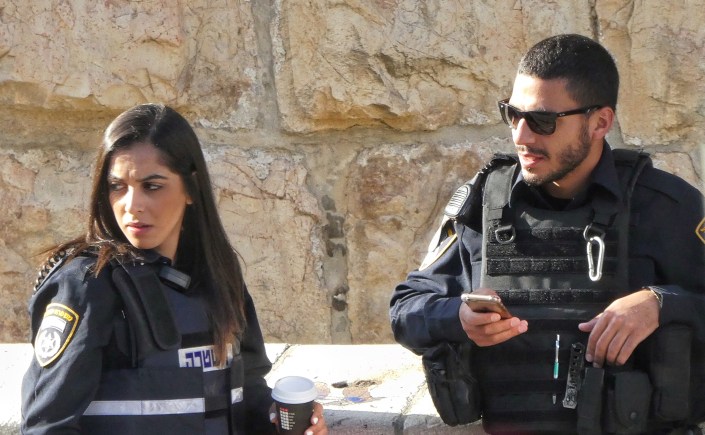
On our recent visits, we noted the high proportion of Mizrahim, and also, to a lesser degree, Ethiopians – most particularly, among young people. In the street, in the cafes, on the light rail, and especially with respect to the conscript army in which all young Israelis, boys and girls, must serve when they turn eighteen (with the exception of the ultra-orthodox Haredim and Israeli Arabs).

We had been contemplating why in recent years, and particularly, during the last Israeli election, right wing politicians were able to capitalize on an anti-Arab sentiment so incongruent (to liberal-minded outsiders, at any rate) among a people that proclaims itself to be conscious of its history of victimization and oppression. Why Israeli street protests and social media feature virulent tirades and slogans against the country’s Arab citizens and Palestinian neigbours (such inflammatory sentiment is returned with equal if not more vigour on the Arab street, on tabloid television, and from the mana-bir of mosques during Friday sermons). And why, therefore, Bibi Netanyahu’s election dog-whistle was so effective, resulting in a coalition government that is probably the most nationalistic, anti-Arab and anti-Palestinian in memory.

Commentators have suggested that the political shift to the right and to an increasingly authoritarian character has been due in part to the influx during the nineties of tens of thousands of Russian Jews who have no experience, appreciation and empathy for the occidental democratic model established by Israel’s founding fathers. It has also been said that the shift has been propelled by the exigencies of the security state that has perpetuated a pattern of fear and retaliation with respect to internal and external threats, be these Palestinian resistance to the occupation, as in the violent street protests and and bombings the first and second intifadas, and the lone-wolf vehicle attacks and stabbings of recent times, the ongoing rocket attacks and tunnel construction of Gaza, or the calls for the destruction of the Zionist entity by the Iran and its Hizbollah proxy, and by the televangelists and shock-jocks of the Muslim media.

It may well be “all of the above”, but there is also possibly the Mizrahi factor.

Now the majority of voters – this is where I am going out on a polemical limb with an argument that runs counter to what I have written above about the Mizrahim and their oriental legacy – Mizrahim don’t want Arabs – as friends, as neighbours, as fellow-citizens. Although Arabs and eastern Jews are literally ‘brothers under the skin’, although they shared the same lands, cultures and lifestyles for centuries, have they grown so far apart that the chasm has bred contempt?

They have grown up with the stories of their parents’ and grandparents’ own Nakba, the Arabic word for “the Catastrophe” of the 1948 war, when their families were cast out of their oriental Eden, expelled from Arab countries amidst threats and pogroms, murder and plunder. They spend their military service as conscripts and as reservists either serving in the occupied territories, or subject to deployment there or in Gaza when tensions flare, as they do frequently. They are aware of Arab mainstream and social media denigrating Jews and Israelis and calling for the destruction of their country. They know that any time, they and their loved ones, including particularly their soldier children, could be attacked by car, knife or bomb, or worse still, killed or kidnapped. Young – and not so young – Mizrahim have been hearing all their lives from their families and from the Arabs themselves that “they want to kill us”.

Nowadays, in many quarters, the Arab pogroms of the twenties and thirties appear to feature more prominently in Israel’s creation story than they did in earlier decades, providing an historical leitmotif to contemporary acts of violence. Times past, it was always the about the Zionist pioneers and, inevitably and unavoidably, the Shoah (and left-wing, peacenik Jews are predominately Ashkenazi of pioneer or Shoah heritage). Back then, there was also the image of triumphant David fending off five Arab armies and killing and expelling Arab Palestinians to create a contiguous national territory. Over half of Israel’s Jewish population has no connection to the Shoah, and to the secular and socialist Zionist ethos and once-powerful foundation institutions like the Kibbutz and Histradrut. The Israel of today, and the average Israeli, indeed, are very different to those of forty, fifty, sixty years ago, as are their perceptions and prejudices.

Perhaps the “victim” narrative appeals to and exploits atavistic fears of Arab hordes threatening to push the Jews into the sea. Maybe, too, it is a function of Israel’s dysfunctional place in the turbulent and bloody Arab world: a garrison state of citizen soldiers on a permanent,  war-footing, the only democratic nation in these parts that nevertheless, paradoxically and immorally, maintains a military occupation of a conquered people, and sustains politically, financially, and among many Israelis, ideologically and spiritually, a neocolonial settler society. But in a sinister twist of fate, it is a narrative that would have been music to the ears of those long-gone Revisionist Zionists who harkened to the call of Zeev Jabotinsky and his Eastern European Ashkenazi crew who had resolved during the Mandate years that there could only be one people in Ha’Aretz, and that The Land would range from the Mediterranean to the Jordan River. Zeev’s vision inspired the vicious Irgun and Stern Gang, and these morphed in time into Likud, which is now effectively the ‘party of government, and the driver of all things intransigent.

One thing’s for sure: the Mizrahi factor adds to the many complications that hinder a just and permanent solution to the intractable conflict between Israelis and Palestinians.

__________________________________________________________________________________________________________

In writing this piece, I am indebted to Israeli journalist and author Avi Shavit and his controversial and enlightening “My Promised Land – The Triumph and Tragedy of Israel” (Scribe 2014). Shavit wrote a brief, sad sequel in March 2015:

http://www.politico.com/magazine/story/2015/03/israeli-elections-israel-future-116266

Veteran Zionist, humanist, journalist, and fighter for justice Uri Avnery wrote the following in February 2017: “When and how the Ashkenazi and Mizrahi Rift was born”. It is well worth reading:

http://zope.gush-shalom.org/home/en/channels/avnery/1487945729

See also:

http://www.haaretz.com/life/1.795156
hthttp://www.haaretz.com/life/1.795156tps://en.m.wikipedia.org/wiki/Mizrahi_Jews
https://en.m.wikipedia.org/wiki/Demographics_of_Israel
In the statistics cited herein, there was no distinction made between Sephardim and Mizrachim. (If the Sephardim, Mountain Jews and other non-European groups are included in the Middle East and Asian group, then Middle Eastern and Asian Jews outnumber European and American Jews by a margin of 52 to 48

On a musical note:
From way back, I was particularly familiar with world-famous Israeli singers of eastern origin – Esther Ofarim, of dubious ‘Cinderella Rockefeller’ fame, (with her then-husband Abi, who was, incidentally, of Russian heritage), the late, sublime Ofra Haza, Noa, and latterly, Ladino diva Yasmin Levy].

https://www.youtube.com/watch?v=72QC8EGnxTw