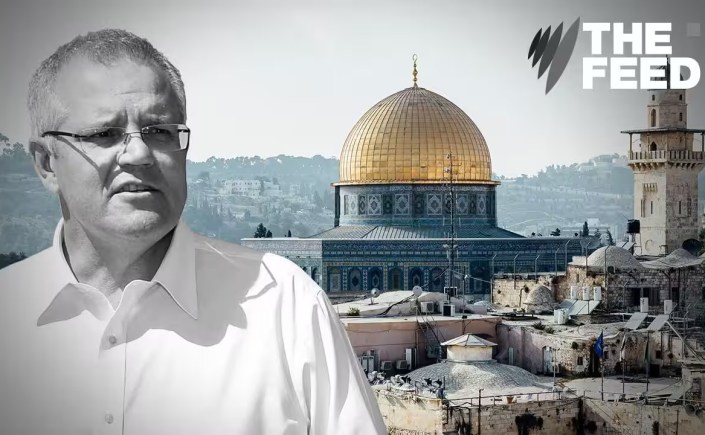
It was entitled: “Keeping Wolves from the Flock: The Case for Good Religion to Fight Anti-Semitism”. It was delivered on International Holocaust Remembrance Day on 27 January 2026 at the Binyaney Ha’uma Conference Center, Jerusalem, Israel. The presenter was former Australian prime Minister Scott Morrison. It was well received by audience, and praised by Israeli prime minister Binyamin Netanyahu. And it quickly reverberated back home.
The venue, the timing, and the company mattered. Israel, in the midst of an ongoing war and under the leadership of a government increasingly isolated internationally, was hardly a neutral stage. The event itself was framed as a moral gathering – a stand against antisemitism at a moment when Jewish communities worldwide feel newly exposed and embattled. Into this charged atmosphere stepped a deposed and disgraced Australian leader, now embarked on an international, largely ecclesiastical speaking circuit, offering prescriptions not for Israel, but for Islam in Australia.
The reaction in Australia followed well-worn grooves. Conservative outlets and commentators – most loudly those aligned with Murdoch media – cast Morrison as a truth-teller, bravely naming uncomfortable realities about radical Islam and standing up for Jewish security against a censorious, “woke” establishment that had been slow to deal with the acknowledged threat of radical Islamism. Progressive commentators, by contrast, focused on the dangers of securitising religion, the selective targeting of Muslims, exacerbating existing Islamophobia, and the symbolic violence of lecturing Australian minorities from abroad. The argument was instantly polarised, less a conversation than a mirror held up to our own media ecosystems and their predictable reflexes.
What was largely missing, however, was sustained attention to the deeper questions the speech inadvertently raised – questions that recur across debates about diversity, cohesion, and authority in plural societies. Who gets to speak about whom, and from where? How does a liberal democracy balance legitimate security concerns with religious freedom and civic trust? When does critique shade into control, and when does concern curdle into performance? And what happens when discussions about coexistence are conducted not face to face, but at altitude, before distant audiences primed for applause?
It is to those questions – rather than to the outrage or applause – that the brief following essay turns.
The politics of posturing
There is a particular genre of speech that is recognisable before one even reaches the second paragraph. It is delivered abroad, framed as courageous, freighted with moral urgency, and aimed not so much at those ostensibly being addressed as at a wider, watching audience. Scott Morrison’s address in Israel belongs squarely in this genre. It is less a contribution to Australian social cohesion than a performance within a global culture war, delivered from a stage carefully chosen for its symbolism rather than its suitability.
Morrison, now out of office and out in the world, occupies a familiar post-political niche as he treads an international speaking circuit, heavily ecclesiastical in tone and audience, where moral clarity is prized over policy detail and applause over accountability. This matters, because the speech was not made in the Australian Parliament, not to Australian Muslims, not even in Australia. It was made in Israel – at a moment when Benjamin Netanyahu, politically cornered and morally embattled, will accept reassurance and affirmation from almost any quarter. In that sense, the speech served two purposes: it burnished Morrison’s credentials with a transnational conservative audience, and it offered Netanyahu symbolic solidarity. Australia, and Australian Muslims, were almost incidental.
The content of Morrison’s address has been widely rehearsed: calls for nationally consistent standards for Islamic institutions; accreditation and registration of imams; translation of sermons; expanded scrutiny of foreign funding; praise for Middle Eastern states that have “reasserted authority” over religious teaching. None of these ideas, taken in isolation, are wholly unthinkable. Liberal democracies already regulate religion in numerous ways – through education standards, charity law, financial transparency, and criminal statutes relating to incitement and abuse. No faith operates in a vacuum, and Islam is not exempt from the tensions between patriarchal authority and moral absolutism, and the egalitarian instincts of a secular, humanist society like Australia’s.
Nor is it controversial to observe that Islam, like Christianity before it, is engaged in a long, unfinished argument with modernity. Questions of gender, authority, pluralism, sexuality, and the limits of clerical power are not impositions from outside but live debates within Muslim communities themselves (see, in In That Howling Infinite, Islam’s house of many mansions and Educate a girl and you educate a community – exclude her and you impoverish it ). Australian Islam, however, is overwhelmingly benign, pragmatic, and law-abiding – a quiet negotiation between inherited tradition and lived reality, not a breeding ground of medieval zealotry. The men and women who left Australia to fight for ISIS were not summoned by local mosques but seduced by freelancing radicals in unregulated prayer halls algorithmic feeds, online grievance, and a search for meaning in a fractured digital world in which they find no place..
This is where Morrison’s argument begins to fray. Security agencies themselves – including ASIO director Mike Burgess – have been clear: you cannot arrest your way to social cohesion, nor spy your way to less youth radicalisation. The most rapidly evolving threats now emerge from the post-Covid morass of conspiracy theorists, anti-government paranoiacs, white nationalists, and apocalyptic survivalists – movements that often cloak themselves in Christian symbolism without any expectation that Christianity as a whole should be placed under special surveillance. To single out Islam, therefore, is not just analytically weak but politically loaded.
That loading is amplified by Morrison’s own biography. He is not a neutral secularist but an openly proselytising evangelical Christian, steeped in a tradition that would respond angrily to equivalent proposals applied to its own institutions. His political career was marked by secrecy, performative culture-war gestures, and a tendency to govern by symbolic posture rather than deliberative engagement – a style that ultimately saw him removed from office. These things do not invalidate his right to speak, but they do shape how his speech is received in his home country.
Then there is the matter of exemplars. Morrison’s citing of Saudi Arabia, the UAE, Egypt, and Jordan as models of religious regulation is not merely unfortunate; it is disqualifying. These are regimes that suppress women, persecute Christians and heterodox Muslims, criminalise dissent, and weaponise religion as an instrument of authoritarian control. They have form for dealing with Islamists like the Muslim Brotherhood with what the Americans euphemistically call “extreme prejudice”.
To invoke them while speaking the language of freedom of worship is to betray a deep confusion about the difference between liberal regulation and illiberal domination. If the aim is integration, these are strange teachers to cite.
Yet even all this misses the most important point, which is not what Morrison said but how and where he said it.
It is presumptuous to lecture Australians from abroad. It is disrespectful to address Australian Muslims without engaging them directly. And it is incendiary to do so from Israel – a place that is anything but neutral in Muslim political consciousness, and where questions of religion, power, land, and legitimacy are already saturated with pain and contestation. To speak from there is to speak over, not to; to align oneself symbolically before dialogue has even begun. No amount of policy caveating can undo that gesture.
This is where the charge of Islamophobia becomes both understandable and, paradoxically, incomplete. Morrison did not denounce Muslims as such, nor did he advocate exclusion or expulsion. But by singling out Islam, invoking authoritarian models, and delivering his critique from a stage freighted with geopolitical meaning, he helped reinforce the sense that Muslims are a problem to be managed rather than citizens to be engaged. That perception matters, because alienation is not a side effect of radicalisation; it is one of its preconditions.
The reactions to the speech followed predictable lines. British commentator Brendan O’Neill, for example, writing in The Australian, cast Morrison as a brave blasphemer, persecuted by a censorious “Islamophobia industry” – a piece of rhetorical theatre entirely consistent with Spiked’s long-standing contrarian brand and its comfortable alignment with Murdoch culture-war politics. Jacqueline Maley, writing in the Sydney Morning Herald, and the progressive wing of liberal commentary, focused on the dangers of securitisation, surveillance, and selective moral panic. Neither is wrong, exactly, but neither escapes their own political ecosystem.
What is striking is how little the speech had to do with Australia at all. It was not an attempt to build consensus, to consult, or to wrestle with the messy realities of pluralism. It was an attention-seeking intervention by a man no longer accountable to the electorate and yet nostalgic for its attention, speaking to an international audience that rewards moral certainty and civilisational framing. In that sense, the speech says less about Islam than it does about the temptations of post-power relevance.
If there is a lesson here, it is an old one. Social cohesion is not forged by speaking about communities from afar, nor by borrowing the language of security to police belief. It is built, slowly and imperfectly, through proximity, dialogue, and the unglamorous work of trust. Morrison chose distance instead. And in doing so, he turned a necessary conversation into a symbolic skirmish – one that generated headlines, applause, and division, but very little understanding. One that we hope, unrealistically alas, in today’s febrile political climate, will be forgotten sooner rather than later.
Call it concern if you like; politics has another word for speeches that travel so far to say so little at home: posturing.
For more on the Middle East in in That Howling Infinite, see A Middle East Miscellany.
Recent posts on the current state of Australian politics include Same old stone, different rock. What’s in a word?’ Shaping facts to feelings – debating intellectual dishonesty, Moral capture and conditional empathy, and Standing on the high moral ground is hard work!
 In That Howling Infinite