Go ask Alice. I think she’ll know

Lewis Carroll’s fabulist masterpiece is 150 years of age this year.

In June, we had the pleasure visiting Ripon Cathedral in Yorkshire. An enthusiastic verger ushered us to the choir stalls. One carving therein depicts a griffin catching a rabbit who escapes down a hole. Is this where Alice, in pursuit of the White Rabbit, fell “down, down, down “to the centre of the earth, landing “bump, bump, bump?”. “Young Charles Dodgson would have played in these very stalls”, she told us. “Just imagine”. Charles’ dad was canon, and the lad would have hung out here, amidst ornate misericord carvings replete with fabulous creatures. On another misericord, a small character resembles what you would look like if you go eating mushrooms:

“One pill makes you larger and one pill makes you small; and the ones that mother gives you don’t do anything at all. Go ask Alice when she’s ten feet tall. And if you go chasing rabbits, and you know you’re going to fall, Tell ’em a hookah-smoking caterpillar has given you the call. Call Alice. When she was just small”.

The mesmerizing Grace Slick of Jefferson Airplane cut through to the rabbit chase channeling the long-gone Lewis in a psychedelic musical masterpiece. The polymath Anglican deacon may not have approved of the ambiance and the subtext of Grace’s soaring rant, but he would have appreciated where she was at:

“When logic and proportion have fallen sloppy dead, And the White Knight is talking backwards, and the Red Queen’s off with her head. Remember what the dormouse said: Feed your head! Feed your head!”

Ripon Cathedral Alice

Which brings me back to Alice’s 150th birthday.

Among the welter of Victorian stories for children, which, however spirited, are always both sentimental and self-conscious, Alice’s entry into a new and nightmare world is unique. And as a tribute to the anniversary of the publication of Alices Adventures In Wonderland, I cannot hope to do better than Peter Craven in his masterful tribute in this weekend’s The Australian. Craven traces the bloodline, the DNA even, of Carroll’s creation. Gilbert & Sullivan, Oscar Wilde, Saki, James Joyce, TS Elliot, the Goons, Monty Python, “the great source of nonsense high and low”, he writes, “where language goes nuts and logic goes haywire as well as highwire”. The curiouser and curiouser world down the rabbit hole. An “epic of a nonsense world that absolutely refuses to acknowledge its lunacy”. The Reverend Dodgson, better known, by his pen name, Lewis Carroll, was a man with two profiles: a pious writer, mathematician, photographer, and priest who was not only an artist and a genius but a very odd fellow indeed.

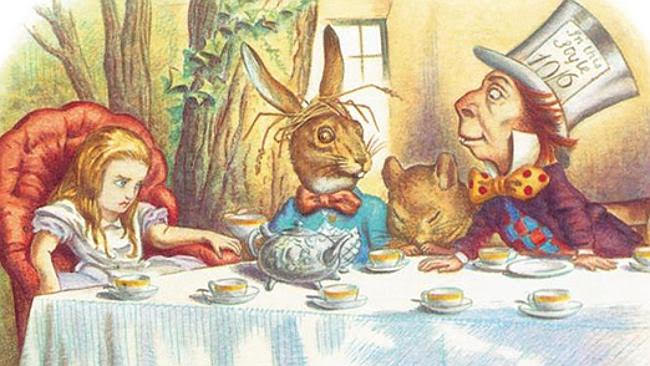
Read Craven’s lovely piece, and celebrate Alice’s 150 by reading Alices Adventures in Wonderland again. Here it is, complete with the iconic John Tenniel illustrations.

Click here to read the book:

Alice In Wonderland

With Carroll, the high dream and the poetry are in the nonsense and it’s part of his genius to have taken a vision of narrative and language that might, with just a twist, have become modernist and abstract, and given it to the Anglo-Saxon world as a children’s story as old and deep as lullabies and the world of sleep where every dream comes and every burble can seem like babble.

If you want an obvious example of the pure linguistic inventiveness of this world (where language goes nuts and logic goes haywire as well as highwire) take the lines Alice reads early on in Through the Looking-Glass.

“ ’Twas brillig, and the slithy toves / Did gyre and gimble in the wabe: / All mimsy were the borogoves, / And the mome raths outgrabe. // Beware the Jabberwock, my son!”

Anyone who has glanced at James Joyce’s Finnegans Wake, with its multiple puns across languages, all contained within a lilting Irish brogue that highlights the Anglo-Saxon backbone of English, will be reminded of Jabberwocky (“Eins within a space and a wearywide space it wast ere wohned a Mookse; “Latin me that, my trinity scholard, out of eure sanscreed into oure eryan!”).

Anyone who has encountered the sheer melodic strangeness, the luxuriance and defamiliarising effect of the proto-modernist poetry of the greatest poetic innovator of the Victorian age, Gerard Manley Hopkins, will see another kind of parallel. “I caught this morning morning’s minion, king- / dom of daylight’s dauphin, dapple-dawn Falcon …”

Carroll had been there before them. Except that in reducing English — English verse in this case — to pure sonic nonsense and suggestion, he was doing do so facetiously.

In France they had the symbolist movement and the poet Mallarme declaring “Paint not the thing, but the effect it produces”, so that language was being used to give us the rustle and shadow of a world through its ghostly glide, as in the poetry of TS Eliot (who translated these effects back into English) where the yellow fog in The Love Song of J. Alfred Prufrock is like a spectral cat.

But take a step back to the origin of this extraordinary children’s story. Charles Lutwidge Dodgson, a young Oxford don, a brilliant mathematician, is rowing along the river and is telling a story to the 10-year-old Alice Liddell and her two sisters. And for all the pleasure of the rowing and the messing about in boats, the true captivation is the story Dodgson is telling about the wonderland that opens up when a girl like Alice goes down that rabbit hole, into the curiouser and curiouser world where she grows big, grows small, and everything seems animated by some principle of distortion yet still seems gravely itself at every point. His friend in the boat asks the man who will eventually take the nom de plume Lewis Carroll if he’s just extemporising these wacko stories. “Oh yes, I am just making it up as I go along,” the storyteller says.

And then Alice Liddell says would Mr Dodgson write down this story and give it to her as a present. And so 18 months later he wrote it up for her and gave it to her with his illustrations.

Then in 1865 the expanded version appeared from Macmillan with the illustrations by John Tenniel, later supplemented by Through the Looking-Glass, to haunt the world as a romance of the 19th-century dreamworld ever since.

No one has ever known what focus of obsession or wonderment drew Dodgson to Alice Liddell. Simon Winchester has written a book, The Alice Behind Wonderland, about the photographs Dodgson took of Alice from the time she was six. The celibate clergyman obviously took a delight in the young child, but why shouldn’t he? There’s no evidence his feeling for her was anything but chaste.

Still, relations with Alice’s family — her classicist father Henry Liddell was co-author of what’s still the standard dictionary of classical Greek — did not stay close and there’s the suggestive fact that some pages were torn from Carroll’s diary. Alice did not attend Carroll’s funeral in 1898. She married in 1880 and had a long life. She was forced by neediness to sell her Lewis Carroll collection and in 1932 she came to New York to celebrate the centenary of the birth of the author, the man who 70 years earlier had turned her into the heroine of his dream story. She was mobbed, she apologised to the people of America for not signing their books, her own manuscript had been bought by an American.

Before she left on that trip she had signed a copy for the six-year-old Elizabeth, the girl who would become the Queen. At the end of World War II, the ­librarian of congress brought the manuscript to London and gave it back to the people of Britain. It was accepted on their behalf by the archbishop of Canterbury with appropriate solemnity. This underlined the common inheritance of English-speaking people in this extraordinary and iridescent story that had become the greatest folktale of the age.

It is a remarkable thing to create a modern fairy story that also embodies, through a spirit of comedy and enchantment at its most delirious, the deeper culture of a civilisation. Alice in Wonderland succeeds in doing this partly because Alice is such a credible girl.

Carroll is so good at inhabiting a child’s-eye view of the world without ever making Alice mawkish or mushy or infantile. She is in her own terms shrewd, practical, alert, full of energy and imagination and a desire to know what’s going on, however bizarre and uncanny it may be.

And the style in which Carroll couches his epic of a nonsense world that absolutely refuses to acknowledge its lunacy (and nor should it) is a masterpiece of plain elegance and precision.

She was looking about for some way of escape, and wondering whether she could get away without being seen, when she noticed a curious appearance in the air: it puzzled her very much at first, but, after watching it a minute or two, she made it out to be a grin, and she said to herself ‘‘It’s the Cheshire Cat: now I shall have somebody to talk to.’’

‘‘How are you getting on?’’ said the Cat, as soon as there was mouth enough for it to speak with.

Alice waited till the eyes appeared, and then nodded. ‘‘It’s no use speaking to it,’’ she thought, ‘‘till its ears have come, or at least one of them.’’ In another minute the whole head appeared, and then Alice put down her flamingo, and began an account of the game, feeling very glad she had someone to listen to her. The Cat seemed to think that there was enough of it now in sight, and no more of it appeared.

The removal of the sublime Cheshire Cat is naturally enough — at the axe-happy queen’s instigation — to be by execution. But, of course, the cat starts his fading-away trick and the ­executioner is mightily unamused: “The executioner’s argument was, that you couldn’t cut off a head unless there was a body to cut it off from: that he had never had to do such a thing before, and he wasn’t going to begin at his time of life.’’

Alice can be read with a fair amount of ease by anybody. It’s in a fresh, idiomatic, racy style that avoids the rich ponderous quality of a lot of grand Victorian prose, so that it can in fact — like Huckleberry Finn and decidedly unlike Moby-Dick (which is no children’s book, whatever they used to imagine) — be read when you’re nine years old. And should be.

But Alice in Wonderland is likely to take every child’s fancy and the main thing is probably to encourage kids — perhaps particularly boys — that they are not too old for it. And the trick there is probably the simple one of convincing them it’s very funny and very weird.

And that’s true. It is bottomlessly funny and sad and wise, and if it’s a kids’ book, even a little kids’ book, it is so with an extraordinary clairvoyant intensity of vision, pitiless and naked to the wildness and poignancy of the world.

Listen to the sublime and solemn description of the Mock Turtle and the Gryphon as they delineate a dance of lobsters with Alice trying not to disclose the fact that she thinks of things from the sea as essentially things to eat:

‘‘You may not have lived much under the sea — ’’ (“I haven’t,’’ said Alice) — ‘‘and perhaps you were never even introduced to a lobster — ’’ (Alice began to say ‘‘I once tasted — ’’ but checked herself hastily, and said ‘‘No, never’’) ‘‘ — so you can have no idea what a delightful thing a Lobster Quadrille is!’’

‘‘No, indeed,’’ said Alice. ‘‘What sort of a dance is it?’’

‘‘Why,’’ said the Gryphon, ‘‘you first form into a line along the sea-shore — ’’

‘‘Two lines!’’ cried the Mock Turtle. ‘‘Seals, turtles, salmon, and so on; then, when you’ve cleared all the jelly-fish out of the way — ’’

“That generally takes some time,’’ interrupted the Gryphon.

‘‘ — you advance twice — ’’

There’s a wonderful understatement that is the medium for releasing the book’s enchantment and delirium. Even though Carroll knows all about the pure suggestiveness of language, as in Jabberwocky, he needs — and effortlessly conjures up — a windowpane prose that has all the necessary clarity and transparency for the wackiness of what is to transpire at every point.

It’s the quality you get in one of the greatest small-scale 20th-century masterpieces about the dreamlike and impossible: Franz Kafka’s Metamorphosis, the story about how Gregor Samsa wakes up to discover that he has turned into a giant insect. It’s the story of Kafka where he is closest to the technique of classic realism, where he is at his sharpest and most Flaubert-like.

Aristotle, the Greek philosopher of literature (and everything else), said that a probable impossibility was to be preferred to an improbable possibility.

This simply means that something like A Midsummers Night Dream, with its fairies and asses’ heads, is better, it is more real as writing, than a bad soap opera where something that could happen, but wasn’t likely, takes centrestage with a complete lack of believability.

Alice in Wonderland and Through the Looking-Glass are full of the high logic and precise realism of the impossibility, and what makes the impossibility so real is that the never less than intellectual Carroll gives his narrative the precision of dream. So the grumpy duchess can be nursing an actual pig. And so we can get all the realistic semi-intellectualised dialogue of Tweedledee and Tweedledum.

“I know what you’re thinking about,” said Tweedledum: “but it isn’t so, nohow.”

“Contrariwise,” continued Tweedledee, “ if it was so, it might be; and if it were so, it would be; but as it isn’t, it ain’t. That’s logic.”

“I was thinking,” Alice said very politely, “ which is the best way out of this wood: it’s getting so dark. Would you tell me, please?”

But the fat little men only looked at each other and grinned.

Was there ever a more vivid portrait of two all but interchangeable dumb-arse clever boys?

A close cousin is Humpty Dumpty who knows everything about words and how to jump hoops through them, logically and super logically: “ ‘When I use a word,’’ Humpty Dumpty said, in rather a scornful tone, ‘it means just what I choose it to mean — neither more nor less.’ ”

And this very intellectual idiot gives a very precise impersonation of a literary critic by undertaking to produce an analysis of Jabberwocky.

This aspect of Alice in Wonderland is inexhaustible because its brilliance is in its silliness and vice-versa. The Goons and Monty Python have nothing on it because its wit and its disdain for intelligence are part and parcel of the same thing, and the Wonderland frame is wonderful because it allows the surrealism of what transpires to have an absolutely ordinary rainbow of actuality.

It’s a bit dazzling just how much realism Carroll packs into his evocation of the surreal through the eyes of an innocent and practical child. There’s something so silly and so dazzlingly profound in the fight between the Lion and the Unicorn towards the end of the Looking-Glass section and then the King’s description of his messenger.

“ ‘Not at all,’ said the King. ‘He’s an Anglo-Saxon Messenger — and those are Anglo-Saxon attitudes. He only does them when he’s happy. His name is Haigha.’ (He pronounced it so as to rhyme with ‘mayor’.)’’

Anglo-Saxon attitudes — who but Lewis Carroll could act them out? The whole book is an enchanted circus of Anglo-Saxon attitudes, but it is also the broadest and most panoramic of comic spectacles.

There’s even the apparition of a White Knight who has the poignancy, the tragicomic absurdity of Cervantes’s Don Quixote in miniature. He flits, he flutters, he indicates his great frailty.

So there are even tears in this strange book of the world that is made up of so many animated jokes, yet the walking jokes and paradoxes have human faces and shapes and possibilities, however glancing, of real feeling, and destiny.

Alice in Wonderland is a book of the deepest kind of magic. It is compounded of poetry and logic and it believes in neither. It is a work of wisdom and a work of madness. It is hilarious and there is a sense in which it is a place where all our memories begin, or seem to.

It’s marvellous that it’s turned 150 and everyone has an excuse to read it again.

Peter Craven is one of Australia’s best known critics and cultural commentators.
Back In The Day

I was in love with Dusty Springfield. In the drear tea-time of my adolescent soul, I worshiped her truly, madly, deeply. Tiny girl, big hair, panda eyes, hands moving like a beckoning siren. I just had to hear “da da da da da da” and then “I don’t know what it is that makes me love you so…” and I was hers for the next two and a half minutes. Until…

It was one of those beautiful late-spring evenings that you would get in the England of memory. The evening sun poured through the gothic stained glass windows of the school library – it was one of those schools. A group of lower sixth lads, budding intellectuals all, as lower sixth tended to be, gathered for a ‘desert island disks” show-and tell of their favourite records. Mine was ‘Wishin’ and Hopinby you know who. Then it was on to the next. Clunk, hiss,  guitar intro, and: “My love she speaks like silence, without ideas or violence, she doesn’t have to say she’s faithful, but she’s true like ice, like fire…” Bob had arrived, and I was gone, far gone. So was Dusty.

dusty

I bought a guitar. A clunky, eastern European thing. I tried ‘Blowin’ in the Wind’, but what came out was unrecognisable. My dad said he’d break it over my head. One day, that tipping point was reached. It sounded indeed like ‘Blowin’ in the Wind’, or something similar. I was away, and the rest, as they say, was hearsay.

Young Bob

On a  high of hope and hype, so it all began. With a heritage of Irish rebel songs and folksongs, and the ‘sixties folkie canon (but never, ever ‘Streets of London’). Sea shanties, a capella Watersons, Sydney Carter’s faith-anchored chants, ‘The Lord of the Dance’ being the most beloved (a song now and forever burdened with the curse of Michael Flatley). Across the pond, young Bob Dylan, Joan Baez, and Peter, Paul & Mary decanted fine old wine into new bottles, and during the Easter CND march in London in 1966, billeted in an old cinema in Southall, a first public ‘performance’ with Ewan MacColl’s “Freeborn Man of the Traveling People”. The journey had begun, and, as the father of America poetry had crooned, “Afoot and light-hearted, I take to the open road, healthy, free, the world before me, the long brown path before me, leading wherever I choose”.

And it led beside strange waters. “Marc Bolan warbled “My people were fair, and had sky in their hair, but now they’re content to wear crowns stars on their brows“. But didn’t they all in the days when Tolkien was king, and elves and ents walked amongst us. We thoroughly understood and empathized. And we marveled at the Scottish bard who could pen ‘The Minotaur’s Song and ‘Job’s Tears‘, and then run off with Old Father Hubbard. Then Roy Harper, the high priest of Anglo angst, sang ‘McGoohan’s Blues’, a twenty minute digression from the concept if not the plot of an iconic if indecipherable television series. “The Prisoner is taking his shoes off to walk in the rain”.

Unicorn(Album)

‘The Songs of Leonard Cohen’ played in every wannabe poet’s bedsit. “Come over to the window, my little darlin’. I’d like to try and read your palm“. What a pick-up line, so fitting for the generous times that were the ‘sixties. Others might sigh over the agonies of ‘The Stranger Song’, and ‘The Stories of the Street’. But I preferred the drollery of “Sometimes I see her undressing for me; she’s the sweet, fragrant lady love meant her to be“. And the wondrous punch-line of ‘Chelsea Hotel #2‘, that gorgeous tribute to the peerless Janis: not what happened on the unmade bed, but “we are ugly, but we have the music”. Bob segued from folk to rock, carrying with him many if not all of acolytes on the joker man’s journey from “Oxford Town” to “Desolation Row”. To this day, people ponder the meaning of Jewels and binoculars hang from the head of the mule”‘ and marvel at “The ghosts of electricity howl in the bones of her face“.

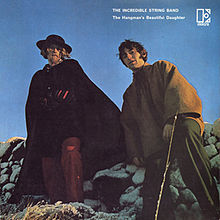
HangmansBeautifulDaughter

Read on in the full Introduction to In That Howling Infinite – Poems of Paul Hemphill, Volume Five

© Paul Hemphill 2013.  All rights reserved.

Something About London

One leg up and one leg down like an old cock sparrer, flyin’ over Piccadilly with me bow an’ arra.  Sydney Carter, Eros

Eros has had a good Brasso session and is looking grand in the intermittent summer sunshine. The skylines of Regent Street, Piccadilly, and Shaftsbury Avenue look gorgeous in their Georgian and Regency splendour. The traffic is terrible and the tourists throng in confused and bemused bunches. The theatres still advertise musicals I would never see in a month of Sundays. The royal parks are in full bloom and abound with swans, geese and ducks and their young families. Soho looks as tacky as ever. And although Carnaby Street looks like, well, just any other street, and Swinging London is a fading artifact of the past, London is London as it always was and always will be in my mind’s eye and in my memories.

There is something about London. It’s in the air and it’s in the paving stones, in the crowds and the smell of the rain (lots of it). I have been coming back here every few years for over thirty years. And it still feels like coming home. As time goes by, you forget more than you remember, but random memories come breaking through the years, your thoughts wind back to way back when. London with its technicolor costume of colour, creeds and complexions, it’s paradoxes of posh and poor, it’s troves of trash and treasure.

In 1777, celebrated essayist Samuel Johnson said “when a man is tired of London, he is tired of life”. A cliché, yes, over-used and over-quoted, oft times, out of context. A cover story of Time Magazine on ‘Swinging London’ in April 1966 was entitled “You can walk across it on the grass’. That was and remains part of the magic of the place. That, and its art, its architecture, its history. “Don’t look at”, they say, “look up!” And, exploring the main streets, mean streets and backstreets, parks and parade grounds, mews and alleys of Old London, I always reckoned that old Sam got it spot on – and still do today, whenever I chance to return.

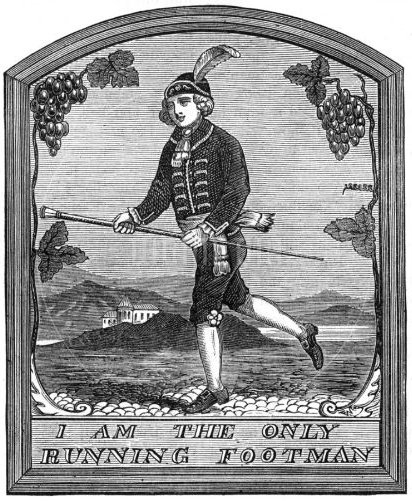
And adjacent, in Hayes Mews, the hostelry with the longest pub name in London, ‘The Only Running Footman’. Such a magical name, it was, conjuring up motion and majesty, speed and style. And it remained in my mind this half-century hence. I had an affinity with this anonymous, antique athlete. These were my running days. I ran everywhere. To the underground, to work, to the shops, to the pub (but not back), though the city, around the town. I revelled in the movement, in the freedom, in the physical and psychological exhilaration of it all. My running days are long over, but I still run in my dreams

running footman

These were days of adapting to new environments and circumstances. They were exciting, they were challenging. I was young, restless, at turns, idealistic and cynical, puritanical and hedonistic. In retrospect, days of emotional and intellectual ferment. Days of “finding one’s way in the world”. Not some reformationey, renaissancial, enlightenment thingy. Post-adolescent onanism, more like.

As John Lennon sang: “Strange days indeed. Most peculiar, Mama!“ Irish bombs, miners’ strikes, power cuts, rubbish piled up on streets, and economic recession. A three-day week as England closed down for want of coal. Candles and coldness. Late starts and early finishes. A stack of books left in the lift in case I was caught when the lights went out. In one job, I’d walk through a bomb shattered foyer, into the mail room, to put all the mail thru a whopping great X ray machine to see if the paddies had sent us any letters. The police arrested my bike when I left it chained to a parking meter – in case it was used to hide a bomb. And you would actually hear explosions as you went about your business. Arriving at a much smaller Heathrow Airport, finding it surrounded by armoured cars and armed soldiers and police. I got a kick out of the blitz-like solidarity, the trench humour, and deprivation and darkness. Layla rocked a London that was neither as drear not as dammed as some paint it. Back then, I was in love with the place. I was young, idealistic, and as the poet said “Bliss was it in that dawn to be alive, but to be young was very heaven!“

From Tabula Rasa Poems of Paul Hemphill , Volume One 

image


Roman Wall Blues – life and love in a cold climate

Over the heather the wet wind blows,
I’ve lice in my tunic and a cold in my nose.
The rain comes pattering out of the sky,
I’m a Wall soldier, I don’t know why.
The mist creeps over the hard grey stone,
My girl’s in Tungria; I sleep alone.
Aulus goes hanging around her place,
I don’t like his manners, I don’t like his face.
Piso’s a Christian, he worships a fish;
There’d be no kissing if he had his wish.
She gave me a ring but I diced it away;
I want my girl and I want my pay.
When I’m a veteran with only one eye
I shall do nothing but look at the sky

We’ve marvelled at Roman brickage from Syria to Cirencester, from Bath to Baalbek, but had never ventured to Hadrian’s Wall in Northumbria. WH Auden’s whimsical song, Roman Wall Blues, came to mind as we stood atop the windswept knoll that is Housesteads Roman Fort on a freezing May morning.

In the preface to Pax, the latest volume of his magisterial history of the Roman Empire, English historian Tom Holland notes that the northern bank of the river Tyne was the furthest north that a Roman Emperor ever visited. What was so important about Hadrian’s visit to Tyneside in 122AD was his decision there to mark in stone, for the first time, the official limits of his Empire. North of this great wall, there was paucity and unspeakable barbarism, scarcely worth bothering about; below the wall was civility and abundance and the blessings of Romanitas. To this day, those 73 miles of the Vallum Hadriani across the jugular of Britain still shape the common conception of where England and Scotland begin and end, even though the wall has never delineated the Anglo-Scottish border. For this colossal structure left enduring psychological as well as physical remains. To the Saxons, it was “the work of giants” and was often thought of as a metaphysical frontier with the land of the dead.

George RR Martin, author of The Game of Thrones, the artistic juggernaut, has said that his Ice Wall separating the northern wintry waste with its nomads and its demons from the settled and temperate Seven Kingdoms of Westeros with it castles and cities, it’s palaces and slums, it’s despots, destitute and the depraved, was inspired by a visit to Hadrian’s Wall – only he built it much longer and much, much higher.

“We walked along the top of the wall just as the sun was going down. It was the fall. I stood there and looked out over the hills of Scotland and wondered what it would be like to be a Roman centurion … covered in furs and not knowing what would be coming out of the north at you. George RR Martin has said that his Ice Wall separating the northern wintry waste with its nomads abd its demons from the settled and temperate Westeros with it castles and cities, it’s palaces and slums, and destitute and the depraved, was inspired by a visit to Hadrian’s Wall – only he built it much longer and much, much higher. “We walked along the top of the wall just as the sun was going down. It was the fall. I stood there and looked out over the hills of Scotland and wondered what it would be like to be a Roman centurion … covered in furs and not knowing what would be coming out of the north at you”.

There we were, then, on the edge of empire. The Roman Empire, that is. Among outposts and outcasts. Up on the hills in the nithering wind and the cold rain, the snow and the sleet, and in the valley below with the baths and the brothels. This is where worlds collided. Between the Roman cives and their satraps, and the barbarians of the northlands. Between Britannia and Caledonia. Where solders from Rome and the Italy-yet-to-be that surrounded it, from Gaul, Batavia, Asturias and Tungria, now France, Spain and the Low Countries, from Germania and Sarmatia in Central and Eastern Europe, marched and marauded, drank and dined, foraged and fucked, lived and died.

At the height of Empire, some seven hundred soldiers manned the fort we now call Housesteads, up high on the moors, a windswept outcrop with a vista of 360 degrees and a temperature near zero. Many more legionaries garrisoned the more sheltered Chesters Fort in the nearby-by valley below where the wall crosses the Tyne. These included cavalry, drafted from Sarmatia, in present day Hungary. This was the fanciful premise of King Arthur (2004) starring Clive Owen as a handsome, tortured soul wandering through a flawed film and Keira Knightly as a scantily clad, elfin  warrior Guinevere, backed up by a gallant band of photogenic heroes who hailed from the eastern steppes.

When the Romans departed Britain, Hadrian’s Wall fell into disrepair – it was always permeable, and in time, had served its purpose – which was perhaps as much about public relations as protection. Archeologist Terri Madenholme wrote in Haaretz: “Despite itself having a culture of violence, Rome aimed to project an image of a nation of the civilized, and what better way than having it monumentalized in stone? When Hadrian set to build the 73-miles-long wall drawing the border between Roman Britannia and the unconquered Caledonia, the message became even more clear: this is us, and that’s them. Hadrian’s Wall was much more than just a border control, keeping the Scots in check: it was a monument to Roman supremacy, an attempt to separate the civilized world from the savages”.

“He set out for Britain”, Hadrian’s historian tells us, “and there he put right many abuses and was the first to build a wall 80 miles long [Roman miles] to separate the barbarians and the Romans.”

image

Housesteads Fort

At Vindolanda, to the south, a small town grew up around a large military camp. First of wood and then of stone, constructed by the legionnaires themselves, who included in their number skilled masons and carpenters. Their settlements endure to engage our imaginations today. In times of turmoil, these soldiers fought and fell. In quieter times, they relaxed and recuperated. And the locals gathered about them, built houses and gardens, opened shops and pubs and those aforementioned brothels. And life went on like it does in our time.

During conflict, the Roman auxiliaries guarded the borderlands, deterring the Picts, a dark-skinned painted people who raided from the northern badlands. When peace prevailed, the locals visited, traded, and settled in the viccii or villages that grew organically to the south of the forts that were constructed at intervals along the empire’s perimeter wall. There, they traded, and provided goods, services and entertainment for themselves and for the martial strangers that had come among them from faraway places they’d never heard of.

In the early days, the auxiliaries were not permitted to bring wives and children to the frontier. But folks being folk, they very soon established friendly relations with their neighbours, and legionaries would keep informal wives and families in the vicus. Soviet writer and war-correspondent Vasily Grossman encapsulated all this poignantly and succinctly in An Armenian Sketchbook: “The longer a nation’s history, the more wars, invasions, wanderings, and periods of captivity it has seen – the greater the diversity of its faces .Throughout the centuries and millennia, victors have spent the night in the homes of those whom they have defeated. This diversity is the story of the crazed hearts of women who passed away long ago, of the wild passion of soldiers intoxicated by victory, of the miraculous tenderness of some foreign Romeo towards some Armenian Juliet”.

Officers were allowed to bring their wives and children to their postings, and these endured their provincial, primitive exile by importing the necessities of a comfortable Roman life, including the celebrated Roman plumbing and central heating. Chesters boasts the best preserved military bathhouse in Britain. And so, the accessories of civic consumerism reached the frontier. Food and wine from the warm South were transported to the cold north-lands. Fashions in clothes and jewelry, day-to-day articles and artifacts, from glass and pewter dinnerware to cutlery, tools and sundry hardware. Recently, it has been revealed that these domestic items included what is believed to be the only known Roman dildo. Remnants and reports gathered in the Vindolanda museum open a window into a gone world.

Housesteads Fort

The wonderful Vindolanda tablets have preserved a picture of the oh-so-normal lives of these transplanted souls so far away from home. Amidst accounts and inventories, orders and troop dispositions, a quartermaster reports that supplies of beer are running low. An officer writes to another in a neighboring fort inquiring about the availability of accommodation for visitors and the quality thereof. One tablet reveals that Roman soldiers wore underpants, which, in view of the locale and climate thereabouts, is comforting to know. And another recounts workplace harassment and bullying that would today invoke grievance procedures. The wife of an officer invites another to a birthday party at her house in Vindolanda. There is an undercurrent of “Please come, I am bored shitless”, though a polite Roman matron would not commit such sentiments to a wooden tablet (nor reveal to her friend the existence of that aforementioned sexual comforter). It is probably the oldest surviving document in Latin written by a woman.

So who were these folk so near to us in their needs and desires, their hopes, fears and expectations, and so far from us in time, space and purpose? What did they think and feel? It is a question oft asked by empathetic history tragics. The thinking of another time can be hard to understand. Ideas and ideologies once compelling may become unfathomable. And the tone and sensibility that made those ideas possible is even more mysterious. We read, we ponder, and we endeavour to empathize, to superimpose the template of our value system, our socialization, our sensibilities upon the long-dead. And thence, we try to intuit, read between the lines, draw out understanding from poems, plays, novels, memoirs, pictures, photographs, and films of the past.

We feel we are experiencing another facet of the potential range of human experience. But in reality, we are but skimming the surface, drawing aside a heavy curtain for a momentary glimpse through an opaque window into the past. Yet, we persist nevertheless, because that is what humans do. Over two and a half thousand years ago, the controversial Greek poetess Sappho wrote ”I tell you, someone will remember us; even in another time”.

And in Vindolanda, up there on the wall, on the weather-beaten rim of the long-gone empire, we do  …

© Paul Hemphill 2015.  All rights reserved

Chesters Fort

The best Roman baths in Britain at Chesters Fort

Here is some further reading about Vindolanda.
http://www.vindolanda.com/
http://en.m.wikipedia.org/wiki/Vindolanda_tablets
http://vindolanda.csad.ox.ac.uk/tablets/browse.shtml

And some pieces from my ‘Roman’ period:  Roman Holiday: What have the Romans done for us?:  Cuddling up to Caligula. Read also about what happened when Harald Went A Viking

Blood and Brick … a world of walls

Postscript – The Man who saved Hadrian’s Wall

One of the great unsung saviours of the UK’s heritage is remembered in the museum housing his remarkable collection at Chesters Roman Fort Museum which houses the Clayton Collection of and 5,500 catalogued items from a variety of sites along the central section of the wall.

Few people today have heard of John Clayton, yet he is one of the single most important individuals in the history of Hadrian’s Wall.

A classically educated Victorian gentleman who combined demanding roles running the family law firm and acting as town clerk for the city of Newcastle-upon-Tyne, Clayton had a passion for archaeology and the Roman military legacy in his beloved Northumberland.
Were it not for Clayton, large parts of Hadrian’s Wall would have disappeared as the industrial revolution fuelled the demand for stone to build factories, mines and mills. His role in the preservation and survival of Chesters Roman Fort – the best-preserved Roman cavalry fort in Britain, is now undisputed.

In the early 19th century Clayton lived at Chesters House in the parkland surrounding the Roman fort and from an early age became fascinated by the Roman relics that surrounded him.

By the 1830s he began buying land to preserve the Wall, at a time when what is now a World Heritage Site was little understood,  and was being unthinkingly vandalised by quarrying and removal of stones for reuse. Clayton’s enthusiasm helped preserve the central stretch of Hadrian’s Wall that includes Chesters (Cilurnum), Housesteads and Vindolanda. He carried out some of the first archaeological excavations on the Wall and even brought early tourism to the area by displaying some of the finds at Chesters. Clayton managed the estate and its farms successfully, generating cash to fund further preservation and restoration work on the Wall. He never married, and died in 1890

The museum housing the Clayton Collection was opened next to the fort site in 1903, 13 years after his death. It is privately owned but curated by English Heritage on behalf of the Trustees of the Clayton Collection, and has been refurbished to bring it up to 21st century standards of conservation, display and interpretation. Yet, great care has been taken to respect its character and to retain the feel of a 19th century gentleman antiquarian’s collection, and many of the labels and original cases have been retained..

John Clayon

For more on Clayton and his museum, read:

http://www.culture24.org.uk/history-and-heritage/art56960

The Spirit of ’45

I was a child of the Welfare State.

Born in the early years after the end of World War II, I was aware that the dominant mood was relief that it was over, sadness at those lost and most importantly a forward looking attitude to improve things and not simply to get back to what life had been like before. The traces of the conflict were all around me in once blitzed Birmingham – in the barren, levelled  ‘wastelands’ where streets had once stood, in the austerity, and the monotonous and monochrome drabness of couture and cuisine. To my boyish mind, “the war” was a shared community experience, a shadow which few, I now recall, talked about; but also, the stuff of puerile fantasies fostered by comic books, Airfix models, and patriotic movies that were literally and figuratively black and white.

Life was not all roses in those immediate post-war years, but better by far than what went before. Rationing was still in place when I was born in Birmingham in 1949, not ending until 1954. Young men still had to do their national service (the last call up was in 1960, the year I started Secondary school). We lived with our aunt in a cold-water, back-alley walk-up on the border of Balsall Heath (just inside Moseley, a ‘better’ suburb). Aunty Mary was my mother’s mother’s sister. When her sister died and daddy Paddy ran off with another women, Mary brought the six children over to Birmingham from Enniscorthy, County Wexford one by one. She had come to Birmingham from Ireland before the war, after her husband had run off (these things happened in Catholic Ireland). And she lived in that same old house right through the Blitz when German bombers regularly targeted The Second City’s engineering, motor and arms factories, and not a few public buildings including the Piccadilly and Waldorf cinemas on nearby Stratford Road.

I was born in her house. She had a friend who had once given birth, so that friend was the midwife. My brothers followed over the next two years. By then, National Health Service had kicked in, so they were born in hospital. Childbirth, forever dangerous, was now rendered less life threatening. There we all lived, three kids, our folks, three uncles, two aunts, a dog and a cat. Three bedrooms, girls in one, boys in another, and our family in the third. Outside loo and coal shed, no bathroom or hot water (we kids bathed in the kitchen sink and grown- ups went down to The Baths), Cold and damp, and close to the shops. And there we lived until, in 1956 when a council house in Yardley Wood became our first family home. Cold and colder running water that froze in winter, but it was at least inside the house;  bathroom with hot water boiled in a big gas boiler; and an outside flush lavatory that was nevertheless immediately adjacent to the backdoor and not down the garden. A big garden too, for winter and spring vegetables, and summer camp-outs.

There we grew, with free medical treatment for all our ailments, and free optical and dental care. I still have crooked teeth – no fancy orthodontics on the NHS – but I have all my teeth still. And my eyesight. We were educated, for free. This came in during the war with the Butler Act. So, thanks to the Welfare State, we were housed and healthy enough to get to primary school and beyond. Once there, we had free books, free pens and paper, and compulsory sport, and doctors and nurses would turn up on a regular basis to check our vitals. And thus, we were able to reach the glorious ‘sixties ready to rock ‘n roll.

Which brings me by a circuitous route to British director Ken Loach’s 2013 documentary, The Spirit of ’45,  a celebration of the radical changes that took place under the Labour government of Clement Attlee which came to power in 1945.

What a year that was! No sooner had the war ended, than the British electorate voted out its esteemed and beloved war leader, Winston Churchill, and bought Labour’s promise of a democratic socialism. Drawing on archive footage, and presented in black and white with contemporary interviews with dockers and miners, doctors and nurses, politicians and economists, Loach describes the nationalisation of the public services, and their subsequent privatisation three decades later. His interviewees provide poignant anecdotes about the poverty of the 1930s, dangerous and exploitative working conditions, poor housing, and abysmal health care, and the renewed sense of purpose and optimism after the end of the war and Labour’s landslide victory. He recounts the subsequent expansion of the welfare state, with its free to all medical service, and the nationalization of significant parts of the British economy, most notably, electricity, the railways, and the mines.

The Attlee government was elected due to a general belief that nothing would or could be as it had been before. Britain had pulled together to win the war; now, it would transform the peace. This was The ‘Spirit’ of ’45.

But whilst ‘spirit’ can imply  ‘esprit’ and elation, it can also mean ‘ghost’ insofar as Loach rages against the death of all that hope, optimism, and vision in the decades that followed.. It is a call to arms for a return to the public unity of those heady post-war years and against the policies of subsequent governments, and most particularly those of Margaret Thatcher, that have progressively demolished the Britain that Clement Attlee and Aneurin Bevan strove to build. And it is a reminder that the NHS is worth fighting for at a time when it is being progressively dismantled. With stills of modern soup kitchens and the Occupy movement camped outside St Paul’s, Loach clearly believes that Occupy inherits that spirit of ’45.

Viewing The Spirit of ’45 was exhilarating. It was full of Wow! moments. The footage of the poverty of the depression years, the slum dwellings, urchin children playing on the streets or on the slag heaps, the unemployment queues, the scavenging for coal, the Jarrow March. Diseases now preventable or eradicated, then mortal. Five in a bed, and two of them dead. Malnutrition and rickets. Bread and dripping sandwiches? You needed beef for dripping. Fat chance. It was bread and jam, thank you (and grateful for it, one was tempted to respond – there were indeed some Monty Python moments there, particularly the one-down-manship sketch “when I was a lad, we were so poor…”

Relying so heavily on memories and reminiscences, the film is nostalgic, sentimental, and simplistic even, with little in-depth analysis. A tick-a-box of the many innovations that greeted the arrival of the baby boomers. Presented in such a clear and uncluttered fashion, it was quite stirring. That is Ken Loach for you. What you see is what you get: a one-sided history lesson.

The film leaps from the Attlee government straight into the darkest days of the Thatcher government, with no discussion of the political, economic and social changes and challenges in between. The road from Clement to Maggie was an eventful and for many, a traumatic one. The Counter Revolution took decades to establish itself. The great experiment of 1945 contained the seeds of its own destruction.

Loach’s focus on the years of nationalization and privatization makes narrative and dramatic sense.

But the years in between were dramatic also. Read Dominic Sandbrook’s great quartet. The titles say it all: Never Had It So Good: A History of Britain from Suez to the Beatles; White Heat: A History of Britain in the Swinging Sixties; State of Emergency; The Way We Were: Britain 1970–1974; and Seasons in the Sun: The Battle for Britain, 1974-1979. These were best of times, these were the worst of times, as the Great Man might have said. And the worst was to come, when Britain apparently went down the gurgler, and Thatcher had to break it to fix it. And like Dr Frank’s monster, it did not quite come back together right.

The Spirit of ’45 received favourable reviews (one follows), most writers qualifying their praise with Loach’s unapologetic partisanship – he is Ken Loach, after all, and you either dig him or you don’t. My favourite film is his 1995 Spanish Civil War drama, Land and Freedom. And you most certainly don’t get a balanced view of that conflict from this. As with The Spirit of ’45, you just sit back and go for a revolutionary ride.

See also othet memories in In That Howling Infinite:

Dave Calhoun, Time Out, 11th Feb 2013

Ken Loach rarely makes documentaries, and when he does, they’re usually about an urgent topical issue, such as the 1980s miners’ strike (‘Which Side Are You On?’) or the 1990s Liverpool Dockers’ strike (‘The Flickering Flame’). On the surface, ‘The Spirit of ’45’ takes a longer view than those films. This rousing and saddening film reminds us of the air of progress and reconstruction that took hold in British politics immediately after World War II. It takes us right back to the founding of the welfare state and, with it, the nationalization of the health service, transport, energy, housing and other areas of public life, as initiated by Clement Attlee’s 1945-1951 Labour government. The faces we see at the beginning of the film of young Britons celebrating in the fountains at Trafalgar Square in May 1945 symbolize the hope of a nation: that things can only get better after six years of war.

But Loach, the director of ‘Kes’ and ‘Looking for Eric’, is equally concerned with the spirit of modern Britain. For him, the socialism of our past – of Attlee and his comrades Nye Bevan, Herbert Morrison and others – could teach the present a thing or two. And so the second part of ‘The Spirit of ’45’ ponders an altogether different mood than that in the 1940s: Thatcherism and the more recent failure of organised labour to live up to its founding principles. If ‘The Spirit of ’45’ might provoke David Cameron to raise his eyes skywards, it might also have Ed Miliband cowering behind an unwritten manifesto. Loach’s quiet, unforced position is that the left is equally guilty of abandoning the promise and passion of the post-war years.

Yet, as political essays go, this is a tender, soft and humane film. It’s a compelling mix of interviews, old and new, with archive footage, much of it from old newsreels and public information films. There’s no voice-over, just faces and voices – the voices of ageing nurses, doctors, miners, union officials and others, alongside a handful of economists and historians. Some of Loach’s arresting interviewees, like Sam Watts from Liverpool and the former Welsh miner Ray Davies, recall what poverty looked like in the 1930s, reminding us why the welfare state was necessary in the first place. Others, like a trio of nurses from Manchester and the Welsh GP Dr Julian Tudor Hart, remember the excitement and the work of the early NHS. In fact, the NHS emerges as one of the film’s chief concerns: it’s both the great survivor of the welfare state and the institution of that age currently facing the biggest threat from political decisions.

Ninety-odd minutes is not enough for this subject. There are inevitable omissions (no education, for example), and Loach makes a slightly jarring leap from a chronology of nationalization that speeds through the 1950s and ’60s to the 1979 election of Thatcher. But always apparent is his clear thesis and the infectious commitment and fervour of his interviewees. The film works all at once as a lament, a celebration and a wake-up call to modern politicians and voters.


Dermott’s Last Ride

So, when my time it comes  and at last I leave this place, I’ll walk out past the charge hand’s gate and never turn my face. Up to the gates and into the sun, and I’ll leave it all behind, with one regret for the lads I’ve left to carry on their grind.    Factory Lad, Colin Dryden

Dermott Ryder, poet, writer, collector and chronicler of songs and stories, singer and songwriter, stalwart of the seventies and eighties Sydney folk scene, one-time manager of the legendary ‘‘Liz” Folk Club, and creator and longtime presenter of the iconic weekly folk radio programme Ryder ‘Round Folk, headed off to his big gig at the great folk club in the sky on the night of Tuesday 3rd March.

A retrospective follows, but first, enjoy two minutes of delight with the theme to Ryder Round Folk: a merrie morris, a hornpipe, and a hoot!

Dermott and I go back a long way, though not as long as most.

He arrived in Oz in 1968 as a Ten Pound Pom. Before that, he’d spent five years in the Royal Artillery on a short term commission, seeing service in Germany and in Malaya,  avoiding the nasty places that proliferated during the declining decades of the moribund British Empire. Trained in management, accounting and IT, he worked in Papua New Guinea before settling down in Sydney where he became a pillar of the folk music scene. Since his retirement, he has devoted his energies to his music and writing.

Dermott In Bougainville

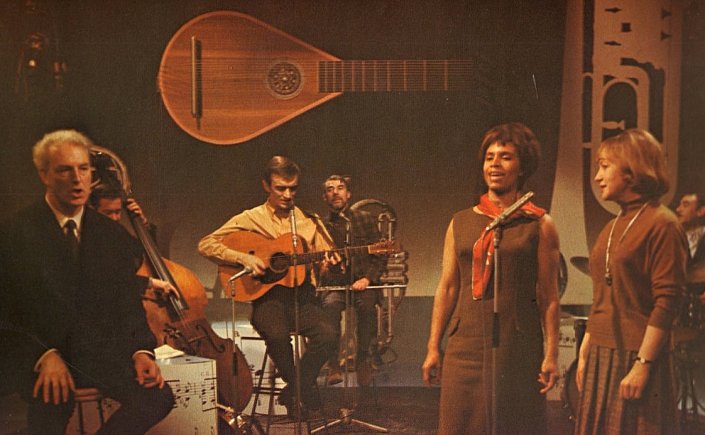
It was Victor Mishalow who first introduced me to Dermott in 1983. He was dropping into 2MBS for an interview on Ryder Round Folk, and he brought me and Yuri the Russian Storyteller along too. We had just launched our short and almost illustrious career as HuldreFolk. Dermott, as guru, mentor, and propagandist for the Sydney folk scene, gave us our first radio appearance. There is a famous photograph to commemorate it (Dermott’s archive of folkdoms’ seventies and eighties should be a national treasure. All the wannabes and could’ve beens, the famous and almost famous are celebrated therein).

HuldreFolk - Early Days. Ryder Round Folk 1983

The live concerts at 2MBS’s Chandos Street studios were a must-listen on the monthly calendar, with the good and the great of Sydney’s folksingers and musicians doing their thing. Guests included Victor, Yuri, Jim Taylor, Robin Connaughton, Penny Davies, Roger Illot, John Broomhall, Gordon McIntyre and Kate Delaney, Phil Lobl, Mary Jane Field, and the Fagans.

This was when Adele and I got to know Dermott and Margaret Ryder for the first time. We then learnt of his history: his part in the famous folk revival of the late sixties and early seventies, the first Port Jackson Folk Festival, the foundation if the NSW Folk Federation, and the famous Liz Folk Club in the Sydney CBD. He was among that first golden generation of folkies, including Colin Dryden, Gary Shearston, Declan Affley, Warren Fahey, John Dengate, Danny Spooner, Mike McClellan, Bernard Bolan, and Judy Small. Many other performers moved in Dermott’s musical orbit, including Andy George, Rhonda Mawer and the Shackistas of Narrabeen, Jim Jarvis, Al Ward, John Summers, and many, many more.

Dermott and I bonded further with our shared origins in the old country. He of Lancashire Irish heritage (Widnes, actually), and me, an Irish Brummie. We had a shared love of traditional Irish and English folk music. We probably even crossed bars in one of the many English folk clubs, in the ‘sixties. Most notably, the celebrated Jug O’Punch in the Birmingham suburb of Digbeth, run by the famous Ian Campbell Folk Group.*

        The Parting Glass

        Trad. as sung by Liam Clancy and Tommy Makem

Oh all the money that e’er I had
I spent it in good company
And all the harm that e’er I’ve done
alas, it was to none but me
For all I’ve done for want of wit
to memory now I can’t recall
So fill to me the parting glass
good night and joy be with you all

Oh all the comrades that e’er I’ve had
they are sorry for my going away
And all the sweethearts that e’er I’ve had
they would wish me one more day to stay
But since it falls unto my lot that
that I should rise and you should not
I’ll gently rise and I’ll softly call
good night and joy be with you all

Farewell, old friend.

Dermott and Margaret Ryder

  Leaving Can Be Easy

  By Dermott Ryder

  Leaving can be easy, when the right time comes.                                                                               Many will have gone before, in a long, long line.                                                                                 When it’s your turn, you look back, and smile,                                                                                     then look forward to your own new, far horizon.

 There are people to tell, and books to return,                                                                                 Broken bridges to mend now, better this way,                                                                                   leave no hurt feelings behind at the end of the day.                                                                           We are all travellers, and we will meet again.

 Don’t think of sleep. Keep that for much later.                                                                                    Give and take addresses and phone numbers.                                                                                  Make promises you probably won’t remember.                                                                                 Be pleasantly surprised and strangely grateful.

Welcome the crowd come to see you on your way,                                                                             and to share this rite of passage, to keep the faith                                                                             in this next step in the long tradition of the traveller.                                                                         Shake hands, and know that you cannot return.

* What a club that was. Back in the day, it hosted the cream of British folk music, including the Dubliners, the Furey Brothers, Martin Carthy, Peter Bellamy, and a very young and acoustic Al Stewart. Overseas guests included Tom Rush, an unknown Paul Simon, a young goddess called Joni Mitchell, and on an antipodean note, Trevor Lucas, who went to marry Fairport’s fair maid, Sandy Denny, and later, become a founding member of The Bushwhackers before his untimely demise in 1989.

The Magic of Dylan Thomas

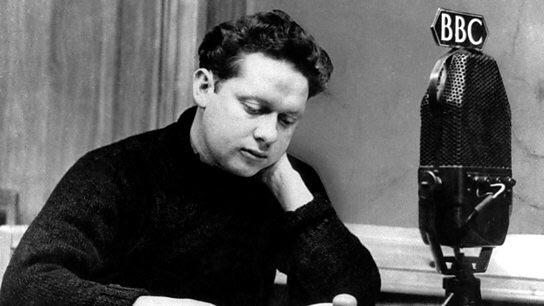
2013 was the sixtieth anniversary of the death peerless Welsh poet Dylan Thomas, one of the many famous artists who departed this planet in New York’s Chelsea Hotel.  The following piece by Peter Craven is a beautiful tribute, illustrating the magic of Dylan Thomas’ poetry. And listen, pray, to the man himself reciting his poems.

Welsh poet Dylan Thomas did not go gentle into that good night
Peter Craven, Weekend Australian, 29 November, 2014

ACCORDING to legend, Bob Dylan took his name from him and he was a kind of rock star: Dylan Thomas, the Welsh poet who gave to the people of Wales — and to that part of the world that reveres what they stand for — a poetry of such reverberating bardic magnificence that he became a popular poet long after the age of popular poetry was over.

Thomas, who died, reportedly of alcohol poisoning, in New York at 39 in 1953, has his centenary this year and for the Welsh there has been no ­tomorrow.

Michael Sheen (the Welsh actor who played Tony Blair and David Frost) has been doing Under Milk Wood, Thomas’s great dreamscape of a radio play, in New York with Kate Burton — daughter of Richard Burton, who first did it on the BBC and even made a film of it with Elizabeth Taylor as Rosie Probert and Peter O’Toole as Captain Cat.

And in Wales they’ve been reading every jot of verse that Thomas ever penned. Distinguished Welsh actors such as Jonathan Pryce have been part of the mass recital and even that northerner, Ian McKellen, old Gandalf himself, has been dragooned into the celebration as if that rhapsodic sense of wizardry could encompass an entire world.

And he was a wizard, Thomas. I remember a lifetime ago lying in the dark of my parents’ bungalow as a young teenager listening to the black graven voice of Burton as he recited:

In my craft or sullen art
Exercised in the still night
When only the moon rages
And the lovers lie abed
With all their griefs in their arms …

It was a poetry made out of mouthfuls of air, as poetry must be, and it was also full of a rich kaleidoscope of imagery, and that seemed to make perfect sense because the emotional thrust was clear from the power of the rhetoric that sustained it.

This was a poetry that was deeply traditional in its sound patterns. It had a romantic grandiloquence and an alliterative richness, a reckless audacity of effects that was a bit like that priestly poet who had anticipated modernism, Gerard Manley Hopkins.

And, of course, it’s that lassoing effect of poetry as a language of the gods that can encompass a universe of feeling and imagining. It can intoxicate itself with language but see the world with a radiant clarity as a consequence of the intoxication. That makes people surrender to Thomas, the way when they are young they surrender to the first stirring of ­desire, that strange sense of body and soul coming together at the prospect of love.

If that sounds a bit much for mere poetry to achieve, listen to the lilting lyricism of Fern Hill:

Now as I was young and easy under the apple boughs
About the lilting house and happy as the grass was green,
The night above the dingle starry,
Time let me hail and climb
Golden in the heydays of his eyes …

It’s poetry of almost total sensuous suggestion and it is saturated with the feeling of sap and possibility. In one way, it’s a poetry that seems to embody the idea of youth even though it is constantly talking about shadows and spectres of mortality. Indeed, Fern Hill ends with a great splash of verbal colour, and an intimation of how the erotic glory of the world, the sense of it as a many-shaped thing of wonder, is inseparable from the pang of transience.

Thomas led an irregular life and before he died in New York’s Chelsea Hotel he told someone he had had 18 consecutive whiskies in a bar. It couldn’t have been quite true but it had a poetic truth because Thomas and his wife Caitlin hit the bottle like a destiny.

Part of Thomas’s fame came from the fact he had a tremendous histrionic gift as a reader of poetry. He read in a very posh-sounding voice with a kind of conscious grandeur that gives a less sinewy sense of his music than Burton does, but has a majestical quality that many people find mesmerising. His reading style tilts towards the preacherly with its Welsh undertone as part of the incantatory quality. But, then, some of his greatest poetry projects a religious vision, which is why Thomas’s poems have become hymns for a modern world that may not know what it believes but has a deep sense of the resonance and the ­afterglow of belief.

Do not go gentle into that good night,
Old age should burn and rave at close of day;
Rage, rage against the dying of the light.

The language is magical in the way it creates, with a fierce flaming elegiac power, the refusal to accept the fact of death. And the fact the perspective is not Christian — we know the darkness does overcome — makes the poem a tremendous affirmation of the heroism of life in the face of death. It’s a poem with a reckless bravery and that urging to “rage” — that impossible, nearly preposterous imperative — sits in such tension with “the dying of the light” that the effect is very poignant.

Some people sneer at Thomas, sometimes in reaction to their own earlier infatuation with him. His poetry enthrals the mind (and heart) long before you know ­exactly what is being said or meant. Is that a disqualification for greatness? Isn’t it a version of what TS Eliot meant when he said that poetry communicates before it’s understood?

If you want the organ notes of elegy, the sombre power that comes from the breath of death on the backs of our necks, and at the same time the sense of the resurrection as always now, try this:

You can, if you like, say the trick is all in the one great line, the line Thomas uses as his refrain, and that he creates a decorative web around it.

And death shall have no dominion.
Dead men naked they shall be one
With the man in the wind and the west moon;
When their bones are picked clean and the clean bones gone,
They shall have stars at elbow and foot;
Though they go mad they shall be sane,
Though they sink through the sea they shall rise again;
Though lovers be lost
love shall not;
And death shall have no dominion.

But that’s not quite the effect of the poem when it is read aloud. If you listen to Burton recite it, for instance, you get a sense of rushing soliloquy, of confusion and conflict and spectacular profusion, resolving itself in the refrain, which becomes like a religious affirmation, a faith in what seems impossible, a refusal to be conquered by something that cannot fail to conquer.

This is compatible with a believer’s position or an atheist’s, because when it comes to poetry we all suspend disbelief. And Thomas’s poetry is such a headlong act of faith in the act of creating poetry that it presents this spectacle — it, in fact, dramatises it — with a sort of breathtaking self-confidence that goes a long way to explain why his poems seem so genuinely bardic, why the Welsh have taken to them like anthems. And also perhaps, commandeering the tragic fact of his early death, why it makes a kind of sense that Thomas died so young.

If your schtick is to give your audience another piece of your heart over and over, you will burn yourself out or you’ll have to change your art.

God knows what Thomas would have done if he had lived. “It was my 30th year to heaven,” he wrote in Poem in October, which with its wonderful sense of the self roaming like a god is one of the greatest lyrical poems of the 20th century.

My birthday began with the water
Birds and the birds of the winged trees flying my name
Above the farms and the white horses And I rose
In a rainy autumn
And walked abroad in shower of all my days.

It was his 30th year to heaven and he already wrote like an angel and he was already talking as if he were in the presence of his own tombstone.

It’s the hugeness of the gift that makes people back away from Thomas and makes them deny his achievement, partly because the mesmerism of his ­manner can create fear of the highest claims.

It makes sense, of course, that there was reaction against the rhetoric of poetry associated with the “New Apocalyptics”, as Thomas’s admirers called themselves and that was partly a reaction against the battering ram of rhetoric the world had suffered with Hitler and Churchill and World War II.

People were sceptical of majesty in poetry. They remembered that the “terrible beauty” of Yeats had been a landing field for a fascist politics. But how unfair to mix Thomas up with this.

Under Milk Wood is the most successful piece of poetic drama of a postwar period haunted by the idea. It has extraordinary brio, and the way Thomas manages to create this surrealist brew of poetic hocus-pocus with choruses of schoolkids and scolding old women and blind, mad Captain Cat and dead lovers, all within a circumambient poetic idiom that is at once rich and grounded in earth, is pretty stunning when you remember that it is also a credible evocation of a village in Wales.

It’s no wonder the Welsh have taken Thomas as their red dragon and their prize dreamer. He was an incomparable poet. He did not go gentle into that good night; he lived hard.

But when it comes to the kingdom of poetry, death shall have no dominion.