Gaza Sunrise or False Dawn?(2) … spectacle or strategy?

Trump’s Gaza Peace Plan: Spectacle, Strategy, and the Limits of Diplomacy

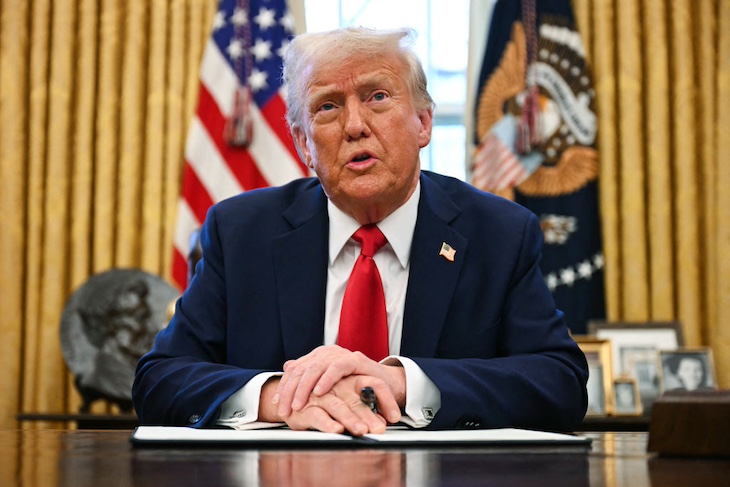
In late September 2025, US President Donald Trump unveiled a sweeping 20‑point peace plan for Gaza, accompanied by the familiar trappings of performance: the East Room of the White House, cameras flashing, a florid declaration of “eternal peace in the Middle East,” and a newly anointed “Board of Peace” with Trump as chair and Tony Blair as his deputy. On paper, the plan promises ceasefire, reconstruction, hostage releases, demilitarization, a staged Israeli withdrawal, and a technocratic administration in Gaza overseen by an international board. In practice, it reads as equal parts showmanship, improvisation, and coercive diplomacy, an audacious gambit with enormous potential benefits and equally enormous pitfalls.

For the Trump administration, the plan is a chance to rewrite the narrative: to isolate Hamas, reassert US influence in the Gulf, forestall further annexation of the West Bank, and offer Netanyahu a politically palatable off‑ramp from the brutal two‑year campaign in Gaza. For the international community — including the Arab Gulf states, Qatar, Jordan, Turkey, and Indonesia — it presents an opportunity to participate in a stabilizing initiative and to demonstrate relevance after years of watching humanitarian crises unfold from the sidelines. Yet beneath the pageantry lie structural asymmetries, enormous trust deficits, and profound omissions, particularly the conspicuous absence of the Palestinians themselves from meaningful negotiation.

In That Howling Infinite reserves its opinion in these early days. It’s the only show in town right now and it is generating interest and potential commitment by all those parties who would have to make it happen. There are already dissenting voices on all sides – the pro-Palestinian “progressive” left have been predictably dismissive  of what is indeed an imposed solution to an intractable problem – although it would appear that there are many cooks in the kitchen other than Donald Trump and Binyamin Netanyahu. Some have even condemned it for its demand that Hamas, the instigator of the war, to surrender unconditionally. But at the end of the day, they have little to offer except more war and vitriol. You don’t use gasoline to put out a fire. The reality is that the parties that can make this happen, including providing the proposed security forces and the resources to rebuild the devastated enclave and rehouse and rehabilitate its homeless and harrowed people, appear at this stage to have signed on. Early days, but, to  borrow from J Lennon, “all we are saying is give peace a chance”.

Read part 1 here: Gaza sunrise or false dawn? Trump’s 20 point peace plan

Also, in In That Howling Infinite, see A Short History of the Rise and Fall of the West and A Middle East Miscellany

[The following analysis is the outcome of a conversation and collaboration between In That Howling Infinite and ChatGPT.

Screenshot

Mechanics of the Plan

The plan’s framework is deceptively simple:

  1. Immediate Ceasefire and Hostage Exchange: Hamas must release all remaining Israeli hostages, alive or dead, within 72 hours. In return, Israel promises a staged withdrawal to a security perimeter.
  2. Prisoner Release and Amnesty: Israel would release approximately 2,000 Palestinian prisoners, including those detained after the October 2023 attacks. Hamas fighters willing to renounce violence could gain amnesty; those choosing exile would receive safe passage.
  3. Board of Peace and Reconstruction: A transitional authority, the so-called Board of Peace, would oversee governance and reconstruction, with Trump as chair and Blair as deputy. Aid delivery, infrastructure rebuilding, and the restoration of hospitals, water, electricity, and sewage would be managed under this international technocratic oversight.
  4. International Stabilization Force (ISF): Western and Arab troops would replace Israeli forces in Gaza, ensuring security during reconstruction and the reestablishment of governance. The exact composition and mandate remain undefined, a critical gap given the operational risks.
  5. Pathway to Palestinian Statehood: A vague promise of “conditions for self-determination” exists, contingent on PA reform, reconciliation between Gaza and the West Bank, and adherence to technocratic administration under international oversight.

On paper, it is a plan that offers incentives to every major party: Hamas faces conditional amnesty; Israel gains hostages, de-escalation, and security assurances; the Gulf states gain influence; and the PA is positioned to regain a governance role in Gaza. It is, in principle, a diplomatic masterstroke — if it can be implemented.

Gaps, Omissions, and Absurdities

Yet the devil — and much of the comedy — lies in the details not addressed:

Hamas Exclusion: The central conflict party, Hamas, was neither consulted nor invited. Trump openly admitted, “I have not dealt with them,” and proposed outsourcing the group’s compliance to Arab and Muslim mediators. The result is a coercive ultimatum dressed as a peace initiative: accept the terms or face complete annihilation with US backing.

Palestinian Agency Ignored: The two million Gazans whose lives are at stake had no seat at the table. Aid, reconstruction, and governance are treated as top-down deliverables, with no credible mechanism for local input. Gaza becomes a theatre set, not a living society.

Unclear Implementation: The ISF, Board of Peace, and PA reform mechanisms are vaguely defined. Who will command the stabilization troops? How will the PA be reformed to earn legitimacy in Gaza? What safeguards prevent reconstruction materials from being diverted to military purposes? These questions are unanswered, leaving enormous operational and political gaps.

West Bank Neglected: Despite daily settler-Palestinian clashes, the plan offers almost no operational framework for the West Bank. New settlements, such as the E1 project, threaten to fracture any contiguous Palestinian state. The plan’s silence on this is a glaring omission.

Asymmetry and Risk: The plan favors Israel far more than Hamas. The militant group is asked to surrender hostages and arms simultaneously, a leap of faith in a context of zero trust. The amnesty offer is conditional and uncertain; refusal triggers an existential threat. Israel, by contrast, faces comparatively modest obligations, particularly given the indefinite “security perimeter” it maintains.

Domestic Israeli Politics: Netanyahu’s right-wing cabinet, notably Bezalel Smotrich and Itamar Ben-Gvir, remain uncompromisingly hawkish. Trump’s backing gives Netanyahu room to sell the plan domestically, but hardliners could sabotage implementation, and prior experience demonstrates Netanyahu’s readiness to resume military operations when politically expedient.

Performance Over Policy: The East Room spectacle was classic Trump: a reality-TV cadence applied to diplomacy. Grandiose claims of “eternal peace,” self-anointment, photo ops with global leaders, and theatrical references to “the ocean” Israel ceded in 2005 illustrate a plan heavy on optics and light on enforceable substance.

International Reception

The plan has drawn broad, if cautious, support:

  • Arab and Muslim States: Qatar, Jordan, UAE, Saudi Arabia, Indonesia, and Turkey issued a joint endorsement emphasizing aid delivery, hostages, non-displacement, and the integration of Gaza with the West Bank under a Palestinian state framework.
  • Europe: Macron and Starmer endorsed the effort to secure hostages and reduce conflict.
  • Australia: Prime Minister Anthony Albanese welcomed the initiative as a constructive step, while opposition figures criticized Canberra’s earlier symbolic recognition of Palestinian statehood as performative and irrelevant.

Yet these endorsements are conditional and aspirational, recognizing the plan’s promise without committing to enforcement.

Perspectives of Israelis, Palestinians, and Activists

Israeli Public: Polls indicate two-thirds of Israelis want the war to end. The hostage release and cessation of bombardment offer tangible relief. Hardline right-wing factions, however, may resist compromises that limit continued Israeli military prerogatives. Indeed, the far-right, whose ethnic cleansing designs are explicit and who have driven so much of Netanyahu’s prosecution of this war appear to hate Trump’s plan: “a tragedy of leadership” and “an act of wilful blindness” in the phrase of Finance Minister Bezalel Smotrich.

Palestinians: Exhausted by years of blockade and bombardment, Gazans desire immediate relief. But the lack of agency and the conditional, externally imposed nature of governance and reconstruction make the plan potentially resented as foreign administration rather than liberation.

Progressives and Activists: Pro-Palestinian advocates will likely view the plan skeptically. While it promises aid and reconstruction, it circumvents local agency, substitutes technocratic administration for democratic governance, and leaves Palestinian sovereignty largely aspirational. International human rights groups will monitor for coercion, displacement, and military overreach.

Political Theatre

The plan is an exercise in spectacle: Trump as self-styled savior, Netanyahu as pliant yet menacing partner, Palestinians and Hamas as props off-stage. The terminology — “Board of Peace,” “International Stabilisation Force,” “demilitarization” — evokes bureaucracy rather than genuine power-sharing. It is as much a political theatre as a policy framework, designed to satisfy domestic and international optics. In that sense, it is both brilliant and cynical: brilliant in its choreography of alliances and threats; cynical in its disregard for the lived realities of Gaza’s population.

Promise and Peril

Trump’s plan is audacious. It isolates Hamas, engages Gulf wealth, nudges Netanyahu toward tactical concessions, and offers a narrow window for reconstruction and peace. Yet structural asymmetries, zero trust, vague operational mechanisms, potential sabotage from hardliners, and the absence of Palestinian agency render it precarious.

If Hamas accepts, the plan could relieve immediate humanitarian crises, return hostages, and establish a technocratic administration capable of rebuilding Gaza — a diplomatic triumph in a region long starved of them. If it fails, it will cement perceptions of American theatre in place of effective policy, leaving Gaza’s suffering unresolved and occupation repackaged as transition.

And if Hamas actually accepts, and the plan moves ahead, what would happen if, having received the hostages, Israel simply decided to remain in Gaza, or refused to return Palestinian prisoners. Given how Netanyahu’s political survival depends on his far-right coalition partners, and given how clearly those partners want the war to continue and Israel to remain in Gaza, this is not remotely a fanciful scenario. And if it transpired, who aside from Trump could do anything about it? Netanyahu highlighted this feature of the plan for a reason: almost certainly as a signal to those far-right allies that they needn’t fear.

The plan is shot through with such difficulties. Netanyahu notes that Israel’s withdrawal from Gaza will be gradual and “linked to the extent of disarmament and demilitarisation” of Hamas. What happens if Israel decides progress on this is too slow and resumes bombing?

The deal envisages a technocratic Palestinian committee to provide day-to-day services, until the Palestinian Authority is adequately reformed. Who would be the arbiter of whether this has been satisfied? And more specifically, what would happen if Israel simply declared it hasn’t? Given this is the precursor to the possibility of the Palestinian state Netanyahu has always opposed, it’s again a perfectly likely scenario. Will some independent body resolve this?

All of this is a reflection of the fact that this is not a deal in any sense. No Arab nation was present at that press conference. The plan was developed with no discernible Palestinian involvement at all. Trump has declared there’s “not much” room for Hamas to negotiate terms, and that it had days to accept or “pay in hell”.
The Arab and Muslim nations that welcomed this, and whose involvement will be crucial in it working, have set out conditions Netanyahu explicitly rejects and which the Trump plan doesn’t allow for, including that Israel withdraw fully from Gaza and commit to a pathway for a Palestinian state. Moreover, they want the Palestinian Authority to invite them to provide troops to stabilise Gaza so they aren’t seen as yet another occupying force. Trump’s plan provides for none of that.

The lesson is stark: diplomacy without inclusion, even when performed at the highest theatrical scale, is fragile. For now, the Board of Peace is more a symbol of hope than a guarantor of change — a test of whether spectacle can ever substitute for governance, and whether exhausted populations, international actors, and political opportunists will allow vision to overcome reality.

It is all down to will. The will of Hamas to accept its dismantling, when this has always been non-negotiable for it. The will of Netanyahu to end a war he has shown every interest in prolonging. The will of Trump to force Israel to abide faithfully by the plan, even where it’s politically inconvenient. The worry isn’t just that this seems unlikely on all fronts. That’s inevitable in such an intractable tragedy. 

In short, the plan may well work; or it may simply provide another act in a two-decade-long tragedy, with Trump and Netanyahu as performers and Gaza as the stage.

“Let’s turn Gaza into Mar-a-Lago!” Changing the game …

Ah, you loved me as a loser, but now you’re worried that I just might win
You know the way to stop me, but you don’t have the discipline
How many nights I prayed for this, to let my work begin
First we take Manhattan, then we take Berlin

L Cohen

The second coming is certainly interesting. President Donald Trump doing everything he said he’d do – in spades.

His proposal for the reconstruction of the destroyed enclave of Gaza is, as Israeli president Benjamin Netanyahu says, out of the box. It looks like a case of “you guys have had years to sort this out for yourselves! Now let a very stable genius and the greatest nation in the universe to have a go”.

But is it an imperial tantrum or an actual initiative? As Israeli commentator Alon Pinkas states in the article republished below, it is incomprehensible, impractical, illogical, unviable – and illegal. He writes:

“So what does Trump want? Distraction. He thrives in the chaos and constant distractions he creates … Trump is a preeminent agent of chaos. That’s a trademark he has always paraded, boastfully and defiantly. As he said he would, he is actively generating and promoting chaos in America, discord within alliances, and is out to undermine the world order. Agents of chaos sow chaos. It’s that simple. They instill discordance, confusion, controversy and uncertainty. That’s a modus operandi, not a tailored policy or crisis management technique. Agents of chaos and anarchy are by definition out to disrupt the status quo by floating outrageous ideas, based on a simple principle: Everyone viscerally understands the status quo has exhausted its usefulness, more-of-the-same doesn’t work anymore”.

Juxtaposed to this article, we also republish an opinion piece by British broadcaster and journalist Jonathan Sacerdoti. He reckons that Trump’s proposal is at once breathtaking and groundbreaking. I’d like to have some of what he is smoking! But then again, maybe not …

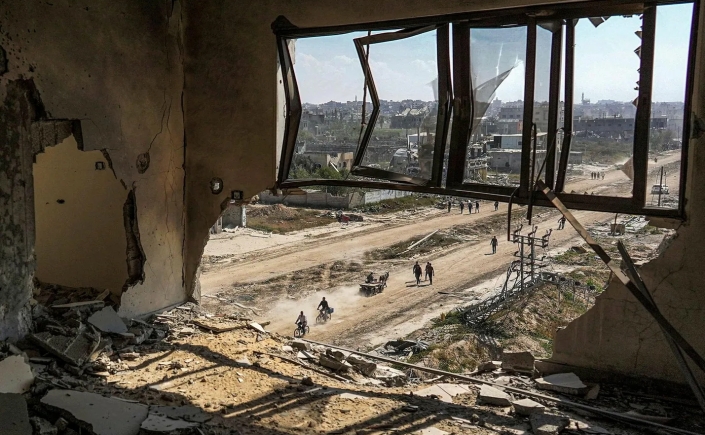
Trump said in the Oval Office that he wants Palestinians to leave Gaza, and that ideally they would not return to the war-torn region. But the ambitious plan is not about to be implemented. Gazans, who survived 15 months of punishing attacks by Israel, largely don’t want to live in exile, and Trump isn’t going to send US troops to push almost 2 million people out of the Strip. Nor will Egypt and Jordan go along with it, despite Trump’s confidence that their reliance on US aid and military support gives him enough leverage to push them to take in massive numbers of Gazan refugees. For both countries, Trump’s proposal crosses red lines.

It is all probably a ploy to “change the game”, and perhaps, to strong arm the wealthy Gulf Arabs into financing Gaza’s reconstruction – though not a dollar will be offered by anyone until Hamas is out of the picture. As for Jordan and Egypt taking the ejected population, they both depend on US economic and military aid, so there’d be heavy Trumpian pressure on them too, though neither are keen to offer the Gazans a home: from past experience, they have no desire to import potential security threats from thousands of exiled jihadis and their families and hundreds of thousands of traumatized and angry refugees.

So, while in all likelihood, the plan will not happen, it will shake up the region nonetheless.

Meanwhile, the world justifiably hyperventilates in reaction to Donald Trump’s statement that the United States will “own” a Gaza Strip that has been ethnically cleansed of Palestinians”. Indeed. The left is hysterically outraged and the right hysterically jubilant. There is ignorance on all sides of the land and its people, their history and culture, needs and aspirations, their resilience and determination to have and to hold.

How people, especially in Gaza, can be so glibly reduced to chattels with no history, no identity, no connection to their land. At least no connection as deep as Trump’s connection to real estate. The two property tycoons are advancing the American Dream for Palestinians – nice big houses, well-paying jobs, upward financial mobility – not the Palestinian dream, which is to return home. They are also selling the renovator’s dream for Gaza: a knock-down-rebuild.

For all his talk about his and others’ “humanitarian hearts”, he probably gives little thought to them as human beings – he asks the world to reframe the rubble of Gaza as a real estate opportunity. He has neither empathy for a people nor an understanding of history and probably sees no personal need nor desire for either. He does not get the power and importance of blood and soil, of religious faith, and a people’s attachment to their homeland, be they Arabs or Israelis. Nor does he understand nor care that to many Arabs and Israelis, this, the modern world’s most intractable conflict, is both existential and sacred. For them, it is much, much more than a real estate deal, but part of their lives and their identity. It does not have a monetary value. See the Qatari carton below, hi ‘ashya’ la tushtaraa.

But never mind that. As republican congresswoman and MAGA acolyte Nancy Mace said in support of Trump’s proposal, “let’s turn Gaza into Mar-a-Largo!”

See also in In That Howling Infinite, Trumps second coming … a new American Revolution? and A Middle East Miscellany.

هي أشياء لا تشترى hi ‘ashya’ la tushtaraa Some things are not for sale. Qatari cartoon

Impractical, Incomprehensible, Illegal: Trump Traps Netanyahu and Sows Chaos With U.S. Takeover Plan for Gaza

Trump’s plan for the Gaza Strip that includes the relocation of 2 million Palestinians is not logical or viable. Whether it’s an imperialist tantrum or an actual ‘out of the box’ initiative, there is really no way to endorse, refute or examine it

Alon Pinkas Feb 5, 2025
Ah, you loved me as a loser, but now you’re worried that I just might win
You know the way to stop me, but you don’t have the discipline
How many nights I prayed for this, to let my work begin
First we take Manhattan, then we take Berlin

Leonard  Cohen

You have to admire the noble attempts to instantly try and make sense of something U.S. President Donald Trump says one day, only to furiously rebuke and deride him the next. Oh wow, the sheer creativity and sublime “out of the box” innovation of proposing to relocate over 2 million Gazans and then “take over Gaza.” Genius.

Makes sense, right? Of course it does, because Gaza truly is uninhabitable. Oh no, but it’s not practical or viable. In fact, it’s incomprehensible.

So what does Trump want? Distraction. He thrives in the chaos and constant distractions he creates. Did he not impose 25 percent tariffs on Canada and Mexico, and then grant them a 30-day extension since they promised they would do the things they are already doing?

Trump is a preeminent agent of chaos. That’s a trademark he has always paraded, boastfully and defiantly. As he said he would, he is actively generating and promoting chaos in America, discord within alliances, and is out to undermine the world order.

Agents of chaos sow chaos. It’s that simple. They instill discordance, confusion, controversy and uncertainty. That’s a modus operandi, not a tailored policy or crisis management technique. Agents of chaos and anarchy are by definition out to disrupt the status quo by floating outrageous ideas, based on a simple principle: Everyone viscerally understands the status quo has exhausted its usefulness, more-of-the-same doesn’t work anymore.

As for the Israeli-Palestinian issue, the endless, irrelevant and incoherent mumbling about “the two-state solution” is just an exercise in futility. Trump only said what many are thinking, right?

Yet still, you might have missed three critical points in Tuesday’s reality TV sitcomin the East Room of the White House. First, until the United States “takes over Gaza,” the cease-fire and stage two of the hostage release agreement need to continue – otherwise how will the Americans take over Gaza?

Second, the United States is applying “maximum pressure” on Iran to compel it to engage in a new nuclear deal. So, no U.S. war in Iran for the time being.

Third, what happened to the “Saudi-Israeli normalization” process?

After Trump returned to power, initially it was all about annexing Canada and turning it into the 51st state. Then came the renaming of the Gulf of Mexico to the Gulf of America. Then came the audacious proposal to purchase Greenland from Denmark – and now the United States wants to take over Gaza and turn it into a Riviera.

Who is Mar-a-Gaza for?

That’s not a bad harvest for two weeks by the “America First” president of a superpower that has always prided itself on being “a reluctant empire.” Are these imperialist tantrums, common-sense truisms aimed at provoking and stirring emotions, a coherent plan? Or are they just outlandish and left-field comments with a life expectancy of several days at best? It could very well be all of the above.

The realtor-in-chief came up with an amazingly simple idea: empty the Gaza Strip so that reconstruction can begin. This real-estate development process evolved throughout Tuesday. First Trump called it a “demolition site,” repeating things he said a few days earlier about how the devastated-to-rubble Strip was uninhabitable. Then his aides said Gaza effectively required 15 years and billions of dollars for reconstruction, so the Palestinians would have no alternative but to move out. That makes sense when you come from real estate.

By noon, Gaza was a “hellhole,” which means that 2 million Palestinians must quickly move to Egypt and Jordan – who, according to Trump, will agree to accept them.

By late afternoon in the White House, Trump was proclaiming that America will take over and turn Gaza into “the Riviera of the Middle East.” But if the Palestinians are relocated, who will this Mar-a-Gaza be built for? Ah, that’s easy according to Trump: “Palestinians, mostly,” though it would also be “an international, unbelievable place.” So maybe Greenlanders fed up with the cold, or Canadians who want an NHL expansion team in Rafah.

Even if you’re not instinctively dismissive of or resistant to Trump’s idea, the total lack of details and specificity make it impossible to endorse or repudiate.

There is no reference to legal matters: By what power and authority can the United States take over Gaza? Logistics: How do you relocate 2 million people, most of whom may not want to leave? Political: Who will manage this process? Financial: Who will fund this monumental undertaking? Regional: Most Arab countries have already vehemently rejected the idea.

Beyond the intuitive inclination to deride the concept, there is really no way to endorse, refute or examine its feasibility. So here’s the bottom line: Do not try to find logic, coherence or patterns. Just wait a few weeks. It may all change.

What Netanyahu did not get 

Throughout his career, Benjamin Netanyahu always followed the sage advice of Yogi Berra: “When you come to a fork in the road, take it.” Years of solipsism, manipulation, deceit, duplicity, confabulation, interpolation and retraction, all woven into a modus operandi that provided him with success.

The indecision-maker would always come up with a speech, delivered with a tormented face and melodramatic baritone, describing the excruciating dilemmas he faced before making no decision. But not making a decision is a decision in and of itself, and he was good at it. Now Trump, for better or worse, is making decisions for him.

Netanyahu’s jig is up. He was nothing more than a prop in the Trump White House show. Trump upended the playing field on Gaza, Iran and everything else. It may not be sustainable, but as of today Netanyahu has to play by Trump’s rules.

Before going to Washington and after his meeting with Trump, he was presented with a fork in the road, a binary choice: desert the hostages, resume a goalless war and save his government in the immediate time frame. Or adhere to the cease-fire agreement he signed, move on to stage two and risk losing his ruling coalition.

Sometimes, making contradictory promises and giving inconsistent assurances is impossible to square. Now Netanyahu will try to market a mirage, according to which he was in on Trump’s plans. Maybe he was.

How does that change the future of Israeli-Palestinian relations? It doesn’t. Can he now annex the West Bank? He cannot. Does it add stability and predictability to relations with the United States? It doesn’t.
So what did Netanyahu get out of his Washington trip? A few days reprieve for his coalition, during which he can persuade them that Trump proved he’ll allow Israel to resume the war. And did Trump do that? No

The audacity of Trump’s Gaza plan

The Spectator, February 2025

Some moments in history demand recognition, not just for their weight in the present but for the seismic shifts they herald. The Trump-Netanyahu press conference was one such moment – not a perfunctory diplomatic exercise, nor a routine reaffirmation of alliance, but an unambiguous declaration of intent. It was a disruption of long-entrenched, failed orthodoxies and the unveiling of a vision that dares to reimagine the Middle East in starkly different terms.

For decades, world leaders have clung to exhausted formulas – peace processes built on illusion, agreements predicated on fantasy, and a wilful refusal to acknowledge the fundamental realities of Palestinian rejectionism and terror. That era is now over. Standing together, the President of the United States and the Prime Minister of Israel made it unmistakably clear: they are not here to mollify, to equivocate, or to perpetuate the cycles of appeasement that have long defined western diplomacy towards the Arab-Israeli conflict. They are here to reset the board entirely.

Amid the declarations that emerged from this historic moment, one stood above all: Trump’s unequivocal statement that the goal is not to reform Gaza, not to manage it, but to remove its population entirely. No more illusions of Palestinian self-rule, no more diplomatic contortions to accommodate an irredeemable status quo. Trump’s is not another failed experiment in Palestinian self-rule – but a move to dismantle the population that carried out the most brutal attack on Jews since the Holocaust and to relocate them elsewhere.

The gravity of this pronouncement cannot be overstated. As Israeli commentator Amit Segal astutely observed, had the hard-right politician Itamar Ben-Gvir proposed such a policy as part of coalition negotiations merely two years ago, it would have ignited an international firestorm. Yet here it was, calmly, deliberately articulated as the official position of the most powerful nation on Earth.

Nor was this an offhand remark – no Trumpian improvisation to be explained away later. The president read from prepared notes, delivering the statement with the deliberation and gravity of a policy long in the making. This was not casual hyperbole, nor an idle provocation; it was a calculated, official pronouncement. It was an act of political theatre designed to break the bubble of denial and intransigence.

But that was only the beginning. Alongside this, Donald Trump laid out an unambiguous multi-part framework: no to a Palestinian state. The old paradigm, a fixture of failed diplomatic orthodoxy, is now irrelevant – a fantasy proven ever more unworkable each time it has been forced into action. Yes to an enduring peace with Saudi Arabia – without Palestinian preconditions. The old linkage between Arab-Israeli normalisation and Palestinian statehood is gone, though the Saudis swiftly denied this. Yes to permanently ending Hamas and ensuring Gaza can never again pose a threat. The destruction will be total. There will be no ‘rebuilding’ for Hamas to rule over, only American led efforts. Yes to stopping Iran’s nuclear ambitions – by any means necessary. Iran will be weakened, its regional reach crushed.

This is not a strategy of containment, nor an effort to sustain the perpetual diplomatic holding pattern that has defined western policy for decades. It is a vision of finality – an approach that seeks not to manage conflict but to bring it to a decisive and irreversible conclusion. If Obama was awarded the Nobel Peace Prize less than eight months into his presidency, Trump must surely be worthy just three weeks into his.

Trump’s ability to impose his will upon seemingly intractable situations is no accident. He understands that power is not merely about policy but about the mastery of organised chaos – the capacity to disrupt, to destabilise, and in doing so, to force a new reality into being. He has demonstrated time and again that resistance to his demands – whether from allies or adversaries – eventually bends to his will. Just ask Mexico, Canada, or the growing list of others. The question, therefore, is not whether this plan is feasible. The question is how long it will take before the world accepts that it is already in motion. Trump’s pronouncement is the emperor’s new clothes of Middle Eastern geopolitics: a reality that exists the moment he dares to name it.

Trump is set now to meet with Egypt’s President and Jordan’s King – two leaders whose cooperation will be critical in reshaping Gaza’s fate. These are not symbolic meetings. They show the seriousness of his intent, and are part of a rapidly unfolding strategy. If past is prologue, their initial resistance will give way to accommodation.

Meanwhile, Netanyahu stood beside Trump not as a mere ally but as a statesman fully aligned with the vision before them. He was not a leader reacting to a surprise American policy shift, but the co-architect of a new regional order. Together, these two men have already upended decades of Middle Eastern diplomacy with the Abraham Accords. What they now propose is even more ambitious.

Furthermore, by means of yet another executive order, Trump gave a forceful rejection of longstanding UN biases against Israel, removing financial and diplomatic support from institutions that have systematically worked against Israel’s legitimacy on the world stage. He cut all US funding to UNRWA, citing its infiltration by designated terrorist groups and the involvement of its employees in the 7 October attack. This move effectively ends American financial support for an agency long accused of fostering anti-Israel narratives and aiding Palestinian terrorism. The order also withdraws the United States from the UN Human Rights Council (UNHRC), halting American participation in a body that has consistently shielded human rights abusers while disproportionately targeting Israel. In addition, the US will conduct a review of its membership of UNESCO, withholding its share of funding and assessing the body’s history of anti-Israel bias, including its efforts to erase Jewish historical ties to significant sites like the Temple Mount and the Western Wall.

Trump’s vision will terrify those who have grown comfortable with the status quo. It will unsettle those who prefer diplomatic inertia to hard truths. And it will enrage those who have built careers, reputations, and fortunes upon the perpetuation of the unsolvable. But what he and Netanyahu propose is not reckless; it is reality-based. It acknowledges the unspeakable truth that policymakers have long whispered but never dared articulate: that Gaza, under its current governance and population, is a failed experiment that cannot be salvaged.

Ever the salesman, Trump frames this all as an opportunity for Gazans to build peaceful, prosperous lives – just somewhere else. Many will recoil at the audacity of this proposition. But is it not more audacious to continue pretending that Palestinian self-rule in Gaza can exist without terror, that this small strip of land under continued Palestinian rule can be anything other than a launchpad for perpetual war?

History will remember this moment not merely for what was said, but for what it signified: the point at which two leaders, long derided by their critics, once again proved that their vision is neither naïve nor impractical, but bold, comprehensive and daring.

Jonathan Sacerdoti (born 1980) is a British broadcaster, journalist, and TV producer. Born in London, his father was a Holocaust survivor, and his grandfather had been an Italian Rabbi.

The sickness at the heart of the international order

Last week, in sheeplike conformity with diplomatic niceties, Australia, together with the US, the EU and NATO offered condolences for Iran’s vicious hanging judge President Ebrahim Raisi.

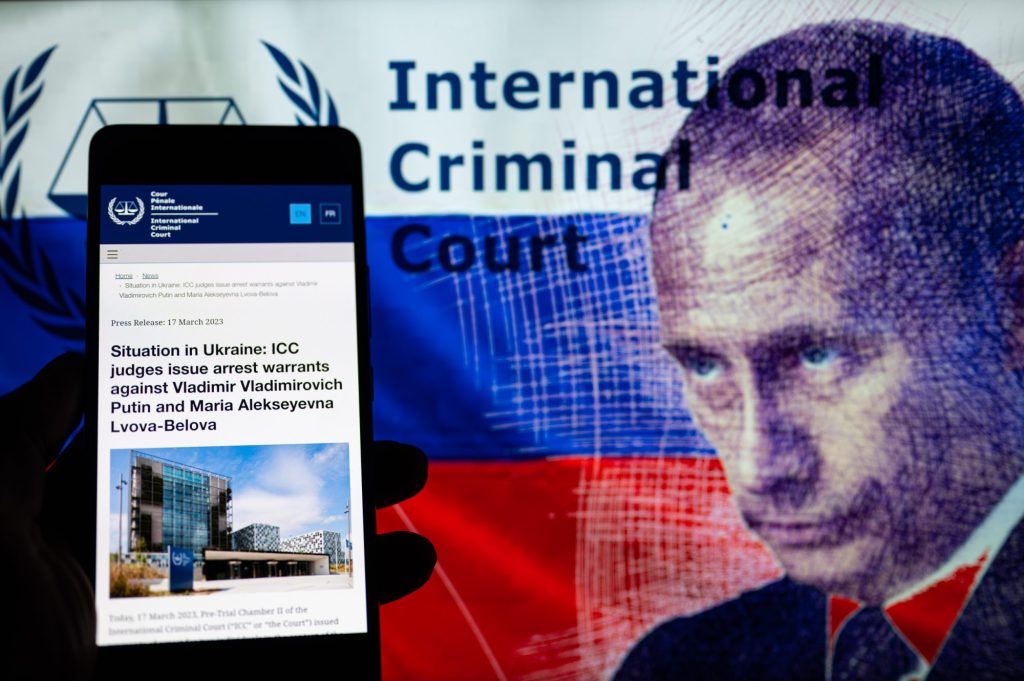
A year ago, the International Criminal Court issued a warrant for the arrest of Russian President Vladimir Putin for crimes against humanity. It would deepen Russia’s international isolation, pundits pronounced. The announcement did not receive the breathless coverage of the recent news that the court was considering similar warrants with respect to Israeli and Hamas leaders with repeat to the atrocities of October 7th and the bloody war that has followed.

A year on, and Vlad’s star still shines as Russia makes gains on the Ukrainian battlefield.

But the ICC is only one part of the malaise that has contaminated international institutions.

I have long believed that the United Nations has long passed its usefulness – if it ever had any purpose at all having been strangled at birth by the veto wielded in the Security Council by the US and Russia.

It has indeed gotten worse. As Greg Sheridan wrote in The Australian on 25th May

“The ethos of institutional liberal internationalism, especially when associated with the UN, has become an inverted parody of what it was once meant to be. The UN culture is a result of a combination of activism from dictatorships, especially China and Russia; plus the in-built voting power of the Arab, North African and Muslim blocs, none of which is sympathetic to democracy, and the ideological leftism of the activist and NGO class in Western societies themselves. Thus.  the UN frequently produces abominations with a kind of PG Wodehouse comic quality – committees on women’s rights headed by Saudi Arabia, human rights bodies chaired by China, non-proliferation committees headed by Pakistan and the like”.

On Ebrahim Raisi in particular, Sheridan wrote:

“Before becoming president Raisi was most famous for his role on the Tehran Death Committee in 1988. Across the Islamic Republic of Iran at that time many thousands of political prisoners were tortured and killed. No jurist was a more enthusiastic deliverer of death than Raisi. Later, when president, he looked back on those days with fondness and claimed the executions as a particular achievement for Iran.

Raisi ran unsuccessfully for president a couple of times. He was neither popular nor in the first rank of Iranian leaders, or of Islamic theologians, though he gave himself the title of Ayatollah. In 2021 Iran’s Supreme Leader, Ayatollah Ali Khameini, decided, with the Islamic Revolutionary Guard Corps, they would make Raisi president. He was a reliable hardliner and someone the IRGC in particular thought they could control”.

For more on Israel and Palestine in In That Howling Infinite, see Middle East Miscellany. See also, Lebensraum Redux – Hamas’ promise of the hereafter, Total war in an urban landscape – Israel’s military quandary, Flight into Egypt, and the promise of the hereafter , and The Calculus of Carnage – the mathematics of Muslim on Muslim mortality

The ICC is a sign of a deep sickness

That UN agencies mourn the Butcher of Tehran as they seek to arrest democratic Israel’s leaders presents the morally inverted, politically corrupted nature of what passes for liberal internationalism today.

Greg Sheridan, The Weekend Australian, 26th May 2024

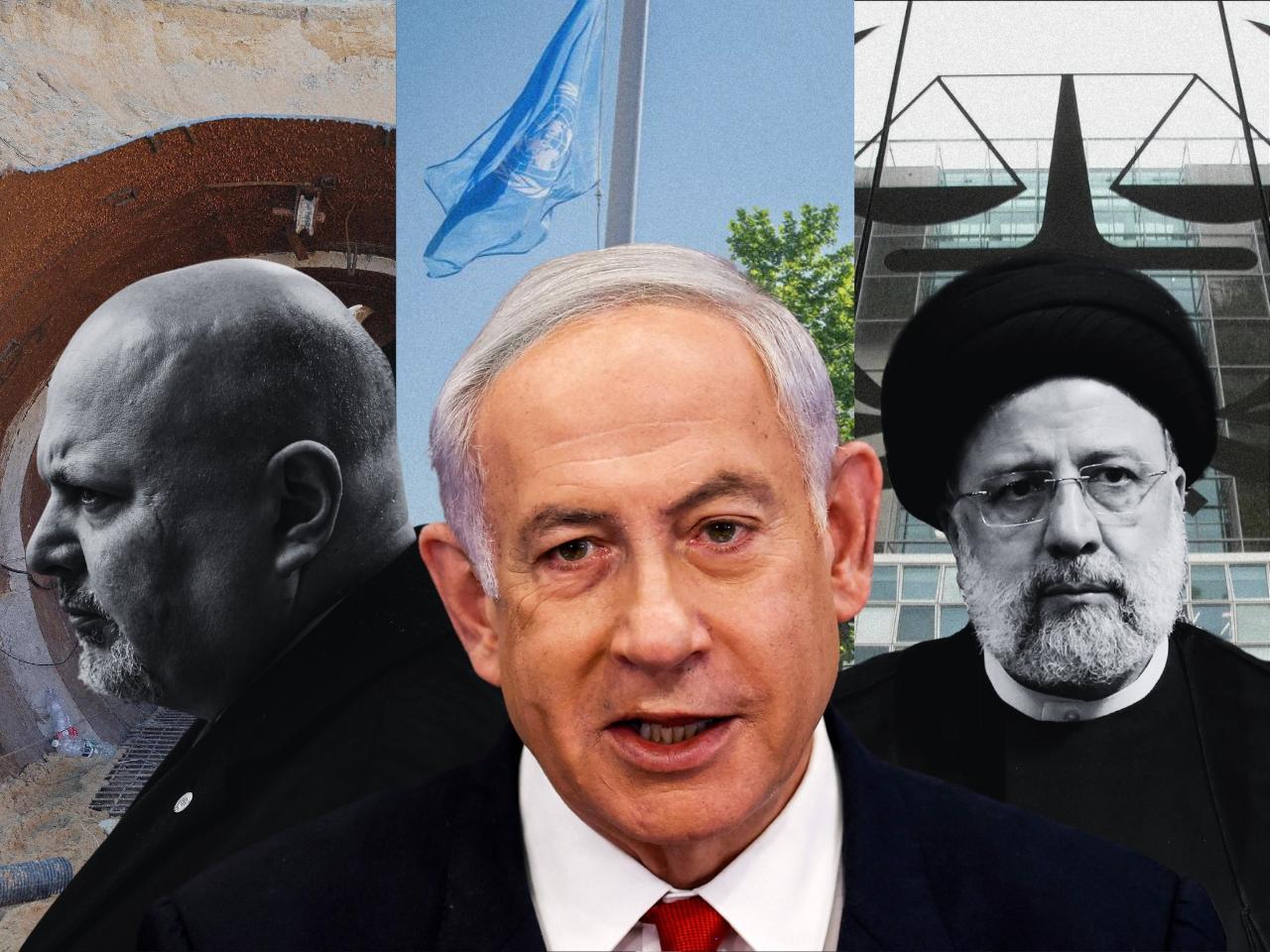
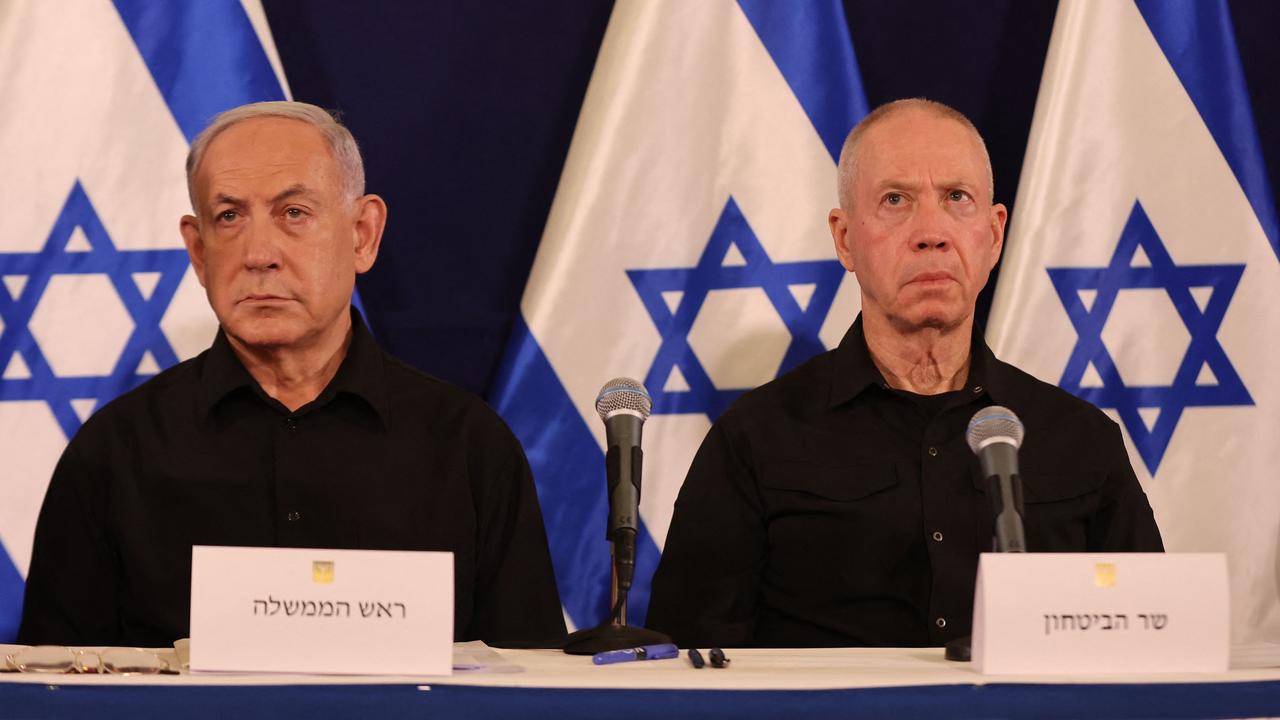
Left to right: ICC chief Karim Khan, Israel PM Benjamin Netanyahu, Iran President, Ebrahim Raisi.

The contrasting treatment, especially at the UN, of Israel’s Prime Minister, Benjamin Netanyahu, and Iran’s president, Ebrahim Raisi, who died in a helicopter crash on May 19, starkly presents the morally inverted, politically corrupted and more than half insane nature of what passes for liberal internationalism today.

The chief prosecutor at the International Criminal Court in The Hague has formally requested arrest warrants for Netanyahu and Israel’s Defence Minister, Yoav Gallant, accusing them of war crimes in Gaza.

Netanyahu is the duly elected Prime Minister of the Middle East’s only democracy. On October 7 his country was attacked, while a ceasefire was in place, by the terrorist group Hamas, which is sponsored by Iran. In the attack the most savage, sadistic and sexually depraved terror was unleashed as 1200 people were exuberantly tortured and butchered, and some 250 taken hostage. Hamas then retreated into its tunnels below the civilians of Gaza.

The ICC has formally requested arrest warrants for Israel’s PM, Benjamin Netanyahu, and Defence Minister, Yoav Gallant, accusing them of war crimes in Gaza.
The ICC has formally requested arrest warrants for Benjamin Netanyahu, and Yoav Gallant

Netanyahu’s government retaliated, with a few clear objectives – to end Hamas rule in Gaza, to destroy Hamas and to ensure October 7 wouldn’t happen again. Hamas vowed it would repeat October 7 over and over. Meanwhile it killed some of the hostages, tortured others, even small children (there’s video) and subjected women and girls to sexual assault, sexual terror.

Raisi, unlike Netanyahu, didn’t have a background in politics, certainly not democratic politics, more the legal system, specifically as a prosecutor. In a totalitarian theocracy such as Iran, prosecutors are always busy. Before becoming president Raisi was most famous for his role on the Tehran Death Committee in 1988. Across the Islamic Republic of Iran at that time many thousands of political prisoners were tortured and killed. No jurist was a more enthusiastic deliverer of death than Raisi. Later, when president, he looked back on those days with fondness and claimed the executions as a particular achievement for Iran.

Raisi ran unsuccessfully for president a couple of times. He was neither popular nor in the first rank of Iranian leaders, or of Islamic theologians, though he gave himself the title of Ayatollah. In 2021 Iran’s Supreme Leader, Ayatollah Ali Khameini, decided, with the Islamic Revolutionary Guard Corps, they would make Raisi president. He was a reliable hardliner and someone the IRGC in particular thought they could control.

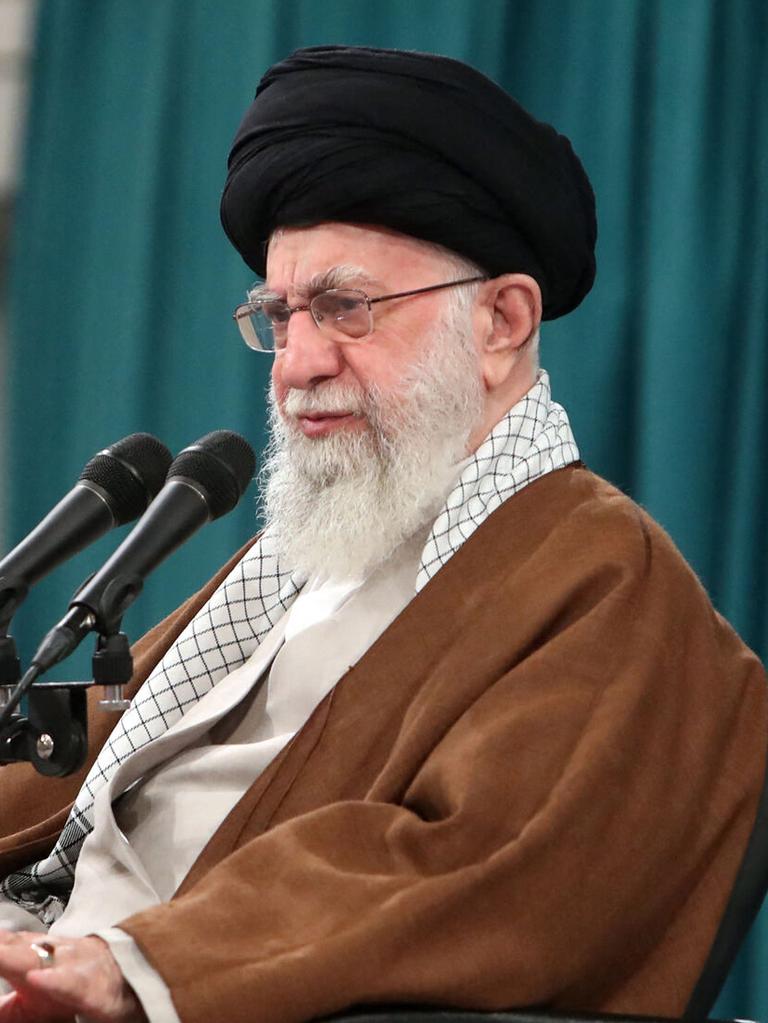
Ayatollah Ali Khameini.

Iranian elections used to have some limited meaning. Elected officials never really had power and Iranian voters several times elected notionally moderate presidents to no avail. The real powers, the IRGC and the office of the Supreme Leader, decided who could run. But much more than

Iranian elections used to have some limited meaning. Elected officials never really had power and Iranian voters several times elected notionally moderate presidents to no avail. The real powers, the IRGC and the office of the Supreme Leader, decided who could run. But much more than the president, they wielded state power.

Consequently, Iranians stopped bothering to vote. When Raisi won, the turnout was claimed to be 49 per cent, though even this is regarded as an exaggeration.

Since Raisi became president in 2021, Iran has been energetic. It redoubled the vice police. Iranian women and girls are routinely arrested, sexually assaulted and beaten to death for offences such as not wearing their hijabs properly. One such case, of a young woman named Mahsa Amini, who died in 2022, set off a round of riots and protests that were savagely repressed, with hundreds dead and more than 20,000 imprisoned.

Internationally, Raisi’s government became famous for murdering Iranian dissidents in Europe and the US. Western governments regard Iran as the chief state sponsor of terrorism. Apart from Hamas, Iran has built Hezbollah, in southern Lebanon, into a powerful non-state military force, with perhaps 150,000 missiles and tens of thousands of soldiers.

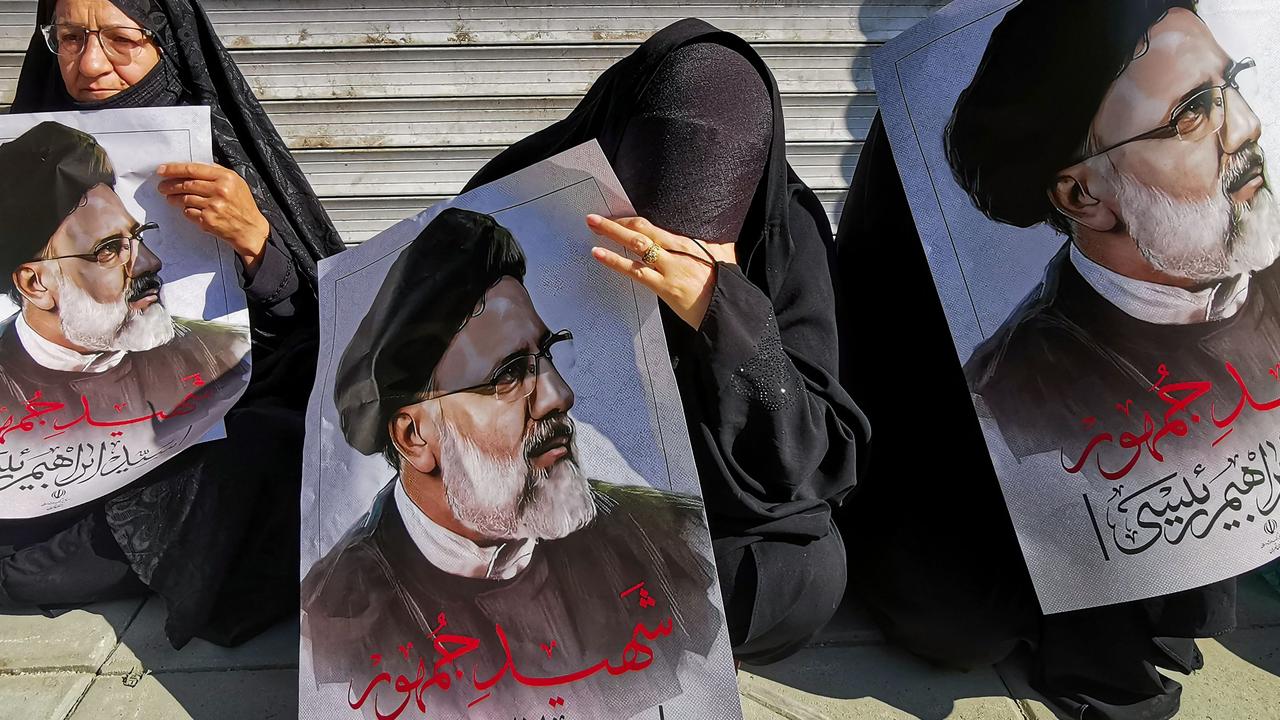
Mourners hold posters of Iranian President Ebrahim Raisi during a funeral ceremony in Tehran, on May 22. Picture: AFP
Mourners hold posters of Ebrahim Raisi during a funeral ceremony in Tehran. AFP

Tehran funds and provides weapons to Shi’ite militias in Iraq and Syria. All these groups deal out death fairly indiscriminately to their opponents and internal critics. Iran also backs the Houthi rebels, whom Australia has just declared a terrorist organisation under our law. They fire missiles at Israel but the Houthis’ great significance has been to massively disrupt shipping in the Red Sea. They exempt Chinese and Russian shipping, which is as sure a sign of Iranian control of their activities.

Many of the deaths Iran caused under Raisi occurred on the soil of nations over which the International Criminal Court claims jurisdiction. Yet the ICC never produced a warrant for Raisi’s arrest. Indeed, the UN lowered its flag to half-mast to honour Raisi after his death. The EU, not quite as otiose as the UN but surely its first cousin in the fatuousness of much that it says and does, used its most senior officials to send heartfelt and sincere condolences over Raisi’s death.

A former immigration minister of Belgium, Theo Francken, chided the EU for praising a “butcher and a mass murderer”. A Swedish member of the European parliament, David Lega, asked the EU leaders: “Can you ever look the brave women and freedom fighters of Iran in the eye again?”

You’ve never heard of Franck­en or Lega and you never will. Voices like theirs are marginal now.

The ethos of institutional liberal internationalism, especially when associated with the UN, has become an inverted parody of what it was once meant to be. The UN culture is a result of a combination of activism from dictatorships, especially China and Russia; plus the in-built voting power of the Arab, North African and Muslim blocs, none of which is sympathetic to democracy, and the ideological leftism of the activist and NGO class in Western societies themselves.

Thus the UN frequently produces abominations with a kind of PG Wodehouse comic quality – committees on women’s rights headed by Saudi Arabia, human rights bodies chaired by China, non-proliferation committees headed by Pakistan and the like.

Feeding into that are two other dynamics. One is that most nations are concerned, understandably but dismally, only to avoid getting themselves criticized in any UN committee. So they go along to get along. And they like to get their little share of UN goodies. So they don’t object to some moral grotesquerie to secure the position of deputy rotating chairperson of the Pots and Pans Committee of the Under Secretary’s eminent Consultative Group.

Far more toxic is the sick obsession in this fetid culture with Israel and Jews. This is a kind of reverse intersectionality. Modern demented left-wing activism absurdly defines Israel as a colonist state. Demented right-wing activism draws on centuries of Western anti-Semitism. Most Arab nations, though many have recently made good accommodations with Israel, would nonetheless rather not have any non-Muslim state in the Middle East, while the tradition of Arab anti-Semitism roars. China, Russia and all their friends will routinely seek to hurt Israel in order to hurt America.

All of this comes together in a witch’s brew of anti-Semitism cloaked in the faux high-minded verbiage of liberal internationalism. Very frequently, specialist UN human rights bodies pass more resolutions criticising Israel than they do concerning the rest of the world combined. Don’t worry about Uighurs or Tibetans or Christians in China; never mind about labour camps in North Korea; leave the Arab world’s treatment of women or indeed of gays to one side – all the human rights evil in the world is insanely attributed to Israel.

By the way, the only nation in the Middle East that has big gay pride days is Israel. I’ve seen the gay pride days in Jerusalem and Tel Aviv. But somehow you never see a protest march with a sign: Queers for Israel.

That the UN and its institutions have become so morally corrupted is partly the fault of the West, as it has lost power, cohesion, self-confidence and the ability to believe in and argue for the values it once regarded as universal.

The UN has been a politically corrupt body for a long time. Our response was not always this feeble. In 1975, only 30 years after the Holocaust, the UN General Assembly passed a resolution equating Zionism with racism. At the time, under Gerald Ford’s presidency, the US seemed all astray, after Watergate and the failures in Vietnam. Its ambassador to the UN was the professorial, slightly dishevelled-looking Daniel Patrick Moynihan, a cloud of stray hairs and half-dropped papers but a whirlwind of moral force. He went on, this most untelegenic of figures, to be a long-term Democrat senator for New York.

He strode, this ungainly figure, to the lectern and thundered forth a modern Gettysburg Address, in its way the finest speech ever delivered at the UN. Moynihan began: “The United States rises to declare before the General Assembly of the United Nations and the world that it does not acknowledge, it will not abide by and it will never acquiesce in this infamous act.” This was not bluster. The US stirred itself to get what was in fact a racist motion reversed, and it succeeded.

Back then Australia voted with the US, unlike now. Joe Biden denounced the ICC action as an outrage. His Secretary of State, Antony Blinken, said he’d work with Republican senators, notably Lindsey Graham, to consider imposing US sanctions on officials of the ICC who enacted such infamy. Biden, in my view a generally weak president, on this has been strong. Perhaps the issue called to an earlier version of Biden, when America itself was stronger.

Of course, Netanyahu deserves great criticism. He has become an increasingly counter-productive Prime Minister for Israel. This is despite past mighty achievements – liberalising and growing the Israeli economy, pioneering new relationships in Asia, welcoming millions of immigrants into the country, creating a good life for Jewish and Arab Israelis alike, and then, during Donald Trump’s presidency, achieving the Abraham Accords in which Israel exchanged diplomatic recognition with the United Arab Emirates, Bahrain, Sudan and Morocco.

But he became too arrogant, too self-obsessed, too complacent. The October 7 attacks are wholly the moral responsibility of Hamas, but they also reflect a shocking intelligence failure, and simple preparedness failure, on Israel’s part. Similarly, Netanyahu has not been able, or perhaps not willing to try, in recent years to control the lawlessness of some of the Israelis who live in the West Bank.

Netanyahu must bear responsibility for these matters. Now, he faces intense criticism from his cabinet colleagues for refusing to address governance in the Gaza Strip once Israel is finished its military operation. None of this remotely makes Netanyahu a war criminal. Israel has not starved Gaza. Hamas itself has made it difficult to get aid convoys safely into Gaza. Egypt has shut its border with Gaza because it doesn’t like Israel controlling the other side. But this means no aid from that quarter. Hamas and its allies have attacked aid shipments coming through the pier the US built to provide a sea route for aid to Gaza.

Similarly, Hamas’s casualty figures are greatly exaggerated. There has been terrible death and destruction in Gaza and this is entirely Hamas’s responsibility. Even today, Hamas could end all the suffering by releasing some Israeli hostages and accepting the ceasefire Israel has been offering for months. Hamas attacked Israel in the most sickening manner possible, then hid among and underneath Palestinian civilians. The ICC seems to be of the view that this means Israel is forbidden from waging a military campaign against Hamas. The UN itself recently halved its estimate of the number of women and children killed in Gaza, which suggests Israel’s efforts to keep civilian casualties as low as it can have been meaningful.

The ICC has no jurisdiction as Palestine is not a state and Israel is not a signatory to the Rome Statute that established the ICC. And finally, the ICC is meant to act only where national governments can’t or won’t act. Israel has a strong judicial system and will certainly have a plenitude of inquiries once the military action in Gaza is complete. The odious ICC action therefore has to be seen as a political expression of the cultural collapse and degradation of the old liberal international ideals.

It’s up to the nations that believe in those ideals, most importantly the US but, you would expect, also its allies and like-minded nations, to vigorously reform or, if this is impossible, simply walk away from those institutions.

Instead, Ireland, Spain and Norway extended formal diplomatic recognition to the state of Palestine. This is a common but bizarre conceit of our day. There is no state of Palestine. Hopefully one day there will be, but this can come about, as the US argues, only through negotiation between Israel and Palestinian representatives.

But, as everyone knows, any Palestinian leader who makes any kind of peace with Israel will surely be assassinated by extremists in his own camp. Some Palestinian groups, such as Hamas, are utterly transparent in their anti-Semitism and vow never to recognise any Jewish state. Others theoretically recognise Israel’s right to exist but have erected a whole lot of preconditions and red lines they know Israel can never possibly meet. Therefore, they won’t ever have to face the hard compromises and choices a Palestinian state would necessitate.

Instead, all the Western gestures of solidarity with the Palestinians have amply and warmly justified Hamas’s terror. The Albanese government rewarded Hamas when it declared, through a very confused and poor speech by Wong, it would recognise Palestine before an agreement was reached with Israel.

Israeli legal scholar and commentator Eugene Kontorovich surely calls out a gruesome truth when he writes: “Hamas’ grisly terror raid on October 7 has proved to be the single most stunningly successful act in gaining support for the Palestinian cause … The bloodier the terror attacks, the more stark the eliminationist rhetoric, the more support for a Palestinian state.”

Kontorovich identifies a crippling syndrome. The more savage the terror, the more entranced Western elite opinion becomes. If Israel responds that same elite instantly reverts to the rhetoric and operating principle of de-escalation.

When Biden was backing Israel most strongly early in the campaign, Hamas released hostages and agreed to a ceasefire. Washington’s efforts more recently have caused Israel delay, and this delay itself prolonged Palestinian suffering and helped Hamas. As Hamas has seen Biden come under political pressure, and therefore put Israel under pressure, it has been effectively rewarded for its barbarism and encouraged to make no compromise.

The ICC is not a court but a sign of the deep sickness at the heart of the international system. Don’t think that sickness cannot kill us here in Australia in time.

Greg Sheridan is The Australian’s foreign editor.

The Deal of the Century is designed to fail

“Trump’s peace plan has ­morphed from being a plan to promote peace between Israel and the Palestinians to a plan to help get Netanyahu re-elected in return for Netanyahu helping to get Trump re-elected,”  Martin Indyk

With the second Israeli election this year taking place this week, the Kushner Peace Plan, the US’ long awaited solution to the seventy year old – no, century old – conflict between Israelis and Palestinians, and put together by President Trump’s ingenue and arguably disingenuous businessman son-in-law Jared and his highly partisan, blinkered and thus discredited amigos. is about to finally be plonked down on the rickety and sloping negotiating table.One of them, Donald’s “special representative to the peace process’  Jason Greenblat has just this week left the room, which says heaps about his confidence in the project.

The “speculative” details are now well known, and it would appear that the “deal of the Century” will be DOA. The plan has been described as a a rewriting of the old story of the king’s new clothes. It will likely be rejected by both Israeli right-wing hardliners and a majority of Palestinians, but Israel’s leadership is likely to accept the plan only because they know that the Palestinians will reject it, allowing them to blame the failure of the Trump administration-brokered “peace process” on the Palestinians. It seems like the Us is going to an awful lot of trouble to get to exactly where things are now : stalemate and the potential for annexation.

There has been much excellent reporting on the so-called ‘deal of the century” (as in “mo one does deals like Donald’. ‘I’m finding Bel Trew’s reports from the Middle East very worthwhile and insightful, alongside her colleagues Robert Fisk and Patrick Cockburn.

The indefatigable Fisk takes the prize, but.

‘How many times can you fit a South Sea Bubble into a Bermuda Triangle?’

Whatever you might think of Robert Fisk or whatever side you take on the Israel-Palestine conundrum, he certainly pinpoints the strangeness of Jared Kushner’s “March of folly”. He was in fine form and in full flight whilst reporting on the recent Bahraini bash that launched the plan’s economic vision, he  was in fine form:

“Trump’s fey and vain son-in-law, a supporter of Israel’s colonial expansion on Arab land, set off with” Jason Greenblatt (who says “West Bank settlements are not an obstacle to peace”) to work out the economic underpinning of Trump’s “deal of the century” … Kushner recently went to visit some Muslim killer-states, some of them with very nasty and tyrannical leaders – Saudi Arabia and Turkey among them – to chat about the “economic dimension” of this mythical deal. Middle East leaders may be murderers with lots of torturers to help them stay in power, but they are not entirely stupid. It’s clear that Kushner and Greenblatt need lots and lots of cash to prop up their plans for the final destruction of Palestinian statehood – we are talking in billions – and the Arab leaders they met did not hear anything about the political “dimension” of Trump’s “deal”. Because presumably there isn’t one …”

Fisk continues: “This very vagueness is amazing, because the Kushner-Greenblatt fandango was in fact a very historic event. It was unprecedented as well as bizarre, unequalled in recent Arab history for its temerity as well as its outrageous assumption … this was the first time in modern Arab history – indeed modern Muslim history – that America has constructed and prepared a bribe BEFORE the acquiescence of those who are supposed to take the money; before actually telling the Palestinians and other Arabs what they are supposed to do in order to get their hands on the loot”.

On the eve of the the peace plan’s great unveiling, we republish from behind News Limited’s paywall, the following a worthwhile interview with veteran US diplomat Martin Indyk.

Related: Throwing Abbas under the bus; and on a lighter note, Bob Dylan’s 116th Dream – a Jerusalem Reverie.

Also, in In That Howling Infinite, see A Middle East Miscellany

Trump’s deal of the century engineered for failure: Indyk

Cameron Stewart, The Weekend Australian, 14th September 2019

People walk past an Israeli election billboard for the Likud party showing Donald Trump shaking hands with Benjamin Netanyahu with a caption in Hebrew reading ‘Netanyahu, in another league’. Picture: AFP

Bibi and his bestie. Israeli election billboard captioned ‘Netanyahu, in another league’

Martin Indyk’s phone won’t stop ringing in his office at the Council on Foreign Relations in New York. US President Donald Trump has just sacked his third national security adviser, John Bolton, while in Israel a few hours earlier Prime Minister Benjamin Netanyahu has vowed to annex a large chunk of the West Bank if he wins next week’s general election.

These events mean that Indyk, the Australian-educated two-time US ambassador to Israel and former National Security Council member in Bill Clinton’s White House, is in high demand for comment from the US media.

“The departure of Bolton suggests that President Trump is going to be his own foreign policy adviser,” he tells The New York Times in a quote that will appear on the front page the next day.

Right now Indyk is watching a confluence of events that will help determine the future of US policy in the Middle East with ramifications for allies such as Australia. On Tuesday Israel goes to the polls in an election that could end the era of Netanyahu, its longest serving prime minister, or extend his reign and reshape Israel’s footprint in the occupied territories. Soon after that election, perhaps even within days, Trump says he will release his long-awaited Middle East peace plan, which he has dubbed “the deal of the century”.

At the same time, the Trump White House is struggling to deal with a more assertive and aggressive Iran as it stares down the US in protest against crippling sanctions imposed on it by Washington.

Trump’s decision to sack Bolton reflected growing differences on a range of issues including Iran, where Bolton unsuccessfully tried to push Trump to launch a military strike over its recent downing of a US drone. Indyk says Bolton’s overly hawkish views on Iran have helped lead Trump down the wrong road on dealing with Tehran. More broadly, he says Trump’s overall policy approach to the Middle East has been poorly advised and badly executed.

“When it comes to the Middle East, Trump is effectively subcontracting to Israel and Saudi Arabia, and that can’t work, it isn’t working,” he tells Inquirer. “It doesn’t work for the peace process, as we can see, and it hasn’t worked for Arab-Israeli relations. These things, I think, are a real setback for American interests.”

Indyk, who was the US special envoy for Israeli-Palestinian negotiations from 2013 to 2014, says there is “zero chance” the Trump White House will produce a plan that will revive the stalled peace process.

“One leading indicator of the expectations for this plan is that Jason Greenblatt, who is Trump’s envoy for the negotiations, has resigned before the plan has come out,” he says. “If he expected that this plan would lead to negotiations he would not be resigning.”

Indyk expects the administration’s plan, which is said to be 60 pages long, will take the form of a vague “vision” for the region rather than a document that can work towards solutions.

“In terms of process, I don’t see how a 60-page document can be the basis for negotiation,” he says.

“A two-page document which laid out the basis for the negotiations could, but not 60 pages. In terms of acceptance there is zero chance that the Palestinians will accept it because it will not see their minimum requirements of a Palestinian state with east Jerusalem as its capital.”

Indyk says Trump’s peace plan was effectively dead from the moment the administration moved the US embassy from Tel Aviv to the disputed city of Jerusalem.

“The peace process had a design fault from that time on,” says Indyk. “It was engineered for failure because there was no way they were going to get the Palestinians to engage.”

Trump’s strong support for Netanyahu is largely driven by the belief of both leaders that they can help each other to get re-elected, Indyk says. Trump has been a far more pro-Israel president than his predecessor, Barack Obama. He has moved the US embassy to Jerusalem, recognised Israeli sovereignty in the Golan Heights, sup­ported Netanyahu’s expansionist policies in the occupied territories and adopted a far tougher stance against Iran, including withdrawing from the nuclear deal. Indyk says Netanyahu’s statement this week that he would seize on the historic opportunity given to him by a sympathetic White House to annex nearly a third of the occupied West Bank if he were re-elected would be a generational blow to peace.

“There is no way that Israel can go ahead and annex the Jordan Valley and expect to have peace with the Palestinians. That is critical territory for the Palestinian state, which is the minimum the Palestinians would require to make peace with Israel,” he says. If the Trump administration backs such a move, as Netanyahu claims, it will be “a recipe for continued conflict”.

“If Trump has in mind green-lighting a (partial) annexation of the Jordan Valley then that’s not a peace plan; that’s a plan for peace between the US and Israel, it’s a plan for the right-wing annexationists and it’s a plan for a one-state solution, which is not a solution at all.”

Indyk says Trump’s support for Netanyahu, which has proved divisive with American Jews, is driven more by domestic US politics than by geo-strategic calculations.

“Trump’s peace plan has ­morphed from being a plan to promote peace between Israel and the Palestinians to a plan to help get Netanyahu re-elected in return for Netanyahu helping to get Trump re-elected,” he says. “The key here for Trump is the (vote of the) US evangelicals. It’s not the American Jews because the vast majority of American Jews vote Democrat. But the evangelicals care deeply about Israel and appreciate what Trump has done for Israel and appreciate it when Netanyahu says he is the best president Israel has ever had, so that’s a critical part of Trump’s base.”

The Democrats gave Trump “a gift” with controversial anti-Israeli comments made by Democratic congresswomen Ilhan Omar and Rashida Tlaib, members of the so-called Squad, Indyk adds.

“That gave Trump the ability to try to paint the Democratic Party as anti-Semitic, and I don’t think anyone really takes it seriously, but he is trying to drive a wedge between the Democratic Party and American Jews. I don’t believe he will succeed but that is his purpose. The way he did it most recently by questioning the loyalty of American Jews … saying they should be loyal to Israel is something that is very dangerous and yet Netanyahu did not say a word. So I think it is an informal pact they have reached that he will do what he can do to get Bibi elected and in exchange Bibi will help him.”

Indyk says if the results of the Israel election reflect current polling then Netanyahu’s prospects of forming a working coalition of 61 seats in the 120-seat Knesset are unlikely. He says in some ways the election will be a referendum on Netanyahu, who faces indictment on corruption charges and has had a larger-than-life presence in Israeli politics for a generation.

“He has dominated the Israeli political scene for more than a decade and he has made this election very much about himself,” he says. “The fact that he is likely to be indicted within a month of the elections also ensures that it’s going to be focused on him.”

On Iran, Indyk says the US has lost the advantage it had in negotiations with Tehran because the White House has overplayed its hand and provoked Iran to step up its aggression. He says the US decision last year to leave the Iran nuclear deal and impose tough economic sanctions on Tehran initially led to a relatively muted response from Iran. “The Iranians were kind of hunkering down in the face of this intense economic pressure from the sanctions hoping to wait Trump out while staying within the nuclear deal hoping to split the Europeans off from Trump,” he says. “So in a sense Trump was winning the game.”

But he says when Trump went a step further by designating Iran’s Islamic Revolutionary Guard Corps as terrorists and further increasing economic pressure, sending Iran’s economy deep into negative territory, he provoked Tehran to become more assertive.

“They decided to show Trump that they could hurt him in every area that mattered to him,” he says. This included attacks on tankers in the Strait of Hormuz, attacking Saudi oil infrastructure, threatening US troops in Iraq and a step-by-step flouting of the terms of the nuclear deal.

“It put Trump in a tighter and tighter corner. He had to decide whether he was going to respond by confronting them.”

But Indyk says Trump then made the mistake of blinking in June when he initially ordered a military strike against Iran for the shooting down of a US drone, only to reverse the order several hours later. As a result, Indyk says, Iran is much more confident that Trump will not pursue armed conflict.

“Trump’s advisers, Bolton and (Secretary of State Mike) Pompeo, should never have put him up to it, one drone being shot down is not a basis for a strike on Iran,” he says. “Trump doesn’t want a war and they don’t want a war, but they have won this round.”

Australia is correct to stand alongside the US in helping enforce safe passage of oil supplies through the Strait of Hormuz against Iranian attacks, Indyk says. “Australia has always been there in every circumstance when the United States has needed military assistance and I think that one would have to say, looking back over the years, with the exception of Vietnam, I think paying that premium has been basically a worthwhile policy from a strategic point of view.

“And given that Australia, like all America’s allies, are now dealing with a mercurial and unreliable President who has a kneejerk disdain for allies who aren’t pulling their weight in his terms, I think it is probably a prudent thing for Australia to do.”

Indyk, who was born in London to Jewish immigrants from Poland, was reared in Sydney, attending the University of Sydney and then the Australian National University. His brother and their family still live in Australia and he visits them each year. He moved to the US in 1992 and became a US citizen the following year. “But you can’t take the Australian out of the American,” he says. “Australia is still very much in my heart.”

In a glittering CV, Indyk says the best job he has had were his two terms as US ambassador from 1995 to 1997 and again from 2000 to 2001, during a turbulent era in Israel. “It was really difficult and in the end disastrous with (prime minister) Yitzhak Rabin’s assassination, the Intifada, but there were also some very high points like the peace treaty between Israel and Jordan, the Oslo Accords; we did some great things,” he says.

“Being an ambassador on the front lines of American diplomacy at a time when the US was heavily involved in trying to make peace was just an amazing experience and a real privilege.”

Cameron Stewart is an Associate Editor of The Australian and its Washington correspondent.

Martin Indyk