Between heaven and hell … Syria at the Crossroads

There are moments in the Middle East when history suddenly shift gears and takes us all by surprise. Lenin knew the cadence: there are decades, he wrote, where nothing happens; and then, weeks in which decades happen. A year ago, Syria – trapped in the vortex of its civil war for almost fourteen years  and virtually ignored by the rest of the world since October 7 2023 – suddenly leapt into one of those crazy weeks, leaving allies, enemies, and analysts alike blinking in the dust. Even now, a year after the astonishing fall of Damascus, the country sits like Kipling’s Tomlinson at the gates of judgement: not quite damned, not fully redeemed, suspended between heaven and hell.

Sleepers awake …

For years, as The Independent’s Bel Trew observed last December (see Syria. Illusion, delusion and the fall of tyrants) the world forgot about Syria – notwithstanding the courageous efforts of western and Syrian reporters and humanitarian workers who strove in perilous circumstances to bear witness. The civil war had become the background hum of the region, a grim drone many had learned to tune out as Ukraine and Gaza dominated the world stage. The regime of Hafez al Assad, brutal and immovable, bolstered by Russia, Iran and Hezbollah, looked set to endure indefinitely. The jihadi rebel enclave in Idlib, though supported by Türkiye, was dismissed as a besieged hold-out. Even those who professed expertise couldn’t reliably tell you whether the war was still ongoing, who was fighting whom, or what stage the conflict had reached. It was as if the wheels of war had stopped spinning.

Then, over the space of days – eleven, to be precise – the wheels spun again. Hay’at Tahrir al-Sham’s fighters burst from their confined redoubt with a momentum no one expected (including, it seems, themselves), sweeping through Aleppo and racing down the highway to the capital. Analysts reached instinctively for historical parallels: Havana 1959, Saigon 1975, Kabul 2021. Analyst David Kilcullen pointed instead to Timur Kuran’s theory of the “preference cascade”: the sudden collapse of a regime that had mistaken silence for loyalty and compliance for consent. Assad’s security apparatus – omnipresent, omniscient, yet somehow oblivious – realised too late that its soldiers had no stomach left for the fight. The all-powerful giant had feet of clay.

It didn’t help that Iran, Assad’s indispensable patron, had stumbled into the most grievous strategic miscalculation of its post-1979 history. Flush with revolutionary zeal, Tehran had kicked the hornet’s nest in Lebanon, prompting Israel to pivot from Gaza to Hezbollah with stunning force. Suddenly Iran’s expeditionary assets were exhausted, its proxies over-extended, and its clerical leadership exposed as both ageing and isolated. Even the Ayatollah’s conspiratorial refrain – that the fall of Damascus was all a plot by the Great Satan, the Little Satan, and the Sultan in Ankara – couldn’t mask the fact that this was less Zionist cunning than simple imperial overreach. When the rebels came, neither Iran nor Hezbollah, nor Russia, entangled in its Ukrainian quagmire, could ride to the rescue.

But the rebels, too, were surprised. Their mandate from Ankara was modest – expand the borders of their statelet a little, test the regime’s nerve. Instead, they found themselves virtually unopposed on the road to Damascus.  In an Informative article in E-zine Unherd republished below, British writer and investigative journalist Tam Hussein  writes how many of the fighters interpreted the victory as divine intervention – not jihadi zealotry, but a sincere theological attempt to explain the inexplicable. The suddenness of Damascus’s collapse felt, to them, like an echo of Muhammad’s bloodless conquest of Mecca. And in a land where the eschatological imagination has always saturated politics, it didn’t take long before social media brimmed with end-times speculation. Ahmed al Shara’a – formerly Abu Mohammad al-Jolani, with a $10 million American bounty on his head – was seen by some as “the one”, and the precursor of the Mahdi and the foretold end of days.

Yet as Hussein rightly notes, miracles make poor policy. The survival of the new Syrian administration will depend not on prophecy but on governance, and on whether Shara’a, interim president and ex-jihadi turned statesman, can transform a miraculous seizure into a sustainable state.

To his credit, he has avoided the catastrophic purges that helped destroy post-invasion Iraq. He has kept the civil service intact, flirted audaciously with Western diplomacy, and allowed at least the theatrical semblance of elections. He has restored the embassy in London, opened channels to Washington, even  visiting the White House  and played the charm-game with Gulf capitals that only recently readmitted Assad into their fold. As Hussein writes, he has shown political finesse: keeping the constitution, appointing seventy parliamentarians himself, and balancing piety with pragmatism.

But the tightrope is frayed. Sectarian wounds – Druze, Alawite, Sunni, Christian – remain raw and unstitched, with the Latakia massacres now entering their fraught judicial phase, and Israel stirring the Druze pot. Kurdish anxieties simmer: the old “Arab-first” chauvinism must be abandoned if Syria’s patchwork is ever to become a tapestry again. Foreign fighters, once lionised, now loiter between hero and hazard, implicated in sectarian atrocities. Kurds clash with Syrian forces; Turkish troops press deeper into Rojava; Israel remains the unpredictable neighbour bestride the Golan; and Iran, though weakened, is never entirely out of the game. It is not inconceivable that the forces that helped topple Assad could yet turn their sights toward Jerusalem in the belief that prophecy demands it.

And there are darker portents too – those flickering shadows that hint the wind of freedom may be blowing from the wrong quarter. The new government’s early gestures toward Islamisation – the hair-covering admonition, the curriculum purge, the dismissal of women from key posts, the torching of a Christmas tree in Hama – suggest that pro-Russia and anti-western platforms like RT and Mint may have a point when they warn that the leopard has not fully changed its theological spots. Shara’a’s declaration that elections may be four years away, the dissolution of the old constitution, and the folding of all rebel factions into state structures recall less a liberal transition than a consolidation of revolutionary power.

Meanwhile, the country remains a mosaic of mini-wars. In the north, Turkish proxies grind against Kurdish forces in Rojava. In the south, local militias continue to resist HTS’s claim to national authority. In the west, Alawite formations cling to their shrinking redoubts. To the east, Islamic State survivors eye the chaos, waiting for the prison gates to break. And overhead, as ever, the Americans and Israelis fly their competing deterrents, ensuring the war never quite ends.

So: Syria stands at the crossroads. Will Syria’s future be heaven, hell, or merely another circle of the inferno?

Optimism is possible – cautiously so. If the West can avoid its habitual fatalism, if, when sanctions are lifted, investment flows, if Turkey and Israel can be coaxed into tolerable coexistence, if Kurdish autonomy is honoured, if sectarian grievances are handled with equity and not vengeance — then Syria could, in time, become a conservatively stable hub. Shara’a’s Idlib experiment shows he can build an economy under duress.

But the inverse is equally imaginable: a Lebanon-style implosion, a Yugoslav-style partition, or a Gaza-style fortress of permanent mobilisation. As Isreali commentator and contributor to Haaretz Zvi Bar’el wrote a year ago, writes, the warm international “envelope” around Damascus is generous but tentative. Nobody quite knows where Shara’a is heading. They simply assume anyone is better than Assad – the same mistake Syrians once made about the old Ba’athi patriarch Hafez al-Assad himself.

Right now, the future’s not ours to see. Something’s happening, but we don’t know what it is, and anyone with a deep knowledge of the Middle East knows that one must expected the unexpected. The old regional wars – Gaza, Lebanon, the Red Sea, Iran’s Axis of Resistance – though seemingly on hold, have not paused to let Syria breathe. The war in Ukraine grinds into winter, the bizarre Gaza peace plan shuffles on, and there are constant political shifts in Washington. Each of these could rewrite the geopolitical chess board yet again.

Still, as Robert Fisk wrote in the final line of the final book he never lived to promote: all wars come to an end, and that’s where history restarts. Syria is restarting now – painfully, precariously, imprecisely –  but restarting nonetheless.

Whether Syria walks toward heaven or hell remains to be seen. The choice –  as ever in the Levant – will not be its alone.

Syria Today: Walking Through the Wreckage

A year after the Assads fell, Syria still moves through its own ruins – startled by its freedom, and half-afraid of it. The dynasty’s collapse ended the nightmare but did not usher in a dream; it simply exposed, in unforgiving daylight, the damage done over half a century of dictatorship and more than a decade of war. The smashed cities are visible to any passer-by; the deeper wreckage – the traumas, resentments, and debts of blood – is harder to map and harder still to mend.

Sednaya prison’s opened gates remain the sharpest indictment. The men who stumbled out were not just survivors but witnesses, their bodies forcing the nation to acknowledge what many had whispered and few had dared investigate. Yet even this reckoning has not united the country. Sectarian reprisals and atrocities on the coast, more atrocity and calls for Druze autonomy demands in Sweida, tribal restlessness in the south and northwest, Kurdish self-rule in the north, and Alawite fear of collective punishment keep the national psyche taut and divided. Bitterness circulates like a second economy.

The economy, meanwhile, balances on a fraying tightrope. Western aid and investment have brought cranes, reopened highways, and a flicker of commerce, but also inflation that is hollowing out households. Reconstruction glimmers like a desert mirage: real enough to chase, never close enough to touch. Corruption accompanying nepotism and patronage has survived the revolution, and many returnees discover that rebuilding a home now costs more than earning one.

Politically, the country sits in an improvised equilibrium. Al Shara’a rules as both liberator and question mark – trusted by some, tolerated by others, watched by all. His pivot toward Washington, his quiet coordination with US forces, and his break with former comrades offer a new direction, but also a gamble. Around him, sovereignty is nibbled at the edges: Israel digs deeper into Quneitra province; Türkiye tightens its grip in the Kurdish north. Liberation has shifted the map without fully restoring control over it.

So Syria stands on the threshold, like Tomlinson, neither damned nor redeemed, simply called to account. The war is over, but its aftershocks and tremors linger in regional loyalties, local vendettas and regional manoeuvres. The people are free, yet unsure of that freedom’s limits and what it asks of them. And the vast machinery of the state still creaks with old habits and temptation.

And yet – a small, highly qualified yet – Syrians are imagining a future again. Not the predetermined script of dictatorship, nor the fatalism of war, but something open, negotiable, theirs’. For a people long told that nothing changes, the mere possibility of change is its own quiet revolution. Hope is not guaranteed; neither is stability. But the impossible has already happened once, and that alone shifts the horizon.

Postscript: the strange, messianic weather of revolutions

Among the HTS fighters Tam Hussein describes, the astonishingly swift and almost bloodless collapse of Damascus could never be reduced to battlefield arithmetic. After over a decade of stalemate and slaughter, the conquest of Damascus and the fall of Assad felt too abrupt, too neat, too historically implausible to be merely human. And so they reached, perhaps instinctively, for the vocabulary of prophecy that has long circulated in the Levant: the old stories of tyrants toppled in the final days, of a just ruler rising at history’s eleventh hour, of a brief season of peace before a climactic confrontation with “the Romans,” a term that in popular imagination now stretches elastically to include Israel, America, or the West at large.

In this folk-level cosmology – not the carefully parsed doctrine of scholars, but the lived, emotional scripture of men who have lived too long fear, death and loss loss – the victory in Damascus reads like a prophetic epic ballad. When a fighter told Hussein that Syria would enjoy “ten years of peace before the war with Israel,” he was drawing from a hazy amalgam of hadith traditions and battlefield folklore to make sense if the improbable: the idea of a lull before the storm, a breathing space before the world tilts into its final reckoning. It is vernacular eschatology, shaped as much by trauma and longing as by text.

Within that register, the murmurs that Shara’a/Jolani might be “the one” carry an unmistakable Mahdist echo. No fatwas or proclamations like when Da’ish leader Abu Bakr  al-Baghdadi famously declared the caliphate from the minbar of Mosul’s al-Nuri Mosque in 2014; but the emotional charge behind the phrase is unmistakabl: an intuitive reach for a Mahdi-shaped idea of the righteous restorer, the unifier, the man who appears when everything has fallen apart. It’s not that anyone literally thinks Jolani is the Mahdi; it’s that the mood of the moment makes such thoughts feel briefly within arm’s length. A silhouette on the horizon, nothing more.

And here, Syria is not unique. Revolutionary periods everywhere – the Protestant Reformation, the French Revolution, the Russian Revolution and Civil War, the Arab Spring even, have their magical phase — those jittery days when people begin to speak as if the world has cracked open, meaning is pouring through the seams, and events blur into myth. When a regime that seemed immovable collapses in a fortnight, people fall back on stories larger than themselves. Sudden upheaval, long suffering, and the ascent of a charismatic figure combine to crack open the ordinary world. Prophecy offers a narrative frame when history seems to be behaving like fable.

So the eschatological edge in these fighters’ conversations tells us less about doctrine and more about psychology. It’s a very human response: a form of magical thinking that arises when reality becomes too strange to process, a way of giving shape to chaos, of telling themselves that their suffering fits into a larger story. A coping mechanism, if you like –  a mythic vocabulary for a moment when Damascus fell, and the ordinary rules stopped making sense and the earth seemed briefly to tilt on its axis.

See also in In That Howling Infinite, Syria. Illusion, delusion and the fall of tyrants and Cold wind in Damascus – Syria at the crossroads. And  on the subject of messianism in general, see A Messiah is needed – so that he will not come
Will civil war return to Syria?

Its future is in the balance

Tam Hussein, Unherd December 8, 2025

A few months ago in Damascus, I discovered a medieval hospital. The door had been left slightly ajar, and I wandered in with my companion Hassan Idlibi — a rebel fighter and old friend. He hadn’t been in the Old City since the fall of Syria’s capital, exactly a year ago today. “When Damascus fell,” he told me, “we were at our lowest ebb. Even the attack on Aleppo was our last gasp. We wanted to break the stalemate. And then we just pushed and pushed, and we ended up sleeping inside the Umayyad Mosque. It was a miracle.”Idlibi, like many Syrians, did not interpret the taking of Damascus through geopolitics — but as divine intervention. This wasn’t because he was a mindless zealot. Far from it. He is one of the most well-read men I know. But, to his mind, the fall of Damascus was so sudden, so unexpected, that only the miraculous could explain it. The victory, he noted, had been achieved by those who had been motivated by Islam. Help had come from foreign fighters, the mujahideen, who travelled from across the globe to aid their co-religionists. And the campaign had been led by a former jihadi, Ahmed al-Sharaa, now the interim president of Syria. At the time, the old al-Qaeda operative, then known by his nom de guerre, Abu Mohammad al-Jolani, had a $10 million American bounty on his head.

After more than a decade of slaughter, no one had expected the capital to collapse. Assad, then president, had seemed like a stubborn wart: unpleasant but immovable. Jolani’s rebel enclave in the northern city of Idlib looked too small, too besieged, to pose a serious threat — though in fact it was performing better economically than inflation-ravaged Damascus, helped along by a reliable flow of Turkish hard currency. I myself expected the rebels to negotiate. What leverage did they have? Yet this rebel government, roughly the size of Croydon, took over the instruments of state, and since then has avoided stumbling into a new civil war.

The unexpected and largely peaceful victory was attributed to piety, prophecy, steadfastness. Some have even compared the final conquest of Damascus to Muhammad’s bloodless conquest of Mecca in 630. The idea of a “miracle”, here, is not mere rhetoric — it shapes political expectations. Some Syrians, at least based on my social media, think all this makes Sharaa “the one”, with my Facebook messages and WhatsApp chats awash with prophetic readings of the present. One believed Syria would now enjoy 10 years of peace before the war with Israel begins. Perhaps, he suggested, this was the prelude to the end of times. After all, so-called “Greater Syria” — encompassing much of the Levant — plays an important role in the Syrian and indeed Muslim sacral imagination. It is where prophets walked and is the place where many of the end of times narratives will play themselves out.

Yet if the fall of Damascus seemed miraculous to many Syrians, the survival of the new administration will depend less on providence than on governance. Despite his past, Sharaa has so far demonstrated an unexpected level of political finesse. He has kept the constitution, held elections — albeit with 70 seats appointed by himself — and all the while has acted the statesman. He is savvy enough to not mind having President Trump spray his latest fragrance on him in the Oval Office, or Syrian Jewish rabbis blessing him.

Sharaa has made some promising early decisions. By keeping the civil service intact, he has avoided the catastrophic purge that helped destroy post-invasion Iraq. He should continue recruiting highly-educated young Syrians from the diaspora — people familiar with Western administrations and political norms. Even so, the administration still has a tendency to fear scrutiny and behaves as if under siege. It should welcome a regulated free press, which would expose blind spots, not undermine authority. The British press has reported that Jonathan Powell’s Inter Mediate is working with the new government. This should be welcomed rather than criticised — not only for reasons of conflict resolution and soft power, but for its value in statecraft and building institutional capacity.

Sharaa’s priorities for the coming year are clear. The country remains immensely fragile, caught in a regional tug-of-war between Israel and its neighbours, and divided along ethnic and sectarian lines. The situation could easily drift into a reprise of Lebanon’s civil war. Sharaa’s first task is therefore to mend Syria’s sectarian and ethnic fractures with a sense of equity. The trials that began this month over the coastal massacres in Latakia will be an important test of how the country intends to move forward. The Druze and Alawite communities — already bruised by conflict and mistrust — require justice delivered without the language of sectarianism.

Meanwhile, Kurdish anxieties must be addressed by ending the Arab-first ideology of the old regime. Syria has never been a purely Arab country: even its favourite son, Saladin, the builder of that hospital I visited and whose grave in Damascus still draws multitudes, was a Kurd. Last year’s tentative permission for Kurdish new year celebrations (Newroz) suggests that a more pluralist future is possible. Yet it remains unclear how far Kurdish cultural expression will be allowed to develop. Already this month, exchanges of fire between Syrian government forces and Syrian Democratic Forces (SDF) units under Kurdish command show how fragile the situation is.

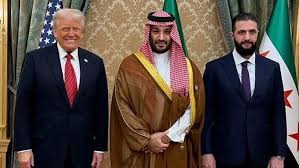
Perhaps the most difficult balancing act involves the foreign fighters who fought on Sharaa’s side. They carry immense symbolic weight in Syrian society — and are the cause of immense fear in the West. Many are ready to resume normal life, but others still see themselves as Islam’s warriors. Recent clashes in the Idlib countryside involving French foreign fighters reflect anxieties that any rapprochement with the West might see them handed over to their home governments. The image of Sharaa standing beside Trump, receiving a symbolic “anointing” of his new fragrance, alarms them even if such engagement is politically necessary.

Granting these fighters legal status, regularising their papers, integrating some into the national army or demobilising them with stipends and educational opportunities — not unlike the GI Bill for US veterans — could go a long way toward neutralising one of Syria’s most volatile pressures.

Then there is the conundrum of Israel. On this, Sharaa has cultivated deliberate ambiguity. At the United Nations, Syria has repeatedly noted its restraint regarding Israel’s illegal strikes on Syrian territory, yet Sharaa has resisted pressure to join Trump’s flagship Abraham Accords. Signing them now would be political suicide. But ambiguity buys him room to manoeuvre — and time to consolidate the state. The question is how long this can last.

For its part, the West has worked to prevent Syria from sliding into another civil war — one that would inevitably spill over into Europe, potentially replaying the exodus of 2015. With regional partners like Saudi Arabia and Turkey, Western governments have effectively restrained Israeli escalation, aware that renewed instability would eventually reach Jerusalem’s door. It’s not impossible to imagine rebels, having overthrown a “pro-Western stooge” like Sharaa and aided by foreign fighters, actually marching toward Israel, convinced that “the infidels” will never allow them to determine their own future. As they did in Damascus, so too — in their imagination — must they do in Jerusalem.

Thus far Sharaa has governed with surprising openness. He has welcomed Britain’s foreign secretary David Lammy, met American diplomats and General David Petraeus, played basketball with US soldiers, and cooperated in counter-terrorism operations. He has also restored relations with London, with foreign minister Asaad al-Shaibani reopening the Syrian embassy.

If Western governments refuse to work with him because of his Islamist roots, they will share responsibility should Syria fracture again. Sharaa’s past is not erased; he may remain an uncomfortable partner. But what is the alternative? That he be excluded from political life and drift into a Castro- or Maduro-like role on the sidelines? If the Saudi Crown Prince can be brought in from the cold after the Khashoggi murder, then almost anything is possible.

Here I recall a meeting with former Saudi spy chief Turki al-Faisal in his South Kensington apartment after the release of his memoir. Faisal lamented how his advice went unheeded after the Afghan-Soviet war. He had urged the international community to launch something akin to a Marshall Plan — an investment programme to stabilise Afghanistan. Had that happened, the region might not have unravelled. Instead, the country collapsed into years of civil war.

Likewise, fully lifting sanctions on Syria and providing a major investment programme, coupled with training and cultural exchange, could restrain the country’s more radical elements. Reining in Israeli escalation, de-escalating the Druze conflict, and mediating between the SDF and Damascus would all help prevent new wars. On this, the West could also spare itself a future security headache by helping Damascus regularise or demobilise foreign fighters rather than leaving them to drift. This would all help to displace messianism.

What, then, would such investment bring the West, beyond avoiding another gaping wound on its eastern flank? For sure, it will not turn Damascus into another Beirut, a place for foreign journalists to party, nor into a Deano-friendly Dubai. Syria will likely remain socially conservative, more like Muscat in Oman. Given time, however, it could become a commercial hub with a distinct cultural life, just as it has been for much of its epic history. This isn’t mere optimism: Sharaa turned Idlib, once a distant town, into a magnet for Damascenes seeking commercial opportunity. Investment now would bring the West a friendly partner, business prospects and political influence. The choice is stark. With support, Syria could become a kind of West Germany: rebuilt, integrated, and stable. Without it, the country risks becoming a new Jerusalem — a battleground charged with fire and prophecy.

Tam Hussein is an award winning investigative journalist and writer. His work has been recognised by the Royal Television Society Awards.
“Because of …” Iran’s voice of freedom

The caged bird sings
with a fearful trill
of things unknown
but longed for still
and his tune is heard
on the distant hill
for the caged bird
sings of freedom
Maya Angelou

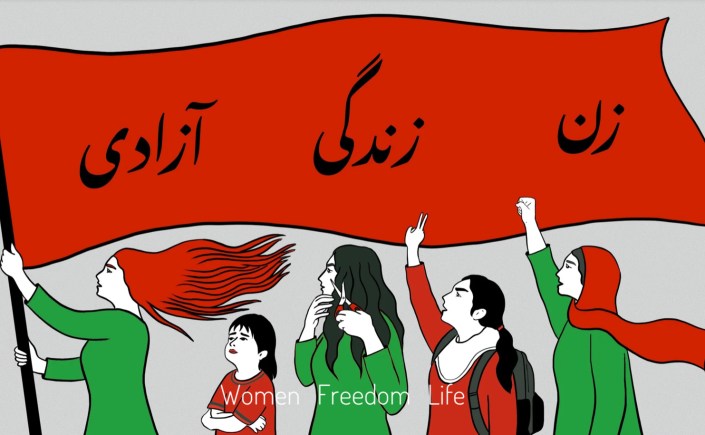
زن زندگی آزادی  Zan zandaky āzādy  Women freedom life

In our relatively comfortable, free and still democratic countries, it is difficult to put ourselves in the position of people desperate and passionate enough to risk life and limb and to face the terrible consequences of potentially heroic failure. We can but sense, vicariously, the ache and the urge behind Maya Angelous’s poem The caged bird sings of freedom (above) and Lord Byron’s passionate couplet:

Yet, Freedom! thy banner, torn, but flying,
Streams like the thunder-storm against the wind.

The courage of the of the Iranian protesters, and particularly the woman and girls who have been the vanguard of this unprecedented intifada cannot be exaggerated. For brave they are indeed. Having endured long years of a brutal and vengeful, corrupt and misogynistic theocratic regime and its security and paramilitary enforcers, they are fully aware of the consequences of their actions.

Several weeks, the nationwide protests that followed the murder in custody of a young woman arrested by the morality police after wearing her hijab inappropriately, and other young women and also, now, young men, who, officially, have died at their own hand or of pre-existing causes, have mobilized Iranians of all ethnicities, classes, ages and genders. And the security state us reacted predictably, red in tooth and claw. There is torture and death actual and awaiting on the streets of villages, towns and cities throughout the country, and the public trials with their black-garbed and turbaned hanging judges are in place and ready to protect the nation and the revolution in the name of Allah and the legacy of the canonised grey and dour uber-mullah Ayatollah Khomeini.

The perseverance and nihilistic exuberance of the Iranian street has reminded me of an exhilarating song and video created by a young Egyptian and his friends celebrating the demonstrations in Cairo’s Tahrir Square that precipitated the fall of practically Egyptian president-for-life Hosni Mubarak thirteen  years ago last February. Sawt Al Huriya (The Voice of Freedom), went viral on YouTube after its release on 11 February 2011, the day before Mubarak’s departure?

Fast forward to the present, and we examine why the Islamic Republic’s  sclerotic theocratic regime is so afraid of another song of revolution, the crowd sourced protest anthem, Baraya, which has become a thorn in the side of the government in Tehran.

Baraye, translated as “because of …” or “for …”, the anthem of Iran’s Woman, Life, Liberty protest movement grew organically from a Twitter hashtag trend in which Iranians expressed their uncountable discontents and their commitment to the protests. It continues to unite Iranians in their opposition to the rules, restriction nd repression of Islamic Republic weeks after it was first released online on an international and social media that the authorities have tried and failed to silence. To paraphrase Canadian songwriter and activist for injustice and the environment in his song Santiago Dawn (see below) to keep millions down “takes more than a strong arm up your sleeve”.

Bareya’s lyrics were created by the Iranians themselves and gathered and set to music , recorded, sung and shared by a young Iranian singer, Shervin Hajipour. Crazy brave, perhaps for predictably, he was detained by security operatives soon after he posted it on his Instagram page and forced to remove it from his feed. But it had already attracted millions of views worldwide and continued to be shared and shared and shared, and it has now been played and performed the world over as people across the glob empathize, identify with, and add to the images verbalised and the emotions these engender. We all have stories to relate of oppression and exclusion, of the abuse of power and privilege and the pervasiveness of prejudice and discrimination. To quote Bruce Cockburn once more about an earlier resistance, “see them matching home, see them rising like grass through cement in the Santiago dawn”.

Baraja gives voice to the voiceless – as Bob Dylan sang in another century, in comparatively  straightened times:

For the countless confused, accused, misused, strung-out ones an’ worseAn’ for every hung-up person in the whole wide universeAn’ we gazed upon the chimes of freedom flashing

The Recording Academy, which hosts the annual Grammy Awards, announced that in its new merit category for best song for social change, more than 80% of nominations were for Baraye. Below is a video of the world-famous band Cold Play singing the song in Buenos Aires with Iranian actor Goldshifte Farahani.

The genesis of Baraya mirrors the organizational structure of the protests themselves insofar as like these, it is networked and leaderless, Ironically, however, David Patrikarakos editor of the e-zine Unherd wrote recently, this lack of leadership portends the protests’ doom:

“No leader has yet emerged. Instead, the protests are organised by different people or groups in different cities and towns on an almost ad hoc basis.The truth is that if the mullahs were to collapse tomorrow, there are no signs that a democratic movement would sweep to power …It is far more likely that the security state — led by the Revolutionary Guard Corps — would step into the void and make apparent what is already largely a fact: that Iran is no longer a clerical state but is now ruled by a Praetorian Guard …

… In 1979, Iranians held up images of Khomeini. In 2022, they tear them down. They know they want the regime gone but they have no one to hold up in its place. For a revolution to succeed, it’s not enough to be against someone; you have to be for someone else. It’s not enough that Khamenei loses. Someone else must win. Until that time, the mullahs will continue to cling on as murderously and barbarously as they always have, and Iranians will continue to die. For years Palestinians would say they needed a Saladin. They were wrong. What they need is a Ben Gurion. What the Iranian revolutionaries need now more than anything else is a Khomeini. Until that happens, this will only ever be half a revolution”.

At this moment in time, the outcome of that revolution hangs in the balance. The passion of the people for a better world is once again going up against the iron fist of the security state. Sadly, history past and present, in Iran and elsewhere, has shown us that when an irresistible force comes up against an immovable object, no matter how popular, righteous and justified that force may be, the immovable object invariably wins.

Meanwhile, hope springs eternal …

Our weapon was our dreams.
And we could see tomorrow clearly.
We have been waiting for so long.
Searching, and never finding our place.
In every street in my country,
The voice of freedom is calling.

Sawt al Huriya

Baraya … Because of 

Because of dancing in the street
Because of fear while kissing
Because of my sister, your sister, our sister
Because of changing rotten minds

Because of shame for moneyless
Because of yearning for an ordinary life
Because of the scavenger kid and his dreams
Because of a command economy

Because of air pollution
Because of ‘Vali Asr’ Avenue, and its dying trees
Because of a cheetah (Pirouz) that may go extinct
Because of innocent, outlawed dogs

Because of the incessant crying
For the image to repeat this moment
Because of the smiling face
For students, for the future
Because of students, for the future

Because of this forced paradise
Because of the imprisoned elites
Because of Afghan kids
Because of all (Because of…) non-repetitive

Because of all these empty slogans
Because of the rubble of fake houses
Because of the feeling of peace
Because of the sun after a long night

Because of the nerve pills and insomnia
Because of man, country, rebuilding
Because of a girl who wished she was a boy
Because of woman, life, freedom

Because of freedom

Because of Mahsa Amini

See also in In That Howling Infinite, Sawt al Hurriya – remembering the Arab Spring, Messing with the Mullahs – America’s phoney war?. and A Middle East Miscellany

Why Is Iran’s Regime So Afraid Of This Song?

Nahid Shamdouz,  assistant professor of Middle East and Media Studies at the University of Texas at Austin, Foreign Policy, 26th October 2022
Demonstrators sing "Baraye" while holding their phone lights high during a march in support of protests in Iran.

Demonstrators sing “Baraye” while holding their phone lights high during a march in support of protests in Iran. Allison Bailey, Reuters. 26th October 2021

“Baraye,” the anthem of Iran’s “Woman, Life, Liberty” protest movement—a song woven together entirely from a Twitter hashtag trend in which Iranians express their investment in the current protests—continues to unite Iranians in their opposition to the Islamic Republic several weeks after it was first released online.

For Iranians in Iran but also for the millions in the diaspora, this is the song of a generation, perfectly expressing this political moment and all that is at stake.

For dancing in the alleyways
Because of the fear you feel when kissing
For my sister, your sister, our sisters
To change the minds that have rotted away
Because of shame, because of being broke
Because of yearning for an ordinary life  

What makes this moment different from previous periods of protest is that the wall of acquiescence and pretense that maintained the state’s authority in the public realm has been torn down on a scale not seen since the 1979 revolution. In its recounting of all the painful grievances, “Baraye,” which translates in English to “for” or “because of,” signals the end of patience with the status quo and opens vistas onto a new future with a vocal crescendo that culminates in the word “freedom.”

The song reveals the simple, ordinary nature of the things that Iranians are aching for, asking for, and even dying for. It is radical in revealing on a national level the cruelty of a system that denies such basic demands—exposing the devastating conditions Iranians face under the current regime.

“Baraye” creates national intimacy by citing very specific events that all Iranians have suffered through together, in a palimpsest of collective traumas.

If “Baraye” reflects a different, perhaps unprecedented mood on a national level, it also mirrors the organizational structure of this recent protest movement. If it is networked and leaderless, so is the song. The lyrics were written by Iranians at large and merely set to music and vocalized by the young up-and-coming singer Shervin Hajipour. This explains why security forces detained Hajipour a couple of days after he posted it on his Instagram page, where it had already accrued millions of views. The regime has tried for years to push the apparent and already real aspects of people’s lives out of the public sphere.

On social media, Iranians have created a life that more closely mirrors their inner selves—replete with harsh criticism of leading clerics including Iran’s supreme leader, Ayatollah Ali Khamenei; female solo vocalists who are otherwise banned singing at the top of their lungs; and the exhibition of private lives that are anything but a reflection of the state’s projected pious paradise. Still, the state has sought to maintain a semblance of its ideology and control in actual public spaces and its media.

“Baraye” has broken that violently imposed wall between the state’s enforced reality and people’s real lives. It forced into the open, in the face of authority, all that people have known for long but were not supposed to express openly on such a national dimension.

For the sake of a laughing face
For schoolkids, for the future
Because of this mandatory paradise
For imprisoned intellectuals

Since its release, the song has become the single most covered protest song in Iran’s history. Within a few short weeks after Hajipour composed the music for it, musicians across Iran and beyond its borders have sung it verbatim in their own voices, translated it, and sung it in other languages—and even universalized the lyrics for a more global audience.

Last week, the Iranian rapper Hichkas released a militant hip-hop track referencing “Baraye” through the more casual rap lingo “vase,” enumerating his reasons, starting with “vase Mahsa” (for Mahsa Jina Amini, whose death at the hands of Iran’s morality police sparked the protests) and ending with “for a good day,” in a nod to his own 2009 Green Movement protest song.

Mahsa Amini Protest in Iran

Protesters gather in London on Oct. 1 in solidarity with people protesting across Iran.

Protesters gather in London on Oct. 1 in solidarity with people protesting across Iran.

For the garbage-picking kid and her dreams
Because of this command economy
Because of this polluted air …
For a feeling of peace
For the sun after long nights

At the same time, “Baraye” creates national intimacy by citing very specific events that all Iranians have suffered through together, in a palimpsest of collective traumas. Hajipour sings “For the image of this moment repeating again,” drawn from a tweet with a photo of Hamed Esmaeilion and his young daughter relaxing together on a couch reading newspapers. (His wife and 9-year-old daughter were killed when Iran’s Revolutionary Guards mistakenly shot down a Ukrainian airliner leaving Tehran in January 2020, and Esmaeilion has become the face of the grief affecting all those who lost loved ones in the crash.)

This line resonates with Iranians because so many families have been torn apart by the country’s massive brain drain, caused by a closed and corrupt economy that offers few opportunities.

In other lines, Hajipour sings sarcastically “Because of this mandatory paradise,” referring to the theocratic state’s imposed restrictions, justified in the name of achieving an Islamic utopia.

In yet another, he sings of “houses in rubble,” pointing to collapsing buildings caused by the rampant nepotism and corruption that shield state-connected builders from transparency on safety measures. In another, he sings of the “imprisoned intellectuals,” in a nod not just to the hundreds of journalists, human rights lawyers, and filmmakers but even award-winning university students who have been locked up.

The chorus arising from hundreds of tweets is clear: This is a regime that seems to be against life itself, punishing dancing, kissing, and smiling faces.

The song’s singular overnight success is not a small achievement given the long, rich history of protest songs in Iran. Already at the time of Iran’s Constitutional Revolution in 1906, poets created songs about the spilled blood of the youth who agitated for representative government and, not long after, about the Morning Bird breaking the cage of oppression, which many decades later became one of the most intoned protest songs in post-revolutionary Iran.

The trajectory of Iran’s musical history clearly exhibited a century-long struggle for freedom and justice, not yet realized.

Although “Baraye” and other songs of the current protest movement continue this strong tradition, they break with the post-revolutionary legacy on one key point: They no longer call for reforms.

At the time of the last major convulsions in 2009, many activists and musicians of the Green Movement called forth songs from the 1979 revolution to stake a claim to the revolution’s original yet unattained promises. People wore headscarves and wristbands in the green of Imam Hussain and went to their rooftops to shout “Allahu akbar” to invoke God’s help against a corrupt, earthly power.

But this time around, there are no religious signifiers or any demands for reforms. If classical songs are performed, they are not the icon Mohammad Reza Shajarian’s conciliatory song Language of Fire in 2009, when Iranians were still agitating for reforms from within, but his militant 1979 song Night Traveler, (also known as “Give Me My Gun”) in which he calls “sitting in silence” a sin and asks for his gun so he can join the struggle. One of Shajarian’s masterful female protégés posted the song with the hashtag #Mahsa_Amini and swapped “the brother” out of the verses to sing “The sister is an adolescent, the sister is drowning in blood,” in recognition of the teenage girls who have given their lives in the protests.

The state security system instantly understood the significance of “Baraye” as a protest song. Hajipour was forced to take it off his Instagram account; however, not only has his song already been shared widely by other accounts and on other platforms, but the sentiments behind the lyrics are within the millions of people who wrote them.

The chants of “Death to the Dictator” have reverberated from the streets to the universities, from oil refineries to urban rooftops, and from bazaars to school courtyards. And so have the haunting calls for freedom repeatedly intoned at the end of “Baraye,” pouring forth from every corner of the actual and virtual Iranian public sphere.

That song’s reality can no longer be repressed and hidden by force.

Song lyrics in this article are based in part on Zuzanna Olszewska’s translations.

Nahid Siamdoust is an assistant professor of Middle East and Media Studies at the University of Texas at Austin, and the author of Soundtrack of the Revolution: The Politics of Music in Iran.

Sawt al Hurriya – remembering the Arab Spring

Ten years ago, people across the Middle East and North Africa rose up in protest against their corrupt, autocratic and repressive rulers, demanding freedom and democracy. Tyrants were toppled or feared that power was being torn from their grasp as millions of demonstrators surged through the streets, chanting that “the people demand the fall of the regime”.  

Myth and memory often embellish the stories and the glories of oppressed people rising up against the power, but when we recall these oft-times forlorn hopes, from Spartacus to the Arab Spring, it is difficult to imagine ourselves, in our relatively comfortable, free and democratic countries, in the position of people desperate and passionate enough to risk life and limb and to face the terrible consequences of heroic failure.  We can but sense, vicariously, the ache and the urge behind Lord Byron’s passionate couplet:

Yet, Freedom! thy banner, torn, but flying,
Streams like the thunder-storm against the wind.

As Patrick Cockburn writes in a gloomy opinion piece in The Independent,

“There was nothing phoney about this mass yearning for liberty and social justice. Vast numbers of disenfranchised people briefly believed that they could overthrow dictatorships, both republican and monarchical. But …the dream of a better tomorrow expressed by herself and millions during the Arab Spring in 2011 was to be brutally dispelled as the old regimes counter-attacked. Crueler and more repressive than ever, they reasserted themselves, or where they had fallen, they were replaced by chaotic violence and foreign military intervention.

… none of the kleptocratic powers-that-be intended to give up without a fight. They soon recovered their nerve and struck back with unrestrained violence. … across the Middle East and North Africa, rulers used mass imprisonment, routine torture and summary executions to crush dissent. Repression not only affected places where the Arab Spring had been at its peak, but spread throughout the region, which is home to 600 million people, as frightened rulers sought to stamp out the slightest hint of dissent in case it could become a threat to their regimes …

… Could could the Arab Spring have ever succeeded against such odds? The question is highly relevant today because oppression by regimes, aptly described as “looting machines” on behalf of a tiny elite, is no less than it was in 2011. Even more people now live crammed into houses with raw sewage running down the middle of the street outside while their rulers loll on yachts anchored offshore.”

We published the following piece just over a year ago. Little has changed since them – if anything, with the world distracted by the pandemic and the US and its allies – and also  adversaries, indifferent if not complicit, the situation has gotten much worse. 

In Egypt, the grip of Egyptian strongman Abd al Fattah al Sisi has tightened. Civil wars rage still in Yemen and Libya exacerbated by outside interference (see Tangled – a cynic’s guide to alliances in the Middle East). Syria’s misery continues with the regime almost but not quite on the verge of victory, and the Kurds betrayed by the Trump administration and defeated by Turkish forces and their Syrian mercenaries. Lebanon, which avoided the fate of other Arab countries a decade ago, although enduring the influx of millions of Syrian refugees, in the wake of a winter of protests, economic meltdown and political paralysis, and the explosive destruction of Beirut’s port and environs, is on the edge of an abyss (see our Lebanon’s WhatsApp Intifada).

All is, as Kent lamented in King Lear, “cheerless, dark and deadly”.

Sawt al Hurriya – Egypt’s slow-burning fuse

In That Howling Infinite, 9th October 2019

Déjà vu

Last month saw the death in exile of former Tunisian strongman, dictator and kleptocrat Zine el Abidine Ben Ali, and the resurgence on 20th September of Friday street protests in Cairo and smaller Egyptian towns – and around the world – against the corruption and oppression of Egyptian strongman Abd al Fattah al Sisi and his military cronies. Predictably, some three thousand people have been arrested – protesters, prominent activists, journalists, lawyers and politicians, including Islamist and leftists alike and dissenters in general. These have now been added to the tens of thousands that have already been incarcerated on conspiracy and terrorism charges, largely without trial.

it appears to be an indiscriminate backlash, The Independent’s Bel True writes: “… according to rights groups and people I’ve interviewed, among those haphazardly rounded up are children who were out buying school uniform, tourists holidaying in Cairo, human rights lawyers going to court to represent clients, confused bystanders, young men popping out for evening strolls, visiting foreign students and street vendors. All are now swallowed up in Egypt’s notoriously opaque justice system”.

The protests have for the moment been contained, but with a third of Egypt’s population below the poverty line (and that’s a government figure – it’s very likely much higher), about one-third of the total under age 14 and sixty percent under 30, one can’t help feeling a hint of déjà vu. It is hard to keep one hundred million people down with just a strong arm up your sleeve.

Meeting with al Sisi in New York, US President Donald Trump praised him for restoring order to Egypt. At this year’s G7 summit in Biarritz, Trump had referred to the Egyptian president  as his “favourite dictator”, a comment that was met with stunned silence from American and Egyptian officials. Boris Johnson has likewise found a friend in Al Sisi. Tru quotes a British-Egyptian filmmaker: “There is a misconception that Sisi is a partner in stability which allows governments, particularly in Europe, to turn a blind eye to his behaviour: as long he keeps buying weapons and submarines and power stations”.

The Voice of Freedom

In our relatively comfortable, free and democratic countries, it is difficult to put ourselves in the position of people desperate and passionate enough to risk life and limb and to face the terrible consequences of potentially heroic failure. We can but sense, vicariously, the ache and the urge behind Lord Byron’s passionate couplet:

Yet, Freedom! thy banner, torn, but flying,
Streams like the thunder-storm against the wind.

The courage of the of the Egyptian protesters – for brave they are indeed For having experienced six years of brutal and vengeful military regime, they are fully aware of the consequences of their actions – reminded me of an exhilarating song and video created by a young Egyptian and his friends, celebrating the demonstrations in Cairo’s Tahrir Square that precipitated the fall of practically president-for-life Hosni Mubarak eight years ago last February. Sawt Al Huriya (The Voice of Freedom)), went viral on YouTube after its release on 11 February 2011, the day before Mubarak’s departure.

Bur first, let us revisit those heady days and the doleful years that followed.

Remembering Tahrir Square

The self-immolation in December 20111 of young Tunisian Muhammed Bouazizi was the catalyst for the pent-up popular outrage that led to the heady days of January and February 2011, with the green of the Arab Spring fresh sprung from the soil of the economic and political bankruptcy of the Arab Middle East.

The fall of longtime dictators Zine el Abidine Ben Ali of Tunisia and Hosni Mubarak of Egypt, was precipitated by the yearning of their oppressed and impoverished people, and particularly the young, for freedom, justice, dignity and employment, and an end to endemic corruption, nepotism and brutality; for a society in which there were jobs and a decent living, where you could save up enough money to get married, where you didn’t have to bribe corrupt officials for everything from traffic fines to court decisions to business permits to jobs, where you could be arbitrarily arrested and/or beaten up or worse for speaking out against the government, the system, or just…speaking out.

Egypt had only known a handful of military rulers until Mubarak was ousted in February 2011, following weeks of protests centred around Cairo’s Tahrir Square.

When elections were held a year later, Mohammed Morsi, standing for the Muslim Brotherhood’s Freedom and Justice Party, emerged as president. After decades of repression of the Muslim Brotherhood under Egypt’s military rulers, Morsi promised a moderate agenda that would deliver an “Egyptian renaissance with an Islamic foundation”.

A year later, he was gone, replaced by Abd al Fatah al Sisi, his own defense minister, who threw him in jail and cracked down on the Muslim Brotherhood, putting hundreds of its members in front of courts that sentenced them to death in mass trials. 

His year in office was turbulent, however, as Egypt’s competing forces struggled over the direction the country should go in. Opponents had accused him of trying to impose an Islamist agenda on the country and mass protests began on the anniversary of his election. After more than a week of spreading protests and violence and talks with Sisi in which Morsi reportedly was prepared to make concessions to the opposition, the army announced it had removed Morsi and taken control on 3rd July 2013.

Morsi’s supporters had gathered in Cairo’s Rabaa Square before he was toppled, and there they remained, demanding he be reinstated. On 13th August, the army moved in, clearing the square by force. More than a thousand people are believed to have been killed in the worst massacre of peaceful demonstrators since China’s Tienanmen Square in 1999.

Whereas Hosni Mubarak died in pampered confinement, Mohamed Morsi, Egypt’s only elected president, was held in solitary confinement for six years, and died in June 2019 after collapsing in a courtroom, the place where his face has been seen most often, behind metal bars, since he was removed from power. See: Nowhere Man – the lonesome death of Mohamed Morsi 

Morsi’s fall led to a military regime more brutal and corrupt than any that preceded it, and with full support from the US and it’s European allies, and of the Egyptian elites, has consolidated the rise and rise of the new pharoah. Al Sisi and other US supporterd and armed Arab autocrats have transformed an already volatile Middle East into a powder keg. 

Mohamed Morsi, Egypt’s only elected president died  in June 2019 after collapsing in a courtroom, the place where his face has been seen most often, behind metal bars, since he was removed from power in 2013

The Arab Spring failed because its youthful vanguard were not prepared for the next stage. In reality, it only occurred in Tunisia and in Egypt. Like the Occupy movement in the west, it lacked coherent leadership and purpose, and in the end, unity against the forces of the establishment that were mobilized against them. But the young, inexperienced idealists were no match for the experienced activists of the Muslim brotherhood, the apparatchiks of the established political parties, and the cadres of the mukhabarat, the military, and the “deep state” that were able to hijack and subvert the revolution.

The Arab Spring was effectively over once the Tunisian and Egyptian dictators had departed and the counterrevolution had already begun – in Egypt particularly with the electoral success and later putsch of the Ikhwan, and finally the “tamarrud” or “rising” of the fearful and conservative middle classes that ushered in military rule.

 The great unravelling

The Tunisian and Egyptian risings were followed rapidly by the outbreak of insurrections in Bahrain, Syria, Libya, and Yemen. These were more sectarian and tribal based, with less reliance on social media, and while media chose to consider them as part of the Arab Spring, in reality, they were not.

This was transformed into a long, hard and bloody winter., and eight years on, the wars of the Arab Dissolution have dragged the world into its vortex. Great Power politics and proxy wars are taxing intellectual and actual imaginations.

And they led to the virtual destruction and disintegration of these countries, the ongoing dismantling of Iraq, and an expanding arc of violence, bloodshed and repression from Morocco to Pakistan, extending southwards across Africa into Mali, Nigeria, Somalia and the Sudans, and their unfortunate neighbours.

Tunisia alone has held on to some of the gains of its “Spring”, but there it is often a case of two steps forward one step back. Nevertheless, the country is holding ostensibly free and fair elections as I write. Elsewhere, the misnamed Arab Spring entered into a cycle of protest and repression little different from earlier unrest, and also, as in the past, foreign intervention. And the story has still a long way to run…

Civil war and economic desperation propelled millions of refugees across the Mediterranean and the Aegean into Europe, threatening the unity and stability of the European Union. Islamic fundamentalism filled the vacuum created by crumbling dictatorships and vanishing borders, unleashing atavistic, uncompromising and vicious Jihadis against their own people and coreligionists, and onto the streets of cities as far apart as Paris, Istanbul, Beirut, Djakarta, and Mogadishu. In Syria particularly, but also in Iraq, Libya and Yemen, outsiders intervened to further complicate the chaos, rendering an early end to these wars a forlorn hope.

All is, as Kent lamented in King Lear, “cheerless, dark and deadly”.

See also in In That Howling Infinite, A Middle East Miscellany

 The voice of freedom

Against this a back-drop of the revolution despoiled, hijacked, and betrayed, I share the song created by Seed Mostafa Fahmy and his friends and the video they shot in Tahrir Square during the demonstrations. “In every street in my country, the voice of Freedom is calling!”

Sawt al Hurriya

I  went (to go protest), vowing not to turn back.
I wrote, in my blood, on every street.
We raised our voices, until those who had not heard us could.
We broke down all barriers.

Our weapon was our dreams.
And we could see tomorrow clearly.
We have been waiting for so long.
Searching, and never finding our place.

In every street in my country,
The voice of freedom is calling.

We raised our heads high into the sky.
And hunger no longer mattered to us.
Most important are our rights,
And that with our blood we write our history.

If you are one of us,
Stop your chattering,
Stop telling us to leave and abandon our dream.
Stop saying the word, “I”.

In every street in my country,
The voice of freedom is calling.

Brown Egyptian hands
Are outstretched amidst the roars (of the crowd)
Breaking barriers.

Our innovative youth
Have turned autumn into spring.

They have achieved the miraculous.
They have resurrected the dead,
Saying: “Kill me,
But my death will not resurrect YOUR country.
I am writing, with my blood,
A new life for my nation.
Is this my blood, or is it spring?
In color, they are both green.”

I do not know whether I smile from happiness,
Or from my sadnesses.
In every street in my country,

The voice of freedom is calling.

(Translated by Egyptian Seed Mariam Bazeed.)

Sout al-Hurriya
صوت الحرية

Nezelt We qolt ana mesh rage3
نزلت وقلت انا مش راجع
I went out and said I would not return

we katabt bedamy fe kol share3
وكتبت بدمي في كل شارع
And I wrote on each street with my blood

Sama3na elli makansh same3
سمعنا اللي ما كمش سامع
We heard what was not heard

we etkasaret kol el mawane3
واتكسرت كل الموانع
And all the barriers were broken

sela7na kan a7lamna
سلحنا كان احلامنا
Our weapon was our dreams

we bokra wade7 odamna
وبكره واضح قدمنا
And tomorrow was clear ahead of us

men zaman benestana
من زمان بنستني
We’ve been waiting a long time

bendawar mesh la2een makkanna
بندور مش لاقيين مكانا
Seeking but not finding our place

fe kol share3 fe beladi
في كل شارع في بلادي
In every street of my country

sout el houriya beynadi
صوت الحريه بينادي
the voice of freedom is calling
……………….
rafa3na rasna fe elsama
رفعنا رسنا في السما
We lifted our heads high (in the sky)

we elgo3 maba2ash beyhemna
والجوع مبقاش بيهمنا
And hunger no longer bothered us

aham 7aga 7a2ena
اهم حاجه حقنا
What’s most important are our rights

wenekteb tarekhna be damena
ونكتب تاريخنا بدمنا
And to write our history with our blood

law kont wa7ed mnena
لو كنت واحد مننا
If you were really one of us

balash terghi we t2ol lena
بلاش ترغي وتقولنا
don’t blather and telling us

nemshy we neseeb &elmna
نمشي ونسيب حلمنا
To leave and abandon our dream

we batal te2ol kelmt ana
وبطل تقول كلمه انا
And stop saying the word “I”

fe kol share3 fe beladi
في كل شارع في بلادي
In every street of my country

Sout El-7ouria beynadi
صوت الحريه بينادي
the sound of freedom is calling
……………..
spoken poetry at 2:14:
ايادي مصريه سمره
Dark Egyptian arms
ليها في التمييز
knows how to characterize (against discrimination)
ممدوده وسط الذئير
reached out through the roar
بتكسر البراويز
breaking the frams
طلع الشباب البديع
the creative youth came out
قلبوا خريفها ربيع
turned it’s fall into spring
وحققوا المعجزه
and achieved the miracle
صحوا القتيل من القتل
awakinging the murdered from death
اقتلني , اقتلني
kill me , kill me
قتلي ما هايقيم دولتك تاني
killing me is not going to build up you regime again
بكتب بدمي حياه تانيه لوطاني
I am writing with my blood another life for my country
دمي ده ولا الربيع
is this my blood or the spring
اللي اتنين بلون اخضر
both seem green
وببتسم من سعادتي ولا أحزاني
am i smiling from my happiness or my sadness
في كل شارع في بلادي
In every street of my country
صوت الحريه بينادي
the sound of freedom is calling
في كل شارع في بلادي
In every street of my country
صوت الحريه بينادي
the sound of freedom is calling

Lebanon’s WhatApp intifada

We know more or less what constitutes Lebanon, but we don’t know how it works. If we had to send into space a country capable of containing the world, Lebanon would fit the bill. If we had to send one that did not contain what is needed to make a real country, Lebanon would also be the answer.   Lebanese author Dominique Eddé

The sparks which that lit the fire of the current protests in Lebanon were an increase in the price of using the WhatApp messaging, which many Lebanese preferred to the high rates charged by private telcos, and destructive wildfires on the iconic Chouf mountains which could not be tamed because the authorities had grounded the firefighting helicopters for want of routine maintenance. But the root of Lebanon’s autumn of discontent go much deeper.

Almost thirty years of stagnation characterized by high unemployment, particularly among the youth, increasing inequality, limited opportunities, rampant corruption, meagre infrastructural reform, and decaying administrative, social, and educational institutions, are bringing young and old from across Lebanon’s many confessional fault lines and clan and party loyalties (often the same thing) onto the streets of major major towns all over this tiny but divided country. They accuse the government being preoccupied with enriching its members and their supporters and neglecting the needs of ordinary Lebanese. See longtime Beirut resident Robert Fisk’s article in The Independent: I don’t blame the Lebanese rioters setting Beirut alight – they are hungry, poor and furious; and Beiruti journalist Samah Hadid’s piece: The protests in Lebanon have bridged social divides – now everyone is fighting against the corrupt elite.

There are many left-wing social media tropes that are blinkered by an obsession with theories of US, Saudi and Israeli conspiracy, accusing them of manipulating the Lebanese street to bring down the Hariri government. They are letting Lebanon’s corrupt and dysfunctional sectarian political establishment off the hook.

Other media are talking excitedly about this being Lebanon’s version of the 2011 Arab Spring – as illustrated by our featured image and the lass sporting the word thawra or ’revolution’’ on her tee shirt – a sure way of drawing the invidious “evil eye’ to the the Lebanese’ peaceful (so far) and convivial (again, so far) intifada, for we all know how the Arab Spring ended. And none have yet allocated this putative revolution a colour like those that popped up from Kiev to Kazakhstan in the early years of this century (the ‘Cedar Revolution’, anyone?). Which is probably wise, because we all should have learned by now to avoid the trap of false analogies.

The party atmosphere and the images of unity among Lebanese of all classes, clans and confessions can be deceptive. Three decades since the end of a brutal civil war, which left over 120,000 propel dead, and tens of thousands “disappeared”, and almost eighty years since the National Pact of 1943 laid the foundations for Lebanon’s shaky and perennially challenged multi-faith political dispensation, divisions run deep. Not only traditional clan and sectarian lines, and the inequitable distribution of power and wealth, but also, the deliberately indeterminate status of upwards of 170,000 Palestinians (the refugees of the 1948 war and their descendants), and upwards of 1.5 million increasingly unwelcome Syrian refugees.

There are many amongst the party faithful and their never quite disarmed militias who at a signal from above, could let lose the dogs of violence with infiltrated provocateurs or strategically placed snipers – we’ve seen this before, in Sarajevo and Kyiv, in Tahrir Square, and in Syria in 2011 when demonstrations had yet to morph into violence and civil war. This it is already happening in Iraq, where security forces and lone wolves affiliated with Iranian interests are alleged to have fired on protesters.

The Lebanese National Army and police force have been ordered to disperse the protesters, but as yet, are merely holding the line. Many on the streets are no doubt anxious about the role the powerful Shia Hezbollah will chose to play in the coming days. Its reclusive but undisputed leader Hasan Nasrallah has declared that the status quo should stand, that the government should hold firm because it would taken too long to form a new one, thus delaying the reforms that the demonstrators are demanding. Hezbollah, with thirteen seats in the parliament and three cabinet posts, is the most powerful political and military and an army stronger than the national army, and whilst bankrolled by Iran, is itself part of the establishment that the protesters and one of the parties that many protesters are demonstrating against – as part of the problem and not of the solution.

Calling for a non-confessional government of technocrats appointed on the basis of experience and not patronage and clan connections, the protesters paint Hezbollah with the same brush as the the Christian Phalange, the Shia Amal, and other self serving confessional parties – quite apart from its constant provocation of what many see as needless confrontation with Israel (and its western backers), and its deep involvement in the Syrian civil war.  Whilst there is no doubt a traditional prejudice towards the country’s Shia minority, many Lebanese resent Hezbollah for exposing their country to potential destruction at the hands of Israel, and for dragging it into the conflict in Syria, a country and a regime for which for which they retain bad memories and harbour little affection.

Meanwhile, there have been indications that Hezbollah’s hitherto uncritical mass following in the south is fraying somewhat as economic hardship bites, tarnishing even Hezbollah’s credentials as a provider of social and educational services. But there are now reports from Beirut of Hezbollah supporters attacking protesters. Dressed in black and wielding batons, they are chanting that their boss is not like the others, whilst he has declared that the protests are being fomented by his enemies (it’s all about him!) and that it could reignite the fifteen year long civil war that ended in 1990. There is also talk of supporters of Hsiang part Amal and of Hezbollah coming to break up the demonstrations. Ominously, they are being called ‘shabiya’, Arabic for ‘ghosts’, and also the name of the murderous Alawi militias unleashed by the regime in Syria. 

There is also talk of supporters of Hsiang part Amal and of Hezbollah coming to break up the demonstrations. Ominously, they are being called ‘shabiya’, Arabic for ‘ghosts’, and also the name of the murderous Alawi militias unleashed by the regime in Syria. 

As I watch from afar, I am reminded of the words of celebrated Lebanon’s national poet Khalil Gibran: “Pity the nation that raises not its voice save when it walks in a funeral, boasts not except among its ruins, and will rebel not save when its neck is laid between the sword and the block”.

 © Paul Hemphill 2019.  All rights reserved


For more on the Lebanese civil war, and the full text of Gibran’s poem, see In That Howling Infinites Pity the Nation

For other posts about the Middle East, see: A Middle East Miscellany

Afterword:  Lebanon’s  huge smallness

In a fascinating article in the New York Review of Books, The Compatibility of Opposites, Lebanese author and novelist Dominique Eddé  writes one of the most profound and insightful descriptions of her homeland, that you could ever read  – a portrait of what I would describe as Lebanon’s  huge smallness (after Walt Whitman’s  “I am small, I contain multitudes”):

“Every Lebanese invents a personal Lebanon for a country that does not exist”.
A Lebanese author writes … Lebanon is both the center of the world and a dead end. The broken little village of a planet that is sick. Chaotic, polluted, and corrupt beyond belief, this is a country where beauty and human warmth constantly find ways to break through” …All extremes and all clumped together. It is like a magician’s trick handkerchief: you simply unfold one end and it will stretch ad infinitum. Individual memories are rich and compelling while the collective memory is nowhere to be found, impossible to recount”.

She continues: “It would hardly be an exaggeration to say that in Lebanon, everything can be explained and nothing can be understood. All the decisions made for this country are made behind its back, and all that happens here epitomizes the rest of the world: the mix of populations, the vulnerability of borders, political lying at its worst, building the present by destroying the past, an utter lack of perspective … “With a total population of 4 to 5 million, Lebanon is home to 1.5 million refugees. Between a quarter and a third of the population is foreign: Palestinians displaced by the wars of 1948 and 1967, Syrians and Palestinians fleeing repression and the war in Syria that began in 2011, Iraqis displaced by the two Gulf wars. Lebanon’s degree of absorption and hospitality is almost proportional to its degree of intolerance. Ambivalence is everywhere, in everything”.

Postscript – the autumn of our discontent 

Last Sunday, a million people marched in London, demanding a second people’s vote on Brexit. In Britain and in Australia environmental protesters are disrupting city centres and enraging commuters. The “law and order brigade” in parliaments, press and social media have called down fire and brimstone upon climate activists’ heads, one television host going so far as suggesting that they should be used as speed bumps.

But in far-away places around the globe, popular protests are far from peaceful.

In Lebanon, Iraq, Ecuador and Chile, people of all ages, genders and political affiliations are on the streets. There are many common themes, including demands for education and employment, and an end to the incompetence, self-interest and corruption of ruling elites. Bolivians are on th streets protesting the ruction of its president. In Spain, Catalans protest jail sentences handed down to their separatist parliamentary leaders. And in Hong Kong, there is no let up to months of demonstrations against China’s relentless chipping away at the city’s tenuous autonomy. Young Indonesians have been on the streets of Jakarta protesting new laws that undermine civil rights and endemic corruption amongst elites, and in Indonesian-occupied Papua, calls for independence have been met with predictable brutality.
In most of these each these outbreaks of popular outrage and protest, the authorities are responding with heavy handed police tactics, tear gas, rubber bullets, water cannon, and mass arrests, and in some instances, deadly live fire.
See The Washington Post’s  The Common Factor Uniting Protesters … ; an Patrick Cockburn’s insightful analysis of the changing nature of the Middle East’s many ethnic and sectarian conflicts: Mass protests against corruption and deprivation are replacing an era of sectarian civil wars. 

The Children of the Revolution

I finally broke into the prison,
I found my place in the chain.
Even damnation is poisoned with rainbows,
all the brave young men
they’re waiting now to see a signal
which some killer will be lighting for pay.
Into this furnace I ask you now to venture,
you whom I cannot betray.
Leonard Cohen, The Old Revolution

The Syrian civil war broke lose in March 2011, two months after the events in Tahrir Square, and one month after the fall of Mubarak.

Amidst the tumult and media hype of the Arab Spring, it was as if the distant drums had suddenly hit the volume switch. In the dusty border town  of Dara’a, just north of Jordan, local kids wrote on a wall: “The people want the regime to fall”. The words had been repeated from Tunisia to Egypt, from Yemen to Bahrain. It was the cry of the revolution. The local governor decided to come down hard. The young people, all under 17, were thrown in jail. The punishment stunned the town, and suddenly, Syria, progressive, diverse, proud, beautiful, but authoritarian Syria greeted the misnamed Arab Spring.

The young men’s families and friends weren’t having any of it. It is said that in broad daylight, dozens of young men pelted a poster of a smiling President Bashar Assad; a statue of the Bashar’s  late father and predecessor Hafiz Assad was demolished; and official buildings, including the HQ of ruling Ba’ath Party’ and the governor’s office, were destroyed. “There is no fear, there is no fear, after today there is no fear!” hundreds of men chanted in shaky mobile-phone footage.

Over that weekend, security forces opened fire on marchers. This was the regime’s well tried negotiating technique. But Assad responded immediately, sending a high-ranking delegation to deliver his condolences to the families of the dead. The governor was sacked, and the boys released.

So far, so “I mentioned the war but I think I got away with it” But the die had been cast. The demonstrators made demands the regime was unwilling or unable to meet. And the rest is tragedy.

I am not about to retell the story of the Syrian revolution. It is still being written, and as yet, there is no ending. Only more blood. As I write, well over three hundred thousand souls have perished (soon, it will overtake the butchers bill of the Spanish and American Civil Wars), and tens of thousands have disappeared into prisons and oubliez. Millions have been displaced within the country; millions have sought shelter in neighbouring countries; and at least eight hundred thousand have taken to the roads of Central Europe.

But I will quixotically hark back to just before events reached the fork in the road, to when there was an outside chance that Syria could avoid the chaos and carnage that was besetting other children of an Arab Spring that was turning into a bitter winter.

Back to the days before The Fall when pundits were asking whether Bashar would be Hammersmith Man, reflecting his former career as a successful ophthalmologist in London, and his glamorous, cosmopolitan, former merchant banker wife, or Hama Man, recalling his father’s crackdown on an Islamist rising in Hama in 1982, in which uncounted tens of thousand are believed to have perished. We discovered very soon whom he was destined to become.

To the days before The Fall, before the revolution became weaponized and islamized, and demonstrators danced together in the streets, earning the intifada the short lived sobriquet ‘the Dabke Revolution’, named for the circle folk dance popular throughout the Middle East and the Balkans.

image

The days before the slaughters began. First by the forces of regime, led by Bashar’s brutal brother Maher and his notorious Fourth Armoured Division. Then by the thuggish Alawi militia – the Shabiha, or “ghosts” or “shadows”, a double-edged meaning alluding to their underworld origin and methods, and also to the fact that they literally turned people into ghosts. And then, in reciprocal ferocity, by opposition militias that grew and proliferated, fought and died, divided, and divided again, and embraced a jihadi creed, sowing the dragon’s teeth that evolved into Jabhat an Nusra and Da’esh.

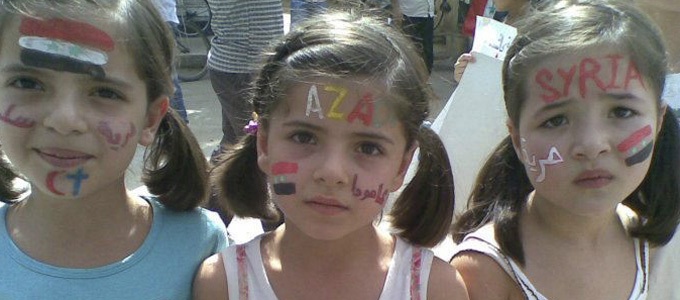
The days before it became too dangerous to gather on the streets, when men, women and children would parade in public places, waving the flag of the old Syria, the one that flew before the Assad clan seized power in 1966. Canny camera men could take media-friendly shots of photogenic little girls in face makeup looking sad, vulnerable and defiant. When the picture that is the featured image of this blog was first published in Al Jazeera in early 2011, I was both enchanted and inspired. I immediately started using it, with acknowledgements, in my publications and postings. When more and more of these images appeared, I used them too. But I was becoming a tad suspicious. The lasses looked too clean, too cute, and indeed, many actually looked alike. The photographers’ daughters, perhaps, or those of friends. Were they for-real or where they posed? I guess I will never find out.

Needlessly to say, as the rebellion morphed into harrowing civil war, such images disappeared, and in their place, we saw destruction and carnage, and the broken bodies of little girls and boys slain by bomb and bullet, hardship and hunger. Now, as families were forced to abandon their homes and make their way to the borders, and thence, into Jordan, Lebanon, and Turkey, and finally, into Europe, we see children staggering on dusty roads, carried piggy back by exhausted fathers, pushed in strollers, scorched by the sun, soaked by the rain, and frozen by the snow. And we see little Aylan on his golden beach, a Kurdish toddler now a symbol of all the drowned babies of the Mediterranean and the Aegean Sea.

Photogenic children no more. Just victims, survivors, lost souls.

I fought in the old revolution
on the side of the ghost and the King.
Of course I was very young
and I thought that we were winning;
I can’t pretend I still feel very much like singing
as they carry the bodies away.
Into this furnace I ask you now to venture…
you whom I cannot betray.

See also, Bombs and Babies

Children of the Revolution

On a personal note, we were last in Syria in March 2009, and whilst visiting the famed Roman amphitheater at Bosra, just northeast of Dera’a, we had the pleasure of the company of a crowd of Syrian school children. They treated us like visiting celebrities and sang us a song of welcome. It is saddening to look at these pictures now, and wonder where these children are now.

Bosra Bosra 2


Bosra