… remember in this country of yours that every man, woman and child who sees you will remember it with joy – remember it in the words of that 17th century poet who wrote these lines, “I did but see her passing by and yet I’ll love her till I die”.
Australian Prime Minister Sir Robert Menzies to Queen Elizabeth, Melbourne, 1963.
Watching a coronation is the constitutional equivalent of visiting a zoo, and finding a Triceratops in one of the enclosures.
British historian Tom Holland
The United Kingdom is alone in Europe in marking the accession of a new monarch with a coronation. Indeed, no monarchy can lay claim to a longer lineage – one reaching back it is said to the Bronze Age and rooted in history and religion, and also magic and superstition. Inside Westminster Abbey, audiences will be encouraged to follow six phases of what is essentially a medieval rite, some of it dating back to Anglo-Saxon kingship: the recognition, oath, anointing, investiture (which includes the crowning), enthronement and homage. Britain is indeed the only European monarchy to retain a religious ceremony.
So, anyone expecting that the upcoming coronation of King Charles III and Queen Camilla would be a thoroughly modern affair suited to the 21st Century is likely to be disappointed.
One significant innovation, however, is that millions of other Commonwealth citizens attending coronation events and watching on television will be asked to cry out and swear allegiance to the King with the public given an active role in the ancient ceremony for the first time in history.
King Charles III’s coronation service – the first for a British monarch in 70 years – has been modernised to include the first-ever Homage of the People and will also include faith leaders from Jewish, Hindu, Sikh, Muslim and Buddhist communities to better represent the make-up of modern Commonwealth countries. A new homage was written to allow “a chorus of millions of voices” to be “enabled for the first time in history to participate in this solemn and joyful moment”, Lambeth Palace – the office of the Archbishop, announced. The Archbishop of Canterbury will call upon “all persons of goodwill in The United Kingdom of Great Britain and Northern Ireland, and of the other Realms and the Territories to make their homage, in heart and voice, to their undoubted King, defender of all … a great cry around the nation and around the world of support for the King” from those watching on television, online or gathered in the open air at big screens.
…. our strength in ages past
As these two highly entertaining and most informative articles makes clear, whilst the guest list is much shorter than that of past right royal enthronements, in the interests of public health bad safety, we are told. There will be no silk stockings and knee breeches for the King or any of the peerage; the number The length of the ceremony has been shortened, for economy and impatient news cycle. The banquets and street parties have been exhorted to eat quiche, a nod to HM’s vegetarianism. The old times are by no means a’changin’. But, rites and rituals historically and hysterically archaic and arcane will prevail as will the imprimatur of the deity, the unctuous sanction of the demographically diminished Church of England and the rights and privileges of the theoretically hereditary aristocracy are upheld in time-honoured, anachronistic fashion.
The first is written by Australian constitutional expert Anne Twomey who has taken time off from her busy day-job explaining defending the coming referendum on the Indigenous and Torres Strait Island Voice to Parliament. the second, by Observer columnist Catherine Bennett describes the amazing and unforetold apotheosis of soon to be Queen Camilla, Charle’s longtime paramour.
But first, a brief forward from celebrated/celebrity Anglo-Australian barrister and author Geoffrey Robertson. He is no fan of royalty, and is possessed of a sharp pen and a wit to match:
“In London, plans for the coronation of the King and Queen of Australia proceed apace. The ceremony is entirely unnecessary because Charles has been our lawful king from the moment of his mother’s death. This event has no meaning in law; it is merely a superstitious rite whereby God is supposed to anoint the King to run the Church of England, a church to which, according to our last census, only 9.8 per cent of Australians adhere. [Indeed, some 40% of Britain’s profess to having no religion, whilst Christianity accounts for a large diminishing proportion of believers in a celestial deity]
But sadly we will not see the most important bit, the spiritual centre of the ceremony, which the palace has decided must be censored. This is the divine appointment itself. Suddenly, in a Pythonesque moment, into the abbey will rush a team of Knights of the Garter carrying a large tent, which they will erect to cover the King and Queen, the Queen’s hairdresser, and the Archbishop of Canterbury. Inside, unseen by the public, the King will change into a white shirt and be anointed with holy oil – on his head, his breast, and his hands – ladled from the coronation spoon. The holy oil has already been mixed in Jerusalem, with the traditional ambergris eliminated reportedly because the King supports “save the whales”.
The Queen is then anointed on her head, and the royal hairdresser steps forward to clean her up. The King quick-changes back into his purple robes, and the divinely appointed monarchs step out of the canopy and back into view for Charles to swear the coronation oath, “to maintain the Protestant Reformed religion and preserve inviolably the settlement of the Church of England”. The King is at last allowed to sit on his throne (it’s only built for one) holding his orb and sceptre, to “receive homage” from the audience. It is uncertain whether Prime Minister Anthony Albanese will manage to swear to be “your liegeman of life and limb and of earthly worship, to live and die against all manner of folks, so help me God”.
On Saturday, when the Archbishop of Canterbury conducts the coronation at Westminster Abbey, he will not just be crowning Charles as the King of England, but the King of Australia as well – though we Aussies will not be granted a three day holiday for the occasion like our British cousins.
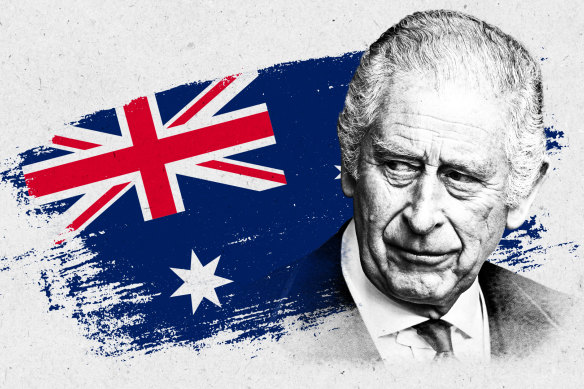
When the late Queen was crowned in 1953, she promised “to govern the peoples of the United Kingdom of Great Britain and Northern Ireland, Canada, Australia, New Zealand, the Union of South Africa, Pakistan and Ceylon, and of [Her] Possessions and the other Territories to any of them belonging or pertaining, according to their respective laws and customs”. These were the nations which at the time were British dominions, and constituted what is still called “the Realm”, i.e. the countries which recognised the sovereign as their head of state.
The words of the coronation oath that Charles will take are briefer. As there are now 15 Realm nations (of which Australia is one), it has been decided not to list them all individually. His majesty’s promise will be to govern “the Peoples of the United Kingdom of Great Britain and Northern Ireland, [His] other Realms and the Territories to any of them belonging or pertaining”.
And thereafter, to reprise, we will be exhorted to pledge homage “in heart and voice, to our undoubted King, defender of all … “
Expect arcane pomp during King Charles III’s coronation
Anne Twomey, The Weekend Australian, 22nd April 2023
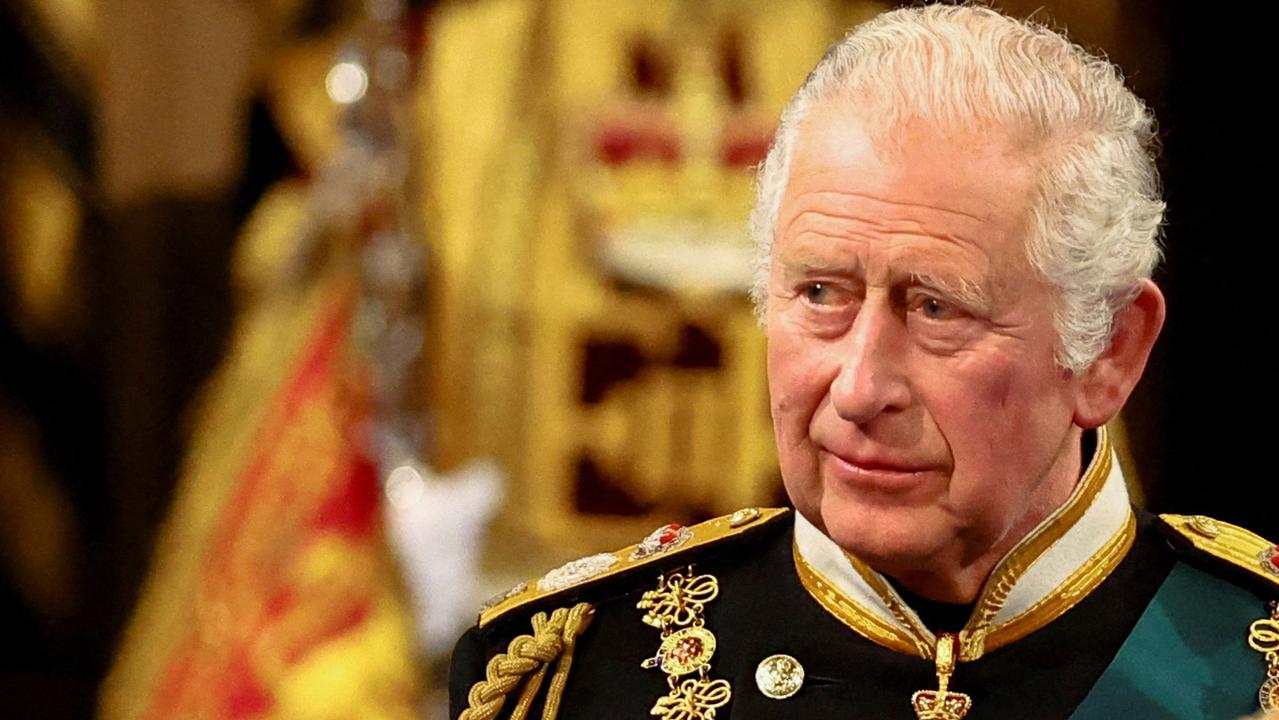
The right to brandish a wand, bear a golden spur or produce a right-handed scarlet glove is more likely to conjure associations with Hogwarts than Westminster Abbey. Yet these rights have been bitterly fought over by British families for centuries, leading to a tense wait for the email summons to fulfil their dynastic destinies at the upcoming coronation.
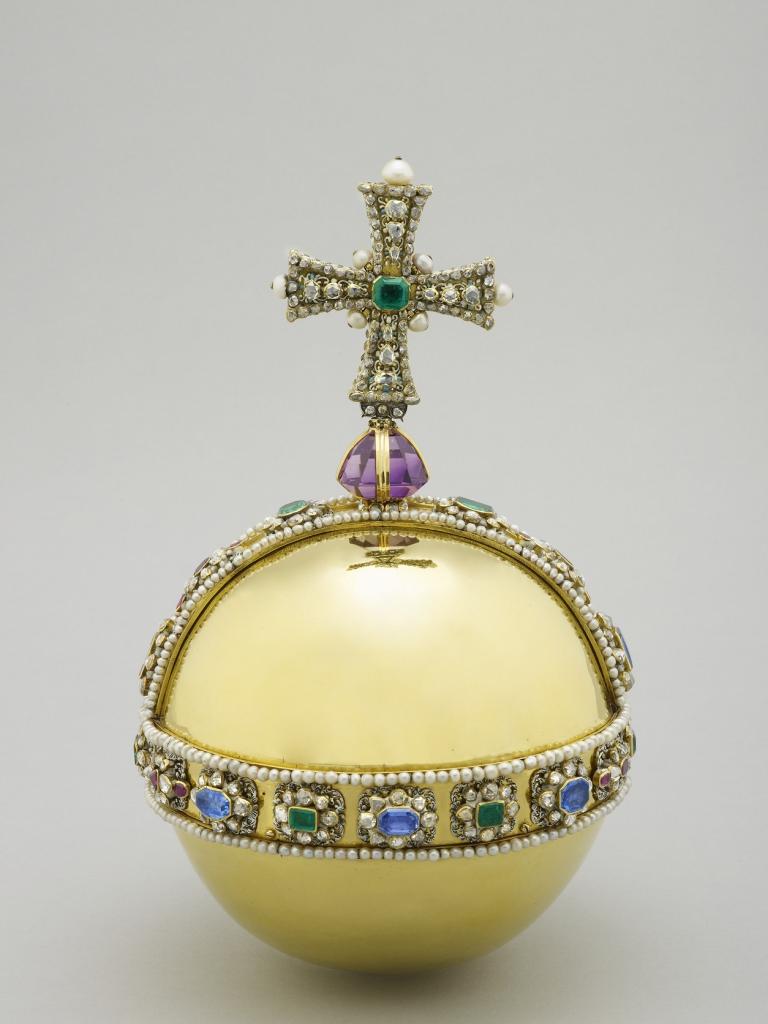
The Sovereign’s Orb, made from gold in the 17th century.
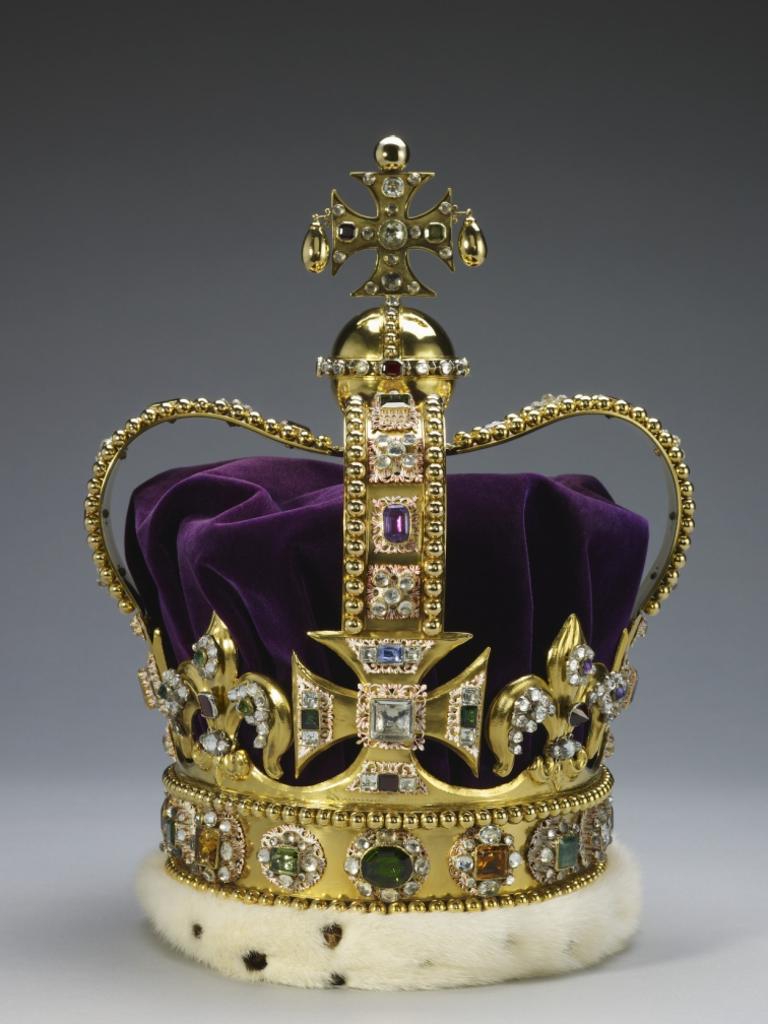
St Edward’s Crown, used to crown the King was made for King Charles II in 1661
to replace the medieval one melted down in 1649 under Oliver Cromwell.
For King Charles III, it will be quite the dilemma. Does he cut out the historical rights and duties of ancient British families to perform particular services at the coronation, such as the King’s Champion, so he can present a modern, relevant monarchy to the world? Or would doing so set the monarchy adrift from the history that justifies its existence?
It seems he is taking a halfway approach, with some of the eccentric pomp and drama surviving, while other roles have been swept away into the dustpan of history.
The golden spurs
One of the most fought-over roles has been to carry the golden spurs and present them to the King, touching them against his ankles.
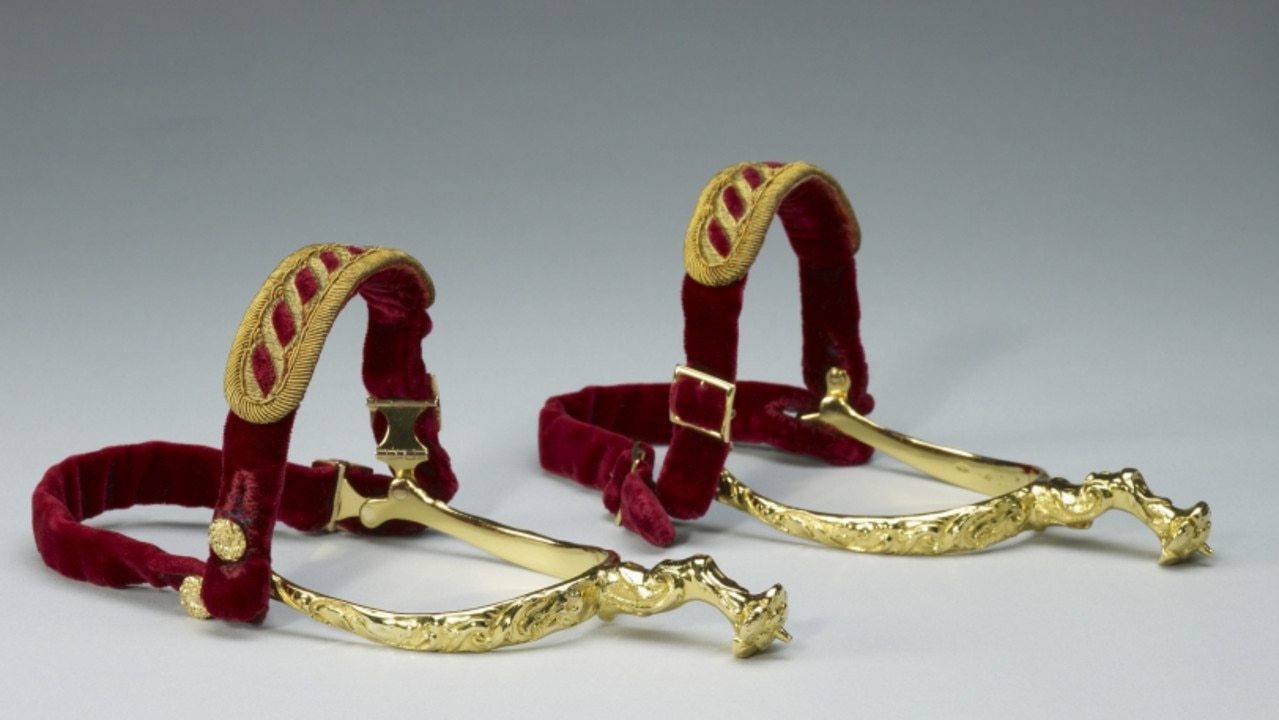
The gold, leather and velvet spurs symbolise knighthood
Spurs were first presented at the coronation of Richard the Lionheart at Westminster Abbey on September 3, 1189. They symbolised his chivalry and his valour as a knight. John Marshal was accorded the honour of presenting them, and this honour has been passed down to his descendants.
The chronicler of Richard’s coronation recorded that there were “evil omens” at the service, including a bat that swooped around the king during the ceremony and a mysterious pealing of bells. Richard survived another decade until dying from battle wounds in 1199.
But the evil omen may have attached itself to the bearer of the spurs, as his line of descendants was sometimes disrupted, with one heir suffering summary execution after having been accused of sorcery in the 14th century and another being killed in a tournament. Second marriages and failures to produce male heirs resulted in disputes about which branch of the family had inherited its coronation rights.
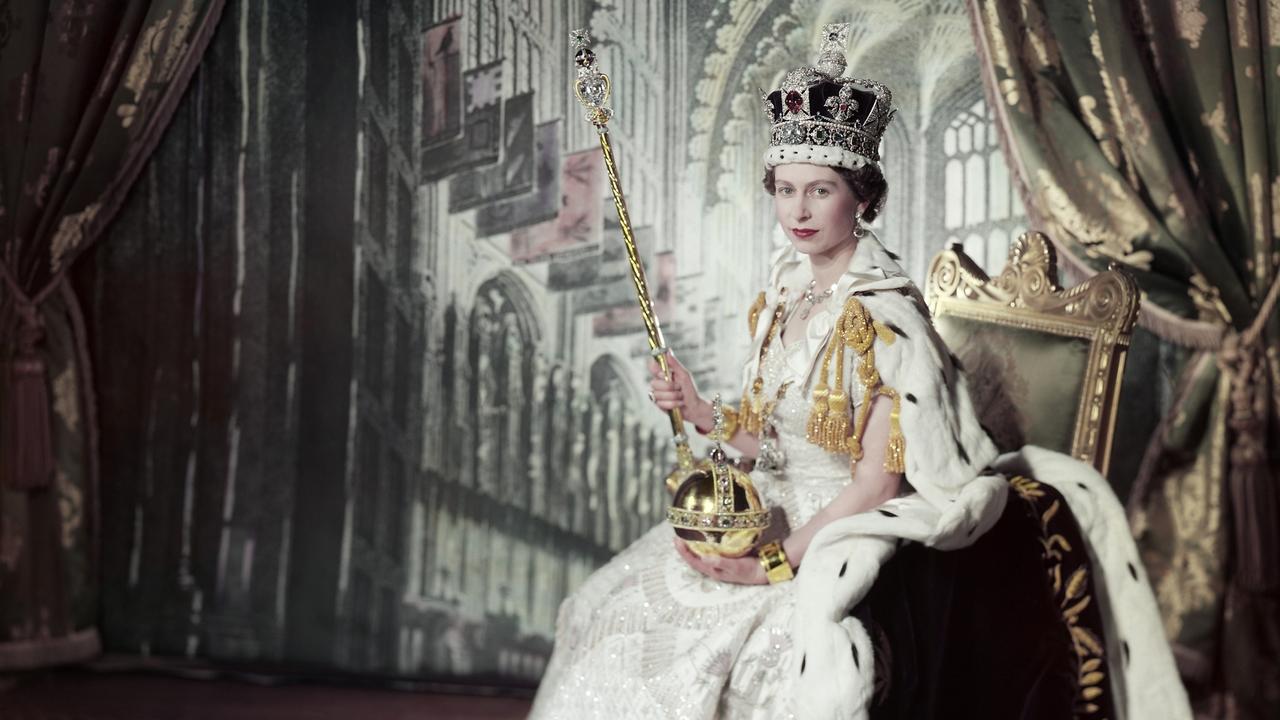
Queen Elizabeth II on her Coronation Day, 1953 by Cecil Beaton.
In the 19th century, the role was dominated by the redoubtable Barbara, Baroness Grey de Ruthyn, a notable fossil collector and geologist, who carried the spurs with aplomb at the coronations of George IV, William IV and Queen Victoria. But her two marriages and a surfeit of daughters who were co-heirs led to a messy chain of inheritance, with four families fighting for the coronation honour ever since.
These disputes were resolved before each coronation by a court of claims, where barristers armed with large scrolls of family trees would battle it out before eminent judges. In 1902, the court held that none of the three claimants had proved their right to carry the spurs at the coronation of Edward VII, and left it to the king to decide. He diplomatically decided that Baron Grey de Ruthyn could carry one spur and the Earl of Loudoun could carry the other. The same division was applied at the coronation of George V.
But in 1936 the coronation court of claims inconveniently found that three claimants had established their claim – Lord Hastings, the Earl of Loudoun and Lord Churston. King George VI, probably wishing he had three legs, found he could not divide two spurs into three and appointed Lord Hastings and Lord Churston to carry one spur each. The same decision was made in 1953 at the coronation of Queen Elizabeth II.
So who would win the right to carry the golden spurs at the coronation of King Charles III? The elderly Lord Churston died in February and the role instead has gone to Lord Hastings, a retired actor and farmer, along with the Earl of Loudoun, an Australian who lives in Wangaratta in Victoria. Each will carry one of the golden spurs.
As the Earl of Loudoun presents his spur, he might indulge a passing thought about how it could have been him on the throne. Some historians have argued that King Edward IV was illegitimate and that the throne should therefore have been passed down a different line to the current Earl of Loudoun.
But while his family still claims the right to present the golden spurs at the coronation, it does not make any claim to the throne.
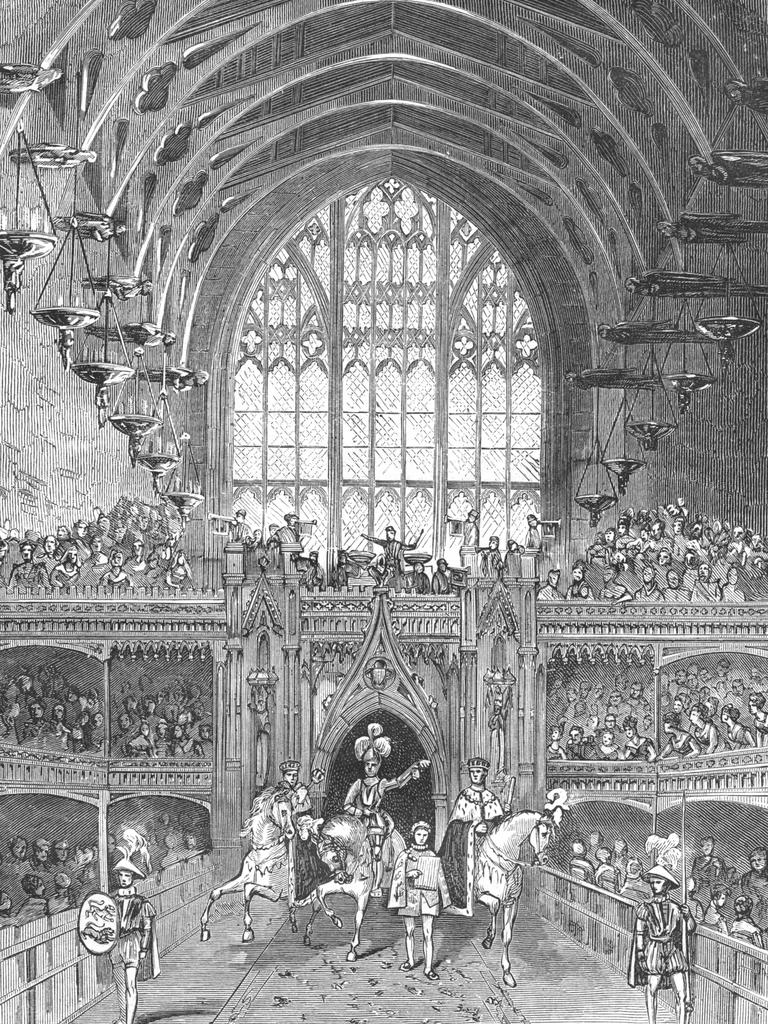
Coronation of George IV in Westminster Hall: The Champion’s Challenge 1897.
The King’s Champion
If the earl did challenge the King’s right to the throne, he could have to face in mortal combat a retired accountant and farmer, Francis Dymoke, who is the King’s Champion. This role, which he traces back to an ancestor who aided William the Conqueror, is actually attached to the ownership of his family home, the manor of Scrivelsby. Anyone who owns the land is the lord of the manor and is therefore the King’s Champion.
It would be interesting to see how a real estate agent would price this unusual land attribute, but as the Dymoke family has held on to the land for many centuries the role of King’s Champion has remained in the family.
Originally it entailed wearing full armour and riding a horse into the coronation banquet in Westminster Hall. The champion would throw down a gauntlet three times in a challenge to anyone who disputed the king’s title. If the challenge was accepted, there was an obligation to fight to the death. The sight was so impressive, however, that no one ever challenged the champion, although one wonders whether any “sovereign citizens” today might take up the gauntlet.
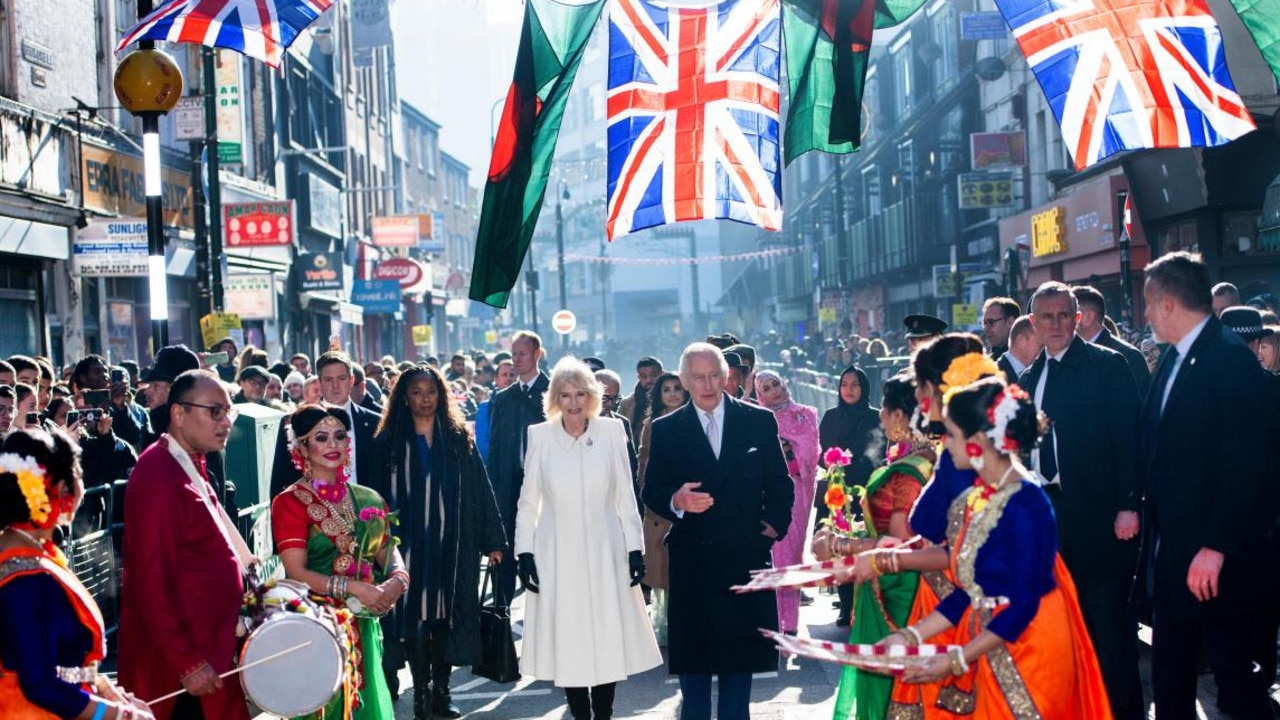
British Bangladeshis welcome the King and Queen on a visit to Brick Lane in February
The greater challenge for the champion was to find a horse that could back out of Westminster Hall without facing its rear-end towards the king, knocking over any tables or defecating over the diners. The last champion to perform this feat at the banquet hired a circus horse that had been trained to walk backwards. But it is claimed that as soon as the horse heard applause from the guests, it assumed it was in the circus and started performing circus tricks, much to the consternation of the man in armour seeking to maintain his balance and the solemnity of the occasion.
As the banquet is no longer held, this picturesque role has ceased. But the King’s Champion was instead given the duty of carrying the Standard of England in the 1937 coronation and the Union Flag at the 1953 coronation.
While the current champion filled in his online form to claim his place, the most recent announcement by the Coronation Claims Office (which replaced the coronation court of claims) made no mention of a role for the King’s Champion. Perhaps the champion’s day is done, or maybe he will get back on the horse.
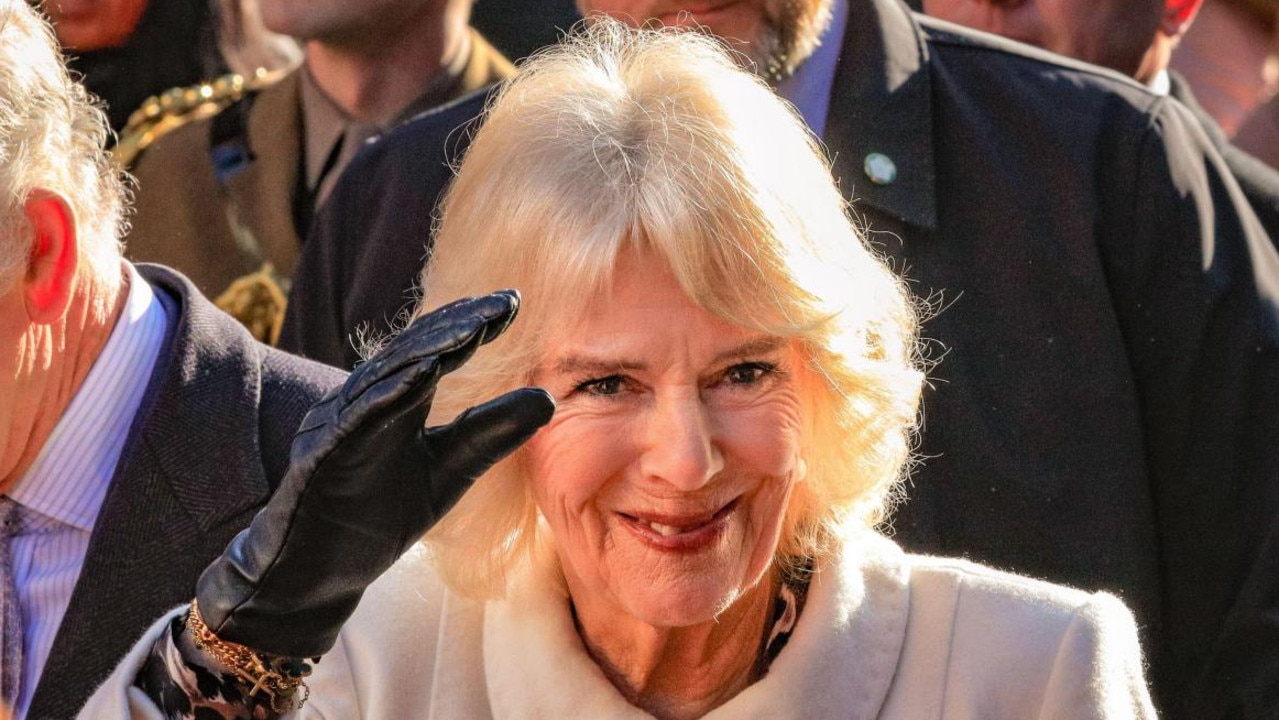
Queen Camilla. The Times
The scarlet glove
Another duty that attaches to the ownership of land is to provide a scarlet glove for the King’s right hand and to support his arm while he holds the royal sceptre during the coronation ceremony. This duty attaches to the lord of the manor of Worksop. From the coronation of Charles II, the owner of the land was the Duke of Norfolk, but in 1840 part of the land was sold to the Duke of Newcastle.
There was a dispute about whether he owned the right part of the land to claim the glove duty, but in 1902 the court of claims decided that he did, and the duke’s family fulfilled this role in the coronations of 1902, 1911 and 1937.
But by 1953 the duke had passed ownership of the land to a family company. The court of claims decided that only an individual, as lord of the manor, could provide the glove and support the king’s arm, so the Duke of Newcastle was excluded.
The manor of Worksop was later sold and it is unknown who owns it and whether they have made a claim to exercise their glove duty. If a prominent footballer, Russian oligarch or a pop singer is seen propping up the King’s elbow during the coronation, you will now know why.
Wands
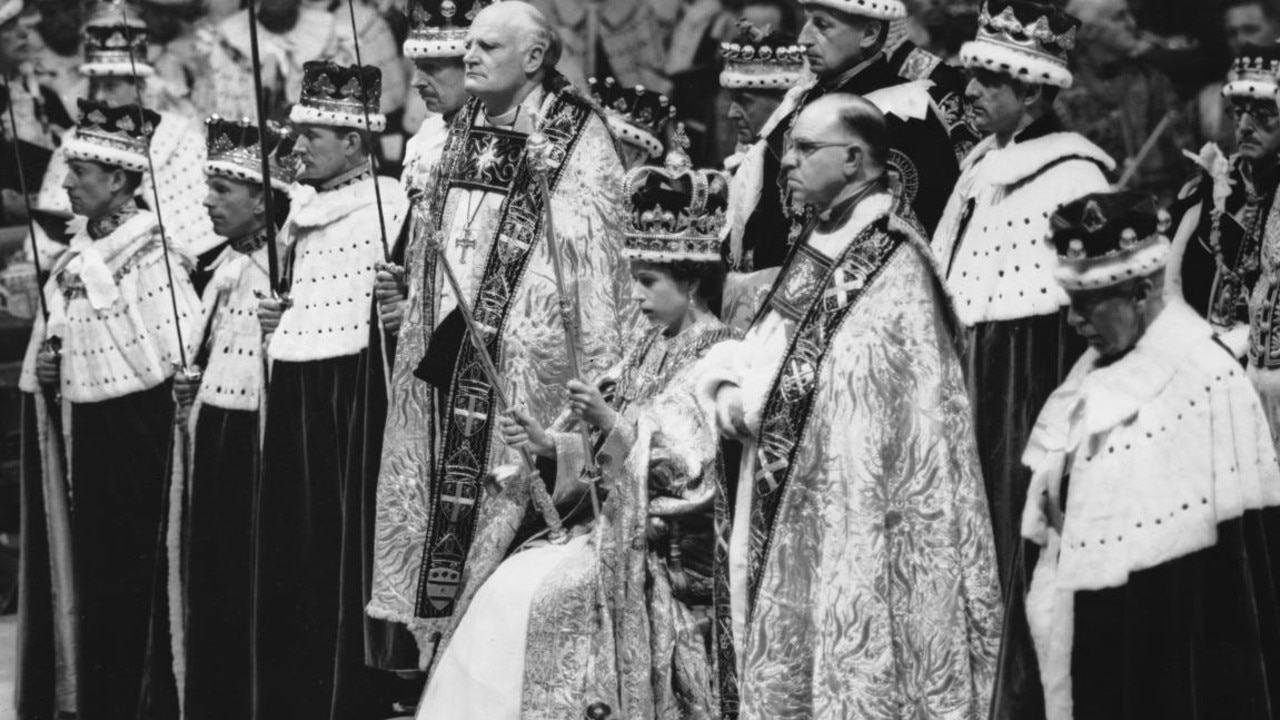
Elizabeth II holds the royal sceptre at her coronation in 1953
The most dramatic moment at the end of the funeral rites for Queen Elizabeth II was when the Lord Chamberlain broke his wand of office and placed it on the queen’s coffin as it was interred.
But a coronation marks the beginning of a reign, so there are plenty of wands, rods, batons and sticks on display, including St Edward’s staff.
So far, we know that the Lord High Constable of Scotland, the Earl of Erroll, has won his right to carry a silver baton tipped at each end with gold.
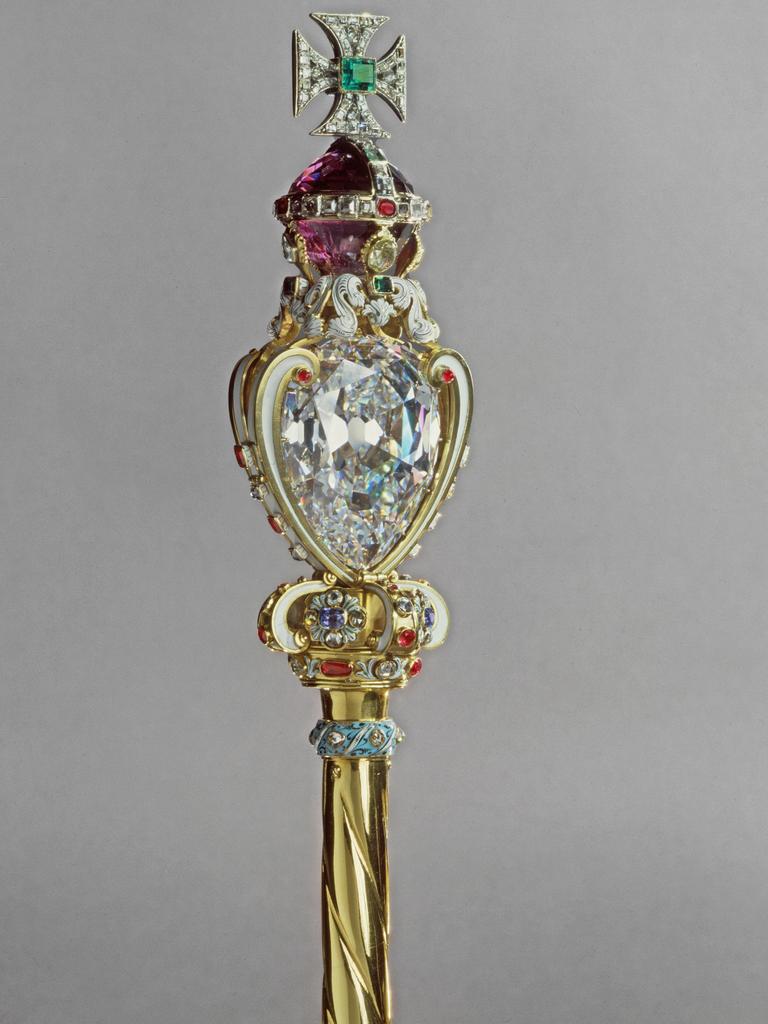
The Sovereign’s Sceptre with Cross.
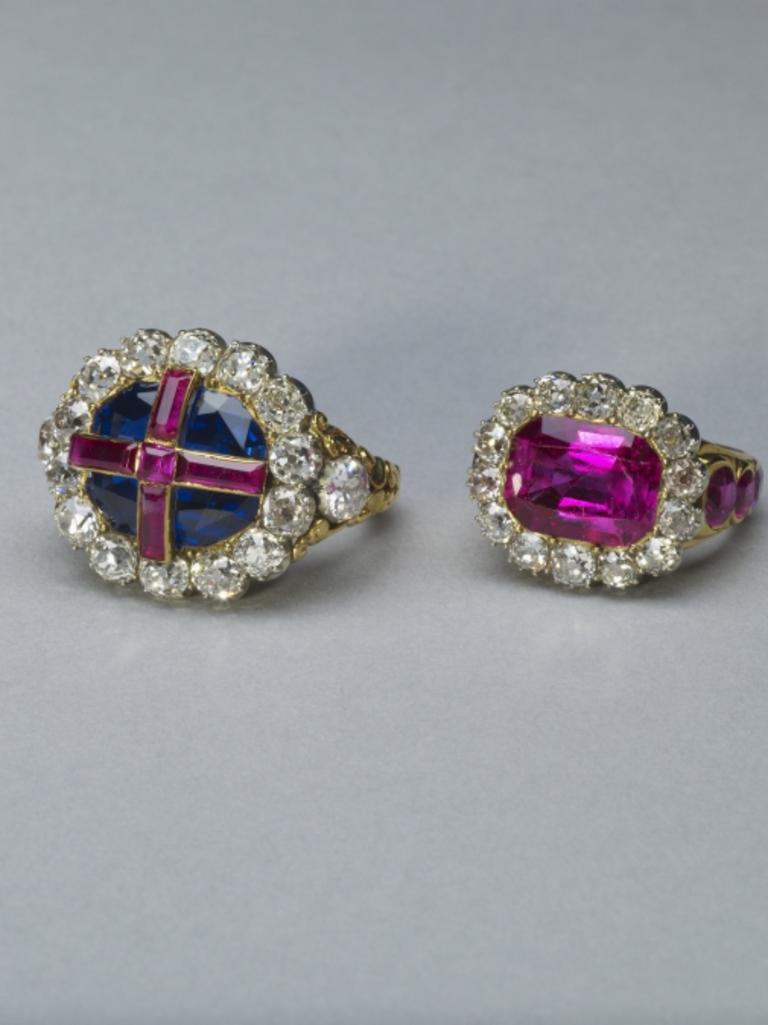
The Sovereign’s Ring, left, and Queen Consort’s Ring.
The Lord Mayor of London, who traditionally carries the crystal mace, will participate. In addition, the Usher of the White Rod (as distinct from the Usher of the Black Rod, who is a parliamentary officer, and the Ushers of the Green Rod, Scarlet Rod, Blue Rod and Purple Rod who serve the royal household) has been invited to attend.
As for the white wand, it is traditionally wielded by the Lord High Steward of Ireland, but the Coronation Claims Office may have exercised the modern-day equivalent of the disarming spell Expelliarmus, leaving him wandless. We must await the coronation spectacle to find out.
Anne Twomey is a professor emerita at the University of Sydney and a constitutional expert.
As Charles is bestowed with mystical powers, so much for a secular coronation
The Church of England is doing its best to turn the new king and queen into latter-day deities
In 1996 more than half of England’s bishops thought Camilla and Charles should never marry. When, in 2005, they did, in a register office, 73% of those polled were opposed to her becoming queen. Although the late queen then denied Camilla the bespoke name checks in Anglican worship enjoyed (until their withdrawal in 1996) by Charles’s first wife, she did enjoy inclusion in regular state prayers for “all the royal family”, followed by her 2022 orison upgrade, one that can still shock unwary congregants out of a spiritual reverie: “Almighty God, the fountain of all goodness, we humbly beseech thee to bless Camilla the Queen Consort.
Now, after a transformation that might in more primitive times have been considered miraculous, the Church of England invites us in its new booklet, Daily Prayers for the Coronation of King Charles III, to celebrate Camilla’s “calling to a life of public service”. Church of Ireland liturgists beseech – or challenge – God, in another Camilla prayer, to “make her an example of virtue and godliness”. If this dismays Diana loyalists unable to forget the rottweiler years, Camilla’s acolytes could reasonably argue that a similar delay in St Augustine’s calling only added to his appeal. There may be hope, yet, for Prince Andrew.
Whatever the final shape of the coronation, traditionalists who fear – as recently reported – that Charles wants some all-faithsy sort of variations on the old template, should surely take heart from the conviction, as testified by feats of prayer-composition alone, with which the Church of England has assumed ownership of the rite. (Not forgetting the king’s probable awareness that a more modest or ecumenical coronation would likely come at considerable cost in Camilla homage.)
While the palace states, vaguely, that the ceremony “will reflect the monarch’s role today”, a letter from the archbishops of Canterbury and York reminds clergy that the ornate enthronement is a religious event: “through it we receive from Jesus”. Though, in a more easily observable transaction, it also receives from the king, in visibly enhanced status, while his mystical authority is, in return, supplied by the clergy in a style that might have verged on the obsequious at the Restoration.
In today’s new coronation prayer we are invited to pray, for example, on behalf of “thy chosen servant Charles our King and Governor”, “that we and all his subjects (duly considering whose authority he hath) may faithfully serve honour and humbly obey him”. A prayer for journalists, in particular, to remember, next time they are denied information on whatever finances he hath concealed.
Repeated arguments for a much edited or secular coronation, citing dwindling Christian belief as well as protagonists less obviously creditable than was Elizabeth in 1953, appear to have dented neither the church’s coronation ambitions nor the palace’s matching enthusiasm for spiritual choreography and knick-knacks. Only the Koh-i-noor has been sacrificed, to be sensitively replaced at the religious ceremony by the largest diamond in the world, the South African Cullinan. With decorative crosses over them, such jewels “remind us”, the prayerbook explains to the untutored, “that Jesus Christ is king over all”.
A royal guide to the “sacred regalia” confidently ignores the possibility that the non-religious, now outnumbering Christians in England and Wales, might find its inventory of treasures, if not absurd, roughly as meaningful as museum labels speculating on the importance of some prehistoric grave-good. Which is not to say that I wouldn’t like my own eagle-shaped chrism-dispenser with convenient removable head; “the oil is poured through an aperture in the beak”.
Non-believers must simply accept that, say, Camilla’s 3ft ivory rod with a dove “symbolic of the Holy Ghost” is too critical to national reverence to allow substitution with a replica more suited to the same nation’s acquired aversion to ivory. That this rod was brand-new on its introduction in 1685 merely underlines, to the devout, the still greater sacredness of an older spoon used in the anointing process. And that this year’s olive oil is literally from the Mount of Olives demonstrates, says the archbishop of Canterbury, “the deep historic link between the Coronation, the Bible and the Holy Land”.
If these links fail to convince younger, more secular, more republican-minded subjects, they may not automatically impress older ones whose presumed pro-Charles tendencies are potentially offset by long memories. Anyone who can recall him, aged 32, smirking “Whatever ‘in love’ means” at the 19-year-old Diana, may think there are worthier objects of prayer. And when did the virtuous Camilla, famously lazy and still a sucker for £735-a-night wellness retreats, start reminding clerics of King Solomon? Or is the deep religious message of the coronation one that the last queen’s conduct helped for so long to obscure: that with heredity in charge, the Church of England is never safe from supreme governance by a future version of Prince Andrew?
Either way, even given the accepted difficulties of picking spiritual leaders, it might have been wise for a church dedicated to the poor to invite fellow professionals to share the responsibility of anointing an irascible billionaire, however docile Charles might currently appear.
No wonder some of the coronation prayers read like a cry for help.
Day 27, “Self-control”: “As we remember the important tasks set before our King, and the challenges he will face, we pray that the fruit of self-control, which informs all our actions and decisions, will give him patience and strength…”
“The Uluru Statement From the Heart, with its reasoned call for constitutional recognition, has become such a politicised issue that it is easy to forget what a beautiful piece of writing it is. It is not even 500 words, but within it is a world: the struggle, tragedy and dignity of one of the world’s oldest living cultures. It discusses the ancestral ties of First Nations peoples to the land, unextinguished by colonisation. It talks about children stolen and incarcerated. “This is the torment of our powerlessness,” it reads “.
You’d have thought that the recognition of Indigenous Australians in our constitution would be a no-brainer, and that their participation as stakeholders and advisers in matters of government policy affecting them, much as many other bodies and institutions do, would be a reasonable and worthwhile proposition. It would, one might’ve thought, be simply the right thing to do.
But you’d be disappointed. Not in today’s Australia, it would seem. The things that divide us are greater than those which unite us.
Anne Twomey, Professor of Constitutional Law at the University of Sydney has written a clear and concise response to the naysayers, fear-mongers and purveyors of misinformation. It ought to be required reading, but as it is behind News Ltd’s paywall, I republish it here.
It is followed by an opinion piece by one time journalist and now academic, Stan Grant, on why the plan for a referendum proposed by our new Minister for Indigenous Australians, Ken Wyatt, may be a forlorn hope (both Grant and Wyatt are indigenous Australians); and after this, an informative article by conservative columnist Chris Kenny.
Kenny is normally a caustic and predictable member of News Corp’s right wing commentariat, but here, he provides a good analysis of the obstacles facing Wyatt and the ambivalent PM Scott Morrison.
“There appears to be no sphere of our national political debate – indigenous groups, conservatives, progressives, media, business, sporting organisations – mature enough to deal with this issue in a meaningful, pragmatic or generous fashion. Perhaps unsurprisingly given the toxicity, shallowness and incompetence of our past decade of national politics, we seemed to have learned nothing about how to conduct this discussion. Instead of reasoned negotiations we have positions shouted and rejected across the airwaves, exaggerations and scare campaigns run against various options … (for) constitutional change that is neither detailed, settled or easily understood. Everyone wants to parade their view … but are less prepared to do the hard work of grinding out a workable compromise. The nation’s first indigenous Minister for Indigenous Australians must despair at the kneejerk responses since he reopened this debate”.
Malcolm Harrison, an old friend of mine, makes the following observations”:
”The liberal, progressive left, identity politics movement seems to have met some severe headwinds of late, and the growing apprehension about some of its more extreme aspects may halt it for the forseeable future. Various forms of conservatism are definitely gaining ground at least in the short term. The voices of oppressed indigenous peoples, and those colonised like India, are growing louder, and demands for financial compensation are becoming more common. It’s only a matter of time before this becomes a very real issue. If I were the government of Australia, I would be making secure deals with what’s left of the indigenous peoples, while I still could. Excluding them from the constitution only strengthens their future case. From the perspective of identity politics, if I were an aboriginal I would be righteously aware that from a human rights perspective, I had a lot to complain about. And sooner or later, the conscience of my society might be forced to acknowledge this in practical ways that at present it is not prepared to countenance or even consider. But, as I imply in the first paragraph, we may not get there in the short term, and indeed we may never get there at all. Indeed, if some of the extreme ideas being privately discussed among our present neoliberal aristocratic elites come to fruition, many more of us might be joining our indigenous brothers on the fringes, beyond the pale”.
There is a darkness at the heart of democracy in the new world “settler colonial” countries like Australia and New Zealand, America and Canada, where for almost all of our history, we’ve confronted the gulf between the ideal of political equality and the reality of indigenous dispossession and exclusion. To a greater or lesser extent, with greater or lessers success, we’ve laboured to close the gap. It’s a slow train coming.
two month’s on, and it would appear that positions have hardened. More like ossified, I would say.
Delivering the 19th Vincent Lingiari Memorial Lecture in early August, Ken Wyatt made explicit, in the strongest terms since becoming Minister for Indigenous Australians, that the Morrison government has decided to dismiss the call for a First Nations Voice enshrined in the constitution.
“I want to be very clear,” he said. “The question we put to the Australian people will not result in what some desire, and that is an enshrined voice to the Parliament – these two matters [constitutional recognition and a Voice to parliament], whilst related, need to be treated separately.”
Whilst carefully choosing how it tackles the Uluru Statement from the Heart, the government’s tactic may be to appear to be doing something, while doing nothing at all.
If the government legislates the Voice without constitutionally enshrining it, it will not only ignore the Uluru Statement and the unprecedented consensus that made it, ii will be setting it up to fail. A First Nations Voice established by an act of parliament alone and not protected by the constitution will one day be diminished or repealed at the whim of a future parliament as has been the fate of all national Indigenous representative bodies. Moreover, Indigenous people do not support mere symbolic constitutional recognition and have dismissed it in regional constitutional dialogues. Those who are to be recognised need to be able determine how they are recognised.
The most remarkable thing about a proposal for an indigenous voice to parliament is how moderate and reasonable it is. It is not a demand to dictate laws. There is no insistence upon a power of veto. There is simply a cry to be recognized — to be listened to with respect.
It means no more than that indigenous views can be channeled into the parliament by a formal mechanism so that they can be taken into account and parliament can be better informed when making laws that affect indigenous Australians.
How many people would prefer that the parliament be poorly informed? Who thinks it is a good idea for parliament to waste money on ineffective programs that achieve nothing?
The proposal is so very reasonable that it has shocked people into imagining hidden conspiracies and conjuring up fright-monsters, because they cannot bring themselves to believe that a proposed change could actually be good.
The best way to dispel fright-monsters is to expose them. The first is the claim that any indigenous voice that could channel its views and advice into the parliament would be a “third house of parliament”.
To state the obvious, it would be a third house only if it was given the power to initiate bills, pass and veto them, and be defined as a constituent part of the parliament in section 1 of the Constitution.
The only people suggesting this are those who are opposing it, so we can strike this off the list of problems.
If the suggestion is that any person or body that formally advises parliament in relation to bills or policies is a third house, then we would have a parliament of very many houses indeed.
Take, for example, the Independent National Security Legislation Monitor, whose role is to provide independent oversight of national security legislation and make recommendations about it, which are tabled in parliament. The monitor is currently conducting an inquiry into laws that terminate the citizenship of people involved with terrorism. Does this make the monitor a “third house of parliament”?
If so, the monitor would join the Auditor-General, the Productivity Commission, the Australian Law Reform Commission, the Australian Human Rights Commission and the many other bodies and people whose job it is to ensure that the parliament is better informed about particular subject matters.
All of these bodies and officers have influence, and should be listened to with respect because of their experience and expertise, but that does not mean they dictate legislation and government policies.
Governments have to take into account broader issues as well, such as the budgetary position and the general wellbeing of the entire country.
There is no greater threat in having an indigenous body advise and influence the parliament than there is in relation to any of these other bodies. Instead, there is a benefit in having a better informed parliament and hopefully better targeted laws and policies.
The next argument is that if this indigenous voice is enshrined in the Constitution, the High Court will get involved and every time indigenous advice is not followed there will be litigation and the High Court will force the parliament to give effect to that advice. This view is misguided. It is part of the principle of the separation of powers that the courts do not intervene in the internal deliberations of the parliament.
The High Court has held that it will not enforce constitutional provisions, such as sections 53 and 54 regarding money bills, because they concern the internal proceedings of the houses. As long as the constitutional provisions concerning an indigenous voice were drafted to make it clear that consideration of its advice was part of the internal proceedings of the houses, the matter would not be one that could be brought before, or enforced by, the courts.
The third argument concerns equality. Some have argued that there is a fundamental principle of equality in the Constitution and that division on the basis of race should not be brought into the Constitution.
First, there is no general provision of equality in the Constitution. For example, Tasmanians have, per head of population, far greater representation in the federal parliament than voters from NSW.
Members of parliament might also be aware by now that section 44 disqualifies them if they are dual nationals.
Second, the Constitution has always provided for distinctions based upon race. From 1901 to 1967 section 127 provided that for certain purposes “aboriginal natives” were not counted in the population.
This did not mean that they weren’t counted in the census. Every census, from the very first, has included detailed information about indigenous Australians. But it did mean that when determining the population for the purpose of calculating how many seats a state had in parliament, indigenous Australians were excluded from the statistics until this provision was repealed in the 1967 referendum.
Section 25 continues to provide that if a state excludes people from voting on the basis of race, it is punished by having its population reduced for the purposes of its representation in the federal parliament. Section 51 (xxvi) continues to allow the federal parliament to make laws with respect to the “people of any race for whom it is deemed necessary to make special laws”.
There are good reasons today to remove sections 25 and 51 (xxvi) from the Constitution, but there will still be a need to include some kind of power to make laws with respect to indigenous Australians.
This is not because of race. It is because of indigeneity.
Only indigenous Australians have legal rights that preceded British settlement and continue to apply today.
Only indigenous Australians have a history and culture unique to Australia.
It is not racist, divisive or a breach of principles of equality to enact laws that deal with native title rights or protect indigenous cultural heritage.
Nor is it racist, divisive or in breach of principles of equality to allow the only group about whom special laws are made to be heard about the making of these laws. Indeed, it is only fair, and fairness is a fundamental principle that Australians respect.
Anne Twomey is a professor of constitutional law at the University of Sydney.
Ken Wyatt, a man in the cross-hairs of history
Stan Grant, Sydney Morning Herald, 13th July 2019
Ken Wyatt is a man of history. He has defied a history of Indigenous children stolen from their families. He has defied a history that locked Indigenous people out of Australian political life, that for too many years denied Aboriginal people full citizenship. This week he made history, speaking at the National Press Club as the first Aboriginal person to be a cabinet minister in a federal government – an Aboriginal person leading the portfolio for Indigenous Australians.
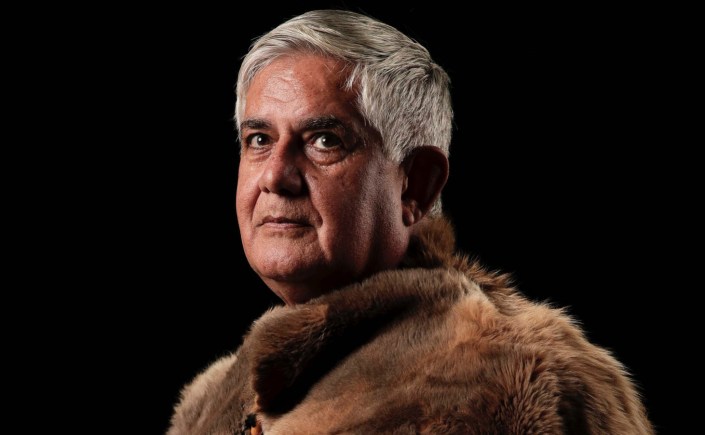
Ken Wyatt, the Minister for Indigenous Australians (Alex Ellinghaussen)
But when it comes to constitutional recognition of Indigenous people, history is against him. There have been 44 referendums put to the Australian people and only eight carried. It has been more than 40 years since the last yes vote. We set a high bar: change requires a majority of voters in a majority of states. Fifty per cent of the national population plus one is not enough.
The numbers are against him: Indigenous people are fewer than 3 per cent of the Australian population seeking to win over 97 per cent. Politics is against him: he is in the wrong party; more than half of all referendums have been put by the ALP. Right now, Ken Wyatt cannot even count on the full support of his own side of politics.
If a referendum won’t succeed, there will be no vote, he says. He’s hoping for consensus, bringing together political opposition including influential politicians such as Pauline Hanson. He wants a conversation with the Australian people around barbecues and dinner tables. His hardest conversation will be with Indigenous people.
Black Australia has already spoken. The Uluru Statement from the Heart remains the clearest expression of the aspirations of Indigenous people, emerging out of an exhaustive and emotional process of negotiation and consultation. It is itself a compromise, a conservative position, achieved in spite of understandable hostility from some Indigenous people who have no faith in Australian politics. Now they are being asked to compromise again.
What was all of that for? Where is the trust? The previous Turnbull government rejected the key recommendation of the Uluru Statement, that there be a constitutionally enshrined “voice” – a representative body allowing Indigenous people to advise and inform government policy. Prime Minister Scott Morrison was among many who called it a “third chamber” of Parliament. He reportedly has not shifted from that view.
Wyatt has already framed future negotiations by indicating that he may prefer some symbolic words of recognition in the constitution and a legislated statutory voice. He is testing the resolve and agility of Indigenous leadership. Will they walk back their demand for a constitutional voice? Can they accept symbolism? He’s already sought to recast constitutional recognition as the preserve of urban Indigenous elites, disconnected from impoverished remote black communities.
Ken Wyatt is also on a collision course with the Labor opposition. Senior Indigenous ALP figures Linda Burney and Patrick Dodson have reasserted their commitment to the spirit of the Uluru Statement and full constitutional recognition. It sets up a divisive political battle, which would scuttle any hope of a successful referendum.
Constitutional lawyer George Williams knows how difficult referendums are. He has previously laid out a roadmap to a yes vote. It requires political bipartisanship and popular ownership. It cannot be perceived as political self-interest. The public must know what they are voting for, so it requires popular education. Referendums, Williams warns, are a minefield of misinformation.
And there must be a sound and sensible proposal.
Professor Williams has cautioned that the referendum process itself may be out of date – not suited to contemporary Australia. He says referendums should be expected to fail if there is political opposition or if the people feel confused or left out of the process.
On that basis, as it stands right now, an Indigenous constitutional voice looks a forlorn prospect.
But there is a glimmer of hope and it comes from our history. In 1967, Australians voted in overwhelming numbers – more than 90 per cent, the most resounding yes vote ever – to count Aboriginal people in the census and allow the Parliament to make laws for First Peoples.
Ken Wyatt is invoking the spirit of ’67, but he also knows its lesson: it was a victory of fairness over difference. Australians are wary of difference, suspicious of questions of rights. Australia has no bill of rights; our constitution is a rule book, not a rights manifesto. Australia is a triumph of liberalism where people are not defined by their race, religion, ethnicity or culture. Australia is a place where migrants are encouraged to leave their histories and old enmities behind. Nationally we are more comfortable mythologizing our own history than probing its darkest corners.
Indigenous people live with their history; they carry its scars; it defines them. In a country founded on terra nullius – empty land – where the rights of the First Peoples were extinguished, where no treaties have been signed, this – as the Uluru Statement says – is the torment of their powerlessness.
When it comes to Indigenous recognition – symbolism or substance – black and white Australia speak with a very different voice.
Ken Wyatt, a man of history, is now in the cross-hairs of history.
Stan Grant is professor of Global Affairs at Griffith University. He is a Wiradjuri and Kamilaroi man.
The key to an indigenous voice’s success – it must be practical
Chris Kenny, The Australian, 13th July 2019
For all their best intentions, it might have been a mistake for Ken Wyatt and Scott Morrison to put indigenous constitutional recognition back on the agenda and commit to getting it done in this term of government. There appears to be no sphere of our national political debate — indigenous groups, conservatives, progressives, media, business, sporting organisations — mature enough to deal with this issue in a meaningful, pragmatic or generous fashion.
Perhaps unsurprisingly given the toxicity, shallowness and incompetence of our past decade of national politics, we seemed to have learned nothing about how to conduct this discussion. Instead of reasoned negotiations we have positions shouted and rejected across the airwaves, exaggerations and scare campaigns run against various options, and groups as diverse and seemingly irrelevant as national sporting organisations and major businesses running jingoistic campaigns supporting constitutional change that is neither detailed, settled or easily understood.
Everyone wants to parade their view and, yes, signal their virtue, but they are less prepared to do the hard work of grinding out a workable compromise. The nation’s first indigenous Minister for Indigenous Australians must despair at the kneejerk responses since he reopened this debate.
Completely lost in the debate is the genesis of the “voice” proposal as a compromise proffered by conservative thinkers looking to deliver a meaningful outcome for indigenous Australians while preserving the integrity of the Constitution. This concept, first devised by indigenous leader Noel Pearson building on work by now Liberal MP Julian Leeser, conservative philosopher Damien Freeman and others, was assiduously workshopped and then explained and promoted to politicians, commentators and activists.
At the heart of this proposal, and a key to understanding this debate, is the desire to ensure constitutional recognition provides more than a cursory or symbolic mention of Aboriginal people in our nation’s founding document but delivers a practical outcome for indigenous advancement. This would be done by guaranteeing indigenous input into decision-making over their affairs — something that happens informally now but under the plan would be genuinely representative and underpinned in the Constitution.
In return, the Constitution would be protected from more radical change and a statement of national values would make more poetic exclamations about the shared indigenous, British and immigrant strands of our national bounty, outside of the Constitution. Incredibly, all the work devising this approach occurred outside the official channels such as the expert panel and select committee inquiries.
Initially its prospects seemed likely to match those of a snowflake at Uluru. It was attacked as a sop by the activists on the left who argued for a racial non-discrimination clause to be inserted into the Constitution as well as an indigenous affairs power and recognition clause that looked like a broad-ranging, de facto bill of rights. The right branded this voice approach as a divisive attempt to give additional rights and representation to indigenous Australians — an attempt to inject race into the Constitution.
Never mind that race is already embedded in our Constitution and that whatever happens on recognition the detailed constitutional changes are likely to remove those redundant race-based clauses. Never mind that by dint of legislation such as the Native Title Act there already are very specific measures that fall under the constitutional responsibility of the federal government that demand special consideration for indigenous people. And never mind that successive governments, Labor and Liberal, have had informal bodies to provide advice from Aboriginal people on these issues.
Somehow, mainly because of the power of the ideas but also thanks to the persuasiveness of Pearson and his team, the thrust of these ideas was embraced by a summit of indigenous community leaders at Uluru in May 2017. It was a monumental achievement but the grandiloquence of the “Statement from the Heart” would always frighten many horses.
Talk of “first sovereign nations” and spiritual links to the land was anathema to calculated, clinical constitutional change. Having invested some time in comprehending this process, I recall being immediately dismayed by the emotive words of the Uluru statement because I foresaw the political resistance they would trigger. It is a beautiful statement in many ways, and certainly encapsulates a wise position, but constitutional change is no place for emotionalism. Still, at its core are two proposals: “the establishment of a First Nations Voice enshrined in the Constitution” and “a Makarrata Commission to supervise a process of agreement-making between governments and First Nations and truth-telling about our history”.
This is now characterized as indigenous people asking too much of their non-indigenous compatriots. It is actually the opposite; these proposals can be seen as a generous offer of compromise from Aboriginal Australia to try to advance reconciliation in a practical but meaningful way.
Instead of demanding a racial non-discrimination clause and direct recognition of their rights in the Constitution, indigenous Australia is merely looking to have a guaranteed, advisory and non-binding input into legislation that affects them. And instead of demanding a treaty, they have come up with a regionally based process of agreements and truth-telling under the Yolngu (Arnhem Land) word of Makarrata, which encompasses conflict resolution but helps to avoid divisive arguments over treaties.
Conservative politicians as different as Malcolm Turnbull and Tony Abbott have dismissed the entire voice proposal as a “third chamber” that is too radical to contemplate. This has made the voice a third rail in the debate.
This is disappointing and ultimately dishonest because there are so many options available to arrange the representation and functions of a voice that if anyone has concerns it might be directly elected and wield some kind of informal veto power over parliament then a way to deal with the issue is to propose an acceptable format rather than just create fears over a third chamber. Otherwise, are they really suggesting the Aboriginal advisory councils reporting to Labor and Liberal governments over past decades have operated as third chambers of parliament?
Not all the blame for the emptiness of this debate rests with the conservatives — let me remind you, conservative thinkers were at the genesis of this proposal. The sloganeering on the progressive side has probably created more concern in the community than the scare campaigns from the Right.
People like Marcia Langton have been so aggressive towards their perceived ideological enemies that they burn goodwill faster than others can create it. And when big business and big sport start pushing loosely formed ideas about Recognition or a Voice onto customers and supporters — out of context and without formal proposals even being in existence — they raise the suspicions of voters, if not their hackles.
The most likely avenue for compromise now is for Morrison to prevail, as hinted at in Wyatt’s speech, and have a voice formalised through legislation but not mandated in the Constitution. This will disappoint many indigenous people but might fly.
Another idea worth consideration to assuage the doubters might be some sort of sunset provision. There is a legitimate argument to be made that one race-based grouping should not have separate consideration in our political processes. For reasons I have outlined previously (mainly recognizing historical disadvantage and accepting special status under native title rights), I think an exception should be made for indigenous Australians. But perhaps in the spirit of the Closing the Gap initiative, any changes could recognize that once those crucial gaps in social outcomes between indigenous and non-indigenous are closed, then special representation might no longer be required.
That will be a long way off. But it might provide extra emphasis on the need to focus on practical outcomes rather than mere symbolism. Let us see where the debate takes us in coming months. Success for Wyatt would be success for the nation. But he and Morrison need to be wise enough to walk away from their self-imposed time frame if necessary.
This will be worthwhile only if it delivers something practical that can help indigenous advancement and provide closure to decades of debate. A trite phrase dropped into a preamble to make the majority feel good about themselves won’t be worth the effort and could create more trouble than it is worth.