The Wrath to Come. Gone With the Wind and America’s Big Lie

You offspring of serpents who warned you of the wrath to come. Matthew 3:7

There was a land of Cavaliers and Cotton Fields called the Old South. Here in this pretty world, Gallantry took its last bow. Here was the last ever to be seen of Knights and their Ladies Fair, of Master and of Slave. Look for it only in books, for it is no more than a dream remembered, a Civilization gone with the wind.  Prelude to the film of Gone with The Wind (1939)

… by the time you can no longer avoid thinking about your history, it has become so complex and confusing that you can no longer think about it clearly, and your morality is what is gone with the wind.
Sarah Churchwell, The Wrath to Come (2023)

American cultural historian Sarah Churchwell’s book The Wrath to Come – Gone With the Wind and the Myth of the Lost Cause or its alternative title, the Lies America Tells (tells itself” is more accurate) is a harrowing read about slavery, America’s original sin; about the civil war fought to end it; the brief Reconstruction years that followed; the lingering stain of white supremacism and racial violence; and of how discriminatory and oppressive Jim Crow laws of the late nineteenth century survived well into the twentieth with lynch law, segregation, vote suppression and the civil rights struggles of the sixties.

The Wrath to Come is also about how historiography – how historians analyze and interpret history, and how “we, the people” recall and retell history.

She quotes author and civil rights advocate James Baldwin’s essay The White Man’s Guilt:

“White man, Hear me! History, as nearly no one seems to know, is not merely something to be read. And it does not refer merely, or even principally, to the past. On the contrary, the great force of history comes from the fact that we carry it within us, are unconsciously controlled by it in many ways, and history is literally present in all we do”.

Churchwell notes how in 1935, Black writer WEB Du Bois warned “against writing history for our pleasure and amusement, for inflating our national ego”, or “using a version of historic fact, in order to influence and educate the new generation along the way we wish”. Such propaganda history is merely “lies agreed upon”, and had enabled a toxic mixture of libel, innuendo and silence to poison the well of American historiography”.

The Wrath to Come is also very much about today. Running right through the narrative are the currents and crises that culminated in the great American unraveling that led to the storming of the Capitol on January 6, 2021 – and as we know well, are yet to be fully played out in November 2024, and, as is most likely, beyond it. January 6th was, in her opinion the actualization of what Baldwin called “the wrath to come”, the moral derangement – spinning the nation off its axis. “Beyond the bars of our foolish little cages”, she writes, “a reckoning looms, at a scale we can’t assimilate”.

As an article in the New Yorker wrote recently, the pertinent issue now is not what caused the Civil War but what we should have learned from it. “January 6, 2021, is not an equivalent date in our history to April 12, 1861, but the radical Republican leaders who lived through the Civil War understood a principle that has been lost on their successors: that, if entrusted with power, leaders who commit assaults on the national government once may well attempt to do so again”. Many commentators remind Americans of the time when Benjamin Franklin, one of the original framers of the US Constitution, was walking out of Independence Hall after the Constitutional Convention in 1787, when someone shouted out, “Doctor, what have we got? A republic or a monarchy?” To which Franklin supposedly responded, with a rejoinder at once witty and ominous: “A republic, if you can keep it.”

“The past is not a prediction” Churchwell writes, “but it is a precedent, creating the possibilities for what the future will tolerate. The American future would, it turns out, tolerate a great deal”.

Gone with the myth 

Gone with the Wind shows what white America has believed – and wanted to believe – about its own history; it’ curates and cultivates America’s great white myths about itself.

Churchwell anchors her history around one of the most well known and loved stories of the twentieth centuries – the novel and the film of Atlanta author Margaret Mitchell’s epical Gone With the Wind. But while she may be deconstructing the iconic motion picture, it is very evident that the real target of her thesis is number forty-seven, whom she sees as America’s chaos personified. Whilst describing the brief and ineffective Reconstruction years that followed the American Civil War, with its “scallywags and carpetbaggers”, she gaslights “the greatest grifter the Republic has ever seen”. Like slavers, abortion and Vietnam, Trump is an issue that divides Americans, splitting families, straining the mystic chords of memory.

Within six months of its release in June 1936, Mitchell’s tale of tangled love set against the northern invasion and fall of the Old South, sold one million copies, making it the biggest-selling American novel to that date. It won a Pulitzer Prize and National Book Award, and has sold more than 30 million copies internationally.

The 1939 film adaptation starring Vivien Leigh as willful anti-heroine Scarlett O’Hara and Clark Gable as her rakish third husband Rhett Butler, won eight Academy Awards, including best picture, best actress for Leigh and best supporting actress for African-American actress Hattie McDaniel. McDaniel portrayed Scarlett’s outspoken chief house slave, Mammy, and made film history as the first black woman to take home an Oscar (although she was colour-barred from attending the Atlanta world premier).

Churchwell mounts an excoriating critique of the novel-turned-film for its denialism of the horrors of slavery and “shameless” historical distortions about the civil war and its aftermath. Such denialism, she contends, continues to divide America today.

Churchwell’s book adds a contemporary, political twist to such criticism: she argues America’s “most famous epic romance … provides a kind of skeleton key, unlocking America’s illusions about itself” and she links its sanitized treatment of slavery and promotion of white nationalism to Trumpism and the January 6, 2021, attack on Washington’s Capitol.

“When we understand the dark truths of American experience that have been veiled by one of the nation’s favourite fantasies, we can see how the country travelled from the start of the Civil War in 1861 to parading the flag of the side that lost that war (the Confederate flag) through the US Capitol in 2021.’’

Gone with the Wind advances a misleading version of American history known as the Lost Cause. This is the notion that “the Confederacy fought the Civil War (1861–65) as a principled defense of a noble civilization (the Old South) and its democratic rights, rather than as an unprincipled defense of the white supremacist system of chattel slavery … The specific rights in question were individual states’ rights to keep and trade enslaved people, but the Lost Cause skipped that part.’’

Extending this mythology, the film’s opening title cards briefly mention slavery but also refer to the Old South – which was home to four million slaves – as “a land of Cavaliers and Cotton fields,” and a “pretty world where Gallantry took its last bow.”

Similarly, she writes that Gone with the Wind “marks a cultural breakdown, the point where mythology triumphed over history’’. Therefore, “urging the erasure of Gone with the Wind would simply reinforce that … “

“… when a nation’s myths, no longer make sense of its reality, violence erupts. That is one of the many things that has happened to America. Mythmaking and misinformation have been spinning wildly through American political discourse, so they can be hard to catcher as they float, disembodied across our conversations … Like a carnival magician, myth-making points at something with its right hand while picking our pockets, with its left stop. If we stop looking where it’s pointing, we might just manage to protect our valuables – in this case a republic, if we can keep it … It turns out that the heart of the myth, as well as its mind, and its nervous system, most of its arguments and beliefs, it’s loves and hates, it’s lies and confusions and defense mechanisms, and wish fulfilments, are all captured) for the most part in inadvertently) in America’s most famous epic romance: Gone with the Wind.

… and when a country, become so lost in dreams, that it can no longer see reality, it loses its moral sanity … This book follows American history back down into the myth, to excavate what’s been buried – not just the fact that historians have carefully been long, bringing to light … but also suppressed psycho political realities. The lies, the distortions, justifications, the half-truths, the rampant projections, the cognitive dissonances, the negations, the flat denials all the stinging truths Americans don’t want to admit about ourselves that Gone with the Wind caught like flypaper …

It has often been said that America had to imagine itself to existence. Less often remarked is the corollary, that America is, in a very real sense, mainly a story the nation tells itself. That makes the US singularly subject to the meanings of stories and myths – all nations tell stories about themselves, but America has little to hold it together beyond those stories (which is one of the reasons it fetishes its founding documents). If Gone with the Wind is one of the most popular stories America has ever told about itself, then it matters that it is a profoundly antidemocratic, and a moral horror Show … judgment has been remarkably absent from the stories we tell about ourselves.

While Churchwell hopes that Donald Trump loses the November election, she is hardly optimistic about the republic’s future.  She sees the events of the last eight years, and indeed those preceding as “portents of a much deeper dislocation in American society. For over two decades now, Americans have been battered by non-stop crises at home and abroad – from the long War on Terror to Covid and the George Floyd protests – leading to what feels like national exhaustion and a deep pessimism about the future of democracy”.

 The old revolution and The Lost Cause

Gone with the Wind took a series of historical forces, and made them seem only natural

Maybe we were on the losing side. Not quite sure it was the wrong one. 
Captain Mal Reynolds, Firefly (episode 3)

From the beginning of Donald Trump‘s campaign to the turbulent end of his presidency, debates raged about whether his supporters were motivated by economic anxiety or racial animus. But in America the two are intertwined in a system of racial capitalism.

Gone with the Wind doesn’t just romanticize that system – it eroticizes it. The Lost Cause provided a genesis for modern America’s racialized economics and paramilitary white nationalism, in which racial segregation was the supposedly logical outcome of a fight over states’ rights. But the most vicious fights over these supposedly principled stances on states’ rights have always consistently been over racial power. In fact, states’ rights are almost never invoked in a context that is distinct from race. States’ rights created a fig leaf, an alibi from which white America benefits so deeply that the denials continue to this day.

Slavery was America’s Original Sin, a stain running through its technicolor grain. Over the period of the Atlantic Slave Trade, from approximately 1526 to 1867, some 12.5 million men, women, and children were taken in captivity from Africa; 10.7 million were taken aboard ship to the New World and placed in bondage in the Americas – possibly the costliest in human life of all long-distance global migrations. Four hundred years of slavery ended in civil war and a wasteland.

America’s road to the Civil War took decades. It is beyond the scope of this article. but within a month of Lincoln’s victory in the presidential election of 1861, South Carolina took the fatal step, followed over the next few months by the secession of most of the Lower South. A month after his inauguration, the Civil War erupted with the bombardment of Fort Sumter in Charleston harbour. As Churchwell recounts it, “…. once a people decides that it cannot live together or when a citizenry divides into clearly opposed blocs, it is impossible to predict just how conflict may erupt. But to say that it cannot happen is to ignore history. Even Lincoln downplayed the threat of southern secession during the 1860 campaign, not believing until it was too late that the South ever would take such a final step”.

The American Civil War claimed more than seven hundred thousand American lives, tore a young nation apart, and its echoes reverberate still one hundred and sixty years later, reflecting unresolved political fault lines that go back two centuries. years. Though the war ended slavery, there was still another hundred years of toiling towards true freedom. As Martin Luther King said, “Lord, we ain’t what we want to be; we ain’t what we ought to be; we ain’t what were gonna be, but thank God, we ain’t where we was”.

“The white South grabbed the moral high ground and clung on for dear life – while the white North met it more than halfway. By the turn of the century the south was winning the war of ideas, its big lie accepted across the United States”.

It used to be said that the South would rise again. It did, and indeed, some reckon, the South finally won the war.

Dixie rising 

Predictably, the ghosts of the American civil war have been haunting the ongoing presidential campaign and have forced their way back into popular consciousness.

Statues depicting figures from the war – and even of founding fathers or older presidents – and even the names of the schools, military bases and streets, have increasingly become a flashpoints for a real political and cultural struggle. A low-intensity war on the past is now being waged across many states, with the effect of hardening hearts and solidifying the battle lines being drawn in the sand.

In May 2024, it was reported that the Shenandoah County School Board in Virginia would restore the names of Confederate generals Thomas “Stonewall” Jackson, Robert E. Lee and Turner Ashby to two local schools. The controversial reversal comes nearly four years after the names were changed.

“Residents speaking in favour of reverting to the Confederate names included Stuart Didawick, who noted that his family’s roots run deep in the community, where his ancestors received land grants in the decades before the American Revolution. “When you vote on the name restorations”, he asked board members, “will you listen to the opinions of woke outsiders who have for the most part no ties to the land, the history, or the culture of this county? Or will you listen to the voices of the people who elected you to represent them, the people whose families built and have sustained this county for generations?” To which a student and athlete responded: “I would have to represent a man that fought for my ancestors to be slaves,” adding that she would feel as if she’s being disrespectful both to her ancestors and her family’s values.

Another pervasive ghost of the Civil War, the battle flag of Dixie, has never gone away. It was long a favoured accessory above government buildings and at right wing rallies in The South, those former secessionists states that lay south of the Mason-Dixon Line. It played a cameo role in popular culture, flying in The Dukes of Hazzard, True Blood, and even The Walking Dead. The right to flaunt “the Stars and Bars”, an enduring symbol of the lost Confederate cause, and a rallying point for those who still believe the rebel cause to be just, those who take solace from an heroic defeat, and those who believed that “the South will rise again”, and indeed those who KNOW that the South has indeed risen again. For have not the white, right wing, God fearing, Clinton-baiting, and Obama-hating ‘Red’ states of the South conquered and colonized the American political system?

Failed Republican presidential hopeful Nikki Haley was governor of South Carolina, the first state to secede in 1861, in 2015, when in 2015, Dylann Roof, a young white supremacist who had draped himself in the Confederate flag, massacred nine African American parishioners at a Black church in Charleston, the state capital. Haley called for the removal of the Confederate flag from the grounds of the State House, where it had been hoisted in the early 1960s as a rebuke to the civil rights movement. When the flag came down, a ceremony that felt like the final surrender of the Civil War, little did we know that what we were actually witnessing that summer was the beginning of the white nationalist counter-offensive headed by Trump. In a strange quirk of history, he launched his presidential bid the very day before the Charleston massacre.

During the run up to the Republican primaries, POTUS aspirant and Florida Governor Ron DeSantis defended part of his state’s African American history curriculum standards that claimed some enslaved people developed skills that “could be applied for their personal benefit.” Flag-remover Nikki Haley omitted any mention of slavery when she was asked to explain the cause of the Civil War at a town hall event. It wasn’t until the next day that Haley acknowledged the war was “about slavery”. Both now failed candidates reflected unresolved political fault lines that go back nearly 200 years.

© Paul Hemphill 2024.  All rights reserved

In !955, Ella Fitzgerald was jailed for singing to an integrated audience in Texas

Author’s note

Last year, my favorite podcast The Rest is History broadcast a long but informative interview with Churchwell herself. The link is below. I also republish a review of the book and its content that first appeared in The Australian in April 2023, and the unique story an escaped slave who found his way to Australia and lived to tell his tale in print – an 18,000-word essay about slavery, titled The United States Governed by Six Hundred Thousand Despots. 

Such was my enthusiasm for Churchwell’s book, I transcribed many of what I considered to be memorable and cogent quotes.  They are categorized and listed immediately after the following videos.

For other posts in In That Howling Infinite about the American Civil War, see Blind Willie McTell – Bob Dylan’s Americana, Cross the Green Mountain – Bob Dylan’s Americana, Rebel Yell, Land of the fearful – home of the heavily armed, and regarding American Fascism prior to World War II, see The Shoah and America’s Shame – Ken Burns’ sorrowful masterpiece 

Like my father before me
I will work the land
And like my brother above me
Who took a rebel stand
He was just 18, proud and brave
But a Yankee laid him in his grave
I swear by the mud below my feet
You can’t raise a Kane back up
When he’s in defeat
Robbie Robertson, The Band

Churchwell quotes …

The Dixie Dreamtime

The story is cloaked in self-delusion far worse than Scarlet’s, and the film – which recognizes the novel’s flaws more clearly perpetuated these solutions out of commercial interests. This modern myth affirmed all the nation’s favorite illusions about itself, up to and including its faith in its own innocence – and then sold that bill of goods to all and sundry, making a fortune in the process. Scarlett’s blinkers are typical too – the willful ignorance in which American popular memory likes to trade. What she couldn’t or wouldn’t see is the subject of the rest of this book …

… the savage viciousness of Jim Crow produced the consoling legend of a noble land of Cavaliers, and ladies, who presided over loyal servants, with gentle benevolence, which would become America’s favourite story for decades to come. Listen closely to what a culture keeps telling itself, and you’ll know not only what’s on its mind, but what it needs to hear. Gone with the Wind told Americans that they could survive anything, especially if ignored it … the denialism of American culture (is) its refusal to face facts, to recognize that what it tells itself simply isn’t true …

Even as white Americans were sharply censoring the rise of Fascism in Europe, traveling to Spain to volunteer against Franco’s army, they were also longing for the good old days when the United States have enslaved millions of non-white Americans …

Good stock

Slavery was abolished by the war, but white supremacism was not. The problem was that white Americans could abhor slavery, and fight a war to end it, and also abhor Black people. They could believe that slavery was a moral abomination, and also believe in eugenicist racial science that claimed non-white people were biologically inferior to white people, and that racism was the natural order of things, even if slavery was not …

Gone with the Wind appeared a mere decade after the Scopes Monkey Trial took Darwinism to court to try to deny that humans will be related to apes. The immense anxiety sparked by this idea was bound up in older racist tropes which held the Black people were apes and white people were human. Proof that white people were also descended from apes challenged the racial hierarchy …

Once white people were forced to concede that they might’ve come out of jungles two, scientific gracious, and sort through that they had emerged much earlier, and how much farther and Black people

Playing along with lesser folks, taking from them what you can, and then, kicking them to the curb, is also the secret of social Darwinism, which is inextricable from the novels racism. Both preach survival of the fittest, defining fitness through biological determinism, as heritable traits that mean survivalism is a question of innate character rather than environmental good fortune These ideas are fundamentally eugenicist, claiming not only that some humans “stock” is biologically superior to others, but that such groups come racially and ethnically presorted. Presumptions of lesser and greater beings, the right of merit to rule, was at the heart of the argument: an aristocratic entitlement to title that claimed privilege was founded on inherited superiority, rather than brute force or the dumb luck of circumstance … the notion of “good stock” and “breeding” that underpinned scientific racism …

In the wake of first first world war and the Russian revolution, the “red scare” enabled the second Klan to maintained its white supremacism but expanded its list of enemies to include most foreigners, especially Catholics, Jews, eastern and southern Europeans, as well as communist, socialist and labor organizations, all of whom it generally equated. This broad, stroke nativism was strongly eugenicist, promising to protect the “pure stock” of white American Protestantism from the racial “pollution” of mixing with inferior breeds …

Heirs to the white supremacist cause, the replacement theorists, Tucker Carlson, Kyle Rittenhouse. Fox host Tucker Carlson professed to be “shocked” that “seventeen year olds with rifles decided they had to maintain order when no one else would”. This is precisely the alibi that was always offered for white supremacist violence, straight out of Gone with the Wind and the newspaper lynching reports that that accompanied it. Scapegoating makes violence redemptive, as savagery is projected onto its victims, who deserve what they’re getting. The Klan was a group shaped around projection and scapegoating. Apologists of white supremacist from Thomas Dixon and Margaret Mitchell to Tucker, Carlson and Ann Coulter to the hyper partisan mob that stormed the Capitol all insisted that they were defending “extralegal justice”, as if extralegal were not just another word for illegal …

History is endlessly revised, even when it’s been chiseled in stone. Newly discovered facts can improve our understanding of the past, and sometimes people even ask new questions about the same old facts.

… Black Americans are left arguing that they are the ones owed by a nation which is yet to redeem the promises it made to the makes to them. That is the entire import of Dr. King’s 1963 “I have a dream” speech, a metaphor of redemption that he makes explicit, and explicitly economic: “we’ve come to our national capital to cash a check”, King said, on the “promissory note” signed by the architects of our republic, a promise of “unalienable rights” to “life, liberty and the pursuit of happiness”. But America has “defaulted on this promissory note” King charged. “America has given the Negro people a bad check, a check which has come back marked “insufficient funds” .

… the seed of white grievance, a nostalgic, resentment that perceives only loss of individual power, refusing to consider the question of collective equality. Grievance is the politics of narcissism, the refusal to shift your ground, nursing your grudges, building spite into politics, while telling your enemies to move on in the interest of unity, a unity in which you do not believe, and which you have no intention of compromising.

Women’s rights and suffrage

Mitchell was outraged that Blacks could vote and women could not … Real estate was also entangled with women’s rights, as women gradually bou property and paid tax, but still could not vote. Her mother argued the women’s suffrage, and is very terms woman paid taxes, but we’re not allowed to vote drunken bums on the sidewalk because they were men that they haven’t paid a dime when titled to vote, and we are not …

White wealth through property ownership is what Gone with the Wind wants to exult – while trying, less than successfully, to ignore the role of slavery and it’s aftermath in the creation of that wealth.

Gone with the Wind Shows how the mythology of American success stories, including those of immigrants, were also inculpated in the bloody history of institutionalized slavery. The triumphalism of the end of the immigrant success story has worked to school the question of complicity, the suppose and dog in this town, making good does so at the expense, And More, senses of one, of an entire Other, racially marked, underclass.

Fascism and the kloning of the Klan

My summary: Fascism as represented by the KKK and the plethora of “clothes line” political groups distinguished by a colourful array of shirts was characterized by an American nativism, xenophobic, and white supremacist, conspiratorially anti-Semitic and anti-communist paramilitary groups, leveraging existing bigotries on behalf of state violence, consolidating power for one small group, while dehumanizing, persecuting, and annihilating – the eugenicist exultation of certain “bloodlines” of over others, white grievance displaced onto racialized enemies within.

Fascism as represented by the KKK and the plethora of “clothes line” political groups distinguished by a colourful array of shirts was characterized by an American nativism, xenophobic, and white supremacist, conspiratorially anti-Semitic and anti-communist paramilitary groups, leveraging existing bigotries on behalf of state violence, consolidating power for one small group, while dehumanizing, persecuting, and annihilating – the eugenicist exultation of certain “bloodlines” of over others, white grievance displaced onto racialized enemies within.

The affinities between the second Klan and European fascism had only grown clearer since they are simultaneous start in the early 20s, with their shared cults of paramilitary violence, legal apartheids, eugenicist, ideologies, and paranoid cultures … a mast native about the sacredness of the course, the purity of the nation, and the exultation of violence to defend against the enemy within.

… there is a strong case for the fascism of the Klan with its paramilitary violence, it’s extra-legal assertions of power, it’s uniforms and rituals, it’s love of esoterica, its nostalgic racial fantasies, its conspiracy theories, and its existential rejection of the legitimacy of any government that opposes it, as historians of fascism pointed out … It was ennobled by myths of national purity, performed by masculinist cults of the leader, and sold as the will of the people.

Robert O Paxton, in the five stages of fascism, characterized it as a politics, “marked by obsessive preoccupation with community decline, humiliation, or victimhood, and by compensatory cults of unity, energy, and purity, in which a mass based party of committed nationalist militants, working in un easy, but effective collaboration with traditional elites, abandons democratic liberties and pursues, with redemptive violence, and without ethical or legal restraints, goals of internal cleansing and external expansion“.

The Black and brown shirts of European fascism were met by America’s own clothesline politics, all declaring sympathy with European fascism and espousing the rights of the white Christian American herrenvolk to dominate their nation too. The American right wing “haberdashery brigade” includes silver shirts, white shirts, dress shirts, and gray shirts. They were joined by the black Legion, the order of ‘76 and as well as Cristo-fascist groups, including defenders of the Christian faith and the Christian Front, whose members called themselves the brown shirts. The Friends of the Hitler movement, the official Nazi Association in America, was established in 1933, eventually becoming the German American Bund.

Denialism it had nothing to do with European Fascism ….

Racial bigotry in America, the times insisted, was just unthinking in the good, old, thickheaded, prejudiced, irrational human fashion. Whether unthinking racism is preferable to thinking racism is probably immaterial to its victims, as if lynching would be less objectionable if it weren’t defended on the grounds of rationality … i.e. white supremacism was just good old thickheaded American prejudice.

If Gone with the Wind is broadly fascistic in its outlook, the lost cause is even more so, in its glorification of the confederate causus belli, the cults of its leaders of its dead, its propaganda, it’s wars for territorial expansion, and the insistence on the sacred rebirth of the nation in the ashes reconstruction, the new order founded on the ongoing defiance of the federalist government of the United States, and a fundamental rejection of pluralist democracy.

A collection of material at Ferris State’s Jim Crow Museum of Racist Memorabilia, Grand Rapids, Michigan, 2004. Jim Prichard/AP

The Grapes of Wrath

Eight months before the film premiered in Atlanta, John Steinbeck published the grapes of broth, which would become the most popular novel of 1939. Widely hailed as a testament to human endurance, the novel took its title from the battle hymn of the Republic, Julia Ward Howe’s mighty Civil War anthem …Howe’s Bible steeped language comes from the book of revelation, in invoking divine Justice, when God’s truth will force the wine of freedom from the grapes of wrath. It is an image of anger, accumulated, even cultivated, long march of times.

What defined fascist propaganda was never its lies, wrote Hannah Arendt in 1945, for all propaganda is based on lies. What distinguishes fascist lies is that they are intended to negate reality, making “that true, which, until then could only be stated as a lie”. Fascists don’t lie to deceive; they lie to change reality. Lies about the Lost Cause did just that, using fiction to displace reality until the fiction has become a reality. Soon that fiction spread beyond the cult of true believers, normalizing itself in the body, politic for the best part of the century, a cancer legitimating unreason that metastasized long ago Mythology replaced history as the arbiter of American truth.

Line is not only the Hitlerian big lie of propaganda, but a culture of perversive, lying, what a Arendt called “lying as a way of life” and “lying on principle”. It is a systematic dishonesty that destroys the collective space of historical-factual reality.

The Birth of a Nation

In February 1915, upon viewing The Birth of a Nation at a special White House screening, President Woodrow Wilson reportedly remarked, “It’s like writing history with lightning. My only regret is that it is all so terribly true. This line has appeared in numerous books and articles over the past seventy years. But it was appended twenty years after the event to add a spurious authority- from a former president no less – to the mythical account of reconstruction told in the birth of a nation that gone with the wind recycled, creating a very efficient closed circle of mythmaking.

The Birth of a Nation, by all accounts the first American blockbuster, the first historical epic, the first Hollywood film to resemble what movies are like today, premiered in Los Angeles exactly 100 years ago on Sunday. But the centennial won’t be celebratory. It will likely be awkward, sobering even — because in director D.W. Griffith’s 12-reel Civil War saga, the Ku Klux Klan members are the glorious heroes.

Since its premiere on Feb. 8, 1915, the film has been at once wildly popular and widely condemned. It inspired the revival of the KKK but also galvanized what was then a nascent NAACP into action. It helped define what cinema means for American audiences. It was the first film ever shown inside the White House.

After 100 years, it has left a complicated, powerful legacy, but a legacy of what, exactly?

“Excuses are sometimes made by scholars of film for the content, but I don’t think that for the last ten to 15 years there has been any doubt that this is an unequivocally, viciously racist film,” says Paul McEwan, Associate Professor of Media and Communications at Muhlenberg College. McEwan has been studying and writing about the history of Birth of a Nation for 12 years. “I mean, this film makes Gone With the Wind look very progressive.”

Griffith claimed to be filming history, but Birth of a Nation, based on the novel The Clansman by Thomas Dixon, features a stunning revision of Reconstruction. White actors in blackface portray members of a barbaric, sex-crazed militia of freedmen that terrorizes and disenfranchises cowering whites. Black men overtake South Carolina’s judicial system and legislature, swigging whiskey and eating fried chicken on the floor of the State House. After the blackface character Gus attempts to rape a white woman, the protagonists don their hoods and apprehend him, lynching him after their version of a fair trial. The film is ostensibly about white national reconciliation at the expense of emancipated black Americans. A title card punctuates the action toward the end of the silent film to declare, “The former enemies of North and South are united again in defense of their Aryan birthright.” Despite its objectionable content, the film remains an essential part of the discussion about American cinema because of Griffith’s pioneering technical innovations. Things that today are completely taken for granted — like close-ups, fade-outs and even varying camera angles — originated with The Birth of a Nation‘s director and crew.

From the poverty shacks, he looks from the cracks to the tracks
And the hoofbeats pound in his brain
And he’s taught how to walk in a pack
Shoot in the back
With his fist in a clinch
To hang and to lynch
To hide ‘neath the hood
To kill with no pain
Like a dog on a chain
He ain’t got no name
But it ain’t him to blame
He’s only a pawn in their game
Bob Dylan

In the courtroom of honor, the judge pounded his gavel
To show that all’s equal and that the courts are on the level
And that the strings in the books ain’t pulled and persuaded
And that even the nobles get properly handled
Once that the cops have chased after and caught ’em
And that the ladder of law has no top and no bottom
Stared at the person who killed for no reason
Who just happened to be feelin’ that way without warnin’
And he spoke through his cloak, most deep and distinguished
And handed out strongly for penalty and repentance
William Zanzinger with a six-month sentence
Bob Dylan, The Lonesome Death of Hattie Carroll

In !955, Ella Fitzgerald was jailed for singing to an integrated audience in  Houston, Texas

Goosestepping back to political relevance

Artist Barry Blitt’s “Back to the Future.” In another year of political chaos, he “looks forward to depicting the pageantry, solemnity, and awe of the upcoming Presidential election”.
A slave writes to a Sydney paper

I’m trying to imagine what it might have been like to be the editor of a little Sydney newspaper called The Empire in the 1850s when a “fugitive slave” – owned from birth by the invalid daughter of an innkeeper in North Carolina – walked through the door, asking for a copy of the US Constitution.

He wanted to write about the slavery endured by whole branches of his family, and he needed the Constitution for reference.

It seems that this actually happened in Sydney in 1855. The New York Times had a story about it on the weekend. And you’re not going to believe how that story ends.

The slave in question was John Swanson Jacobs, described by the editors of The Empire (they are sadly not named) as “a man of colour, with bright intelligent eyes, a gentle firm voice, and a style of speech decidedly American.”

Jacobs had escaped bondage and made his way to Australia where he was desperate to find somebody willing to tell the story of slavery. By chance, the editors had “the last edition of the United States’ Constitution authorised by Congress” in their offices, and they agreed to lend it to Jacobs, who returned it after a fortnight, with an 18,000 word essay about slavery, titled The United States Governed by Six Hundred Thousand Despots.

The editors of The Empire agreed to publish it, and “scarcely altered a word”.

A first-hand account of slavery by an escaped slave has been found in an Australian newspaper archive.

A first-hand account of slavery by an escaped slave has been found in an Australian newspaper archive.

“The writer is in Sydney; we understand he has been among the successful gold-diggers,” they said. “We shall be much mistaken if his narrative is not read with a lively interest.”

More than 160 years later, you are being offered the opportunity to read that essay, because it has rather amazingly been re-discovered, and published in book form, and oh, it’s so harrowing.

It begins: “I was born in Edenton, North Carolina, one of the oldest States in the Union, and had five different owners in 18 years.

“My first owner was Miss Penelope Hannablue, the invalid daughter of an innkeeper. After her death I became the property of her mother.”

He describes the slavery endured by his father: “To be a man, and not to be. A father without authority – a husband and no protector … Such is the condition of every slave throughout the United States; he owns nothing – he can claim nothing. His wife is not his – his children are not his; they can be taken from him, and sold at any minute, as far as the fleshmonger may see fit to carry them.

“Slaves are recognised as property by the law and can own nothing except at the consent of their masters.

“A slave’s wife or daughter may be insulted before his eyes with impunity; he himself may be called on to torture them, and dare not refuse. To raise his hand in their defence, is death by the law. He must bear all things and resist nothing. If he leaves his master’s premises at any time without a written permit, he is liable to be flogged; yet they say we are happy and contented.”

He describes the death of Mrs Hannablue, and the sale of her slaves: “Here they are, old and young, male and female, married and single, to be sold to the highest bidder … They began to sell off the old slaves first, as rubbish; one very old man sold for one dollar; the old cook sold for 17 dollars; from that to 1,600 dollars, which was the price of a young man who was a carpenter.

“Dr Norcom, whose daughter owned my sister, bought me for a shop boy. It would be in vain for me to attempt to give a description of my feelings while standing under the auctioneer’s hammer.”

Jacobs escaped, and spent years on a whaling ship before landing in Australia. His essay was discovered just a few years ago, by an American literary scholar, Jonathan D.S. Schroeder, who came across it while digging through the Australian online newspaper database, Trove.

It is being published by the University of Chicago Press, who says accounts of slavery by the slaves themselves are exceedingly rare, and precious. They believe that Jacob was the brother of Harriet Jacobs, whose 1861 autobiography, Incidents in the Life of a Slave Girl is revered in the US as one of the first, first-hand published accounts of slavery, and therefore a treasure, as this essay also so very clearly is. You may read the whole thing on Trove or buy the book here.

Gone with the Lost Cause: O’Hara, Butler recast as ‘homicidal white supremacists’

The 20th century’s most famous fictional lovers had ‘profoundly fascistic worldviews’, according to an author who has mounted an excoriating critique of the novel-turned-film for its denialism of the horrors of slavery.

Actors Clark Gable and Vivien Leigh in 1939 film Gone with the Wind. Picture: Supplied

Clark Gable and Vivien Leigh in Gone with the Wind

American author Margaret Mitchell expected her first and only novel, Gone With The Wind, to sell about 5000 copies. Yet from the day it was published on June 30 1936, Mitchell’s 1037-page fable about the American Civil War and the pampered, manipulative daughter of a Georgia plantation owner, was not merely a bestseller: it evolved into an enduring – and polarising – cultural phenomenon.

Within six months of its release, Mitchell’s tale of tangled love set against the northern invasion and fall of the Old South, sold one million copies, making it the biggest-selling American novel to that date. It won a Pulitzer Prize and National Book Award and has sold more than 30 million copies internationally.

The 1939 film adaptation starring Vivien Leigh as willful anti-heroine Scarlett O’Hara and Clark Gable as her rakish third husband Rhett Butler, won eight Academy Awards, including best picture, best actress for Leigh and best supporting actress for African American actress Hattie McDaniel. McDaniel portrayed Scarlett’s outspoken chief house slave, Mammy, and made film history as the first black woman to take home an Oscar.

The film’s melodramatic love story — Scarlett spends years pining for a man she cannot have — along with its elegant balls, burnt orange skies, hooped gowns and epic scenes of dead and injured Confederate troops, proved a hit with moviegoers around the world. When adjusted for inflation, Gone with the Wind, which tracks Scarlett’s journey through civil war, near-starvation, three marriages and the loss of her only child, remains the highest-grossing film of all time, ahead of Avatar and Titanic.

American author Sarah Churchwell recounts these milestones in her provocative book, The Wrath to Come: Gone with the Wind and the Lies America Tells — and goes on to mount an excoriating critique of the novel-turned-film for its denialism of the horrors of slavery and “shameless” historical distortions about the civil war and its aftermath. Such denialism, she contends, continues to divide America today.

In fact, Churchwell — one of the headline speakers at next month’s Melbourne Writers Festival — argues that society belle-turned-wily survivor, Scarlett O’Hara, and gambler turned doting father, Rhett Butler, are “homicidal white supremacists with profoundly fascistic worldviews’’. Not the kind of academic who pulls her punches, she adds that Mitchell’s novel is “about enslavers busily pretending that slavery doesn’t matter — which is pretty much the story of American history’’.

The novel and film’s depiction of loyal, happy enslaved people — neither Scarlett’s family nor their wealthy plantation neighbours mistreat their slaves — has long been criticised. “Gone with the Wind does such violence to American history that it practically lynches it,’’ black journalist Ben Davis Jr wrote in 1940.

Scarlett (Vivien Leigh) being laced into a corset by Mammy (Hattie McDaniel) in Gone With the Wind.

Scarlett (Vivien Leigh) being laced into a corset by Mammy (Hattie McDaniel)

Churchwell’s book adds a contemporary, political twist to such criticism: she argues America’s “most famous epic romance … provides a kind of skeleton key, unlocking America’s illusions about itself” and she links its sanitised treatment of slavery and promotion of white nationalism to Trumpism and the January 6, 2021 attack on Washington’s Capitol. Significantly, just months before this attack, Donald Trump invoked Gone with the Wind at a rally while complaining about the South Korean film, Parasite, winning the Best Picture Oscar. Trump said he wished America would “bring back” films like the 1939 classic: “Can we get, like, Gone with the Wind back please?’’

As an American who lives in London and writes about US culture and history, Churchwell is often asked, “What has happened to America?”, since the 2016 election of Trump as US president “dumbfounded most of the watching world’’. She writes: “When we understand the dark truths of American experience that have been veiled by one of the nation’s favourite fantasies (Gone With The Wind), we can see how the country travelled from the start of the Civil War in 1861 to parading the flag of the side that lost that war (the Confederate flag) through the US Capitol in 2021.’’

In a Zoom interview, Review asks Churchwell whether she has faced pushback over her claims Scarlett and Rhett are homicidal white supremacists. A professor of American Literature at the University of London, she grins and says: “People have noticed it.’’

She says the book hasn’t come out in the US yet – it will be published there in June – “so we’ll see what they think’’ of her revisionist history of this popular American classic.

With her curtain of long blonde hair, Churchwell cuts a glamorous figure as she delivers her rapid-fire answers, which, like her writing, are mercifully free of academic jargon. She says of her denunciation of Scarlett and Rhett: “It is a statement of fact because they both espouse white supremacism over and over and over again. So it’s not an interpretation. It is a simple description of the things that they do and the things that they say.’’

The Wrath to Come – which British critics have described as “extraordinary” and as prising opening “often jaw-dropping history’’ – documents how, when under pressure, Scarlett uses the n-word in the novel. This racial slur appears in Mitchell’s book more than 100 times but was removed from the film’s script after black cast members and activists lobbied the blockbuster’s powerful producer, David O. Selznick.

Gone With the Wind author Margaret Mitchell

In Mitchell’s novel, during one wartime crisis, Scarlett threatens to sell a young, flighty slave, Prissy, “down the river’’ and also threatens her with: “You’ll never see your mother again or anybody you know’’. Later, when Scarlett and her Tara household are facing starvation following the siege of Atlanta, she again loses her temper with Prissy, uses the n-word against her for the first time and threatens to “wear this whip out on you’’.

During Reconstruction, Scarlett refers in disparaging terms to “damned n—-r lovers” and when she starts a timber mill business, she is troubled by “free nxxxxrs’” who won’t work for her (because ex-slaves now have the right to resign). All of these racial insults are omitted or softened in the film.

As for those homicidal claims, Scarlett shoots a white Yankee deserter who invades her family’s plantation house, in self-defence, takes his money and hides the body. In the novel, she is initially shocked at her violence, but Churchwell notes how she later mused she “could have … taken sweet pleasure in the feel of his warm blood on her bare feet’’. Rhett Butler, a self-interested gambler who eventually joins the Confederacy, admits in the book he killed a Yankee soldier in a bar-room argument, and murdered a black man because “he was uppity to a lady, and what else could a Southern gentleman do?’’

Then there is the racist language of Mitchell’s novel, which is “far more extreme”, says Churchwell, “than those who haven’t read it probably imagine’’. She argues: “Gone with the Wind never once refers to Black people as people or human beings – not a single time. They are only dehumanised and generic racial categories. Black people are either (various) animals, especially all sorts of apes; or they are savages, just out of the jungle; or they are ‘slaves’, ‘blacks’, ‘darkies’, ‘pickaninnies’, ‘negroes’, ‘mulattos’, or ‘nxxxxrs’.

“ … Tara’s field hands have ‘huge black paws’ and ‘caper with delight’ at encountering Scarlett, while freed slaves run wild ‘like monkeys or small children’ after emancipation, ‘as creatures of small intelligence might naturally be expected to do’.’’

The film uses the now-objectionable term “darkies” and as mentioned above, dropped the n-word. This toning down of the book’s racism “had the perverse outcome of reinforcing the Lost Cause myth that white Southerners treated Black people courteously,’’ Churchwell argues.

For the academic and author, the novel’s racial prejudice goes beyond its extensive use of offensive words: “It’s unreflective in its racism. It thinks there’s such a thing as a willing slave without stopping to think about the fact that those two words literally mean the opposite.’’ Although slavery ended because of the Civil War, she also contends that Gone with the Wind presents America’s post-war reconstruction and new era of rights for freed slaves as a tragedy – for Scarlett, and her slave-owning plantation class.

Churchwell, who has also written cultural histories of other American icons Marilyn Monroe and The Great Gatsby, says Gone with the Wind advances a misleading version of American history known as the Lost Cause. This is the notion that “the Confederacy fought the Civil War (1861–65) as a principled defence of a noble civilisation (the Old South) and its democratic rights, rather than as an unprincipled defence of the white supremacist system of chattel slavery … The specific rights in question were individual states’ rights to keep and trade enslaved people, but the Lost Cause skipped that part.’’

Extending this mythology, the film’s opening title cards briefly mention slavery but also refer to the Old South – which was home to four million slaves – as “a land of Cavaliers and Cotton fields,” and a “pretty world where Gallantry took its last bow.”

Churchwell, who has a PhD in English and American literature from Princeton University, is not the only cultural expert to question Gone with the Wind’s use of racist terms and extreme euphemism. This month, British journalists revealed that Pan Macmillan, publisher of Mitchell’s epic, had added a detailed trigger warning to the 2022 edition, pointing out the novel “includes problematic elements including the romanticisation of a shocking era in our history and the horrors of slavery’’.

In 2020, HBO Max temporarily pulled the film in the wake of George Floyd’s murder. It has since been restored to the streaming service with accompanying videos that denounce its racial representations and examine the film’s historical context.

The African-American rapper Queen Latifah has said the film should have been permanently banned by HBO Max. “Let Gone with the Wind be gone with the wind,’’ she said. Actress and TV host Whoopi Goldberg – the second black woman to win an acting Oscar after McDaniel – disagreed. She favoured educating viewers on the film’s context, adding: “If you start pulling every film, you’re going to have to pull … a very long list of films.’’

Churchwell’s inspiration for her book, which took her five years to write, were the American and UK statue wars. “I initially envisioned it as a much shorter, faster book,’’ she says. “ … At the same time, history kept galloping forward and Gone With the Wind kept coming into the news and Donald Trump kept pushing things forward. And so it was like it had more and more to say to our moment.’’

Sarah Churchwell.

Sarah Churchwell

She does not advocate cancelling Gone with the Wind or destroying statues. She argues it is better to place key statues of controversial historical figures in museums, with accurate contextual information. Similarly, she writes that Gone with the Wind “marks a cultural breakdown, the point where mythology triumphed over history’’. Therefore, “urging the erasure of Gone with the Wind would simply reinforce that failure’’.

Mitchell disliked nostalgic characterisations of the Old South as a land of “magnolias and moonlight’’. She describes Rhett – the embodiment of masculine virility – as “dark of face, swarthy as a pirate”, and conceived of Scarlett as a not especially beautiful anti-heroine: she was perplexed when her self-centred protagonist became a national heroine. An ex-journalist from Atlanta, Mitchell saw the adoration of Scarlett as “bad for the mental and moral attitude of a nation” and once complained: “The mythical Old South has too strong a hold on their (the public’s) imaginations to be altered by the mere reading of a 1037-page book.’’

The Wrath to Come acknowledges all this but notes that while Mitchell condemns Scarlett’s failings such as her greed and lack of self-awareness, she doesn’t challenge her racism. “Her white supremacism isn’t part of what makes her not admirable for Mitchell,’’ Churchwell tells Review.

Mitchell maintained that her black characters, including Tara’s slaves Mammy, Pork and Big Sam – the latter saves Scarlett’s life when she is attacked – behaved in a more noble manner than their white mistress. “It’s true most of the black characters in the novel are admirable in the sense they’re not evil,’’ responds Churchwell. However, she says that after the Civil War, as slaves were freed, Mitchell’s text often falsely characterised them as “a danger to civilised society’’.

Published in 27 languages, the novel has often been praised as a powerful account of the effects of war on innocent civilians, especially women, and Scarlett has been seen as a proto-feminist — a selfish but determined young woman who endures the chaos of war and flouts the stifling gender conventions of her time by going into business for herself. Former Democrat first lady Eleanor Roosevelt was a fan of the book, writing that it made the lingering enmity of the south “easy to understand … even to those who haven’t understood it before”. As a result, she sympathised, she said, with southern women whose “bitterness persisted so long” against the “northern invaders”.

Churchwell writes scornfully of this: “Even a white liberal like Eleanor Roosevelt sympathised after reading the novel not with enslaved people but with the women fighting to keep them in chains. This is what it means to naturalise a value system.’’ In our interview, Churchwell says Roosevelt’s sympathetic take “was obviously very representative of the ways that Americans read the book at that time’’.

The university professor concedes Scarlett has some winning qualities: “Vivien Leigh’s portrayal of Scarlett is one of the things that makes the film quite indelible. I think it’s an incredible performance. And she takes this character who is unlikable in all kinds of ways — is kind of stupid — and makes her a lot more interesting, charming and sympathetic.’’

McDaniel’s parents had been enslaved and she famously retorted to critics of her devoted house-slave role that she had chosen between $7 a week to be a maid, or $700 a week to play a maid. Even so, on the night she made Oscars history, McDaniel was forced to sit apart from white cast members during the awards ceremony in Los Angeles. Says Churchwell: “A lot of people now have the idea of a Jim Crow segregation in the US as being something that only happened in the south, but …. a kind of an apartheid line ran all the way across the US.’’

What about the notion Mitchell was a product of the early 20th century era, and that adult readers of her saga would understand this? “It’s true up to a point,” replies Churchwell. She says Mitchell’s contemporaries, Hemingway and Fitzgerald, also reflected the casual racism of their era, but “considerably less viciously” than she did. Unlike Mitchell, who defended her right to use the n-word, “they both evolved”.

Although Leigh’s Scarlett and Gable’s Rhett were arguably 20th century film’s most recognisable lovers, Churchwell maintains that Gone with the Wind’s historical distortions are still “vastly underestimated.’’.

“The book has always been recognised as racist,’’ she says. “I certainly didn’t write the book to be like, ‘Hey, I’ve got a revelation, ‘Gone With the Wind is racist – we never knew’.

“But the more that you go into it, the more you realise that there are ways in which we still haven’t reckoned with some of the truths about their (Scarlett and Rhett’s) positions. And (this is) despite the fact that they are both homicidal white supremacists — they just are.’’
A House Divided – the nature of civil war

A house divided against itself cannot stand. Abraham Lincoln

The North would not let us govern ourselves, so the war came. Jefferson Davis

Perhaps is the personal dimension that makes civil wars so attractive to re-enactors in the U.K the US – the gloomy and yet paradoxically romantic concept of “a family divided” and “brother against brother”. When hundreds of ordinary folk meticulously don period garb and take up replica weaponry to replay Gettysberg and Shiloh, Worcester and Naseby, Towton and Bosworth Field, it is much, much more than a fun day out in the countryside. It might be good-natured play-acting, or participating in “living history”, but might it not also speak to some inner-need to connect with long-dead forbears who endured “the longest day” on those very fields in mortal combat with their own kith and kin.

This is just one of the many thoughts that entered my head on reading an article in the New York Review of Books in 2017 reviewing Civil Wars: A History in Ideas byDavid Armitage, and another in the Times in January 2022 reviewing a new book by american political scientist Barbara F Walter called How Civil Wars Start – And How To Stop Them. The review are reprinted in full below, but first, some of  of my own observations.

Notwithstanding the fact that civil wars are so devastating in terms of lives lost, the destruction wrought on the urban and rural environment, and the shattering of social and political institutions, fear of civil war and its consequences apparently does not deter belligerent parties from marching down that road. Often, one or another actually forces the issue, aware of the potentially disastrous consequences, but rationalizing it along the lines of national, ideological or sectional interest, and indeed, some concept of community, social, religious or ethnic survival, a perception defined nowadays as an existential threat, as happened historically, one could argue, in England, in the US, Russia, Spain, and Bosnia. Sometimes, it is an accumulation of seemingly minor events, perceived slights, discrimination, actual atrocities, miscalculations, or overreactions that ignite pyres that have been building for ages – generations even. I think of Lebanon here, and Syria.

So often, casus belli that are in hindsight viewed by historians as pivotal, are not seen as critical to the participants, and indeed, many would protest that they had “no idea that things would come to this”, and that even then, there may have been a sense that wiser heads would prevail, that it would blow over or that it would be all over soon. The idea of what people are fighting about often looks different from the perspective of those actually engaged in it to his outside observers, both contemporarily and retrospectively. Indeed, sometimes, reasons are tacked on afterwards, and indeed, actually mutate progressively as matters escalate.

Lebanon and Syria, again, and perhaps even the southern slave states that sought to secede from the Union in 1861, and the English parliamentarians who challenged the royal prerogative. But one can be damn sure Generalissimo Franco knew what he was doing when he flew the Spanish Foreign Legion with its Moorish mercenaries to the mainland in 1936, as did Leon Trotsky when he unleashed the Red Army against the Whites in the wake of the Russian Revolution.

A civil war can spawn from a wider, ongoing conflagration when factions or parties dispute the nature and terms of the post-bellum status quo and fracture along political and ideological lines. Many civil wars have arisen from the ashes of a prior war, when there are what are perceived as existential issues unresolved and the availability of weapons and materiel and experienced and discontented men to use them. The Russian Civil War which followed on from The First World War and the Chinese and Vietnamese civil wars which followed the second spring to mind, and historically, the Paris Commune which raised its red banner after the Franco-Prussian War whilst the victorious Prussian Army was still camped outside the city. Ireland’s civil war bled out of its independence struggle against British rule after  the Anglo-Irish Treaty left Ireland divided and dependent with the six Ulster counties excised as Northern Ireland.

The experience, cost, and legacy of civil war is often a powerful political and social disincentive to venture there again. It is this fear that probably prevents Lebanon from falling back into the abyss notwithstanding the many centrifugal forces at play in this perennially divided country. It most probably had a powerful influence on the political development of post-bellum England in the mid seventeenth century. The next and ultimate showdown between crown and parliament, and indeed “regime change” as we now call it, was a relatively peaceful one, and indeed, was thus named the “Glorious Revolution”. And yet, the deposition of James III and the ascension of Queen Mary and her husband,the Dutch Prince William of Orange, was preceded by what can be described as the last invasion of England by a foreign force. The spectre of the Commune haunts still the French soul. The beautiful church of Sacre Coeur was built as a penance for and as a solemn reminder of the bloodletting In the streets of Paris in much the same way as Byzantine emperor Justinian raised the glorious Hagia Sophia in Constantinople as a form of contrition after his soldiers had slaughtered tens of thousands of his rebellious citizens and buried their bodies under the Hippodrome.

There is a view that civil war can be retrospectively be seen as a crucible of nation, a fiery furnace through which the righteous must walk – an ex post facto rationalization  of the Nietzschean paradox of “that which does not kill us makes us strong”. Abraham Lincoln verbalized this in his Gettysberg Address in 1863 on a battlefield where the fallen had been only recently interred. Franco made a similar play as he laid claim to the wreckage that was Spain in the wake of three years of carnage, but then petrified his riven, country in autocratic stone until his death many decades later. The Russian Civil War was not accorded such a nation-building ethos as it was viewed by the Bolshevik victors as the crushing of a counter-revolution against a new world already being born.

 And finally, to conclude this conversation, let us briefly contemplate the article’s discussion of how and when protagonists actually define their internecine conflict as civil war. The American Civil War is a case in point, referred to at times as “The Rebellion” and “The War Between the States”. The American War of Independence, also know as The American Revolution was indeed a civil war as defined by the author, fought along political lines by people who had race, faith, culture and identity in common. The English Wars of the Roses, which staggered on for thirty years in in the  fifteenth century is largely viewed as a dynastic struggle between noble houses rather than civil wars per se. And yet, nearly thirty thousand Englishmen died on the snow-swept fields of Towton, near York, the largest loss of English lives on a single day (a third more than perished on the first day of the Somme in June 1916).

 The Syrian tragedy, as the author notes, is regarded by the concerned, and hypocritically entangled outside world, a civil war by any definition. But it is at present a harrowing work in progress, viewed by the Assad regime and its supporters as a rebellion and as an assault by extremist outsiders, and by the rebel forces, as a revolution, albeit a comprised and even hijacked one. Jihadis for their many sins, see it as a messianic prelude to Armageddon.

Once thing for sure, civil war, the Hobbesian “war if all against all” (Hobbes was thinking England’s) is undoubtably the saddest, bloodiest and most visceral of all conflicts. I leave the last words to WB Yeats:

    Things fall apart; the centre cannot hold;
   Mere anarchy is loosed upon the world,
   The blood-dimmed tide is loosed, and everywhere
   The ceremony of innocence is drowned;
   The best lack all conviction, while the worst
   Are full of passionate intensity.

© Paul Hemphill 2017, 2022.  All rights reserved


This is a revised version of the original post of June 1st 2017

See also: Rebel Yell. Pity the Nation, Sic Semper Tyrannis, and A Brief History of the Rise and Fall of the West

Now, read on…


What Gets Called ‘Civil War’?

Linda Colley, New York Review of Books, June 8, 2017
Civil Wars: A History in Ideas,  by David Armitage (Knopf) 

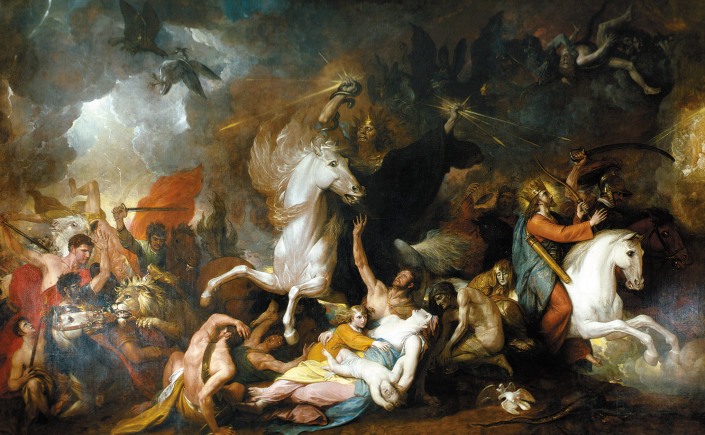
The end of the world is on view at Philadelphia. Hurtling across a twenty-five-foot-wide canvas in the Pennsylvania Academy of the Fine Arts are the Four Horsemen of the Apocalypse. Together, Death, Pestilence, Famine, and War ravage the earth amid blood-red banners and what looks like cannon smoke. Warriors fall before their swords and spears, and women, children, and babies are slaughtered.

Benjamin West completed this version of Death on the Pale Horse in 1817, two years after the Battle of Waterloo. It is tempting therefore to see in the painting not only the influence of the book of Revelation, and perhaps the elderly West’s intimations of his own imminent mortality, but also a retrospective verdict on the terrible catalogue of death and destruction that had been the Napoleonic Wars. Yet West’s original inspiration seems to have been another conflict. He first sketched out his ideas for Death on the Pale Horse in 1783, the concluding year of the American War of Independence. Bitterly divisive on both sides of the Atlantic, the war imposed strains on West himself. Pennsylvanian born and bred, he was a supporter of American resistance.

But in 1763 he migrated to Britain, and he spent the war working as a historical painter at the court of George III. So every day he served the monarch against whom some of his countrymen were fighting, knowing all the while that this same king was launching his own legions against Americans who had once been accounted British subjects. It was this tension that helped to inform West’s apocalyptic vision. More viscerally than most, he understood that the American Revolution was also in multiple respects civil warfare.

Tracing some of the histories of the idea of civil war, and showing how definitions and understandings of this mode of conflict have always been volatile and contested, is the purpose of this latest book by David Armitage. Like all his work, Civil Wars: A History in Ideas is concise, wonderfully lucid, highly intelligent, and based on a confident command of a wide range of printed sources. It is also ambitious, and divided into three parts in the manner of Julius Caesar’s Gaul. This seems appropriate since Armitage roots his account in ancient Rome. It was here, he claims, between the first century BCE and the fifth century CE, that lethal conflicts within a recognized society, a common enough experience in earlier eras and in other regions, began to be viewed and categorized as a distinctive form of war: bellum civile.

How this came to pass is the subject of Part One of the book. In Part Two, Armitage switches to the early modern era, which is here defined mainly as the seventeenth and eighteenth centuries, and shows how elite male familiarity with classical texts encouraged Europeans and some of their overseas colonizers to interpret the civil commotions of their own times very much in Roman terms. Part Three takes the story from the nineteenth century to the dangerous and precarious present. Whereas the incidence of overt conflicts between major states has receded during the post-1945 “long peace,” civil wars have proliferated, especially in parts of Eastern Europe, Asia, the Middle East, and Africa. The “shadow of civil war,” Armitage contends, has now become “the most widespread, the most destructive, and the most characteristic form of organized human violence.”

But why ancient Rome to begin with? Armitage attributes its centrality to evolving Western conceptions of civil warfare partly to this culture’s marked success in establishing and stabilizing the idea of a distinct citizenry and political community. “Civil War could, by definition, exist only after a commonwealth (civitas) had been created.” More significant, as far as perceptions in later centuries were concerned, were the writings and careers of two brilliant Romans, each of whom in different ways was caught up in the rivalry between Julius Caesar and Pompey and destroyed by the violence of their warring successors.

Cicero, an opponent of Caesar, is the earliest-known writer to have used the term “civil war.” He also employed it in a speech that he delivered at the Forum in 66 BCE, close to the spot where his severed head and hands would be put on display twenty-three years later, as punishment for his activism and his words. In the following century, the youthful poet Lucan completed a ten-book masterwork, De Bello Civile, on how, under Caesar, “Rome’s high race plunged in her [own] vitals her victorious sword.” Lucan dedicated his saga to Nero, the emperor who later forced him to commit suicide.

Their writings and the gory fate of these men helped to foster and perpetuate the idea that civil warfare was a particularly nasty variant of organized human violence. It is in part this reputation, Armitage contends, that has made the subject of civil war a more impoverished field of inquiry than inter-state conflict. Given that the English, American, and Spanish civil wars have all long been historiographical cottage industries, I am not sure this is wholly correct. But it is the case, and he documents this powerfully throughout, that the ideas and negative language that have accumulated around the notion of “civil war” have resulted in the term’s use often being politically driven in some way. As with treason, what gets called civil war, and becomes remembered as such, frequently depends on which side eventually prospers.

 At times, the term has been deliberately withheld for fear of seeming to concede to a set of antagonists even a glimmer of a claim to sovereignty in a disputed political space. Thus the royalist Earl of Clarendon chose in his history to describe the English Parliament’s campaigns against Charles I after 1642 not as a civil war, but as a rebellion. In much the same way, an early US official history of the Union and Confederate navies described their encounters between 1861 and 1865 as a “War of the Rebellion,” thereby representing the actions of the Southern states as a mere uprising against an indisputably legitimate government.

For Abraham Lincoln at Gettysburg in 1863, by contrast, it was essential to insist that America was undergoing a civil war. He wanted to trumpet in public more than simply the rightness of a particular governing regime. Since its survival was still in doubt, he needed as well to rally support for the Union itself, that “new nation, conceived in liberty” as he styled it: “Now we are engaged in a great civil war, testing whether that nation, or any nation so conceived, and so dedicated, can long endure.”

Of course, had the American Civil War ended differently, it might well not have been called a civil war at all. Later generations might have remembered it as a “War of Southern Independence,” or even as a “Southern Revolution.” As Armitage points out, when major insurrections break out within a polity, they almost invariably start out as civil wars in the sense that the local population is initially divided in its loyalties and responses. But if the insurrectionists eventually triumph, then—as in Russia after 1917, or China after 1949—it has increasingly been the case that the struggle is redescribed by the victors as a revolution. Partly because of the continuing influence of the ancient Roman cultural inheritance, “revolution” possesses far more positive connotations than the more grubby and ambivalent “civil war.”

Joseph Eid/AFP/Getty Images

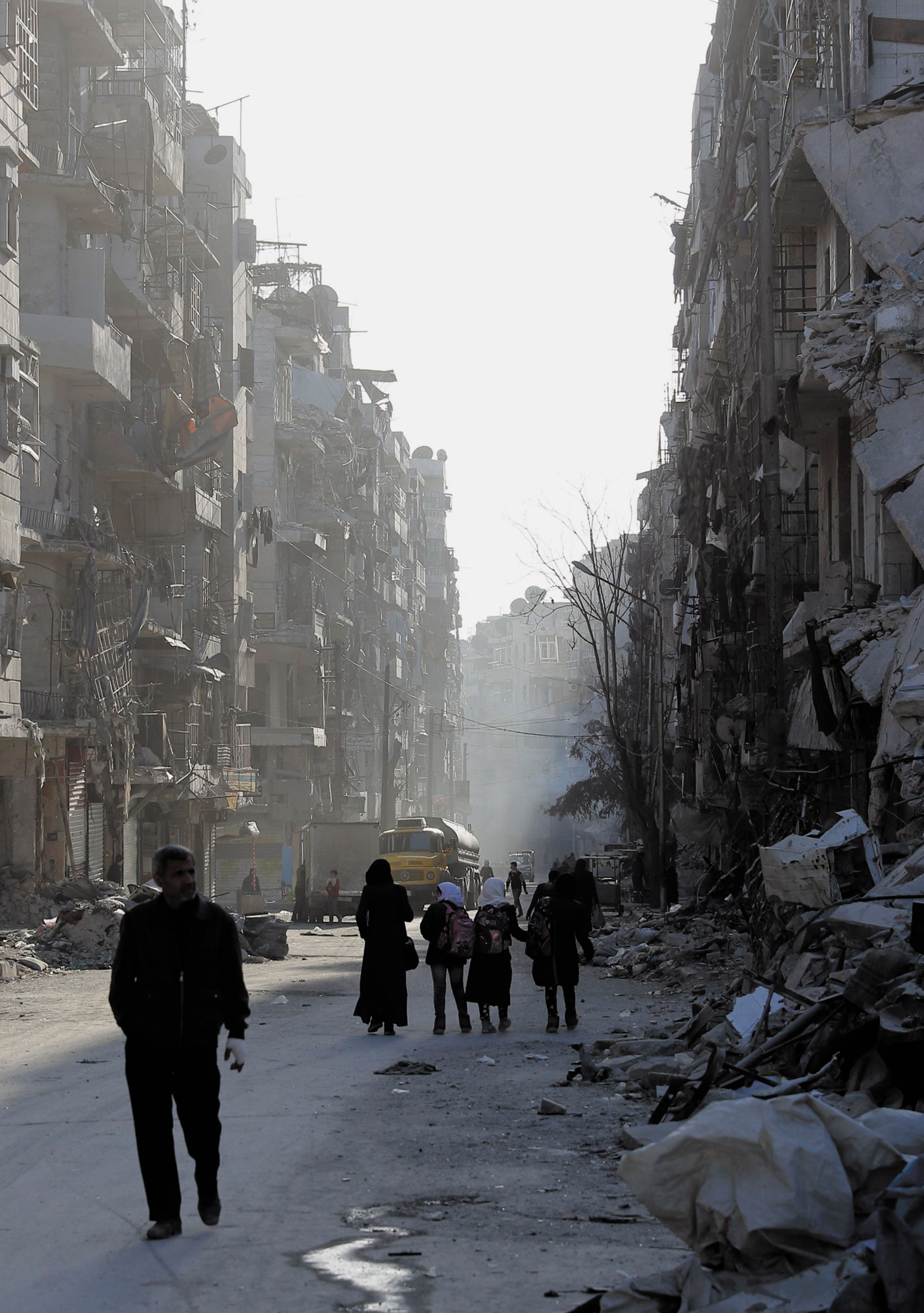
Rebel–held al-Shaar neighborhood of Aleppo,  recaptured by government forces, March 2017

As a searching, nuanced, and succinct analysis of these recurring ideas, linguistic fluctuations, and shifting responses over a dramatic span of time, and across national and continental boundaries, Armitage’s account is a valuable and suggestive one. But as he admits, it is hardly comprehensive. This is not simply because of the scale of his subject matter, but also because of his chosen methodologies.

In dealing with civil wars he practices what, in an earlier work, he styled “serial contextualism.” This means that he offers detailed snapshots of a succession of discrete moments and of particular intellectual, political, and legal figures spread out over a very long stretch of time. The strategy is sometimes illuminating, but one has to mind the gaps. Most obviously, there are difficulties involved in leaping, as he does, almost immediately from ancient Rome to the seventeenth century. By the latter period, for instance, England’s “Wars of the Roses” were sometimes viewed and described in retrospect as civil wars. But at the time, in the 1400s, commentators do not seem to have resorted to medieval Latin phrases such as bella civilia or guerre civiles to describe these particular domestic and dynastic conflicts. Although classical texts such as Lucan’s De Bello Civile were known to medieval scholars, the impress of this ancient Roman inheritance on contemporary interpretations of fifteenth-century England’s internal wars does not appear to have been a vital one.

Why might this have been? The question could be rephrased. Why should it be imagined that language and concepts drawn from the ancient Roman past supplied the only or even the dominant ideas and methods for subsequent Westerners wanting to make sense of the experience of large-scale civil contention and slaughter? After all, in the medieval era and long after, most men and even more women possessed no direct knowledge of the Roman classics. Multitudes in Europe and everywhere else could not even read, never mind afford books. Yet in the past as now, it was precisely these sorts of “ordinary” people who were often the most vulnerable to the chaos and bloodshed of civil warfare, and so had little choice but to work out some ideas about it. What were these ideas?

A practitioner of intellectual history from the so-called Cambridge School of that discipline, Armitage barely touches on such questions. More international in range than many of his fellow scholars, he shares some of this school’s leading characteristics: its fascination with the long-term impact of Aristotelian and Roman republicanism, its overwhelming focus on language and on erudite elite males, and its comparative neglect of religious texts. It is partly this deliberately selective approach to the past and its sources that allows Armitage to venture on such an enormous topic over such a longue durée. But again, there is a mismatch between this methodology and the full extent and vital diversity of his subject.

To be sure, many of the impressive individuals who feature in his book were much more than desk-bound intellectuals or sheltered and austere political players. One of the most striking segments in Civil Wars is Armitage’s treatment of the multiple roles of the Prussian-born American lawyer Francis Lieber, who provided Lincoln with a legal code for the conduct of the Civil War. Lieber had fought at Waterloo and was left for dead on the battlefield. During the 1860s, he also had to bear the death of one of his sons who fought for the South, even as two others were fighting for the North. As he remarked: “Civil War has thus knocked loudly at our own door.” The fact remains, however, that most men caught up in civil wars throughout history have not been educated, prosperous, and high-achieving souls of this sort. Moreover—and this has a wide significance—civil wars have often been viewed as having a particular impact on women.

In harsh reality, even conventional warfare has usually damaged non-combatants, women, children, the elderly, and the infirm. Nonetheless, the idea long persisted that war was quintessentially a separate, masculine province. But civil wars were seen as taking place within, and cutting across, discrete societies. Consequently, by their very nature, they seemed likely to violate this separation of spheres, with women along with children and the old and frail all patently involved. This was a prime reason why civil warfare was so often characterized in different cultures not just as evil and catastrophic, but as unnatural. In turn, this helps to explain why people experiencing such conflicts have often resorted, far more avidly than to any other source of ideas, to religious language and texts for explanations as well as comfort.

The major holy books all contain allusions to civil warfare and/or lines that can be read as addressing its horrors. “I will set the Egyptians against the Egyptians,” declares the King James version of the book of Isaiah: “and they shall fight every one against his brother, and every one against his neighbour.” It was often the Apocalypse, though, as demonstrated by Benjamin West’s great canvas, that Christians mined for terrifying and allusive imagery. Such biblical borrowings sometimes crowded out references to the Roman classics as a means of evoking and explaining civil war altogether, as seems often to have happened in medieval England.

At other times, religious and classical imagery and arguments were combined. Thus, as Armitage describes, the English poet Samuel Daniel drew on Lucan’s verses on the Roman civil war when composing his own First Fowre Bookes of the Civile Wars between the Two Houses of Lancaster and Yorke in 1595, a work plundered for its plots and characters by William Shakespeare. But it is also easy to see in portions of Daniel’s text the influence of the Apocalypse:

Red fiery dragons in the aire doe flie,

And burning Meteors, poynted-streaming lights,

Bright starres in midst of day appeare in skie,

Prodigious monsters, gastly fearefull sights:

Straunge Ghosts, and apparitions terrifie,

…Nature all out of course to checke our course,

Neglects her worke to worke in us remorse.

It was never just Christians who turned to holy books and religious pieties so as to cast some light on the darkness of civil war. Unlike allusions to the Roman past, such responses seem to have been universal. Indeed, I suspect that the only way that a genuinely trans-continental and socially deep history of civil warfare could conceivably be written would be through an examination of how civil wars have been treated by the world’s various religions, and how such texts and interpretations have been used and understood over time. In particular, the idea that Samuel Daniel hints at in the passage quoted above—that civil war was a punishment for a people’s more than usually egregious sins—has proved strikingly ecumenical as well as persistent.

Thus for Sunni Muslims, the idea of civil war as fitna has been central to understandings of the past. But fitna in this theology connotes more than civil warfare. The term can evoke sexual temptation, moral depravity—once again, sin. The First Fitna, for instance, the war of succession between 656 and 661, is traditionally viewed by Sunnis as marking the end of the Rightly Guided Caliphs, the true followers of Muhammad.

As Tobie Meyer-Fong has shown, the civil wars that killed over twenty million Chinese in the 1850s and 1860s, the so-called Taiping Rebellion, were also often interpreted as divine retribution for immoral, decadent, or irreligious behavior.* Confucian, Daoist, and Buddhist commentators on all sides rationalized the carnage and disorder in these terms. Poor, illiterate Chinese caught up in this crisis seem also to have regularly turned to religion to make sense of it, and not simply out of faith, or as a means to explain apparently arbitrary horrors. By viewing civil war as punishment for Chinese society’s sins in general, they could also secure for themselves a strategy and a possible way out, even if only in spiritual terms. They could make extra and conscious efforts to follow a moral pathway, and hope thereby to evade heaven’s condemnation.

Analogous responses and patterns of belief continue today, and understandably so. As the ongoing civil warfare in Syria illustrates all too terribly, vulnerable people caught up in such ordeals can easily be left feeling that no other aid is available to them except a deity, and that the only alternative is despair. David Armitage concludes his book with a discussion of how the “long-term decline of wars between states” (a decline that should not be relied on) has been “accompanied by the rise of wars within them.” As in his previous book, The History Manifesto (2014), co-written with Jo Guldi, he also insists that historians have a duty—and a particular capacity—to address such large and recurrent features of human experience:

Where a philosopher, a lawyer, or even a political scientist might find only confusion in disputes over the term “civil war,” the historian scents opportunity. All definitions of civil war are necessarily contextual and conflictual. The historian’s task is not to come up with a better one, on which all sides could agree, but to ask where such competing conceptions came from, what they have meant, and how they arose from the experience of those who lived through what was called by that name or who have attempted to understand it in the past.

Certainly, a close reading of Civil Wars provides a deeper understanding of some of the semantic strategies that are still being deployed in regard to this mode of warfare. Thus President Bashar al-Assad and his supporters frequently represent Syria’s current troubles as the result of rebellion, revolt, or treason; while for some of his Russian allies, resistance in that country is to be categorized as terrorism.

But historians can illumine the rash of civil warfare that has characterized recent decades more deeply than this. Whereas Armitage focuses here on the making and unmaking of states, it is the rise and fall of empires that have often been the fundamental precipitants of twentieth- and early-twenty-first-century civil wars. At one level, the decline and demise of some old, mainly land-based empires—Austrian, Ottoman, and Soviet—have contributed to a succession of troubles in Eastern Europe. At another, the old maritime empires that invaded so much of Asia, Africa, and the Middle East frequently imposed new boundaries and yoked together different peoples in those regions in ways that were never likely to endure, and stoked up troubles for the future. In these and other respects, Armitage is right to insist that history can equip men and women with a better understanding of the past and of the troubled present. It always has done this. But only when its practitioners have been willing to adopt broad and diverse and not just long perspectives.

Linda Colley is Shelby M.C. Davis 1958 Professor of History at Princeton. Her latest book is Acts of Union and Disunion: What Has Held the UK Together—and What Is Dividing It? 
. (June 2017)

Is America’s second civil war brewing? All the signs are all there

The Balkans conflict gives an ominous glimpse of potential future strife in the US. A democracy founded more than two centuries ago, has entered very dangerous territory

David Aaaronovitch, The Times,  January 21, 2022

It turns out that there is a discipline that you might call “civilwarology” – the study of the factors that lead to civil war. It exists in think tanks and universities, and its experts are consulted by state agencies anxious to better understand the world in which they operate.

Barbara F. Walter became a civilwarologist nearly a quarter of a century ago and her entry is evidently well thumbed in the Rolodexes of the CIA and the US State Department.

In other words, she knows what she’s talking about – which makes this book rather scary.

The discipline is based on observation and measurement over time. Out of these have emerged a series of data sets and analytical tools relating to the progression towards or away from the conditions likely to lead to civil war. And it adds a word to the list of possible-ocracies.

Anocracy, disappointingly, is not government by assholes, but a troubling middle point between democracy and autocracy. An anocracy may exist during the transition from authoritarianism to full democracy, or the other way round, but it is less stable than either. Right now some states that lay claim to being democracies are in fact anocracies.

If anocracy is a key precondition for the outbreak of a civil war, “factionalisation”, Walter says, is another. Not to be confused with polarisation, this is “when citizens form groups based on ethnic, religious or geographic distinctions – and a country’s political parties become predatory, cutting out rivals and enacting policies that primarily benefit them and their constituents”. Winner takes all. Or loser loses all.

The postwar conflict that features most prominently in this book happened in the territories that had once been Yugoslavia. For 35 years the communist autocrat Marshal Tito had suppressed any latent ethnic rivalry between a series of closely related peoples. When he died in 1980 this settlement died with him.

As the component republics of the old state began to agitate for more autonomy, one group – the Serbs – saw themselves as losing out. This sense of loss on the part of a large group, Walter says, is a significant element in creating the conditions for war.

She reminds us that the election of Abraham Lincoln as US president in 1860 meant slaveholding Southern states no longer exercised a veto on federal policy; the other states could outvote them.

In Yugoslavia the new anocracy opened the way for what experts call “ethnic entrepreneurs” – a breed of politician that mobilises around ethnic grievances or anxieties. These included most notably Slobodan Milosevic in Serbia, Franjo Tudjman in Croatia and Radovan Karadzic for the Bosnian Serbs.

At a more local level ethnic politics became exploited by “violence entrepreneurs” – the men who formed and armed militias to take control and to kill their enemies. These militias do not need to be large. In the town of Visegrad one man with 15 gang and family members carried out a local genocide of Bosnian Muslims.

Rescue workers remove the body of victim following mortar attack on Sarajevo market in 1994.

A common dimension in civil war development, Walter tells us, is a rural/urban divide, in which resentful “sons of the soil”, organising away from the supervision of the authorities, see themselves at cultural war with the more cosmopolitan town-dwellers. In Bosnia this was embodied in the bloody four-year siege of Sarajevo, with the Serb hicks from the hills mortaring and sniping the occupants of the city.

One of Walter’s reasons for reminding us of the horrors of the former Yugoslavia is to point out that to the population of these lands, civil war had never seemed likely until it happened and suddenly, one day, their good neighbours turned into their executioners.

And here we come to the nub of it. The title of the book is misleading. It isn’t really about civil wars generically, but about one conceivable conflict in particular: the Second American Civil War. Roughly at the halfway point, having established how fratricidal conflict occurs, Walter turns her attention fully to her own country. Naturally, she knows how absurd such a possibility will seem to many readers as they take the subway to their downtown offices or listen to the audiobook as they drive the children to school.

“No one wants to believe,” she writes, “that their beloved democracy is in decline, or headed toward war; the decay is often so incremental that people often fail to notice it or understand it, even as they’re experiencing it.”

Yet objectively the danger signs are there. So that “if you were an analyst in a foreign country looking at events in America – the same way you’d look at events in Ukraine or the Ivory Coast or Venezuela – you would go down a checklist, assessing each of the conditions that make civil war likely. And what you would find is that the United States, a democracy founded more than two centuries ago, has entered very dangerous territory.”

My psychological disposition inclines me against claims such as these. In the Great Journalistic Division between the hysterics and the phlegmatists, I tend to side with the latter. But happenings in the US since 2016 – and especially the events of the past two years – have shaken my complacency.

There has been the loss of conventional politics from much of the national discourse, so that sharp political difference no longer concerns taxes or the environment, but (for one side at least) is almost entirely about ethnicity, identity, culture and loss. The Kyle Rittenhouse court case arose from armed men stalking the ungoverned streets shooting at each other in pursuit of political, not criminal objectives. Militias line statehouse steps openly carrying weapons of civil war lethality.

Erick and Jade Jordan guard the perimeter of Civic Center Park while activists protest the verdict in the Kyle Rittenhouse trial on November 21, 2021 in Kenosha, Wisconsin. Picture: AFP

Then there was January 6, 2021, and the storming of the Capitol, in which political thugs sought to prevent the accession of a democratically elected president. Even more alarming than the mere fact of this act of what the CIA classified as “open insurgency” has been the way the Republican Party and its supporters have minimised this attempt at insurrection.

Walter shows how developments in the US match the conditions for other civil wars.

The sense of loss among many white-identifying voters (the US as a whole will follow where California and Texas have led by becoming minority white by 2045), the rural-urban divide, a failure of trust in politicians and other citizens, the factionalisation of politics, the rise of grievance-exploiting “ethnic entrepreneurs” (in this case most obviously Donald Trump), and all of this hugely exacerbated by the catalyst of that great creator of anxiety, social media.

Portland police officers chase demonstrators after a riot was declared during a protest against the killing of Daunte Wright on April 12, 2021 in Portland, Oregon. Picture: AFP

The psychological fuel for civil war, Walter reminds us, is not hate, but fear. Between January and October 2020 a record 17 million firearms were sold in the US. In December 2020 one poll showed that 17 per cent of respondents agreed with the statement: “A group of Satan-worshipping elites who run a child sex ring are trying to control our politics.”

Walter admits that in light of all this she and her husband, children of European migrants to the US, considered leaving the US last year. A useful rule of thumb could be that when your experts on civil strife start moving abroad you may be in trouble.

Yet for all that, Walter is not fatalistic. If the forces of division have a playbook, then, she writes, “we have a playbook too”. She advocates better civics lessons in schools, prosecuting armed militias as terrorists, reform of what is a terribly inefficient and patchwork voting system, tech regulation and much greater attention to developing policies that benefit the majority of citizens. The threat can be averted. To which the watching Brit, otherwise powerless, can only whisper a heartfelt: “Amen.”

How Civil Wars Start – And How to Stop Them, by Barbara F. Walter (Viking)

A Brief History of the Rise and Fall of the West

The great and the good, the wise and the weary, have all offered a definition of ‘history’. To Napoleon, it was “a myth that men agree to believe”. Historian Marc Bloch observed that it was “an endeavour towards better understanding”. His Nazi killers disagreed – their’s was a less nuanced, more zero-sum approach. Abba Eban, long time Israeli foreign minister, wrote that it “teaches us that men and nations behave wisely once they have exhausted all other alternatives”. Aldous Huxley wrote “that men do not learn very much from the lessons of history is the most important of all the lessons that history has to teach.” And channeling Mark Twain and Karl Marx, Buffy Summers remarked, “You know what they say. Those of us who fail history are, doomed to repeat it in summer school”. But best is John Banville’s admission in The Sea that “the past beats inside me like a second heart”. Simply put, we like to see some pattern, some sense of order to it all. Arthur Schlesinger Jr. commented: “The passion for tidiness is the historian’s occupational disease”. Niccolo Machiavelli wrote: “Whoever wishes to foresee the future must consult the past; for human events ever resemble those of preceding times. This arises from the fact that they are produced by men who have ever been, and shall ever be, animated by the same passions. And thus they necessarily have the same results”. And yet, whilst seeking patterns, we cannot really use them to predict outcomes. And it is impossible to know what really happened. The past is another country and all that. All we can say for sure is that in the end, history will remember where we end up much more than how we got there. And, history takes time. All the time in the world.

As Mark Twain remarked sardonically, “history doesn’t repeat itself. A best, it sometimes rhymes”. A recent rhyme was evident when an opulent exhibition on the life and legacy of Alexander The Great of Macedon was brought from ‘old world’ St.Petersburg, the twice renamed city of Peter The Great of Russia, to ‘ new world’ Sydney, Australia. For all his ‘greatness’, young Alexander was, like Lord Byron “mad, bad, and dangerous to know”, but with murderous psycho mixed in. In his ‘Inferno’, Dante had him standing in the river of boiling blood, along with war-mongers and murderers. Why don’t these people just stay at home! Well, what would you think? You are minding your own business down beside the rivers of Babylon, and then suddenly, there’s an army of 50,000 Greeks on the other bank intent on doing damage. Or there you are, beside the sacred Indus, just about to tuck into your chicken vindaloo, when a rampaging horde of homesick Greeks come charging over the horizon. And you ask to no one in particular, because they have all been massacred or enslaved by now, “Why don’t they do the things they do back in their own bloody country?” And there you are on the banks of the Tigris, minding your own business, and keeping out of the way of the Mukhabarat, when over the horizon in a cloud of dust and disco sweeps a column of armoured vehicles and hordes of ka-firi-n with rifles and ray-bans. And you ask to no one in particular, because they have all been bombed or strafed by now, “Why don’t they do the things they do back in their own bloody country?” Plus ça change, plus c’est la meme chose. Nothing much has changed, really.

Which brings us back perhaps, to what Basil Fawlty called ‘the bleeding obvious”. Beyond the scholars’ passion for patterns, and the dry dialectics of cause and effect, there is the personal dimension. Who were the actual inhabitants of ‘history’? What did they think and feel? The thinking of another time can be hard to understand. Ideas and ideologies once compelling may become unfathomable. And the tone and sensibility that made those ideas possible is even more mysterious. We read, we ponder, and we endeavour to empathize, to superimpose the template of our value system, our socialization, our sensibilities upon the long-dead. And thence, we try to intuit, read between the lines, draw out understanding from poems, plays, novels, memoirs, pictures, photographs, and films of the past. We feel we are experiencing another facet of the potential range of human experience. But in reality, we are but skimming the surface, drawing aside a heavy curtain for a momentary glimpse through an opaque window into the past. Simply put, people who lived ‘then’ are not at all the same as we who live ’now’.

Over two and a half thousand years ago, the controversial Greek poetess Sappho wrote:”I tell you, someone will remember us; even in another time”. And so we do, for one thing is for certain: we all love a good story. As they say, in Arabic, as indeed in all tongues, times and places, “ka-n ya ma ka-n bil ‘adim izzama-n wa sa-lifi al aSri wa la-wa-n”‘ or, “once upon an time”.

So, let us walk down what Welsh poet RS Thomas called ‘the long road of history”, beginning with, yes, the usual suspects: power and pride, greed, and aggrandizement, and as accessories after the fact, dolour, devastation, and death.

Time: Year Zero of the Christian era. Place: The Mediterranean littoral

Often, with overwhelming political and military power and economic wealth come arrogance, decadence, and complacency. And with lean and hungry barbarians on the borderland, the geographical interface between the desert and the sown, and soon hanging around the gates, so the seeds of decline and destruction are scattered and germinate. The Pharaohs conquered and ruled over much of North Africa and the Middle East for centuries. Indeed, the first historical record of a ‘formal’ set piece battle between two armies took place in 1468 BCE at Meggido, just south east of Haifa in present day Israel – some five thousand Egyptians took on and bested two thousand Canaanite soldiers of local city states. But Egypt was to fall to the ascendant and ambitious Greeks and Persians, and later, the Romans. And down went these mighty successors. Thebes, Athens, Sparta, Persepolis, Ctesiphon, Rome, Carthage, Byzantium, Constantinople. Grand names, but now bones, bones, dry bones. The Bard of Avon declaimed “The cloud-capp’d tow’rs, the gorgeous palaces, the solemn temples, the great globe itself, Yea, all which it inherit, shall dissolve”. As Percy B Shelley intoned: “My name is Ozymandias, king of kings: look on my works, ye Mighty, and despair!” Nothing beside remains. Round the decay of that colossal wreck, boundless and bare, the lone and level sands stretch far away”.

It was the English historian Toynbee who suggested that “civilizations die from suicide, not murder”. They lose their “mojo”. The 14th Century Arab philosopher of history, Ibn Khaldun, called it “assabiyah” – in short, they lose their élan, their sense of direction and their minds. His point was that the moribund Byzantine and Sassanian empires were broke and militarily overstretched, corrupt, venal and soft, and hence no match for the desert hardened, combat keen, tribally cohesive, spiritually zealous warriors of the one true faith.

At the dawn of the Christian era, the known world was divided up between the those Romans and Persians, who themselves had subjugated and subsumed the Greeks and Phoenician Carthaginians, and Hittites and Assyrians respectively (in the east, the Chinese and Indians boasted powerful, prosperous civilizations as old as The Pharaohs, but this is not their story). Anyhow, the Romans, who morphed into the Byzantines with the loss of the western empire (to nomadic rovers from out of the east) in the third and fourth centuries, and the Persians, were over extended and overspent, slave societies living off the land and labour of conquered peoples. Until they were challenged and defeated by another ascendant power. Those Arabs of Arabia and of the imperial marches.

For generations this lot had served as mercenaries and satraps of both empires, and fired up by the energy and unity of a new but hybrid faith, and muscled up with a martial spirit built upon generations of mercenary employment and privateering, stormed the sclerotic empires from within and without, and in the space of fifty years after the prophet’s death, built a domain that extended from Spain to Afghanistan. Modern genetic analysis has shown that the bloodline of these desert conquerors is as much a mosaic as most other overlords. Assyrian, Babylonian, Hittite, Persian, Egyptian, Nubian, Greek, Phoenician, Roman, Arabian, Hebrew. And whoever else may have been passing through. Many races came and settled, and many too were invaded and scattered. The ruins and artefacts endure still to remind us of their passage.

And this genetic calabash was stirred some more with the Arab conquests. As they surged eastwards and westwards, slaves were sent homewards as plunder and labour. This was the modus operandi of carnivorous empires throughout history. The Babylonians did it; the Romans too. They conquered and controlled though mass death and deportation, dragging their broken subjects in tens and hundreds of thousands across the known world. So too with the Arabs, therefore, as hundreds of thousands of souls from afar afield as the Pyrenees and the Hindu Kush ended their days in Cairo, Damascus, Jerusalem, and Baghdad. Blue eyed blondes and redheads, sallow skinned Turkic and Chinese. You see their heirs today in Homs and Aleppo, Gaza and Hebron. In a fascinating post-classical irony, the European empires were likewise catalysts for ethic trans-migration. The suburbs of Paris and Marseilles, Birmingham and Bradford reflect the colours, cuisines, and conflicts of once-upon-a-homeland.

It is the view of some revisionist historians that whilst Mohammad and his revelations provided the impetus for the Arab “surge”, the religion that we know as Islam was actually retrofitted to the Arab adventurers’ ethos, a kind of ex post facto justification for what was in reality an old fashioned smash and grab. They suggest, therefore, that Islam and the role of Mohammad within it as the messenger and final word were cleverly constructed one to two hundred years after his death by Arab dynasties seeking legitimacy and heavenly sanction for their own aggrandizement. But then, wasn’t it always thus? As Jarred Dimond and others have written, this pandering to invisible friends and post-mortem insurance is part of our genetic baggage. It goes back to way back, to Neanderthals, and before them, to chimpanzees, our closest relatives).

Notwithstanding this, these parvenus ushered in the flowering of Arab culture in the arts, architecture, literature, and science as caliphs encouraged intellectual inquiry, and invited polymaths from across the known world to abide in their domains. Indeed, much of the work of the Greek and Roman philosophers, mathematicians, astronomers, doctors and scientists was translated into Arabic and preserved for posterity when the Roman Empire was overrun by waves of barbarians, the beginning of what are called The Dark Ages.

One other ‘safe house’ for these tracts during these dire days was Ireland, in the monasteries of the far west, where monks would meticulously copy rare texts, often embellishing them with their own, ‘Celtic’ art work. The Book of Kells owes a stylistic debt to the monasteries of the Byzantine Levant. And whilst we digress on the subject of books, it is believed by some scholars that The Quran was not actually written in Mecca or Medina, but most likely in Baghdad, which did not exist whilst Mohammad breathed. Learned iconoclasts also purport that it was originally written in Aramaic, the language of the Levant at the time of Jesus, and that Arabic has not yet evolved as a written language. The Torah, the basis of Jewish law and custom, and of The Bible, was written in Babylon and not Jerusalem. And The New Testament? Well. that was assembled all over the shop: in cosmopolitan Athens, Rome, the desert solitudes of Syria and the Sinai. The Quran itself drew on both of these. Such is the power of foundation myths. There are always issues surrounding the literal ‘Word of God’.

Contrary to popular assumptions, these centuries were not that dark at all. The Islam tide was turned at Tours by the Frankish forces of Charles ‘the Hammer’’ Martel, named nostalgically for the Israelite rebel who defied and defeated the Seleucid Greeks in the Maccabee Revolt in the second century BCE. Charlemagne founded the French monarchy which endured until the unfortunate Louis the Last lost his head to the French revolutionaries in 1793. The Western Christian church established many fundamentals of law, politics and theology that endure to this day. There was, nevertheless, a lot of fighting, most of it between squabbling European potentates, and a major doctrinal rift in the Christian Church that saw it bifurcate, often with accompanying bloodshed, into the Catholic Church of Rome, and the Eastern Church of Constantinople. Between the Christian ‘West’ and the Muslim ‘East” however, there endured an armed peace interspersed with occasional warfare until the eleventh century. The Byzantine heirs of Constantine were reasonably content to maintain a kind of Cold War with the many fractious emirs who ruled the lands to their east, and to sustain their power and influence through canny diplomacy, alliances, mercenaries, and proxies (It is testament to the ‘byzantine’ skills of these emperors and their servants that the empire endured for a thousand years as a powerful political, economic, and military force until Constantinople fell to the Ottoman Mehmed the Conqueror in 1453).

Things changed utterly for east-west relations towards the end of the eleventh century. The heirs to the Roman Empire in the west, the Franks and the Normans, descendants of those nomadic marauders who broke the power of Rome, fired up with religious zeal and the prospects of material gain, embarked upon a series of Crusades to free the Holy Land, the paths that Jesus trode, from the heathen Mohammedan. But do not for a moment dismiss the power of religious fervour in those far-off days. The promise of a full remission of all sins and a place in paradise was a powerful motivator. Nevertheless, God and gilt, backed by martial grunt, conveniently colluded with another new power, out of the east. The Mongols had spilled out of the steppes of central Asia, having conquered the ancient Chinese empire, and once again, the nomads were on the move as the sons and heirs of Genghis Khan sought khanates and kingdoms of their own in the west. And when they advanced into the Levant, they came up against, and collaborated with the Franks against the Saracens. History is never black and white – the crusaders also did deals with Muslim warlords if it suited their common interests. In their politics as well as their lifestyles, many ‘went native’.

It was always thus. The barbarians, usually horsemen originating from central Asia, surge in from the wild lands, devastate the settled lands, and take the cities. In Eastern as well as Western Europe, and the Middle East, they came, they saw, they conquered, and they moved in. Settled down, intermingled, and developing a taste for the good life, and gave up their roving, rampaging ways. We are their heirs and successors, us descendants of Celts and Saxons, Goths and Vikings, Vandals and Huns, as are French people, Italians, Spaniards, Turks, and Arabs.

Vaslily Grossman encapsulated all this poignantly and succinctly in An Armenian Sketchbook: “The longer a nation’s history, the more wars, invasions, wanderings, and periods of captivity it has seen – the greater the diversity of its faces .Throughout the centuries and millennia, victors have spent the night in the homes of those whom they have defeated. This diversity is the story of the crazed hearts of women who passed away long ago, of the wild passion of soldiers intoxicated by victory, of the miraculous tenderness of some foreign Romeo towards some Armenian Juliet”.

The story of the Vandals is an epic in itself. From out of what we now call Sweden they came, ethnic kin to the Norsemen and Vikings. Scouring through the Baltic lands, and present day Poland, Germany, and France, they settled in Spain. Andalusia is Arabic for ‘Land of the Vandals’. And eventually they established a kingdom in Libya, challenging and then paying tribute to the ascendant Roman Empire.

But the Norsemen were not quite finished with the east. On a rail of the gallery of the beautiful Aya Sofya basilica in Istanbul, there is some graffiti carved by Halvden, a 9th Century soldier of the Emperor’s Varangarian Guard, an elite force of Viking mercenaries. One commander of this guard was Harald Hardrada, who, as King of Norway, died in Yorkshire at the Battle of Stamford Bridge, the first of two kings to die during the English summer of 1066. Whilst specifically the imperial bodyguard, the Varangarians fought on the empire’s frontiers against Arab pirates and raiders, marauding nomads from the steppes, Saracens, Normans and Bulgarians. How Harald came to Mickelgard, or Great City, as the Norsemen called Contantinople, is a story in itself, but the sagas say that he even travelled to Jerusalem, protecting caravans of Christian pilgrims. Just picture it. A brigade of Norseman slashing and bashing their way through the wadis and wastelands of Syria, fifty years before the first crusaders put Jerusalem to the sword. One further Scandinavian digression: in 1110, Sigurd, the teenage King of Norway, having fought his way around the Mediterranean with a sixty ship fleet massacring infidels as he went, landed at Acre in Palestine and wintered in what the Norsemen called Jorsalaberg (See Harald Went a ‘Viking).

“If I forget thee, Oh Jerusalem!” The Arabs call the city ‘Al Quds’, “The Holy’. It was deemed sacred from pre-history. Those aforementioned iconoclast scholars suggest that Jerusalem was actually the holiest place in Islam, and that like Islam itself and the Prophet, Mecca and Medina were retrofitted to suit the conqueror’s narrative. A city of the mind as much as of this earth, it haunts the prayers and dreams of three faiths, and to this day, it is coveted and contested. “The air above Jerusalem”, wrote Israeli poet Yehuda Amichai, “is filled with prayers and dreams, like the air above cities with heavy industry. Hard to breath”. Arthur Koestler wrote: “The angry face of Yahweh is brooding over the hot rocks which have seen more holy murder, rape and plunder than any other place on earth”. Perhaps it is because Jerusalem is mankind’s number one hot spot. “There’s this thing that happens here, over the Hell Mouth”, says Buffy, “where the way a thing feels – it kind of starts being that way for real. I’ve seen all these things before – just not all at once”. More Jews have probably died violently in Jerusalem than in the Holocaust. And countless folk of other faiths have likewise perished.

Razed down to the bedrock like Jerusalem of old

Razed down to the bedrock like Jerusalem of old

The crusader kingdoms of Palestine lasted a hundred years, leaving their castles and churches to remind us of their passing, and have haunted the Arab historical memory to this day. The Arabic word for foreigner, ‘faranjiye’ is derived from Frank (or maybe not – it is also said that Varangarian derived from the Greek Varangos, for the Scandinavian Varing or Vara, either a placename or a family name, which became the Arabic Varank). They fell to the Kurdish warlord from Tikrit (hometown of Saddam Hussein, small world that it is), Salah ad Din Ibn Ayyubi, and were restored to the House of Islam. But even this renowned soldier and schemer could not escape the assassin’s poison forever (it may have been just typhoid, but why spoil a good yarn?). He was supplanted by other despots, not the least, the famed one-time slave, the blonde, blue-eyed Mameluk Barbars who ruled Egypt, conquered Syria, and died when he inadvertently ate the poison he intended for his dinner guest. And then, out of the east, came the aforementioned Mongols, and these brought the house down. They conquered, settled, assimilated, and then weakened and fell as they, in their turn, were supplanted by, yes, another nomad band, this time the Turkic Ottomans (and again, out of central Asia). That’s how assabiyeh works. Once you have it, you have to work on it. Lose it and you are done.

The Ottoman Empire inherited the Arab, Islamic patrimony and assumed the caliphate as the official ‘Deputy of God’. The Ottoman Caliphate, successor to the famed Umayyad and Abbasid Caliphates of Damascus and Baghdad, endured until its abolition in 1924 by Kemal Ataturk, the creator of modern Turkey. It was restored in 2014 as ad Dawlet al Islamiye fi Iraq w ash Sham or Da’esh. We will get to that later, but meantime, the wars and plagues and famines that beset the Middle East brought an end to the golden age of Arab civilization, with all its ecumenical, martial, intellectual, artistic, and scientific adventurousness (the same wars, plagues, and famines scoured the western world too, but these had less far to fall). And so, time stood still for Islam and the Arab world, as the outlying, often neglected provinces of the ascendant Ottoman Empire. It is said of old, that before the advent of the Mongol lord, Hulagu, a cockerel could graze from Baghdad to Basra without alighting to earth, such was the fertility and prosperity of the Land of the Two Rivers. In the wake of the Mongol, with his mass slaughter and the destruction of the long-lasting irrigation systems, came the Arab proverb: “When God made Hell he did not think it bad enough so he created Mesopotamia.” The place never recovered, although the Marsh Arabs of southern Iraq endured through all of this until the present, when their way of life was finally destroyed by Saddam.

Meanwhile, the focus of our story shifts westwards with the crusader armies returning home, bringing with them a taste for the luxuries of the east, and scientific and philosophical ideas and inventions lost to the west during the Dark Ages (what they didn’t take home, however, was a tolerance for folk of different colours and creeds). The Islamic world settled into the backward looking atrophy that we see today. And in time, came the rise of the great European powers. To Western Europe came the social and economic upheavals of war and plague, and the social and intellectual unravelling that was to lead to the age of discovery. Came the power of the papacy, the questioning of that power, the end of the feudal system and the rise of absolute monarchy, and the invention of the printing press and with it, the dissemination of knowledge. All this set the stage for the next act.

Enter the Spanish and Portuguese, resource poor and priest-ridden, astutely patronizing the adventurers, and hence, made wealthy and powerful on the riches that then flowed in from the New World. Enter the inquisition and the straighteners of religious conformity, the bedrock of imperial power. And enter also, the mercantile nations who challenged their claim to the Americas (sanctioned and sanctified as it was by Alexander, the Borgia Pope) and papal supremacy: England, France, and Holland. The era of world empires thus began against a backdrop of trade and religious wars that would set the stage for the very gradual evolution of what would become democratic institutions. But that was way, way down the bloody track.

The wars of religion, between Catholicism and Protestantism morphed into great powers’ wars by proxy (for there is nothing new under the sun). These endured some two hundred years, giving us the renaissance and the reformation, and many, many people perished. And amidst the scramble for colonies and resources, and the ever-widening scope of scientific and intellectual inquiry, there ensued interminable blood-letting. Folk got much too close to the fire, literally and figuratively. Many were dragged there, and many were eager pyromaniacs. The Thirty Years War wasn’t called that for nothing, and unlike The Hundred Years War between France and England before that, which enjoyed a few time-outs between bouts, this was an interminable danse macabre that was at once mediaeval and mid-20th Century in its savagery. ‘Full on’ is the term we use today. It is said that it staggered to an end in 1648 because the combatants just collapsed with exhaustion.

And in its shattered wake, came the decline of the Spanish and the Portuguese, and the ascendency of the English, the French, and the Dutch. Germany and Italy were still a profusion of principalities and oppressed satellites, Russia had yet to emerge out of an anarchic fog, and the USA had not even been thought of. Meanwhile, in the most populous parts of the planet, the Chinese and Indian empires carried on ever, in splendid isolation, narcissistic and ethnocentric, though not above trading profitably with the occident. The potentates that is – the lower orders were, and in many in many ways remain, in a state of repression and submission.

So came an era of religious and intellectual ferment and the mass movement of peoples across the known world and beyond it, to the Americas. Innovation in transport, communications, industry and warfare, and the trans-global transit of armies and of international commerce in goods and in humanity literally changed the face of the planet. Eleven million slaves crossed the Atlantic in four centuries. Over forty million migrants “went west” in less than one. The inscription on Our Lady Of The Harbour, a gift from the Old World to the New, still says: “Give me your tired, your poor, your huddled masses, yearning to breathe free, the wretched refuse of your teeming shore, send these, the homeless, tempest tost to me, I lift my lamp beside the golden door”. And so indeed did folk travel, fleeing poverty and pogroms, powerlessness and persecution, seeking “a new home in the sun”. From the glens of the Gael, from the shtetl and the steppe, from Old Europe and Old Asia. The Great American Dreaming. Today, some 1,300 airplanes a day cross ‘the pond” (475,000 transits a year).

And the printing press and the bible in the vernacular changed the way men thought. Merchants and missionaries and military men, seekers and makers of fortunes, slavers and saviours, prophets and potentates, philosophers and pamphleteers, poets and painters. Enlightenment, revolution, and war. And in America, the creation of democratic institutions.

Royal France was a midwife to this American Revolution, and endured the ironic blowback when French armies returned home harbouring the virus of republicanism and the concepts of liberty and equality. Be careful what you wish for, for liberty wields a two-edged sword as the revolution devours its children. Mounting the scaffold, the doomed Girondin Manon Roland exclaimed “Oh Liberty, what crimes are committed in thy name!” The redoubtable journalist Robert Fisk noted that freedom and liberty often had to crawl over broken glass.

And thence, the Nineteenth Century and the Age of Revolutions – political, industrial, and ideological, bountiful and bloody. And the rise of new empires – Russia, Germany, and the USA, competing with the old, and all extending their power and influence throughout the world, conquering and colonizing the oldest – India, China, and the Ottomans – and spanning the globe. The Americas, Africa, Asia, Australasia, no place was beyond the reach of the empire’s military and mercantile power, and no indigene was safe from the depredations of these latter-day Medes and Assyrians. Diamond again: it was all down to “guns, germs, and steel”. The ‘discovered’ world was ripe for plunder. For land, for minerals, for food. And if the natives got fractious, we had machine guns and gun boats to back us up. For this was the era of militant and muscular Christianity and gunboat diplomacy, synergized in a divine plan to render the world a holier and happier place. Rudyard Kipling said it best: “Take up the White Man’s burden, send forth the best ye breed. Go bind your sons to exile to serve your captives’ need”. A new age of Empire had arrived wherein competing white countries seeking economic and political aggrandizement, sent their boys to die far away from home. The West, it seemed, had got its mojo back!

So far away from home

So far away from home

A little known facet of that century’s history is that contemporaneous to the western expansion of ‘These United States” and the spread of British red across the globe, Imperial Russia was moving eastwards. One outstanding volume of George McDonald Fraser’s rollicking, picaresque and quite political incorrect Flashman series sees the eponymous anti-hero fleeing eastwards out of The Crimea having precipitated the disastrous Charge Of the Light Brigade (Captain Nolan was fitted up), and making his way through the vast Asian hinterland, one step ahead of the invading Czarist armies, and of sundry Muslim warlords. In the Flashman books, the unreconstructed villain of Thomas Hughes’ Victorian yarn “Tom Brown’s Schooldays” is roving and rogering his way through the late nineteenth century, somehow managing to escape by the skin of his teeth from one military disaster after another, including Custer’s famous “Last Stand” at Little Big Horn, and the last stand of the 44th Foot at Gandamak during the disastrous First Afghan War of 1842.

Amidst the humour and ribaldry is a poignant reminder of those ‘lost worlds’ that succumbed to the relentless blade of progress, a theme revisited in Thomas Berger’s Little Big Man and Theodore Olsen’s Soldier Blue, set in the American West, and Vincent Cronin’s The Last Migration and James A Michener’s Caravans, set in Iran and Afghanistan respectively. Ibn Khaldun’s ‘asabiyyah’ is no match for modern weaponry.,

With trade and economic wealth creation came the rise of the middle class. The urban, mercantile elite who seek political power commensurate with their economic clout thus demand a say in how they are governed. In an age of mass production and the beginnings of mass communication, we see the emergence of the masses as a political concept, and of mass society in which rulers are responsive and reactive to the needs fears, and rages of the masses and their representatives. The times of Machiavelli give way to those of Marx. And the focus of history is as much on the ruled as on the rulers.

So passed the Nineteenth Century. The Old World ruled. The New had its own preoccupations, with civil war and western expansion. The east and the south were conquered and colonized. God (European and most probably, English-speaking) was in His heaven and all was good and right in the world. The old scourges continued as they has since time immemorial: plague and famine, drought and flood, economic boom and bust, migration and invasion, war and peace, and comme d’habitude, death and destruction on a large scale. Good times and bad times as ever, with little to impede the onward march of progress. A reporter once asked Gandhi: “What do you think of Western civilization?” The Mahatma replied: “I think it would be a very good idea”.

In came the Twentieth Century. Same old, same old, but with markets and machines much more efficient, and likewise our capacity to create and destroy. A time of totalitarian regimes and total war, social change and technological wizardry. In 1905, the Imperial Russian Navy sailed eighteen thousand miles to the Korea Strait only to be broken by the Imperial Japanese Navy. There was a new boy on the block, and once the guns of Tsushima Bay had fallen silent, signalling that the white man could indeed be beaten, and thence, the decline of the colonial empires of old as the “our new-caught, sullen peoples” threw off their chains. In the political, economic, military and demographic spheres, balances of power changed, and changed again. In the wake of two World Wars, from Old Europe to the USA and the Soviet Union, and then, in these present times, to a totally new configuration that reflects the transitory rise and fall of nations. As I write, we see a hesitant America and a struggling Europe competing with a resurgent and belligerent Russia, and the rise and rise of its fellow BRICs, Brazil, India and China – an ascendency that is not however assured in this unstable and unpredictable world of ours. And in the post-Cold War, global financial crisis world of wide-open borders and the mass movement across them of people, goods, and capital, everything has a price and can be bought and sold. Immoral mathematics: “in these shifting tides, bombs and babies, girls and guns, dollars, drugs, and more besides, wash like waves on strangers’ shores – damnation takes no sides” (from E Lucevan le Stelle).

And passing strange it is that whilst we can place men on the moon and machines on Mars, we still live in a world riven by superstition. We have come through the age of enlightenment, the age of revolutions, the age of machines, the age of mass society, mass war, and of mass communications, And yet, we are so, so ignorant. We thought that the rising tide of progress and knowledge would raise all the boats. But how wrong we were. The Muslims in their glory days would refer to what went before as al Jahiliyya, the age of ignorance. But in so many ways, we have returned there. Helped in no small part by their more atavistic descendants who see some wisdom and benefit to all in reverting to a mediaeval ethos and lifestyle.

One thing is pretty certain. We are almost closing a circle. The history of the West, for the past two millennia has been dominated by the emergence and triumph of Christianity and of Islam. As the early Muslims saw it, al Dar al Harb and al Dar al Islam, the houses of war and peace respectively. A pretty good description if the terms are used interchangeably. Much of what has passed has been refracted through the prisms of these theologies. Call it crusade or call it jihad; or call it blow back on a grand scale. The legacy of two millennia of empire is coming back up the pipes. “Take up the White Man’s burden (or any conqueror’s burden, in fact) and reap his old reward: the blame of those ye better, the hate of those ye guard”.

For surely, “by all ye cry or whisper, by all ye leave or do, the silent, sullen peoples shall weigh your gods and you”. Weigh them all and find them wanting. In compassion and loving kindness, in reason and rationality, in patience and peacefulness. And the greatest, saddest irony of all for all who have a passion for history and for charting the unbroken story of humankind, and for those with this passion who treasure the depths of their cultural lineage through all the fugues, follies, and fault lines of our heritage, is the dawning realization and regret, that after two millennia, the religion that kicked off so much controversy and conflict, schism and schadenfreude, brilliance and bigotry, bounty and bloodshed, that was the heir to ancient faiths and the progenitor of many more, is probably now doomed in the lands wherein it was born.

It’s as if over a millennium of painful, staggering, stuttering, blood soaked, inventive, and pioneering progress has meant naught, and that we might as well have remained in the dark, literally and figuratively. “It is written in the Book of Days where the names of God a wrought, where all our dead a buried and all our wars a fought”. We range through “the battlefields and graveyards and the fields our fathers knew”. The cartography of carnage: Bali, Beslan, Gaza, Grozny, Kabul, Kigali, Sabra, Srebrenica, to mention but a few of those “far-away places with strange sounding names”. ”Many have perished, and more most surely will”. This latter quotation is adapted from Auden’s often overlooked masterpiece The Age of Anxiety, a meditation on a world between the wreckage of The Second World War and the foreboding for the impending armed peace. “The bane of bad geography, the burden of topography. The lines where they’re not meant to be are letters carved in stone”. And all this against a back-drop of the revolution despoiled, hijacked and betrayed. “The revolution’s father, the hero psychopath” shows us how hopes and dreams can be “fooled by the riddle of the revolution”. “Words carried far in time and space will topple tyrants, but there’s no salvation”. (see In That Howling Infinite – Poems of Paul  Hemphill)

When Miranda exclaimed “what brave new world, with such people in’t!’, when the dismal Dane moaned ‘what a piece of work is man, how noble in reason, how infinite in faculty, in form and moving, how express and admirable’, was the Bard being singularly ironic? He was writing at the dawn of the Sixteenth Century when the wars of religion were well under way, and yet, the reign of Elizabeth had brought a degree of civil calm, and King James was determined to heal the schisms, using his translation of The Bible as his balm. Reasons to be cheerful, perhaps. The Thirty Years War had yet to devastate continental Europe, and the English Civil war had still to come. Sweden had not yet ravaged Eastern Europe (yes, the Swedes had indeed attempted world dominion before ABBA). The Pilgrim Fathers were not to set sail for a decade, the Inca and Aztec were already no more, and as the Plains Indians rode the range mounted on the descendants of the conquistadors’ horses, the American West had not yet been discovered let alone ‘won’.

Some digression, that! So, back to where are we now, in the first decade of the 21st century. A world of wonders, no doubt, of technological advances in medicine, machines, and mass communications. But the new millennium began with the destruction of the Twin Towers, and war in Afghanistan and Iraq. The wars in these sad states continue. Conflagrations now engulf Syria, Libya, and Yemen, and turmoil threatens Egypt and Turkey. These are all the battlegrounds of old. Alexander marched this way and back (he burned Persepolis and died in Babylon, and his body, embalmed in gold, lies waiting to be discovered). In 1853 Czar Nicholas I of Russia demanded the right to protect Christian shrines in Ottoman Jerusalem, setting in train the chain of events that led to the Crimean War, and thence to the dissolution of the once grand Ottoman Empire. Indeed, the long decline and eventual demise of what the ascendant Europeans called ‘the sick man of Europe”, accompanied by Europe’s cultural and political – and in the case of France, territorial – conquest of the Muslim Middle East and South Asia bred a bitterness that endures and manifests today. In June 1914, in Sarajevo, a former outpost of that empire, a wrong turn put Archduke Franz Ferdinand, the heir to the throne of the imminently moribund Habsburg Empire in pistol range of Bosnian Serb Gavrilo Princip. The sixth attempt on his life that morning sounded the first shot of “the war to end all wars”, which led, incidentally to the destruction of the long-declining Ottoman Empire, to the Balfour Declaration, and to the Sykes Picot Agreement that created the tortured Middle East that today is the sum of all our fears.

So, we are still paying the price as all these ghosts watch over a brave new world of asymmetrical, ideological warfare weaponized by the Lords of War who know no frontiers or ethics, and waged by rag-tag armies who likewise know neither. The sundered and sullied tribes of man are caught up in the dreams and fears of their fathers and grandfathers, all the old hatreds and habits, schemes and shibboleths, the ethnic, sectarian and partisan traps of their elders. “There rides the mercenary, here roams the robber band. In flies the emissary with claims upon our land. The lesser breed with savage speed is slaughtered where he stands, his elemental fantasy felled by a foreign hand” (from ‘Freedom Comes’).

Over to the good and the noble players of the new Great Game who wage those ‘savage wars of peace’ that are “the white man’s burden”. As the seventeenth century philosopher Thomas Hobbes expounded gloomily, “I show in the first place that the state of men without civil society (which state may be called the state of nature) is none other than a war of all against all; and that in that war, all has a right to all things”. He had the English civil war on his mind, but, if he had slept for over four hundred and fifty years, and awoke today, he would cry “See! What did I tell you?” In the war of all against all, Homer’s blinded Cyclops is staggering around, endeavouring to catch the one who robbed him of his sight.

And he wages his savage wars of peace with weapons that would make the inquisition jealous. In his tombstone of a book about Lebanon’s civil war, and Israel’s intervention therein, the redoubtable journalist Robert Fisk writes of a Lebanese doctor, Amal Shamaa: “I had to take the babies and put them in buckets of water to put out the flames. When I took them out half an hour after, they were still burning. Even in the mortuary, they smouldered for hours”. “Next morning”, Fisk continues, “Amal Shamaa took the tiny corpses out of the mortuary for burial. To her horror, they again burst into flames”. Such is the effect of phosphorous shells on mortals. Made in America, used on Arabs, by Jews. But it happens anywhere and everywhere, inflicted by anyone on everyone.

And meanwhile, back in the lands of the rich folks, economic recession and high unemployment, and political and social instability, financial graft and funny money dressed up in manufactured metaphors like derivatives, sub-prime mortgages, and collateralised debt obligations. And in the lands of the poorer folks, those “faraway places with strange sounding names”, as The Springfields once sang, and of those who are climbing out of the mud, a sliding scale of prosperity and poverty, venality and violence. And threatening all of us, environmental degradation and climate change, with ice caps melting, low lands flooding, pasturelands turning to dust, and oceans becoming deserts. Fires and floods, and twisters and earthquakes, famines and plagues. As Joni Mitchell sang, paraphrasing Yeats, “Surely some revelation is at hand, surely it’s the second coming and the wrath has finally taken form” (the word ‘apocalypse’ is derived from the Greek for ‘revelation’).

We are not on the ‘Morningtown Ride’ to Honalee, but are we on the road to Pichipoi? This not the last stand of the 44th Foot at Gandamak but are we Israelites looking out over Canaan Land? We are not climbing Jacob’s ladder to Paradise, but are we sliding down the road to Ragnarok? In Dante Alighieri’s Inferno, the poet begins his descent into Hell saying:”I came to myself in a dark wood where the straight way was lost”. Journeying down and then back up through the seven levels of Hell, he finally returns to the surface saying: “And thence we emerged to see the stars again”. We yearn, to quote Nigella Lawson, “that blissful moment when the bagpipes stop”. But in all truth, the crystal ball is shattered. All bets are off. Everyone has a game, and all is now in play. And remember what Bob said: “Come writers and critics who prophesize with your pen, and keep your eyes wide, the chance won’t come again. And don’t speak too soon for the wheel’s still in spin, and there’s no tellin’ who that it’s namin’, for the loser now will be later to win, for the times they are a-changin”’.

Epilogue
Yarmouk Camp, Damascus 2014

Yarmouk Camp, Damascus 2014

Since I wrote this history, the final paragraph has effectively been mugged by reality. The heady days of February 2011, with the green of the Arab Spring fresh sprung from the soil of the economic and political bankruptcy of the Arab Middle East, had not yet transformed into a long, hard and bloody winter. Five years on, the wars of the Arab Dissolution have dragged the world into its vortex. Great Power politics and proxy wars are taxing intellectual and actual imaginations.

The fall of longtime dictators Zine el Abidine Ben Ali of Tunisia and Hosni Mubarak of Egypt, was precipitated by the yearning of their oppressed and impoverished people, and particularly the young, for freedom, justice, dignity and employment, and an end to endemic corruption, nepotism and brutality. It was followed rapidly by the outbreak of insurrections in Syria, Libya, and Yemen that have led, five years later, to the virtual destruction and disintegration of these countries, the ongoing dismantling of Iraq, and an expanding arc of violence, bloodshed and repression from Morocco to Pakistan, that has extended southwards across Africa into Mali, Nigeria, Somalia and the Sudans, and their unfortunate neighbours.

Civil war and economic desperation have propelled millions of refugees across the Mediterranean and the Aegean into Europe, threatening the unity and stability of the European Union. Islamic fundamentalism has filled the vacuum created by crumbling dictatorships and vanishing borders, unleashing atavistic, uncompromising and vicious Jihadis against their own people and coreligionists, and onto the streets of cities as far apart as Paris, Istanbul, Beirut, Djakarta, and Mogadishu. In Syria particularly, but also in Iraq, Libya and Yemen, outsiders have intervened to further complicate the chaos, rendering an early end to these wars a forlorn hope.

In the game of political ifs and buts, the world reaps the whirlwind of bad decisions by our owners and rulers. If “the Coalition of the Willing” hadn’t destroyed Iraq in the Third Gulf War; if the war in Afghanistan hadn’t been subcontracted out to warlords and private security firms; if the west hadn’t propped up tyrants and kleptocrats for decades; if it hadn’t turned a blind eye to its Saudi friends financing and inspiring the Salafi Killers; if the US had destroyed the Da’esh convoys as they crossed the open desert to capture and desecrate Palmyra; if the Russians had attacked IS rather than other Syrian militias; if the coalition had made as many bombing runs as the Russians. If so many events that had come before had not happened – the fall of the Shah and Iraq’s invasion of Kuwait (apparently given the nod by the US), and the wars that ensued; the Russian invasion of Afghanistan and the civil war that followed it; the rise of al Qa’ida. If, if, if. But, at the end of the day, Muslims pay the price, and yet, it will have to be Muslims who sort it out. Western boots on the ground will not fix it, but, rather, as in days of yore, it will create yet another whirlwind for us all to reap.

We are in midst of what could be described as the final phase of the Wars of the Ottoman Succession. The lines drawn on maps by British and French bureaucrats in the years after The Great War have been dissolved. The polities fabricated by Messrs Sykes and Picot, and manifested in the mandates that evolved into the present states of Syria and Iraq have effectively disintegrated. The future of the other former mandates, Lebanon, Jordan and Israel, is uncertain, as is that of Turkey, the country which rose out of the ashes of defeat and civil war to inherit the Ottoman Anatolian heartland. Indeed, new states could emerge from the maelstrom. A Kurdistan long denied; a partitioned Iraq; Ottoman redux: and the atavistic Islamic Caliphate.

All is, as Kent lamented in King Lear, “cheerless, dark and deadly.

Children of the Revolution

Children of the Revolution

© Paul Hemphill 2013, 2016. All rights reserved

The featured image: Timeless. A Syrian moment, in Foreign Policy 23rd July 2012. Paul Simon once sang “On the side of a hill in a land called somewhere”. Little changes.
The Destruction of the Temple, AD70, Francesco Hayes
So Far From Home, William Barnes Wollen’s The Last Stand of the 44th Foot at Gandamak, 13th January 1842 (1898). The phrase ‘so far from home’ is the title of young Mary Driscoll’s 1847 account of her migration from Ireland to America.
Yarmouk Camp, Damascus February 2014. Al Jazeeraz 26 February 2014
Babes in the Wilderness. Syrian children in the eye of the storm. Al Jazeera, September 2011

Some References

In addition to a multitude of Wiki and Google searches, and references to and quotations from many songs and poems, including my own poetry and verse , special note is made of the following books that I have read of late that have inspired this piece:

Karen Armstrong, Fields of Blood (Knopf)
Thomas Cahill, How The Irish Saved Civilization (Sceptre)
William Dalrymple, From The Holy Mountain (Harper Perennial)
William Dalrymple, Return Of A King (Knopf)
Robert Fisk, The Great War For Civilisation (HarperCollins)
Robert Fisk, Pity The Nation (Andre Deutsch)
Vaslily Grossman, An Armenian Sketchbook (NYRB Classics)
Tom Holland, In The Shadow Of The Sword (Doubleday)
Robert D Kaplan, The Revenge Of Geography (Random House)
Amin Malouf, The Crusades Through Arab Eyes (Schoken)
Simon Sebag Montefiore, Jerusalem, The Biography (Orion)
Simon Winchester, Atlantic (HarperCollins)


Rebel Yell

I didn’t surrender, but they took my horse and made him surrender. They have him pulling a wagon up in Kansas I bet.
Chief Dan George, as Lone Watie in The Outlaw Josie Wales

In the winter of ’65
We were hungry, just barely alive
By May the 10th, Richmond had fell
It’s a time I remember, oh so well,
The night they drove old Dixie down.
Robbie Robertson and The Band

The Band, from The Last Waltz

I do not profess to be an expert on the subject, and being an outsider, I do not presume to preach. Nor am I a civil war tragic like some of our politicians here in Australia – they can tell you precisely who said what at what o’clock on such and such a location on this battlefield or that.

Mind you, a civil war that claimed more than seven hundred thousand American lives, tore a young nation apart, and the echoes of which reverberate still one hundred and fifty years later, is bound to exert a degree of fascination on an inquiring mind.

Recently, the dead hand of the American Civil War reached out and touched the hearts of Americans and their friends throughout the world in the wake of yet another mass shooting. This time, a young man gunned down worshippers at prayer. That the victims were folk of colour, and the shooter, a young white extremist, reopened wounds that have never really healed.

What made this massacre different from all the other massacres was the prominence of the Confederate flag in the iconography of the fresh-faced killer. The battle flag of Dixie has never gone away. It flies inThe Dukes of Hazzard, True Blood, and even The Walking Dead, and is a favoured accessory above government buildings and at right wing rallies in The South, those former secessionists states that lay south of the Mason-Dixon line

But what also makes this slaughter different from all those other slaughters is that something is actually being done about it.

Not, however a tightening of gun laws. The Second Amendment is safe and still well kept. The President mourns with the grieving relatives and congregation and breaks into song. POTUS’ rendering of Amazing Grace goes viral on You Tube. But as ever, nothing can be done. No God or mortal can stymy the U.S’ long-time love affair with the gun, nor challenge the NRA choke-hold on the American polity – particularly with the next presidential race in the starting blocks.

No, not the right to bear arms. But the rather, the right to flaunt the Stars and Bars, an enduring symbol of the lost Confederate cause, and a rallying point for those who still believe the rebel cause to be just, those who take solace from an heroic defeat, and those who believed that “the South will rise again”, and indeed those who KNOW that the South has indeed risen again. For have not the white, right wing, God fearing, Clinton-baiting, and Obama-hating ‘Red’ states of the South conquered and colonized the American political system?

Flags can unite nations. And also divide them. And none more so, it seems, than this one.  Professor Colin Tatz once said People will forget what you said. People will forget what you did. But people will never forget how you made them feel. This flag is potent symbol that spans both sides of the great divide. It is seen by many a a symbol of racism, and in the wake of the killings, there has been a loud call to remove it from public places and events. Others see it as part of their identity, of who they and their families are. They refuse to surrender it and to trade it in for Old Glory. The call has been met with with, well, dare I say it, defiance and rebellion. If you’ve got one, flaunt it – on houses, on cars, on roadsides, on Facebook posts, blogs and websites. Here are few of th m, all worth reading to place the battle flag in its social and political context:

http://www.thedailybeast.com/articles/2016/09/21/for-the-virginia-flaggers-it-s-hate-not-heritage.html

http://www.vox.com/first-person/2016/9/30/13090100/confederacy-myths-lost-cause

http://www.historynet.com/embattled-banner-the-convoluted-history-of-the-confederate-flag.htm

I do not want to editorialize here. Rather, I would like to share the following piece in the Washington Post. It is symptomatic of the intellectual and cultural reaction to tragic events. If your cannot do something positive and practical about a problem. Advocate something symbolic, politically correct, a placebo even. Like banning the film Gone with the Wind.

http://www.washingtonpost.com/news/act-four/wp/2015/07/01/why-we-should-keep-reading-gone-with-the-wind/

The past is another country. They thought things differently there: The iconic film opened with “There was a land of Cavaliers and Cotton Fields called the Old South. Here in this pretty world, Gallantry took its last bow. Here was the last ever to be seen of Knights and their Ladies Fair, of Master and of Slave. Look for it only in books, for it is no more than a dream remembered, a Civilization gone with the wind…”

So, as students of history, do we call for the suppression of an artistic rendering of the past because we feel uncomfortable with the ideas, opinions and sentiments expressed therein? If this sprawling Southern soap opera, this pseudo Shakespearean tale of love lost and found and lost again, against a backdrop of great events, is to be consigned to the oublier of history, why cease there? Why not Lawrence of Arabia? The Outlaw Josie Wales? The Searchers? Showboat?

Let’s not go there. The South will always be with us, in our thoughts, in our historical memory, in our art and literature, our books and films. It is forever on the border of our consciousness. Even when listening to our favourite music.

Take the Flag, but leave the songs alone.

Here is what the Rebel Yell sounded like:

Alison Krauss and Union Station

Paul Robeson, from Show Boat

Chet Atkins

http://www.deathandtaxesmag.com/254760/hero-rushes-through-traffic-to-rip-confederate-flag-off-truck/

.

Blind Willie McTell – Bob Dylan’s Americana

Bob Dylan’s song, named for blues singer Blind Willie McTell, was recorded in May 1983 for the Infidels album but was not released until 1991’s The Bootleg Series Volumes 1–3. The melody is loosely based on St. James Infirmary Blues. Bob plays piano and Dire Straits’ front man and songwriter Mark Knopfler, twelve-string guitar. Although inexplicably excluded from Infidels, the song is now recognized as one of Dylan’s best.

He said of his song: “I started playing it live because I heard the Band doing it. Most likely it was a demo, probably showing the musicians how it should go. It was never developed fully, I never got around to completing it. There wouldn’t have been any other reason for leaving it off the record. It’s like taking a painting by Monet or Picasso – goin’ to his house and lookin’ at a half-finished painting and grabbing it and selling it to people who are ‘Picasso fans”.

Howe continues: “McTell himself had been recorded by musicologist John Lomax who, apart from teaching himself ancient Greek and Latin, realised before anyone else the invaluable contribution to American music that had been made by black American cowboys. He and his sons John Jnr and Alan spent their lives recording the music that was already fading from American life and whose practitioners were dead, in jail or otherwise silenced. McTell’s thin volume of music – he died in 1959 – is a jaunty mix of blues and country and perhaps with hints of Scott Joplin. One of his songs to survive – with that distinctive clear, penetrating vocal – is Statesboro Blues which has been recorded by Taj Mahal, David Bromberg and was famously part of most Allman Brothers’ sets. ­English folkie Ralph May recorded it before changing his surname to McTell”.

Dylan’s song traces lines in American history from slavery, chain gangs, hostile Confederate “rebel yells” to the Civil War and the burning of rundown plantations after it when the cheap labour that sustained them dried up.

For Dylan, “God is in His heaven” but man proved himself untrustworthy in the Garden of Eden through “power and greed and corruptible seed”. Knopfler too was struck by this composition’s undecorated beauty. “I love that song,” he said. Indeed, they had been discussing influences with Dylan “who was big into Robert Johnson, and I said ‘do you listen to Blind Willie McTell?’. It could be that I put Blind Willie McTell into Bob’s head”.

Indeed it could. It’s not a song about McTell (pictured left), it is just a device to link the verses together, and unlike Johnson, McTell rhymes with lots of words. Dylan clearly thought he had never nailed the song he heard in his head. There are three versions of it about, the one with Knopfler that came out on the Official Bootleg Series, another with the Rolling Stones’ Mick Taylor on slide, and a third yet-to-surface version, of which Knopfler said: “I did (it) with electric guitar and piano. I don’t know what happened to that, which was really spaced out.”

On May 5, 1983, Dylan and Knopfler recorded it a final time, a hauntingly spare rendition. Still Dylan was unhappy. He never returned to that song. It sounds like another manufactured myth of Dylanology to point out that it would have been Blind Willie’s 80th birthday.

Whatever the untold story, Bob Dylan captures its essence in the following quote from Greil Marcus’ masterful telling of the story behind Dylan’s memorable collaboration with The Band in the sessions that became The Basement Tapes, The Invisible Republic: “I have to think of all this as traditional music. Traditional music is based on hexagrams. It comes about from legends, Bibles, plagues, and it revolves around vegetables and death”

http://en.m.wikipedia.org/wiki/Invisible_Republic

Blind Willie McTell is Dylan’s historical equivalent of his A Hard Rains Gonna Fall, a graphic compendium of images, not of an impending apocalypse this time, but of scenes from America’s harrowing history. More specifically, it is history of The South, a South that you don’t see in Gone With The Wind.

In 1936, Margaret Mitchell wrote: “There was a land of Cavaliers and Cotton Fields called the Old South. Here in this pretty world, Gallantry took its last bow. Here was the last ever to be seen of Knights and their Ladies Fair, of Master and of Slave. Look for it only in books, for it is no more than a dream remembered, a Civilization gone with the wind”.

There is no such romantic reverie in Dylan’s song. It is a journey to through America’s heart of darkness. As Leonard Cohen wrote in Democracy, America is “the cradle of the best and the worst”. And Dylan dwells on the latter.

As with all Dylan songs, commentators and aficionados have pondered the breadth and the depth of the lyrics. I reprint some of their thoughts below, if you have the time and the curiosity. But first, here the lyrics, followed by some of my own thoughts.

Seen the arrow on the doorpost
Saying, “This land is condemned
All the way from New Orleans
To Jerusalem”
I traveled through East Texas
Where many martyrs fell
And I know no one can sing the blues
Like Blind Willie McTell

Well, I heard that hoot owl singing
As they were taking down the tents
The stars above the barren trees
Were his only audience
Them charcoal gypsy maidens
Can strut their feathers well
But nobody can sing the blues
Like Blind Willie McTell

See them big plantations burning
Hear the cracking of the whips
Smell that sweet magnolia blooming
See the ghosts of slavery ships
I can hear them tribes a-moaning
Hear that undertaker’s bell
Nobody can sing the blues
Like Blind Willie McTell

There’s a woman by the river
With some fine young handsome man
He’s dressed up like a squire
Bootlegged whiskey in his hand
There’s a chain gang on the highway
I can hear them rebels yell
And I know no one can sing the blues
Like Blind Willie McTell

Well, God is in His heaven
And we all want what’s His
But power and greed and corruptible seed
Seem to be all that there is
I’m gazing out the window
Of the St. James Hotel
And I know no one can sing the blues
Like Blind Willie McTell

Copyright © 1983 by Special Rider Music

When I first listened to the song, I misheard the very first words. It was my fancy that the song opened with an arrow thumping into a door post – an archetypical image from many Westerns, movies that Dylan has often referenced – a signal that bad things are about to happen. I imagined a message attached to the arrow, another movie trope, a message of prophetic warning. Mankind has been weighed and found wanting. My good friend Malcolm Harrison corrected my initial perception. The arrow is ON the doorway, not IN it, he said, pointing eastwards. More likely, the arrow echoes the blood of lambs daubed on the Israelites’ doors protecting them as the Angel of Death passed over, forcing Pharoah to let the enslaved Chosen People go. As was Egypt condemned, so is America. The whole world, even, from New Orleans,  music Mecca at the end of the Mississippi, the River of Song flowing through the heartland of The Blues from Nashville and Memphis in Tennessee, to the Gulf of Mexico. To fabled Jerusalem, a city of the mind and heart as much as of this earth.

The narrator travels through East Texas, literally the borderland where the South ends and the West begins. It was also The Frontier, where the West was won. The fallen martyrs could be any the souls who perished here. Soldiers and settlers, Indians and slaves, the nameless dead of the wars with Mexico, the American Civil War, and the Indian Wars, the dead of the expansion westward and of the indigenous resistance to it, or casualties of Reconstruction, the Ku Klux Klan, the Dust Bowl, and the Great Depression.

He then takes us out beyond City Limits to the to the realm of Midnight Ramblers and Hoochy Coochie Men, fast guns and fast women, traveling circuses and honky-tonks, itinerant preachers and gospel tents. This was another ‘frontier’, a no-man’s-land where the laws of man and morality did not run.

And then, to the dark side of Dixie. Slavery was America’s Original Sin, a stain running through its technicolor grain. Carried to captivity from Africa; taken aboard ship to the New World, and placed in bondage. Four hundred years of slavery end ending in civil war and a wasteland. And yet there was still another hundred years of toiling towards true freedom. As Martin Luther King said, “Lord, we ain’t what we want to be; we ain’t what we ought to be; we ain’t what were gonna be, but thank God, we ain’t where we was”.

The Civil War and its aftermath. Crime and punishment. Sin and corruption. Trial and retribution. There are the winners with their fine clothes and bad habits, and the losers who end up working on the chain gang, another archetypical American image. And finally, that rebel yell echoing down the years. It used to be said that the South would rise again. It did, and indeed, some reckon, the South finally won the war.

The song ends where is started with the accusing prophecy. The road to heaven’s gate is a rocky one indeed. The back story is the decline and fall of civilizations, viewed through the fall of Man and the expulsion from The Garden. Race and slavery, sin and corruption, crime and punishment, trial and retribution, and the condemnation of all. Does the narrator sit in the famous hotel, watching the world pass by, or has he been imagining the passing parade he has described in the song? Is he a mere observer or is he a seer?

Paul Hemphill © 2015

The Band did a great cover of Blind Willie  McTell on their 1993 Jericho album.

 The Darker Meanings In A Bob Dylan Masterpiece

Sean Wilentz, The Beast, 09.05.2010

The Power Station studio is hushed; there is a barely audible footfall, then Dylan strikes a single piano key. It is a quiet but stark call to musical order. Mark Knopfler softly, exquisitely picks an acoustic guitar in the background, then joins in; Bob Dylan hits a quick pair of somber E- flat minor chords, sketches two measures of melody, and begins to sing, wearily: “Seen the arrow on the door po-ost, sayin’ this land is condemned.” Twenty years after A Hard Rains A-Gonna Fall, he has written another of his many songs that traverse appalling sights and sounds. Almost right away, it is obvious that the melody of Blind Willie McTell comes from St. James Infirmary– the same melody that dominates Blind Willie McTell’s own The Dyin Crapshooters Blues—with possibly just a touch of Frédéric Chopins Marche Funèbre.

Recording the song has been giving Dylan difficulty. Three complete takes from the first day of work on the album, with his entire ensemble, don’t work, and neither do two complete takes from the seventh Infidels session. Now, after a grueling three weeks of recording sessions, working six days a week, Dylan returns to Blind Willie McTell and attempts to rediscover it at the piano, much as he attempted in 1966 after he lost “She’s Your Lover Now.” With Knopfler playing beside him, his foot quietly tapping out the time, Dylan runs through the entire song, slowly, but fails to reconnect: whatever he had once heard in his head is gone. Infidels would appear later in the year without Blind Willie McTell and the recording of Dylan and Knopfler’s studio run-through would circulate as a demo tape for possible use by other performers, until it finally appeared in 1991 on an official three-CD retrospective of rare Dylan performances and outtakes. Only then did listeners learn that Dylan had recorded a masterpiece.

Dylan’s revision of the second line describes a yearning for life everlasting—but also humankind’s blasphemous disregard for the separation of heaven and earth.

The arrow on the doorpost that the singer sees when the song begins is a sign. It might protect the home inside, much as doorway signs of lamb’s blood protected the enslaved Israelites in the Passover story. It might mark the household as righteous and observant, like the Jewish mezuzah, affixed to the doorposts of the pious in accord with the holy injunctions in Deuteronomy. But it certainly signifies that the land as a whole is condemned. Which land? “All the way from New Or- leeans to Je- ru- sa- lem,” Dylan sings. The land where blacks were enslaved; the land where the Israelites ruled only to be cast out and oppressed, and where Herod, in trying to kill the Christ child, massacred the innocents: these lands and all the lands between them, the whole world over, are damned.

The singer suddenly tells of traveling through East Texas, home to Blind Lemon Jefferson, though not to McTel, “where many martyrs fell.” The martyrs could be, as the word normally connotes, holy victims, or they could be broken slaves and lynched freedmen, or even Confederate and Union soldiers, or soldiers from the war against Mexico, or the fallen fighters at the Alamo. Or they might include John F. Kennedy. Or they could be all of these. And what does the singer know from these sights and travels? That “no one can sing the blues like Blind Willie McTell.”

The next verse thrusts us into Willie McTell’s world. The singer recalls hearing a hoot owl singing late at night, after some sort of show had ended and the tents were being struck and folded. (They could be revival show tents or medicine show circus tents; McTell had connections to both.) Yet even though the singer heard the owl, a symbol of wisdom and victory in ancient Greece, although in other cultures a symbol of bad luck and evil – nobody else did; the owl’s only audience was the stars above the barren trees. By contrast, one can only imagine that an enthusiastic crowd cheered the charcoal gypsy maidens, strutting their feathers, whom the singer recalls next. It seems that the tent show was a lusty one, with swaggering black chorus girls who might have stepped out of “The Dyin’ Crapshooter’s Blues”—although Dylan himself had performed with his own soulful black maidens, who were also, at various times, his lovers. In the American South, the lines between one kind of show and the other – Holy Rollers and hoochie-coochie- had always been blurry; indeed, one sometimes followed the other on the same night. But no matter because, finally, Dylan sings, “ No-bu-dee can sing the blues like Blind Willie McTell.”

Now sunk in deepest Dixie, the song moves backward in time, not forward through space, and the singer doesn’t just relate what he finds, but calmly bids us to look for ourselves:  See them big plantations burnin’, Hear the cracking of the whips,Smell that sweet magnolia bloomin’, See the ghosts- uuuuuuuuuvv slavery ships.

From the Civil War and slavery’s Armageddon back to slavery times, cruelty cracked while lush beauty bloomed, and in back of it all stood the shades of the deathly Middle Passage. Suddenly, though, time has slipped again: these are ghosts, not the ships or slaves themselves, and the singer tells of how he can still “hear them tribes a- moanin’” and hear the undertaker’s bell ringing. The moaning tribes are the tribes of Africans being sold into slavery, but they could also be the moaning Africans of today, or the ancient enslaved tribes of Israel, or any suffering tribe you choose, at any time you choose. And though the undertaker’s bell tolled all over the slave South, that bell has tolled forever, and it tolls for everyone. And still – still – the singer repeats, “Nobody can sing the blues like Blind Willie McTell.”

Now the song flashes on other southern scenes, and Dylan’s voice rises in revulsion. A woman, who seems to know exactly what’s up, is down by the riverside with a fine young man, dressed to the nines, who is carrying a bottle of bootleg whiskey (the song does not say whether they are black or white, because they could be either). Up on the highway, a convict chain-gang toils and sweats. The singer can hear rebel yells. And now he knows no one can sing the blues like Blind Willie McTell. An instrumental break sets off the singer’s tale of his journey from his final reflections. Atop Knopfler’s strums and liquid licks, Dylan plays a jumpy piano, banging out the chorus with doubled-up, backbeat chords.

Then he sings: “Well, God is in His heaven, And we all want what’s His.” As performed on the session tape, the lines echo the famous conclusion of the poet Robert Browning’s Pippas Song – “God’s in His heaven – All’s right with the world!”, by which Browning really meant that despite all of the evil and vicious injustice in the world, it is still possible to have faith in God. But as rendered in Dylan’s official book of lyrics, Well God is in heaven”. The lines echo the Bible and convey a darker message. “God is in heaven, and thou upon earth,” reads Ecclesiastes 5:2. Dylan’s revision of the second line describes a yearning for life everlasting- but also humankind’s blasphemous disregard for the separation of heaven and earth. Continuing in a biblical vein, the song explains that in this world, all is vanity, and “power and greed and corruptible seed seem to be all that there is.” And there is still another possibility, just as close to Dylan’s preoccupations and the historical themes of “Blind Willie McTell”: “But God is in Heaven, and Grant in the Town, And Right through might is Law, God’s way adore,” Herman Melville wrote in one of his poems in Battle Pieces, describing the fall of Richmond, the Confederate capital, and the conclusion of the Civil War. The singer has seen, heard, and smelled unspeakable things, in the past and in the present. He reports no redress and no redemption, even in Jesus Christ; the only sign he sees of the Lord’s true and righteous judgment is an arrow marking condemnation of a heedless world riddled with greed, corruption, and the lust for power. And with that the singer concludes, gazing out a hotel window, his voice rising again, as if to give himself and his listeners something to hold on to, proclaiming one last time the one thing that he really knows, that “ no one can sing the blu- oo-ues like Blind Will-ah-ee McTe-uhl.” All he has left is the song and its singer.

Dylan and Knopfler play two more verses of instrumental, slowing and swelling at the end, and the performance concludes with a softly ringing harmonic and quick single note from Knopfler’s guitar. There the studio life of “Blind Willie McTell” ended for Dylan. It was May 5, 1983—which, as best anyone can tell, but unknown to everyone at the Power Station, would have been Blind Willie McTell’s 80th birthday.

http://www.thedailybeast.com/articles/2010/09/05/new-book-about-bob-dylan.html

(Sean Wilentz is a history professor at Princeton University whose books include The Rise of American Democracy: Jefferson to Lincoln and The Age of Reagan: A History, 1974-2008 and Bob Dylan in America, Doubleday 2010)

Others have a different view. Tony Attwood wrote on November 12, 2008 on  bob-Dylan.org.uk

I suspect that for most of us, Blind Willie McTell was the name of a blues singer whose music we had never heard of. I suspect also that for most of us it is unimaginable that such a wonderful piece of music should not appear on a mainstream album from Bob Dylan.

There have been other instances of such oddness on Dylan’s part – the delay in releasing Mississippi, for example, and the issues surrounding Dignity. In the case of the former, the original version was a love song that Dylan didn’t want to reveal – and he had to wait until he had re-written it as a political commentary. In the latter case, the piece is flawed. It is a masterpiece, but it isn’t right (as the multiple attempts to play it in different ways show. In effect it is hard to find the right way to cope with the piece – but more on that when I move on to that song)

But Blind Willie McTell falls into neither category. It is not only a perfect song, with not a word out of place, the classic recording that we have is itself wonderful. The slightly out of time piano works. The guitars work. Why not release it?

The first insight I can offer is that the song has nothing to do with the music of Blind Willie McTell. My source, Atlanta Strut, is a fine collection, and I am told it is representative of Willie McTell’s work. But it raises the question – what is the connection between the songs of McTell’s and Dylan’s song. In fact, on the surface there isn’t a connection. He’s not singing at all about McTell – it is just a throw away line in the song, that no one can sing the blues like Blind Willie McTell. Where is the connection between the famous line about “power and greed and corruptible seed” and a song like “I got religion and I’m so glad”.

Musically, Dylan’s song is a true masterpiece – although in effect a borrowed masterpiece. Back to strophic form, as it has to be for a song about the blues, it never tires through verse after verse, because of the unusual chord structure.

So we are edged towards the references to Willie McTell being a reference to the whole issue of slavery, and the music of the slaves and their descendants. “There’s a chain gang on the highway”… the humiliation of the people continues generation to generation. But even here it doesn’t quite work – because if humiliation is the theme, then Blind Willie McTell isn’t the man to cite.

In the end, we get a clue as to where we are going, appropriately, at the end…

And that is the clue. St James Hotel was nothing to do with Willie McTell – except McTell did record the song St James Infirmary Blues (on which Dylan’s tune is based) under the title Dying Crapshooters Blues. The melody is a derivative, and I suspect Dylan wasn’t too happy with that fact, which probably explains why he didn’t put it on an album.

See more at: http://bob-dylan.org.uk/archives/14#sthash.XCt0392j.dpuf

Zach Grudberg wrote in https://waxtrash.wordpress.com/2012/05/25/the-song-remains-the-same-1-dylans-blind-willie-mctell/

Whatever the costume Dylan wishes to don – folk troubadour, confessional songwriter, country crooner, tough bluesman, Beatnik rock and roller – his music always carries with it a vital understanding of roots music. The best folk songs sound modern but they also sound like they could’ve been written a hundred years ago. And that is the crux of Dylan’s music; that essence which places it not in a time period or genre but into the larger continuum of the American music tradition.

If any song by Bob Dylan fully exemplifies the above, it’s Blind Willie McTell. It was recorded for but curiously left off of 1983’s Infidels, an album warmly received for its return to secular themes after Dylan’s much-reviled gospel period. Religious overtones still find their way into the subject matter however. The version I’ll be discussing in this article is actually a demo; a take that Dylan recorded with a full band has yet to be officially released. Since I don’t own a would-be illegal copy of it, the full-band version will remain untouched in this article. Dylan aficionados being the notorious bootleggers that they are, (I’m not kidding; they were actually the first fan base to circulate bootlegs on a widespread level starting in the 60’s) the song found its way onto unofficial tapes and quickly became of Dylan’s most popular compositions among his fans and colleagues. The man himself never performed it live until he heard a cover by the Band, but since then it has become a concert staple for the “Never Ending Tour.”

So what makes Blind Willie McTell such a powerful song that deserves to be heard outside the circle of Dylanologists arguing over who exactly is “Einstein disguised as Robin Hood?” It’s the very subject matter of the song itself; a damning of America’s troubled past and the redeeming music that emerges from those who have suffered the most. Dylan imbues the song with a sense of timelessness in two important ways. First, he adopts the melody from “St. James Infirmary Blues,” an American folk song about a man who finds his lover lying dead in a hospital as a result of their morally questionable actions. This already connects the song to the rest of Americana by doing what people have been doing for hundreds of years; taking old songs and changing them. (St. James Infirmary Blues is itself adapted from an an English folk song known as The Unfortunate Rake). As I’ll discuss later, it also ties into the larger theme of the song itself. The second thing Dylan does to make the song mythic in scope is weaving the narrator’s perspective in and out of different periods of American history. This conveys to the listener that the cycle of pain and seeking relief from that pain through music is not unique to any time; it is something universal to the American experience.

Although not an outright gospel tune, religious imagery plays a key part in the lyrics. It becomes a framing device that Dylan uses to chastise America’s various ills in a manner similar to the way the narrator of “St. James” laments the sins that’ve brought their lover to death.

The last couplet ends each and every verse, tying together scenes of Civil War (There’s a chain gang on the highway, I can hear them rebels yell), debauchery (There’s a woman by the river With some fine young handsome man/. He’s dressed up like a squire, Bootlegged whiskey in his hand”), slavery (See them big plantations burning, Hear the cracking of the whips) and death (Hear the undertaker’s bell). Dylan’s vocals grow louder and louder by the end of each refrain. At the collapse of the last verse he’s practically howling the words, giving one of his best vocal performances.  It is here where the song gets its name, but why is Blind Willie McTell mentioned at all? Again, Dylan is tying the song and the subject matter to Americana at large. The blues was developed in the Mississippi Delta, an expression of pain molded by the experiences of living in Jim Crow America. Blind Willie McTell is revered as one of the best of the original Delta blues singers (Dylan obviously thinks so) and thus the metaphor now becomes clear. Amidst the evils of America, it is in the music created by those affected that Dylan finds redemption. Even though he is blind, Willie McTell expresses the pain of living in America in a more beautiful and better way than most of those with sight. Another telling aspect are the last days of the blues singer’s life; after becoming a preacher, he never sang the blues again. But America is not yet at peace.

Religion enters the lyrics again during the last verse, and it is here that we find another link to St.James Infirmary Blues. St.James was a real place that opened as a hotel in New Orleans in 1859 and was later converted into a military hospital by Union troops during the Civil War. The lyric serves not only as a nod to “St. James” but also as a tie-in to the Civil War and the larger themes of death and the decay of America. Dylan’s last rendition of the refrain ends on a hopeful note, despite the apocalyptic overtones of the rest of the song. Even as the narrator is in bed dying at the St. James Hotel, he still manages to find meaning in Blind Willie McTell’s music. Whether the rest of us can find similar redemption in anything is the real question the song poses. It’s one that people have asked themselves throughout our nation’s history and is a vital part of what makes the song so haunting. Astounding for a piece of music that might’ve been thrown away forever, Blind Willie McTell is surely deserving of the accolades usually reserved for Bob Dylan’s more popular tunes.

You can find Blind Willie McTell on the Bootleg Series Volume 13 (Rare and Unreleased) 1961-1991, an officially released compilation of various Dylan bootlegs collected over the years. St. James Infirmary Blues has been covered by countless artists over the years, but the version that made the song famous was Louis Armstrong’s 1928 recording. The White Stripes (also big fans of Blind Willie McTell, to which their first record is dedicated) have also released their own take on this classic folk song.  Blind Willie McTell himself recorded around 70 songs over his lifetime and they are all available on various compilations. If you want to to dive right into the deep end, you get all three volumes of his Complete Recorded Works from Document Records.

St. James Infirmary Blues, Louis Armstrong:

Statesboro Blues, Blind Willie McTell:

Glynne Walley wrote in his blog on 28 February 1996, http://expectingrain.com/dok/songs/bwmctell.html

First of all, what’s the arrow on the doorpost?  I seem to remember hearing somewhere that stations on the Underground Railroad would paint arrows on their doorposts as secret identification to runaway slaves, but I’ve tried to confirm this in the local library with no success, so I could be completely imagining it.  It would fit in real nice with slavery references later.  Putting signs on doorposts obviously ties in with the blood of lambs on the Israelites’ doors (they were slaves, too) in Egypt, a land that, like the slaveholding South, was condemned.

Also, what’s significant about East Texas?  I think he’s comparing the South to the Holy Land, dead slaves being equated to religious martyrs, all of which leads to Blind Willie McTell–in the song he’s not only a blues singer par excellance, but maybe something of a prophet as well. Blues singer as prophet – the only one able to fully express the horror and despair of what man is doing to man. But why East Texas in particular? McTell was from Atlanta, wasn’t he, so it’s not a reference to his stomping grounds.

Tents. Circus? Maybe a revival meeting, maybe a minstrel show? Maybe both (didn’t one usually follow the other, after the kids went to bed?). But in either case the owl is the one who really has something to say, and nobody’s listening–even the trees, his audience, are barren and desolate. Parallel between the owl and a prophet no one listens to, and with McTell. The choice of McTell is significant here, I think, in part because he’s not one of the most famous of bluesmen. I mean, he’s well-known in blues circles, and now among Dylan fans, but your average American, who may have heard of John Lee Hooker, Robert Johnson, Muddy Waters, etc., chances are doesn’t know McTell.  I think Bob’s suggesting that not only is the bluesman a prophet, but he’s an unheeded one, like the owl.

The gypsy maidens. If the tents are from a minstrel show/juke joint type of scene, then these would be the dancers. “Strut their feathers well” is a wonderfully evocative image of sassy, erotic dancing, I take it, and maybe he also means that they were using feather boas like you see in old movies. And their dancing, too, in this context, is likely meant to express a certain desperation, a certain longing (lust being a hallowed component of even the most philosophical of blues), but even so, McTell expresses it better.

(The next verse) seems to kaleidoscope the whole history of American slavery into one series of vivid images. The plantations burning is the apocalyptic end of the institution of slavery in the Civil War. The cracking of the whips, though, contrasted to the sweet magnolia blooming, is the long period when slavery was practiced, to support the genteel society of the South. The slavery ships need no explanation, but the fact that they’re ghosts is significant:  not only does this underscore the deadly nature of the ships, but it brings the listener back to the present, when those ships are long gone, but their effects still remain on American society. Tribes moaning takes us back to the very beginnings of slavery on the continent, when slavers broke up tribes and families, exploiting tribal enmities and loyalties. The undertaker’s bell casts a note of deathly finality over the whole verse’s reflections on slavery, and he concludes by once again insisting that the only one with power to fully deliver the burden of what has gone on (burden in the Old Testament sense of a message of prophecy) is Blind Willie McTell.

(Then)”There’s a woman by the river…” I think this woman and this man are what Bob elaborated on in Man in the Long Black Coat. The woman is by the river – a multifaceted image, as others have pointed out, in this case, I suspect it means mobility and escape. Could have just as easily been a road. The fine young handsome man is the Man in the Long Black Coat – alluring, groomed and handsome, but somehow sinister – the bootleg whiskey.  What’s she doing with him?  He’s alluring and sinister, ’nuff said. While they’re trying to escape the desperation of their lives, the world is still going to hell around them – the chain gang (slaves? prisoners? some kind of image of bondage) is at work on the highway, and the rebels (asserting their freedom, in direct contrast to the chain gang) are trying to split up the country. The rebel yell, too, is an echo of the blues song – a direct vocal expression of desperation, defiance, strong emotion. Inspiring, but scary if you’re a slave, in chains – where in the distance are the rebels, are they coming this way, and what have they got on their minds?

“Well God is in His heaven”…The conclusion of the whole matter, like it says in Ecclesiastes.  We all want Heaven – but all we can seem to find is power, greed, and a wicked mankind.  These relate to God – God has power, although it’s not the same as man’s political power to exploit; God has riches, although they’re spiritual and not the material ones that inspire greed; and God created man, that seed which, we find, is all too corruptible. ie. everybody talks about God, but their actions are just a parody of His nature. Case in point being all those ministers in the South who for hundreds of years maintained that God and the Bible justified the slave economy.

The St..James hotel? I’m sure the reference is also to James in the New Testament, but I confess I don’t get exactly what he means. This image brings us neatly back to the present, though, where the singer is contemplating all this evil and desperation, and realizes with a surety that no one at all can do it justice except Blind Willie McTell, prophet and bluesman. Oracles in Greece were supposed to be blind, weren’t they?

The intricate layers of irony in this song have been pointed out elsewhere, but it doesn’t hurt to repeat them in this context. Throughout, the singer is protesting that only McTell can really sing the blues.  But the singer is singing.  Dylan is singing.  In one of his best songs ever he’s protesting his inability to get it right (and then very coyly not releasing the song, protesting he never got it quite right).  And even in the lyrics, he strictly confines himself to description, instead of the kind of open statements the blues excel in, as if to say, I can tell you what I see, but I can’t interpret it completely for you. Of course, telling us exactly is poetically the greater accomplishment, because it enables us to make the judgement.