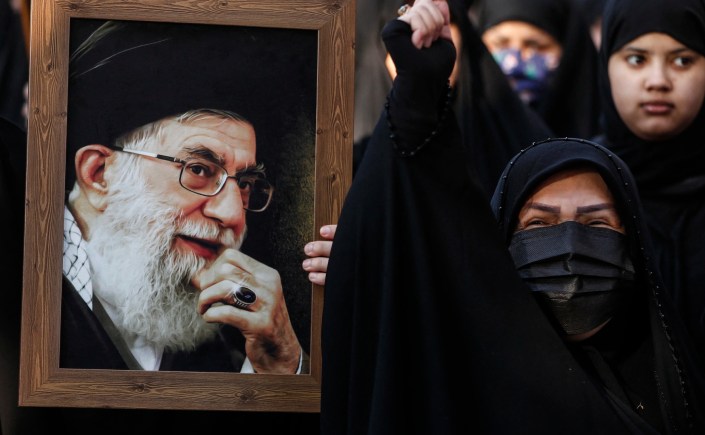
Ali Hosseini Khamenei (born 19 April 1939, Mashhad, Iran, died 28 February 2026, Teheran) was the second and longest-serving Supreme Leader of the Islamic Republic of Iran, holding office since 1989. A cleric shaped by the Shi’a seminaries of Mashhad and Qom, he was active in opposition to Shah Mohammad Reza Pahlavi and was arrested and exiled several times before the 1979 Islamic Revolution. After the revolution, he rose steadily through the new political order: survived an assassination attempt in 1981 that left his right arm partially paralyzed, and later that year became President of Iran, serving two terms (1981–1989) during the Iran–Iraq War. Following the death of Ayatollah Ruhollah Khomeini in 1989, the Assembly of Experts selected him as Supreme Leader. In that role, he exercised ultimate authority over Iran’s armed forces, judiciary, state broadcasting, and key strategic decisions, shaping the country’s domestic governance, regional policy, and contentious nuclear program for more than three decades. His tenure was marked by consolidation of clerical authority, periodic internal unrest and brutal repressions, international sanctions, and enduring tensions with the United States and its regional rivals. He is reported to have perished in the rubble of his sprawling presidential compound.
In an eloquent article in The Atlantic, Karim Sadjadpour, American policy analyst at the Carnegie Endowment for International Peace Karim Sadjadpour casts him as custodian of a mausoleum, spokesman for a ghost, while Orwell hovers like a specter over the scene, reminding us that the dead impose upon the living a worldview and a way of life long after the society beneath it has shifted, urbanised, digitised, globalised. Under Khamenei, the Islamic Republic became precisely that: liturgical slogans, policing of women’s bodies, the hijab both banner and boundary. And yet revolutions, like stubborn shadows, rarely die when their architects do.
For the Islamic Republic was never a single body; it was an ecosystem, vascular and sprawling: clerical networks, the Revolutionary Guard, the Basij, foundations controlling vast swathes of the economy, a security apparatus honed by decades of sanctions, war, assassination, and unrest. Khamenei may have been the last of the first generation, the final living ligament to 1979—but institutions outlive men. The IRGC, less ghost than organism, adaptive, entrepreneurial, entwined in Iran’s political economy and regional projection of power, had already evolved into a praetorian creature, more barracks than seminary. The revolution had become its own bureaucracy; the fervour was folded into files, the ecstatic theology into choreography. Khomeini was revelation; Khamenei was preservation. And that may yet be his most enduring achievement: he turned prophecy into paperwork, charisma into system, and systems, unlike prophets, require only control, not belief.
Makes no mistake. The regime and its security apparatus and military industrial complex is lodged in the Iranian throat. It will take more than a gargle of American mouthwash to dislodge it! This stark image encapsulates decades of entrenchment, ideology, and bureaucracy, with a sly nod to futility.
So what now? The hinge has turned, though the door may swing in any direction. Three paths suggest themselves. Consolidation: a successor, deliberately colourless, rises, the Guard tightens its grip, ideology becomes theatre while power migrates behind the curtain, the revolution persists because it can control, not because it inspires. Managed mutation: flexibility, the Islamic Republic’s paradoxical talent; controlled elections, tactical moderation, negotiation where expedient. Rhetoric may soften, “resistance” may become nationalist rather than theological, the ghost changes costume but remains on stage. Fracture: succession is a stress test unlike any other; elite rivalries, public impatience, economic exhaustion, and the memory of Mahsa Amini could conspire to splinter the coercive apparatus. The moral centre of Iranian society has shifted far from the revolution’s founding certainties; the dead can govern only so long as the living consent, or are compelled, to remember in the prescribed way.
Sadjadpour warns that Khamenei’s life’s work was to preserve a revolution “heading for the ash heap.” Perhaps. But ash heaps are treacherous metaphors: they imply finality, neatness, closure. Iran’s modern history – constitutionalism, coups, revolution, reformist surges, Green Movement, uprisings—reveals something less linear and more cyclical: endings that seed beginnings, collapses that mutate, institutions that sediment while eras blur. The Islamic Republic may yet prove more durable than its critics predict, or more brittle than its guardians admit; revolutions, like empires, seldom die cleanly—they fade, calcify, mutate, or fall when no one quite expects it.
Obituaries are tidy things. They suggest closure, a soft percussion of earth on coffin lid, the moral summation of man and era alike. But Khamenei’s political body was never contained within his frame. It was diffused: in barracks, seminaries, intelligence files, oil contracts, prison walls, procurement networks, and the muscle memory of repression. You cannot bury that with a single spade. What makes this moment feel epochal is generational: he was the last living ligament to 1979. The revolution has passed from incandescent revelation to bureaucratic inheritance, from the explosive charisma of Khomeini to the methodical, suspicious choreography of Khamenei, and inheritance is always more fragile than creation. One can die for a revolution; it is harder to live bureaucratically for one.
So: exaggerated? If one means the man, no. If one means the era, perhaps—but eras rarely end cleanly. They blur, overlap, leave sediment, rearrange furniture before the house collapses. The hinge has turned. One can almost hear the machinery shifting—the faint metallic groan of succession in closed systems. Whether the door closes, swings wider, or jams halfway remains uncertain. Perhaps the true exaggeration lies not in the reports of death but in the certainty with which commentators predict what follows.
For now, the obituary hovers between elegy and warning. Something has ended. What replaces it may look familiar, at least at first glance, but history delights in surprising both mourners and celebrants alike. And if one must borrow Wilde properly: it is not the death that is exaggerated—it is our confidence about the afterlife.
This short epitaph is a précis of the article by Karim Sadjadpour in the Atlantic in 1March 2026 written by an AI language model
The Second American Iranian War – Reckoning Without a Map
On 1 March 2026, following the initiation of U.S. and Israeli air strikes on the Islamic Republic of Iran, The Atlantic published analyses by Anne Applebaum, Graeme Wood, and Tom Nichols, each offering distinct yet complementary perspectives on the unfolding crisis. Collectively, their essays examine not only the immediate military events but the deeper political, ideological, and strategic dynamics that underpin the confrontation.
Anne Applebaum emphasizes the ideological nature of the Islamic Republic. From her perspective, Iran is not merely a state defending territorial or security interests; it is a revolutionary regime whose worldview drives both domestic repression and regional aggression. Applebaum’s central concern is process and planning: the strikes were launched without public explanation, congressional authorization, or international consensus, and no coherent strategy has been articulated for post-strike governance. Without a plan for legitimate political transition, she argues, military action risks chaos, nationalist backlash, and the strengthening of hardliners rather than meaningful reform.
Graeme Wood focuses on the operational and geopolitical consequences of the strikes. He highlights the recent escalation in which Iran targeted Gulf Arab monarchies—including Saudi Arabia, Qatar, Kuwait, Bahrain, and the UAE—marking a dramatic shift from shadow conflict to overt regional confrontation. Wood argues that these attacks may inadvertently unify Tehran’s adversaries, closing off avenues for containment and amplifying the risk of a broader Middle Eastern war. In his analysis, the strikes are not simply tactical military events; they are catalysts that reshape regional political calculations and threaten to escalate a localized conflict into a multi-front crisis.
Tom Nichols frames the strikes in terms of U.S. strategic coherence and the historical perils of regime-change operations. He stresses that regime change is not a discrete military objective but a complex political project, one requiring alignment of domestic unrest, fractures in security forces, and credible alternatives capable of governance. Nichols warns that absent such conditions, air strikes—even if tactically successful—may produce more instability than progress, mirroring cautionary lessons from Iraq and Libya.
Taken together, these three perspectives converge on a central thesis: while Iran is a hostile actor with a history of regional destabilization, military action alone cannot achieve sustainable political outcomes. Applebaum foregrounds ideological complexity and the necessity of post-strike planning; Wood highlights the regional and geopolitical repercussions of escalation; Nichols underscores the asymmetric risks inherent in regime-change gambits. Their combined insights frame the March 2026 strikes as a high-stakes venture, one in which tactical gains may be easily overshadowed by strategic uncertainty and unintended consequences.
The Bombs Without a Blueprint
Applebaum is particularly critical of process. The strikes were carried out without explanation to the American public, without congressional authorization, and without securing international consensus—a procedural void that mirrors a deeper strategic void. U.S. policy, she argues, has long oscillated between pressure and engagement, alternating sanctions with diplomacy, threats with negotiation, but rarely confronting the ideological core of the Islamic Republic. Bombing nuclear facilities or military infrastructure might degrade capabilities, yet it does nothing to dismantle the regime’s revolutionary worldview or empower a credible alternative political force. In the absence of a plan for governance after the strikes, the result is more likely to be chaos, intensified repression, or nationalist backlash rather than democratic transition.
Nichols similarly emphasizes that regime change is a political project, not a military objective. Even successful strikes do not guarantee that the regime will collapse, that protests will coalesce, or that security forces will fracture. The historical record—from Iraq to Libya—underscores the difficulty of building a functioning political order once a government is weakened or removed. The upside—a rapid emergence of a moderate or reformist government—is narrow; the downside—regional war, prolonged instability, economic shocks, and emboldened hardliners—is broad and asymmetric.
Wood complements these arguments by situating the crisis in the regional context. Iran’s missile strikes against Gulf Arab monarchies, including Saudi Arabia, Qatar, Kuwait, Bahrain, and the UAE, mark a dramatic escalation beyond shadow conflict with Israel or the United States. By attacking states that had previously attempted neutrality, Tehran risks unifying its regional adversaries, erasing remaining arguments for coexistence or containment. Gulf monarchies that had long debated restraint versus confrontation may now lean decisively toward the latter, viewing the Iranian regime as an existential threat that must be confronted. In Wood’s analysis, these strikes have not only military but profound political consequences: they reshape regional alliances, heighten the likelihood of broader war, and create a cascade of strategic uncertainty for both Iran and the United States.
Strategic Whiplash
Applebaum and Nichols also highlight the confusion in U.S. messaging preceding the strikes. During domestic unrest in Iran earlier this year, President Trump encouraged citizens to “take over their institutions,” implying support for revolution. Yet senior officials soon suggested accommodation, framing U.S. interests narrowly around nuclear non-proliferation. This whiplash—between fomenting revolution and hinting at negotiation—reveals a lack of clarity about ultimate objectives, and the strikes themselves appear more a gamble than a coherent strategy.
The risks of this approach are manifold. Iran could retaliate asymmetrically through Hezbollah, Iraqi militias, Houthis, cyberattacks, or strikes on Gulf oil infrastructure, pulling the United States into a wider regional conflict. American forces in the region could become exposed, and global energy markets destabilized. Domestically, hardliners may consolidate power, justifying repression in the name of national survival. The very elements Washington hopes to weaken could be strengthened. Applebaum, Wood, and Nichols each stress that these asymmetric risks are more numerous and plausible than the narrow upside of regime collapse.
Regional Ramifications
Perhaps the most immediate consequence of the March 2026 strikes is the escalation of the conflict beyond Iran’s borders. Wood notes that Iran’s targeting of Gulf monarchies represents a strategic miscalculation of historic proportions. For decades, Tehran benefited from the hesitation, rivalry, and caution of its regional adversaries. By striking countries that had attempted neutrality, Iran may have inadvertently unified the Gulf against it. Saudi Arabia and its allies, long cautious about provoking Tehran, may now view confrontation as inevitable. The calculus of containment and cautious coexistence may be irreversibly replaced by an era of escalation, where Iranian aggression is met with coordinated regional response, potentially with U.S. support.
This shift also reframes the nature of war in the Middle East. What had been a shadow conflict—missile exchanges, proxy skirmishes, and calibrated threats—has become overt. Sovereign states are now active targets, and the implications for regional security, energy stability, and global geopolitics are immediate and profound. The Gulf, long a buffer zone of uneasy coexistence, may now become the front line of a broader confrontation, with consequences that extend far beyond Tehran, Riyadh, or Washington.
Conclusion: Strategy Without a Map
The analyses of Applebaum, Wood, and Nichols converge on a stark assessment: the U.S. and Israeli strikes on Iran, however tactically precise, are untethered from a coherent political strategy. Applebaum warns that ideological complexity cannot be solved with bombs; Nichols reminds us that regime change is a political transformation, not a military objective; and Wood highlights the unintended regional consequences that may escalate the conflict far beyond initial calculations.
Together, they suggest that the March 2026 strikes represent a high-stakes gamble. The narrow upside—rapid collapse of the Iranian regime and the emergence of a moderate government—is contingent on unlikely alignments of internal political and social forces. The downside—regional war, economic disruption, entrenchment of hardliners, and prolonged instability—is broad, asymmetric, and more probable. By acting without a clearly articulated post-strike plan, the United States and Israel have entered a perilous chapter in Middle Eastern geopolitics, one in which the consequences will unfold unpredictably, and in which success cannot be measured merely by the destruction of targets, but by the construction of a viable political order in Tehran and a durable regional equilibrium.
The lesson, as Applebaum, Wood, and Nichols collectively insist, is clear: military action without strategy is a leap into uncertainty. The map may be blank, but the stakes are real, and the cost of miscalculation could echo for decades.
Addendum
We have republished below two articles about the January protests by British historian, author, and journalist
The Islamic Republic’s bloody endgame
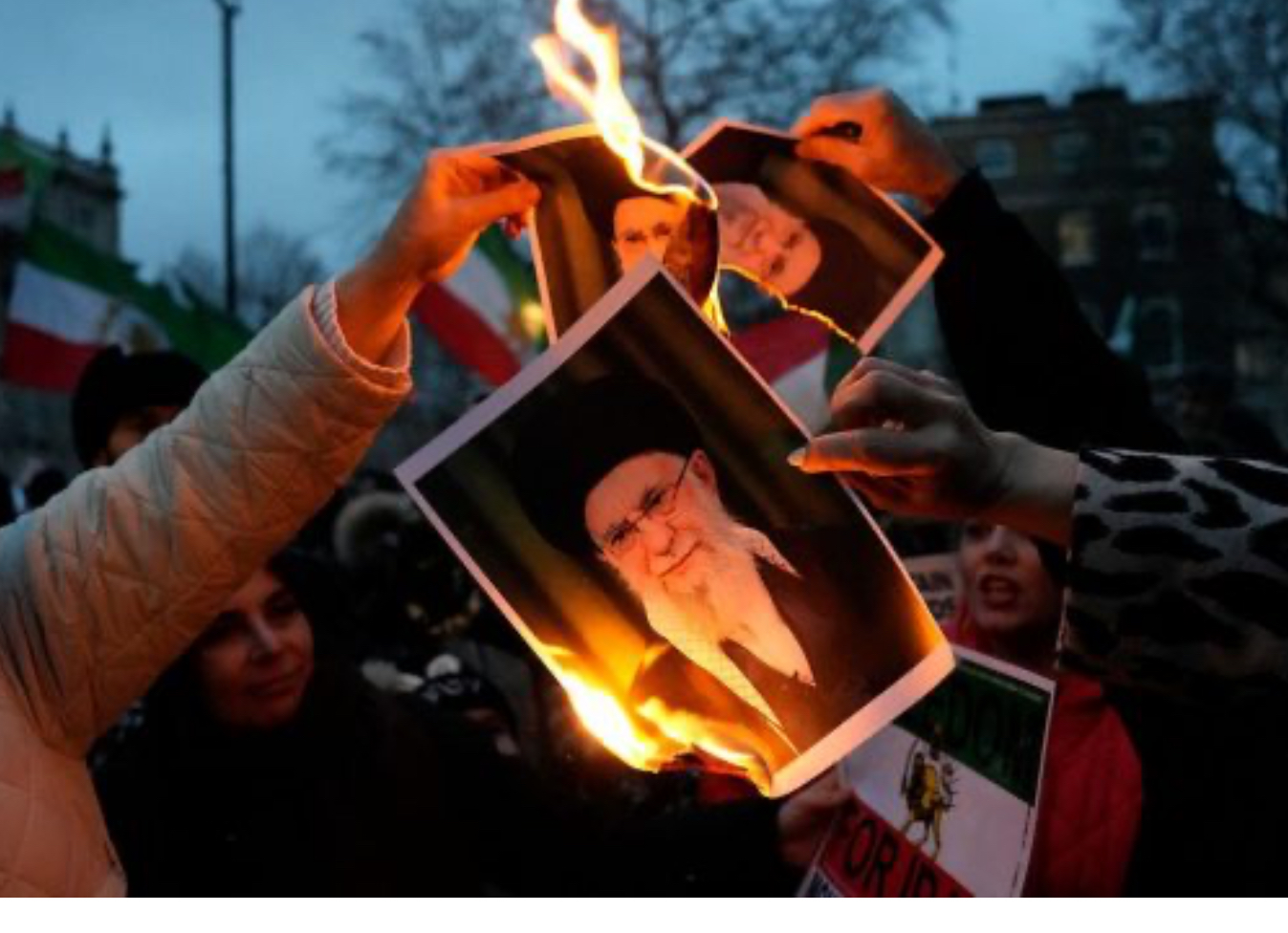
Credit. Carlos Jasso/AFP/Getty
Iran’s fanatics dream of martyrdom
As America’s advanced warplanes and ships arrive within striking distance of Iran, Donald Trump has promised attacks “far worse” than those of last June, when Iran’s nuclear sites and air defences were attacked and several of its military leaders assassinated. In response, the Islamic Republic has signalled readiness to return to the negotiations that Trump’s 12-day war with Israel against Iran had interrupted. Parley between Steve Witkoff, the American envoy, and Abbas Araghchi, the Iranian foreign minister, is to resume on Friday in Istanbul. It is unlikely, however, that Iran will accept Israel’s demands that it relinquish uranium-enrichment, dismantle its ballistic missile programme and desist from reconstituting its network of regional proxies: effectively, the unconditional surrender that the Supreme Leader, Ayatollah Ali Khamenei, has consistently refused to entertain. His inflexibility has come at the price of an unremitting Western hostility that has, along with endemic corruption and mismanagement, crashed the economy and provoked the huge protests, revolutionary in character, which erupted across the country last month. The most plausible explanation for Khamenei’s preparedness to talk, then, is that he is playing for time and hoping that, if the worst comes to the worst, he will be saved by Trump’s aversion to wars which last more than a few hours. On 1 February, the Supreme Leader warned that American aggression would precipitate a “regional” war, by which he meant Iranian attacks on tankers in the Persian Gulf and civilians in Israel. A few days earlier, Admiral Ali Shamkhani, an adviser of the Supreme Leader — who had a narrow escape when his apartment was targeted by an Israeli airstrike last summer — promised an “immediate, comprehensive, and unprecedented” response, “directed at the aggressor, at the heart of Tel Aviv, and at all who support the aggressor”. But Iran, we now know, is a spent military force and cannot carry out such threats.
Some 1,200 Iranians were killed in the 12-day war, compared with 28 Israelis and not a single American, while enemy aircraft bossed Iranian airspace. Around 90% of the missiles that Iran fired in response towards Israel were intercepted; a mere handful of its 500 or so drones made it into Israeli territory, the rest meeting a similar fate to that of the Iranian drone that flew close to the US aircraft carrier Abraham Lincoln on Tuesday, and was shot down by one of the carrier’s jets. For all Iran’s bluster, the imbalance between a belt-and-braces autarky and the world’s most advanced militaries is as stark as that between the Mahdist army and the British at the Battle of Omdurman in 1898, when thousands of Sudanese tribesmen were mowed down by Maxim guns to the loss of 47 British lives; or between the Mamluks and Napoleon’s Armée d’Orient a century earlier, when a medieval cavalry was put to flight by modern infantry squares spitting grapeshot. No, it isn’t chaos in the Gulf nor brimstone over Tel Aviv that need concern us should the negotiations fail. It is the possibility of mass slaughter of unarmed civilians in the Islamic Republic itself.
In the event, thousands were mown down, Omdurman-style, on the streets of Tehran and dozens of other cities by Revolutionary Guardsmen firing Dushkas and AK-47s. We don’t yet know exactly how many people died, though the death toll certainly exceeds by thousands the nugatory figure of 2,985 conceded by the government — dwarfing also the 3,164 people killed by the Shah’s forces over the 16 years of sporadic revolutionary activity culminating in the monarch’s flight in 1979. As for the help promised by Trump, it never came.
The bloodiest episode of civil strife that Iran has seen for at least two centuries could have been avoided had the 86-year-old Khamenei bowed to longstanding demands and stepped aside. This would have paved the way for elections to an assembly to draw up a new constitution — a relatively bloodless transition, involving members of the current regime untainted by the worst excesses of corruption and cruelty, might have been possible. By refusing such a transition and turning his stormtroopers on mostly unarmed crowds — amid reports of the Revolutionary Guards’ snipers shooting bystanders in the head and of knife thrusts aimed deliberately at the genitals — Khamenei has cleared the field of potential unifiers, in the process condemning the Islamic Republic and its internal opponents to a fight to the finish.
A former British official with close connections to Western policy-makers told me this week that the thinking among Western countries, including Britain, is that the regime is out of puff and that a collapse as rapid and as straightforward as that of Syria’s Bashar al-Assad is likely. But in 30 years of reporting on the Middle East, I have learned never to be surprised by the ignorance and complacency of our policymakers. Iran resists such a reassuring prognosis; a messier denouement awaits.
Do not be fooled by the worldliness of Iran’s artistic and literary culture or the prosperity and accomplishments of its diaspora. For much of its post-Islamic history, Iran has contained a minority of fanatics; the difference is that today’s fanatics have guns in their hands and their backs to the wall. This is what Hatam Ghaderi refers to as the revolutionary “hard core” which has gathered around Khamenei, and is composed of Revolutionary Guardsmen, hardline clerics and members of the Basij militia.
They learned their trade fighting small, dirty wars in Iraq, Syria and Yemen; their worldview formed in prayer halls and barracks where a hatred of the godless West is propagated alongside a deep yearning for the return of the 12th Shia imam, who disappeared from view 10 centuries ago and will emerge to inaugurate an epoch of justice and peace. Religious meetings are conducted by men who sing of martyrdom and purity; they regard the killing of godless “rioters” acting at the behest of Israel as a virtuous act. With blood already on their hands, they have no way back into general acceptability, and nowhere to go but further and further into their own fantasies of martyrdom, all the while nurturing fond expectations of divine intervention. There is no reason to exclude Ali Khamenei from their number.
Whatever happens in Istanbul on Friday, and during the weeks to come, the Islamic Republic is unlikely to survive. Its people hate it too much. But its fall will not be the simple event that is seemingly contemplated in Washington and Jerusalem. The correct analogy is not with the kleptocracy that melted away with the fall of Assad but with those members of the Waffen-SS who carried on fighting even after Hitler’s death in 1945, exhibiting the same unappeasable contempt for death and hatred of their enemies that they did when he was alive.
When Reza Pahlavi was asked whether he took responsibility for the slaughter on the streets of his homeland, he replied coldly, “this is a war, and war has casualties”. That words have consequences means something tangible in a world of bullets and flesh and the destiny of a people. Many Iranians have entered a war with their regime that must end with the elimination of one or the other. Trump should think hard before he next promises Iranians his help, and mean it if he does, or he too will have blood on his hands.
The Ayatollah will fight to the death
He could unleash a killing machine

Ever since he became Iran’s Supreme Leader in 1989, Ayatollah Ali Khamenei’s approach to domestic unrest has been defined by three assumptions. The first is that protesters can be discredited through accusations of collusion with the country’s Western foes. The second is that, having engineered the 1979 revolution that brought the mullahs to power in the first place — and suffered the consequences — Iranians will do anything to avoid another upheaval, the poor letting themselves be seduced by government handouts while judicious shows of force dissuade the middle class from taking to the streets. The third is that Iranians are incapable of uniting around a single opposition figure: whether a disaffected insider like Mir Hossein Mousavi, or Reza Pahlavi, exiled son of the deposed last Shah, easily caricatured as a creature of the Virginia suburbs and who hasn’t seen his homeland in almost half a century. Such assumptions have seen Khamenei and his acolytes in the Revolutionary Guard, the clerical establishment and the Basij militia ride out crisis after crisis, starting with the Green Movement led by Mousavi in 2009, extending through the Woman, Life, Freedom movement of 2022-3 and climaxing in the battering that the country received last summer at the hands of Israeli and US aircraft. Then, calls by Benjamin Netanyahu and Pahlavi himself for ordinary citizens to take advantage of the regime’s military disarray, by going out and toppling it, went conspicuously unanswered. Now all has changed. Initially sparked by economic collapse, two weeks of protests have coalesced into a national movement, one whose aim is nothing less than the destruction of the Islamic Republic. Along the way, the regime’s tenaciously-held assumptions have become obsolete. The authorities have been caught unawares, and seem unable or unwilling to change course. On the contrary, the Islamic Republic remains fatally wedded to the old assumptions while the country enters an unpredictable and explosive new phase. The scene was set by a summer of chronic water shortages and electricity outages. In December, the riyal collapsed and inflation touched 50%, the consequence of mismanagement, corruption and sanctions that the revolutionary oligarchy has knowingly courted and in some cases profited from. Tellingly, the initial protests, on 28 December, were staged not by the hijab-discarding young women, the sort who spearheaded the Woman, Life, Freedom movement. Rather, the discontent was sparked by the revolution’s traditional supporters: grizzled, pious traders in the bazaar. They were soon joined by youthful members of the country’s dispossessed middle class: nouveaux pauvres with a Jacobin rage in their hearts and supportive compatriots by their side.
The regime has responded by killing dozens of protesters before cutting the internet on Thursday night. Behind the blackout, as is clear from video and audio files that continue to trickle out, more protesters are dying, more public buildings are being attacked and more hospitals are becoming war zones as parents smash down mortuary doors and remove the bodies of their dead children before the authorities can surreptitiously bury them. Such confrontations are a throwback to the 1979 revolution, which advanced to the rhythm of Shia mourning ceremonies, each funeral being a magnet for more protests and more deaths.
Only a few government services — notably regime propaganda conducted through social media — have been exempted from the blackout. Card transactions, on which the economy depends, have not. With shops shuttered, the protests seem to be growing. In one video clip of a huge nocturnal gathering, a voice is heard: “They say they are going to come and kill us. Let them try to kill this crowd!”
On Friday, the Revolutionary Guard’s intelligence wing warned against “any refusal to act” on the part of other organs of the state, a rare public admission of concern on the subject of regime cohesion. The following day the regular army, which usually takes no role in maintaining law and order, announced that it would safeguard strategic infrastructure and public property, also urging Iranians to thwart “enemy plots”.
But such warnings, and Khamenei’s own denunciation of the protesters as “rioters” whose motivation is to curry favour with Donald Trump, derive from the old reasoning that equates any call by Iranians for foreign intervention with unpatriotic betrayal. The country has a long history of such interventions, not least the 1953 coup in which MI6 and the CIA overthrew Mohammad Mosaddegh, Iran’s legitimate prime minister. Yet judging by the protesters’ cheerful calls for further attacks by the US and Israel, it is clear that they have rejected their parents’ squeamishness. According to the logic on the streets, another Western aerial campaign would be welcome if it advances the goal of toppling the Islamic Republic.
The main political beneficiary of the growing appetite for outside action is Pahlavi, who on Friday exhorted Trump to “be prepared to intervene to help the people of Iran”. And, for the first time, the self-styled crown prince is regarded as a serious contender for leadership of a new regime whose main attribute would be its good relations with Tel Aviv and Washington.
It is a remarkable transformation for the diffident 65-year-old who left Iran for Lubbock, Texas as an air force cadet in 1978, and was for years dismissed by liberal and Leftist opponents of the regime as an embarrassing reminder of his father’s corrupt and authoritarian rule. Pahlavi’s support for the joint Israeli-US attack on Iran this summer, furthermore, in which more than 1,000 Iranians were killed, appeared to put him at odds with his compatriots. No longer. On the burning streets of Tehran calls of “Long live the Shah!” ring insistently while Pahlavi’s former Leftist critics, in the words of one veteran Iranian analyst, “have started treating him with respect”.
Pahlavi rises, Khamenei falls. As recently as three years ago, the Supreme Leader’s will was unchallenged and his authority total; since then, the so-called “Axis of Resistance” he had built up across the Middle East has been obliterated by Israel, with his own intelligence services clearly compromised. Most significant, the bombing of Iran’s nuclear facilities last summer removed any possibility of an Iranian bomb, in the short term at least.
Khamenei lost the use of an arm when he was blown up early in the revolution. He is not a quitter but a quietly stolid fanatic who will leave the Islamic Republic horizontally or not at all. And he has yet to turn the full force of his killing machine on the protesters. Observing all this, and fanning his tail feathers after his exfiltration of Nicolás Maduro from Venezuela, is the US president — who, by immediately reimposing his policy of “maximum pressure” on the Islamic Republic following his election last year, has, it is now clear, helped bring the Islamic Republic to its knees. “If they start killing people like they have in the past,” Trump declared on Saturday, “we’ll be hitting them very hard where it hurts.” By that time, of course, the slaughter of protesters was well underway.
Trump has so far avoided meeting Pahlavi, perhaps judging that the regime remains a long way from collapse, or because, if the time comes, he favours a Venezuela-style decapitation and Khamenei’s replacement from within the current set-up. Hassan Rouhani, a former president known both for his moderation and his toughness, might be a candidate.
As if by providential design, the ousting of Maduro lends an aura of inevitability to the demise of the Islamic Republic. And yet regimes are not toppled by auras. They are not toppled because Dara Khosrowshahi, the CEO of Uber, who was born into a good family in Iran in 1969, says that he is looking forward to “investing aggressively” in his homeland in the “first 100 days” after liberation. They are toppled because the men with guns are killed or lose their stomach for the fight. And of that, so far as we know, there is no sign.
A lot has happened since the summer. Iranians have got over their horror of foreign interventions and have adopted the closest figurehead to hand. A people out of time, they are fighting for a liberal democracy, or — quainter still — a constitutional monarchy, just as the brand seems defunct. Behind the penumbra of the communications blackout, a country of 90 million, an ancient culture dishonoured by its leaders, goes to work on itself.
 In That Howling Infinite