Between heaven and hell … Syria at the Crossroads

There are moments in the Middle East when history suddenly shift gears and takes us all by surprise. Lenin knew the cadence: there are decades, he wrote, where nothing happens; and then, weeks in which decades happen. A year ago, Syria – trapped in the vortex of its civil war for almost fourteen years  and virtually ignored by the rest of the world since October 7 2023 – suddenly leapt into one of those crazy weeks, leaving allies, enemies, and analysts alike blinking in the dust. Even now, a year after the astonishing fall of Damascus, the country sits like Kipling’s Tomlinson at the gates of judgement: not quite damned, not fully redeemed, suspended between heaven and hell.

Sleepers awake …

For years, as The Independent’s Bel Trew observed last December (see Syria. Illusion, delusion and the fall of tyrants) the world forgot about Syria – notwithstanding the courageous efforts of western and Syrian reporters and humanitarian workers who strove in perilous circumstances to bear witness. The civil war had become the background hum of the region, a grim drone many had learned to tune out as Ukraine and Gaza dominated the world stage. The regime of Hafez al Assad, brutal and immovable, bolstered by Russia, Iran and Hezbollah, looked set to endure indefinitely. The jihadi rebel enclave in Idlib, though supported by Türkiye, was dismissed as a besieged hold-out. Even those who professed expertise couldn’t reliably tell you whether the war was still ongoing, who was fighting whom, or what stage the conflict had reached. It was as if the wheels of war had stopped spinning.

Then, over the space of days – eleven, to be precise – the wheels spun again. Hay’at Tahrir al-Sham’s fighters burst from their confined redoubt with a momentum no one expected (including, it seems, themselves), sweeping through Aleppo and racing down the highway to the capital. Analysts reached instinctively for historical parallels: Havana 1959, Saigon 1975, Kabul 2021. Analyst David Kilcullen pointed instead to Timur Kuran’s theory of the “preference cascade”: the sudden collapse of a regime that had mistaken silence for loyalty and compliance for consent. Assad’s security apparatus – omnipresent, omniscient, yet somehow oblivious – realised too late that its soldiers had no stomach left for the fight. The all-powerful giant had feet of clay.

It didn’t help that Iran, Assad’s indispensable patron, had stumbled into the most grievous strategic miscalculation of its post-1979 history. Flush with revolutionary zeal, Tehran had kicked the hornet’s nest in Lebanon, prompting Israel to pivot from Gaza to Hezbollah with stunning force. Suddenly Iran’s expeditionary assets were exhausted, its proxies over-extended, and its clerical leadership exposed as both ageing and isolated. Even the Ayatollah’s conspiratorial refrain – that the fall of Damascus was all a plot by the Great Satan, the Little Satan, and the Sultan in Ankara – couldn’t mask the fact that this was less Zionist cunning than simple imperial overreach. When the rebels came, neither Iran nor Hezbollah, nor Russia, entangled in its Ukrainian quagmire, could ride to the rescue.

But the rebels, too, were surprised. Their mandate from Ankara was modest – expand the borders of their statelet a little, test the regime’s nerve. Instead, they found themselves virtually unopposed on the road to Damascus.  In an Informative article in E-zine Unherd republished below, British writer and investigative journalist Tam Hussein  writes how many of the fighters interpreted the victory as divine intervention – not jihadi zealotry, but a sincere theological attempt to explain the inexplicable. The suddenness of Damascus’s collapse felt, to them, like an echo of Muhammad’s bloodless conquest of Mecca. And in a land where the eschatological imagination has always saturated politics, it didn’t take long before social media brimmed with end-times speculation. Ahmed al Shara’a – formerly Abu Mohammad al-Jolani, with a $10 million American bounty on his head – was seen by some as “the one”, and the precursor of the Mahdi and the foretold end of days.

Yet as Hussein rightly notes, miracles make poor policy. The survival of the new Syrian administration will depend not on prophecy but on governance, and on whether Shara’a, interim president and ex-jihadi turned statesman, can transform a miraculous seizure into a sustainable state.

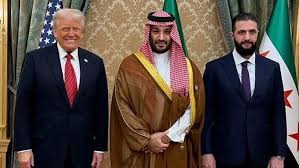
To his credit, he has avoided the catastrophic purges that helped destroy post-invasion Iraq. He has kept the civil service intact, flirted audaciously with Western diplomacy, and allowed at least the theatrical semblance of elections. He has restored the embassy in London, opened channels to Washington, even  visiting the White House  and played the charm-game with Gulf capitals that only recently readmitted Assad into their fold. As Hussein writes, he has shown political finesse: keeping the constitution, appointing seventy parliamentarians himself, and balancing piety with pragmatism.

But the tightrope is frayed. Sectarian wounds – Druze, Alawite, Sunni, Christian – remain raw and unstitched, with the Latakia massacres now entering their fraught judicial phase, and Israel stirring the Druze pot. Kurdish anxieties simmer: the old “Arab-first” chauvinism must be abandoned if Syria’s patchwork is ever to become a tapestry again. Foreign fighters, once lionised, now loiter between hero and hazard, implicated in sectarian atrocities. Kurds clash with Syrian forces; Turkish troops press deeper into Rojava; Israel remains the unpredictable neighbour bestride the Golan; and Iran, though weakened, is never entirely out of the game. It is not inconceivable that the forces that helped topple Assad could yet turn their sights toward Jerusalem in the belief that prophecy demands it.

And there are darker portents too – those flickering shadows that hint the wind of freedom may be blowing from the wrong quarter. The new government’s early gestures toward Islamisation – the hair-covering admonition, the curriculum purge, the dismissal of women from key posts, the torching of a Christmas tree in Hama – suggest that pro-Russia and anti-western platforms like RT and Mint may have a point when they warn that the leopard has not fully changed its theological spots. Shara’a’s declaration that elections may be four years away, the dissolution of the old constitution, and the folding of all rebel factions into state structures recall less a liberal transition than a consolidation of revolutionary power.

Meanwhile, the country remains a mosaic of mini-wars. In the north, Turkish proxies grind against Kurdish forces in Rojava. In the south, local militias continue to resist HTS’s claim to national authority. In the west, Alawite formations cling to their shrinking redoubts. To the east, Islamic State survivors eye the chaos, waiting for the prison gates to break. And overhead, as ever, the Americans and Israelis fly their competing deterrents, ensuring the war never quite ends.

So: Syria stands at the crossroads. Will Syria’s future be heaven, hell, or merely another circle of the inferno?

Optimism is possible – cautiously so. If the West can avoid its habitual fatalism, if, when sanctions are lifted, investment flows, if Turkey and Israel can be coaxed into tolerable coexistence, if Kurdish autonomy is honoured, if sectarian grievances are handled with equity and not vengeance — then Syria could, in time, become a conservatively stable hub. Shara’a’s Idlib experiment shows he can build an economy under duress.

But the inverse is equally imaginable: a Lebanon-style implosion, a Yugoslav-style partition, or a Gaza-style fortress of permanent mobilisation. As Isreali commentator and contributor to Haaretz Zvi Bar’el wrote a year ago, writes, the warm international “envelope” around Damascus is generous but tentative. Nobody quite knows where Shara’a is heading. They simply assume anyone is better than Assad – the same mistake Syrians once made about the old Ba’athi patriarch Hafez al-Assad himself.

Right now, the future’s not ours to see. Something’s happening, but we don’t know what it is, and anyone with a deep knowledge of the Middle East knows that one must expected the unexpected. The old regional wars – Gaza, Lebanon, the Red Sea, Iran’s Axis of Resistance – though seemingly on hold, have not paused to let Syria breathe. The war in Ukraine grinds into winter, the bizarre Gaza peace plan shuffles on, and there are constant political shifts in Washington. Each of these could rewrite the geopolitical chess board yet again.

Still, as Robert Fisk wrote in the final line of the final book he never lived to promote: all wars come to an end, and that’s where history restarts. Syria is restarting now – painfully, precariously, imprecisely –  but restarting nonetheless.

Whether Syria walks toward heaven or hell remains to be seen. The choice –  as ever in the Levant – will not be its alone.

Syria Today: Walking Through the Wreckage

A year after the Assads fell, Syria still moves through its own ruins – startled by its freedom, and half-afraid of it. The dynasty’s collapse ended the nightmare but did not usher in a dream; it simply exposed, in unforgiving daylight, the damage done over half a century of dictatorship and more than a decade of war. The smashed cities are visible to any passer-by; the deeper wreckage – the traumas, resentments, and debts of blood – is harder to map and harder still to mend.

Sednaya prison’s opened gates remain the sharpest indictment. The men who stumbled out were not just survivors but witnesses, their bodies forcing the nation to acknowledge what many had whispered and few had dared investigate. Yet even this reckoning has not united the country. Sectarian reprisals and atrocities on the coast, more atrocity and calls for Druze autonomy demands in Sweida, tribal restlessness in the south and northwest, Kurdish self-rule in the north, and Alawite fear of collective punishment keep the national psyche taut and divided. Bitterness circulates like a second economy.

The economy, meanwhile, balances on a fraying tightrope. Western aid and investment have brought cranes, reopened highways, and a flicker of commerce, but also inflation that is hollowing out households. Reconstruction glimmers like a desert mirage: real enough to chase, never close enough to touch. Corruption accompanying nepotism and patronage has survived the revolution, and many returnees discover that rebuilding a home now costs more than earning one.

Politically, the country sits in an improvised equilibrium. Al Shara’a rules as both liberator and question mark – trusted by some, tolerated by others, watched by all. His pivot toward Washington, his quiet coordination with US forces, and his break with former comrades offer a new direction, but also a gamble. Around him, sovereignty is nibbled at the edges: Israel digs deeper into Quneitra province; Türkiye tightens its grip in the Kurdish north. Liberation has shifted the map without fully restoring control over it.

So Syria stands on the threshold, like Tomlinson, neither damned nor redeemed, simply called to account. The war is over, but its aftershocks and tremors linger in regional loyalties, local vendettas and regional manoeuvres. The people are free, yet unsure of that freedom’s limits and what it asks of them. And the vast machinery of the state still creaks with old habits and temptation.

And yet – a small, highly qualified yet – Syrians are imagining a future again. Not the predetermined script of dictatorship, nor the fatalism of war, but something open, negotiable, theirs’. For a people long told that nothing changes, the mere possibility of change is its own quiet revolution. Hope is not guaranteed; neither is stability. But the impossible has already happened once, and that alone shifts the horizon.

Postscript: the strange, messianic weather of revolutions

Among the HTS fighters Tam Hussein describes, the astonishingly swift and almost bloodless collapse of Damascus could never be reduced to battlefield arithmetic. After over a decade of stalemate and slaughter, the conquest of Damascus and the fall of Assad felt too abrupt, too neat, too historically implausible to be merely human. And so they reached, perhaps instinctively, for the vocabulary of prophecy that has long circulated in the Levant: the old stories of tyrants toppled in the final days, of a just ruler rising at history’s eleventh hour, of a brief season of peace before a climactic confrontation with “the Romans,” a term that in popular imagination now stretches elastically to include Israel, America, or the West at large.

In this folk-level cosmology – not the carefully parsed doctrine of scholars, but the lived, emotional scripture of men who have lived too long fear, death and loss loss – the victory in Damascus reads like a prophetic epic ballad. When a fighter told Hussein that Syria would enjoy “ten years of peace before the war with Israel,” he was drawing from a hazy amalgam of hadith traditions and battlefield folklore to make sense if the improbable: the idea of a lull before the storm, a breathing space before the world tilts into its final reckoning. It is vernacular eschatology, shaped as much by trauma and longing as by text.

Within that register, the murmurs that Shara’a/Jolani might be “the one” carry an unmistakable Mahdist echo. No fatwas or proclamations like when Da’ish leader Abu Bakr  al-Baghdadi famously declared the caliphate from the minbar of Mosul’s al-Nuri Mosque in 2014; but the emotional charge behind the phrase is unmistakabl: an intuitive reach for a Mahdi-shaped idea of the righteous restorer, the unifier, the man who appears when everything has fallen apart. It’s not that anyone literally thinks Jolani is the Mahdi; it’s that the mood of the moment makes such thoughts feel briefly within arm’s length. A silhouette on the horizon, nothing more.

And here, Syria is not unique. Revolutionary periods everywhere – the Protestant Reformation, the French Revolution, the Russian Revolution and Civil War, the Arab Spring even, have their magical phase — those jittery days when people begin to speak as if the world has cracked open, meaning is pouring through the seams, and events blur into myth. When a regime that seemed immovable collapses in a fortnight, people fall back on stories larger than themselves. Sudden upheaval, long suffering, and the ascent of a charismatic figure combine to crack open the ordinary world. Prophecy offers a narrative frame when history seems to be behaving like fable.

So the eschatological edge in these fighters’ conversations tells us less about doctrine and more about psychology. It’s a very human response: a form of magical thinking that arises when reality becomes too strange to process, a way of giving shape to chaos, of telling themselves that their suffering fits into a larger story. A coping mechanism, if you like –  a mythic vocabulary for a moment when Damascus fell, and the ordinary rules stopped making sense and the earth seemed briefly to tilt on its axis.

See also in In That Howling Infinite, Syria. Illusion, delusion and the fall of tyrants and Cold wind in Damascus – Syria at the crossroads. And  on the subject of messianism in general, see A Messiah is needed – so that he will not come

Will civil war return to Syria?

Its future is in the balance

Tam Hussein, Unherd December 8, 2025

A few months ago in Damascus, I discovered a medieval hospital. The door had been left slightly ajar, and I wandered in with my companion Hassan Idlibi — a rebel fighter and old friend. He hadn’t been in the Old City since the fall of Syria’s capital, exactly a year ago today. “When Damascus fell,” he told me, “we were at our lowest ebb. Even the attack on Aleppo was our last gasp. We wanted to break the stalemate. And then we just pushed and pushed, and we ended up sleeping inside the Umayyad Mosque. It was a miracle.”Idlibi, like many Syrians, did not interpret the taking of Damascus through geopolitics — but as divine intervention. This wasn’t because he was a mindless zealot. Far from it. He is one of the most well-read men I know. But, to his mind, the fall of Damascus was so sudden, so unexpected, that only the miraculous could explain it. The victory, he noted, had been achieved by those who had been motivated by Islam. Help had come from foreign fighters, the mujahideen, who travelled from across the globe to aid their co-religionists. And the campaign had been led by a former jihadi, Ahmed al-Sharaa, now the interim president of Syria. At the time, the old al-Qaeda operative, then known by his nom de guerre, Abu Mohammad al-Jolani, had a $10 million American bounty on his head.

After more than a decade of slaughter, no one had expected the capital to collapse. Assad, then president, had seemed like a stubborn wart: unpleasant but immovable. Jolani’s rebel enclave in the northern city of Idlib looked too small, too besieged, to pose a serious threat — though in fact it was performing better economically than inflation-ravaged Damascus, helped along by a reliable flow of Turkish hard currency. I myself expected the rebels to negotiate. What leverage did they have? Yet this rebel government, roughly the size of Croydon, took over the instruments of state, and since then has avoided stumbling into a new civil war.

The unexpected and largely peaceful victory was attributed to piety, prophecy, steadfastness. Some have even compared the final conquest of Damascus to Muhammad’s bloodless conquest of Mecca in 630. The idea of a “miracle”, here, is not mere rhetoric — it shapes political expectations. Some Syrians, at least based on my social media, think all this makes Sharaa “the one”, with my Facebook messages and WhatsApp chats awash with prophetic readings of the present. One believed Syria would now enjoy 10 years of peace before the war with Israel begins. Perhaps, he suggested, this was the prelude to the end of times. After all, so-called “Greater Syria” — encompassing much of the Levant — plays an important role in the Syrian and indeed Muslim sacral imagination. It is where prophets walked and is the place where many of the end of times narratives will play themselves out.

Yet if the fall of Damascus seemed miraculous to many Syrians, the survival of the new administration will depend less on providence than on governance. Despite his past, Sharaa has so far demonstrated an unexpected level of political finesse. He has kept the constitution, held elections — albeit with 70 seats appointed by himself — and all the while has acted the statesman. He is savvy enough to not mind having President Trump spray his latest fragrance on him in the Oval Office, or Syrian Jewish rabbis blessing him.

Sharaa has made some promising early decisions. By keeping the civil service intact, he has avoided the catastrophic purge that helped destroy post-invasion Iraq. He should continue recruiting highly-educated young Syrians from the diaspora — people familiar with Western administrations and political norms. Even so, the administration still has a tendency to fear scrutiny and behaves as if under siege. It should welcome a regulated free press, which would expose blind spots, not undermine authority. The British press has reported that Jonathan Powell’s Inter Mediate is working with the new government. This should be welcomed rather than criticised — not only for reasons of conflict resolution and soft power, but for its value in statecraft and building institutional capacity.

Sharaa’s priorities for the coming year are clear. The country remains immensely fragile, caught in a regional tug-of-war between Israel and its neighbours, and divided along ethnic and sectarian lines. The situation could easily drift into a reprise of Lebanon’s civil war. Sharaa’s first task is therefore to mend Syria’s sectarian and ethnic fractures with a sense of equity. The trials that began this month over the coastal massacres in Latakia will be an important test of how the country intends to move forward. The Druze and Alawite communities — already bruised by conflict and mistrust — require justice delivered without the language of sectarianism.

Meanwhile, Kurdish anxieties must be addressed by ending the Arab-first ideology of the old regime. Syria has never been a purely Arab country: even its favourite son, Saladin, the builder of that hospital I visited and whose grave in Damascus still draws multitudes, was a Kurd. Last year’s tentative permission for Kurdish new year celebrations (Newroz) suggests that a more pluralist future is possible. Yet it remains unclear how far Kurdish cultural expression will be allowed to develop. Already this month, exchanges of fire between Syrian government forces and Syrian Democratic Forces (SDF) units under Kurdish command show how fragile the situation is.

Perhaps the most difficult balancing act involves the foreign fighters who fought on Sharaa’s side. They carry immense symbolic weight in Syrian society — and are the cause of immense fear in the West. Many are ready to resume normal life, but others still see themselves as Islam’s warriors. Recent clashes in the Idlib countryside involving French foreign fighters reflect anxieties that any rapprochement with the West might see them handed over to their home governments. The image of Sharaa standing beside Trump, receiving a symbolic “anointing” of his new fragrance, alarms them even if such engagement is politically necessary.

Granting these fighters legal status, regularising their papers, integrating some into the national army or demobilising them with stipends and educational opportunities — not unlike the GI Bill for US veterans — could go a long way toward neutralising one of Syria’s most volatile pressures.

Then there is the conundrum of Israel. On this, Sharaa has cultivated deliberate ambiguity. At the United Nations, Syria has repeatedly noted its restraint regarding Israel’s illegal strikes on Syrian territory, yet Sharaa has resisted pressure to join Trump’s flagship Abraham Accords. Signing them now would be political suicide. But ambiguity buys him room to manoeuvre — and time to consolidate the state. The question is how long this can last.

For its part, the West has worked to prevent Syria from sliding into another civil war — one that would inevitably spill over into Europe, potentially replaying the exodus of 2015. With regional partners like Saudi Arabia and Turkey, Western governments have effectively restrained Israeli escalation, aware that renewed instability would eventually reach Jerusalem’s door. It’s not impossible to imagine rebels, having overthrown a “pro-Western stooge” like Sharaa and aided by foreign fighters, actually marching toward Israel, convinced that “the infidels” will never allow them to determine their own future. As they did in Damascus, so too — in their imagination — must they do in Jerusalem.

Thus far Sharaa has governed with surprising openness. He has welcomed Britain’s foreign secretary David Lammy, met American diplomats and General David Petraeus, played basketball with US soldiers, and cooperated in counter-terrorism operations. He has also restored relations with London, with foreign minister Asaad al-Shaibani reopening the Syrian embassy.

If Western governments refuse to work with him because of his Islamist roots, they will share responsibility should Syria fracture again. Sharaa’s past is not erased; he may remain an uncomfortable partner. But what is the alternative? That he be excluded from political life and drift into a Castro- or Maduro-like role on the sidelines? If the Saudi Crown Prince can be brought in from the cold after the Khashoggi murder, then almost anything is possible.

Here I recall a meeting with former Saudi spy chief Turki al-Faisal in his South Kensington apartment after the release of his memoir. Faisal lamented how his advice went unheeded after the Afghan-Soviet war. He had urged the international community to launch something akin to a Marshall Plan — an investment programme to stabilise Afghanistan. Had that happened, the region might not have unravelled. Instead, the country collapsed into years of civil war.

Likewise, fully lifting sanctions on Syria and providing a major investment programme, coupled with training and cultural exchange, could restrain the country’s more radical elements. Reining in Israeli escalation, de-escalating the Druze conflict, and mediating between the SDF and Damascus would all help prevent new wars. On this, the West could also spare itself a future security headache by helping Damascus regularise or demobilise foreign fighters rather than leaving them to drift. This would all help to displace messianism.

What, then, would such investment bring the West, beyond avoiding another gaping wound on its eastern flank? For sure, it will not turn Damascus into another Beirut, a place for foreign journalists to party, nor into a Deano-friendly Dubai. Syria will likely remain socially conservative, more like Muscat in Oman. Given time, however, it could become a commercial hub with a distinct cultural life, just as it has been for much of its epic history. This isn’t mere optimism: Sharaa turned Idlib, once a distant town, into a magnet for Damascenes seeking commercial opportunity. Investment now would bring the West a friendly partner, business prospects and political influence. The choice is stark. With support, Syria could become a kind of West Germany: rebuilt, integrated, and stable. Without it, the country risks becoming a new Jerusalem — a battleground charged with fire and prophecy.

Tam Hussein is an award winning investigative journalist and writer. His work has been recognised by the Royal Television Society Awards.

Syria. Illusion, delusion and the fall of tyrants

So we march to the rhythm of the revolution;
Oh it is our shining hour.
Move to the rhythm of the revolution,
And the revolution’s power.
Run with the rhythm of the revolution,
Storm the palace, seize the crown.
Rise to the rhythm of the revolution,
Shake the system, break it down!
Paul Hemphill, Rhythm of the Revolution

Recent events in the Middle East seem to validate Vladimir Lenin’s aphorism, “there are decades where nothing happens; and there are weeks where decades happen”.

For years” wrote Bel Tru, the Independent’s correspondent in the Levant, a worthy successor to the late Robert Fisk and now retired Patrick Cockburn.East, “the world forgot about Syria. Many believed it was lost in an unsolvable abyss following the collapse of the 2011 revolution into a bloody civil war – made increasingly complex by the intervention of a mess of internal and international actors. Most assumed that the immovable regime of Bashar al-Assad had won, and that nothing would ever change. Few could even tell you if the war was still ongoing, let alone what stage it was at”.

Until Syrian rebel fighters stormed out of their fastness in Idlib province, which had been besieged and contained and for years by government forces and Russian bombers, and in an off sense that too the world by surprise, they took control of Aleppo, Syria’s largest city?

Over the space of a week, it seemed as if the nightmares of the past had come rushing into the present as the current wars in Gaza and Lebanon were pushed to the sidelines.

Iran’s theocratic tyrant Ayatollah Khamenei declared that the rebel offensive that destroyed the 52-year-old Assad dynasty in a mere eleven days was all a foreign plot concocted by the Great Satan and the Little Satan, aided and abetted by the wannabe Sultan of Türkiye (and there might indeed be a kernel of truth in that). In his opinion, it had nothing to do with the fact that the brutal and irredeemably corrupt Syrian regime was rotten to its core and that like the Russian army in 1917, its reluctant conscript soldiers, neglected, poorly paid and hungry, refused to fight for it whilst its commanders ran for their lives. Built to fight Israel and then to subdue Syrians, it had over time ate itself in corruption, neglect and ineptitude. Western radicals of the regressive left will doubtless believe the good ayatollah because that is what they are conditioned to believe rather than learning anything about Syria or the region generally.

if Khamenei could only have removed the mote from his eye, he’d have seen that the fall of Bashar al Assad was the indirect result of the most disastrous series of foreign policy miscalculations since the theocratic regime took power in Tehran in 1979. In the wake of Hamas’s murderous attack on Israel on October 7, 2023, Iran made the fatal error of ordering its proxy Hezbollah in Lebanon to begin a low-level war against northern Israel, lobbing missiles and drones into it almost daily. What Tehran did not calculate was that once Israel had largely destroyed Hamas in Gaza it would turn its guns on to Hezbollah with stunning force. The indirect effect of Iran’s miscalculation was that neither Hezbollah nor Iran was in a position to help Assad repel the rebels when they launched their assault. Iran has now lost its regional ally Syria, in addition to Hezbollah and Hamas, leaving it unusually isolated in the region when its ageing clerical leadership is increasingly unpopular with its own people.

Over the coming weeks and months, commentators, pundits and so-called experts will ruminate on the causes of the fall of one of the Middle East’s most enduring and also, even by the region’s low standards, brutal regime, and on what may or may not happen now.

I republish below two excellent opinion pieces offering some answers to each question respectively. Each in their own way follow the advice of most scholars of the Middle East: expect the unexpected. And whilst most observers admit to having been taken by surprise when Hayat al Tahrir al Sham fell upon Aleppo, including intelligence organizations that ought to have known better, none were perhaps more surprised than the insurgents themselves when only a fortnight ago, they were given the nod by their Turkish patron to endeavour to expand the borders of their statelet and suddenly found themselves on an almost empty highway to Damascus.

Analyst and commentator David McCullen (who has featured prominently on this blog in the past) examines warning signs that may have indicated that all was not well in the Assad kingdom, drawing on on historical parallels to explain why the Bashar al Assad and his longtime all-pervasive and ever-watching security apparatus failed to see the gathering storm unlit it had engulfed them.

He references particularly the political scientist Timur Kuran, the originator of the concept of “preference cascade”: “… under repressive regimes (or ostensibly democratic ones that censor dissent) the gap between public pronouncements and private opinions increases over time, until many individuals dissent from the approved narrative and lose faith in institutions that promote it but remain reluctant to reveal their real views. This “preference falsification” creates a deceptive impression of consensus. It can make regimes believe they have more support than they really do, while convincing dissidents they are all alone so there is no point expressing a contrary opinion. But when an unexpected shock reduces the regime’s power to suppress dissent, people suddenly feel empowered to express their real opinions. They realise these opinions are widely shared and the false consensus evaporates. This can trigger a “preference cascade”, where individuals or institutions suddenly change sides and support for the government collapses overnight”.

Kilcullen concludes: “Given the speed and totality of Assad’s collapse, some observers seem to be assuming that HTS will now, by default, become the dominant player in Syria. On its face, this may seem a reasonable assumption, given what happened in similar situations – Havana 1959, Saigon 1975, Kabul 2021 and so on”. But he cautions that “it would be premature in Syria’s case since the war is very much ongoing. As the northern hemisphere winter closes in and Western allies prepare for a change of administration in Washington, Syria – along with Gaza, Lebanon, the Red Sea, Ukraine, Taiwan and the Korean peninsula – will remain a major flashpoint into the new year”.

Indeed, the immediate future is far from clear. It is axiomatic to say that most commentators who say they understand what is going to happen in the Levant often don’t. To quote B Dylan, something’s happening, and we don’t yet know what it is …

In the second article republished below, Israeli commentator Zvi Bar’el examines possibilities, including the Herculean task of putting the fractured state of Syria back together again. As Australian diplomat David Livingstone wrote in the Sydney Morning Herald on 3 December, “Syria and its conflict is a mosaic of combatants rather than a dichotomy of good versus evil. Loyalties usually reflect a person’s religion or ethnicity. The Sunnis hate the nominally Shiite regime of Assad; Assad himself is the inheritor of atrocities by his father’s regime against the Sunni, including the destruction of Hama and slaughter of many of its inhabitants in 1982; the Kurds want an autonomous homeland; and the Turkmen are no friends to Assad or extremist Sunnis”.

So, where to from here? Syria now pauses at a crossroads, where both hope for a better future, and scepticism that it will be achieved, are equally warranted. Whether or not the new Syrian regime can succeed is an open question.

There is much to be done, with little time and meagre resources to do it. Forces, factions and faiths will now have to be reconciled. The divided country is shattered physically, economically and psychologically. Some 410,000 Syrians are estimated to have been killed in war-related violence up to the end of last year making it the bloodiest conflict of the 21st century to date. The dead will have to counted and accounted for, including tens and tens of thousands lost in the regime’s jails and prisons, and the survivors of rehabilitated. Scores may have to be settled either in blood or in spirit. About half of the country’s pre-war population has either fled abroad or internally displaced. The new government will need to ensure civilians’ safety, enable the return of millions of refugees and internally displaced, and rehabilitate the infrastructure and civil services. But the country is broke, while one economist estimates that the physical damage across the country amounts to $150 billion.

What form will a government take? Does the new administration intend to hold elections? Will HTS leader Ahmed al Shara and his comrades set up a government that will be agreed on by all the communities, factions, militia, and foreign forces? Will the new constitution be Islamic? To this his new prime minister replies, “God willing, but clearly all these details will be discussed in the constitutional process.” When Italian journalist Andrea Nicastro asks him “do I understand correctly when I say you’re ready to make peace with Israel and that you’re hostile to Iran, Hezbollah and Russia?” Al-Bashir thanks him and leaves without answering.

Meanwhile, Arab states, who once spurned Assad’s regime and were tentatively cozying up to him only recently, having invited Syria back into the Arab League. European states are contemplating whether or not to remove HTS from their lists of proscribed terrorist organizations. Assad’s erstwhile backers, Iran and Russia, which in fact controlled large parts of Syria, left Dodge in haste and are now replaced by two new-old occupiers, Israel, and Turkey. One took over the “Syrian Hermon” and a little further – to the condemnation of Arab regimes and the United Nations, the other is completing the occupation of the Kurdish regions in northern Syria.

No love is lost between the two of them, but it seems fate insists on making them meet in war fronts. As Bar’el adds, “… once as partners when they helped Azerbaijan in its war against Armenia and once as enemies in the Gaza front or now on Syrian soil. There’s no knowing, maybe al Shara will be the best man who will get to reconcile between them. Miracles happen, even if under the nose of the best intelligence services in the world, who didn’t know and didn’t evaluate the complete collapse of the Assad regime”. “The warm Arab and international envelope tightening around Damascus”, he writes, “is ready to give him credit although it doesn’t know yet where he’s heading, assuming any leader will be better than Assad. That, by the way, is what the Syrians also believed Assad senior would be when he toppled the rule of General Salah Jedid, only to get a new mass murderer.

Right now, as the old song goes, “the future’s not ours to see …” But we might take hope from the last line of the late Robert Fisk‘s last book, The Night of Power, published posthumously earlier this year: “… all wars come to an end and that’s where history restarts”. 

Author’s note

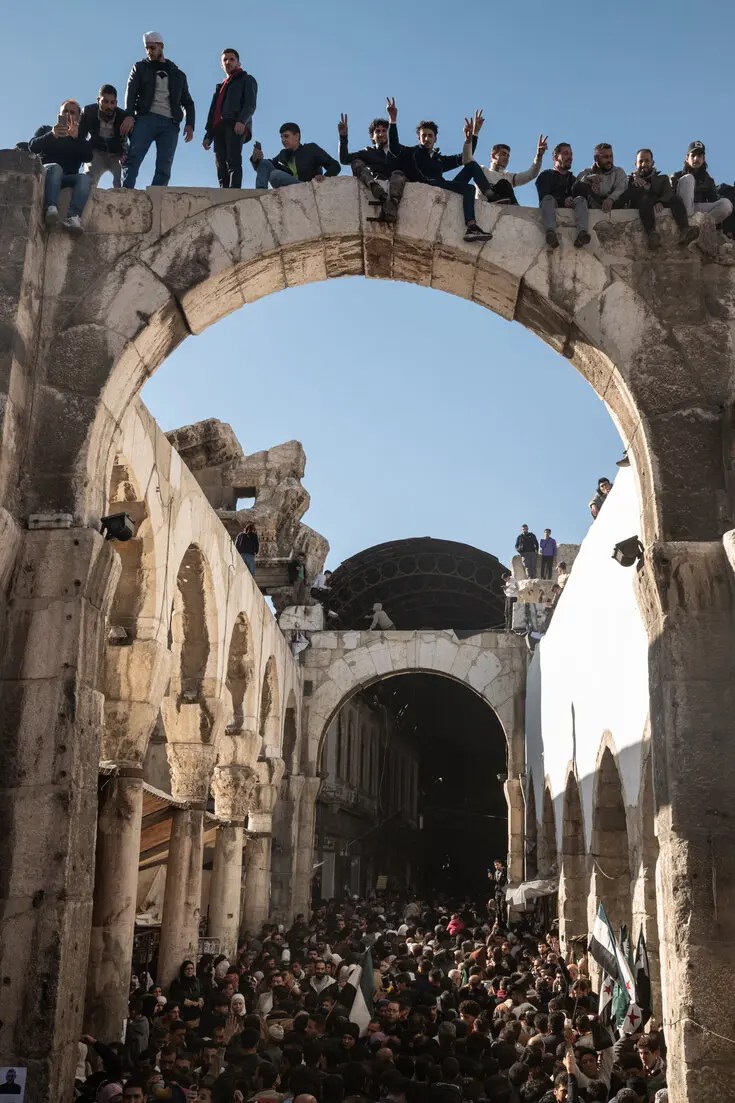
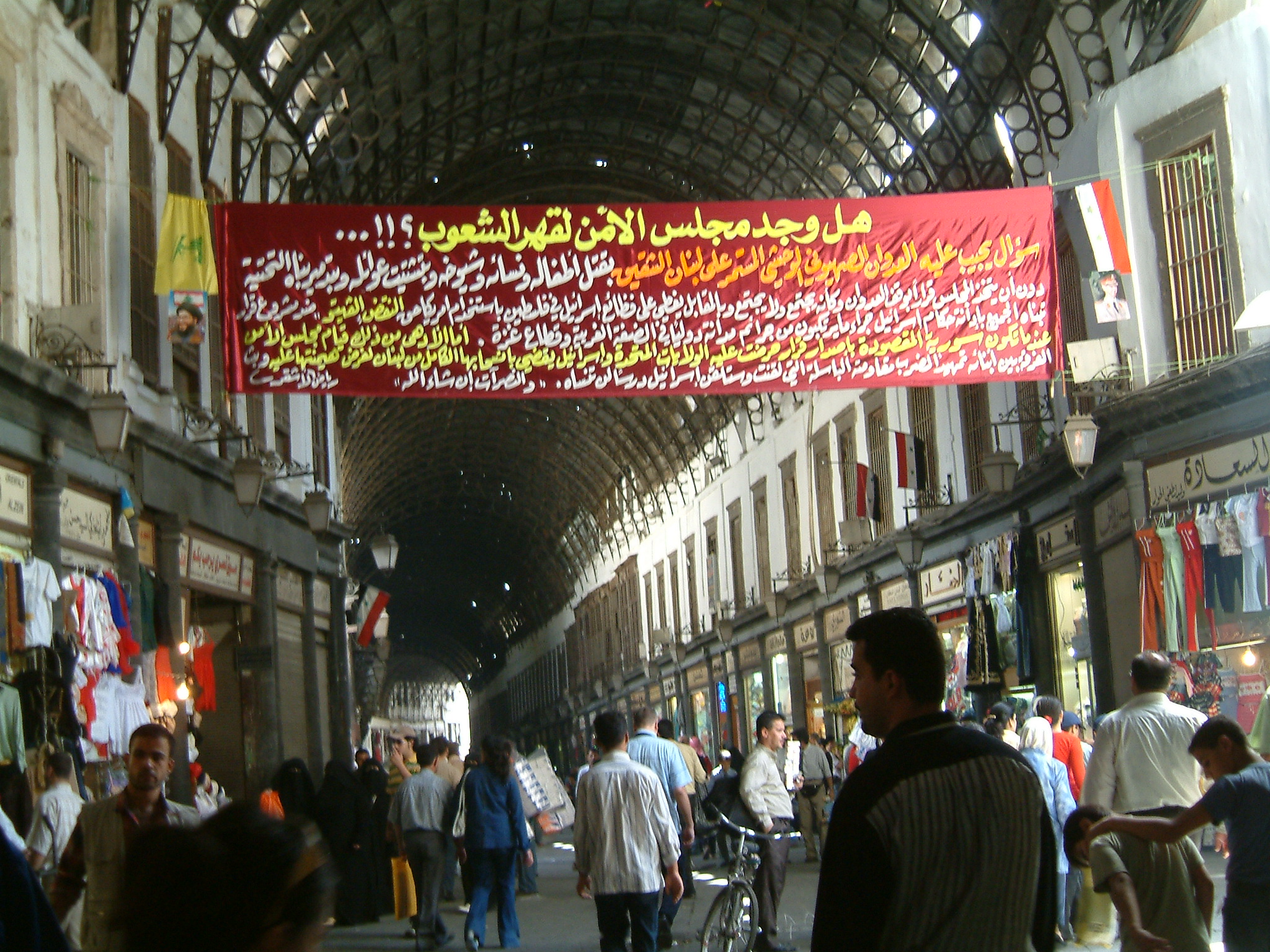
There have been many stunning pictures published to date of the Syrian revolution, but none that I’ve found as personally poignant as this one. It depicts jubilant Syrians lining the Roman archway that stands at the eastern end of Damascus’ historic Suq al Hamadiyah. When we were last in Syria, in the Spring of 2009, I photographed the arch from inside the darkened Suq (during one of the city’s frequent power cuts) , revealing the impressive remnants of the Roman Temple of Jupiter and the magnificent Omayyad Mosque, the fourth holiest place in Islam (after Mecca, Medina and Al Quds/Jerusalem).

For more on the Middle East in in That Howling Infinite, see A Middle East Miscellany:  

Syrians atop the Roman archway at the end of Damascus’ historic Suq al Hamadiyah

The Suq Al Hamadiyah, Temple of Jupiter and the Umayyad Mosque Mosque. P Hemphill 2009

The Suq Al Hamadiyah, Temple of Jupiter and the Umayyad Mosque Mosque. P Hemphill 2009

Aleppo shock to Hama huge leap forward: triggers in Syria’s 11-day blitz that unravelled Assad

David Kilcullen, The Australian, 13th December 2024

The speed of the regime’s collapse was startling, but it should not have been. Beyond the general dynamics of government collapse, something else was happening.

The regime’s collapse accelerated dramatically after the fall of the central Syrian city of Hama on the evening of Thursday, December 5, Syria time. Picture: Emin Sansar/Anadolu via Getty Images

The regime’s collapse accelerated dramatically after the fall of the central Syrian city of Hama on the evening of Thursday, December 5, Syria time. Picture: Emin Sansar/Anadolu via Getty Images

This was not strictly true: HTS had been biding its time in its stronghold of Idlib province, on Syria’s northwestern border with Turkey, for five years since a ceasefire brokered by Turkish and Russian negotiators in 2020, avoiding direct confrontation with the regime and building its own structure outside state control.

Its parallel government included several ministries and a civil administration, the Syrian Salvation Government, governing a population of four million, the size of Croatia or Panama. Though dominated by HTS, the SSG has been somewhat politically inclusive, and several non-HTS leaders have had key roles in its administration.

It sought to include the independent governance councils that had arisen organically during the early days of the anti-Assad rebellion, and it established local municipal managers to provide essential services across its territory.

HTS’s small combat groups operated like a fast-moving light cavalry force. Picture: Omar Haj Kadour / AFP

HTS’s small combat groups operated like a fast-moving light cavalry force. Picture: Omar Haj Kadour / AFP

American analysts in 2020 assessed the SSG as technocratic, “post-jihadi”, focused on internal stability and non-ideological governance, seeking acceptance from Turkey and the US, and unlikely to become a launch pad for external attacks.

Aaron Zelin – the Western expert most familiar with HTS and the author of an important book on the organisation, The Age of Political Jihadism – has observed that despite still holding extremist beliefs, HTS acts more like a state than a jihadist group.

While the SSG was focusing on social services and economic activity, HTS commanders were investing in advanced military capabilities. Building on experience from before the 2020 ceasefire, HTS organised its forces into small combat groups of 20 to 40 fighters that could mass quickly to swarm a target using several teams, or disperse to avoid enemy airstrikes or artillery.

They were highly mobile, operating like a fast-moving light cavalry force, mounted in a mix of hard and soft-skinned vehicles that included captured armoured vehicles and armed pick-up trucks (known as technicals).

Reconnaissance teams, scouts and snipers moved in civilian cars or on motorcycles. HTS combat groups carried heavy and light weapons including rocket launchers, captured artillery pieces, mortars, recoilless rifles, anti-tank missiles and Soviet-bloc small arms seized from the government or rival resistance groups including Islamic State.

Rebel fighters stand next to the burning gravesite of Syria's late president Hafez al-Assad at his mausoleum in the family's ancestral village of Qardaha. Picture: Aaref Watad / AFP

Rebel fighters stand next to the burning gravesite of Syria’s late president Hafez al-Assad at his mausoleum in the family’s ancestral village of Qardaha. Picture: Aaref Watad / AFP

HTS also used the ceasefire to professionalise itself, studying the wars in Ukraine, Gaza and Lebanon. It established a military academy to educate officers in “military art and science”, and created civil affairs units, humanitarian agencies and a specialised organisation to convince government supporters to defect.

It used drones for reconnaissance, for leaflet drops on regime-controlled areas and as one-way attack munitions to strike targets with explosive warheads. It manufactured weapons and drones, and modified technicals with additional armour. HTS leaders built intelligence networks and command-and-control systems while allegedly also forging relationships with regional intelligence services and special operations forces.

Thus, the strength of HTS was not unexpected in itself. On the other hand, the rapidity of the regime’s collapse – which accelerated dramatically after the fall of the central Syrian city of Hama on the evening of Thursday, December 5, Syria time – was startling. It probably should not have been. Governments, unlike resistance movements, are tightly coupled complex systems that rely on numerous institutions and organisations, all of which must work together for the state to function.

As Joseph Tainter showed in The Collapse of Complex Societies, once co-ordination begins to break down, these interdependent systems unravel, the collapse of each brings down the next, and the entire structure falls apart. For this reason, in a process familiar to practitioners of irregular warfare, resistance groups (which tend to be loosely structured and thus more resilient to chaos) degrade slowly under pressure – and rebound once it is relieved – whereas governments collapse quickly and irrevocably once initial cohesion is lost.

As a team led by Gordon McCormick showed in a seminal 2006 study, governments that are losing to insurgencies reach a tipping point, after which they begin to decay at an accelerating rate. The conflict then seems to speed up and the end “is typically decisive, sudden and often violent”.

This pattern was very noticeable during the fall of the Afghan republic in 2021, for example, which also occurred in an 11-day period. The final Taliban offensive captured every province but one, and took the capital, Kabul, in a series of victories between August 4 and 15, 2021. Many garrisons surrendered, fled without fighting or changed sides.

Initial rebel successes made the regime look weak, allies failed to offer support, the security forces defected and other rebel groups suddenly rose up across the country. Picture: Aaref Watad / AFP

Initial rebel successes made the regime look weak, allies failed to offer support, the security forces defected and other rebel groups suddenly rose up across the country. Picture: Aaref Watad / AFP

To be sure, the Taliban’s final campaign was built on years of coalition-building and insurgent warfare. Similar to HTS, the Taliban relied on patient construction of parallel networks largely illegible to an Afghan state increasingly alienated from, and seen as illegitimate by, its own people.

It also was enabled by a stunningly shortsighted political deal with the US in 2020 and an incompetent US-led withdrawal in 2021. Even so, the collapse of the Kabul government was faster than expected, with president Ashraf Ghani fleeing by helicopter in a manner remarkably similar to Bashar al-Assad’s exit last weekend.

The fall of South Vietnam in 1975 was likewise extraordinarily rapid, occurring in just nine days after the decisive battle of Xuan Loc, with South Vietnam’s last president, Nguyen Van Thieu, fleeing for Taiwan on a military transport plane.

Similarly, Fulgencio Batista’s government in Cuba fell in only five days, between December 28, 1958 – when a rebel column under Che Guevara captured the town of Santa Clara – and the early hours of January 1, 1959, when Batista fled by aircraft to the Dominican Republic. He had announced his resignation to shocked supporters a few hours earlier at a New Year’s Eve party in Havana, starting a scramble for the airport.


In Syria’s case, beyond these general dynamics of government collapse, something else was happening: a military version of what political scientists call a “preference cascade”.

As Timur Kuran, originator of the concept, points out, under repressive regimes (or ostensibly democratic ones that censor dissent) the gap between public pronouncements and private opinions increases over time, until many individuals dissent from the approved narrative and lose faith in institutions that promote it but remain reluctant to reveal their real views. This “preference falsification” creates a deceptive impression of consensus. It can make regimes believe they have more support than they really do, while convincing dissidents they are all alone so there is no point expressing a contrary opinion.

But when an unexpected shock reduces the regime’s power to suppress dissent, people suddenly feel empowered to express their real opinions. They realise these opinions are widely shared and the false consensus evaporates. This can trigger a “preference cascade”, where individuals or institutions suddenly change sides and support for the government collapses overnight.

In particular, the moment when security forces, particularly police, refuse to fire on protesters is often decisive, as seen in the fall of the Suharto government in 1998, the overthrow of Hosni Mubarak in 2011 or the collapse of the East German regime in 1989.

Kuran’s initial work centred on the East European revolutions of 1989, which were unexpected at the time but seemed inevitable in retrospect, something Kuran later came to see as inherent in revolutionary preference cascades.

The most extreme case was the fall of Nicolae Ceausescu in Romania. During a mass rally on December 21, 1989 the dictator suddenly realised, his face on camera registering utter shock, that what he had initially perceived as shouts of support were actually calls for his downfall. When his security ser­vices refused to fire on the protesters, Ceausescu was forced to flee by helicopter. Four days later, he and his wife Elena were dead, executed after a brief military trial.

A woman poses for a photograph with a rebel fighter's gun in Umayyad Square in Damascus. Syria’s population finally felt free to dissent from the dominant narrative. Picture: Chris McGrath/Getty Images

A woman poses for a photograph with a rebel fighter’s gun in Umayyad Square in Damascus. Syria’s population finally felt free to dissent from the dominant narrative. Picture: Chris McGrath/Getty Images

Syria this week was another example of a preference cascade. Initial rebel successes made the regime look weak, allies failed to offer support, the security forces defected and other rebel groups suddenly rose up across the country. Syria’s population – previously reluctant to express anti-regime sentiment for fear of repression or social ostracism – finally felt free to dissent from the dominant narrative. Assad lost control, was forced to flee, and his government collapsed. It is worth briefly recounting the sequence of events.

On November 27, the HTS offensive began with a sudden attack on Aleppo City. The outskirts of Aleppo are only 25km from the HTS stronghold in Idlib, so although the outbreak of violence was a surprise, there was little initial panic. The regime responded with airstrikes and artillery, with Russian warplanes in support.

The first major shock was the fall of Aleppo on November 30, after three days of heavy fighting. As Syria’s second largest city, scene of a bloody urban battle in 2012-16, Aleppo’s sudden collapse was a huge blow to the government. The HTS capture of Aleppo airport, east of the city, denied the regime a key airbase from which to strike the rebels, and cut the highway to northeast Syria. At this point the regime seemed capable of containing HTS, though clearly under pressure, and there was still relatively little panic.

But then on December 4, HTS attacked the city of Hama, which fell on the evening of December 5. This was a huge leap forward – Hama is 140km south of Aleppo down Syria’s main north-south M5 highway, meaning the rebel forces had covered a third of the distance to Damascus in a week. The fall of Hama was another political and psychological blow to Assad’s regime: Hama had never been under rebel control at any time since 2011.

Syrian rebel fighters at the town of Homs, 40km south of Hama, a critically important junction controlling the M5 and the east-west M1 highway that links Damascus and central Syria to the coast, and dominating Syria’s heavily populated central breadbasket. Picture: Aaref Watad / AFP

Syrian rebel fighters at the town of Homs, 40km south of Hama, a critically important junction controlling the M5 and the east-west M1 highway that links Damascus and central Syria to the coast, and dominating Syria’s heavily populated central breadbasket. Picture: Aaref Watad / AFP

The collapse at Hama – and the perception of regime weakness this created – triggered a preference cascade. Immediately, commanders began negotiating with or surrendering to the rebels or evacuating their positions. Also, after Hama’s fall, Iranian forces negotiated safe passage and began withdrawing from Syria, denying the government one of its key allies, further weakening Assad’s credibility, and encouraging yet more supporters to defect.

The regime’s other main ally, Russia, had already retreated to its bases at Khmeimim and Tartous, on Syria’s Mediterranean coast, after losing large amounts of military equipment and a still-unknown number of casualties. The same day, Hezbollah declined to offer material assistance to the Syrian government, given that it was still under Israeli pressure and had taken significant damage in 66 days of conflict.

The town of Homs lay 40km south of Hama – not much closer to Damascus but a critically important junction controlling the M5 and the east-west M1 highway that links Damascus and central Syria to the coast, and dominating Syria’s heavily populated central breadbasket. By early Friday, December 6, HTS combat groups were massing to assault Homs, but the city’s defences collapsed and it fell without a significant fight. By this point, security forces were dispersing, some retreating to Damascus but many fleeing to coastal areas.

The fall of Hama and Homs in quick succession encouraged other rebel groups to pile on, with several now mounting their own offensives against the regime. Uprisings broke out in the southern cities of Daraa and As-Suwayda on Friday and Saturday, December 6 and 7. These were less of a shock than the loss of Hama – Daraa was, after all, the cradle of the revolution in 2011 – but given everything else that was happening, the government simply lacked the forces to suppress them.

Simultaneously, US-backed forces in the far south advanced north from their base at al-Tanf, near the Jordanian border, while US-allied Kurdish troops of the Syrian Democratic Forces attacked in the east, crossing the Euphrates and seizing regime-controlled territory near Deir Ezzour. American aircraft flew airstrikes to support the SDF, which also seized the border post at Bou Kamal, blocking access to Iraqi militias that had been crossing into Syria to support the regime.

By Sunday, the regime had collapsed and the rebels occupied Damascus without a fight. Picture: Louai Beshara / AFP

By this point – last Saturday evening, December 7, Syria time – the government was on its last legs. That night an uprising broke out in Damascus, launched by civilian resistance groups and disaffected military units keen to distance themselves from the regime as the rebels closed in. Government troops began abandoning their posts, changing into civilian clothes, ditching their equipment and disappearing into the night. Large numbers of armoured vehicles, including T-72 tanks, were abandoned in the streets of the capital. Assad had planned to address the nation that evening but did not appear.

Later that night, apparently without asking Assad, the high command of the Syrian armed forces issued an order to all remaining troops to lay down their weapons and disperse. Assad fled about 2am on Sunday, flying out in a Russian transport aircraft. Assad’s prime minister, Mohammed al-Jalali, announced that he was willing to act as caretaker during transition to a provisional government, showing that Syria’s civil government, like the regime’s military forces, had collapsed. Despite initial reports that Assad’s aircraft had been denied entry into Lebanese airspace then shot down over Homs, Russian media reported later on Sunday that he had arrived in Moscow.

By Sunday, the regime had completely collapsed and the rebels, led by HTS commander Ahmed al-Sharaa, formerly known as Abu Mohammed al-Jolani, occupied Damascus without a fight.

The same day, US aircraft mounted dozens of airstrikes across the country, targeting Islamic State or regime forces, while Israeli troops crossed the Golan Heights buffer zone and began advancing towards Damascus. By Monday, despite initially claiming their incursion was limited and temporary, Israeli forces were 25km from Damascus, Israeli politicians had announced the permanent annexation of the Golan, and Israeli aircraft were striking Syrian military bases and sinking Syrian ships at the Latakia naval base.

Israel has denied media reports that its troops have taken control of Syrian territory.
In addition to the Israeli incursion through the Golan, Turkish-backed troops of the Syrian National Army are attacking the SDF across a strip of northern Syria, apparently attempting to create their own buffer zone separating the SDF – which Ankara sees as allied to the Kurdistan Workers Party – from Turkish territory.

The SDF has seized a chunk of eastern Syria, other US-allied rebel groups hold key parts of the south, and Islamic State still has numerous supporters and active cells in the country. Russia still controls its two Syrian bases, while Syria’s ethnic and religious minorities including Christians and Alawites are deeply anxious about the future, despite promises of tolerance from HTS.

Given the speed and totality of Assad’s collapse, some observers seem to be assuming that HTS will now, by default, become the dominant player in Syria. On its face, this may seem a reasonable assumption, given what happened in similar situations – Havana 1959, Saigon 1975, Kabul 2021 and so on.

But it would be premature in Syria’s case since the war is very much ongoing. As the northern hemisphere winter closes in and Western allies prepare for a change of administration in Washington, Syria – along with Gaza, Lebanon, the Red Sea, Ukraine, Taiwan and the Korean peninsula – will remain a major flashpoint into the new year.

David Kilcullen served in the Australian Army from 1985 to 2007 and was a senior counter-insurgency adviser to General David Petraeus in 2007 and 2008, when he helped design and monitor the Iraq War troop surge.

The Most Courted Leader in the Middle East Still Has No State

Arab and European heads of state are lining up to meet Ahmed A-Shara, the leader of the Syrian rebel organizations that ousted Assad, who has returned to his original name and is no longer calling himself al-Golani

Zvi Bar’el, Haaretz ,Dec 13, 2024
After taking control, he hastened to renounce his underground name and resumed his local name, Ahmed A-Shara. He ousted Bashar Assad’s horror regime and started to sprout the first buds of “new Syria,” whose outcome is still hard to fathom. The race for shaking his hand is in full swing.
Qatar is an old friend of A-Shara (one has to practice the name) and during the years of his organization’s existence it supported the militias that made up Hayat Tahrir al-Sham, which he set up on the ruins of Jabhat a-Nusra and it’s also expected to help him rehabilitate his country.

Qatar isn’t alone. In the race to the presidential palace in Damascus the Turkish Foreign Minister Hakan Fidan came first to shake A-Shara’s hand. The foreign ministers of other Arab states, such as Egypt, Saudi Arabia, and the UAE are preparing to land in Damascus in the coming days to personally congratulate the leader of the sister state.

At the same time Biden’s administration is examining the possibility of removing A-Shara and his group from the terrorists’ list while European leaders, headed by Italian Prime Minister Giorgia Meloni, who only two weeks ago spoke of the possibility to normalize their relations with the Assad regime, are already trying to coordinate meetings with the new regime’s leadership.

The irony doesn’t stop there. Iran and Russia, which in fact controlled large parts of Syria, are now replaced by two new-old occupiers, Israel, and Turkey. One took over the “Syrian Hermon “and a little further, the other is completing the occupation of the Kurdish regions in North Syria. No love is lost between the two of them, but it seems fate insists on making them meet in war fronts.

Once as partners when they helped Azerbaijan in its war against Armenia and once as enemies in the Gaza front or now on Syrian soil. There’s no knowing, maybe A-Shara will be the best man who will get to reconcile between them. Miracles happen, even if under the nose of the best intelligence services in the world, who didn’t know and didn’t evaluate the complete collapse of the Assad regime.

The warm Arab and international envelope tightening around Damascus is ready to give him credit although it doesn’t know yet where he’s heading, assuming any leader will be better than Assad. That, by the way, is what the Syrians also believed Assad senior would be when he toppled the rule of General Salah Jedid, only to get a new mass murderer.

The first declarations and interviews of A-Shara and senior officials of his administration sound good and even encouraging. The temporary prime minister, Mohammed al-Bashir, said in an interview to the Italian newspaper Corriere della Sera on Wednesday that at this stage the new administration has three top goals – to ensure the civilians’ safety, to return the refugees and to rehabilitate the infrastructure and civil services.
How to achieve those goals? “It will take time but we’ll get there,” says the former prime minister of the Idlib region’s rescue government under A-Shara’s command and was blasted publicly for the brutal way he ran the rebel province.
Al-Bashir also says the temporary government will serve until the beginning of March, but does not clarify what will happen after that date. Will he manage to draft a new constitution and election law by then? Does the new administration even intend to hold elections, or does he hope within that time to set up a government that will be agreed on by all the communities, factions, militia, and foreign forces?
Will the new constitution be Islamic? To this he replies, “God willing, but clearly all these details will be discussed in the constitutional process.”
Journalist Andrea Nicastro asks him “do I understand correctly when I say you’re ready to make peace with Israel and that you’re hostile to Iran, Hezbollah and Russia?” Al-Bashir thanks him and leaves without answering.
There can be no complaints about a prime minister or organization head who only two weeks ago merely prepared to expand the borders of his control region and suddenly found himself on an empty highway to Damascus, for having no political, economic, or strategic plan and for having to wriggle around ideological and religious issues. A-Shara has more urgent business, for example, an empty state coffer.
If he wants to ensure civilian safety and public services he’ll have to pay wages to thousands of policemen, teachers, judges, garbage contractors, rebuild the crushed electric system, mend roads and traffic lights when not a single dollar, according to al-Bashir, remain in the till.
Head of the Syrian trade bureau said this week Syria will move from a state-controlled economy to a free market economy. This is encouraging but to apply it they will need investors and ensure their investment.
Government ministers, most of them served in the “rescue government” in Idlib, estimate they’d be able to raise funds from Arab countries and mainly the UAE and Turkey, persuade Syrian businesspeople in exile to invest in the homeland and also return to Syria funds that were smuggled out by the Assad regime. But Arab and international aid usually comes with a list of rigid conditions, like demands for a profound economic reform, preserving human rights and minority rights, civilian safety, and no less important a political agenda that is compatible with the donor states’ aspirations.
Syria is not an only child. Soon the donor states will be asked to help to rebuild Lebanon and perhaps later Gaza as well. A conservative estimate sets Syria’s national debt at some $31 billion, $5 billion of them to the IMF and $26 billion to Russia and to Iran.
More realistic estimates cite a debt of more than $30 billion to Iran alone, which invested some $50 billion in the last 14 years.
The oil wells that remained in the Assad regime’s control produced only some 9,000 oil barrels a day, now the new administration can produce oil from the oil fields controlled by the Kurds in the northeast of the state after they retreated from Dir A-Zur, which was reoccupied by the pro-Turkish militias.
But perhaps this will no longer be enough to reinstate the agriculture and food production industry, or to generate millions of workplaces that were lost during the war.
A-Shara portrays himself as “everyone'” leader and his prime minister aspires to set up an administration that represents all the ethnic communities and minorities. But will he gain the cooperation of the Alawite minority, which makes up 10 percent of the population? Will the Kurds in the north give up their aspirations for autonomy?
A large concentration of Alawites resides in the Latakia province on the Mediterranean coast, its people are well armed and afraid that armed militias or the regime itself would want to take revenge on them. Will they agree to disarm?
The Kurds are being pushed out of some of their provinces and only this week retreated from Manjib city west of the Euphrates River, after the Syrian National Army, the large pro-Turkish militia, conquered the city.
This retreat is the outcome of American mediation leaning on a Turkish commitment not to harm Kurdish civilians who leave the city. But Kurds continue to control the regions east of Euphrates, and Turkey wants to keep them away from those too. AT the same time their conduct has made it clear it is ready to cooperate with the A-Shara regime and be an integral part of Syria.

But it’s not clear yet under what terms. Will they want to preserve their provinces’ autonomy, and will the Syrian regime agree, when Turkey operates its military and economic leverages. Will the Kurds even have a bargaining chip left when Trump enters the White House? Trump tried already in 2019 to withdraw U.S. forces from Syria and was blocked by internal and external pressure. Now he may implement his wish with his ally Recep Erdogan.

Syrian commentators have begun to draw a map in which Syria could be a federation divided into autonomous cantons, Kurdish in the north, Sunni-Arab in the center, Alawite in the west and perhaps Druze in the south, a sort of expansion of the Iraqi model where an autonomous Kurdish region exists. The Shi’ites in the south are demanding their own province.
It is doubtful whether this model has a chance of being implemented in Syria but bringing it up in itself shows the explosives in store for the new Syrian regime. This is only a partial list because beyond the various ethnic communities and minorities, A-Shara will have to deal with a population that is mostly Sunni but secular. Will this population toe the line with a radical religious agenda, on which A-Shara was raised and has preached?
So far Syria has conveniently been attached to the “Shi’ite axis though it was an organ of Iran’s Islamic revolution.
But the Alawite faction doesn’t count in Iran as an authentic Shi’ite faction. Hafez Assad himself had to ask his friend, the influential religious leader Moussa al-Sader, to issue a ruling that the Alawite religion is part of the formal “Shi’a” and therefore part of the Islam religion.
This was after a long violent clash he conducted against Sunni and Shi’ite religious leaders who ruled the Alawite faction wasn’t Muslim at all and therefore Assad senior cannot be president, because the constitution stipulated the state’s president had to be Muslim.
A-Shara won’t have that dilemma, but as one who hasn’t concealed his aspiration to set up a religious state, he will have to decide how to settle between the religious vision and the character of the population and the state that hasn’t yet been established

The many lives of an unsung Anzac hero

Once upon a war

Back in the last century, before ANZAC Day became the secular Christmas that it has become, before marketing people and populist politicians saw its commercial and political potential, before the fatal shore became a crowded place of annual pilgrimage, my Turkish friend, the late Naim Mehmet Turfan, gave me a grainy picture of a Turkish soldier at Gelibolu carrying a large howitzer shell on his back. Then there was this great film by Australian director Peter Weir, starring young Mel Gibson and Mark Lee. There were these images of small boats approaching a dark and alien shore, of Light Horsemen sadly farewelling their Walers as they embarked as infantry, and of the doomed Colonel Barton humming along to a gramophone recording of Bizet’s beautiful duet from The Pearl Fishers, ‘Au fond du temple saint’ before joining his men in the forlorn hope of The Nek …

At the heart of the Anzac Day remembrance is the Australian and New Zealand Army Corps’ role the Dardanelles campaign of 1915-16, Winston Churchill’s grandiose and ill-conceived plan to take the Ottoman Empire out of the war by seizing the strategic strait between the Black Sea and the Mediterranean, thereby threatening Istanbul, the Ottoman capital. It was a military failure. From the initial seaborne assault to the evacuation, it lasted eight months and cost 114,000 lives with 230,000 wounded.

In 1915, Australians greeted the landings at Gallipoli with unbridled enthusiasm as a nation-making event. But it wasn’t long before they were counting the dreadful cost. More than 8000 Australians died during the Gallipoli campaign. As a loyal member of the British Empire, Australia eventually sent 330,000 men overseas to fight for the King. Volunteers all, not all of them white men – despite the authorities’ policy of recruiting only Australians of Anglo-Celtic stock, their ranks included many indigenous, Chinese and others. By the time the war ended in 1918, 60,000 of them were dead. As the late historian Ken Inglis once pointed out: “If we count as family a person’s parents, children, siblings, aunts and uncles and cousins, then every second Australian family was bereaved by the war.

Gallipoli is cited as the crucible of Australian nationhood, but the Anzacs’ part in the doomed campaign was but a sideshow of the wider campaign. Although it is celebrated in Australian song and story, it was the Ottomans’ most significant victory in the war that was to destroy the seven-hundred-year-old Ottoman Empire secure the reputation of its most successful general Mustafa Kemal, who as Ataturk, became the founder of modern Turkey.

Some thirty-four thousand British soldiers died on the peninsula, including 3,400 Irishmen who are remembered In The Foggy Dew, one of the most lyrical and poignant of the Irish rebel songs: Right proudly high over Dublin town, they hung out the flag of war. ‘Twas better to die ‘neath that Irish sky than at Suvla or at Sud el Bar…Twas England bade our Wild Geese go that small nations might be free, But their lonely graves are by Suvla’s waves or the fringe of the grey North Sea.

Ten thousand Frenchmen perished too, many of these being “colonial” troops from West and North Africa. Australia lost near on ten thousand and New Zealand three. Some 1,400 Indian soldiers perished for the King Emperor. Fifty seven thousand allied soldiers died, and seventy five thousand were wounded. The Ottoman army lost fifty seven thousand men, and one hundred and seven thousand were wounded (although these figures are probably much higher). An overlooked fact is that some two thirds of the “Turkish” solders in Kemal’s division were actually Arabs from present day Syrian and Palestine. Gallipoli was indeed a multicultural microcosm of a world at war.

Whilst the flower of antipodean youth is said to have perished on Gallipoli’s fatal shore, this was just the overture. Anzac troops were dispatched to the Western Front, and between 1919 and 1918, 45,000 Aussies died there and 124,000 were wounded.

Once upon a war, the Dardanelles Campaign of 1915-16 was a sideshow to the bigger theatres of the Eastern and Western Fronts. To some, it was a reminder that they could not stomach Winston Churchill for this was said to be his greatest stuff up in a career replete with such (although they would admit that he more than exonerated himself his and Britain’s Finest Hour). For many Australians and New Zealanders, it was a national baptism of fire, of youthful sacrifice on the altar of Empire. And notwithstanding the military defeat and retreat, the folly and foolhardiness, in the harrowing adversity and heroism, lay the bones of a young country’s enduring creation myth.
Former soldier James Brown, Anzac’s Long Shadow

From The Watchers of the Water – a song about Gallipoli, © Paul Hemphill 2015. All rights reserved

Official war historian Charles Bean went ashore at Anzac Cove on 25 April, more than 5 hours after the first troops. Here is his first dispatch (it was not published in Australia until 13th May):

It was eighteen minutes past four on the morning of Sunday, 25th April, when the first boat grounded. So far not a shot had been fired by the enemy. Colonel McLagan’s orders to his brigade were that shots, if possible, were not to be fired till daybreak, but the business was to be carried through with the bayonet. The men leapt into the water, and the first of them had just reached the beach when fire was opened on them from the trenches on the foothills which rise immediately from the beach. The landing place consists of a small bay about half-a-mile from point to point with two much larger bays north and south. The country rather resembles the Hawkesbury River country in New South Wales, the hills rising immediately from the sea to 600 feet [183m]. To the north these ridges cluster to a summit nearly 1,000 feet [305m] high. Further northward the ranges become even higher. The summit just mentioned sends out a series of long ridges running south-westward, with steep gullies between them, very much like the hills and gullies about the north of Sydney, covered with low scrub very similar to a dwarfed gum tree scrub. The chief difference is that there are no big trees, but many precipices and sheer slopes of gravel. One ridge comes down to the sea at the small bay above mentioned and ends in two knolls about 100 feet [30m] high, one at each point of the bay.

It was from these that fire was first opened on the troops as they landed. Bullets struck fireworks out of the stones along the beach. The men did not wait to be hit, but wherever they landed they simply rushed straight up the steep slopes. Other small boats which had cast off from the warships and steam launches which towed them, were digging for the beach with oars. These occupied the attention of the Turks in the trenches, and almost before the Turks had time to collect their senses, the first boatloads were well up towards the trenches. Few Turks awaited the bayonet. It is said that one huge Queenslander swung his rifle by the muzzle, and, after braining one Turk, caught another and flung him over his shoulder. I do not know if this story is true, but when we landed some hours later, there was said to have been a dead Turk on the beach with his head smashed in. It is impossible to say which battalion landed first, because several landed together. The Turks in the trenches facing the landing had run, but those on the other flank and on the ridges and gullies still kept up a fire upon the boats coming in shore, and that portion of the covering force which landed last came under a heavy fire before it reached the beach. The Turks had a machine gun in the valley on our left, and this seems to have been turned on to the boats containing part of the Twelfth Battalion. Three of these boats are still lying on the beach some way before they could be rescued. Two stretcher-bearers of the Second Battalion who went along the beach during the day to effect a rescue were both shot by the Turks. Finally, a party waited for dark, and crept along the beach, rescuing nine men who had been in the boats two days, afraid to move for fear of attracting fire. The work of the stretcher-bearers all through a week of hard fighting has been beyond all praise.

And this was just the beginning …

More on the Anzacs in In That Howling Infinite: Tel al Sabi – Tarkeeth’s ANZAC Story 

On 27th July 2024, the Australian published extracts from a recently published biography of Henry Koba Freame, adventurer, soldier, orchardist and interpreter. It provides such a stirring account of the landing of Australian soldiers at what is now Anzac Cove on 25th April 2015 and the subsequent Gallipoli campaign that it was worth republishing below. But first, a brief summary of Freame’s eventful life.

The road to Gallipoli

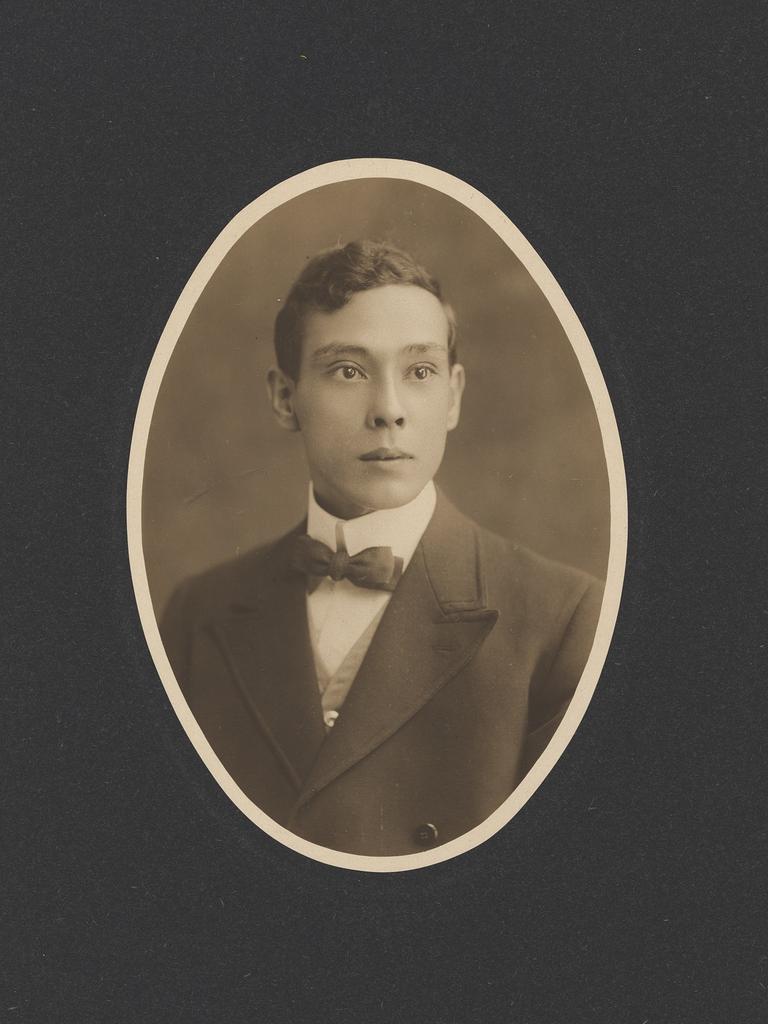
Wykeham Henry Koba Freame is believed to have been born on 28 February 1885 at Osaka, Japan, though on his enlistment in the Australian Imperial Force he gave his birthplace as Kitscoty, Canada. He was the son of Henry Freame, sometime teacher of English at the Kai-sei Gakko in Japan, and a Japanese woman, Shizu, née Kitagawa. As he was fluent in Japanese and spoke English with an accent it is likely that he was brought up in Japan. In 1906 he was a merchant seaman and on 19 July of that year married Edith May Soppitt at St John’s Anglican Church, Middlesbrough, England.

Freame probably came to Australia in 1911 and on enlisting in the A.I.F. on 28 August 1914 described himself as a horse-breaker of Glen Innes, New South Wales. Posted to the 1st Battalion as a private, he embarked for Egypt on the troopship Afric on 18 October and was promoted lance corporal on 7 January 1915. On 25 April he landed at Anzac and after three days of heavy fighting was promoted sergeant. He was awarded one of the A.I.F.’s first Distinguished Conduct Medals for ‘displaying the utmost gallantry in taking water to the firing-line although twice hit by snipers’. He was mentioned in dispatches for his work at Monash Valley in June when Charles Bean described him as ‘probably the most trusted scout at Anzac’.

Having served in the Hottentot rising of 1904-06 in German East Africa and in the Mexican wars, Freame was an accomplished scout before joining the A.I.F. He had an uncanny sense of direction and would wriggle like an eel deep into no man’s land, and at night even into enemy trenches, to pick up information. His dark complexion and peculiar intonation of speech had led his companions to believe that he was Mexican—an impression which he reinforced at Anzac where, in cowboy fashion, he carried two revolvers in holsters on his belt, another in a holster under his armpit and a bowie knife in his boot pocket. On 15 August he was wounded during operations at Lone Pine and was evacuated to Australia. He was discharged as medically unfit on 20 November 1916.

Freame settled on the Kentucky estate in New England, New South Wales, when the estate was subdivided for a soldier settlement scheme, and was appointed government storekeeper. He eventually acquired a Kentucky block and was a successful orchardist. His wife died in 1939 and on 16 August 1940 he married Harriett Elizabeth Brainwood, nurse and divorced petitioner, at St John’s Anglican Church, Milson’s Point, Sydney. With the outbreak of World War II he offered his services to the Australian Military Forces and in December 1939 was planted among the Japanese community in Sydney as an agent by military intelligence. In September 1940 he was appointed as an interpreter on the staff of the first Australian legation to Tokyo.

Early in April 1941, however, Freame returned to Australia because of ill health and was admitted to North Sydney Hospital suffering from a severe throat condition which greatly impaired his speech. He died on 27 May and was buried in Northern Suburbs cemetery with Anglican rites. His death certificate records the cause of death as cancer though Freame himself and later his wife alleged that he had been the victim of a garrotting in Japan. He considered that the attack was the consequence of the injudicious wording of the announcement in the Australian press of his posting to Tokyo. He had been described as employed by the Defence Department at a time when he was telling his Japanese acquaintances another story. Extant evidence provides no definite clarification of the circumstances of his death, though the claim of garrotting was investigated, and rejected, at the time.

James W. Courtney, the Australian Dictionary of Biography, Volume 8,1981

How did we forget this Anzac hero?

Harry Freame in 1915 before departing for Gallipoli

Harry Freame in 1915 before departing for Gallipoli

In the years after World War I, Harry Freame had a legitimate claim to be considered the most famous Anzac soldier to have landed at Gallipoli. Born in Japan and raised as a Samurai, he was the recipient of the first Distinguished Conduct Medal to be awarded to an Australian soldier for his efforts in those first bloody days of Gallipoli, and his name was legend among the Australian troops who had fought that tragic battle. As the landing turned into trench warfare, the troops knew Harry risked his neck each night to venture out into no-man’s land and map the Turkish defences.

Harry was on personal terms with the key Anzac commanders, and in the postwar years generals would visit him and reminisce about the war. Australia’s official war historian for World War I, Charles Bean, who first met Harry in June 1915, was fascinated by Harry his whole life. The Australian public came to know Harry through the newspapers of the day that splashed his wartime exploits of courage and daring across their pages.

What became of him?

The Bravest Scout at Gallipoli by Ryan Butta

Harry Freame’s boots hit the sands of Anzac Cove at around 7.40am on April 25, 1915. He was part of D Company, 1st Battalion. By the time they landed, Anzac Beach, as it came to be known, was already strewn with the broken and bloodied bodies of the men and pack animals that had come before them on that infamous morning.

It wasn’t Harry’s first sight of the region – he had sailed this way before – and it wasn’t his first taste of war.

There is a picture of Harry taken before the landing, most likely in Egypt. In it he is in full uniform, flat-brimmed hat, a bandana tied around his neck, wire clippers and binoculars attached to his belt. He holds his Lee–Enfield full wood .303 rifle by the barrel, the butt resting on the ground. He is looking slightly downwards at the camera. There is none of the naive merriment so often seen in the pictures of young Australian soldiers who had mistaken war for a great boys’ own adventure. But nor is there any fear in those eyes. Harry knew what he was in for, and he was ready for it.

As he waded through the waist-high water towards the sand, Harry carried in his pack three days’ rations and an extra 150 rounds of ammunition. He would have heeded the warning of Lieutenant General William Birdwood, the British officer in overall command of the ANZAC (Australian and New Zealand Army Corps) forces, who had advised the troops prior to landing to drink as much water as they could, as once ashore supply of food and water could not be guaranteed for at least three days.

The landing itself had been rehearsed as much as possible on the nearby Greek islands, under conditions nothing like what Harry and the rest of the Anzacs would soon face, but as the 1st Battalion’s official war diary records, “we knew very little of the actual plans for the attack – in fact, the whole thing seemed to be rather in the air, and so it proved”.

All that the officers of the 1st Battalion knew was that the 3rd Brigade was to land first and rush the enemy positions. When Harry and D Company landed on Anzac Beach, they had no idea what success, if any, the 3rd Brigade had had. Judging by the dead and dying who littered the beach, staining the Aegean waters red, and the enemy bullets and shells that whistled around their heads and whipped the waves to foam, it could be easily believed that none of the 3rd Brigade had survived that hellfire of a dawn.

Harry at age the age of 24

Harry at age the age of 24

Harry’s battalion formed up just north of Anzac Beach, in the shadow of Ari Burnu, sheltered from the murderous fire being poured down upon the landing from the peaks of Gaba Tepe, and waited for orders. When the orders came, they “were very vague”, alluding to nothing more than the need for the battalion to reinforce the firing line. But to reinforce a firing line, you needed to first find the firing line, and when the men looked up towards the imposing ridges and valleys that confronted them, there was no firing line.

The ridges above the beaches were crawling with pockets of men, some engaged in isolated fights, hand-to-hand combat wherein they lived or died by the thrust of their bayonets or the quickness of their wits.

Recalling that bloody morning, poet John Masefield wrote:

“All over the broken hills there were isolated fights to the death, men falling into gullies and being bayoneted, sudden duels, point blank, where men crawling through the scrub met each other and life went to the quicker finger, heroic deaths, where some half section which had lost touch were caught by ten times their strength and charged and died.

“No man of our side knew that cracked and fissured jungle. Men broke through it on to machine guns, or showed up on a crest and were blown to pieces, or leaped down from it into some sap or trench, to catch the bombs flung at them and hurl them at the thrower.

“Going as they did, up cliffs, through scrub, over ground … they passed many hidden Turks, who were thus left to shoot them in the back or to fire down at the boats, from perhaps only fifty yards away.”

The firing line, a concept easily imagined in the safety of an officer’s headquarters, was non-existent on the actual field of battle. On that first morning there was just a mad rush for high ground, up the forbidding slopes and into the ridges and valleys that held not only Turkish and German and Syrian troops and gunners but also the hope of cover and survival.

A primeval need to push further and further inland gripped the soldiers, in the hope that there, beyond the next valley, the next ridge, lay safety.

By 10am, with clothes still heavy with sea water after the landing and many of their rifles jammed with sand, now useful only for bayonet thrusts and charges, Harry and what elements of D Company were able to be formed up left the beach and set off for the ridges. Coming upon officers from the 3rd Battalion, D Company was redirected to the hill known as Baby 700, where reinforcements were urgently needed.

Through dense, waist-high scrub of gorse-like bushes and along the dried-up water courses littered with boulders, the men forged ahead uphill, legs heavy but the words of the commanding officers to advance, advance, advance running through their heads. Many of the men of D Company who fought their way up towards Baby 700 that clear bright morning would etch their names into the history of the Anzacs and the 1st Battalion: Major FJ Kindon, second-in-command of 1st Battalion; Major Blair Swannell, commanding officer of D Company; Captain Harold Jacobs, second-in-command of D Company; Lieutenant Geoffrey Street; and Captain Alfred Shout, the man who would leave Gallipoli the most decorated soldier of all, though sadly not with his life. And beside Shout, as was so often the case in the blood-soaked months that followed, in lock step, there was Lance Corporal Harry Freame.

Strategically important, Baby 700 had been the focus of intense fighting all morning, with remnants of the Australian 9th, 11th and 12th battalions all joining the battle as the Turkish troops advanced and retreated in a series of intense skirmishes conducted under the continuous hail of shrapnel fire from unseen Turkish positions. The approaches to Baby 700 were complicated by folds of ridges and valleys, and in these the Australian men became detached from their companies and lost until they could connect up with other Australian soldiers, sometimes from their own company, sometimes not.

Freame at his final Anzac Day march, in 1940.

Freame at his final Anzac Day march, in 1940.

By 11am, Harry and D Company had reached The Nek, a thin strip of ridge that connected to Baby 700. The area was being held by Captain Lalor and men of the 12th Battalion. Lalor was the grandson of Peter Lalor, the man who had led the revolt at Eureka. With him on that morning on the approaches to Baby 700, Lalor carried a magnificent sword, said to be the one used by his grandfather at that famous stockade. Swords had been prohibited to be carried during the landing, but Lalor had disregarded the order.

Across The Nek on the slopes of Baby 700, Turkish troops were gathering. Joining up with Lalor’s group, the newly arrived men of D Company formed up and charged the Turkish troops, driving them back into a gully before advancing up Baby 700.

After reaching the summit, D Company started to dig into that hardscrabble ground. The Turkish troops they had driven before them had retreated, but only to a previously unseen trench, and from here they poured heavy fire on the entrenching D Company. It was here that D Company’s commander, Major Blair Swannell, was killed on that first morning, shot dead just as he had earlier predicted he would be to his mates aboard the Minnewaska in the predawn fog before the landing.

Against the fierce Turkish assault, the Australians had only their rifles (when they worked), bayonets and pistols. The naval guns offered no support, as those manning them were afraid of firing on their own troops in the complicated mess of invaders and invaded that swarmed the hills of the peninsula.

A few artillery guns had been brought ashore at midday but were then ordered to be sent back out to the boats. Other commanders had refused to allow their guns to be landed, such was the chaos on the beaches, and it wasn’t until dusk that the first artillery guns came into action in support of the Australian troops.

The Australian firing line on Baby 700 could not hold, and over the course of the morning the Australian troops moved over the summit only to be thrown back by vicious counterattacks no fewer than five times.

In the midst of the fighting, there was Harry Freame, moving from position to position, scouting the ground and enemy positions, running messages between commanding officers.

At one point Harry and a small group of men drove a contingent of Turkish troops from a trench. But having gained the trench they found they were then held in place by persistent enemy fire. The men hadn’t heeded the words of Lieutenant General Birdwood, and who could blame them, and they were out of water, exhausted and near death. Without water they felt that they would soon perish or be forced to surrender.

Harry called for volunteers to brave the bullets and shrapnel and go for water. None raised a hand or spoke a word, so over the side of the trench he went, collecting water bottles from those who would never thirst again, fallen soldiers whose twisted repose could never be mistaken for the sleeping, a last look, a last thought of home or their best girl held fast in a glassy eye like a butterfly trapped in amber.

When Harry returned, he brought not only precious water but food and pickaxes for the grateful men.

All day the fighting raged on Baby 700, with ground taken then lost, the attackers and counterattackers continually changing roles, the air perfumed with the smell of the wild thyme that had been lashed by the bullets and shrapnel bursts. And as the day stretched on, still the men had no idea where the firing line was, only supposing that it was somewhere ahead of them, always somewhere over the next ridge, and that they must get to it. And if they could not advance, then at all costs they tried to hold on to whatever patch of land they had come to stop on.

At around 4.30pm, as D Company, reinforced now with New Zealand troops, fought to hold the right side of the Baby 700 slope, a massive Turkish counterattack was launched that peeled the Australians off the slope. Alfred Shout, who had been with Lalor when he was killed, had earlier left Harry and fourteen men at The Nek with orders to hold it no matter what. The small group came under intense fire and before long only nine men were left, and by the time Shout returned, retreating from Baby 700, only Harry and one other man held the position. The rest lay dead or dying about them. Shout ordered them both to follow him in retreat towards the beach.

After regrouping on the beach, Shout and Harry then set about rounding up men from various battalions, a combination of the stragglers and shirkers, the lost and the shell-shocked. Harry collected around two hundred men and led them back up the slopes to reinforce the New Zealand troops who were holding Walker’s Ridge, a key position leading back to Baby 700, which was by now firmly in Turkish hands.

Recording the efforts of Lance Corporal Harry Freame on that chaotic first day at Anzac Cove, official war correspondent Charles Bean wrote:

 “With such fighters as Lieutenant A.J. Shout, Lieutenant G.A. Street and Lieutenant Jacobs, all of his own battalion, he and others held vital positions in that constantly moving and changing fight but none was so ubiquitous as he, now holding a key ­position on The Nek leading to Baby 700, now ­finding for his commander the scattered parts of his battalion.”

As night fell on the evening of April 25, the fighting abated only somewhat; rifle fire and shrapnel bursts echoed through the night. At around midnight, Lieutenant General Birdwood sent an urgent message to his commander-in-chief, Sir Ian Hamilton, urging an immediate evacuation of the peninsula. Hamilton, from the comfort of the HMS Queen Elizabeth, was having none of it, advising Birdwood that he had “got through the difficult business and you have only to dig, dig, dig until you are safe”.

Freame with his stepsister in 1898.

Freame with his stepsister in 1898.

The following morning, April 26, the hills of the peninsula rang with the sounds of shovels, digging, digging, digging. Those not digging or engaged in holding a position were out scouring the ravines and hillsides for the wounded and missing, and it was while thus engaged that Harry came across a detachment of men under the command of Captain Harold Jacobs sheltering in a trench at Quinn’s Post. The men had had no water to drink and were in a desperate state. Harry offered to go for water and without a second thought braved the enemy fire that came in from unseen snipers and dashed back down the valley from where he had just come. He soon returned with the promised water, allowing the position to be held.

Realising that Lieutenant-Colonel Leonard Dobbin, the company commander, would need information on Captain Jacobs’ position and situation, Harry was again up and over the side of the trench, making his way back down the valley to where Lieutenant-Colonel Dobbin was located. As Harry approached Dobbin’s trench, he was heard to yell out, ‘All right!’ Arriving, he delivered his message to Dobbin. Mission accomplished, it was only then that Harry revealed that on the descent he’d been struck twice by snipers’ bullets, once through the fingers of the left hand and once through the left arm.

For the duration of the fighting at Gallipoli, Quinn’s Post remained the Anzacs’ most advanced position and the key to their defensive positions. It would never have been held if not for the bravery of Harry Freame.

Charles Bean later noted that very few men received decorations for the deeds performed at the Anzac Cove landings. But when the recommendations came out, the name Harry Freame was first among them. His citation read: “Has displayed the utmost gallantry in taking water to the firing line, though twice hit by sniper fire.” Harry’s commanding officer further reported: “Since I have assumed command of the Brigade, Serjeant Freame has almost daily performed some action worthy of recognition in the shape of carrying out night reconnaissance, conveying messages through dangerous zones etc etc. He is a fine fearless soldier who I strongly recommend for recognition.”

The recommendation was heeded and Harry, for his work over those first days of Gallipoli, was awarded the Distinguished Conduct Medal. Writing both publicly and privately years after the war, Bean offered the view that Harry should have been awarded the Victoria Cross and that the only reason he wasn’t awarded the VC was because, “Australian commanders hesitated to set up for that hallowed decoration any standard short of the impossible. I think that it is safe to say but for that Harry would have been awarded the highest decoration”.

When I set out to write this book, I wanted to discover why we had forgotten Harry Freame. Why, when our schoolchildren learn of the history of the Anzacs, do they learn more about a donkey than a man who was known at the time as the Marvel of Gallipoli? And I wanted to know why the Australian government covered up their role in the death of Harry Freame, why the man Charles Bean described as probably the most trusted scout at Gallipoli was never believed when he said, “They got me”.

This is an extract from The Bravest Scout At Gallipoli by Ryan Butta (Affirm Press) out now.

Song of the Road (2) – The Accidental Traveller

In a highway service station
Over the month of June
Was a photograph of the earth
Taken coming back from the moon
And you couldn’t see a city
On that marbled bowling ball
Or a forest or a highway
Or me here least of all
You couldn’t see these cold water restrooms
Or this baggage overload
Westbound and rolling taking refuge in the roads
From Joni Mitchell’s Hejira

When the Beatles and their partners, with Donovan and Mia Farrow in tow, travelled to India to sit at the well-kissed feet of the Maharishi, they would’ve travelled by BOAC jetliner. But hundreds if not thousands of young people from Europe and North America were already making their own own way, by boats, trains, trucks and automobiles, motorbikes and bicycles, and in extremis, shank’s pony, some ten thousand kilometres and more  to the end of the line, be this Kathmandu, Kolkata (where I ended up), South East Asia (Tim Page, a recently departed friend, ended up there as a war photographer in America’s “crazy Asian war) or Australia (that’s where my uni pals washed up – see below). Other adventurers set out in the opposite direction from conservative Australia and New Zealand-Aotearoa heading for Britain, the “old country” and a wider world. The numbers would swell during the seventies and the “overland” as it was then called became the well-travelled “Hippie Trail” – until the Iranian Revolution and the Afghan wars effectively blocked it to all but a resolute and crazy-brave few.

The Beatles in India

I’d never intended to hit the hippie trail back in the day. In the northern summer of 1971, I didn’t even know it existed.

I’d just finished my final exams, graduating with a good degree, but after three exciting and formative years, it was as if everything had suddenly ground to a halt. Uni was over; a romantic relationship was on the rocks; I was footloose and free, floating and feeling the urge to escape elsewhere, somewhere, anywhere. I’d no idea at all what I would do next, other than an inchoate plan to undertake post-graduate study – guided by my tutor and mentor exiled Hungarian academic Tibor Szamuely, my academic interest was Eastern Europe and the Soviet Union, but that was to be down the track.

When the finals results came out, I spent the evening at the student union with friends, unwinding and getting pissed; and the very next day, I walked into the Student Travel office and booked a one-way air ticket to Athens (only my second time on an aeroplane), passage by steamer from Piraeus, Athen’s port, to Alexandria, Egytpt, via Limassol, Cyprus, and back from Egypt to Piraeus and thence to Tel Aviv, Israel, with no bookings for onward travel.

Seized by the idea of visiting the two principal antagonists of the almost recent Six Day War, I’d a naive and uninformed notion to view both sides of the Arab-Israeli puzzle (and we’re no nearer a solution today, and I’ve spent half a century since watching and waiting – but that is another story). Within a few weeks, I’d bought a second-hand rucksack and sleeping bag, converted my savings to traveler’s cheques – there were still currency restrictions in the UK on how much cash you could take out of the country – packed a few things, and in the words of Cat Stevens, I was “on the road to find out”.

That road took me through the Middle East, and on and on, until I reached Kolkata in Bengal. What was planned as but a two month holiday to “clear my mind out”, to quote that Cat song again, extended to over six months as the appetite grew with the eating.

I traveled through lands of which I knew very little, picking up fragments of history and heritage, parables and politics as eastwards I roamed, through the lands of antiquity and of empire: Greece and Cyprus; Egypt and Israel; the Levant (old French for the lands of the rising sun – Lebanon, Syria, and Jordan); Iraq before Saddam, and Iran under the Shah; Pakistan and India, who went to war with each other as I crossed their frontiers (a story for another time); and then back to Britain by way of Turkey and the fabled Pudding Shop.

I stood beside the great rivers of ancient stories – the Nile and the Jordan, the Orontes and the Yarmouk, the Tigris and Euphrates, the Indus and the Ganges. I traveled though deserts and mountains, the Himalayas and the Hindu Kush. I climbed through the Kyber Pass, immortalised by imperial endeavour and hubris, and the valley of Kashmir, a betrayed and battered paradise. I crossed Lake Van, in the shadow of Mount Ararat, and the Bosphorus, from into Europe. I stood atop ancient stones in Memphis and Masada, Baalbek and Babylon, Jalalabad and Jerusalem.

On my return, my plan to specialize in Soviet Studies evaporated as I resolved to learn more about these lands, their peoples, and their histories, and this I did. The Middle East has long-since captivated and colonized much of my intellectual life, imbuing it with a passion that has found expression in my persona, my politics, my prose, my poetry, and my songs.

See: East – an anthology and Song of the Road (1)  – my hitchhiking days

Broken statues, empty tombs.
Ghosts of commoners and kings
Walk the walls and catacombs,
The castles and the shrines,
Marking lives and story lines,
Lie the ruins and the bones,
The ruins and the bones,
Ruins and bones.

Through the desert to the beyond … 

I was at the end of the beginning. Having travelled through Egypt and Israel, I’d decided, for many reasons, that I wasn’t ready to return to England as planned, and recalling the advice of a fellow traveler I’d met in Cairo, I resolved to head east …

In early 1972, I wrote in an empty1962 diary: “Friday 20th August 1971, a fateful day indeed, when manifold and manifest destinies unfolded, when plans were forgotten and begotten, when the past was shelved and the future postponed. To the desert. Through the desert. To the beyond. To see. To decide. To move forever onwards with no direction home. With no grip of time to defeat me or dictate to me …”

Less prosaically, my actual travel diary recorded on that day:

“Arriving in Nicosia from Tel Aviv at 15.15 after a neglectful and body-shaking El Al flight, I headed straight into town from.an almost deserted airport. How much Anglo, how much Greek, how empty. Hot and boring in my mobile mood. Bought a ticket to Beirut and headed straight out again on the six o’clock Air Liban Boeing 707. A highly hospitable fifty five minute flight and by seven o’clock I was passing through Lebanese customs … “

The following day, I wrote:

Saturday, 21st August 1971, Beirut
“Now for a calculation space … I have £55 in travelers’ cheques and £25 in cash. Eighty quid in all. How far will that go? Syria? Iraq? Jordan? Afghanistan, Iran? Then home? Visas, maybe five quid? Amman to Baghdad, four? Damascus Amman Two? Amman to Baghdad, Teheran, Kabul 10 quid? That’s £21 all up. Kabul to Istanbul, £13, so £34 in all. £3 max in each for contingencies? £15 or £49. Leaving about 30 quid by Istanbul. Cutting Jordan, could save four. India? There is time, but little money … Even if the three quid were cut and Jordan too, that would leave £19 from Kabul to Delhi – but I must eat, I must eat somewhere – hence, no India…this time … “

But the appetite grew with the eating and the road led on and on …

Life on the road …

People will tell you where they’ve gone
They’ll tell you where to go
But till you get there yourself you never really know
Where some have found their paradise
Others just come to harm
Amelia, it was just a false alarm

Joni Mitchell, Amelia

Traveling was sooo different back then in the days before ubiquitous air travel, the Internet and mobile phones. On the road, our destinations were set, but these were fluid in their timeline and attainment. Much of our information came by word of mouth from other travellers on the road. You’d head to places other people had recommended, without having seen pictures and read descriptions on the internet. You couldn’t book a hotel room in advance so we often never knew where we’d sleep. You’d find a bed for the night once we’d arrived in a city, town or village or if you were in the information loop, you’d rock up at well-frequented hostelries like Amir Kabir in central Teheran, Mrs Dunkeley’s Guest House in the heart of New Delhi, and the famed houseboats on Dal Lake in Kashmir. Often, you slept on floors, in railway station waiting rooms, in constant fear of robbery, or beneath the stars. You’d spend long hours waiting in the post office to place a call home, and sometimes the operator didn’t know where that was. Letters would take an age to reach their destination. I wrote letters to England from Amir Kabir, and picked up the replies on my return journey months later. You’d work out how to deal with banks and money changers to convert travelers cheques to the local currency – and  keep a close count of every cent because these were limited, and you were constantly worried about being ripped off.

Hotel Amir Kabir, Teheran

Like many on the road, I travelled on the cheap, crowded onto local buses, struggling to grab a third class seat on packed trains, eating street food. watched every dinar and dollar, rial and rupee. To supplement my diminishing funds, I washed dishes – and sold blood twice, to the Red Crescent in Jerusalem’s Old City (risky) and In New Delhi (in hindsight, potentially suicidal).

I’d only intended to be out of the country for about a month, but had cleaned out my bank account. I’d worked on building sites in Birmingham during the summer breaks from University, and had earned enough to keep me in books and records and other “luxuries” and also for travel. And I got to India and back to Istanbul before I ran out of cash and had to get my folks to wire me enough for a ticket home. My university pals who took The Overland a year later washed up in Darwin stoney broke and had to work their way all the way south to Bondi Beach, where they’d resolved to rent a flat overlooking the Pacific Ocean. Of the five who roved out, three returned to England, but two remained, establishing careers, marrying “sheilas” and raising children and grandchildren – by happy circumstance, I too settled in Australia six years later, and John (RIP) and Christian became my oldest friends in Australia.

Most of us travelled without cameras and so relied on travel diaries and memories. I had a dinky old Kodak and couldn’t afford a lot of film – I sold some for extra cash somewhere along the way – so I had had just a few pictures on a couple of rolls. And I had to wait until my return to England to take them to Boots Chemist for processing. And looking back, perhaps it was easier and also most adventurous in those days to be present, to live in the moment, and to be surprised over things you hadn’t seen before, not even in books and photographs. So many everyday things are now very practical with ATMs and mobile phones and travel advisories to hand, whilst our mobile phones and tablets absorb so much of our attention. In some ways these take away much of the vicarious risks and also, magic. I’m sure glad to have experienced travelling in the old-fashioned way.

If you never go, you’ll never grow 

I’ll conclude this story by observing in the present how in all my journeying, I never came to harm, whether by mishap or misadventure, malice or malignancy.

The accidental journey was driven by a combination of whim, thrift, expedience, and necessity, but also, by a sense of romantic adventure – buoyed by what seems in retrospect, a naive feeling of dare-devil invulnerability.

Passers-by, and local people I’d meet would often ask where I was going and why I traveled thus. They’d tell me it was dangerous, that there were men out there who would rob me or do me harm. When I returned home, folk would ask if I faced danger and if I was  afraid. Yet, we who traveled the world before jumbo jets and cruise ships understood that bad things could happen and that they sometimes did whether you journeyed by thumb, van, bus or train. In hotels and hostels from Beirut to Baghdad, Kabul to Kolkata, you’d pick up word-of-mouth “travel advisories”, warnings and “war stories”. In India, I’d been told of a chap who’d been robbed and stranded in Afghanistan, and I actually met him when I bunked down in a backpackers’ in Sultanahmet, Istanbul, on my way back to Britain.

As I journeyed “there and back again”, I took risks on rickety buses and in reckless cars. I’d walk alone through slums and shanty towns and eat food sold on the streets. I risked typhoid and cholera outbreaks, caught “Cairo belly”, sold blood in “third world” clinics, and ran from thrown stones and the sound of gunfire. I was arrested for spying on the Aswan Dam in upper Egypt (though released soon afterwards) and handcuffed as a “joke” in a Beirut police station. I’d crossed a battle-scarred landscape between Syria and Jordan on foot, and watched the military buildup in Kashmir as the Indo-Pakistan war was breaking out.

So yes, there always was a risk; but if you think too much about it, you’d never go, and if you never go, you’ll never grow.

The Road goes ever on and on
Down from the door where it began.
Now far ahead the Road has gone,
And I must follow, if I can,
Pursuing it with eager feet,
Until it joins some larger way
Where many paths and errands meet.
And whither then? I cannot say.
Walking Song, JRR Tolkien

© Paul Hemphill 2023 All rights reserved

My road in pictures

The brown fedora, Giza 1971

By the rivers of Babylon, August 1971

Srinegar, October 1971

Luxor, Egypt 1971

Me and the gang, Mount Scopus, Jerusalem 1971

Layers, Damascus 2009

Salah ad Din al Ayubi, Damascus 2009

Sun al Hamadiyya, Damascus 2006

Bakdash ice cream parlour, Damascus 2009

Cruising the Golden Horn, Istanbul 2014

The Sulaymaniya Mosque, Istanbul 2014

Jerusalem the Golden

Bondi or Bust

The morning after the night before …
In late summer 1972 we housemates threw an all-night farewell party before going our separate ways. Christian, Brendan, John, Mike and Eric embarked on the hippie trail across Asia and ended up in God’s Own Country. Having recently returned from that same odyssey, I remained in London, but destiny saw me washed up DownUnder five years later. The first picture portrays the laid-back lethargy of that morning in East Finchley. Chris is in the shot so Brendan must’ve taken the photograph. The second is taken when we got it all together for a more formal tableau with Chris behind the camera.


Shortly thereafter, the five pioneers set off for Dover and the East. Many years later, Christian revealed these pictures from their journey. The first is of John and Chris soon after landing in northern Australia. The others are pictures of Chris’ tote bag. He still has it.

David Kilcullen’s 2021 wrap up – a weak US emboldens its rivals

Commentator and counterinsurgency expert is always worth reading – and below is his latest piece  for The Australian.

As the time of the year would have it, I read his review of 2021 as I was completing my own for publication in the That Was The Year That Was series. Here is mine. Kilcullen’s follows.

As for the world at large, COVID19 continues to dominate the news, with more contagious variants popping up all over the place lake a game of “whack a mole”. As does the ongoing struggle to reach global consensus on the need to confront climate change. Tackling both looks a little like the story of Sisyphus, the Greek King of old who was condemned by Zeus to spend eternity rolling a huge boulder to the top of a hill only to have it roll back down as soon as he reached the top.

The year kicked off to a fine start with the January 6th Insurrection in Washington DC as Donald Trump endeavoured to cling on to office by inciting his supporters and sundry militias to storm the Capitol to stop the count of electoral votes that would cede the presidency to Joe Biden. Though he failed, and was impeached for a second time, and the Biden administration sought to calm America’s troubled waters, the Orange One haunts The US’ fractious and paralyzed politics and the prospect of a second Trump term is not beyond imagination.

Trump’s bestie, Benjamin Netanyahu, Israel’s longest serving Prime’s minister, also got the push in the wake of the third election in just over a year. The unique coalition that emerged from torturous negotiations spanned the political, social and religious spectrum – left and right, secular and orthodox, Arab and Jew, and promised little more than maintaining the unsatisfactory status quo, that pertaining to the occupation and the settlements, illegal migrants, and the disproportionate influence the Haredim, none of which are morally, politically, socially or economically sustainable.

China under would-be emperor Xi Jinping continues to aggressively build its military and economic power, determined to take its rightful and long overdue place at the top of the geopolitical ladder, causing consternation among its neighbours and also other powers and fears of war in our time. With Xinxiang’s Uighurs and Hong Kong firmly under its autocratic boot, it continues to expand its nautical footprint in the South China Sea and signals loudly that Taiwan’s days as a liberal democracy are numbered. It’s belligerency is increasingly meeting blow-back as other nations react in various ways to what they perceive as clear and present danger. What happens next is anybody’s guess.

Russia under would-be czar Vladimir Putin continues to aggressively rebuild its military power and influence, determined to revive the glory days of the defunct Soviet Union, whist channeling memories of its former imperial glory. Whilst in no way as powerful as China, it is taking advantage of the the world’s preoccupation with the ascendancy of the Celestial Kingdom Redux to reassert its influence in its own backyard – including the veiled threat to reconquer Ukraine – and also in the world, particularly in Syria and also, through the use of shadowy proxies and mercenaries, in Africa. What happens next is anybody’s guess.

America finally ended its “endless war” in Afghanistan, in a chaotic, deadly scramble that left that country’s forever unfortunate people in the hands of a resurgent and apparently unreformed and unrepentant Taliban. It’s over a 100 days since the last evacuation plane took off in scenes of chaos and misery, leaving behind thousands of employees and others at risk of retribution, and the new regime has yet to establish a working government. Meanwhile professionals, human rights workers, officials of the former regime, members if the old government’s security forces, and especially women and girls wait, many in hiding, for the worst. Meanwhile, winter is coming and th country is broke and on the brink of of starvation. A major humanitarian crisis is imminent. What happens next, everybody does indeed know. As St. Leonard said, “We have seen the future and it’s murder!”

Whilst the war in Afghanistan ended, there are still plenty to go around for the weapons manufacturers and arms dealers, the mercenaries and the proxies. The year began well for Azerbaijan when it emerged victorious from a vicious 44 day drone and missile war against Armenia for control of the Nagorno-Karabakh enclave that saw Turkish and Syrian proxies engaged each side of the conflict. An old War was rekindled in Ethiopia as a Nobel Peace Prize winner sent his troops to rake pillage and conquer a fractious province which turned the tables and is now poses to seize his capital. Hubris extremis?  Meanwhile, war went on in the usual places – Syria, Libya, Mali, the Central African Republic, and places too obscure to mention.

Meanwhile, back home DownUnder, the story that dominated political news – apart from COVID19 and the total fuck-up of the vaccine roll-out, was the delinquent behaviour of politicians and their staffers in Parliament House – commentators have likened the goings-on in there to a school yard or frat house, and more bluntly, to a Roman orgy, with tales of bullying and sexual harassment, drunken parties, mutual masturbation sessions, and even rape. The prime minister huffed and puffed and asked his wife how he should deal with the situation; commissions of inquiries were set up; and reports handed down. The motto is “we must do better – and we shall!” But as with most things these days, nobody believes what politicians say anymore.

And not just here in Australia, but all over the world. Trust is in short supply, and indeed, people’s faith in democratic traditions and processes is shaking as populism and a taste for autocracy spreads like … well, a coronavirus. The US was recently named a “backsliding democracy” by a Swedish based think-tank, an assessment based on the attempted Capitol coup and restrictions on voting rights in Red states. In the bizarro conspiracy universe, American right wing commentators and rabble-rousers are urging their freedom-loving myrmidons to rescue Australia from totalitarianism. Apparently we have established Covid concentration camps and are forcible vaccinating indigenous people.

In early December, US President Joe Biden held a summit for democracy, and yet his administration are still determined to bring Julian Assange to trial, a case that, if it succeeds, will limit freedom of speech. The conduct of the trial also poses a threat to the US’s reputation because it could refocus attention on the ugly incidents during the US wars in Iraq and Afghanistan that were exposed by WikiLeaks. There is a strong humanitarian and pragmatic case to look for a way out of Assange’s Kafkaesque nightmare, but the bastions of freedom, America, Britain and Australia show no interest in doing so notwithstanding the harm it does to their democratic credentials.

Uncustomary for him – it must be the season of goodwill – Kilcullen ends his review on a note of cautious optimism:

“Given the events of 2021, all this suggests that in 2022, despite the darkening international threat picture, a more independent, self-reliant, resilient and capable Australia, stepping up to confront the challenges of great-power competition – amid a rising threat from China, declining US influence and an increasingly complex and dangerous security environment – will be necessary and achievable. We should all hope for a sense of urgency and commitment in the face of the new environment’.

I am more sanguine. To quote  the famous American coach Yogi Berra. As we leave 2021:
“Predictions are always very hard, especially when they’re about the future”
Over to David Kilcullen …


.Weak US emboldens China, Russia and Iran  
The security picture for Australia has never been darker or more complex. But several key events this year offer clues into the challenges we’ll be facing in the year ahead.

David KilCullen, Weekend Australian 18th December 2021


Afghans struggle to reach the foreign forces to show their credentials to flee the country outside the Hamid Karzai International Airport, in Kabul.

Afghans struggle to reach the foreign forces Hamid Karzai International Airport,Kabul.

    As we look forward into next year, the geostrategic and security picture for Australia has never been more complex and rarely more challenging. In security terms, this year was one of American weakness, Afghan betrayal, rising Russia-NATO tension and the emergence of space warfare and advanced technologies as domains in a new Sino-American Cold War.

    But it was also the year of AUKUS and the year Australia found its feet despite increasingly belligerent bullying from Beijing. Several key events shaped 2021, and these in turn give us a clue as to how things might develop next year.

    US weakness  

    The year began in chaos as Donald Trump’s supporters stormed the US Capitol, seeking to stop what they saw as a stolen election. Belief that an election has been stolen is one of the most well-documented triggers for revolutionary unrest.

    Many Republicans, independents and even some Democrats still see the election as rigged – and, by extension, the Biden administration as illegitimate – boding ill for US stability into next year. The unrest that peaked during deadly riots in 200 US cities and all 50 states through the summer of 2020 seems to have subsided. But this is an illusion, since last year’s tension was stoked by the media and anti-Trump politicians.

    Now back in charge, establishment institutions have an interest in damping dissent and, as a result, media amplification of unrest has been more subdued this year. But the underlying issues remain: riots continue in places such as Portland and Seattle, racially charged trials have triggered deadly protests, extremists are active on left and right, and murder rates are at levels not seen for 30 years. All of this is likely to come to a head next year around the US midterm elections. The worst inflation in four decades, supply-chain disruptions, labour disputes, retail shortages, soaring fuel prices, persistent Covid-19 restrictions (800,000 Americans have now died during the pandemic) and the most illegal border crossings since records began in 1960 complete the picture of a superpower in decline whose domestic weakness encourages its international adversaries.

    Afghanistan: a triple betrayal

    US feebleness was evident in August when, without bothering to consult his allies, President Joe Biden insisted on the rampantly incompetent withdrawal from Afghanistan that prompted apocalyptic scenes at Kabul airport. The botched evacuation was not only a betrayal of our Afghan partners – in whom the international community, at Washington’s urging, had invested unprecedented effort since 2001 – but also a betrayal by Biden of NATO and non-NATO allies, including Australia.

    Afghan people climb atop a plane as they wait at the Kabul airport in Kabul on August 16, 2021, after a stunningly swift end to Afghanistan's 20-year war, as thousands of people mobbed the city's airport trying to flee the group's feared hardline brand of Islamist rule.

    Afghans climb atop a plane at the Kabul airport in Kabul,lAugust 16, 2021, 

    It was a defeat on the scale of Saigon in 1975, though the comparison is unfair to that withdrawal, which was more profes­sional and less self-inflicted than this one. The resulting contempt in coalition capitals (and military headquarters) has been quietly intense, even as Americans’ trust in the armed forces plummeted to its lowest level this century, reflecting the military’s recent inability to win wars and its failure to hold anyone accountable when it loses.

    It was a triple betrayal: Afghan leaders from president Ashraf Ghani down abandoned their people in the moment of truth, fleeing to safety while leaving them to the Taliban and the prospect of famine. The UN estimates that more than 20 million Afghans are at risk of starvation this winter, meaning 2022 may well turn out to be an even worse year for Afghans than 2021. Even while many of us continue working frantically to help evacuate his people, Ghani is calmly writing a book in Abu Dhabi – perhaps a sequel to his well-received Fixing Failed States – while his henchmen live large on money squirrelled away in advance of the collapse or carried with them as they fled. Some, such as the leaders of the National Resistance Front, Amrullah Saleh and Ahmad Massoud, fight on, while others (including former president Hamid Karzai) proved courageous in the crisis. But with these few exceptions, never was a people so ill-served by their own leaders or so badly left in the lurch by their self-styled friends.

    Russia: playing a poor hand well

    America’s enemies, and not only the terrorists emboldened by the Taliban victory, have noticed its weakness. Vladimir Putin moved quickly to fill the vacuum in Afghanistan’s Central Asian borderland, partnering with China on several military and economic initiatives, deploying troops to the Afghan-Tajik border and signing a weapons deal with India, a move that parallels his efforts to win Turkish support through arms sales. In the Pacific, Indian, Atlantic and Arctic oceans Russian ships, submarines and aircraft are more active than at any time since the fall of the Soviet Union 30 years ago next week.

    Putin always has been brilliant at playing a weak hand well, and this year has been no exception. In the early months of 2021, with Biden distracted after the Capitol riot, and congress impeaching Trump for the second time, Russian forces pressured Ukraine with a troop build-up and threatening deployments on its border. The result was a conciliatory summit meeting between Putin and Biden in June, seen in Europe as mostly benefiting the Russan side.

    President of Russia Vladimir Putin and Chinese President Xi Jinping toast with vodka during a signing ceremony in Shanghai, China.

    Vladimir Putin and  Xi Jinping toast with vodka during a signing ceremony in Shanghai

    After the Afghan fiasco, Russian activity in the Baltic States and Ukraine ramped up, and Russia’s ally Belarus tested the frontier defences of Poland and Lithuania with a manipulated flood of refugees, copying a Russian technique pioneered in Norway in 2015 and repeated several times since. Now Russian forces, including missile, tank and artillery units – perhaps 175,000 troops in all – are again massing within striking distance of the Ukrainian border, prompting urgent concern in Kiev.

    Again, the US response reeked of appeasement, with Biden allegedly urging Ukrainian President Volodymyr Zelensky to offer formal autonomy to the eastern region of his country that has been under de facto Russian occupation since 2014, while assuring Russia and NATO that the US has no plans to fight for Ukraine’s freedom. These assurances were given the same week Biden hosted the Summit for Democracy, posing as leader of the free world. Neither Ukraine’s elected leaders nor Afghan parliamentarians – now on the run for their lives – commented, though Russia and China issued stinging critiques.

    With winter approaching, Russian energy exports remain essential for Europe, while Russia – as a side effect of US policies targeting domestic energy production in pursuit of the Green New Deal – is the second largest source of US petroleum imports, giving Putin yet another card to play. The northern hemisphere winter of 2021-22 is thus likely to see Russia making use of its “energy weapon” within a broader suite of coercive tools.

    China’s uneasy rise

    If Russia played a weak hand well this year, China continued strengthening its hand. Beijing’s navy is growing at an astonishingly rapid pace while the modernisation and professionalisa­tion of its land, air, cyber and rocket forces continue. The regime’s nuclear arsenal is undergoing substantial expansion, with hundreds of new missile silos discovered in remote desert areas. Cyber attacks, economic coercion and diplomatic bullying remain core elements of the Chinese repertoire, even as Western business leaders and sports stars (again with honourable exceptions) turn a blind eye to its crackdown in Hong Kong, bullying of Taiwan and oppression of the Uighurs.

    China’s completion last year of its BeiDou satellite constellation, equivalent to the US Global Positioning System, threatened the dominance of GPS for the first time since 1993, with implications for every aspect of Western society, from EFTPOS transactions to infrastructure and transportation. Then in mid-October China tested a fractional orbital bombardment system, a shuttle-like spacecraft moving at hypersonic speed, able to evade missile def­ences and deliver a nuclear warhead anywhere in the world with limited chance of interception.

    The Chinese test demonstrated how far US technology is lagging in this area, while marking the emergence of space warfare as a domain of conflict. Russia’s demonstration of a counter-space capability, destroying one of its own satellites in orbit (and creating a debris cloud that threatened the International Space Station) showed China is not the only adversary in space. Moscow and Beijing have announced joint plans for a permanent moon base, while China’s space station appears to include military modules.

    More broadly, hypersonic technology – missiles moving at more than five times the speed of sound that can manoeuvre to avoid defences – are proliferating.

    The so-called tech war among the superpowers includes these technologies alongside directed-energy weapons, robotics, nanotechnologies, bioweapons, quantum computing and human performance enhancements. These are among the most important areas of competition in the new cold war, along with the contest to control commodities (rare earth metals, copper, cobalt, lithium and uranium) and assets such as silicon and gallium nitride semiconductors that sustain them.

    The first big event for China next year will be the Winter Olympics in February. Australia has joined a US-led diplomatic boycott of the Games, with Britain, Canada, Japan, New Zealand and Lithuania. Others may follow, but a diplomatic boycott – where athletes still participate – will have limited impact.

    The Olympics are important for another reason: Admiral John Aquilino, newly appointed chief of US Indo-Pacific Command, has argued that Beijing is holding back on any move against Taiwan until the Games are over, meaning that from next March the risk of war in the Taiwan Strait may rise significantly.

    Reservists of the Ukrainian Territorial Defence Forces line up during military exercises at a training ground outside Kharkiv, Ukraine December 11, 2021.

    Reservists of the Ukrainian Territorial Defence Forces Kharkiv, Ukraine, December 11, 2021.

    Beijing may be emboldened towards any future conflict by US failure in Afghanistan, of which China is the biggest beneficiary. China’s control of mineral res­ources in the country (and its de facto recognition of the Taliban) gives it leverage, while Beijing’s alliance with Islamabad allows the currently dominant Taliban faction in Kabul, which is heavily influenced by Pakistan’s intelligence service, to draw on Chinese support to consolidate control.

    Indirectly, the failure of two decades of intervention in Afghanistan is seen as discrediting Western attempts to meddle in the internal affairs of other countries, vindicating China’s transactional approach.

    Beijing’s 25-year strategic co-operation agreement with Tehran, signed in March, lets China import oil directly from Iran, helping to draw Afghanistan into a Chinese-dominated regional economic and security order.

    It also reduces China’s reliance on seaborne petroleum imports through the Malacca Strait and South China Sea, making it less vulnerable to US action in the Pacific.

    Iran: further than ever from a nuclear deal

    For its part, Tehran has made great strides in developing its nuclear capability since 2018, when Trump suspended US participation in the multilateral deal signed by Barack Obama in 2015. This prompted severe concern about Iranian nuclear weapons in Israel and in the Sunni Arab states of the Middle East, while European diplomats warn the 2015 deal will soon be beyond saving. Iran suspended its involvement in talks to rescue the deal, conducting an internal review after its presidential election in June. Though talks have resumed, and Tehran seems willing to co-operate with UN monitoring, a return to the previous deal appears further away than ever. The fact Iran is revising its stance largely because of pressure from Russia and China, rather than in response to US sanctions, underlines American impotence and Sino-Russian influence, even as the two US rivals meet this week to discuss joint responses to what they describe as increasingly aggressive US rhetoric and sanctions threats.

    Iran’s dominance in Iraq, Syria and Lebanon (and Lebanon’s ongoing humanitarian and security crisis) has helped cement Tehran’s influence across the Middle East and Levant while reinforcing the regional role of Iran’s proxy, Hezbollah, and the Russia-Iran and China-Iran partnerships that made that position possible. This will persist next year. After the Afghan withdrawal it is hard for Washington to justify its troop presence in Iraq (where the anti-ISIS combat mission has officially ended) or eastern Syria, where US forces are deployed without approval from congress or any clear mission or end state. Something to watch in the coming year will be whether progress towards any resumption of the nuclear agreement coincides with further US withdrawals across the region.

    AUKUS: doubling down on a weak partner?

    As this overview shows, Australia’s environment this year has been more threatening and less predictable than at any time since the 1930s, as recognised in last year’s strategic update and cyber-security strategy, and underlined by the AUKUS agreement in September. Much has been made of the nuclear-powered submarines to be acquired under the agreement, a truly transformational move for Australian naval capability, though one that will take a long time to implement. Much sooner, indeed starting next year, long-range strike capabilities including Tomahawk and JASSM-ER missiles for the navy and air force, Apache attack helicopters for the army, and self-propelled artillery (under a separate deal with South Korea) will represent an immediate step up in Australia’s military posture. A new national critical technologies strategy, part of the broader technological component of AUKUS, is another important element of the new, more assertive stance.

    As 2022 unfolds, AUKUS will represent an important indicator of the way ahead. If the agreement becomes a broadbased framework on which to build expanded co-operation with like-minded players – particularly Britain, which is rediscovering a role East of Suez and partnering with Australia on more issues than ever – then it will strengthen our leverage in the face of this new era of conflict.

    If, on the other hand, AUKUS becomes another way to double down on the US relationship, increasing our reliance on a declining partner, the agreement could quickly become a net negative.

    Prime Minister Scott Morrison announces the AUKUS pact with the President of the United States Joe Biden and the Prime Minister of the United Kingdom Boris Johnson in Canberra. Picture: Newswire/Gary Ramage

    Scott Morrison announces the AUKUS pact oe Biden and  Boris Johnson 

    The alienation of France (given that the French have more citizens and more capable military forces than any other European power in the Pacific) carries significant risks, as the South Pacific increasingly looks like a new theatre of conflict with China. Likewise, as India’s recent weapons deal with Russia illustrates, AUKUS can neither replace the Quadrilateral Security Dialogue – the informal partnership between the US, Japan, India and Australia – nor should it.

    Encouragingly, 2021 seems to have been the year Australia found its feet despite bullying by Beijing since Canberra’s call for accountability on Covid-19 last year. China’s diplomatic high-handedness, shrill anti-Australian propaganda, economic coercion, cyber attacks, political interference and aggressive deployment of intelligence assets near our coastline were designed to teach us a lesson and show every Western-allied power what happens to those who step out of line. This backfired badly, pushing Australia into closer relations with allies, helping Australia’s economy diversify away from a damaging dependence on China, and prompting a sharp decline in Australians’ perceptions of China.

    As a global energy shortage began to bite in late 2021, and China’s growth slowed, Chinese dependence on Australian iron and coal revealed itself as a key aspect of economic leverage – naturally prompting Beijing to threaten Australia over it.

    Given the events of 2021, all this suggests that in 2022, despite the darkening international threat picture, a more independent, self-reliant, resilient and capable Australia, stepping up to confront the challenges of great-power competition – amid a rising threat from China, declining US influence and an increasingly complex and dangerous security environment – will be necessary and achievable. We should all hope for a sense of urgency and commitment in the face of the new environment.

    Sawt al Hurriya – remembering the Arab Spring

    Ten years ago, people across the Middle East and North Africa rose up in protest against their corrupt, autocratic and repressive rulers, demanding freedom and democracy. Tyrants were toppled or feared that power was being torn from their grasp as millions of demonstrators surged through the streets, chanting that “the people demand the fall of the regime”.  

    Myth and memory often embellish the stories and the glories of oppressed people rising up against the power, but when we recall these oft-times forlorn hopes, from Spartacus to the Arab Spring, it is difficult to imagine ourselves, in our relatively comfortable, free and democratic countries, in the position of people desperate and passionate enough to risk life and limb and to face the terrible consequences of heroic failure.  We can but sense, vicariously, the ache and the urge behind Lord Byron’s passionate couplet:

    Yet, Freedom! thy banner, torn, but flying,
    Streams like the thunder-storm against the wind.

    As Patrick Cockburn writes in a gloomy opinion piece in The Independent,

    “There was nothing phoney about this mass yearning for liberty and social justice. Vast numbers of disenfranchised people briefly believed that they could overthrow dictatorships, both republican and monarchical. But …the dream of a better tomorrow expressed by herself and millions during the Arab Spring in 2011 was to be brutally dispelled as the old regimes counter-attacked. Crueler and more repressive than ever, they reasserted themselves, or where they had fallen, they were replaced by chaotic violence and foreign military intervention.

    … none of the kleptocratic powers-that-be intended to give up without a fight. They soon recovered their nerve and struck back with unrestrained violence. … across the Middle East and North Africa, rulers used mass imprisonment, routine torture and summary executions to crush dissent. Repression not only affected places where the Arab Spring had been at its peak, but spread throughout the region, which is home to 600 million people, as frightened rulers sought to stamp out the slightest hint of dissent in case it could become a threat to their regimes …

    … Could could the Arab Spring have ever succeeded against such odds? The question is highly relevant today because oppression by regimes, aptly described as “looting machines” on behalf of a tiny elite, is no less than it was in 2011. Even more people now live crammed into houses with raw sewage running down the middle of the street outside while their rulers loll on yachts anchored offshore.”

    We published the following piece just over a year ago. Little has changed since them – if anything, with the world distracted by the pandemic and the US and its allies – and also  adversaries, indifferent if not complicit, the situation has gotten much worse. 

    In Egypt, the grip of Egyptian strongman Abd al Fattah al Sisi has tightened. Civil wars rage still in Yemen and Libya exacerbated by outside interference (see Tangled – a cynic’s guide to alliances in the Middle East). Syria’s misery continues with the regime almost but not quite on the verge of victory, and the Kurds betrayed by the Trump administration and defeated by Turkish forces and their Syrian mercenaries. Lebanon, which avoided the fate of other Arab countries a decade ago, although enduring the influx of millions of Syrian refugees, in the wake of a winter of protests, economic meltdown and political paralysis, and the explosive destruction of Beirut’s port and environs, is on the edge of an abyss (see our Lebanon’s WhatsApp Intifada).

    All is, as Kent lamented in King Lear, “cheerless, dark and deadly”.

    Sawt al Hurriya – Egypt’s slow-burning fuse

    In That Howling Infinite, 9th October 2019

    Déjà vu

    Last month saw the death in exile of former Tunisian strongman, dictator and kleptocrat Zine el Abidine Ben Ali, and the resurgence on 20th September of Friday street protests in Cairo and smaller Egyptian towns – and around the world – against the corruption and oppression of Egyptian strongman Abd al Fattah al Sisi and his military cronies. Predictably, some three thousand people have been arrested – protesters, prominent activists, journalists, lawyers and politicians, including Islamist and leftists alike and dissenters in general. These have now been added to the tens of thousands that have already been incarcerated on conspiracy and terrorism charges, largely without trial.

    it appears to be an indiscriminate backlash, The Independent’s Bel True writes: “… according to rights groups and people I’ve interviewed, among those haphazardly rounded up are children who were out buying school uniform, tourists holidaying in Cairo, human rights lawyers going to court to represent clients, confused bystanders, young men popping out for evening strolls, visiting foreign students and street vendors. All are now swallowed up in Egypt’s notoriously opaque justice system”.

    The protests have for the moment been contained, but with a third of Egypt’s population below the poverty line (and that’s a government figure – it’s very likely much higher), about one-third of the total under age 14 and sixty percent under 30, one can’t help feeling a hint of déjà vu. It is hard to keep one hundred million people down with just a strong arm up your sleeve.

    Meeting with al Sisi in New York, US President Donald Trump praised him for restoring order to Egypt. At this year’s G7 summit in Biarritz, Trump had referred to the Egyptian president  as his “favourite dictator”, a comment that was met with stunned silence from American and Egyptian officials. Boris Johnson has likewise found a friend in Al Sisi. Tru quotes a British-Egyptian filmmaker: “There is a misconception that Sisi is a partner in stability which allows governments, particularly in Europe, to turn a blind eye to his behaviour: as long he keeps buying weapons and submarines and power stations”.

    The Voice of Freedom

    In our relatively comfortable, free and democratic countries, it is difficult to put ourselves in the position of people desperate and passionate enough to risk life and limb and to face the terrible consequences of potentially heroic failure. We can but sense, vicariously, the ache and the urge behind Lord Byron’s passionate couplet:

    Yet, Freedom! thy banner, torn, but flying,
    Streams like the thunder-storm against the wind.

    The courage of the of the Egyptian protesters – for brave they are indeed For having experienced six years of brutal and vengeful military regime, they are fully aware of the consequences of their actions – reminded me of an exhilarating song and video created by a young Egyptian and his friends, celebrating the demonstrations in Cairo’s Tahrir Square that precipitated the fall of practically president-for-life Hosni Mubarak eight years ago last February. Sawt Al Huriya (The Voice of Freedom)), went viral on YouTube after its release on 11 February 2011, the day before Mubarak’s departure.

    Bur first, let us revisit those heady days and the doleful years that followed.

    Remembering Tahrir Square

    The self-immolation in December 20111 of young Tunisian Muhammed Bouazizi was the catalyst for the pent-up popular outrage that led to the heady days of January and February 2011, with the green of the Arab Spring fresh sprung from the soil of the economic and political bankruptcy of the Arab Middle East.

    The fall of longtime dictators Zine el Abidine Ben Ali of Tunisia and Hosni Mubarak of Egypt, was precipitated by the yearning of their oppressed and impoverished people, and particularly the young, for freedom, justice, dignity and employment, and an end to endemic corruption, nepotism and brutality; for a society in which there were jobs and a decent living, where you could save up enough money to get married, where you didn’t have to bribe corrupt officials for everything from traffic fines to court decisions to business permits to jobs, where you could be arbitrarily arrested and/or beaten up or worse for speaking out against the government, the system, or just…speaking out.

    Egypt had only known a handful of military rulers until Mubarak was ousted in February 2011, following weeks of protests centred around Cairo’s Tahrir Square.

    When elections were held a year later, Mohammed Morsi, standing for the Muslim Brotherhood’s Freedom and Justice Party, emerged as president. After decades of repression of the Muslim Brotherhood under Egypt’s military rulers, Morsi promised a moderate agenda that would deliver an “Egyptian renaissance with an Islamic foundation”.

    A year later, he was gone, replaced by Abd al Fatah al Sisi, his own defense minister, who threw him in jail and cracked down on the Muslim Brotherhood, putting hundreds of its members in front of courts that sentenced them to death in mass trials. 

    His year in office was turbulent, however, as Egypt’s competing forces struggled over the direction the country should go in. Opponents had accused him of trying to impose an Islamist agenda on the country and mass protests began on the anniversary of his election. After more than a week of spreading protests and violence and talks with Sisi in which Morsi reportedly was prepared to make concessions to the opposition, the army announced it had removed Morsi and taken control on 3rd July 2013.

    Morsi’s supporters had gathered in Cairo’s Rabaa Square before he was toppled, and there they remained, demanding he be reinstated. On 13th August, the army moved in, clearing the square by force. More than a thousand people are believed to have been killed in the worst massacre of peaceful demonstrators since China’s Tienanmen Square in 1999.

    Whereas Hosni Mubarak died in pampered confinement, Mohamed Morsi, Egypt’s only elected president, was held in solitary confinement for six years, and died in June 2019 after collapsing in a courtroom, the place where his face has been seen most often, behind metal bars, since he was removed from power. See: Nowhere Man – the lonesome death of Mohamed Morsi 

    Morsi’s fall led to a military regime more brutal and corrupt than any that preceded it, and with full support from the US and it’s European allies, and of the Egyptian elites, has consolidated the rise and rise of the new pharoah. Al Sisi and other US supporterd and armed Arab autocrats have transformed an already volatile Middle East into a powder keg. 

    Mohamed Morsi, Egypt’s only elected president died  in June 2019 after collapsing in a courtroom, the place where his face has been seen most often, behind metal bars, since he was removed from power in 2013

    The Arab Spring failed because its youthful vanguard were not prepared for the next stage. In reality, it only occurred in Tunisia and in Egypt. Like the Occupy movement in the west, it lacked coherent leadership and purpose, and in the end, unity against the forces of the establishment that were mobilized against them. But the young, inexperienced idealists were no match for the experienced activists of the Muslim brotherhood, the apparatchiks of the established political parties, and the cadres of the mukhabarat, the military, and the “deep state” that were able to hijack and subvert the revolution.

    The Arab Spring was effectively over once the Tunisian and Egyptian dictators had departed and the counterrevolution had already begun – in Egypt particularly with the electoral success and later putsch of the Ikhwan, and finally the “tamarrud” or “rising” of the fearful and conservative middle classes that ushered in military rule.

     The great unravelling

    The Tunisian and Egyptian risings were followed rapidly by the outbreak of insurrections in Bahrain, Syria, Libya, and Yemen. These were more sectarian and tribal based, with less reliance on social media, and while media chose to consider them as part of the Arab Spring, in reality, they were not.

    This was transformed into a long, hard and bloody winter., and eight years on, the wars of the Arab Dissolution have dragged the world into its vortex. Great Power politics and proxy wars are taxing intellectual and actual imaginations.

    And they led to the virtual destruction and disintegration of these countries, the ongoing dismantling of Iraq, and an expanding arc of violence, bloodshed and repression from Morocco to Pakistan, extending southwards across Africa into Mali, Nigeria, Somalia and the Sudans, and their unfortunate neighbours.

    Tunisia alone has held on to some of the gains of its “Spring”, but there it is often a case of two steps forward one step back. Nevertheless, the country is holding ostensibly free and fair elections as I write. Elsewhere, the misnamed Arab Spring entered into a cycle of protest and repression little different from earlier unrest, and also, as in the past, foreign intervention. And the story has still a long way to run…

    Civil war and economic desperation propelled millions of refugees across the Mediterranean and the Aegean into Europe, threatening the unity and stability of the European Union. Islamic fundamentalism filled the vacuum created by crumbling dictatorships and vanishing borders, unleashing atavistic, uncompromising and vicious Jihadis against their own people and coreligionists, and onto the streets of cities as far apart as Paris, Istanbul, Beirut, Djakarta, and Mogadishu. In Syria particularly, but also in Iraq, Libya and Yemen, outsiders intervened to further complicate the chaos, rendering an early end to these wars a forlorn hope.

    All is, as Kent lamented in King Lear, “cheerless, dark and deadly”.

    See also in In That Howling Infinite, A Middle East Miscellany

     The voice of freedom

    Against this a back-drop of the revolution despoiled, hijacked, and betrayed, I share the song created by Seed Mostafa Fahmy and his friends and the video they shot in Tahrir Square during the demonstrations. “In every street in my country, the voice of Freedom is calling!”

    Sawt al Hurriya

    I  went (to go protest), vowing not to turn back.
    I wrote, in my blood, on every street.
    We raised our voices, until those who had not heard us could.
    We broke down all barriers.

    Our weapon was our dreams.
    And we could see tomorrow clearly.
    We have been waiting for so long.
    Searching, and never finding our place.

    In every street in my country,
    The voice of freedom is calling.

    We raised our heads high into the sky.
    And hunger no longer mattered to us.
    Most important are our rights,
    And that with our blood we write our history.

    If you are one of us,
    Stop your chattering,
    Stop telling us to leave and abandon our dream.
    Stop saying the word, “I”.

    In every street in my country,
    The voice of freedom is calling.

    Brown Egyptian hands
    Are outstretched amidst the roars (of the crowd)
    Breaking barriers.

    Our innovative youth
    Have turned autumn into spring.

    They have achieved the miraculous.
    They have resurrected the dead,
    Saying: “Kill me,
    But my death will not resurrect YOUR country.
    I am writing, with my blood,
    A new life for my nation.
    Is this my blood, or is it spring?
    In color, they are both green.”

    I do not know whether I smile from happiness,
    Or from my sadnesses.
    In every street in my country,

    The voice of freedom is calling.

    (Translated by Egyptian Seed Mariam Bazeed.)

    Sout al-Hurriya
    صوت الحرية

    Nezelt We qolt ana mesh rage3
    نزلت وقلت انا مش راجع
    I went out and said I would not return

    we katabt bedamy fe kol share3
    وكتبت بدمي في كل شارع
    And I wrote on each street with my blood

    Sama3na elli makansh same3
    سمعنا اللي ما كمش سامع
    We heard what was not heard

    we etkasaret kol el mawane3
    واتكسرت كل الموانع
    And all the barriers were broken

    sela7na kan a7lamna
    سلحنا كان احلامنا
    Our weapon was our dreams

    we bokra wade7 odamna
    وبكره واضح قدمنا
    And tomorrow was clear ahead of us

    men zaman benestana
    من زمان بنستني
    We’ve been waiting a long time

    bendawar mesh la2een makkanna
    بندور مش لاقيين مكانا
    Seeking but not finding our place

    fe kol share3 fe beladi
    في كل شارع في بلادي
    In every street of my country

    sout el houriya beynadi
    صوت الحريه بينادي
    the voice of freedom is calling
    ……………….
    rafa3na rasna fe elsama
    رفعنا رسنا في السما
    We lifted our heads high (in the sky)

    we elgo3 maba2ash beyhemna
    والجوع مبقاش بيهمنا
    And hunger no longer bothered us

    aham 7aga 7a2ena
    اهم حاجه حقنا
    What’s most important are our rights

    wenekteb tarekhna be damena
    ونكتب تاريخنا بدمنا
    And to write our history with our blood

    law kont wa7ed mnena
    لو كنت واحد مننا
    If you were really one of us

    balash terghi we t2ol lena
    بلاش ترغي وتقولنا
    don’t blather and telling us

    nemshy we neseeb &elmna
    نمشي ونسيب حلمنا
    To leave and abandon our dream

    we batal te2ol kelmt ana
    وبطل تقول كلمه انا
    And stop saying the word “I”

    fe kol share3 fe beladi
    في كل شارع في بلادي
    In every street of my country

    Sout El-7ouria beynadi
    صوت الحريه بينادي
    the sound of freedom is calling
    ……………..
    spoken poetry at 2:14:
    ايادي مصريه سمره
    Dark Egyptian arms
    ليها في التمييز
    knows how to characterize (against discrimination)
    ممدوده وسط الذئير
    reached out through the roar
    بتكسر البراويز
    breaking the frams
    طلع الشباب البديع
    the creative youth came out
    قلبوا خريفها ربيع
    turned it’s fall into spring
    وحققوا المعجزه
    and achieved the miracle
    صحوا القتيل من القتل
    awakinging the murdered from death
    اقتلني , اقتلني
    kill me , kill me
    قتلي ما هايقيم دولتك تاني
    killing me is not going to build up you regime again
    بكتب بدمي حياه تانيه لوطاني
    I am writing with my blood another life for my country
    دمي ده ولا الربيع
    is this my blood or the spring
    اللي اتنين بلون اخضر
    both seem green
    وببتسم من سعادتي ولا أحزاني
    am i smiling from my happiness or my sadness
    في كل شارع في بلادي
    In every street of my country
    صوت الحريه بينادي
    the sound of freedom is calling
    في كل شارع في بلادي
    In every street of my country
    صوت الحريه بينادي
    the sound of freedom is calling

    Tangled 2 – Libya’s bloody circus rolls on

    UN-sponsored talks have produced a new interim government for Libya aimed at resolving a decade of chaos, division and violence by holding national elections later this year. But with myriad factions loathe to surrender influence they already hold, and with foreign powers invested in local allies, the new government may rapidly come under pressure. The appointment of a new government may also do little to change the balance of military power on the ground, where armed groups rule the streets and factions remain split between east and west along a fortified front-line.  

    Some Libyans have been critical of a process which they view as being managed from abroad and which they fear will allow existing power-brokers to cling to their influence. “It’s just a painkiller to portray Libya as stable for a while. But war and tension will certainly come back sooner or later so long as militias have power,” said Abdulatif al-Zorgani, a 45-year-old state employee in Tripoli.

    “Déjà vu all over again”

    A year ago, In That Howling Infinite published Tangled – a cynic’s guide to alliances in the Middle East Back then, Libya held poll position for its multitude of active players and, to use that Shakespearean script note, “voices off”. A year on, borrowing again from the Bard, there are continuing “alarums and excursions”. 

    Libya has long been a jigsaw puzzle of competing interests –  tribal versus urban, Islamist versus secularist, revolutionary versus old-regime, localist and regional players, Middle Eastern and European – all prepared to tear the country apart for in pursuit of their own political and economic interests – which include, as is often the case, oil and gas. Their contortions get more and more torturous. 

    It was reported year last year that that more than 1400 Russian mercenaries had been were deployed in 2019 by the Wagner company, a Russian military outfit headed by a confidant of Russian President Vladimir Putin, had deployed in Libya to assist warlord Khalifa Haftar’s self-styled Libyan National Army in its push against Libya ostensibly internationally recognized government. It was joining troops hired by Haftar’s backers, Egypt and the United Arab Emirates, and included mercenaries from Sudan’s brutal Jamjaweed militia – aided and abetted by several EU members and French, Italian and sundry other arms suppliers. 

    Wagner’s sell-swords included a good number of Syrians – sundry rebels and jihadis left high, dry and unemployed by the Syrian regime’s ongoing ‘reconquista’ – which is, as we know, bolstered by the Russian military – including Wagner’s fighting men, who include in their number many Muslim Chechens from Russia’s subservient neighbour. 

    When Haftar’s offensive stalled outside Tripoli, Libya’s capitol, last June, it was reported that more than a thousand of the Russian and Syrian mercenaries had been  pulled back from the front lines and taken planes to who knows where. This “retreat” was precipitated by a Turkish military intervention that has helped block an assault on the capital. 

    The Turkish contingent is comprised of numerous specialists and advisers, artillery and aircraft, and a contingent of, surprise surprise, hirelings drawn from the same battered battlefields of northern Syria. Those same jihadis and rebels in Wagner’s pay. 

    Many Syrians sell their services because it is the only way they can feed their families in the war-battered economy of the regime’s Syria, and the besieged enclaves of the disparate rebel forces. It reported that these mercenaries, zealous and reluctant alike, have also been deployed in the disputed enclave of Nagorno-Karabakh during the recent brief but bloody war between Russian-backed Armenia and Turkish-supported Azerbaijan. Recruits on both sides in both conflicts are reportedly complaining that they are not being paid what they were promised nor on time. 

    Haftar spend time late last year in Egypt conferring with his patron and mentor, Egyptian president Abdel Fattah el-Sisi, over possible next moves. There is speculation now that whilst Haftar’s backers are becoming increasingly disillusioned with his martial abilities, they are reluctant to relinquish their influence in this politically and economically strategically area leaving the field to an ambitious Erdogan. They may, indeed, be surreptitiously looking around for a new dance-partner. 

    As COVID-19 infections continued to rise, and as Turkey and Russia vied for influence in this strategically important corner of the Mediterranean, there were incoherent mumblings that the that the USA might be about to throw its MAGA cap into the crowded ring, This did not however eventuate, and there are indications that the new administration may be reluctant to involve itself in torturous proxy wars involving disreputable Arab and other despots. 

    Nevertheless, Libya’s nightmare continues. As American baseball wizz Yogi Berra once said, “It feels like déjà vu all over again”.

    In That Howling Infinite, see also; Tangled – a cynic’s guide to alliances in the Middle East and A Middle East Miscellany

    Here is a good  analysis of this unwinnable civil war:  The citizens of Libya are suffering – All sides have to take the blame for this bloody stalemate

    © Paul Hemphill 2021.  All rights reserved

    Tangled! – a cynic’s guide to alliances in the Middle East

    The paradox of piety observes no disconnect
    Nor registers anxiety
    As the ship of fools is wrecked
    So leaders urge with eloquence
    And martyrs die in consequence
    We talk in last and present sense
    As greed and fear persist
    E Lucevan Le Stelle, Paul Hemphill

    At a recent conference in Berlin, Germany’s prime minister Angela Merkel and and UN Special Representative Ghassan Salamé managed, at least on paper, to cajole the external actors guilty of super-charging Libya’s misery to sign onto a unified agenda. Russia’s Vladimir Putin, Turkey’s Recep Tayyip Erdoğan, France’s Emmanuel Macron, Britain’s Boris Johnson, and Egypt’s pharaoh (and Donald Trump’s “favourite dictator”) Abdel Fatah el-Sisi,  joined a dozen or so others (with Secretary of State Mike Pompeo representing the United States) in declaring an intention to end foreign interference in Libya’s internal affairs: “We commit to refraining from interference in the armed conflict or in the internal affairs of Libya and urge all international actors to do the same,” states the communiqué, in language one hopes all participants endorsed in (what would be uncharacteristic, for some) good faith.

    This corroboree of hypocrites acknowledged that the increasingly violent and globally tangled Libyan civil war could only be ended if outside powers backed off and ended their meddling. They made altruistic and totally disingenuous declarations about a conflict  that they themselves have incited, exacerbated and perpetuated for nine years. And yet, explicitly excluded Libyan participation, contradicting the 2012 UN Guidance for Effective Mediation and its insistence on “inclusivity” and “national ownership” as fundamental elements for peaceful conflict resolution. It’s focus at this point was on the on the external, rather than the Libyan, actors and for reviving the world’s attention on the Libyan conflict.

    A follow-up conference in Munich was convened in mid-February to renew its pledges to quit meddling. Stephanie Williams, the UN deputy special envoy for Libya reported zero progress and declared the agreed-upon arms embargo to be a joke. A sick joke, indeed – plane after plane land in Benghazi loaded with weapons from the UAE and other arms-suppliers destined for self-anointed warlord Khalifa Haftar‘s self-styled Libyan National Army.

    Unfortunate Libya is neither the first nor the last pawn to be used and abused by outsiders in the new Great Game as the following guide demonstrates.

    But first, there’s this letter to a British daily from Aubrey Bailey of Fleet, Hampshire (where hurricanes hardly happen):

    Are you confused by what is going on in the Middle East? Let me explain.

    We (she’s talking if Britain and us generic “good guys”) support the Iraqi government in the fight against Islamic State. We don’t like IS but IS is supported by Saudi Arabia, whom we do like. We don’t like President Assad in Syria. We support the fight against him, but not IS, which is also fighting against him. We don’t like Iran, but Iran supports the Iraqi government against IS.

    So, some of our friends support our enemies and some of our enemies are our friends, and some of our enemies are fighting against our other enemies, whom we want to lose, but we don’t want our enemies who are fighting our enemies to win. If the people we want to defeat are are defeated, they might be replaced by people we like even less. 

    And this was started by us invading a country to drive out terrorists who weren’t actually there until we went in to drive them out. Do you understand now? Clear as mud! 

    It casts new light on that thorny old aphorism “the enemy of my enemy is my friend”!

    A cynic’s guide to alliances in the Middle East

    Libya

    We begin with  Libya, the “beneficiary” of the Berlin talk-fests.

    On the side of the internationally recognized government in Tripoli, Libya’s capital there’s: Not many … Italy (former colonial oppressor, in it for the oil, who’d just love to see an end to those refugee boats that wash up on its shores); Turkey (former Ottoman oppressor now ruled by a wannabe Ottoman sultan Recep Tayyip Erdoğan, and eager for offshore oil and gas leases); and potentially, Qatar (who fell out with Egypt, Saudi and the United Arab Emirates over its tepid support for the Sunni grand alliance against Shia Iran).  Turkish soldiers fly the government’s drones whilst Turkey’s Syrian jihadi mercenaries provide military muscle – Turkey would like to move them out of Kurdish Syria on account of their murderous behavior).  

    On the side of the self-anointed warlord Khalifa Haftar, based in Benghazi in the east, whose sharp uniform is festooned in medals for this and that act of service and heroism), there’s: Egypt, (the US’ impecunious, brutal “partner in Freedom” – strange bedfellows in this amoral “new Middle East” that is just like the old Middle East); Saudi Arabia, and the UAE (see above, re. Qatar, whom they blockaded for several years); Jordan (perennially cash-strapped and dependent on rich Arab relatives), France and Russia (arms, oil, and influence); plus Russian mercenaries (plausibly deniable, capable and reliable, and familiar with the Middle East – see below); and Sudan’s murderous Janjaweed Arab militias (broke Sudan seeks Saudi favour).

    And on the sidelines, a disinterested and divided UN, the UK and the US – although Britain, with France, helped wreck the joint by ousting longtime dictator Gaddafi; arguably, the US, although Donald Trump has confused matters by phoning Haftar and then saying that he’s a great bloke (he has a thing for dictators actual and potential, including Putin, Erdogan, Al Sisi, and the thuggish Saudi crown Prince Mohammed bin Salman); and in the middle, and against all of the above, the ever-opportunistic and troublesome Da’ish and al Qa’ida.. 

    As American baseball wizz Yogi Berra once said, “It feels like déjà vu all over again”.

    Syria

    On the side of the internationally recognized government in Damascus headed up by Bashar al Assad, there’s: The Islamic Republic of Iran (Iran’s Shia Muslims are related to Syria’s heterodox Alawi minority, whose elite happen to have rule the country for half a century, and Iran is consolidating it’s Shia axis across the Middle East); Russia (oil, pipelines, and restoring Soviet greatness); Lebanese Shia Hezbollah (de facto ruler of Lebanon) and its soldiers; the Iranian Quds brigade (the expeditionary arm of the Revolutionary Guard, a military-industrial complex that virtually runs Iran); sundry Iraqi and Afghan Shia militias beholden to Iran for cash, weapons, training and ideology); Russian and Chechen mercenaries (see above – deniable, reliable and capable); and, quite surreptitiously, Turkey (former Ottoman oppressor) which is ostensibly opposed to Assad, but needing Russian pipeline deals, runs with the hares and hunts with the hounds – but see below, and also, above with respect to Libya. As the song goes, “I’m so dizzy, my head is turning” already! 

    On the side of “the other side”, which is not really a “side’ at all, but a grab bag of sundry rebels who were once supported by the US and are predominantly Islamist, with some indeed linked to al Qa’ida, which, of course, we all love to hate (Twin Towers, Osama bin Laden and all that), there’s: the US, Britain and France (why do they persevere so in what Donald Trump has called these forever, endless wars?); Saudi Arabia (Salafi Central and banker for all the bad guys) and the United Arab Emirates (also a financier for the foe); Israel (of course – mortal foe of Iran and of Hezbollah (“the enemy of my enemy” fair-weather friend – anything that distracts its perennial enemies is good for Israel); Hamas, the Islamists who rule the Palestinian enclave of Gaza, and oppose the Alawi oppressor of Sunni Muslims and of Palestinian refugees in Syria; and Turkey (see above –  hares and hounds, on the outer with Saudi and the UAE and pals with outcast Qatar, and engaged in an ongoing blood feud with Syrian Kurds ostensibly allied with Turkey’s outlawed separatist Kurds), and as we write, ominously trading blows with the Syrian Army and its Russian allies; and Turkey’s Syrian jihadi mercenaries – erstwhile former rebels and al Qa’ida and Da’ish fighters who are in it for the money, for vengeance against the Kurds and the Assad regime, and, for many, good old blood-lust. 

    And stuck in the middle: Those Syrian Kurds, of formerly autonomous Syrian enclaves Afrin and Rojava (betrayed by America, invaded by Turkey, and forever abandoned by the rest of the world, they have been forced to come to terms with the Assad regime which has discriminated against them forever; sundry Bedouin tribes who work to a code of patronage and payback; the scattered remnants of Da’ish which was at the height of its power a veritable “internationale” of fighters from all over the world, including Europeans, Australians, Chechens, Afghans, Uighurs, Indonesians and Filipinos – the remnants of whom are still in the field and hitting back; and sundry die-hard jihadis from constantly splintering factions. Da’ish and the jihadis have been dubiously aided and abetted by money and material from allegedly unknown patrons in the Gulf autocracies, as evidenced by those long convoys of spanking new Toyota Hi Lux “technicals” – which have now curiously reappeared in Haftar’s Libyan National Army (see Libya, above).

    Yemen 

    On the side of the internationally-recognized government of Yemen, there’s: Saudi Arabia, the US, and Britain; plus sundry mercenary outfits from Australia and Brazil; and Sudan (its militias paid by Saudi, as in Libya). The UAE was formerly on this side, but now supports a breakaway would-be Yemeni government Opposed to the present one. On the side of Houthis, a rebel Shia tribe in the north of the country, there’s: Iran and ostensibly its Iraqi and Lebanese auxiliaries – see above, the Shia ‘Arc” of Iranian influence. And in the middle, and against all of the above, the ever-opportunistic and troublesome Da’ish and al Qa’ida.

    Afghanistan

    Its America’s longest ever war – ours too …

    On the side of the UN recognized government there’s: NATO, including the US, Canada, Britain, Germany, Denmark and Norway; and also, Australia and New Zealand – though why antipodeans want to get involved in the faraway Afghan quagmire beats me … Oh yes, the US alliance, and our innate empathy for the poor and downtrodden.

    On the other side, there’s: The ever-patient, ever-resilient Taliban, aided and abetted by duplicitous Pakistan (an ally of the US – yes!), and al Qa’ida and Da’ish, both dubiously aided and abetted by money and material from Gulf despots. 

    And on the sidelines,  miscellaneous corrupt and well-armed Afghani warlords who take advantage of the ongoing turmoil and grow rich on bribes, option and smuggling; and the rest of the world, really, which has long ago zoned out of those “forever, endless wars”. 

    So, what now? 

    More of the same, alas. Great Power politics and proxy wars are taxing intellectual and actual imaginations. It is business as usual in the scattered killing grounds as a bewildering array of outsiders continue to wage their proxy wars in Syria, Libya and Yemen. Bombs still explode in Afghanistan and Somalia, and whilst Islamists terrorise the countries of the Sahel, and even distant Mozambique, warlords rape and pillage in Congo. As usual in these proxy conflicts the poor people are stuck in the middle being killed in their thousands courtesy of weapons supplied by the US, European, Israeli, Russian and Chinese arms industries.

    As outsiders butt each other for dominance, and the Masters of War ply their untrammelled trade, we are condemned, as Bob Dylan sang in another time and another war, to “sit back and watch as the death count gets higher’. I am reminded of WH Auden’s September 1, 1939, a contemplation on a world descending into an abyss: “Defenseless under the night, our word in stupor lies’. All is, as Kent lamented in King Lear, “cheerless, dark and deadly”.

     © Paul Hemphill 2020.  All rights reserved

    In That Howling Infinite, see also; A Middle East Miscellany

    A postscript  from Alice’s Adventures in Wonderland

    ‘What I was going to say,’ said the Dodo in an offended tone, ‘was, that the best thing to get us dry would be a Caucus–race.’

    ‘What IS a Caucus–race?’ said Alice; not that she wanted much to know, but the Dodo had paused as if it thought that SOMEBODY ought to speak, and no one else seemed inclined to say anything.

    ‘Why,’ said the Dodo, ‘the best way to explain it is to do it.’ (And, as you might like to try the thing yourself, some winter day, I will tell you how the Dodo managed it.)

    First it marked out a race–course, in a sort of circle, (‘the exact shape doesn’t matter,’ it said,) and then all the party were placed along the course, here and there. There was no ‘One, two, three, and away,’ but they began running when they liked, and left off when they liked, so that it was not easy to know when the race was over. However, when they had been running half an hour or so, and were quite dry again, the Dodo suddenly called out ‘The race is over!’ and they all crowded round it, panting, and asking, ‘But who has won?’ This question the Dodo could not answer without a great deal of thought, and it sat for a long time with one finger pressed upon its forehead (the position in which you usually see Shakespeare, in the pictures of him), while the rest waited in silence. At last the Dodo said, ‘EVERYBODY has won, and all must have prizes.’

    November 1918, the counterfeit peace

    Of our elaborate plans, the end
    Of everything that stands, the end
    No safety or surprise, the end
    Jim Morrison

    For God so loved the world, that He gave His only begotten Son.  John 3:16

    The eleventh hour of the eleventh day of the eleventh month of 1918 saw an end to four years of carnage on the western front and the end of of the First World War. The armies were demobbed and men went home to lives that were changed utterly:  British and French, Austrian and German, Belgian and Italian, Serbs and Bulgarians, Turks and Arabs, and also, soldiers from across the ocean – Americans and Canadians, Australians and New Zealanders,  South Africans and Indians. Friends and foes.

    The victors retired to a restless peace, but the vanquished, Germany, Austria, and Hungary, descended into revolution and civil war for a time as  gangs of former soldiers fought on the left and the right. In eastern Europe, the crumbling of empires, the Russian revolution, civil war and the struggle to establish the borders of newly established states meant that armed violence continued, leaving deep scars and bitterness that many ways set the stage for the autocracies of the 1930s and further bloodshed.

    The Polish-Soviet war lasted until 1921. The Russian Civil War, ending in 1923, raged across most of today’s Ukraine, Belarus, Moldova and the Baltic region. British, Australian, American and French soldiers were dispatched to Murmansk and Archangel to fight the Red Army; Poles fought Ukrainians and Lithuanians, and defeated the Soviets at the gates of Warsaw; pogroms were perpetrated against Jews just as they had been for years, decades, centuries prior, accelerating  ,  with subsequent consequence, Aliyah to Palestine.

    The Greek-Turkish war of 1919-1922, which saw the Greeks, with British and French support, endeavouring to seize Constantinople, led to terrible massacres, and a forced exchange of populations that uprooted one and a half million Greeks and Turks from towns and villages they had occupied for a millennium. Armies marched back and forth across the Great European Plain, bringing devastation and starvation and destroying millions of lives. Central Asia, the lands now covered by the once Soviet ‘’stans likewise became battlegrounds for Reds, Whites and local warlords.

    And in ‘John Bull’s Other Island’, as expat GBS Shaw called it, a “terrible beauty was born” – WB Yeats’ exquisite words – the doomed intifada that was the rebellion of Easter 1916, launched, opportunistically yet quixotically whilst English eyes were elsewhere, led exponentially into open rebellion, a qualified victory, and a civil war and partition that rested, roused and then resurrected in Derry in 1968 and decades termed somewhat innocuously ‘The Troubles’.

    For some, there was light at the end of the terrible territorial tunnel. Poles, Czechs, Slovaks, Finns, Estonians, Latvians and Lithuanians, achieved statehood, or the restoration of nationhood, as did, fleetingly, Ukrainians, Armenians and Azerbaijanis. Poland reappeared on the map after over a century of having been carved up by empires. Hungarians lost two-thirds of their territory and more than half of their population. “Little” Serbia, which had ignited the Balkan powder keg in 1914, with Gavril Princip’s famous shot that ricocheted through complacent, twitchy and mightily armed Europe, was united with its Slav but religiously fractured Balkan neighbours in the Kingdom of Yugoslavia – and we now know how well that worked out.

    Beyond Europe too, a bitter ‘Peace’ sowed dragon’s teeth. Last year, we commemorated the centenaries of the infamous Sykes Picot Agreement, the first draft of a colonial dispensation that established borders that remained unchallenged until Da’ish assaulted the status quo in 2014, and the Balfour Declaration, which set in train the rise and rise of the state of Israel and the long descent of Palestinian hopes for a land of their own. Ironically, the most militant Zionist pioneers and later, soldiers, terrorists and statesmen, emigrated from Poland and the Tsarist empire. These many legacies resonate today.

    The end of WW1 saw the destruction of the Ottoman Empire and left Britain in control of Palestine and Mesopotamia. The peace conferences that followed led to the creation of modern Turkey, and, though for decades under French and British colonial rule, Lebanon, Syria, Iraq and Jordan. The Kurds turned up at the conference table but were denied a seat and thereafter, a state.

    The war changed more than maps, frontiers and regimes. The needs of modern warfare brought women into the workforce, galvanizing the movements that won them the vote in many democracies. The pace of technological change already underway in industrialized countries was quickened by the demands of war, and advances in land transportation and aviation continued exponentially, as did the development of weaponry, together with the insatiable demand for fossil fuels. Economic privation precipitated the first successful Communist revolution and many failed ones, whilst the peace, resentments, reparations, and recession prompted many to turn to far-right authoritarians in Italy and then Germany. The mass movements of populations helped spread the deadliest epidemic the world has ever known: the 1918 influenza virus or Spanish Flu, which quietly killed possibly up to a hundred million souls – more than both world wars combined.

    In the last decades of the Twentieth Century, historians would observe with the benefit of hindsight how the Second World War rose ineluctably from the ashes of the first, just as the division of Europe and the Soviet enslavement (and I say this as a lifelong leftist) of those Eastern European countries that emerged after 1918 led to the Europe of today, and as the peoples of the Middle East reaped the whirlwinds of both conflagrations. Many look back on the tumultuous decades that followed the Great War, and sensing signals and signposts in contemporary  temporal tea leaves, advise is to be afraid, be very afraid.

    We like to identify patterns in history that help us understand and explain our contemporary world. But we should exercise caution. To continue the hindsight riff, remember that things we see in the rear view mirror appear closer than they really are. The world is very much different today, as is our knowledge, our perception, our hopes and fears, and so also, our prognostications and expectations. If we can do it all over again, we’ll do it differently, and much more dangerously and destructively. Having learned so much, we have, one fears, understood so little.

     As we remember that moment in Western Europe and the Levant when the guns at last fell silent, let us contemplate melancholy mathematics of the human toll poignantly described by American economist and academic Patrick Chovanec in a fine article in the New York Review of Books, which I have reproduced below:

     “In the Great War itself, over sixteen million people died, including almost seven million civilians. The US got off relatively lightly, with 117,465 people killed, just 0.13 percent of its population. In Serbia, somewhere between 17 and 28 percent of the country’s population was killed. But even numbers like these leave little concrete impression on our minds … people would (tell) me about a grandfather or great-uncle who fought and died in the war, and is forever twenty-four-years old in some field in France, or Turkey, or Italy, or at sea. For most people, that absence is what defined the war: someone left and never came home. The world that they shaped, by their presence and their absence, is the one that we live in, whether we realize it or not. And we, like them, can only grope our way forward, day by day, into an unknown future”.

    Qurba-n قُرْبان

    Sacrifice  – Rayner Hoff, Anzac Memorial, Sydney

    On the occasion of the centenary, read also, Dulce et ducorem est – the death of Wilfred Owen, and A Brief History of the Rise and Fall of the West, 


    World War I Relived Day by Day

    Photo12/UIG via Getty Images

    Gavrilo Princip arrested after his assassination of Archduke Franz Ferdinand of Austria, Sarajevo, June 28, 1914

    Four years ago, I went to war. Like many of the people whose stories I followed in my daily “live-tweets” on World War I, I had no idea what I was getting myself into. What began as an impulsive decision to commemorate the hundredth anniversary of Austrian Archduke Ferdinand’s death at the hands of a Serbian assassin, in June 1914, snowballed into a blood-soaked odyssey that took me—figuratively and literally—from the rolling hills of northern France, to the desert wastes of Arabia, to the rocky crags of the Italian Alps, to the steel turret of a rebel cruiser moored within range of the czar’s Winter Palace in St. Petersburg, Russia. And like the men and women who actually lived through it, now that the Great War is ending I find myself asking what, if anything, I’ve learned from it all.

    In the American mind, World War I typically occupies an unimpressive place as a kind of shambolic preamble to the great good-versus-evil crusade of World War II, a pointless slugfest in muddy trenches for no worthy purpose, and no worthwhile result. Its catchphrases—“The War to End All Wars,” “Make the World Safe for Democracy”—evoke a wry and knowing chuckle. As if. But the war I encountered, as it unfolded day by day, was far more relevant, passionate, and unpredictable.

    Posting daily newspaper clippings and photographs, found mainly in books and online archives, I began to see the Great War as a kind of portal between an older, more distant world—of kings with handlebar mustaches, splendid uniforms, and cavalry charges—and the one that we know: of planes and tanks, mass political movements, and camouflage. It snuffed out ancient monarchies in czarist Russia, Habsburg Austria, and Ottoman Turkey, and gave birth to a host of new nations—Poland, Hungary, Czechoslovakia, Syria, Iraq, Jordan, Lebanon, Finland, Estonia, Latvia, Lithuania, Ukraine, Armenia, Azerbaijan—that, in their struggles to survive and carve out an identity, continue to shape our world today. The British declared their intent to create a national homeland in Palestine for the Jews.

    Daily Mirror/Mirrorpix via Getty Images

    Russian infantry marching to battle, Poland, August 1914

    The needs of the war brought women into the workforce, and helped win them the right to vote. The huge privations it inflicted triggered the world’s first (successful) Communist revolution, and the frustrations it unleashed prompted many, afterward, to turn to far-right authoritarians in Italy and then Germany. And finally—though many have forgotten it—the comings and goings of people caused by the war helped spread the deadliest epidemic the world has ever known: the 1918 influenza virus, which quietly killed an estimated 50–100 million human beings in their homes and in hospitals, more than both world wars combined.

    I also encountered a cast of characters more varied and amazing than I thought possible. Rasputin, the dissolute Russian mystic who warned Czar Nicholas that going to war would destroy his dynasty, and was murdered in part because he was (falsely) suspected as a German agent. The Austrian Emperor Karl, who inherited a war he didn’t want, and tried fruitlessly to make peace. T.E. Lawrence, a scholarly young intelligence officer whose affinity for the Arabs helped turn them to the Allied cause, and shaped the modern Middle East. Mata Hari, a Dutch-born exotic dancer who played double-agent, seducing high-ranking Allied and German officers for valuable information, until she was caught and shot by the French as a spy.

    Some of the names are familiar, and offer hints of future greatness—or infamy. A young anti-war journalist named Benito Mussolini, sensing the way the wind blows, changes his tune and aggressively advocates for Italy to enter the war, before signing up himself. A young Charles De Gaulle is wounded at Verdun and taken prisoner for the rest of the conflict. A relatively young Winston Churchill plans the disastrous Gallipoli Campaign and pays his penance by serving in the trenches, before making a political comeback. A young Harry S. Truman serves as an artillery officer on the Western Front, alongside (and outranked by) a young George C. Marshall (his future Army Chief of Staff and Secretary of State) and Douglas MacArthur (his future general in the Pacific and Korea). A young George S. Patton develops a fascination with tanks. A young Walt Disney doodles cartoons on the side of the ambulances he drives, in the same unit as a young Ray Kroc (the founder of McDonald’s). Another young ambulance driver, Ernest Hemingway, finds inspiration on the Italian Front for his novel A Farewell to Arms. A young Hermann Göring (later head of the Luftwaffe) becomes a dashing flying ace, while a young Erwin Rommel wins renown fighting at Verdun and in the Alps. Meanwhile, an odd young German corporal, who volunteered in the very first days of the war, is blinded by poison gas in its final days, and wakes up in hospital to the bitter news that Germany has lost. His name is Adolf Hitler.

    General Photographic Agency/Getty Images

    French troops under shellfire during the Battle of Verdun, 1916

    The dramatic panoply of people, places, and events, however, only occasionally rises to the fore. For the most part, the war is a steady stream of ordinary people doing ordinary things: washing their clothes, attending a concert, tallying supplies, fixing a car. History books give us a distorted sense of time, because they fast forward to major events. A day may take a chapter, a month may be passed over in a sentence. In fact, there were periods where nothing much happened—plans were being made, troops trained, supplies positioned—and when you live-tweet, you experience that waiting. Sometimes, it led to intriguing surprises, like photographs of dragon dances performed by some of the 140,000 Chinese laborers brought over to France to lend muscle to the Allied war effort. Mostly, it was a matter of endurance. Each winter, the fighting came to almost a complete stop as each country hunkered down and hoped its food would last. The “turnip winter” of 1916–1917, when the potato crop failed, nearly broke Germany; the increasingly desperate craving for “bread and peace” did break Russia the following year.

    The future president Herbert Hoover made his reputation by coordinating food relief shipments to German-occupied Belgium, and later as the US “food czar” ensuring Allied armies and populations were fed. The vast mobilization was effective: by 1918, the Allies were able to relax their food rationing, while Germany and its confederates, strangled by an Allied naval blockade, were on the verge of starvation. America’s war effort was accompanied by a vast expansion in the federal government’s power and reach. It nationalized (temporarily) the railroads and the telephone lines. It set prices for everything from sugar to shoes, and told motorists when they could drive, workers when they could strike, and restaurants what they could put on their menus. It seized half a billion dollars of enemy-owned property, including the brand rights to Bayer aspirin, and sold them at auction. The US government also passed espionage and sedition laws that made it illegal to criticize the war effort or the president. Some people were sent to prison for doing so, including the Socialist Party leader Eugene V. Debs, who ran for president for a fifth and final time from a cell.

    Hulton Archive/Getty Images

    A woman munitions worker operating a machine in an armaments factory, Britain, circa 1915

    Winning the war, however, was far from a sure thing. For three years, the Allies threw themselves against an evenly-matched enemy on the Western Front, without making any breakthroughs, while the Eastern Front gradually crumbled. An early Allied foray to take out Turkey, at Gallipoli in 1915, ended in bloody disappointment. Inducing Italy to enter the war on the Allies’ side, that same year, was supposed to swing the entire conflict in their favor; instead, the catastrophic Italian rout at Caporetto, in the autumn of 1917, put the Allied effort in greater jeopardy. When Lenin seized power in Russia, at the end of 1917, he took it immediately out of the war and ceded immense land and resources to German control. True, the US had by then entered the war, in response to Germany’s submarine campaign against merchant ships and its clumsy diplomatic scheming in Mexico. But with the war in the East essentially won, the Germans saw a window in which they could shift all of their armies to the West and crush the exhausted British and French before enough American troops could arrive to make a difference. Their spring offensive, or “Kaiser’s Battle,” in early 1918 drove deep into Allied lines, prompting the French government to evacuate Paris.

    The Germans’ big roll of the dice failed. The Allies held, and the US mobilized much faster than anyone expected. By the summer of 1918, a perceptible change had taken place. Hundreds of thousands of American troops were arriving every month at French ports, and their first units were taking part in battles, piecemeal at first, to push the Germans back. Even in September, however, nearly everyone expected the war to continue into 1919. That was when a huge US army of 3 million men would be ready to take part in a big Allied offensive that would drive all the way to Berlin. It never happened. That fall, the German army—and those of Turkey, Austria, and Bulgaria—first buckled, then collapsed like a rotten log. By November 11, the war was over.

    The fact that nobody saw the end coming, the way it did, highlights the value of going back, a hundred years later, and reliving events day by day, as they took place. What may seem obvious now was anything but so then, and we do the people who lived through it, and our understanding of them, a real disservice when we assume that it was. “Life can only be understood backwards,” the Danish philosopher Søren Kierkegaard observed, “but it must be lived forwards.” The British historian C.V. Wedgewood elaborated on the same idea: “History is lived forwards but is written in retrospect. We know the end before we consider the beginning and we can never wholly recapture what it was like to know the beginning only.” We can’t entirely forget that we know what happened next, but when we at least try to identify with people who did not know, we shed new light on them, and on what did happen.

    Fine Art Images/Heritage Images/Getty Images

    Leon Trotsky with the Soviet delegation to negotiate a peace treaty with Germany, Brest-Litovsk, 1918

    Take the Russian Revolution. We see it as the birth of a Communist superpower, and struggle to make sense of the seemingly half-baked, half-hearted effort by the Allies to intervene by sending troops, including Americans, to Russia’s ports in the far north and far east. People at the time, however, saw it almost entirely through the prism of the Great War. At first, the Allies welcomed the overthrow of the czar, and believed it would rejuvenate the failing Russian war effort. By replacing an infamous autocrat on the Allied roster with a fledgling democracy, it made “making the world safe for democracy” a more credible call to arms, and helped pave the way for the US to enter the war. When Lenin took over and made a ruinous peace with the Central Powers, he was seen as simply a German puppet. And when Bolshevik forces, augmented with released German and Austrian prisoners of war, attacked a unit of Czech soldiers crossing Siberia to rejoin the Allies on the Western Front, those suspicions blossomed into fear of a full-fledged German takeover of Russia. The Allies sent troops to key Russian ports to secure the war supplies stockpiled there and provide an exit route for the loyal Czechs. They considered trying to “reopen” the Eastern Front, but realized it would take far too many men. They assumed that when Germany was defeated, their proxy Lenin would eventually fall, and when the war ended, they naturally lost interest. It all makes sense, but only if you see through the eyes that people saw through at the time.

    Did it really matter who won the war? In its aftermath, the Great War came to be seen as a colossal waste, a testament to the vanity of nations, of pompous older men sending foolish younger men into the meat-grinder for no good reason. War poems like “Dulce et decorum est” and novels like All Quiet on the Western Front have crystalized this impression. But this was not how people felt at the time. German atrocities in Belgium and on the high seas—some exaggerated, but others quite real—convinced many people that civilization, as they knew it, really was at stake. I was consistently and often surprisingly struck by the sincerity of support, not just on the home front, but among soldiers who had seen the worst of combat, for pursuing the war unto victory. The tone matures, but remains vibrant: these were, for the most part, people who believed in what they were fighting for. At what point the bitter cynicism set in, after the war ended, I cannot say. But at some point, that enthusiasm, and even the memory of it, became buried with the dead.

    Bettmann/Getty Images

    Boys wearing bags of camphor around their necks to ward off influenza, 1917

    Though, in fact, in many places the war did not actually end. An armistice was declared on the Western Front, and the armies there were disbanded and sent home. But Germany, Austria, and Hungary all descended into revolution and civil war for a time, with gangs of demobilized soldiers fighting on all sides. In Russia, the Soviet regime and its multiple enemies would battle for several years, while trying to reconquer territory surrendered when it quit the war against Germany. The Greeks tried to reclaim Constantinople from the Turks, and would be massacred when the Turks succeeded in reconsolidating their country. The Poles fought wars with the Ukrainians and the Soviets to define the boundaries of their newly independent country. Jews and Arabs continue to fight over the new lands liberated from the Ottoman Empire to this day.

    In the Great War itself, over 16 million people died, including almost 7 million civilians. The US got off relatively lightly, with 117,465 people killed, just 0.13 percent of its population. In Serbia, somewhere between 17 percent and 28 percent of the country’s population was killed. But even numbers like these leave little concrete impression on our minds. Some of the most touching parts of my experience live-tweeting were the times when people would tweet back to me about a grandfather or great-uncle who fought and died in the war, and is forever twenty-four-years old in some field in France, or Turkey, or Italy, or at sea. For most people, that absence is what defined the war: someone left and never came home. The world that they shaped, by their presence and their absence, is the one that we live in, whether we realize it or not. And we, like them, can only grope our way forward, day by day, into an unknown future.

    Historica Graphica Collection/Heritage Images/Getty Images

    British artillery at the Somme, France, 1916

    O little town of Bethlehem, how still we see thee lie…

    Bethlehem has captured the imagination of the world for centuries – we are culturally and spiritually drawn to this famous Palestinian town, and specifically, to an event that may or may not have happened 2,020 years ago. Many express doubt but we nevertheless embrace the myth and the magic it inspires: the appearance of a “star of wonder, star of light, star of royal beauty bright”, harking back to prophecies of old; stories of wise men journeying on camels’ back from the exotic and mysterious east, choiring angels, simple shepherds watching their flocks, and homely livestock; and an auspicious birth in the outhouse of a village pub – all the well-loved dramatis personae of the classic manger scene.

    These moments in time have long inspired painters and poets, and are recalled by carol singers from the field mice of The Wind in the Willows to the sentimentality of that famous book by the one they now hail as “the man who invented Christmas” to the songs that make shopping at this time of the year cruel and unusual punishment.

    For over a century, Christian pilgrims have flocked to Bethlehem from all over the world – until COVID and the current conflict. It has long been the bedrock of the town’s economy. As a frequent visitor to Israel and Palestine, an amateur historian and a one-time catholic, I’ve visited the town and the Church of the Nativity many times over the years. Though I do not profess faith, I treasure Bethlehem for what it represents in Christianity’s story and also my own.

    Poets have always been ambivalent about Bethlehem. It’s been invested with a symbolism quite detached from the geographic. TS Elliot’s magi we’re unsure what it all actually meant, whilst to WB Yeats, it might’ve been a place where bad things would happen. But then they hardly knew the place, and them and countless others, it is a place of myth and memory, most of it imagined.

    And whilst “the hopes and fears of all our years” abide with this town of some 27,000 souls, it has a life of its own, a history, a society, an economy, and a political story that reaches back eleven thousand years.

    Like Jerusalem, its sacred, senior sibling, just ten kilometres away as the crow flies (and much, much longer by road due to the impositions of the occupation), the “little town of Bethlehem”  is as much a city of the mind and heart as one of bricks and mortar and of ordinary people with myriad preoccupations and passions.

    British author and screenwriter Nicholas Blincoe has now written an affectionate and informative biography of a town that is as close to the heart of our culture as any town ever was, and yet one that is almost unknown. Whilst “the hopes and fears of all our years” abide with this town of some 27,000 souls, it has a story of its own that reaches back eleven thousand years.

    Ballad of a border town 

    Blincoe’s story is part history, part travelogue and memoir, the past intermingling with the present in informative and ofttimes entertaining anecdotes and interviews, memories and personal experiences, as he takes us on a journey from the stone age to the stone wall – one that is in places eight metres in height.

    Bethlehem has since the beginning of recorded history been a border-town on a physical and metaphysical borderland.

    A borderland between “the desert and the sown”, the Judean Desert with it’s sheep-herding nomads and Bedouin bandits, and the orchards and vineyards in the fertile wadis that for centuries had supplied world-famous wine and olive oil.

    A borderland also between the Christians who once constituted a majority, and who for generations have tended to the churches, shrines, and monasteries that were drawn to the holy ground around the Church of the Nativity, and the vast Muslim hinterland from whence over the centuries have come traders and invaders, missionaries and marauders, tourists and tanks. For two thousand years, Jerusalem and Bethlehem have been one of the world’s preeminent destinations for religious tourism, and over two million tourists and pilgrims visit the town each year.

    Bethlehem’s location has given it a social, political, economic, and strategic significance disproportionate to its size. It grew the confluence of the springs and aqueducts that have supplied nearby Jerusalem for millennia. “All ittakes to conquer Jerusalem is to seize its water supply…This is what every future invader did.” It was close to the historic trade route between the Kings Road that linked the Hijaz to the Hauran, Damascus and the north, and the ancient Palestinian ports on the Mediterranean.

    Its importance as a Christian island in a sea of Islam saw it serve as a refuge for the oppressed and dispossessed of Ottoman pogroms and genocides and also of the Nakba, it has earned a reputuaion as a haven for the more secular and radical elements of the Palestinian national movement their struggle with more religious and indeed fundamentalist adversaries.

    But over the last half-Century, it is town that is increasingly cut off and isolated by the Separation Wall, encircled and encroached upon by the ever multiplying and expanding Israeli settlements (forty one at the last count with well over 100,000 inhabitants), hostile and acquisitive settlers, and the daily impositions and injustices of the military occupation with its restricted roads, armed soldiers and border police, checkpoints and the Kafkaesque permit system.

    A cultural caravanserai

    For most of his historical narrative, Blincoe maintains a degree of scholarly detachment with regard to the serpentine history and politics of the region, and  crafts a captivating tale of warlords and adventurers, of soldiers and saints,  as a parade of foreign armies pass through. Egyptians, Hittites, Persians, Greeks, and Romans, Arabs, Franks, and Mamluks, Turks, Brits, and finally, Israelis. There is a great picture of a group of Anzacs from the far side of the world in their winter coats emerging from the cave of the nativity in December 1917. Rulers and rebels have passed this way, and many, like mad, bad King Herod, Bar Kokba’s Jewish fighters, and the Shabab of the Palestinian Intifada-t have died nearby.

    Given its religious significance, Bethlehem has forever been a focus and at times, a flash-point for events that have enmeshed the Holy Land and its Holy Places, from the fossicking of Emperor Constantine’ mother Helena and the self-imposed exile of estranged Empress Eudocia, through the Muslim conquest, the Crusades and Mongol raids to the Crimean War, the Palestine Campaign of WW1, and the Arab-Israel conflict. Bethlehem’s history has been one of civilization, colonization and conquest.

    As a former scholar of philosophy, Blincoe seems particularly at home amidst the theological disputes of the early Christian, Byzantine period, and brings to life a host of passionate, idiosyncratic, adventurous, and infuriating men and women – the wandering saints and scholars, clerics and ascetics, wealthy widows and society matrons of the Middle Ages, and an unending caravan of pilgrims, tourists, evangelical adventurers and amateur archaeologists that have walked these hills and valleys for centuries. As with Jerusalem, seekers of the numinous could never get enough of the place.

    He doesn’t shy away from the social, theological and political complexities of his chronicle, but his objectivity is severely tested in his final chapters when writing of Bethlehem and the occupation.

    But then he does after all have a lot of skin in the game: he is married to Bethlehem filmmaker Leila Samsour, dividing his time between London and Bethlehem. He is quite embedded with Leila’s Christian Palestinian family, one with deep roots in the town’s history and politics, and has often been in the thick of the crises, protests, incursions and violent clashes that periodically embroil his adopted home.

    He is not some desktop warrior, NGO apparatchik or “occupation tourist”. And whilst he deplores the actions of the settlers and the right wing politicians – Avigdor Leiberman and other nationalist MKs are virtual neighbours of his – and ascribes to revisionist Israeli historians like Ilan Pape and Benny Morris’ reading of the Nakba, he is not one of Israel‘s haters But he is disappointed, saddened, infuriated even by the Jewish state’s often cavalier and callous approach to its Palestinians who are its neighbours and also, its sullen, subject people.

    Banksy’s Bethlehem Bouquet. Paul Hemphill

    Breaking the wheel

    Palestine, and with it,  Jerusalem and Bethlehem, have always been under strangers’ dominion. But in the past, the rulers largely left the locals to live their own lives and manage their own affairs in accordance with their own social, political, and religious ways, and in the fullness of time, they departed, ceding the land to the next despot. Until, that is, the Israelis. In the words of Daenerys Targaryen: “ We’re not going to stop the wheel. I’m going to break the wheel.”

    Year by year, Bethlehem’s economy shrinks. Over two million tourists and pilgrims visit “Royal David’s City” annually, but its economically stressed, and it has the highest unemployment rate (nearly 30%) in the West Bank.

    Year by year, Bethlehem’s Christian population diminishes as people head overseas in search of a better life – and particularly its young folk. In 1950, Bethlehem and the surrounding villages were 86% Christian, but by 2016, the Christian population was but 12%.

    Year by year, the settlements grow, and settlers, encouraged by an extremist, nationalist government and a seemingly compliant IDF, become more emboldened in their expansion onto Palestinian land. Considered illegal under international law, Israel regards them as legitimate suburbs of Jerusalem- a territorial fait accompli that is tantamount to de facto annexation.

    Year by year, Bethlehem becomes more and more cut off from the rest of the West Bank by walls, wire, and a web of “Israeli only” highways, and indeed from the world beyond the wall. Travel to Jerusalem and to the rest of the West Bank is severely restricted by roads, checkpoints and permits, whilst the interaction between Israelis and Palestinians that existed during the seventies and eighties, in workplaces, educational and health institutions, friendships and romances, ceased after the terrors of the second, bomb Intifada as israel and Israelis withdrew into their mental and physical fortress.

    A generation of young people on either side of the old and ostensibly moribund Green Line have grown up with negligible contact with their peers on the “other side” – and this is most likely to be limited to military service in the Occupied Territories on the one hand, and confrontations with armed soldiers on the other.

    Writing of the 1948 war, Blincoe notes: “From their future actions it became clear that both Jordan and Israel saw the term “Palestine” as an empty tag: it was the name of a piece of real estate rather than the home of people demanding self representation”, this is how he sees the future for Palestine and for Bethlehem, his adopted home. He argues that the settlement project is first and foremost about land and cheap housing for middle and lower class Israelis pressed by rising property values and a shortage of affordable housing to rent or buy in Israel proper. it is real estate developers, he argues, with friends in high places, who are calling the shots, rather than the more visible and vocal Zionist nationalists. As the Israeli historian and one–time deputy mayor of Jerusalem Meron Benvenisti puts it, the settlements are a “commercial real estate project that conscripts Zionist rhetoric for profit”. The story of Jesus and the money-changers somehow comes to mind.

    It is an intriguing argument that invites further research. it also echoes what would appear to be a similar patter in those parts of the West Bank that are under the direct control and administration of the Palestinian Authority, as we have reported earlier in Castles Made of Sand, an account of the land rush that is taking place in Area A.

    With this and all the other pressures in play, from Blincoe’s perspective, the future prospects of Palestine and the little town of Bethlehem not appear to be promising. Bethlehem – Biography of a Town does not have a happy ending.

    Synchronicity – a footnote

    A few days after this post was published, an article by Hillel Zand appeared in the Matzav Review addressing the settlements and the real estate argument:  “Israel’s right-wing has strengthened in recent years because it has promoted heavily financing the settlement project as a way to compensate for the not insignificant negative side-effects of neoliberal economic policy, especially rising housing prices and increasing inequality and poverty…In Israel, the “losers” are being compensated by the advocates of these policies with incentives, subsidies and entitlements that allow them to maintain, or even raise, their quality of life by living in West Bank settlements”.

    The Israel-Jordan collaboration referred to by Blincoe also raised its controversial head recently when Justice Minister Ayalet Shaked and her boss Naftali Bennett hinted, favourably, at the prospects of US’ impending “peace deal” that includes the West Bank being ceded to Jordan and Gaza to Egypt. Murmurings from US allies Egypt and Saudi Arabia have also indicated support for such an idea.

    Aida Refugee Camp, Bethlehem. Paul Hemphill

    Walls and wire define the brotherhood of man.  Paul Hemphill

    Some further reading about Bethlehem:

    There are the PLO’s official facts and figures, and the National Catholic Reporter on the declining Christian population. And there is always Wikipedia. There are a series of posts in In That Howling Infinite about Jerusalem and Palestine in: O Jerusalem, and A Middle Eat Miscellany

    Author’s Note: 

    Whenever I pen commentaries such as this, people ask why I rarely forward my own opinion on the issues I am presenting or discussing. On the contrary, I would argue that my views are fairly transparent in the subjects I chose to engage with, the words I use, and the vein in which I use them.

    With respect to my numerous posts about Israel and Palestine, and the Middle East in general, I  come to my conclusions from a political science and sociology perspective – that’s where my academic experience came from – and a background in conflict resolution, supported by study and travel. If I do on occasions display any particular bias, it originates in my longtime interest, understanding and affection for the history, politics culture and language of the region, of its geography and archaeology, and of its people of all faiths and nationalities that I make my observations.

    I am presently working on a piece that encapsulates my thoughts on this complex and controversial subject. But meanwhile, here is a brief exposition.

    I do believe that the systematic dispossession of almost a million Palestinians and the destruction of half of their towns and villages in 1948 is Israel’s original sin. It is the primal stain that colours and corrupts all that followed. And yet, if not for the actions, often daring, often brave, often questionable, and often deplorable, of the politicians and soldiers of 1948 – and of the generations that folllowed –  Israel would not exist today. This paradox is addressed sympathetically by Avi Shalit in My Promised Land, referred to above, and scathingly by ‘new history’ scholar Ilan Pappe in The Ethnic Cleansing of Palestine.   

    The Occupation, fifty years old this year, which grew out of the unexpectedly total victory of June 1967, has taken on strategic, ideological and indeed messianic dimensions by many in the  Israeli government and political elite. It compounded the original sin, deepened the primal stain, released the demons of messianic fervour, and wounded Israel’s soul. The settlements locked the nation into the the colonialist project. With the close-call of the Yom Kippur War, the violence and murder of the first and second Intifadat, and present Palestinian jaquerie, Israel’s heart has not just hardened, it has become sclerotic.

    I admit that I have always been sympathetic towards Israel – from my first visit in 1972. But it is not a blinkered viewpoint. I am deeply critical of Israeli politics and policies, and have no respect for many of its leaders.

    Ayelet Shaked, the nationalist’s La Passionaria, and her boss Naftali Bennett do not not represent ALL Israelis! They hold extremist views just like we in UK, US, and Australia have parties and individuals with extremist views. But there are hundreds of thousands of Israelis who oppose the present government and long for justice and peace. And if – a very big “if” – Arab Israelis and the Israeli left could work together, they could obtain a majority in the Knesset and change Israel’s politics.

    Yet meanwhile, Binyamin Netanyahu and his nationalist allies call all the shots, the Israelis continue to control and exploit the land, its people, and its resources, whilst varying degrees of annexation are on the cards. The settlements are an abomination, as are the policies and practices of the state and its occupying army, as described by Lyons and others. There’s no escaping these facts.

    But I am likewise critical of Palestinian governance, politics and politicians. Hamas and the PA are on the nose in their respective fiefdoms, and if a moderate “third force” were to arise – and survive, because sure as hell, they would risk being murdered – Palestinians who just want a quiet, normal life, adequate services, and opportunities for their children, and Israelis who want likewise, might – just might – reject their extremist, dogmatic, entrenched leaders and reach some form of modus vivendi.

    Palestinians themselves have to take control of their own lives, kick out their corrupt leaders, cease inculcating their children with hatred and jihadism, and use all that international good will and dollars to build a viable economy that can provide jobs, opportunities, and security, economic and physical to the people. Only this way will they be inoculated against cronyism, corruption and extremism. And yet, the dead hand of a moribund, patriarchal, conservative and ethnocentric culture holds them back –  but that is the subject of another, future discussion for In That Howling Infinite.

    Today, the ‘powers that be’, defenders and beneficiaries of a status quo that looks more like a cul de sac, predominate over a dispiriting array of competing, clamouring factions, left, right, nationalist, secular, tribal, Haredi, and Islamist alike. New, young, brace, local voices in both Israel and Palestine, are not heard.

    So what happens next?

    I get that question too. And I am perennially reluctant to venture an answer beyond one that runs like “on the one hand…but then on the other”.  I inevitably fall back on Robert Fisk’s response to the same question with regard to the calamitous freezing over of the Arab Spring and the fall and rise again of the same old autocrats and tyrants: “my crystal ball is broken”. It’s a cop out, really, but just as cogent as that famous line in that UK spy drama Spooks: “What’s gong to happen to me?” “Bad things!”

    One thing is for sure: as songwriter Warren Zevon sang, “the hurt gets worse, and the heart get harder”.

    October 8th 2017

    For more posts on Jerusalem, Israel and the Middle East, visit:
    https://m.facebook.com/HowlingInfinite/
    https://m.facebook.com/hf1983/

    See also, my collection of posts about Jerusalem. 

    The Church of the Nativity. Paul Hemphill

    Where Christianity began. Paul Hemphill