Once in Royal David’s Citadel

During its long history, Jerusalem has been destroyed at least twice, besieged 23 times, attacked 52 times, and captured and recaptured 44 times.

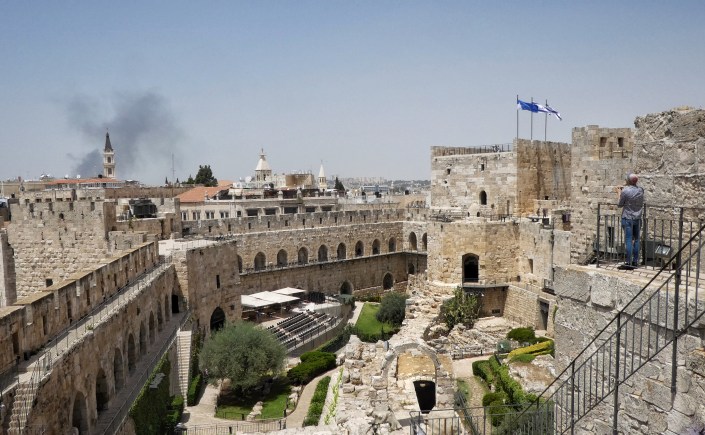
The Citadel or Tower Museum at the Jaffa Gate, the westernmost entrance to the city, is all the history you can eat in a four hour sitting. It’s a four thousand year old story: from the Canaanites and the Hebrews to the end of the Mandate and the establishment of the State of Israel, via Egyptians, Assyrians, Persians, Greeks, Hasmoneans, Romans, Byzantines, Umayyads, Abbasids, Fatamids, Crusaders, Ayyubids, Tartars, Mongols, Mamluks, Ottomans, British, and even Australians. Each left their mark on Jerusalem, and most planted their brickage upon and within the Citadel.

image

There is a long roll-call of famous names who may or may have not resided in the place.

King David didn’t, despite his name being given to the place and the apocryphal story that he once spied on the bathing Bathsheba from its ramparts – indeed, her bathroom is said to be underneath the New Imperial Hotel, just across the way. Nor did his son and heir, Solomon, builder of the First Temple. Conquerors Nebuchadnezzar and Cyrus did not. They just wrecked the joint. Judah Maccabee might have, and those other famous Jewish rebels, the Zealots didn’t, but during Great Revolt, they retreated there and trashed the place. Herod the Great, a psycho with an serious edifice complex, resided here. As did also Procurator Pontius Pilate when he was in town (he preferred the luxuries of Caesaea Maritimus (Latin for “on Sea). Historians now believe that the Citdel was where he actually cast judgement on Jesus, and not in the Antonine Fortress which overlooked the Temple (where the Haram al Sharif now stands) throwing into question the whole basis for the existence of the Via Dolorosa.

Roman general and future emperor Titus would have taken up residence therein after he destroyed the city in 70CE, leaving only the citadel standing. His troops needed somewhere to crash. Constantine didn’t, but his mom Helena most likely did when she “discovered” The True Cross, commissioned the construction of the Church of the Holy Sepulcher, and single-handedly invented the Holy Land pilgrim industry that endures to this day. The Muslim conquerors Omar Ibn Khattab, Salah ud-Din, and Baybars may have, but Ottoman Sultan Suleiman the magnificent, who built the city walls we see today, never set foot in Jerusalem, and nor did his successors.

image

Ottoman troops occupied it, and General Djemal Pasha would hang Arab Nationalists in the Square before it. General Allenby declared Jerusalem and Palestine liberated on the steps leading to the citadel in 1917, but most likely stayed across the square at our wonderful East New Imperial Hotel (the Kaiser stayed there too when he visited Jerusalem in 1898). British troops garrisoned it during the Mandate years – like the Roman legionaries before them, they’d’ve needed a place to lay their heads. The British-commanded Arab Legion of then Transjordan took control of it in during the the battle for Jerusalem in 1948 and defended it successfully against the new IDF. They did so again in 1967 only to lose it and the Old City.

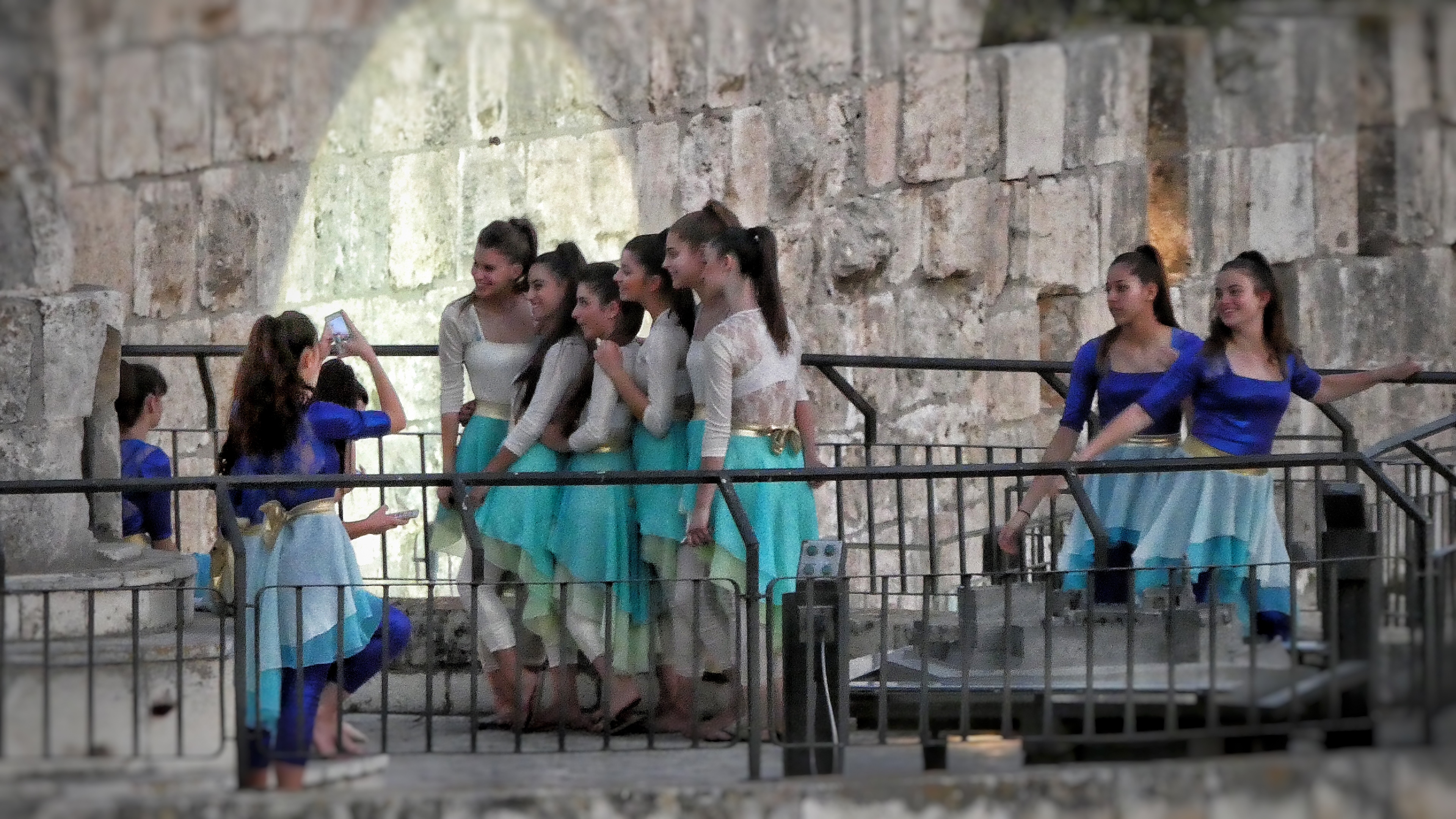
If the stones could talk, what a tale they would tell. And indeed, the museum now does just that, in content and in form. We sit on the roof garden of our hotel, directly across the street on Omar Ibn Al Khattab Square, and look across at its towers, ramparts and gardens, and sense it’s story in our souls. We watch present generations passing beneath its walls, and the young folk dancing on the ramparts, all part of the passing parade of humanity that has lingered by and upon these ancient walls.

For further reading, you can’t beat Simon Sebag-Montefiore’s Jerusalem : The Biography (Phoenix 2011).

See also in In That Howling Infinite, The Grand Old New Imperial Hotel, and Nova Via Dolorosa. For other posts about Jerusalem see: O Jerusalem

History Lessons

History Lessons

Carnivale

Dancers from the Son et Lumiere promenade

King Herod’s Edifice Complex

Herod the Great ruled from 37 to 4 BCE.

Like Lord Byron, he was mad, bad, and dangerous to know. He may or may not have been a psychopath – he killed his way to the top, murdering his relatives, and also, his wife Mariamne, whom loved truly, madly, deeply – but he suspected her of plotting to depose him, so she had to go too. He regretted it instantly and embalmed her in honey so he could spend quality time with her by her open catafalque.

Herod did a lot of questionable things, but he has gone down in Christian demonology for an atrocity he did NOT commit – he didn’t massacre the Innocents to ensure that baby Jesus would not live to supplant himself as King of the Jews! The slaughter of the babies was an invention of later Christian propagandists. Also, he was not the Herod who’s daughter Salome invented lap dancing and in payment, demanded the head of John the Baptist. Nor was he the Herod who told the imprisoned Jesus “I’m the King of the Jews!” That was Andrew Lloyd Webber’s camp caricature. Herod was a common name amongst the later (and last) Hasmoneans.

To his Jewish subjects, he was not a Kosher King, being only half Jewish, and then, only through this dad (even today, opinions about him are mixed for the same reason). Accordingly, he felt that he had to prove himself, like similarly half-Jewish, and much wiser King Solomon. So he built things. And man! Could he build! His stuff was not large – it was Monumental.

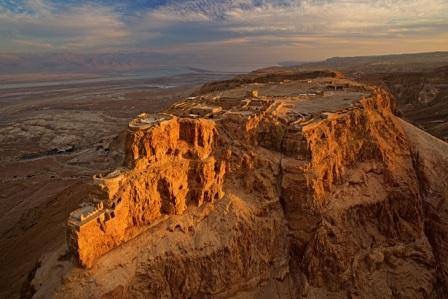
At Caesarea, on the Mediterranean coast, he build a port, a seaside palace and a city. In Jericho, another magnificent palace. At Herodium, he built a fortress-palace-mausoleum, but first, he built a hill high enough that he could see Jerusalem from the summit. Across the River Jordan, in present day Jordan, he rebuilt a fortress-palace at Machaerus which was said to be location of the imprisonment and execution of John the Baptist, and the venue for Salome’s notorious dance, The ancient town of Sebastia, on a hill with panoramic views across the West Bank, is another location of Herodian brickage; its Nabi Yahya Mosque is said to be the burial site of  the Baptist – although his head is believed to rest in an ornate catafalque in Damascus’s splendid Umayyad Mosque.  And he a fortress and summer palace on the Masada massif overlooking the Dead Sea, and the site of one of history’s most famous “last stands”.

He obviously liked palaces. When he died – and he died horribly as befits a bad boy – he was laid to rest in a bespoke tomb in his Herodium eyrie.

But his crowning glory was his breathtaking refurbishment of the Second Temple, rendering it a wonder of the contemporary world. Too bad that a “wabble of woudy webels”, to quote Bickus Dickus in “The Life of Brian”, had to rise up against Rome in 66CE, precipitating the destruction of Jerusalem, the death of thousands, and the razing of temple to the ground. All that impressive Herodian brickage was sent crashing to the ground, and all that remains is the Kotel, the hallowed Western or Wailing Wall.

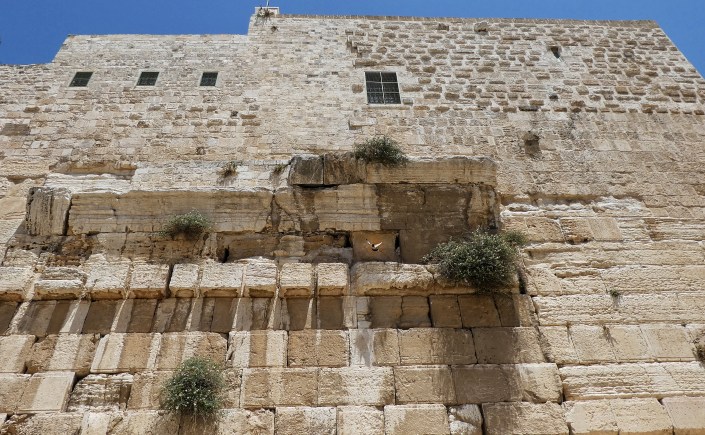
(The featured image shows signature Herodian ashlar blocks in the Kotel, the Western or “Wailing” Wall)

That’s my telling of the life and times of King Herod. Here’s what Wikipedia says : https://en.m.wikipedia.org/wiki/Herod_the_Great

Postscript

Apart from building things, was Herod really that “great”? I reckon he gave himself that soubriquet – or else the Romans did, probably in sardonic irony (which Herod, narcissistic and paranoid, probably didn’t get). His subjects didn’t think so and were happy when he died. Some accounts suggest that he’d ordered his bodyguard to slaughter the heads of prominent Hebrew families on the event of his death so that the people would not feel like rejoicing when he passed.


Herodian brickage thrown down bu the Romans

Herodian brickage thrown down by the Romans

Herodium

Herodium

Masada

Masada

The largest house brick in the world. The Western Stone of the Kotel 13.6m

The largest house brick in the world. The Western Stone of the Kotel 13.6m


Sic semper tyrannis

You come at the king, you best not miss.
Omar Little, The Wire (after RW Emerson)

The phrase “one man’s freedom fighter is another man’s terrorist” is at once apt, correct, and yet often oversimplified to the point of disingenuousness. The word “terrorist” itself describes its goal. To instill fear in the heart of the enemy. In the past, the target would have been the king, the dictator, the ruling class, and those who served them and upheld their rule. Politicians, officials, solders and policemen. Today, terrorists indiscriminately target whole societies. Irish bombers blasted communities of the rival faith, murdered shoppers, office workers, and pub patrons, as well as soldiers and policemen. Palestinian suicide bombers hit malls and pizza bars in city centres. ISIS, al Qa’ida and the Taliban detonate cars in busy city streets and publicly execute prisoners in callous and calculating “lectures in flesh” (the phrase is civil rights lawyer Geoffrey Robertson’s, from his chilling account of the trials and execution of King Charles I of England and those who sentenced him, The Tyrannicide Brief.).

But targeted and random terrorism has a long historical pedigree. For centuries, it has been the desperate and nihilistic weapon of last resort of resistance and rebellion against perceived oppression and injustice, and against invaders and occupiers.

In the second century BCE Palestine, the Maccabees used assassination in their resistance to the Seleucid Greeks, and a century later, the Jewish zealots, the Sicarii, named for the easily concealed small daggers, paid the Romans in like coin, and ultimately in an insurrection that culminated in the destruction of Jerusalem in 70CE and the scattering of the Jewish race (giving history the emotive and symbolic last exit that was Masada). In an etymological irony that Mark Twain would have been proud of, the present unrest in Jerusalem, a large number of young Palestinians have perished in attempting to stab jewish soldiers and civilians. Their jaquerie is called the “Intifada Sakni-in”, the ‘Knife Uprising – an echo of those long-dead Sicarii “dagger men”.

Nowadays, one would be excused for thinking that “terrorism” and “terrorist” are synonymous with Arabs and Muslims. And a historical precedent reinforces this erroneous assumption. The Hashishan or “Assassins” of Middle East fame (yes, that is where that noxious noun originated) were Muslim men and boys mesmerized and mentored by Rashid ad Din as Sina-n, the “Old Man of the Mountain” (and all this, before Osama in the caves of Tora Bora), and were Twelfth Century  hit-men contracted out to rival Muslim princes in the internecine conflicts that plagued the Levant in the wake of the Crusades and the demise of the great Arab Caliphates.

But the assassin’s knife (and in modern times, the gun and bomb, and latterly cars and trucks) predates these medieval hoods and links the Hebrew rebels of old to the Irgun and Stern Gang who encouraged Britain and the UN to abandon Palestine in 1948, bequeathing most of it to the new state of Israel, and triggering the Palestinian diaspora. European anarchists and Irish rebels and loyalists were adept at shootings and ambushes. In Algeria, during the ‘fifties, the nationalist FLN and the “colon” OAS shot and bombed each other and those unfortunates caught in the crossfire. The IRA perfected the improvised explosive device that today has crippled thousands of American, Canadian, and Australian soldiers in Iraq abd in Afghanistan. Hindu Tamil separatists of Sri Lanka introduced the suicide bomber, an economical and efficient weapon against soft (civilian, that is) targets, deployed today by Islamist killers in the streets of London and Lahore, Damascus and Dar es Salaam, Jerusalem and Jakarta. Whilst Arabs – and particularly Palestinians may have given the world the hijacking of aircraft – a tactic that fell into disuse due to diminishing political returns and rapid response forces – other Arabs showed us how to fly them into public buildings as the whole world watched in horror and disbelief. The shockwaves of this one are still reverberating through the deserts of the east and the capitals of the western world.

In going up up against their occupiers, the Palestinians have an old heritage. In my old country, Boudicca and Caractacus fought a losing battle against the Romans in Britain during the First CE. The Roman historian Tacitus ascribed to a vanquished chieftain the memorable words  “solitudinem faciunt, pacem appellant” – they make a desert and they call it peace. After the battle of Hastings in 1066, the defeated Saxons pushed back against the Normans and brought the genocidal wrath of William the Conqueror down on their heads with the devastating “Harrying of the North”. The Green Man and Robin Hood legends are said to be a retrospective and romanticised remembering of the Saxon resistance. Warrior fugitives from that failed guerilla war fled as far as Constantinple, where many joined the Emperor’s acclaimed Varangarian Guard, (see When Harald Went A Viking) 

In the streets and the countryside of Ireland, my parents’ birthplace, the United Irishmen, Fenians, Free Staters, IRA and Unionists fought against the redcoats, tommies, and black and tans of the British Army. Fought amongst themselves, fought against each other, and killed and were killed in their centuries long war of liberation. And in my adopted country, indigenous Australians fought a futile frontier war against settlers and soldiers just as native Americans did, albeit on a much smaller scale, and paid the price in hangings, massacres, poisoned wells, dispossession, marginalization, and “stolen children”. The legacy of those times lingers still – see The Frontier Wars – Australia’s heart of darkness.

In Central America, Juarez led the Mexicans against the French, and Sandino, Nicaraguans against US marines. Spaniards rose up against Napoleon’s forces, giving the world the word “guerilla”, or “little war”. Russian partisans ambushed the Grande Armé and the Wehrmacht. Throughout occupied Europe, the very term “resistance” became synonymous with the heroic unequal struggle against tyranny. In another of history’s ironies, muqa-wamat, Arabic word for resistance, unites sectarian rivals Hamas and Hizbollah against Israel.

And not just resistance to invasion and occupation, but also against oppression by one’s own rulers. Religious tracts tie themselves in knots reconciling the obligation to obey our rulers with the right to resist and overthrow those that rule badly. The unequal struggle against tyranny – or what is perceived by the perpetrators as tyranny – is the cause that inspires men and women to desperate acts.

The most celebrated in fact, film and fiction is the death of Julius Caesar at the hands of peers who feared that he intended to usurp the ostensibly democratic Republic (ostensible because democratic it was not) and institute one-man rule. That ended badly for the conspirators, and for Rome, as it precipitated years of civil war and ultimately, half a century of empire).

In 1880 the reforming Czar Alexander II of Russia, discovered the hard way that liberating the serfs did not inoculate himself against the bomb that took his legs and his life. His fearful and unimaginative successors hardened their hearts and closed their minds against further reform. setting in train the crackdown on dissent and democratic expression that led eventually to the storming of the Winter Palace on Petrograd in 1917. Narodnaya Volya, the killers called themselves – the People’s Will. And that is what terrorists do. They appeal and owe fealty to a higher court, a greater good, a savage God.

So it was when student and Serbian nationalist Gavril Princip assassinated Archduke Ferdinand of Austria-Hungary in June 1914 and ignited the spark that lit the conflagration of World War 1 which precipitated the demise of the old European empires.

So too when John Brown and his sons brought their broadswords to bear on slavers and their sympathizers and made a date with destiny at Harpers Ferry. Their famous raid may or may not have accelerated the downward slide to the secession and civil war that erupted the following year, but it provided a moral and symbolic prelude and also, the resonating battle hymn of the republic. John Wilkes Booth bookended this bloody era with his histrionic and public murder of Abraham Lincoln, shouting “sic semper tyrannis”, “thus always to tyrants,” attributed to Brutus at Caesar’s assassination – today, it’s the Virginia state motto. Brown and Booth were quite clear in their motives. As was were the segregationalist shooters who did for African Americans Medgar Evers and Martin Luther King. Less so were the killers of the Kennedy brothers in the sixties.

To conclude, sometimes that savage, rebel God is one of faith, sometimes, of blood and soil. In some instances, it is revenge for wrongs real and imagined – the reasons at times lost or forgotten through the passage of time and fading memories. And often, “the cause” is corrupted by the immoral economics of illicit commerce, including contraband, kidnapping, blackmail and extortion. Sometimes all merge in an incongruous hybrid of religious passion, ethic identity, libertarian or anarchistic fervour, and protection racket. As was the case in Northern Ireland, in Lebanon, in sub-Saharan Africa, and currently so in Syria and Iraq.

But most times, terror and turmoil is simply a political weapon planned, targeted and executed as a mechanism of regime change. Rebellion, revolt and revolution. Resisting, opposing, challenging, confronting and defeating the central authority. The seizing, holding, consolidation and keeping of political power.

And one thing is for sure. The outcome is unpredictable. History does not move in straight lines, but often follows a bitter and twisted path. Cliched as it is, the phrase “be careful what you wish for” is an apt one. And when, as Bob Dylan sang, “the line it is drawn, the curse it is cast”, there is no going back. To quote WB Yeats’ famous lines, “all is changed, changed utterly”.

Terrorism, then, can shift the course of history. If we were to stumble into the swamp of alternative histories, imagine what might of happened

If Caesar had walked home from the senate on the Ides of March
If Lincoln had been able to guide the Reconstruction
If the reforming Czar had introduced democratic government to Russia
If Gavril Princip’s shot had missed the archduke
If Kennedy had returned from Dallas
If John Lennon outlived George Harrison
If Yitzak Rabin had left the peace concert in Tel Aviv
If the Twin Towers stood still

To quote “Stairway to Heaven”, a curiously apposite title given the millenarian mindset of many terrorists, “Oh, it makes you wonder!”
Hejira

You know it never has been easy
Whether you do or you do not resign
Whether you travel the breadth of extremities
Or stick to some straighter line
Joni Mitchell, Hejira

People’ll tell you where they’ve gone
They’ll tell you where to go
But till you get there yourself you’ll never really know
Where some have found their paradise
Other’s just come to harm
Oh Amelia it was just a false alarm
Joni Mitchell, Amelia

How sweet it is to learn new things – to walk new streets, to look through new windows. Working lately as a volunteer with the Humanitarian Settlement Services progrmme,  I have had that opportunity. The HSS’ mission is to assist newly arrived refugees to settle in Australia, participate in our way of life,  access services available to us all, and to develop the skills and knowledge needed to begin a new life in our country. The  following  pieces recall two days in my volunteer life. They are a sequel of sorts, and indeed, a happy ending to my recent post No Going Home in which I endeavored to imagine the refugee journey.  

Hejira is an Arabic word that commemorates specifically  the flight of Muhammad from Mecca to Medina in 622.  But it also refers to any emigration or flight, and this is the context here.

Arrival

I wait at our tiny  airport for an Afghani family coming to Australia from a refugee camp on the Pakistani border. They have come here straight from Iran with but a short transit in Sydney. The plane is a little QANTAS Dash 8, and the passengers walk down the gangplank. The day is hot. Young girls in short shorts and skivvies disembark, and young men in shorts, tees and thongs (the sandals, that is). There a few suited businessmen, and retirees in nondescript array.

Our new arrivals are last off. Mum and two teenage sons. She wears a hijab and Iranian dress,, and the boys, jeans and tee shirts. They step onto the hot tarmac and walk, tired and nervous, to the arrivals lounge. We are with the welcoming party – a family of Afghanis who settled here a short while ago, two young girls, their mother and their auntie. They too are dressed in salwar kameez – they came here from a  camp in Pakistan. The ladies dwelt there for twelve years, and the girls were born there.

A young Hazara serves as our interpreter. She is dressed like a fashionable Iranian muhajibabe in simple and smart attire – for it is indeed Iran that she and he family sought shelter from the Afghan storm. She is eighteen, and arrived with her mother and siblings two years ago. Her English is excellent – she wants to be an interpreter, and is working towards that goal at TAFE. And this is the thing. These folk have all come here on 204 visas for women at risk, the sole carers of dependent families. Their husbands are either dead or decamped in Afghanistan or in the border camps.

And then there are we three Aussies. The tireless Humanitarian Settlement Service caseworker, a lady from community services who wanted to witness an arrival, and myself, working for the HSS as a volunteer, likewise bearing witness to what is quite a powerful scene.

The meeting and the greeting is done with salaams, embraces (the Afghanis) and handshakes (we locals). The first minutes in their new home in the sun. I help the lads load the suitcases on to the bus, and my work done, I bid them all “khoda hafez” and take my leave. They are driven off to their new digs, an Afghan meal, the first of much paperwork, and then sleep.

But not before they are taken to the headland, from where they will view the Pacific Ocean to the east, hills covered in banana plantations to the west, and beyond them, below the cloudless blue sky, the blue-green foothills of the Great Dividing Range. On the other side, far to the northwest, their landlocked, shattered  home is 11,353 kilometers away.

Moving

Our mission today is to move a Hazara family from their first, interim dwelling, to a permanent home on the other side of town. A mother with four children. Three of these are at school today, and the eldest, a sparky eleven year old, has stayed home to help mom move house and help us with translation. Although she has been in Australia for just six months, her English is astonishing. She later tells me she can speak five Afghan languages, Urdu, and a bit of Hindi. Nothing is going to hold this one back.

Their bags and boxes are ready, and these fill the bus. So off we all go to their new home. Two Afghani neighbours greet us on  arrival, with two young girls and a tiny boy. Three ethnic groups, three languages, and two religions, and they are getting along famously.

“Why do you think that is?” asks the caseworker. “Because there are no men around”. No men. No controllers. No patriarchy. No rules. No tribes. No prejudice.

 In Sydney, in Melbourne, with the larger Afghan and Muslim communities, with the mosques and madrassas, imams and ideologies, the self-appointed and self-perpetuating mullahs and muftis, male control would be asserted, with their restrictive rules and regimentation. All the old baggage that was left behind would be brought in and unpacked – the tribal loyalties and enmities, the specious theological diktats on dress and demeanor, form and function. And the patriarchy.

But not here, in this northern, sea-side town. Just women doing their best to get along and make the new life work for themselves and their children.

What will the future hold for these women taken out of their homes, their culture, their society, and asked to craft a new life and identity for themselves and their children in a new and strange land? How will they go with the language and with life in general? Will they make new friends, find rewarding work, and “fit in”,  or will they cling to their old lives, lonely and isolated, their children the sole interface between themselves and the world?

I wonder about the young girls – and particularly the bright and outward-going ones I have met. Will they build successful school and professional careers? Will they make long and lasting friendships with their Australian and other peers?  Will they let go the costumes, conventions, and constrictions of their parents’ culture?

I wonder about the young boys, and the young men whom I greeted at the airport. How will they fare in their matriarchal domestic world? How will they adjust to their new life here with all its challenges and temptations?

If they remain in this regional city, who will be their role models? Will they become more Australian than Afghani as they grow up and mature among their north coast peers? Will they complete their education, and find work in an area with a very high level of youth unemployment? Or will they be isolated and lonely, dislocated and discontented? Will they assume their old culture’s patriarchal role and demand their mothers and sisters subject themselves to the son’s authority as head of the family, and impose restrictions their movements and morality, demeanor and dress?

Will they be drawn to the capital cities with their diverse Muslim communities. And into which circle will they be drawn? To the moderate ones who just want to get on with their lives in an Aussie world, to the pious and unassuming who see jihad as an internal spiritual quest, to the criminal and bikie gangs that we hear so much about, or to the radical proselytizers who view our culture and values as anathema to the word and will of God?

All this is in the future, and as these folk might say, in Gods hands. But in reality, it is in their’s and their’s alone. But I am glad to have been able to play a small part in setting these new arrivals on their path.

see also: No Going Home