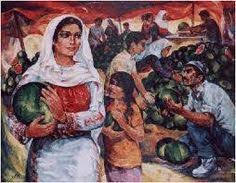
Modern history is built upon exodus and displacement

“We are cursed to live in a time of great historical significance: when future historians look back at 2023, the distinguishing feature of this year will likely be the recurrence of ethnic cleansing on a vast scale”.

Thus wrote Unherd columnist and former war correspondent Aris Roussinos in December. 2023, but he would draw the same conclusion in 2024 and in 2025. He notes that ethnic cleansing is taking place on a vast scale in many parts of the world. Yet, apart from the current outrage at Israel’s war on Hamas in Gaza, turbocharged as it is by unprecedented and arguably one-sided mainstream and social media coverage, international reaction has been muted to the point of indifference. Roussinos’ article is republished below, and the following overview is inspired by and draws on his observations.

The term ethnic cleansing is elusive and politically charged. In an age of endemic conflict, identity politics and competing narratives, it has become a contested and often diluted concept invoked with increasing frequency. Yet, it remains undefined in law. Unlike genocide or war crimes, it has never been codified as a distinct offence under international law, and so its use is contested.

A United Nations Commission of Experts investigating violations during the wars in the former Yugoslavia offered the most widely cited descriptions. In its interim report it defined ethnic cleansing as “rendering an area ethnically homogeneous by using force or intimidation to remove persons of given groups from the area.” In its final report the following year, the Commission elaborated: it is “a purposeful policy designed by one ethnic or religious group to remove by violent and terror-inspiring means the civilian population of another ethnic or religious group from certain geographic areas.” What is clear in these descriptions is that ethnic cleansing is deliberate, systematic, and political in nature.

The Commission also catalogued the methods through which such policies are carried out. They include murder, torture, arbitrary arrest and detention, extrajudicial executions, rape and sexual violence, severe injury to civilians, confinement of populations in ghettos, forcible deportation and displacement, deliberate military attacks or threats of attacks on civilian areas, the use of human shields, the destruction and looting of property, and assaults on hospitals, medical staff and humanitarian organisations such as the Red Cross and Red Crescent. The Commission concluded that these acts could amount to crimes against humanity, war crimes, and in some instances, fall within the meaning of the Genocide Convention.

Many people today use the term ethnic cleansing interchangeably with genocide, since both involve the violent removal and destruction of communities and often lead to similar outcomes of death, displacement, and cultural erasure. Ethnic cleansing, which refers to the forced expulsion of a group from a territory through intimidation, violence, or coercion, frequently overlaps with acts that fall under the 1948 UN Genocide Convention, such as mass killings and the destruction of cultural or religious life. This blurring of concepts reflects not only the moral outrage provoked by such crimes but also frustration at the narrowness of legal categories, which can leave survivors feeling their suffering has been minimized by technical distinctions. Historical cases illustrate how the line between the two has often been perilously thin: the mass deportations and killings of Armenians in 1915, which many scholars and states regard as genocide and even describe as a holocaust – though Türkiye denies it and Israel avoids official recognition for fear of diluting the unique status of the Shoah – the expulsions and massacres of Bosnian Muslims in the 1990s, and the flight of the Rohingya from Myanmar all show how ethnic cleansing has so often carried genocidal dimensions – as is particularly the case today with the war in Gaza which has polarized and politicized ordinary people and activists alike worldwide who have through lack of knowledge or opportunism conflated the two.

Yet it is important to recognize that genocide and ethnic cleansing are not strictly interchangeable. Genocide requires proof of an intent to destroy, in whole or in part, a national, ethnic, racial, or religious group, whereas ethnic cleansing focuses primarily on expulsion, which may or may not involve that deeper intent to annihilate. Ethnic cleansing can amount to genocide when the purpose is to eradicate a group, but not all instances meet this threshold. In public discourse, however, people motivated more by empathy and emotion than by detailed knowledge of history or law are often inclined to conflate the two, since the lived experience of the victims—violence, displacement, and cultural obliteration – appears indistinguishable from destruction itself. More informed observers, by contrast, emphasize legal precision and historical context, recognizing that while the outcomes often overlap, preserving the distinction remains vital for accurate analysis and accountability.

The moral revulsion ethnic cleansing excites is the natural and humane reaction, but historically and also presently, it is not an uncommon phenomenon. For the American sociologist and academic Michael Mann, ethnic cleansing is the natural consequence of modernity, “the dark side of democracy”: a recurring temptation of the modern nation-state. The following sections provided examples from the last thirty years, followed by a survey of instances of ethnic cleansing during the early to mid Twentieth Century. They describe how ethnic cleansing is not only a crime of forced removal and murder but also an assault on identity, memory, and the very visibility of a people.

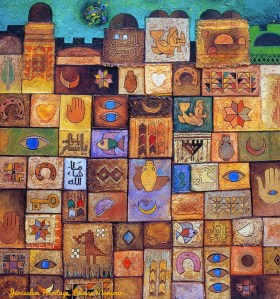
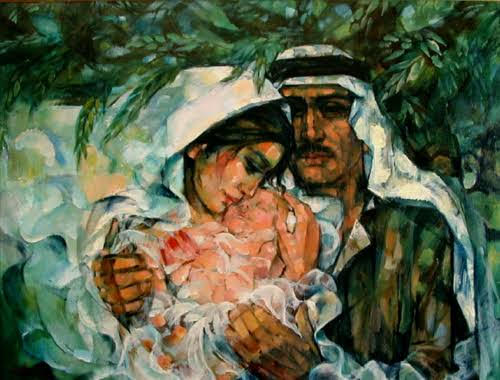
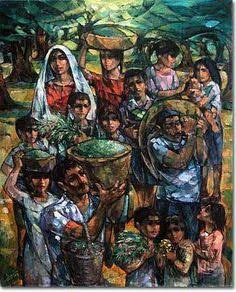
[The featured picture at the head of this blog post is one of Palestinian artist Ismail Shammout’s striking illustrations of Al Nakba, the dispossession of tens of thousands of Palestinian Arabs during Israel’s war of independence, from In That Howling Infinite’s Visualizing the Palestinian Return – the art of Ismail Shammout]. More of his art is included below]

Expulsion, eradication and exile

The Wars of the Yugoslav Succession in the 1990s – encompassing Croatia, Bosnia, and Kosovo – offer a clear illustration of ethnic cleansing in a modern European context. As Yugoslavia disintegrated, political and military leaders pursued campaigns aimed at creating ethnically homogeneous territories, often through the systematic targeting of civilians. In Bosnia, Serb forces carried out mass killings, forced deportations, rape, and the deliberate destruction of homes, schools, and cultural heritage sites, culminating in the Srebrenica massacre of 1995, in which more than 8,000 Muslim men and boys were killed. In Croatia and Kosovo, similar tactics were deployed: ethnic minorities were expelled, villages razed, and communities terrorised into flight. The International Criminal Tribunal for the former Yugoslavia (ICTY) documented and prosecuted these actions as crimes against humanity and war crimes, establishing that the campaigns were not chaotic consequences of war, but deliberate, coordinated policies of ethnic removal. The tribunal’s rulings provide a legal benchmark for understanding ethnic cleansing as the purposeful removal of populations through violence, intimidation, and coercion, a pattern that recurs across history and geography—from the forced expulsions of Armenians in 1915, to the population exchanges of Greece and Turkey in 1923, to the contemporary displacement of Rohingya, Palestinians, Ukrainians, and Afghans. These cases demonstrate that ethnic cleansing combines physical violence, forced migration, and cultural erasure, often leaving long-term social, political, and demographic scars that endure generations after the immediate conflict.

Sudan has witnessed repeated waves of ethnic cleansing over recent decades, most infamously in Darfur in the early 2000s, when government-backed Arab Janjaweed militias targeted non-Arab communities with systematic violence. Villages were burned, civilians massacred, women subjected to mass rape, and more than 2.5 million people displaced, in what the International Criminal Court later described as crimes against humanity, war crimes, and genocide. The displacement and destruction in Darfur followed earlier campaigns of forced removal during Sudan’s long north–south civil war, where entire communities in the south and Nuba Mountains were uprooted by aerial bombardment, scorched earth tactics, and starvation sieges. Today, ethnic cleansing has returned with devastating intensity: since April 2023, renewed fighting between the Sudanese Armed Forces and the Rapid Support Forces (successors to the Janjaweed) has triggered mass atrocities, including the killing of thousands and the flight of more than 7 million civilians, many across borders into Chad, South Sudan, and Egypt. Reports of targeted massacres against non-Arab groups in West Darfur suggest continuity with earlier campaigns, underscoring how ethnic cleansing in Sudan is not an isolated event but a recurring feature of its violent political landscape.

The Rohingya expulsions in Myanmar provide a stark contemporary example of ethnic cleansing. Since 2017, Myanmar’s military has carried out systematic campaigns of violence, including mass killings, sexual violence, arson, and the destruction of villages, aimed at driving the Rohingya Muslim population from Rakhine State. More than 700,000 Rohingya have fled to neighbouring Bangladesh, creating one of the world’s largest refugee crises. The violence has been accompanied by measures of cultural and social exclusion: denial of citizenship, restrictions on movement, and the erasure of Rohingya identity from official records. The United Nations and international observers have described these actions as ethnic cleansing, noting the deliberate intent to remove an entire ethnic group from a geographic area, while some investigators have determined that elements of the campaign meet the criteria for genocide.

Armenia and its surrounding regions have been scarred by cycles of ethnic cleansing for more than a century. The Armenian genocide of 1915–1916, carried out by the Ottoman Empire, combined forced deportations, massacres, and cultural destruction with the intent of removing Armenians from their ancestral lands in Anatolia. More than a million were killed or died on death marches, and countless others were scattered into diaspora communities across the Middle East, Europe, and the Americas. Later, in the Soviet period, Armenians and Azerbaijanis experienced repeated forced movements, with pogroms and expulsions erupting during times of political instability. Most recently, the 2023 offensive by Azerbaijan in Nagorno-Karabakh resulted in the flight of almost the entire Armenian population of the enclave—around 120,000 people—into Armenia proper, effectively erasing a centuries-old community. These waves of displacement illustrate how ethnic cleansing in Armenia is not confined to the past but has recurred across generations, leaving lasting demographic, cultural, and political consequences for the region.

During the past two years, mass expulsions from neighbouring countries returned large numbers of Afghans to Taliban-run Afghanistan. Pakistan has deported nearly half a million Afghans; Iran has driven out hundreds of thousands more. What is packaged as “repatriation” is, in many cases, forced displacement: exiles who had tenuous livelihoods, access to education, or limited civil freedoms in exile are now returned to a polity where the rights — especially the rights of women and girls — are ruthlessly curtailed. The Taliban’s record on gender is well known: it controls a society where women are barred from education and work, forced into early marriages, and denied even minimal public freedoms. Public-life prohibitions and systematic punishments disproportionately harm women and girls. Returning families are therefore being pushed into what many observers describe as among the worst possible places in the world for women — a profoundly gendered and life-threatening form of displacement.

The erasure of culture and historical memory

Like genocide, ethnic cleansing may not be limited the physical expulsion or eradication of people. It can be political, cultural and geographical, and often works through more insidious forms of erasure.

China’s policies in Xinjiang are an example. It has renamed at least 630 villages in Xinjiang, erasing references to Uyghur culture in what human rights advocates say is a systematic propaganda rebrand designed to stamp out the Muslim minority group’s identity. Human Rights Watch has documented a campaign of renaming thousands of villages across the region, stripping out references to Uyghur religion, history and culture. At least 3,600 names have been altered since 2009, replaced by bland slogans such as “Happiness,” “Unity” and “Harmony.” Such bureaucratic changes appear mundane, but they are part of a systematic project to erase Uyghur identity from the landscape itself.

Ukraine illustrates another, more violent dimension of contemporary ethnic cleansing. Russia is coercively integrating five annexed Ukrainian regions — an area the size of South Korea — into its state and culture. Ukrainian identity is being wiped out through the imposition of Russian schooling and media, while more than a million Russian citizens have been settled illegally into the occupied zones. At the same time, some three million Ukrainians have fled or been forced out. Torture centres have been established, with one UN expert describing their use as “state war policy.” Russian forces have employed sexual violence, disappearances and arbitrary detentions, and carried out massacres. Civilian deaths officially stand at around 10,000, but independent estimates suggest a figure closer to 100,000. Homes and businesses have been seized and redistributed to the cronies of Russian officials and officers. On top of these abuses, thousands of Ukrainian children have been taken from their families and deported into Russia for adoption and assimilation, with the threat that when they reach 18 they will be conscripted into the Russian military. This programme of child transfers has been declared a war crime by international courts, and represents perhaps the most chilling element of the campaign to erase Ukrainian identity across generations. Russian propagandists, including ideologues such as Alexander Dugin, routinely describe Ukrainians as “vermin” to be eliminated — language that many experts say is consistent with genocidal intent.

The long arm of history

Historical precedent is sobering, underscoring how entrenched practices definable as ethnic cleansing are. Some examples follow.

The Armenian genocide of 1915–1916 is a historical example where the term “ethnic cleansing” can be applied alongside, though not identical to, the legal concept of genocide. Ottoman authorities systematically deported, massacred, and starved Armenians from their ancestral homelands in Anatolia, often under the guise of military necessity. Entire villages were emptied, survivors forced on death marches into the Syrian desert, and cultural and religious heritage deliberately destroyed. These actions aimed to remove the Armenian population from the territory of the Ottoman Empire, making the region ethnically and religiously homogeneous, which aligns closely with contemporary definitions of ethnic cleansing. The genocide combined mass killing with forced displacement and cultural erasure, illustrating how ethnic cleansing and genocide can overlap in both intent and method. (See The Fall of the Ottoman Empire and the birth of Türkiye)

The Armenian case also illustrates how recognition of genocide is often bound up not only with history but with contemporary politics. Türkiye continues to deny that the mass deportations and killings of Armenians in 1915 amounted to genocide, framing them instead as wartime relocations within the collapsing Ottoman Empire. Israel, despite wide acknowledgment among its own scholars of the genocidal character of the events, has avoided official recognition, partly out of diplomatic considerations toward Türkiye, once a key regional ally, but also out of concern that equating the Armenian tragedy with the Shoah might dilute the unique historical and moral status attached to the Holocaust in Jewish memory and international discourse. This reluctance is not unique to Israel: several states have long hesitated to employ the term “genocide” for fear of straining relations with Ankara or complicating their own foreign policy priorities. Such debates demonstrate how the line between ethnic cleansing and genocide is not only a matter of legal precision but also of political narrative, with governments and institutions sometimes reluctant to apply the most condemnatory labels even where evidence overwhelmingly supports them.

As the Northern Irish writer Bruce Clark observed in his excellent book Twice A Stranger on the euphemistically termed “population exchanges” between Greece and Turkey exactly a century ago, “Whether we like it or not, those of us who live in Europe or in places influenced by European ideas remain the children of Lausanne,” the 1923 peace treaty, finalizing the dismemberment of the Ottoman Empire after the First World War, which decreed a massive, forced population movement between Turkey and Greece”, and in effect, One and a quarter million Greek Orthodox Christians were removed from Anatolia, the heartland of the new republic of Türkiye, and nearly 400,000 Muslims from Greece, in a process overseen by the Norwegian diplomat Fridtjof Nansen leading a branch of the League of the Nations which would later – perhaps ironically – evolve into today’s UNHCR.

During the Second World War, Soviet Union alone deported half a million Crimean Tatars and tens of thousands of Volga Germans to Siberia. In 1945, the victorious Allied powers oversaw the removal of some 30 million people across Central and Eastern Europe to create ethnically homogeneous states. At Yalta and Potsdam, Britain, the US, and the Soviet Union endorsed the expulsion of 12 million Germans, over 2 million Poles, and hundreds of thousands of Ukrainians, Hungarians, and Finns.

The partition of British India in 1947 produced one of the largest and bloodiest forced migrations in modern history. As the new states of India and Pakistan were created, an estimated 12 to 15 million people crossed borders in both directions – Muslims moving into Pakistan, Hindus and Sikhs into India – in a desperate effort to reach what they hoped would be safer ground. The upheaval was marked by extreme communal violence, massacres, abductions, and sexual assaults. Between 500,000 and 1 million people are thought to have been killed, and millions more were uprooted from ancestral homes they would never see again. The trauma of Partition continues to shape Indian and Pakistani national identities, as well as the politics of South Asia to this day. (See Freedom at Midnight (2): the legacy of partition) and Freedom at Midnight (1): the birth of India and Pakistan

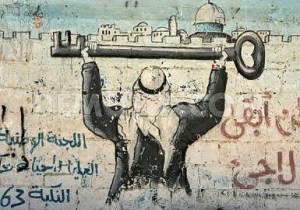
The dismemberment of Mandate Palestine by the new state of Israel, Jordan and Egypt in 1948 brought two simultaneous mass displacements that remain unresolved. During the first Arab–Israeli war more than 700,000 Palestinians fled or were expelled from their homes in what became Israel. Known as the Nakba or “catastrophe,” this created a vast refugee population now numbering in the millions, many still stateless. Jews living in what is now the Old City and East Jerusalem, and the West Bank seized by Jordan were expelled. Jews living across the Arab world in Iraq, Yemen, Egypt, Libya, Syria and elsewhere – faced growing hostility, persecution, and expulsion. Between 1948 and the 1970s, an estimated 800,000 to 1,000,000 Jews left or were forced out, many stripped of property and citizenship. Most resettled in Israel, where their presence profoundly altered the country’s politics and culture. Palestinians and Jews alike endured dispossession, trauma and exile, and both experiences fuel competing narratives of grievance that continue to define the conflict.

Israelis are themselves, for the most part, the product of 20th-century ethnic cleansings, in the Middle East as well as Europe: indeed the descendants of Middle Eastern Jews, like the Security Minister Itamar Ben-Gvir, are the country’s most radical voices on the Palestinian Question. But unlike the Mizrahim,  and displaced of Eastern and south-eastern Europe, the Palestinians have no Israel to go to. There is no Palestinian state waiting to absorb them. Indeed, for Gaza’s population, the vast majority of whom descend from refugees from what is today Israel, Gaza was their place of refuge, and the 1948 Nakba the foundational event in their sense of Palestinian nationhood. For all that ethnic cleansing punctuates modern history, there is no precedent for such a process of double displacement, and the political consequences cannot at this stage be determined. We may assume they will not be good, and an analogue to Europe’s post-war neighbourly relations will not be found.

Conclusion: The Age of Dispossession 

In many historical cases, expulsions, however brutal, were stabilized by the existence of ethnic homelands ready to absorb the displaced. Refugees were incorporated into nationalist projects in Greece and Türkiye, or into newly homogenized states such as Poland and Ukraine, where they became central to the shaping of modern politics. The Karabakh Armenians driven into Armenia may follow this precedent, potentially reshaping the political order of a small and embattled state.

Ethnic cleansing in the twenty-first century, however, combines these older methods with new techniques. Violence, rape, deportation, and massacre continue, but are now accompanied by cultural erasure, bureaucratic renaming, engineered resettlement, propaganda, and the deliberate targeting of children for assimilation. Unlike many twentieth-century precedents, today’s displaced populations often have nowhere safe to go, forced into territories with no protective homeland or into environments of repression, creating open-ended cycles of dispossession. The erasure of identities in Xinjiang, the coercive integration of Ukrainian territories, the expulsion of Rohingyas and Afghans, the depopulation of Karabakh, and the looming threat of Gaza – where Palestinians face the looming threat of another mass displacement, echoing the 1948 Nakba – collectively demonstrate that ethnic cleansing is not a relic of the past.

It remains a recurring feature of our age – modern history is indeed built upon exodus and displacement – and its human cost is profound and incalculable.

© Paul Hemphill 2024,2025. All rights reserved

Nagoorno Karabakh

Postscript … Al Nakba, a case study in dispossesion

In the late nineteenth and early twentieth centuries, European Jews came to a land that was already inhabited by another, different people. Over two decades, they forced the guarantor power out by terrorism and took the land by conquest, expelling most of  its original inhabitants by force. They have sowed their share of wind, too. Both sides want all the land for themselves.

Al Nakba, is the Arabic name for the “catastrophe” that befell the Arab inhabitants of Mandate Palestine during the war that was fought between Arabs and Jews in 1947-1948, resulting in the expulsion of upwards of 700,000 Arab Palestinians. That it happened is incontrovertible. But the facts, even those that are attested to by all reputable politicians and academic authorities, including Israelis, have long been subject to doubt and distortion by all sides of what has since been called “The Middle East Conflict” – notwithstanding that there have been conflicts in the Middle East more devastating and bloodier in terms of destruction and mortality including in Lebanon, Iraq, Syria, Algeria, Libya, and Sudan.

I do not to intend here to retell the history of Al Nakba. There many accounts available in print including those by Arab and Israeli authors, and in film, particularly an excellent documentary broadcast by Al Jazeera in May 2013 and repeated often?

June 17th, 2018, I wrote about it in a Facebook post:

Al Nakba did not begin in 1948. Its origins lie over two centuries ago….


So begins this award-winning series from Al Jazeera, a detailed and comprehensive account of al Nakba, the establishment of the State of Israel in 1948 and the dispossession and expulsion of the Palestinians who lived within its borders.

It is a well-balanced narrative, with remarkable footage, that will not please the ardent partisans of both sides who prefer their story of 1948 to be black and white.

Revisionist Israeli historians Ilan Pappe, Avi Shlaim, and Teddy Katz describe the ruthless and relentless military operations to clear and cleanse “Ha’aretz”, the land, of its Arab inhabitants and their history, whilst Palestinian historians tell the story from the Palestinian perspective, describing the critical failings of Palestinian’s political leaders and neighbouring Arab governments. Elderly Palestinians who were forced into exile and to camps in Jordan and Lebanon tell their sad stories of starvation and poverty, violence and death, and of terrible sadness, homesickness and longing that the passing years and old age have never diminished.

“When I left my homeland, I was a child. Now, I’m an old man. So are my children. But did we move forward? Where is our patriotism? Patriotism is about the pockets of our current leaders. They build high buildings and go to fancy banquets. They pay thousands for their children’s weddings”. Refugee Hosni Samadaa.

“We’re repeating the same mistakes. Before 1948 the Palestinian National Movement was split on the basis of rival families. Today, it is split into different parties over ideology, jurisdiction and self-interests. We didn’t learn our lesson. We were led by large, feudal landowners. Today, we are led by the bourgeoisie. Before 1948, we were incapable of facing reality. Today, we are just as inept. Before 1948, people chose the wrong leadership. And today, we are following the wrong leaders”. Researcher Yusuf Hijazi.

https://www.aljazeera.com/program/featured-documentaries/2013/5/29/al-nakba

I republish below Roussinos’ article in full, also a brief but comprehensive account about Al Nakba by economist and commentator Henry Ergas.

al Nakba, Ismail Shammout

al Nakba, Ismail Shammout

The truth about the ethnic cleansing in Gaza – modern Europe was built on exodus and displacement

Aris Roussinos, Unherd, December 18 2023

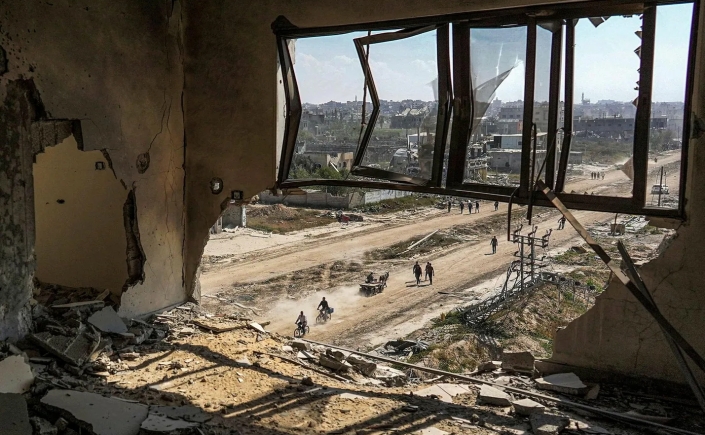
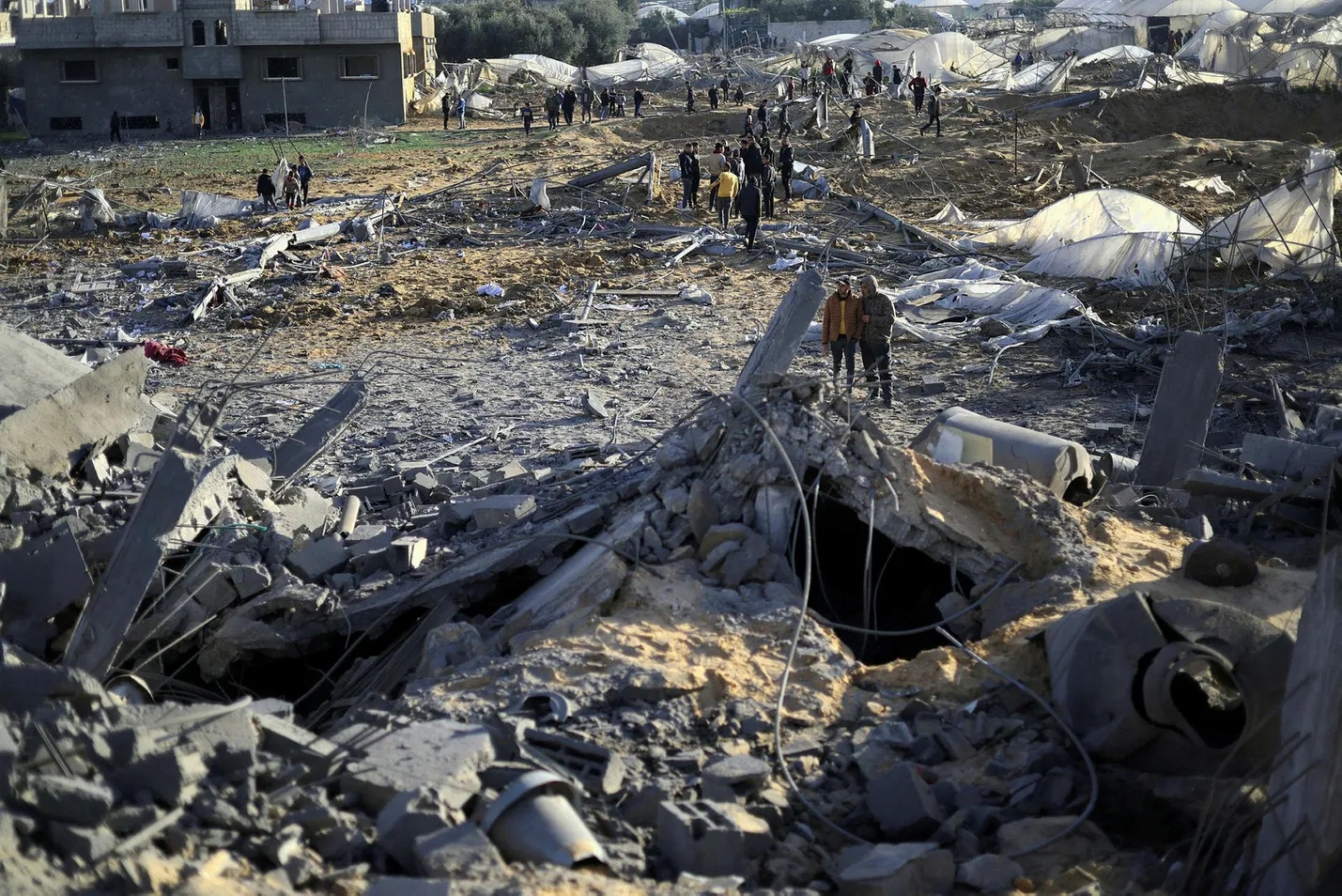
We are cursed to live in a time of great historical significance: when future historians look back at 2023, the distinguishing feature of this year will likely be the recurrence of ethnic cleansing on a vast scale. In just the past few months, Pakistan has deported nearly half a million Afghan migrants, while Azerbaijan has forced 120,000 Armenians — the statelet’s entire population — from newly-conquered Karabakh, both to broad international indifference. As the UNHCR has warned, the forced expulsion — that is, the ethnic cleansing — of Gaza’s Palestinian population is now the most likely outcome of the current war.

With no prospect of Palestinians and Israelis living together peaceably, anything short of absolute military victory unacceptable to both the Israeli government and its voters, but no meaningful plan for who will rule the uninhabitable ruins of post-war Gaza, the only realistic solution to the Palestinian problem, for Israel, is the total removal of the Palestinians. As Israel’s former Interior Minister has declared: “We need to take advantage of the destruction to tell the countries that each of them should take a quota, it can be 20,000 or 50,000. We need all two million to leave. That’s the solution for Gaza.”

Israeli officials have not been shy in promoting this outcome to a war, according to the President Isaac Herzog, for which “an entire nation… is responsible”. Israel’s agriculture minister Avi Dichter has asserted that “We are now rolling out the Gaza Nakba,” adding for emphasis that the result of the war will be “Gaza Nakba 2023. That’s how it’ll end.”Israel’s Intelligence Ministry has published a “concept paper” proposing the expulsion of Gaza’s entire population to the Sinai desert, and Israeli diplomats have been trying to win international support for this idea. According to the Israeli press, Israeli officials have sought American backing for a different plan to distribute Gaza’s population between Egypt, Turkey, Iraq and Yemen, tying American aid to these countries’ willingness to accept the refugees. In a Wall Street Journal opinion piece, two Israeli lawmakers have instead urged Western countries — particularly Europe — to host Gaza’s population, asserting that: “The international community has a moral imperative—and an opportunity—to demonstrate compassion [and] help the people of Gaza move toward a more prosperous future.” The outcome for Gaza’s Palestinians does not appear to be in doubt: what remains to be haggled over is their final location.

The only actor that can prevent the ethnic cleansing of Gaza is the United States, and for domestic political reasons it is disinclined to do so. While the Biden administration declaresit does not support “any forced relocation of Palestinians outside of the Gaza Strip”, it is not taking any action to prevent it. If the expulsion of Gaza’s 2.3 million population comes to pass, the result will be the most significant instance of ethnic cleansing in a generation, which will define Biden’s presidency for future historians. Yet outrage over such events is selective. It is not entirely true, as some Middle Eastern commentators claim, that Western complicity in the looming ethnic cleansing of Gaza highlights a lesser interest in Arab or Muslim lives: the Armenian case highlights that eastern Christians also barely flicker on the world’s moral radar.

This week’s awarding of the right to host next year’s COP29 climate conference to Azerbaijan, just a few months after its ethnic cleansing of Karabakh, reminds us that the supposed international taboo on the practice does not, in reality, exist. When ethnic cleansing is permissible, and when it is a war crime, depends, it seems, on who is doing it, and to whom. Azerbaijan is oil-rich, useful to Europe, and able to buy favourable Western coverage; Armenia is poor, weak and friendless in the world. Similarly, the extinction of much of the Christian population of the Middle East as a result of the chaos following the Iraq War won very little international attention or sympathy: communities which survived in their ancient homelands from Late Antiquity, riding out the passage of Arab, Mamluk, Ottoman and European imperial rule, did not survive the American empire.

Yet while the moral revulsion such events excite is the natural and humane reaction, ethnic cleansing is less rare an event than the crusading military response to its Nineties occurrence in the Balkans may make us think. For the sociologist Michael Mann, ethnic cleansing is the natural consequence of modernity, “the dark side of democracy”. As the Northern Irish writer Bruce Clark observed in his excellent book Twice A Stranger on the euphemistically termed “population exchanges” between Greece and Turkey exactly a century ago, “Whether we like it or not, those of us who live in Europe or in places influenced by European ideas remain the children of Lausanne,” the 1923 peace treaty “which decreed a massive, forced population movement between Turkey and Greece”. One and a quarter million Greek Orthodox Christians were removed from Anatolia, and nearly 400,000 Muslims from Greece, in a process overseen by the Norwegian diplomat Fridtjof Nansen leading a branch of the League of the Nations which would later — perhaps ironically — evolve into today’s UNHCR.

It was a cruel process, wrenching peoples from ancestral homelands in which they had lived for centuries, even millennia— and by the end of it half a million people were unaccounted for, presumably dead. Yet it was viewed as a great diplomatic triumph of the age, perhaps with good reason: without meaningful minorities on each side of each others’ borders to stoke tensions, Greece and Turkey have not fought a war in a century. Indeed, as late as 1993, the Realist IR scholar John Mearsheimer could propose a “Balkan Population Exchange commission” for the former Yugoslavia explicitly modelled on the 1923 precedent, asserting that “populations would have to be moved in order to create homogeneous states” and “the international community should oversee and subsidize this population exchange”. For the younger Mearsheimer, ethnic cleansing was the only viable solution to Yugoslavia’s bloody and overlapping ethnic map: “Transfer is a fact. The only question is whether it will be organized, as envisioned by partition, or left to the murderous methods of the ethnic cleansers.” Thirty years later, however, Mearsheimercondemns Israel’s planned expulsions from Gaza outright.

There is a dark irony here: the forced expulsion of peoples is an affront to liberal European values, yet it is rarely acknowledged that our modern, hitherto peaceful and prosperous Europe is built on the foundation of ethnic cleansing. Perhaps the ramifications of such a truth are too stark to bear, yet it is nevertheless the case that the peaceable post-1945 order depended on mass expulsions for its stability. Using the 1923 exchange as their explicit model, the victorious allies oversaw the forced removal of 30 million people from their homes in Central and Eastern Europe towards newly homogeneous ethnic homelands they had never seen. At the Yalta and Potsdam conferences, Britain, the United States and the Soviet Union settled upon the expulsion of 12 million Germans, more than 2 million Poles and hundreds of thousands of Ukrainians, Hungarians and Finns from their ancestral homes.

As Churchill declared in Parliament in 1944, “expulsion is the method that, so far as we have been able to see, will be the most satisfactory and lasting. There will be no mixture of populations to cause endless trouble, as has been in the case of Alsace-Lorraine. A clean sweep will be made.” Only two years later, once the Cold War had begun and the Soviet Union and its vassal Poland become a rival, did Churchill fulminate against the “enormous and wrongful inroads upon Germany, and mass expulsions of millions of Germans on a scale grievous and undreamed of” by “the Russian-dominated Polish Government”. In ethnic cleansing, as in so many other things, political context is the final arbiter of morality.

But as a result, Germany has never since unsettled Europe with revanchist dreams; both Poland and Western Ukraine became, for the first time in their histories, ethnically homogenous entities. As the Ukrainian-Canadian historian Orest Subtelny has observed, the forced separation of Poles and Ukrainians, once locked in bitter ethnic conflict against each other, has led to today’s amicable relationship: “It seems that the segregation of the two peoples was a necessary precondition for the development of a mutually beneficial relationship between them. Apparently the old adage that ‘good fences make for good neighbors’ has been proven true once more.” That we have forgotten the vast scale of the forced expulsions which established Europe’s peaceful post-war order is, in a strange way, a testament to their success.

Yet what made the mass expulsions following the First and Second World Wars broadly successful was that those expelled at least had ethnic homelands to receive them. In Greece and Turkey, the refugees fully adopted the ethnic nationalism of their new countries, in Greece providing the bedrock of later republican sympathies, and in Turkey the core support for both secular Kemalist nationalism and occasional bouts of military rule. In the newly-homogenous Poland and Ukraine, refugees shorn of their previous local roots and at times ambiguous ethnic identities fully adopted in recompense a self-identification with their new nation-states which has helped define these countries’ modern politics. The 120,000 Karabakh refugees will likely become a political bloc in tiny Armenia, affecting the country’s future political order in ways yet hard to discern.

Israelis are themselves, for the most part, the product of 20th-century ethnic cleansings, in the Middle East as well as Europe: indeed the descendants of Middle Eastern Jews, like the Security Minister Itamar Ben-Gvir, are the country’s most radical voices on the Palestinian Question. But the Palestinians, like the ethnic French narrator of Houellebecq’s Submission, have no Israel to go to. Unlike the 20th century displaced of Eastern and south-eastern Europe, there is no Palestinian state waiting to absorb them. Indeed, for Gaza’s population, the vast majority of whom descend from refugees from what is today Israel, Gaza was their place of refuge, and the 1948 Nakba the foundational event in their sense of Palestinian nationhood. For all that ethnic cleansing punctuates modern history, there is no precedent for such a process of double displacement, and the political consequences can not at this stage be determined. We may assume they will not be good, and an analogue to Europe’s post-war neighbourly relations will not be found.

Egypt’s disinclination to host two million Gazan refugees is not merely a matter of solidarity, but also self-preservation: flows of embittered Palestinian refugees helped destabilise both Lebanon, where their presence set off the country’s bloody ethnic civil war, and Jordan, where they make up the demographic majority. It is doubtful too, given the recent tenor of its politics, that Europe will be eager to receive them, no matter how humanitarian the language with which Israeli officials couch their planned expulsion. Rendered stateless, driven from their homes and brutalised by war, Gaza’s refugees remain unwanted by the world, perhaps destined to become, as the Jews once were, a diaspora people forever at the mercy of suspicious hosts.

A terrible injustice for the Palestinians, their ethnic cleansing may yet provide Israel with a measure of security, even as it erodes the American sympathy on which the country’s existence depends. The broader question, perhaps, is whether or not the looming extinction of Palestinian life in Gaza, like the expulsion of Karabakh’s Armenians, heralds the beginning of a new era of ethnic cleansing, or merely the settling of the West’s unfinished accounts. Like the movements which bloodily reshaped Central Europe, Israel’s very existence is after all a product of the same nationalist intellectual ferment of fin-de-siècle Vienna. In 1923, while acknowledging its necessity, the British Foreign Secretary Lord Curzon called the Greco-Turkish population exchange “a thoroughly bad and vicious [idea] for which the world would pay a heavy penalty for a hundred years to come”. Exactly a century later, Gaza’s Palestinians look destined to become the final victims of Europe’s long and painful 20th century

Nakba, where Palestinian victim mythology began

‘Nakba Day’ was commemorated this week with even more vehemence than usual. The greatest tragedy is that the Palestinian people who fled remain frozen in time.

The Australian, 18th May 2024

Pro-Palestinian protesters hold banners and flags as they listen to speakers at a rally held to mark the anniversary of the ‘Nakba’ or ‘catastrophe’ of 1948, in Sydney on Wednesday. Picture: David Gray/AFP

Protestors at a Sydney rally to mark the anniversary of the ‘Nakba’. David Gray/AFP

On Wednesday, “Nakba Day” was commemorated around the world with even more vehemence than usual as outpourings of hatred against Israel, sprinkled with ample doses of anti-Semitism, issued from screaming crowds.

What was entirely missing was any historical perspective on the Nakba – that is, the displacement, mainly through voluntary flight, of Palestinians from mandatory Palestine. Stripped out of its broader context, the event was invested with a uniqueness that distorts the processes that caused it and its contemporary significance.

It is, to begin with, important to understand that the displacement of Palestinians was only one facet of the sweeping population movements caused by the collapse of the great European land empires. At the heart of that process was the unravelling of the Ottoman Empire, which started with the Greek war of independence in 1821 and accelerated during subsequent decades.

As the empire teetered, religious conflicts exploded, forcing entire communities to leave. Following the Crimean War of 1854-56, earlier flows of Muslims out of Russia and its border territories became a flood, with as many as 900,000 people fleeing the Caucasus and Crimea regions for Ottoman territory. The successive Balkan wars and then World War I gave that flood torrential force as more than two million people left or were expelled from their ancestral homes and sought refuge among their co-religionists.

The transfers reshaped the population geography of the entire Middle East, with domino effects that affected virtually every one of the region’s ethnic and religious groups.

The formation of new nation-states out of what had been the Ottoman Empire then led to further rearrangements, with many of those states passing highly restrictive nationality laws in an attempt to secure ethnic and religious homogeneity.

Nothing more starkly symbolised that quest for homogeneity than the Convention Concerning the Exchange of Greek and Turkish Populations signed on January 30, 1923. This was the first agreement that made movement mandatory: with only a few exceptions, all the Christians living in the newly established Turkish state were to be deported to Greece, while all of Greece’s Muslims were to be deported to Turkey. The agreement, reached under the auspices of the League of Nations, also specified that the populations being transferred would lose their original nationality along with any right to return, instead being resettled in the new homeland.

Underlying the transfer was the conviction, articulated by French prime minister (and foreign minister) Raymond Poincare, that “the mixture of populations of different races and religions has been the main cause of troubles and of war”, and that the “unmixing of peoples” would “remove one of the greatest menaces to peace”.

That the forced population transfers, which affected about 1.5 million people, imposed enormous suffering is beyond doubt. But they were generally viewed as a success. Despite considerable difficulties, the transferred populations became integrated into the fabric of the recipient communities – at least partly because they had no other option. At the same time, relations between Turkey and Greece improved immensely, with the Ankara Agreements of 1930 inaugurating a long period of relative stability.

The result was to give large-scale, permanent population movements, planned or unplanned, a marked degree of legitimacy.

Thus, the formation of what became the Irish Republic was accompanied by the flight of Protestants to England and Northern Ireland, eventually more than halving, into an insignificant minority, the Protestant share of the Irish state’s population; that was viewed as easing the tensions that had so embittered the Irish civil war.

It is therefore unsurprising that further “unmixing” was seen by the allies in World War II as vital to ensuring peace in the post-war world. In a statement later echoed by Franklin Roosevelt, Winston Churchill made this explicit in 1944, telling the House of Commons he was “not alarmed by the prospect of the disentanglement of populations, nor even by these large transferences, which are more possible in modern conditions than they ever were before”.

The immediate effect, endorsed as part of the Potsdam Agreements and implemented as soon as the war ended, was the brutal expulsion from central and eastern Europe of 12 million ethnic Germans whose families had lived in those regions for centuries. Stripped of their nationality and possessions, then forcibly deported to a war-devastated Germany, the refugees – who received very little by way of assistance – gradually merged into German society, though the scars took decades to heal.

Even more traumatic was the movement in 1947 of 18 million people between India and the newly formed state of Pakistan.

As Indian novelist Alok Bhalla put it, India’s declaration of independence triggered the subcontinent’s sudden descent into “a bestial world of hatred, rage, self-interest and frenzy”, with Lord Ismay, who witnessed the process, later writing that “the frontier between India and Pakistan was to see more tragedy than any frontier conceived before or since”. Yet in the subcontinent too, and especially in India, the integration of refugees proceeded to the point where little now separates their descendants from those of the native born.

All that formed the context in which the planned partition of Palestine was to occur. The 1937 Peel Commission, which initially proposed partition, had recommended a mandatory population exchange but the entire issue was ignored in UN Resolution 181 that was supposed to govern the creation of the two new states.

When a majority of the UN General Assembly endorsed that resolution on November 29, 1947, the major Zionist forces reluctantly accepted the proposed partition, despite it being vastly unfavourable to them. But the Arab states not only rejected the plan, they launched what the Arab League described as “a war of extermination” whose aim was to “erase (Palestine’s Jewish population) from the face of the earth”. Nor did the fighting give any reason to doubt that was the Arabs’ goal.

At least until late May 1948, Jewish prisoners were invariably slaughtered. In one instance, 77 Jewish civilians were burned alive after a medical convey was captured; in another, soldiers who had surrendered were castrated before being shot; in yet another, death came by public decapitation. And even after the Arab armies declared they would abide by the Geneva Convention, Jewish prisoners were regularly murdered on the spot.

While those atrocities continued a longstanding pattern of barbarism, they also reflected the conviction that unrestrained terror would “push the Jews into the sea”, as Izzedin Shawa, who represented the Arab High Committee, put it.

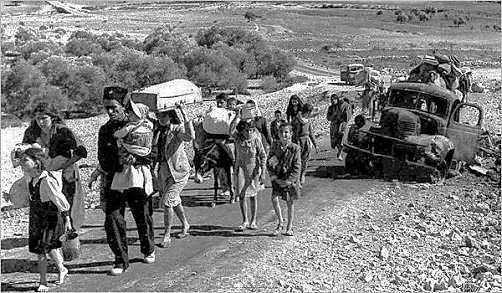
Arabs flee in 1948 ahead of the ‘war of extermination’ against Israel. Picture: History/Universal Images Group via Getty Images
Arabs flee in 1948 ahead of the ‘war of extermination’ against Israel.
History/Universal Images Group via Getty Images

A crucial element of that strategy was to use civilian militias in the territory’s 450 Arab villages to ambush, encircle and destroy Jewish forces, as they did in the conflict’s first three months.

It was to reduce that risk that the Haganah – the predecessor of the Israel Defence Force – adopted the Dalet plan in March 1948 that ordered the evacuation of those “hostile” Arab villages, notably in the surrounds of Jerusalem, that posed a direct threat of encirclement. The implementation of its criteria for clearing villages was inevitably imperfect, but the Dalet plan neither sought nor was the primary cause of the massive outflow of Arab refugees that was well under way before it came into effect.

Nor was the scale of the outflow much influenced by the massacres committed by Irgun and Lehi – small Jewish militias that had broken away from the Haganah – which did not loom large in a prolonged, extremely violent, conflict that also displaced a very high proportion of the Jewish population.

Rather, three factors were mainly involved. First, the Muslim authorities, led by the rector of Cairo’s Al Azhar Mosque, instructed the faithful to “temporarily leave the territory, so that our warriors can freely undertake their task of extermination”.

Second, believing that the war would be short-lived and that they could soon return without having to incur its risks, the Arab elites fled immediately, leaving the Arab population leaderless, disoriented and demoralised, especially once the Jewish forces gained the upper hand.

Third and last, as Benny Morris, a harsh critic of Israel, stresses in his widely cited study of the Palestinian exodus, “knowing what the Arabs had done to the Jews, the Arabs were terrified the Jews would, once they could, do it to them”.

Seen in that perspective, the exodus was little different from the fear-ridden flights of civilians discussed above. There was, however, one immensely significant difference: having precipitated the creation of a pool of 700,000 Palestinian refugees, the Arab states refused to absorb them.

Rather, they used their clout in the UN to establish the UN Relief and Works Agency for Palestine Refugees, which became a bloated, grant-funded bureaucracy whose survival depended on endlessly perpetuating the Palestinians’ refugee status.

In entrenching the problem, the UN was merely doing the bidding of the Arab states, which increasingly relied on the issue of Palestine to convert popular anger at their abject failures into rage against Israel and the West. Terminally corrupt, manifestly incapable of economic and social development, the Arab kleptocracies elevated Jew-hatred into the opium of the people – and empowered the Islamist fanaticism that has wreaked so much harm worldwide.

Nor did it end there. Fanning the flames of anti-Semitism, the Arab states proceeded to expel, or force the departure of, 800,000 Jews who had lived in the Arab lands for millennia, taking away their nationality, expropriating their assets and forbidding them from ever returning to the place of their birth. Those Jews were, however painfully, integrated into Israel; the Palestinian refugees, in contrast, remained isolated, subsisting mainly on welfare, rejected by countries that claimed to be their greatest friends. Thus was born the myth of the Nakba.

That vast population movements have inflicted enormous costs on those who have been ousted from their homes is undeniable. Nor have the tragedies ended: without a murmur from the Arab states, 400,000 Palestinians were expelled from Kuwait after the first Gulf War, in retaliation for the Palestine Liberation Organisation’s support of Saddam Hussein. More recently, Myanmar has expelled 1.2 million Rohingya.

But the greatest tragedy associated with the plight of the Palestinians is not the loss of a homeland; over the past century, that has been the fate of tens of millions. Rather, it is the refusal to look forward rather than always looking back, an attitude encapsulated in the slogan “from the river to the sea”.

That has suited the Arab leaders, but it has condemned ordinary Palestinians to endless misery and perpetual war. Until that changes, the future will be a constant repetition of a blood-soaked past

The first Intifada … Palestine 1936

In 1929, there is violence at the Western Wall in Jerusalem – then a narrow alley named for Buraq, the steed with a human face that bore the Prophet Mohammed on his midnight journey to Jerusalem, and not the Kotel Plaza of today. The event, which was actually called the Buraq rising was incited by rumours that Jews planned to overrun the Haram al Sharif, the third holiest site in Islam. A massacre of Jews in Hebron in the south followed. These were a bleak precursor of the wars to come.

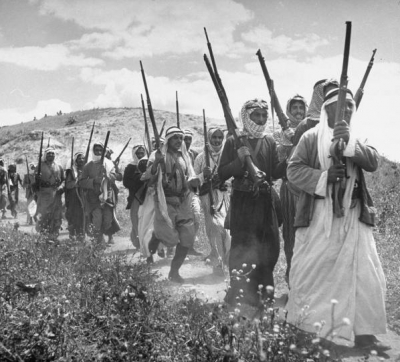
Fast forward to mid-April 1936. Following two incidents of killing carried out in by both Arabs and Jews, an Arab National Committee declared a strike in the city of Jaffa. National Committees were formed in other Palestinian cities and representatives of Arab parties formed the “Arab Higher Committee” led by Haj Amin al-Husseini. A general strike spread throughout Palestine, accompanied by the formation of Palestinian armed groups that started attacking British forces and Jewish settlements. Thus began the “Great Palestinian Revolt. It lasted for three years.

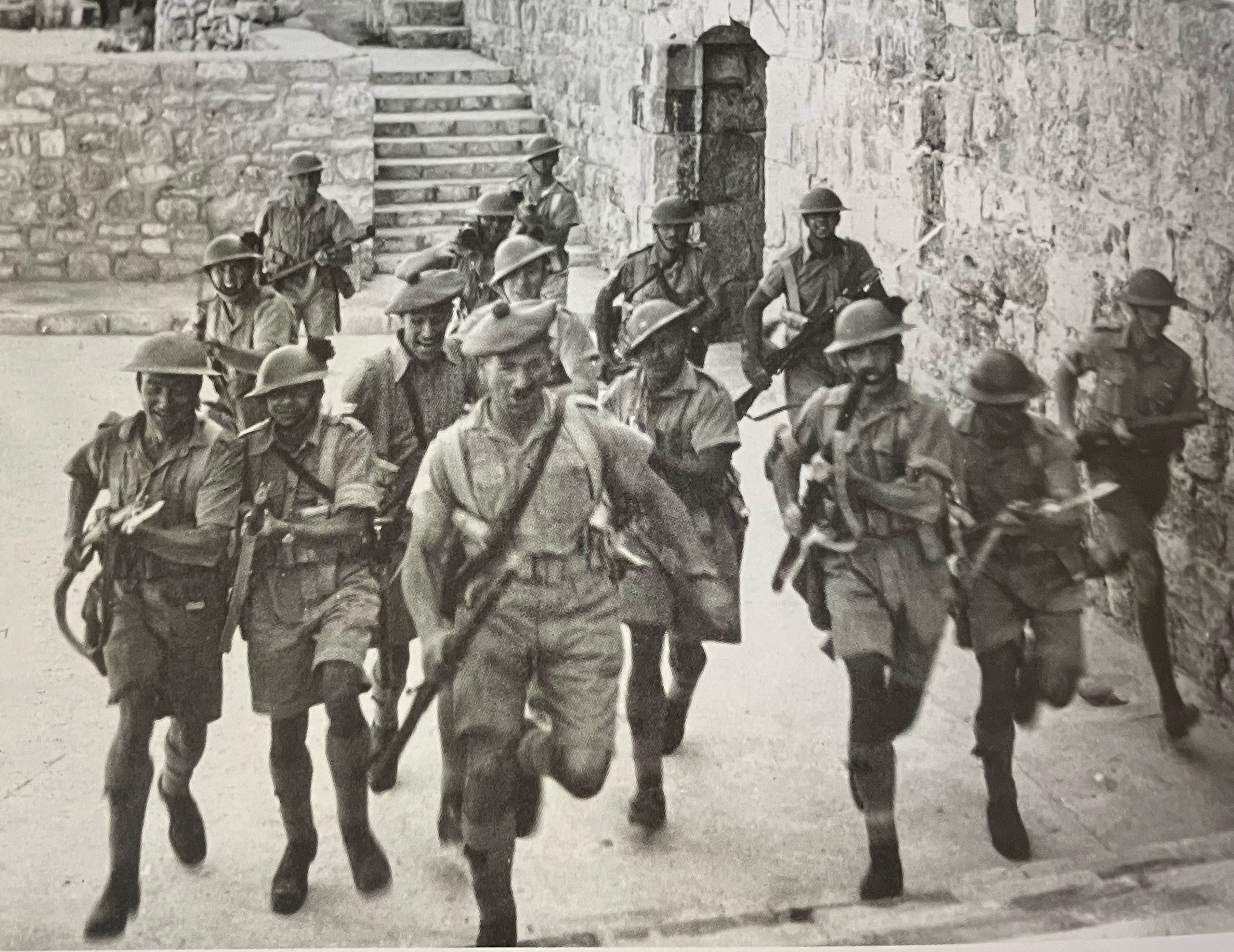
British troops run through Jerusalem’s’ Old City during the Great Revolt

Roots and fruits 

The ongoing struggle with regard to the existence Israel and Palestine is justifiably regarded the most intractable conflict of modern times. Whilst most agree that its origins lie in the political and historical claims of two people, the Jewish Israelis and the predominantly Muslim Palestinians for control over a tiny wedge of one-time Ottoman territory between Lebanon and Syria in the north, Jordan in the east, and Egypt to the south, hemmed in by the Mediterranean Sea. There is less consensus as to when the Middle East Conflict as it has become known because of its longevity and its impact on its neighbours and the world in general, actually began.

Was it the infamous Balfour Declaration of 1917 promising a national home for Jews in an Ottoman governate already populated by Arabs, or the secretive Sykes Picot Agreement that preceded it in 1916, staking imperial Britain’ and France’s claim to political and economic influence (and oil pipelines) in the Levant? Was it the establishment of the British Mandate of Palestine after the Treaty of Sèvres of 1922 which determined the dissolution of the defeated Ottoman Empire. Or was it the end of that British mandate and the unilateral declaration of Israeli independence in 1948 and the war that immediately followed?

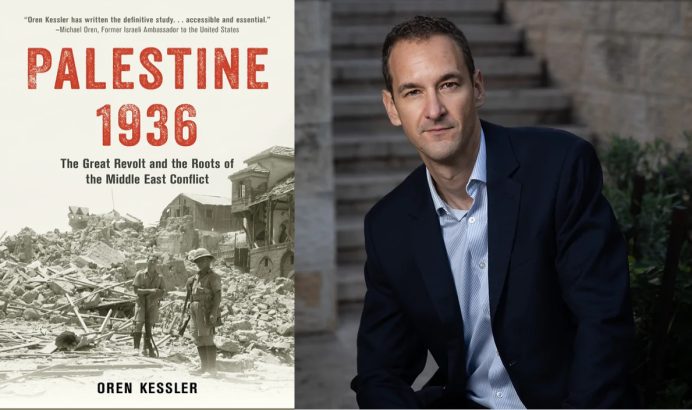
In his book Palestine 1936: The Great Revolt and the Roots of the Middle East Conflict (Rowman & Littlefield, 2023) Israeli journalist and author Oren Kessler argues powerfully that the events in Mandatory Palestine between 1936 and 1939 shaped the subsequent history of the conflict for Israelis and Palestinians. The book identifies what was known at the time as The Great Revolt  as the first Intifada, a popular uprising which actually sowed the seeds of the Arab military defeat of 1947-48 and the dispossession and displacement of over seven hundred thousand Palestinian Arabs, which has set the tone of the conflict for almost a century.

It is a tragic history shared with knowledge in hindsight of the decades of violence and bloodshed in the region that followed. It begins in the time before Palestine became political entity, when mainly Eastern European Jews began settling in progressively larger numbers to the consternation of the Arab populace.

The 1936 conflict stemmed from questions of how to divide the land and how to deal with the influx of Jewish people – questions that remain relevant today. In an extensive interview coinciding with the book’s publication (republished below) Kessler notes that, for the Arab residents, the problem was one of immigration and economics; for the Zionists, it was about finding a home. These two positions soon became irreconcilable issues, leading to sporadic violence and then to continual confrontation.

He believes that the Revolt is the point when both sides really came to see the conflict as zero sum. insofar that whichever community had the demographic majority in Palestine would be the one that would determine its fate. However, in the 1920s, the Jews were so far from that majority that both sides were able to postpone the final reckoning. In the 1930s, the Jews threatened to become a majority, and this was the immediate precursor to the rising. There was no way that the objective of bringing as many Jews to the land as possible could be achieved without bringing about some serious Arab pushback.

It is Kessler’s view that it was during revolt that a strong sense of Arab nationalism in Palestine extended beyond the urban elites to all corners of the country. All segments of Arab society – urban and rural, rich and poor, rival families, and even to a large extent Muslim and Christian – united in the same cause against Zionism and against its perceived enabler, the British Empire. The Arab public in Palestine was becoming increasingly politically aware and consciously perceiving itself as a distinct entity – distinct from its brethren in Syria, in large part because it has a different foe: not simply European imperialism but this very specific threat presented by Zionism.

The British government made early efforts at keeping the peace, but these proved fruitless. And when the revolt erupted in 1936, it sent a royal commission to Palestine, known to history as the Peel Commission, to examine the causes of the revolt. It proposed in effect the first ‘two state solution.’ The Emir Abdullah of Transjordan publicly accepted this plan. The main rival clan to the Husseinis, the Nashashibis, privately signaled that they were amenable – not thrilled, but amenable. And their allies held the mayorships of many important cities – Jaffa, Haifa, and even Nablus, Jenin and Tulkarem, which today are centres of militancy. And yet the Mufti makes very clear that he regards this plan as a degradation and a humiliation, and all of these erstwhile supporters of partition suddenly realise that they are against partition.

Kessler believes that this is the point at which a certain uncompromising line became the default position amongst the Arab leadership of Palestine, with dire consequences for the Palestinians themselves, and when Yishuv leader David Ben Gurion saw an opportunity to achieve his long-standing objective of creating a self-sufficient Jewish polity, one that could feed itself, house itself, defend itself, employ itself, without any help from anyone – neither British or Arabs. When the Arabs called a general strike and boycott, cut all contacts with the Jewish and British economies and closed the port of Jaffa in Spring 1936, he lobbied successfully with the British to allow the Jews to open their own port in Tel Aviv, ultimately causing a lot of economic pain to the Arabs and helping the Jews in their state-building enterprise.

This is a mosaic history, capturing the chaotic events on the ground through snippets of action. And also, the people involved. 

There are heroes and villains aplenty in this relatively untold story. The urbane and erudite nationalists Muhammed Amal and George Antonius who strive for middle ground against increasingly insurmountable odds, and who died alone and exiled having failed to head off the final showdown that is today known as Al Nakba. The farseeing, resolute, and humourless Ben Gurion and the affable, optimistic Chaim Weizmann, who became Israel’s first prime minister and president respectively. The New York born Golda Meyerson, more of a realist than either leader, who would also one day become prime minister. The irascible revisionist Vladimir Ze’ev Jabotinski, the forebear of today’s virulent rightwing nationalists

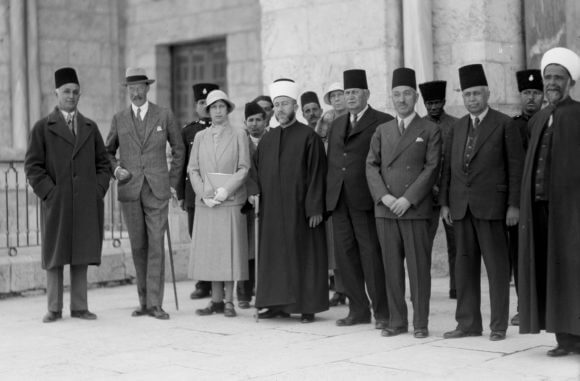
The hardliner Mufti Haj Amin al Husseini, whose uncompromising stance, malign political influence, and conspiratorial association with the Nazis set the stage for a long general strike, the Great Revolt, and ultimately, the débâcle of 1948. The flamboyant rebel leaders, Syrian Izz al Din al Qassam, who is memorialized in the name of the Hamas military wing and a Gaza-made rocket, and Fawzi al Qawuqji. Qassam was gunned down by British soldiers during the revolt whilst Qawuqji lived on to become one of the most effective militia leaders in the war of 1948, and to perish therein. Both are remembered today as Palestinian martyrs whilst the Mufti is an arguably embarrassing footnote of history. There’s an article about his relatively unremarked death at the end of this post. 

Amin al-Husseini in 1929

And in the British corner, the well-intentioned high commissioners who vainly endeavoured to reconcile the claims of two aspirant nations in one tiny land, and quixotic figures like the unorthodox soldier Ord Wingate who believed he was fulfilling prophecy by establishing the nucleus of what would become the IDF (like many charismatic British military heroes, and particularly General Gordon and Baden-Powell, both admirers and detractors regarded him a potential nut-case); and the Australian-born ex-soldier Lelland Andrews, assistant district commissioner for Galilee, who also conceived of his mission as divinely ordained. Lewis was murdered by Arab gunmen and Wingate went down in an aeroplane over Burma during WW2.

There are appearances from among many others, Lloyd George, Winton Churchill and Neville Chamberlain, Adolph Hitler and Benito Mussolini, Franklin D Eisenhower and Joseph Kennedy.

The book highlights the work of powerful British functionaries in handling early confrontations: they are memorialized for starting commissions to study the matter and to generate ideas, though many of their ideas weren’t followed or were followed to ill effect. None solved the problem, making this account of the earliest days of the conflict all the more heartbreaking.

All under the shadow of the impending Shoah, and the inevitable showdown that would culminate in al Nakba.

The road to Al Nakba

Kessler argues that the Arab social fabric and economy are completely torn and shattered by the end of this revolt that in many ways the final reckoning for Palestine between Jews and Arabs – the civil war that erupts in 1947 – is actually won by one side and lost by the other nearly a decade earlier.

The final paragraphs of Kessler’s enthralling book are worth quoting because they draw a clear line between the events of the Great Revolt and the catastrophe, al Nakba, of 1948:

“For the Jews, perhaps the greatest shift was psychological. they had withstood of powerful sustained assault and lived to tell about it. One book on Zionist leaders” thinking in this era is titled Abandonment of Illusions. The belief of material gains would bring Arab consent now naïve and, worse, dangerous. Instead, by the end of the revolt and the start of the world war, much of Palestine’s Jewish mainstream had accepted the fact that the country’s fate would ultimately be determined and maintained by force.
 
“By 1939, the Yishuv had achieved the demographic weight, control of strategic areas of land, and much of the weaponry and military organization that would be needed as a springboard for taking over the country within less than a decade”, writes the Palestinian American historian Rasheed Khalidi.
 
Khalid argues that the Palestinian catastrophe of 1947 -1949 was predicated on a series of previous failures: “a deeply divided leadership, exceedingly limited finances, no centrally organized military forces or centralized administrative organs, and no reliable allies. They faced a Jewish society in Palestine which although small relative to theirs, was political unified, had centralized para-state institutions, and was increasingly well-led and extremely highly motivated”.
 
For Palestinians, he maintains, the Nakba – the catastrophe of their military drubbing, dispossession and dispersal – was but a forgone conclusion. For them, the terrible events that bookended the year 1948 “were no more than a postlude, a tragic epilogue to the shattering defeat of 1936- 39”.
 
The Great Revolt, Kessler says, has cast its shadow over the Israeli-Palestinian conflict ever since – for the Arabs, for the Jews, and for attempts to resolve the conflict. It is still remembered by Palestinians and Israelis alike. Palestinian folk songs still celebrate the revolt, and in my he regards the. BDS movement as direct descendant of the general strike that preceded the revolt. The two-state solution that is still the international community’s favoured solution to the conflict is but a variation of that original partition plan of 1937.

In so many ways, for both Israelis and Palestinians, this revolt rages on.

© Paul Hemphill 2024.  

Kessler’s interview in Fathom e-zine follows, together with serval informative articles on the Great Revolt and its aftermath

For more on Israel and Palestine in In That Howling Infinite, see: A Middle East Miscellany

The picture at the head of this post shows British troops marching through Ibn Khatib Square in 1936 past King David’s Citadel and towards the Jaffa Gate

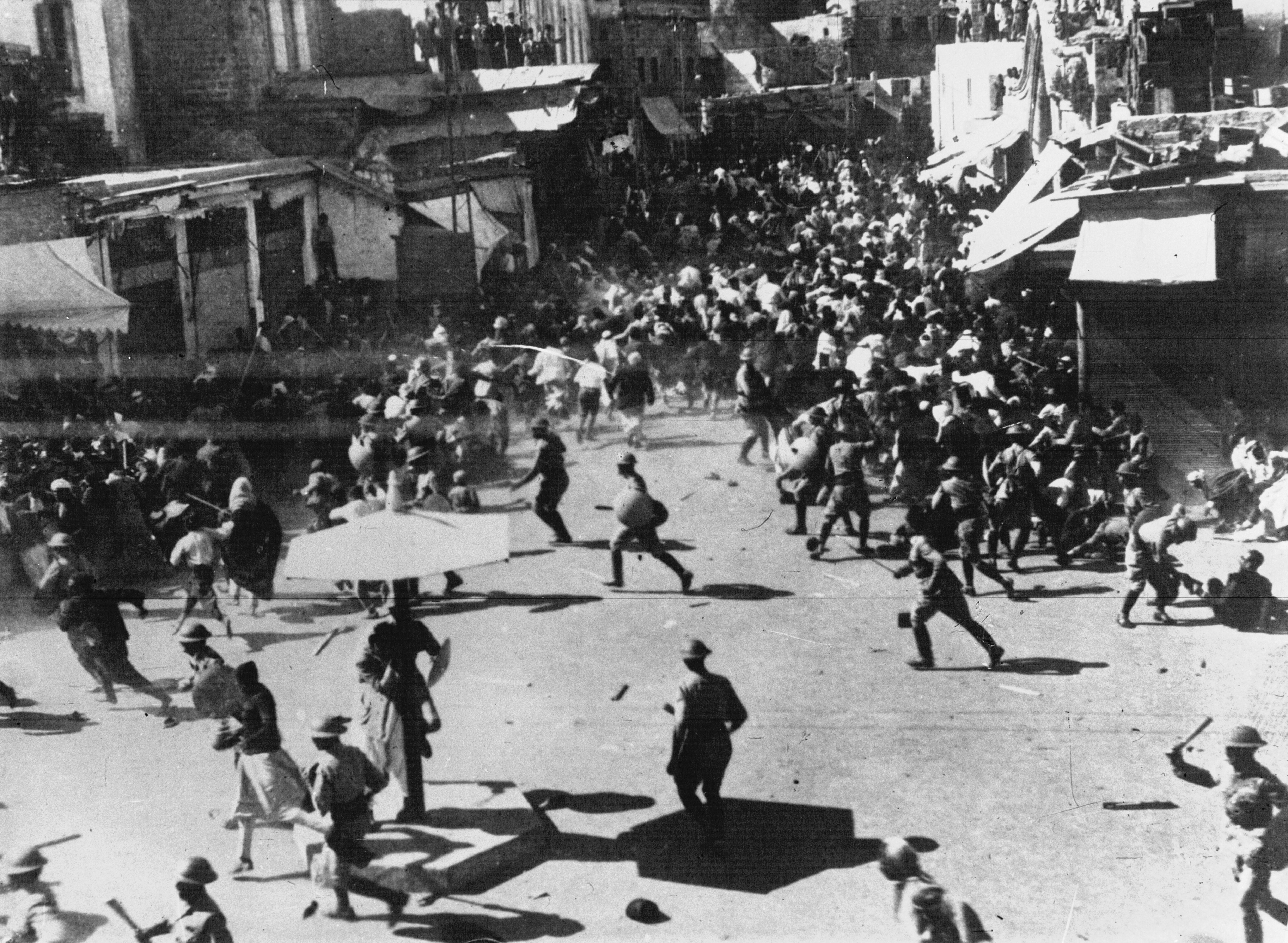
British policemen disperse an Arab mob during the Jaffa riots in April 1936 (The Illustrated London News)


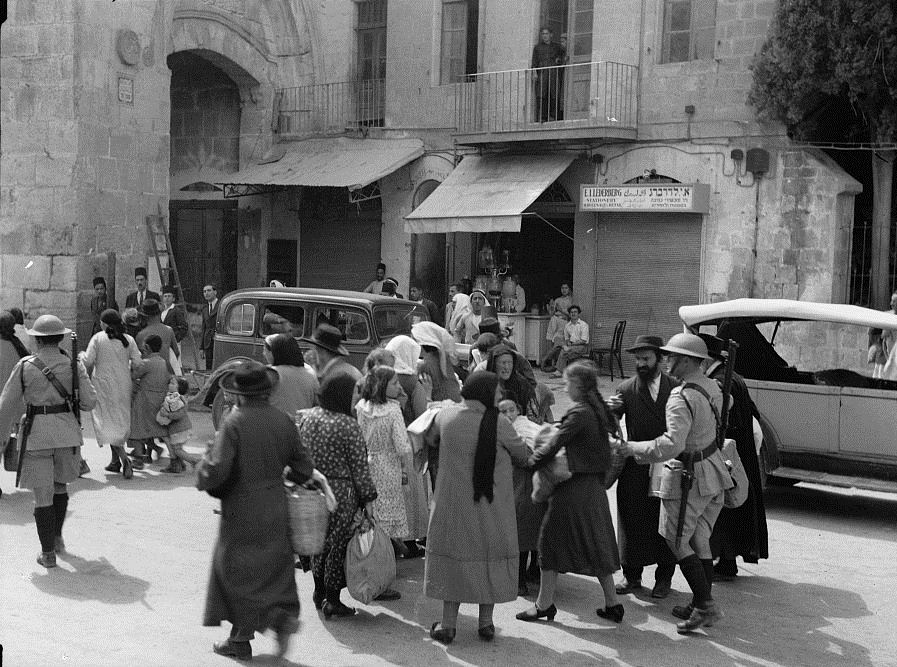
Jews evacuate the Old City of Jerusalem after Arab riots in 1936.

An interview with Oren Kessler

by Oren Kessler
 
 
3365748242
Great Arab Revolt, 1936-1939
A Popular Uprising Facing a Ruthless Repression
 
In 1936, widespread Palestinian dissatisfaction with Britain’s governance erupted into open rebellion. Several key dynamics and events can be seen as setting the stage for this uprising. In Palestine, as elsewhere, the 1930s had been a time of intense economic disruption. Rural Palestinians were hit hard by debt and dispossession, and such pressures were only exacerbated by British policies and Zionist imperatives of land purchases and “Hebrew labor.” Rural to urban migration swelled Haifa and Jaffa with poor Palestinians in search of work, and new attendant forms of political organizing emerged that emphasized youth, religion, class, and ideology over older elite-based structures. Meanwhile, rising anti-Semitism—especially its state-supported variant—in Europe led to an increase of Jewish immigration, legal and illegal, in Palestine.

Unsurprisingly, the combination of these various trends produced periodic upheavals, from the 1929 al-Buraq Uprising to multicity demonstrations in 1933 against the British Mandate. In October 1935, the discovery of a shipment of arms in the Jaffa port destined for the Haganah fueled Palestinian concerns that the Zionist movement was introducing the human and military resources necessary for its state-building project under the nose of the British. Meanwhile, the popular and populist Syrian Shaykh Izzeddin al-Qassam , who preached to the slum-dwelling rural transplants near Haifa’s rail yards and who had spent the early 1930s building a cell-based paramilitary network, was killed in a firefight with British forces in November 1935. Qassam’s funeral in Haifa elicited a mass outpouring of public outrage. These events are often seen as direct predecessors of the mass Palestinian uprising that took place in 1936.

The Great Palestinian Rebellion , or the Great Arab Revolt, as this uprising came to be known, lasted for three years and can be generally divided into three phases. The first phase lasted from the spring of 1936 to July 1937. With tensions throughout Palestine running high since the fall of 1935, the revolt was ignited in mid-April 1936 when followers of Qassam attacked a convoy of trucks between Nablus and Tulkarm , killing two Jewish drivers. The next day, the  Irgun killed two Palestinian workers near Petah Tikva , and in the following days, deadly disturbances ensued in Tel Aviv and Jaffa. In Nablus, an Arab National Committee was formed and a strike was called on 19 April. National Committees in other cities echoed the call to strike, and on 25 April the Arab Higher Committee (Lajna) (AHC) was formed, chaired by Haj Amin al-Husseini , to coordinate and support a nationwide general strike, which was launched on 8 May.

The strike was widely observed and brought commercial and economic activity in the Palestinian sector to a standstill. Meanwhile, Palestinians throughout the countryside came together in armed groups to attack—at first sporadically, but with increasing organization— British and Zionist targets. Some Arab volunteers joined the rebels from outside Palestine, though their numbers remained small in this period. The British employed various tactics in an attempt to break the strike and to quell the rural insurrection. The ranks of British and Jewish policemen swelled and Palestinians were subjected to house searches, night raids, beatings, imprisonment, torture, and deportation. Large areas of Jaffa’s Old City were demolished, and the British called in military reinforcements.

Concurrent with military operations and repressive measures, the British government dispatched a commission of inquiry headed by Lord Peel to investigate the root causes of the revolt. In October 1936, under the combined pressure of British policies, other Arab heads of state, and the effects of a six-month general strike on the Palestinian population, the AHC called off the strike and agreed to appear before the Peel Commission . A period of lower intensity conflict prevailed as the Peel Commission toured the country, but tensions continued to build in anticipation of the commission’s report. In July 1937, the Peel Commission published its report, recommending Palestine’s partition into Jewish and Arab states. Dismayed by this negation of their desires and demands, the Palestinian population relaunched their armed insurgency with renewed intensity, initiating the second phase of the revolt.

This second phase, lasting from July 1937 until the fall of 1938, witnessed significant gains by the Palestinian rebels. Large swaths of the hilly Palestinian interior, including for a time the Old City of Jerusalem , fell fully under rebel control. Rebels established institutions, most significantly courts and a postal service, to replace the British Mandate structures they sought to dismantle. The British, meanwhile, imposed even harsher measures to try to quash the revolt. The AHC and all Palestinian political parties were outlawed, political and community leaders were arrested, and a number of high-profile public figures exiled. The military aspects of counterinsurgency intensified, and British tanks, airplanes, and heavy artillery were deployed throughout Palestine. The British also meted out collective punishment: thousands of Palestinians were relegated to “detention camps”; residential quarters were destroyed; schools were closed; villages were collectively fined and forced to billet British troops and police. Zionist military institutions took advantage of the situation to build up their capacities with British support. By early 1939, members of the Jewish Settlement Police (about 14,000) were subsidized, uniformed, and armed by the British government as a thinly veiled front for the Haganah, and so-called Special Night Squads  comprising Jewish and British members launched “special operations” against Palestinian villages.

The third phase of the rebellion lasted roughly from the fall of 1938 to the summer of 1939. The British dispatched another commission of inquiry, this one headed by Sir John Woodhead , to examine the technical aspects of implementing partition. In November 1938, the Woodhead Commission report concluded that partition was not practicable, marking a certain British retreat from the Peel recommendation. At the same time, however, the British launched an all-out offensive: in 1939 more Palestinians were killed, more were executed (by hanging), and nearly twice as many were detained than in 1938. Such brutality placed immense pressure on the rebels, exacerbating rifts between the political leadership of the AHC exiled in Damascus and local leadership on the ground, between rebel bands and village populations that were expected to support and supply them, and ultimately between Palestinians who remained committed to the revolt and those willing to reach a compromise with the British. British-supported Palestinian “Peace Bands” were dispatched to battle their compatriots.

In May 1939, the British government published a new White Paperthat proposed the following: Britain’s obligations to the Jewish national home had been substantially fulfilled; indefinite mass Jewish immigration to and land acquisition in Palestine would contradict Britain’s obligations to the Palestinians; within the next five years, no more than 75,000 Jews would be allowed into the country, after which Jewish immigration would be subject to “Arab acquiescence”; land transfers would be permitted in certain areas, but restricted and prohibited in others, to protect Palestinians from landlessness; and an independent unitary state would be established after ten years, conditional on favorable Palestinian-Jewish relations.

The combined impact of Britain’s military and diplomatic efforts brought the rebellion to an end in the late summer of 1939. Over the revolt’s three years, some 5,000 Palestinians had been killed and nearly 15,000 wounded. The Palestinian leadership had been exiled, assassinated, imprisoned, and made to turn against one another. At the same time, the White Paper—despite its limitations—offered certain concessions to the rebels’ demands. Whatever gains Palestinians might have made through the revolt, however, were quickly overtaken by the larger geopolitical processes of World War II , and the combined British-Zionist assault on Palestinian political and social life during the revolt had a long-lasting impact.

 
Selected Bibliography:

Anderson, Charles W. “State of Formation from Below and the Great Revolt in Palestine.” Journal of Palestine Studies 47, no. 1 (Autumn 2017): 39-55.

Hughes, Matthew. “From Law and Order to Pacification: Britain’s Suppression of the 1936–1939 Arab Revolt in Palestine.” Journal of Palestine Studies 39, no.2 (Winter 2010): 6–22.

Kanafani, Ghassan. The 1936–39 Revolt in Palestine.

Shbeib, Samih. “Poetry of Rebellion: The Life, Verse and Death of Nuh Ibrahim during the 1936–39 Revolt.” Jerusalem Quarterly 25 (Winter 2006): 65–78.

Sufian, Sandy. “Anatomy of the 1936-39 Revolt: Images of the Body in Political Cartoons of Mandatory Palestine.” Journal of Palestine Studies 37, no.2 (Winter 2008):  23–42.

Swedenburg, Ted. Memories of Revolt: The 1936–1939 Rebellion and the Palestinian National Past. Fayetteville: University of Arkansas Press, 2003.

Britain says releasing a 1941 document about Palestine might ‘undermine security’

A two-part archive, labeled “Activities of the Grand Mufti of Jerusalem” and dated 1940-1941, sits in Britain’s National Archives in Kew. This writer successfully had the first part declassified in 2014. The second part remains sealed. My 2018 attempt to have these ten pages declassified was refused on the grounds that the archive might “undermine the security of the country [Britain] and its citizens.”[1] None of its secrets are to be available until January, 2042; and if the paired file is any precedent, even in 2042 it will be released only in redacted form.

The ‘Grand Mufti’ in the archive’s heading is Haj Amin al-Husseini, the Palestinian leader whom posterity best remembers for his alignment with the Italian and German fascists; and the years 1940-1941 place him not in Palestine, but in Iraq — and if the second archive extends to late 1941, in Europe. What could possibly be hidden in a World War II document about a long-dead Nazi sympathizer that would present such a risk to British national security eight decades later, that none of it can be revealed? At present, only the UK government censors know; but the answer may have less to do with the fascists and al-Husseini than with British misdeeds in Iraq, and less to do with Britain’s national security than with its historical embarrassment.

When in 1921 votes were cast for the new Mufti of Jerusalem, Amin al-Husseini came in last among the four candidates. But votes in Palestine mattered as little then as they do now, and the British, Palestine’s novice replacement occupiers for the Ottomans, handed the post to al-Husseini. At first, he proved to be an asset to the British. But as the years passed, his opposition to Zionism, support for Palestinian nationalism, and ultimately his involvement in the 1936 Palestinian uprising, led to calls for his arrest.

Photograph labelled 'Arab demonstrations on Oct. 13 and 27, 1933. In Jerusalem and Jaffa. Return of Grand Mufti from India. Met by hundreds of cars at Gethsemane, Nov. 17, 1933.'

“ARAB DEMONSTRATIONS ON OCT. 13 AND 27, 1933. IN JERUSALEM AND JAFFA. RETURN OF GRAND MUFTI FROM INDIA. MET BY HUNDREDS OF CARS AT GETHSEMANE, NOV. 17, 1933.” LIBRARY OF CONGRESS, LC-M33- 4218.

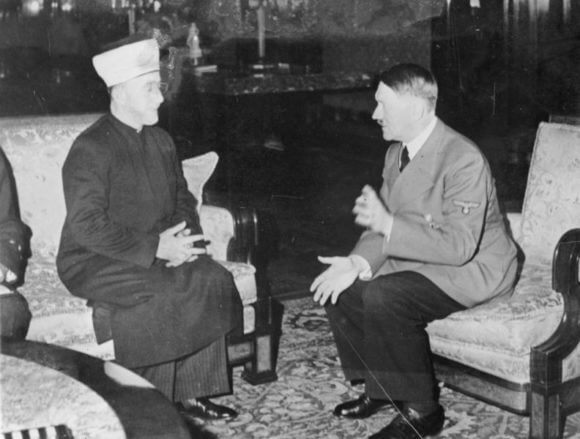
In mid-October of 1937, he fled from hiding in Palestine to Beirut. Two years later and six weeks after the outbreak of World War II, in mid-October of 1939, he slipped to Baghdad, where his sympathies for the Italian fascists further alarmed the British. Fast-forward another two years to late 1941, and al-Husseini is in Europe, meeting with Benito Mussolini on the 27th of October, and on the 28th of November meeting with the Führer himself at the Reich Chancellery in Berlin.

Al-Husseini’s motivation for embracing the Axis was likely a combination of selfish political opportunism and the belief that the alignment would help safeguard against the takeover of Palestine by the Zionists. The reasoning, however grotesque, was the same used by Lehi (the ‘Stern Gang’) in its own attempted collaboration with the fascists: Britain was the obstacle both to Palestinian liberation, and to unbridled Zionism, and for both the Mufti and Lehi, defeating that obstacle meant embracing its enemies. Even the ‘mainstream’ David Ben-Gurion had no moral qualms about taking advantage of Britain’s struggle against the Nazis — a struggle for which his Jewish Agency was already conspicuously unhelpful — by exploiting Britain’s post-war vulnerabilities.[2]

Posterity has treated Lehi’s and the Mufti’s flirtations with the fascists quite differently. Lehi, the most fanatical of the major Zionist terror organizations, was transformed into freedom fighters, and ex-Lehi leader Yitzhak Shamir was twice elected as Israeli Prime Minister. In contrast, Zionist leaders quickly seized on al-Husseini’s past to smear not just him, but the Palestinians as a people, as Nazis.

The use of al-Husseini’s unsavory history to ‘justify’ anti-Palestinian racism continues to the present day. Most bizarrely, in 2015 Israeli Prime Minister Benjamin Netanyahu claimed that Hitler had not intended to exterminate the Jews — that is, not until al-Husseini planted the words in his ear — which translates as “got the idea from the Palestinians”. A private citizen would likely have been arrested under German law for this attempt to rewrite the Holocaust.

The mufti of Jerusalem, Sayid Amin al Husseini, meets with Hitler, November 1941.

THE MUFTI OF JERUSALEM, SAYID AMIN AL HUSSEINI, MEETS WITH HITLER, NOVEMBER 1941.

Iraq won limited independence in 1932, just before the Nazis came to power. When the Mufti ensconced himself in Iraq seven years later, the country was under nominally ‘pro-British’ Prime Ministers, and Regent ‘Abd al-Ilah for the four-year-old king, Faisal II. This uneasy British-Iraqi equilibrium ended on first day of April 1941, when four Iraqi officers known as the Golden Square, wanting full independence (and similarly aligning themselves with the fascists in the foolish belief that doing so would help them get it), staged a coup d’état. It lasted two months. British troops ousted the coup on the first day of June — and as they did, anti-Jewish riots rocked Baghdad. An estimated 180 Jewish Iraqis were killed and 240 wounded in this pogrom known as the Farhud.

Why would the momentary power vacuum of the British takeover lead to anti-Jewish terror? While doing research for my 2016 book, State of Terror, I was intrigued by the claim of one Iraqi Jewish witness, Naeim Giladi, that these ‘Arab’ riots were orchestrated by the British to justify their return to power.[3] Indeed, the riots seemed unnatural in a society where Jews had lived for two and a half millennia, and the “pro-Axis” Golden Square takeover two months earlier had not precipitated any such pogrom. Yet it was also true that Zionism had created ethnic resentment, and Giladi did not question that junior officers of the Iraqi army were involved in the violence. The evidence provided by Giladi was compelling enough to seek out clues among British source documents that were not available to him.

And that, along with the hope of shedding new light on the Mufti’s pro-fascist activities, brought me to the archive at issue and my qualified (redacted) success in getting the first part declassified– officially titled, CO 733/420/19. Not surprisingly, much of the file focused on legitimate worry over the Mufti’s dealings with the Italian fascists. Some of the British voices recorded considered him to be a serious threat to the war effort, and a report entitled “Inside Information” spoke of the Mufti’s place in an alleged “German shadow government in Arabia”. Others dismissed this as “typical of the sort of stuff which literary refugees put into their memoirs in order to make them dramatic” and suggested that the Mufti’s influence was overstated.

Whatever the case, by October 1940, the Foreign Office was considering various methods for “putting an end to the Mufti’s intrigues with the Italians”, and by mid-November,

it was decided that the only really effective means of securing a control over him [the Mufti] would be a military occupation of Iraq.

British plans of a coup were no longer mere discussion, but a plan already in progress:

We may be able to clip the Mufti’s wings when we can get a new Government in Iraq. F.O. [Foreign Office] are working on this”.

So, the British were already working on re-occupying Iraq five months before the April 1941 ‘Golden Square’ coup.

A prominent thread of the archive was: How to effect a British coup without further alienating ‘the Arab world’ in the midst of the war, beyond what the empowering of Zionism had already done? Harold MacMichael, High Commissioner for Palestine, suggested the idea “that documents incriminating the Mufti have been found in Libya” that can be used to embarrass him among his followers; but others “felt some hesitation … knowing, as we should, there was no truth in the statement.”

But frustratingly, the trail stops in late 1940; to know anything conclusive we need the second part’s forbidden ten pages: CO 733/420/19/1.

The redacted first part partially supports, or at least does not challenge, Giladi’s claim. It proves that Britain was planning regime change and sought a pretext, but gives no hint as to whether ethnic violence was to be that pretext. Interestingly, Lehi had at the time reached the same conclusion as Giladi: its Communique claimed that “Churchill’s Government is responsible for the pogrom in Baghdad”.[4]

Does the public have the right to see still-secret archives such as CO 733/420/19/1? In this case, the gatekeepers claimed to be protecting us from the Forbidden Fruit of “curiosity”: They claimed to be distinguishing between “information that would benefit the public good”, and “information that would meet public curiosity”, and decided on our behalf that this archive fit the latter.[1] We are to believe that an eight-decade-old archive on an important issue remains sealed because it would merely satisfy our lust for salacious gossip.

Perhaps no assessment of past British manipulation in Iraq would have given pause to the Blair government before signing on to the US’s vastly more catastrophic Iraqi ‘regime change’ of 2003, promoted with none of 1940’s hesitation about using forged ‘African’ documents — this time around Niger, instead of Libya. But history has not even a chance of teaching us, if its lessons are kept hidden from the people themselves.

Note: According to Giladi, the riots of 1941 “gave the Zionists in Palestine a pretext to set up a Zionist underground in Iraq” that would culminate with the (proven) Israeli false-flag ‘terrorism’ that emptied most of Iraq’s Jewish population a decade later. Documents in Kew seen by the author support this. But to be sure, the Zionists were not connected with the alleged British maneuvers of 1941.

1. Correspondence from the UK government, explaining its refusal to allow me access to CO 733/420/19/1:

Section 23(1) (security bodies and security matters): We have considered whether the balance of the public interest favours releasing or withholding this information. After careful consideration, we have determined that the public interest in releasing the information you have requested is outweighed by the public interest in maintaining the exemption. It is in the public interest that our security agencies can operate effectively in the interests of the United Kingdom, without disclosing information that would assist those determined to undermine the security of the country and its citizens.

The judiciary differentiates between information that would benefit the public good and information that would meet public curiosity. It does not consider the latter to be a ‘public interest’ in favour of disclosure. In this case, disclosure would neither meaningfully improve transparency nor assist public debate, and disclosure would not therefore benefit the public good.

2. Ben-Gurion looked ahead to when the end of the war would leave Britain militarily weakened and geographically dispersed, and economically ruined. He cited the occupation of Vilna by the Poles after World War I as a precedent for the tactic. For him, the end of WWII only presented an opportunity for the takeover of Palestine with less physical resistance; it also left Britain at the mercy of the United States for economic relief, which the Jewish Agency exploited by pressuring US politicians to make that assistance contingent on supporting Zionist claims to Palestine. At a mid-December 1945 secret meeting of the Jewish Agency Executive, Ben-Gurion stressed that “our activities should be directed from Washington and not from London”, noting that “Jewish influence in America is powerful and able to cause damage to the interests of Great Britain”, as it “depends to a great extent on America economically” and would “not be able to ignore American pressure if we succeed in bringing this pressure to bear”. He lauded Rabbi Abba Silver in the US for his aggressiveness on the issue, while noting that he was nonetheless “a little fanatical and may go too far”. (TNA, FO 1093/508). The Irgun was more direct in 1946, stating that Britain’s commuting of two terrorists’ death sentences and other accommodations to the Zionists “has been done with the sole purpose to calm American opposition against the American loan to Britain”. (TNA, KV 5-36). Meanwhile, in the US that year Rabbi Silver’s bluntness on the tactic worried Moshe Shertok (a future prime minister). Although like Ben-Gurion, Shertok said that “we shall exploit to the maximum the American pressure on the British Government”, in particular the pre-election period (and in particular New York), but urged “care and wisdom in this” so as not to give ammunition to “anti-Zionists and the anti-semites in general”. Shertok criticized Silver for saying publicly that “he and his supporters opposed the loan to be granted to the British Government”. (TNA, CO 537/1715)

3. Suárez, Thomas, State of Terror: How Terrorism Created Modern Israel[Skyscraper, 2016, and Interlink, 2017]; In Arabic, هكذا أقيمت المستعمرة [Kuwait, 2018]; in French, Comment le terrorisme a créé Israël[Investig’Action, 2019]
Giladi, Naeim, Ben-Gurion’s Scandals: How the Haganah and the Mossad Eliminated Jews [Dandelion, 2006]

4. Lehi, Communique, No. 21/41, dated 1st of August 1941

Update: This post originally referred to the “four-year-old Prime Minister, ‘Abd al-Ilah,” not the four-year-old King Faisal under Regent ‘Abd al-Ilah. Commenter Jon S. corrected us, and the post has been changed.

The day the Mufti died 

Yes, Hajj Amin al-Husayni collaborated with the Nazis, but that’s not why he was dropped from the Palestinian narrative 

Martin Kramer, Times of Israel Blogs, July 5, 202

Please note that the posts on The Blogs are contributed by third parties. The opinions, facts and any media content in them are presented solely by the authors, and neither The Times of Israel nor its partners assume any responsibility for them. Please contact us in case of abuse. In case of abuse,

“To His Eminence the Grand Mufti as a memento. H. Himmler. July 4, 1943.” Israel State Archives.

Fifty years ago, on July 4, 1974, Hajj Amin al-Husayni, the “Grand Mufti” of Jerusalem, passed away in Beirut, Lebanon, at the American University Hospital. At age 79, he died of natural causes. The Mufti had faded from the headlines a decade earlier. In 1961, his name had resurfaced numerous times during the Jerusalem trial of Adolf Eichmann. But a couple of years later, the Palestinian cause gained a new face in Yasser Arafat. With that, the Mufti entered his final eclipse.

When he died, the Supreme Muslim Council in Jerusalem asked the Israeli authorities for permission to bury him in the city. Israel refused the request. Any Palestinian who wanted to attend the funeral in Lebanon would be allowed to do so, but the Mufti of Jerusalem would not be buried in Jerusalem. Instead, the Mufti was laid to rest in the Palestinian “Martyrs’ Cemetery” in Beirut.

The Mufti was appointed to his position by the British in 1921. Within the British Empire, authorities preferred to work through “native” institutions, even if they had to create them on the fly. So they established a supreme council for Palestine’s Muslims and placed the Mufti at its helm. Although he lacked religious qualifications, he came from a leading family and appeared capable of striking deals.

In fact, he used his position to oppose the Jewish “National Home” policy of the Mandate. The “Arab Revolt” of 1936 finally convinced the British that he had to go, and in 1937 he fled the country.

After a period in Lebanon, he ended up in Iraq, where he helped foment a coup against the pro-British regime. When British forces suppressed the coup, he fled again, making his way through Tehran and Rome to Berlin. There, the Nazi regime used him to stir up Arabs and Muslims against the Allies. He was photographed with Hitler and Himmler, recruited Muslims to fight for the Axis, and attempted to secure promises of independence for colonized Arabs and Muslims. None of his efforts met with much success. His role, if any, in the Holocaust is a contested matter. Hitler and his henchmen hardly needed any prompting to execute their genocidal plans. Clearly, though, the Mufti rooted for Jewish destruction from the fifty-yard line.

After the Nazi collapse, he fell into French hands and spent a year in comfortable house detention near Paris. Later, he fled to Egypt and subsequently moved in and out of Syria and Lebanon. Following the Arab debacle of 1948, Egypt established an “All Palestine Government” in the refugee-choked Gaza Strip, leaving the presidency open for the Mufti. It didn’t last long. He continued to maneuver through Arab politics, but he was yesterday’s man to a new generation of Palestinians born in exile. During the Eichmann trial, the prosecution sought to implicate the Mufti as an accomplice. Yet the Mossad never came after him, and he didn’t die a martyr’s death.

Man without a country

The Mufti was a formidable politician. In 1951, a State Department-CIA profile of him opened with this evocative enumeration of his many talents, which is worth quoting at length:

King of no country, having no army, exiled, forever poised for flight from one country to another in disguise, he has survived because of his remarkable ability to play the British against the French, the French against the British, and the Americans against both; and also because he has become a symbol among the Arabs for defending them against the Zionists. His suave penchant for intrigue, his delicate manipulation of one Arab faction against another, combined with the popularity of his slogan of a united Muslim world, has made him a symbol and a force in the Middle East that is difficult to cope with and well nigh impossible to destroy. The names of Machiavelli, Richelieu, and Metternich come to mind to describe him, yet none of these apply. Alone, without a state, he plays an international game on behalf of his fellow Muslims. That they are ungrateful, unprepared, and divided by complex and innumerable schisms, does not deter him from his dream. 

Profilers would later write similar things about Arafat, but the Mufti had none of Arafat’s cultivated dishevelment. He was manicured, even chic:

The Mufti is a man of striking appearance. Vigorous, erect, and proud, like a number of Palestinian Arabs he has pink-white skin and blue eyes. His hair and beard, formerly a foxy red, is now grey. He always wears an ankle length black robe and a tarbush wound with a spotless turban. Part of his charm lies in his deep Oriental courtesy; he sees a visitor not only to the door, but to the gate as well, and speeds him on his way with blessings. Another of his assets is his well-modulated voice and his cultured Arabic vocabulary. He can both preach and argue effectively, and is well versed in all the problems of Islam and Arab nationalism. His mystical devotion to his cause, which is indivisibly bound up with his personal and family aggrandizement, has been unflagging, and he has never deviated from his theme. For his numerous illiterate followers, such political consistency and simplicity has its advantages. The Mufti has always known well how to exploit Muslim hatred of ‘infidel’ rule. 

So why did the Mufti fade into obscurity? (By 1951, he was on his way out.) Many mistakenly believe his collaboration with Hitler and the Nazis discredited him. It didn’t. Not only did the Arabs not care, but Western governments eyed the Mufti with self-interest. The general view in foreign ministries held that he had picked the wrong side in the war, but not more than that.

The above-quoted American report expressed this view perfectly: “While the Zionists consider him slightly worse than Mephistopheles and have used him as a symbol of Nazism, this is false. He cared nothing about Nazism and did not work well with Germans. He regarded them merely as instruments to be used for his own aims.” If so, why not open a discreet line to him and let him roam the world unimpeded?

Nakba stigma

What finally discredited the Mufti in Arab opinion, where it mattered most, was his role in the 1948 war. It was a war he wanted and believed his side would win. In late 1947, the British sent someone to see if there might be some behind-the-scenes flexibility in his stance on partition, which he had completely rejected. There wasn’t. He explained:

As regards the withdrawal of British troops from Palestine, we would not mind. We do not fear the Jews, their Stern, Irgun, Haganah. We might lose at first. We would have many losses, but in the end we must win. Remember Mussolini, who talked of 8,000,000 bayonets, who bluffed the world that he had turned the macaronis back into Romans. For 21 years he made this bluff, and what happened when his Romans were put to the test? They crumbled into nothing. So with the Zionists. They will eventually crumble into nothing, and we do not fear the result, unless of course Britain or America or some other Great Power intervenes. Even then we shall fight and the Arab world will be perpetually hostile. Nor do we want you to substitute American or United Nations troops for the British. That would be even worse. We want no foreign troops. Leave us to fight it out ourselves. 

This underestimation of the Zionists proved disastrous, even more so than his overestimation of the Axis. He later wrote his memoirs, blaming “imperialist” intervention, Arab internal divisions, and world Zionist mind-control for the 1948 defeat. To no avail: his name became inseparable from the Nakba, the loss of Arab Palestine to the Jews. His reputation hit rock bottom, along with that of the other failed Arab rulers of 1948.

Upon his death in 1974, he received a grand sendoff in Beirut from the PLO. In 1970, Arafat had transferred the PLO headquarters from Jordan to Lebanon, and the funeral finalized his status as the sole leader of the Palestinian people. Four months later, Arafat addressed the world from the podium of the UN General Assembly, achieving an international legitimacy that the Mufti could never have imagined.

The PLO then dropped the Mufti from the Palestinian narrative; nothing bears his name. Even Hamas, which inherited his uncompromising rigidity and Jew-hatred, doesn’t include him in their pantheon. (Their man is Izz al-Din al-Qassam, a firebrand “martyr” killed by the British in 1935.)

If anyone still dwells on the Mufti, it’s the Israelis, including their current prime minister, who find him useful as a supposed link between the Palestinian cause and Nazism. One can understand Palestinians who push back on this; the Mufti was no Eichmann. But that doesn’t excuse Palestinian reluctance to wrestle candidly with the Mufti’s legacy. He personified the refusal to see Israel as it is and an unwillingness to imagine a compromise. Until Palestinians exorcise his ghost, it will continue to haunt them.


Flight into Egypt, and the promise of the hereafter

Mainstream and social media are perennially focused on the plight of Palestinian civilians caught in the crossfire between the IDF and the Hamas terrorists embedded amongst and below them with total disregard for their safety and welfare. Negligible attention is paid to what is not in plain sight.

There have recently been reports of Israel endeavouring to recruit influential families and clans in Gaza who traditionally wield social and economic authority at the grassroots level and are often unaligned with groups such as Hamas and Islamic Jihad, to manage the distribution of humanitarian aid and ostensibly to form the nucleus of a future administration once the present hostilities cease. There have also been reports of Hamas operatives reacting violently against those believed to be assisting and indeed organizing the distribution of aid – including attacks on convoys that they are guarding, and the murder of such collaborators and of members of the Palestinian Authority who have also been co-opted to assist. Many may not recall in this febrile political environment that the Hamas and the PA have been mortal enemies for

There are also reports of members of elite families and the well-off paying their way out of Gaza into Egypt via the Rafah crossing, transits that are believed to cost many thousands of dollars to fixers with the appropriate connections.

Left-wing Israeli platform Haaretz reports that one of the recurring stories of the Israel-Gaza war has been the exorbitant fees being charged by Egyptian fixers to get Palestinians through the Rafah border crossing into Sinai. A report last month claimed that one Egyptian travel company has generated nearly $90 million in a few weeks by charging the desperate over $5,000 to leave the Strip. Gazans on social media have grown increasingly critical of the practice, which shows no sign of abating for those able to raise the hefty fees required to leave the war behind.

Many less  well-off Palestinians have resorted to trying to raise money with desperate appeals on digital platforms such as GoFundMe. Over the past eight months, an estimated 100,000 people have left Gaza, Diab al-Louh, the Palestinian ambassador to Egypt, said in an interview. Though some got out through connections to foreign organisations or governments, for many Palestinians, exiting Gaza is possible only by way of Hala, a firm that appears to be closely connected to the Egyptian government. Hala charges $US5000 to co-ordinate the exits of most people 16 and older and $US2500 for most who are below that age, according to seven people who have gone through this process or tried to do so.

Other pathways out of Gaza exist, but many of them require large payments, too. One route is to pay unofficial middlemen in the enclave or in Egypt, who demand $US8000 ($12,000) to $US15,000 per person in exchange for arranging their departure within days, according to four Palestinians who had either made the payments or had tried to.

Palestinians connected to international organisations and governments, holders of foreign passports or visas, wounded people and some students enrolled in universities outside Gaza have been able to leave without paying large fees, but most of the more than 2 million people in the enclave do not fall into those categories.

Now the future of that avenue is uncertain, especially after the Israeli military launched an offensive against Hamas in Rafah and took over the crossing there, leading to its closure in May. No Palestinians have been allowed to pass through it since, and it is unclear when it will reopen.

That such stories are largely disseminated by Israeli media may lead outside observers unsympathetic to Israel to dismiss them as hasbara, derived from the  Hebrew for explaining, but interpreted by many, particularly the lazy, as public diplomacy propaganda, public relations or spin. But to people with a deeper knowledge of Israeli and Palestinian history, politics, and society, and of the Middle East generally, they are potentially quite credible.

I personally surmised as much when the Australian authorities recently cancelled the visas of several Gaza residents whilst they were in transit from Cairo to Australia – much to the outrage of pro-Palestinian activists and NGOs down under. Our Department of Home Affairs intimated that the rushed visa assessment process raised questions of how the travelers in question had exited Gaza, not just through Egyptian and Hamas controlled checkpoints, but also underneath the border via the so-cheeked Gaza “metro”. These families were clearly well-turned out and well-nourished, looking nothing like the bloodied, hungry and traumatized souls we are seeing daily on our television and social media feeds. Straddling the fence between support for and condemnation of Israel, and running scared of pro-Palestinian public opinion, the Australian government let this matter go.

Haaretz reports that one of the recurring stories of the Israel-Gaza war has been the exorbitant fees being charged by Egyptian fixers to get Palestinians through the Rafah border crossing into Sinai. A report last month claimed that one Egyptian travel company has generated nearly $90 million in a few weeks by charging the desperate over $5,000 to leave the Strip. Gazans on social media have grown increasingly critical of the practice, which shows no sign of abating for those able to raise the hefty fees required to leave the war behind.

The “flight into Egypt” is actually the primary story of the long Haaretz article published below despite its catchy, sensationalist and potentially contentious title which refers to the “Promise of the Hereafter Post-Liberation Palestine” conference, held in Gaza on September 20, 2021, a gathering that has only now, in the wake of the Shabbat pogrom on October 7, received a modicum of media attention.

The promise of the hereafter 

This conference was sponsored by the Hamas’ leader in Gaza Yahyah Al-Sinwar and attended by senior officials from Hamas and other Palestinian factions. It discussed preparations for the future administration of the state of Palestine following its “liberation” from Israel after the latter “disappears”.

It is, in essence, a kind of Lebensraum Redux.

Though reported in October 2021 by the Israel-aligned Middle East Media Research Institute (MEMRI), the conference did not attract mainstream and social media interest at the time. Even after October 7, it has received little coverage, with the exception of Israeli media including Haaretz and Times of Israel – presumably because it might have seemed to some as elaborate hasbara. The neglect is nonetheless surprising considering its clear exposition of  the Islamist, genocidal intent of the Hamas and Islamic Jihad,  and accords with view held by many knowledgeable and well-informed observers and commentators that the original intent of Operation Al Aqsa Flood was to race en masse across the Negev to the Occupied Territories and spark a general Palestinian rising which would precipitate an invasion of Israel by its Arab neighbours – a repeat of 1948 without its al Nakba outcome.

We’ll probably never really know why this scenario was not followed through, and what may have been the outcome. Some may argue that the militants who descended on the borderland kibbutzes and the Nova Trance Festival were distracted by the release of pent-up rage and brutal vengeance after years of siege in Gaza.

The conference’s concluding statement made clear the Resistance’s understanding of “from the river to the sea”  and also its Islamist mission. Its very name originates in Quran 17:104: “And We said thereafter unto the Children of Israel, ‘Dwell in the land. And when the promise of the Hereafter comes to pass, We shall bring you as a mixed assembly”.

It claimed as its historical pedigree Muslim victories in the past – over Christians, not Jews, mind – and proposes  what appears to be a “back to the future” plan for “the day after“. The following extract is taken from MEMRI’s report on the event:

“Immediately after the liberation, the liberation forces will issue a Palestinian independence document setting out the Palestinian principles, highlighting the Palestinian national identity and its Arab, Islamic, regional and international depth. The formulation of this document will be overseen by a team of experts in the spheres of politics, law and media, for this will be a historic document on the legal and humanitarian levels, a direct continuation of the Pact of ‘Umar Bin Al-Khattab and of the announcement issued by Salah Al-Din upon his liberation of the Al-Aqsa Mosque [in 1187].

The conference published a concluding statement listing “ideas and methods of operation [to be implemented] during the liberation of Palestine” after Israel ceases to exist. This list included, inter alia, a call for drafting a document of independence that will be “a direct continuation of the Pact of ‘Umar Bin Al-Khattab” concerning Byzantine Jerusalem’s surrender to the Muslim conquerors which took place apparently in 638; a definition of the leadership of the state until elections are held; recommendations for engagement with the international community and the neighboring states; a call for preparing in advance appropriate legislation for the transition to the new regime; a call for establishing apparatuses to ensure the continuation of economic activity once the Israeli shekel is no longer in use and to preserve the resources that previously belonged to Israel; and a call for compiling a guide for resettling the Palestinian refugees who wish to return to Palestine.

The conference also recommended that rules be drawn up for dealing with “Jews” in the country, including defining which of them will be killed or subjected to legal prosecution and which will be allowed to leave or to remain and be integrated into the new state. It also called for preventing a brain drain of Jewish professionals, and for the retention of “educated Jews and experts in the areas of medicine, engineering, technology, and civilian and military industry… [who] should not be allowed to leave.” Additionally, it recommended obtaining lists of “the agents of the occupation in Palestine, in the region, and [throughout] the world, and… the names of the recruiters, Jewish and non-Jewish, in the country and abroad” in order to “purge Palestine and the Arab and Islamic homeland of the hypocrite scum”.

Read the complete MEMRI  report HERE. It is republished in full after the following Haaretz article.

A former high-ranking Fatah member from Gaza who was well acquainted with the Hamas leadership recently spoke to Haaretz about another aspect of Hamas’s scheme for the “day after,” namely the administrative division of “liberated Palestine” into cantons. He said he was contacted by a well-known Hamas figure who informed him that Hamas was “preparing a full list of committee heads for the cantons that will be created in Palestine.” In 2021, he was reportedly offered the chairmanship of the “Zarnuqa” committee, named after the Arab village where his family lived before 1948, that was slated to cover the cities of Ramle and Rehovot.

The Fatah official reportedly reacted to the Hamas offer in disbelief: “You’re out of your minds.”

The Middle East Media Research Institute (MEMRI), officially the Middle East Media and Research Institute, is an American non-profit press monitoring and analysis organization that was co-founded by Israeli ex-intelligence officer Yigal Carmon and Israeli-American political scientist Meyrav Wurmser in 1997. It publishes and distributes free copies of media reports that have been translated into English—primarily from Arabic and Persian, but also from Urdu, Turkish, Pashto, and Russian.

Critics describe MEMRI as a strongly pro-Israel advocacy group that, in spite of describing itself as being “independent” and “non-partisan” in nature, aims to portray the Arab world and the Muslim world in a negative light by producing and disseminating incomplete or inaccurate translations of the original versions of the media reports that it re-publishes.[9][10] It has also been accused of selectively focusing on the views of Islamic extremists while de-emphasizing or ignoring mainstream opinions.

https://www.memri.org/reports/hamas-sponsored-promise-hereafter-conference-phase-following-liberation-palestine-and

For more on Israel and Palestine in In That Howling Infinite, see Middle East Miscellany. See alsoTotal war in an urban landscape – Israel’s military quandary, and The Calculus of Carnage – the mathematics of Muslim on Muslim mortality

Hamas believed it would conquer Israel. In preparation, it divided it into cantons

Tens of thousands of Gazans have fled to Egypt since the war broke out, many of them members of the elite who are able to pay the enormous costs. I met old friends in Cairo who were still astonished at the messianic insanity that seized Hamas’ leadership.

Shlomi Eldar,

CAIRO – In Gaza, they’re known as the “new Jews.” They’re the rich merchants of the Gaza Strip who were the first to flee for their lives after October 7, managed to save themselves and their families, and are continuing to run their businesses safely by remote. While enjoying the good life in Cairo’s luxury hotels, they’re selling the Strip to the highest bidders. When a kilogram of sugar costs 70 shekels (almost $19) and a liter of gas 150 shekels, it’s only natural for the 1.5 million internal refugees in Gaza to add the profiteers to their list of enemies, after Israel and Hamas. Not necessarily in that order.

Escaping the inferno costs around $10,000 per person. It entails finding a wakil (Arabic for “macher”) who can organize entry to Egypt via the Rafah crossing, and getting there safely, hoping that you don’t run into the Israeli army on the way. Having done that, there’s a chance that the gates of paradise to the Land of the Nile will open wide for you. But that doesn’t yet ensure tranquility and security. Cairo is very cheap, by almost any measure, but it’s still expensive in terms of the Gaza Strip. And with no income, and your home in ruins, your property lost, your savings depleted from paying for the exit permits – what future, exactly, is there to dream about? Only a successful Gaza merchant who is adept at maneuvering and surviving between Hamas and Israel will be able to live in Cairo and enjoy its delights. And the city has plenty to offer.

The last time I was in Cairo was after the removal from power of Hosni Mubarak, in 2011. The city was turbulent and frightening. The millions of angry demonstrators who flooded the streets were a third way, beyond the corruption of the Mubarak regime and the fundamentalist takeover of the Muslim Brotherhood led by Mohammed Morsi. That ended with the Egyptian army taking matters into its hands and stifling the breezes of the Arab Spring. Today, photographs of President Abdel Fattah al-Sissi are ubiquitous in Cairo, but they are smaller and more modest than the likenesses of the ousted omnipotent president, who died a pariah.
Cairo has gone back to being a city that never stops, even during Ramadan. The appalling poverty and ostentatious wealth fuse into a bustling urban patchwork of vast shopping malls, narrow alleys, bicyclers precariously carrying sacks of food on their head as they ride, dangerously overloaded pickup trucks swaying to and fro, and packed minibuses carrying the dwellers of this dense city of 10 million through the congested streets.

It’s easy to get lost and disappear here, and that is exactly what thousands of Gazans who fled from the war are trying to do. Their hope is to stay under the radar until they can start a new life in some corner of the world that will agree to accept them. It’s clear to them that they will not be able to stay in Egypt indefinitely. Egypt is hosting them, legally, until things settle down, but it’s not an easy place for foreigners, certainly not for Palestinians.

I flew to Cairo to meet Gazans who fled from the war, some of them old friends from the years when I worked in the Gaza Strip – though not all of them were willing to meet with me. I began by calling S., the brother of my former late cameraman, who died of cancer a year and a half ago. S. was evasive and I couldn’t understand why. After all, I had often stayed in the family home when I was covering the second intifada for Israeli television. On the day of the coup led by Hamas in the Strip in 2007, when armed militants from the Iz al-Din al-Qassam Brigades tried to apprehend my colleague, I saved his life by getting him out of Gaza to Ramallah, in the West Bank. S.’s nephew Amjad explained to me now that S.’s daughter had been killed by an Israeli bomb; besides which, he didn’t want problems with the Egyptians. “It wouldn’t have been easy for him to tell you,” Amjad said apologetically and asked me to forgive S. I understood.

Arriving in Cairo around midday on a Friday, I made my way to the area around the Intercontinental Hotel where many of Gaza’s leading merchants are staying. It’s an extensive complex of structures that include luxury hotels and an immense mall – 10 floors of outlets carrying the world’s top labels and brands. Many young Gazans can be seen here riding the escalators up and down, some carrying bags stuffed with purchases, others just feasting their eyes on the shop windows and trying to digest the disparity between Gaza and Cairo, between a place where death lurks around every corner, and the place that signifies, perhaps, what Gaza could be if its leaders implemented just a fraction of the fantasies that they promised would materialize after the Oslo Accords were signed.

One of the big dreamers from the Oslo period is Sufyan Abu Zaydeh. How ironic it is that the man who dreamed that a Palestinian state would be established alongside Israel is now living in a gated neighborhood called Dreamland, which is about an hour’s drive from the center of Cairo and generations from Palestine Square in Gaza City.

Abu Zaydeh, who’s 64, was one of the first Palestinians to be released from Israeli incarceration following the White House ceremony in 1993. In short order he became something of a Palestinian media star among Israelis, analyzing on local television, in his fluent Hebrew, the complex situation that characterized the period after Oslo. Now, too, he quickly became something of a star on Egyptian TV. Back then he provided a running commentary on a collapsing peace process; today he’s doing the same for a war.

In a taxi on the way to meet him, I passed Ain Shams University, where Sheikh Ahmed Yassin was a student in the mid-1960s and where he hooked up with the Muslim Brotherhood, two decades before he founded Hamas. Along the way we also went by Al-Azhar University, the Muslim world’s most important academic center, which to this day turns out the religious sages shaping modern Islam, and which drove a wedge between the moderate Muslim world and fundamentalist Islam.

Not far from there is the stadium in which President Anwar Sadat was assassinated on October 6, 1981. Indeed, the month of October shouts from every corner of Cairo. For an Israeli, that shout resonates even more powerfully. The debacle and trauma of the Yom Kippur War blend into the trauma of a new, accursed October.

Sufyan Abu Zaydeh, at home in Cairo. His house in Gaza became the Israel Defense Forces’ headquarters in the Jabalya area.Credit: Shlomi Eldar

Wearing slippers, Abu Zaydeh was waiting for me on the shoulder of a side road in his neighborhood, a gated and guarded community of tall, desert-hued buildings. We hadn’t met in person since 2001, the period of the second intifada, and even then the encounter had been in England, where he was a doctoral student. As I stepped out of the cab, we both burst into liberating laughter at the vagaries of fate that have brought us together in different regions of the world.

“When I was released from your [Israel’s] prison in 1993, I was certain that the suffering and pain were over, that – enough – we were starting a life of quiet, peace and hope,” he said with a smile. “But since then I have known only wars. All the time, wars.”

Abu Zaydeh spent time studying Israeli history at Sapir College in Sderot, obtained a doctoral degree in England, and in 2005 was appointed minister of prisoner affairs in the Palestinian Authority. In 2006, he was abducted from his home by the Iz al-Din al-Qassam Brigades, and afterward was persecuted by Palestinian President Mahmoud Abbas, because he was considered loyal to Abbas’ rival, Mohammed Dahlan. Abbas deprived him of his salary and seized his pension and his house in Ramallah. In 2019, Abu Zaydeh was compelled to return to the Gaza Strip, from which he had fled after Hamas’ coup. He lived in Jabalya refugee camp in a closed enclave ruled by Yahya Sinwar‘s gang. “And when I thought I’d already endured everything,” he said, “the war broke out and I became a refugee again.”

He met with Sinwar on many occasions. Their talks, he says, dealt mainly with the economic aid, consisting of funds from the United Arab Emirates, that Dahlan – who himself went into exile in Abu Dhabi in 2011, where he became close to the ruler, Mohammed bin Zayed al Nahyan – sent to the inhabitants of Gaza, principally for projects in the Jabalya and Khan Yunis refugee camps. “We founded many projects and awarded study scholarships totaling millions of dollars to young people,” Abu Zaydeh says. “Hamas had a vested interest in this, because in practice we made things easier for them. That’s the reason they didn’t harass us.”

Not able to hold back, I said, “In other words, you were like [Israeli Prime Minister Benjamin] Netanyahu, who channeled Qatari money to Hamas that helped them build tunnels and establish an army? You also wanted quiet and got smacked in the face.”

But unlike Netanyahu, Abu Zaydeh does not shrink from taking responsibility. He admits his mistake and explains that the Dahlan group wanted to alleviate the distress in Gaza, because they saw themselves as being responsible for their people. They too believed that Hamas was aiming to arrive at a modus vivendi with Israel, and their ambition was to have as many Gazans as possible work in Israel.
On the morning of October 7, when he saw dozens of rockets being fired from the Strip, he thought that Israel had assassinated a top figure in Hamas and that this was the response. But when he saw a military jeep go by his home, and understood that it was carrying a woman abducted from Israel, and saw how dozens of jubilant local residents surrounded – he grasped the intensity of the storm that was about to engulf all of the Gaza Strip. “I knew that Gaza was finished. Gaza was on the road to perdition.”

A compulsive consumer of the Israeli media, Abu Zaydeh is well acquainted with the outlook of the public and the leadership. “I told my wife that the Israelis were going to run over us with tanks and that they would destroy everything. ‘All these tall buildings that you see around you,’ I told her, ‘the Israelis will topple them. One after the other. They will level all of Gaza.'”

Which is indeed what happened. The buildings are gone. Abu Zaydeh’s house became the Israel Defense Forces’ headquarters in the Jabalya area.

On the basis of his experience, observing previous IDF operations, he expected the army to split the Strip into two parts, and that if he did not move fast to leave the north, he would not make it to the Rafah crossing and get his family out. His primary concern was for the life of his daughter and her infant son: They had arrived from Boston for a visit a few days earlier and now were caught on the battlefield.

Only holders of Palestinian passports were being allowed to leave via Rafah, but his American-born grandson didn’t have a local passport. By the time his exit was arranged, the crossing to the south had been closed. But the Abu Zaydeh family hadn’t waited, having arrived at Rafah before the IDF blocked the passage from north to south.
“I had tears in my eyes,” Abu Zaydeh recalls. “I knew I would never return to that place.”

Sufyan Abu Zaydeh in his prison cell in 1993. He was one of the first Palestinians to be released from Israeli incarceration following the signing of the Oslo Accords.Credit: Courtesy of Kan

He was born in Jabalya, as were his children. At the beginning of the 1980s, he was imprisoned in Israel for his membership in Fatah. After his release, he returned to the alleyways of the refugee camp, determined to be a Palestinian leader who would change the world. And when he fled to Ramallah for fear of Hamas, the home in Jabalya remained the object of his longing.

“I didn’t cry only for the house,” he says. “I cried for the dreams that had vanished. For the state that would not be established, for the children who would die for no reason. I had many dreams and hopes – and nothing remains of them. Everything collapsed, together with my house.”

He took a few items, some clothes, photographs and keepsakes, all in one small suitcase for the family. As they entered the car, they still saw happy people around them. “I saw that they were pleased. I saw them and I told my wife that we were headed for perdition.”

I asked him whether he understood the jubilant shouts of many Palestinians when they saw the captives who were brought triumphantly into Gaza.

Not for a moment did he try to defend their reaction. “You can write it in capital letters,” he said. “From my point of view, it’s a disgrace.” He raised his voice so I would not miss his determination. “I, as a Palestinian, say to you in a loud voice: It is a disgrace. I am ashamed that they murdered and abducted people – children, women, old people. I am ashamed. That is not heroism. Absolutely not heroism.”

In the first two days of the war, he recalls, he heard even Hamas figures say that the civilians should be released. “If there was a little sense, the Israelis could have got back the women, the elderly and the children for free. I tell you this with certainty. From knowledge. But Israel thought that pressure would lead to the release of the captives. They didn’t understand what Hamas is.

“But again I say, and I am not afraid to say it: To kill civilians and to abduct women, old people and children is not heroism. And I tell you this as a Palestinian who knows that there are now 32,000 killed and at least 10,000 buried under the rubble. Ten people were killed in my family alone. Nine had nothing to do with Hamas, including a cousin and a nephew. They went to look for food and a missile was fired at them.”

Abu Zaydeh has never been one who feared to utter what he thinks, and from the time we first met, in 1993, I found that he could be unsparingly critical of both the Israelis and the Palestinians. He sometimes paid a price for that attitude. In 1996, after Israel assassinated Yahya Ayyash, the Hamas bombmaker nicknamed “The Engineer,” Abu Zaydeh told Israeli state television that the timing was wrong – not the act itself. (During the two months that followed the killing of Ayyash, Hamas carried out four suicide bombings in Israel, killing a total of 78 people.)

“I understand the Israeli response,” he says about the current, unprecedented round of violence. “I knew there would be a response. But I didn’t believe there would be a response of this cruelty. To kill Ahmed Andor you destroy a whole neighborhood? Have you gone mad?”

Andor was Hamas’ northern Gaza brigade commander, and the man in charge of developing the military wing’s rocket arsenal. On November 16, the IDF bombed the site where he was hiding along with other ranking personnel. IDF Spokesperson Daniel Hagari said afterward, “Two powerful attacks were carried out against two underground compounds.”

According to Abu Zaydeh, the IDF used tons of explosives in the attack, wiping out an entire neighborhood and killing about 250 Palestinians. It was later reported in Israel that three captives – Sgt. Ron Sherman, Cpl. Nick Beizer and civilian Elia Toledano – were killed in a nearby tunnel, apparently as a result of the attack.

“For one person whom you wanted to assassinate, you killed hundreds of people. Does that make sense to you?” Abu Zaydeh says accusingly. “Even if the goal was justified from your viewpoint, and you are fighting against Hamas, do you not have any limits? No red lines? Afterward you are amazed that the whole would comes out against you. Because from your perspective, there are no innocent people in Gaza. As you see it, compassion died and therefore you are shutting your eyes to what is happening in Gaza.”

Destruction in Rafah following the operation to rescue two Israeli captives, during which more than 100 people were killed, according to Palestinian reports .Credit: Ibrahim Abu Mustafa/Reuters

True, I reply. Many Israelis lost the little compassion they still had after seeing the atrocities that Hamas perpetrated in the communities adjacent to the Gaza Strip, and the shouts of joy in the Strip. Those who exulted are now crying, Abu Zaydeh says. “But you can’t undertake an angry response and revenge that go on for six months. Shlomi, for us every day has been an October 7 – every day, for half a year already.”

What riles him no less is the attitude of the Israeli media toward the events in Gaza. As an example, he cites the rescue of two Israeli captives, Fernando Merman and Luis Har, from a refugee camp in Rafah on February 11, in the course of which more than 100 people were killed, according to Palestinian reports.

“You undertook a heroic action to liberate captives who never should have been abducted,” Abu Zaydeh says. “But you also killed 100 civilians, [including] women and children, in order to provide cover for the Israeli force. Is that an act of heroism by the Israelis? To liberate two captives and to kill 100 innocent people?” Abu Zaydeh pounds the table with his fist. “And that doesn’t even merit a mention of one second in the Israeli media?”

I checked his allegation. With the notable exception of Jack Khoury in Haaretz, there was hardly any mention of the circumstances surrounding that rescue in the Israeli media. “So then you say that these are Hamas numbers, and they’re lying,” Abu Zaydeh continues. “Well, no. They are not Hamas numbers. We see it with our eyes. Watch television. Forget Al Jazeera; every other television channel in the world showed the images from Rafah – except for you. And then you say that the Israeli army is the most moral in the world. They are so trigger-happy, Shlomi. It’s wrong. You must not lose compassion.”

In fact, contrary to what is going on today in Gaza, Israel was careful for many years to avoid mass attacks on civilians. If civilians were hurt, Israel was quick to explain, express remorse and learn from the event. The Israeli media took a critical stance and asked questions. The best example is the response to the decision to assassinate Salah Shehadeh, the head of Hamas’ military wing, at the height of the second intifada, in July 2002. The missile that struck his home also killed another 14 civilians. The event caused a public furor in Israel, and 27 Israel Air Force pilots famously sent a letter to protest the action. The then-commander of the IAF, Maj. Gen. Dan Halutz, who defended the assassination, was asked about the event in an interview in Haaretz, and replied that in a situation of that kind, a pilot feels “a light tremor in the wing.” The phrase entered the language as a synonym for a loss of compassion and morality.

I asked Abu Zaydeh whether he had ever thought that Hamas was capable of perpetrating horrors like those of October 7. “If you had asked me,” he replied, “I would have answered like any Israeli intelligence officer: It’s inconceivable that this is what they’re planning. I would not have believed that they would not take into account what would happen to them on the day after.”

He adds, “There were many statements by Hamas before October 7, and we in Fatah would laugh. For example, someone from Hamas wrote on Facebook: ‘Remember, in another few months the al-Qassam men will get to Ashkelon, enter the jail and free all the prisoners.’ That was the atmosphere. It was hard for us to grasp that they believed that with 3,000, 5,000 or even 10,000 armed militants they would conquer Israel. That’s insane. But when you believe that God is sending you to do his bidding, there’s no one to argue with. The signs were out there the whole time.”

Indeed, Abu Zaydeh is well aware that for the past two years the Hamas leadership had been talking about implementing “the last promise” (alwaed al’akhir) – a divine promise regarding the end of days, when all human beings will accept Islam. Sinwar and his circle ascribed an extreme and literal meaning to the notion of “the promise,” a belief that pervaded all their messages: in speeches, sermons, lectures in schools and universities. The cardinal theme was the implementation of the last promise, which included the forced conversion of all heretics to Islam, or their killing.

In a militant speech Sinwar delivered in 2021, after the IDF’s Guardian of the Walls operation in Gaza, he made it clear that he was preparing for a broad war. “We stand before an open confrontation with the enemy, who is stubbornly insisting on transforming the battle into a religious war,” he screamed into the microphone. “We must be ready to defend Al-Aqsa. Our whole nation needs to be ready to march in a ‘raging flood’ in order to uproot this occupation from our land.”

But outside the hard core of the Hamas leadership, talk of an apocalyptic showdown was considered no more than a pipe dream in Gaza, nonsensical prattle that was intended to serve the PR purposes of Sinwar and his group, in order to divert public discussion away from the distress of Gazans. The group’s madness was apparent to many. In fact, anyone who watched the Hamas television channel, heard Sinwar’s speeches or followed his colleagues on Twitter, could have understood that a process was underway in Gaza of preparing people for a large-scale military operation. Yet only a few realized that these were not just fantasies, but a concrete ambition that would be translated into a concrete plan.
An Israeli tank captured near the Gaza border. Those who exulted are now crying”, Abu Zaydeh  Credit: Yousef Masoud / AP

Another friend whom I met in Cairo made it clear to me just how operative the plan was.

“We’ve known each other for exactly 30 years and three months,” the friend said, and sat down next to me. Yes, we met in days of hope, when he was released from prison and I spent a night at home shooting a story for Israel TV. He’s 60, a former high-ranking figure in Fatah, who remained in Gaza even after the Hamas takeover. He arrived in Cairo with his family exactly a month ago, still looking for a direction and at pains to keep under the radar. As such, he agreed to speak freely but under an assumed name. I’ll call him “Iyad.”

He’s a well-known figure in Gaza. Despite the hardships there, he never aspired to leave. Not even now. But he had to save his family, he says. After being released from Israeli imprisonment during the Oslo period, he formally renounced the path of violence, and connected with many Israeli peace activists, who to this day call him “brother.” In the past, his son was wounded by an IDF missile, and his Israeli friends raised money to help pay for his medical treatment within Israel. That’s something he will never forget.

Over the years, in all the struggles between Hamas and Fatah, he tried to calm the situation and mediate between the sides, efforts that earned him the confidence of the moderate leaders in Hamas. They didn’t see him as one of theirs, but treated him with respect.

Iyad is well acquainted with Hamas and its leadership, and they with him. A few years ago, during a meeting with Sinwar, the latter crowed about Hamas’ achievements and showed him and a few others their vast tunnels project in Gaza. “He said they had invested $250 million in order to put Gaza under the ground,” Iyad relates. “I told him he was crazy.”

Already then, he says, he knew that Hamas had gone off the deep end. When they started talking about “the last promise,” he too didn’t think it was serious. But in 2021, his opinion changed. By then Iyad realized that this wasn’t some off-the-wall idea propounded by a coterie of “wild weeds,” but that the entire leadership had been taken captive by the Sinwar group’s deranged idea of an all-out battle. They had an orderly plan and they believed they were fulfilling a divinely ordained mission.
“So strongly did they believe in the idea that Allah was with them, and that they were going to bring Israel down, that they started dividing Israel into cantons, for the day after the conquest.”
Iyad describes an astonishing event, which demonstrates the scale of the madness in Hamas. “One day, a well-known Hamas figure calls and tells me with pride and joy that they are preparing a full list of committee heads for the cantons that will be created in Palestine. He offers me the chairmanship of the Zarnuqa committee, where my family lived before 1948.”
The Arab village of Zarnuqa lay about 10 kilometers southwest of Ramle; today the Kiryat Moshe neighborhood of Rehovot stands on its land. Iyad was being informed that he would lead the group that would be in charge of rehabilitating the Ramle-Rehovot area on the day after the realization of “the last promise.”

Iyad says he was flabbergasted. “You’re out of your minds,” he told the Hamas person, and asked him not to call him again.

Iyad’s account may sound wacky, but it will not surprise those who know what went on in “The Promise of the Hereafter Conference,” which was held on September 30, 2021, a few months after the end of Operation Guardian of the Walls. The event, which was held in the Commodore Hotel on the Gaza seashore, discussed in great detail the deployment ahead of the future management of the State of Palestine, following its “liberation” from Israel.

The conference was funded by Hamas and organized by the organization’s Kanaan Obeid. Obeid, who is not a member of the military wing and seems to be a bland, unthreatening administrator, is considered the progenitor of the idea that prepared the hearts of the Hamas leaders and the residents of Gaza for the “Judgment Day” takeover of Israel. He is currently imprisoned in Israel, having been captured as he tried to flee to the south of the Gaza Strip.

Kanaan Obeid at “The Promise of the Hereafter” conference. “We have a registry of the numbers of Israeli apartments and institutions … and we have no choice but to get ready to manage them,” Obeid told the conference.Credit: The Muthana Press’ Youtube account

In a written speech that Sinwar sent to the conference, the organization’s leader hinted that the campaign for the complete conquest of “the state of the Zionists” was “closer now than ever before.” He averred that “victory is nigh” and that the “full liberation of Palestine from the sea to the river” is “the heart of Hamas’ strategic vision… To this end, we are working hard and making many efforts on the ground and deep below it, in the heart of the sea, and in the heights of the heavens… We [can already] see with our eyes the [imminent] liberation and therefore we are preparing for what will come after it…”

Following a lengthy day of discussions, conclusions were reached – which were published at length on the website of MEMRI (the Middle East Media Research Institute), headed by Col. (res.) Yigal Carmon. They dealt with the question of how Hamas should prepare for the day after Israel’s conquest and destruction, and with the establishment of a different state on its ruins. (All quotes from the conference were translated by the institute.)

So detailed were the plans that participants in the conference began to draw up list of all the properties in Israel and appointed representatives to deal with the assets that would be seized by Hamas. “We have a registry of the numbers of Israeli apartments and institutions, educational institutions and schools, gas stations, power stations and sewage systems, and we have no choice but to get ready to manage them,” Obeid told the conference.

One issue was how to treat the Israelis. “In dealing with the Jewish settlers on Palestinian land, there must be a distinction in attitudes toward [the following]: a fighter, who must be killed; a [Jew] who is fleeing and can be left alone or be prosecuted for his crimes in the judicial arena; and a peaceful individual who gives himself up and can be [either] integrated or given time to leave.” They agreed that, “This is an issue that requires deep deliberation and a display of the humanism that has always characterized Islam.”

More specifically, the issue of a brain drain was discussed. “Educated Jews and experts in the areas of medicine, engineering, technology and civilian and military industry should be retained [in Palestine] for some time and should not be allowed to leave and take with them the knowledge and experience that they acquired while living in our land and enjoying its bounty, while we paid the price for all this in humiliation, poverty, sickness, deprivation, killing and arrests,” the conference’s concluding statement asserted.

The participants discussed the establishment of political apparatuses and decided that, “An announcement will be addressed to the United Nations declaring that the State of Palestine has succeeded the occupation state and will enjoy the rights of the occupation state.” They also assumed that the new state would inherit the border agreements with Egypt and Jordan, “as well as the economic zone delimitation agreements with Greece in the eastern Mediterranean, the passage and shipping rights in the Gulf of Aqaba, etc.” Because the shekel’s value was likely to be reduced to “zero,” they would recommend to Palestinians that they to convert all their savings “into gold, dollars or dinars.”

One day, a well-known Hamas figure calls and tells me they are preparing a full list of committee heads for the cantons that will be created in Palestine. He offers me the chairmanship of the Zarnuqa committee, where my family lived before 1948.

Iyad

The conference dealt with the need to recruit personnel for popular committees that would “secure the resources of the land… They will be trained and then assigned to [different] work teams,” the statement declared, adding, “Preparations for this will begin right now, first of all in the Gaza Strip.”

“We are headed for the victory that Allah promised his servants,” the summarizing statement asserted. “The time has come to act.”

“Everyone laughed when Kanaan organized that big show in Gaza,” I was told by a leading Fatah figure from Ramallah with whom I spoke after October 7. “But I didn’t laugh. I knew that the head [behind it] was the head of Sinwar.”
He also added details about the conference. “They invited refugees from 1948 [survivors or their descendants] who are considered to have high status, and gave them tasks in all seriousness. Not only as committee heads, but more than that, genuinely professional roles: handling of land, education, even transportation and communications.”
Because of this, the senior figure says, he was not in the least surprised by Hamas’ attack last October. “I knew where it was going, once Sinwar seized power and removed all his opponents,” he says. “If you’re talking about a blunder, the release of Sinwar from prison in Israel [in 2011] is the forefather of your blunder. You [in Israel] talk about Hamas all the time, and don’t understand that it’s Sinwar. As long as he’s breathing, he manages things, and he is an insane fanatic.” He notes that while Sinwar was “in prison in Israel, he only became more extreme, to the point where he believes truly and sincerely that he is ‘the helper of the prophet Mohammed.'”
The senior figure relates that on one occasion he met a ranking Israeli figure in a Jerusalem hotel and warned him about Sinwar’s character. Israel, he said, doesn’t know who it’s messing with.
Everything was out in the open, but Israel didn’t hear and didn’t see. The Hatzav group in Unit 8200, the signals intelligence division of IDF Military Intelligence, whose personnel collected open intelligence material, was shut down in 2021. Israeli intelligence completely missed the picture that was taking shape.

Volunteers pack food that is slated to be shipped to Gaza, in Cairo this week. Egypt isn’t promising security for those who fled Gaza.Credit: Shokry Hussien/Reuters

It didn’t have to be this way, Iyad relates sorrowfully. From his acquaintanceship with the people involved in Hamas, he notes that Sinwar actually lost the election for the top position that was held on March 10, 2021, half a year before the conference. Nizar Awadallah, from Hamas’ political wing, won the secretly held election by a narrow margin, but Marwan Issa, the No. 2 figure in the military wing, who was killed recently, and his personnel threatened the local members of the Shura Committee, who supervised the polling places, to induce them to change the results. That was done and Sinwar was declared the leader of Hamas for the second time, having previously won an election in 2017.

Reports published around that time contain clear hints about what was to come. In Haaretz, Jack Khoury noted on March 10, 2021, that according to unofficial reports, Sinwar lost to Awadallah in the first round of voting by a few votes. Hamas denied this, claiming that the vote was indecisive and therefore a second round had been declared, which was won by Sinwar. In the second round the fix was in. Awadallah, who was forced to concede defeat, fled from Gaza while he still could.

Nor was he the only one who left. Iyad relates that after Sinwar and his aides seized power, some of the pragmatic figures in the leadership realized that they were heading for a fall and abandoned the Gaza Strip. Although Hamas is a movement that sanctifies death, its leaders turn out to want to keep on living. Ismail Haniyeh, for example, the leader of the organization’s political bureau, settled in Qatar, as did his deputy, Khalil al-Haya. “They didn’t know the date. But they definitely knew where things were heading,” Iyad says.

Others fled from the Strip days before October 7. Dr. Razi Hamad, who was in charge of the negotiations for the release of the abducted soldier Gilad Shalit (held captive for five years, beginning in 2006), left Gaza a week before the invasion and has been in Beirut since then.

Haniyeh’s eldest son took a similar course of action. Around midday on October 2, Abed Haniyeh chaired a meeting of the Palestinian sports committee, which is headed by the minister of sports, Jibril Rajoub. Suddenly he received a phone call, left the room for a few minutes and then returned, pale and confused. He immediately informed the committee – whose members were in a Zoom conference with counterparts in the West Bank – that he had to leave for the Rafah crossing straightaway, as he had just learned that his wife had to undergo fertility treatment in the United Arab Emirates. (He was lying.) He granted full power of attorney to his deputy and left the Gaza Strip hurriedly.

“When the war broke out,” Iyad relates, “two of the committee members who had been at that meeting called me. ‘Look at that bastard,’ they said. ‘If he had told us, we would have run, too.'” Another person who called him said sadly, “Wallah, if we had known that they were going to implement their insane ‘promise,’ we wouldn’t have bought homes, wouldn’t have married, wouldn’t have had children. Now they are in Qatar and we are eating shit.”

This information casts doubt on the view that has prevailed since October 7, to the effect that the Qatar-based political leadership of Hamas wasn’t in on the attack. Even if Haniyeh and his staff weren’t part of the planning, they had advance information about the date of the attack. “Everyone knew the attack was coming,” Iyad says. “But they weren’t sure about the date. It was only on Monday, five days beforehand, that there was apparently a leak.”
“Tell me,” I asked him, “it is possible that everything you’re recounting wasn’t seen or heard by Israeli intelligence?”
Iyad paused for a minute and replied, “They didn’t take heed of the data. They knew about the conference at the Commodore Hotel, which was even reported in the Israeli media. But they didn’t attach any importance to it. It sounded so crazy, they thought it was nothing.”
On October 7, Iyad went to pick dates from the tree that grew in his backyard in Jabalya. When he grasped the scale of the invasion, and saw that abducted civilians and soldiers were being transported into the Strip, he drove his wife and relatives to his home in Sheikh Redwan, which was far from the border with Israel. He remained in the house for the time being. On Tuesday, when the din of the artillery, the tanks and the planes became unbearable, he tried to get into his car and flee, but then the ceiling of his house collapsed, with him inside. He was barely able to pull himself out.
As soon as I reached my daughter’s house, I saw that the house next door had been destroyed and had collapsed on its occupants. So I realized I had to start looking for a way to leave Gaza.”

He reached Cairo a month ago, and he too is troubled by a harsh feeling of defeat and discomfort for having left the people of Gaza to fend for themselves. “I had no choice,” he says. “My wife and my relatives had breakdowns. I couldn’t let that happen.”

Now he’s in Egypt. It’s not clear how and from what he will earn a living, or how he will pay for the house he’s rented on the outskirts of a neighborhood in the vast metropolis of Cairo.

It’s hard to estimate just how many Palestinians have been able to leave the Gaza Strip since the start of the war. Palestinians I spoke to think it’s between 30,000 and 50,000. Naturally, those who managed to get out are those with status and families who had the wherewithal “to buy” an exit ticket to Egypt. But there are also young people whose parents scraped together every dollar they could to send their children out of the Gaza inferno. I met two of them by chance.

When I got to Cairo, I promised myself that I would not approach Palestinians I didn’t already know. Even when I saw dozens of Gazans wandering about the mall in packs, and when I gazed from afar at Palestinian families who were strolling in Tahrir Square or along the Nile promenade, I was very tempted to approach them, but I overcame that journalistic instinct. Who knows? What if they had lost their homes or had people in their family who were killed? How could I introduce myself to them as an Israeli journalist? I was also very meticulous about upholding the terms of my entry visa to Egypt and not to do anything to irk my hosts. I tried to walk the streets of Cairo as though I were transparent.

One day I went for a walk in Tahrir Square. The place where the great revolution of the Arab Spring was launched has changed unrecognizably in the past 13 years. These days it’s neat and quiet. The Egyptians “planted” large concrete pots in which trees are now growing, so that the square will no longer be able to be accommodated large masses of people.

The issue of a brain drain was discussed. ‘Educated Jews and experts in medicine, engineering, technology and industry should be retained [in Palestine] for some time not be allowed to leave.’

Thousands of people come to the historic square every evening, and it wasn’t difficult for me to spot Palestinian families among them, with babies and small children. They didn’t mix with the Egyptians, but sat by the side, in the corners of the square, speaking among themselves.

I saw a group of young Egyptians who were repeatedly photographing their thumbs. I asked them, in English, what they were doing. Two inquisitive young people nearby the side listened to the conversation and laughed. They too thought it was a bizarre trend. Then we started to speak. They spoke fluent English, better than mine. We talked about Egypt. About the square, and they said enviously: If only we could have “Freedom” one day, like the Egyptians. That’s when the penny dropped for me.

They were brothers – Imad and Husam. Their family is from the Rimal neighborhood of Gaza City, their father worked in the Arab Bank, but the whole neighborhood had been destroyed. Their friends and neighbors had been killed. Their parents used all their savings to send them away from the battlefields of Gaza.

Before they could finish their story, I told them that I too had something to say. I told them that I was an Israeli, a Jew, a journalist by profession. The silence didn’t last long, and to my surprise they weren’t alarmed by my revelation. Imad, the older of the two, said he had suspected me from the start, because of the interest I showed in them. “What else do you want to hear?” he asked. I said I’d like to hear the whole story.

They suggested that we go to the bank of the river. So, two young Palestinians and an Israeli who had already seen a lot in Gaza went for an evening stroll to talk about war.

Imad, who’s 21, said that he had completed electrical engineering studies but hadn’t been able to find work and had taken odd jobs. His brother, Husam, 19, is studying computers. Now they have to rebuild their lives from the bottom up.

I asked whether their home is a “total loss.” They laughed at the expression, which of course generally refers to cars. “Why are you laughing?” I asked.

They replied that they were laughing on the outside, but crying inside. I couldn’t possibly know, they told me, how much crying they had accumulated over the years.”

They told me about the day when their mother decided that she had to part from her two older sons. By then, they were staying with an aunt in Dir al-Balah, in the south of the Strip. “We have two sisters and a 7-year-old brother who remained In Gaza, but we couldn’t get them out,” Imad said. To which his brother added, “Mom said that it was her duty to get out whomever she could. Dad was against it at first – he said everyone had to stay together. But when we heard that Israel had destroyed the whole Rimal neighborhood, Dad relented.”
They managed to leave three weeks ago. “Dad was silent, didn’t say a word. Mom cried. I asked her why – told her we’ll return and build a new house.” But their mother was determined. She brought a Quran and had them swear on it that they will never return to Gaza. “Don’t come back here,” she told them. “Look for somewhere else to work, to marry, to build, to live.”

And what did your father say?

“Nothing. Dad was silent. Maybe he knew that he would never see us again.”

Is there any chance of their getting out?

“No. Dad is looking after his mother. She’s 85. And our mother is tired. Where would they go? To Egypt? What’s for them here?”

Do they have food? Money? What will they do?

“What all the Gazans do. Live, die, it’s fate.”

And what about you two?

They referred the question back to me: “And what about you [Israelis]? How long will you go on killing us, huh?”

Their dream is to find a university that will award them a scholarship in Europe or in America. Or, as Husam said, laughing, even in the Congo – as long as there’s no shelling going on.

It was 1:30 A.M. when I got back to the hotel. Two Gazan merchants were sitting in the lobby. I didn’t approach them. Thy were busy selling Gaza to the highest bidder, and I didn’t want to disturb them. Let them go about their business, and I’ll tend to mine

‘Promise Of The Hereafter’ Conference For The Phase Following The Liberation Of Palestine And Israel’s ‘Disappearance’: We Must Differentiate Between Jews Who Should And Should Not Be Killed, And Prevent A Jewish ‘Brain Drain’ From Palestine

MEMRI October 4th 2024

The September 30, 2021 “Promise of the Hereafter[1] – Post-Liberation Palestine” conference, sponsored by Hamas leader in Gaza Yahyah Al-Sinwar and attended by senior officials from Hamas and other Palestinian factions, discussed preparations for the future administration of the state of Palestine following its “liberation” from Israel after the latter “disappears.”

The conference published a concluding statement listing “ideas and methods of operation [to be implemented] during the liberation of Palestine” after Israel ceases to exist. This list included, inter alia, a call for drafting a document of independence that will be “a direct continuation of the Pact of ‘Umar Bin Al-Khattab” concerning Byzantine Jerusalem’s surrender to the Muslim conquerors which took place apparently in 638; a definition of the leadership of the state until elections are held; recommendations for engagement with the international community and the neighboring states; a call for preparing in advance appropriate legislation for the transition to the new regime; a call for establishing apparatuses to ensure the continuation of economic activity once the Israeli shekel is no longer in use and to preserve the resources that previously belonged to Israel; and a call for compiling a guide for resettling the Palestinian refugees who wish to return to Palestine.

The conference also recommended that rules be drawn up for dealing with “Jews” in the country, including defining which of them will be killed or subjected to legal prosecution and which will be allowed to leave or to remain and be integrated into the new state. It also called for preventing a brain drain of Jewish professionals, and for the retention of “educated Jews and experts in the areas of medicine, engineering, technology, and civilian and military industry… [who] should not be allowed to leave.” Additionally, it recommended obtaining lists of “the agents of the occupation in Palestine, in the region, and [throughout] the world, and… the names of the recruiters, Jewish and non-Jewish, in the country and abroad” in order to “purge Palestine and the Arab and Islamic homeland of this hypocrite scum.”

The conference was organized by the Promise of the Hereafter Institute, which was established in 2014; the institute called it “a conference that looks to the future.” Dr. Issam Adwan, chairman of the conference’s preparatory committee and former head of Hamas’s department of refugee affairs, said that the conference’s recommendations would be presented to the Hamas leadership, which also funded the event.[2] The recommendations were also included in the strategies that the Promise of the Hereafter Institute had been drawing up since its establishment to address the phase following the liberation of Palestine.[3]

In his statements for the conference, which were delivered by Hamas political bureau member Kamal Abu Aoun, Hamas leader Al-Sinwar stressed that “we are sponsoring this conference because it is in line with our assessment that victory is nigh” and that “the full liberation of Palestine from the sea to the river” is “the heart of Hamas’s strategic vision.”

This report will review the concluding statement of the September 30, 2021 Promise of the Hereafter conference and statements by several participating officials.

The Concluding Statement Of The “Promise Of The Hereafter” Conference

“Today, on Safar 30, 1443 AH, September 30, 2021, under the generous sponsorship of the leader Yahya Al-Sinwar Abu Ibrahim, head of the Hamas movement in the Gaza Strip, the Promise of the Hereafter Institute held the first strategic vision conference of its kind: the Promise of the Hereafter Conference, which formulated ideas and methods of operation [to be implemented] during the liberation of Palestine in various areas that were discussed at the conference. This complements the strategies that have been formulated by the Promise of the Hereafter Institute since its establishment in 2014, with the aim of providing a clearer vision for those in charge of liberating Palestine. The following are some of the recommendations [formulated at] the conference:

“1. The sovereign body that is to lead the liberation is the Council for the Liberation of Palestine, which is to include all the Palestinian and Arab forces who endorse the idea of liberating Palestine, with the backing of friendly countries.

“2. The liberation of Palestine is the collective duty of the entire [Islamic] nation, first and foremost of the Palestinian people. Its is [therefore] crucial to formulate a plan for utilizing the nation’s resources and dividing the labor among its different components, each according to its abilities. That is the responsibility of the Council for the Liberation of Palestine.

“3. The Council for the Liberation of Palestine will be headed by a general secretariat, led by a steering council, which, upon the liberation of Palestine, will become an executive council headed by an interim presidential council until the holding of presidential and parliamentary elections and the formation of a new government.

“4. Immediately after the liberation, the liberation forces will issue a Palestinian independence document setting out the Palestinian principles, highlighting the Palestinian national identity and its Arab, Islamic, regional and international depth. The formulation of this document will be overseen by a team of experts in the spheres of politics, law and media, for this will be a historic document on the legal and humanitarian levels, a direct continuation of the Pact of ‘Umar Bin Al-Khattab[4] and of the announcement issued by Salah Al-Din upon his liberation of the Al-Aqsa Mosque [in 1187].[5]

“5. Following the liberation, the Palestinian judicial system will be directly regulated by an interim basic law that will allow implementing  the laws from before the establishment of the independent state, each in its area of application, as long as they do not contradict the content of the Palestinian Declaration of Independence or the laws that will be legislated and ratified by the judiciary authorities in Palestine during the interim period or after it, until the unification of the judiciary authorities in Palestine – because the disappearance of states [i.e. Israel] does not mean the disappearance of legal effects, for the law is not abolished but rather amended by another law.

“6. The liberation forces will declare a series of interim laws, to be formulated in advance, including a land and real estate law granting [these forces] control over all state lands and assets, as well as laws [regulating the activity of] the civil service, the interim government, the Palestinian army, the judiciary and security [apparatuses], the return [of the refugees], the [state] comptroller and the municipal authorities.

“7. A [document] will be prepared declaring the application of Palestinian sovereignty over the 1948 territories, setting out a position on various agreements and contracts.

“8. An announcement will be addressed to the UN declaring that the state of Palestine has succeeded the occupation state and will enjoy the rights of the occupation state, based on the articles of the 1978 Vienna Convention on Succession of States.[6]

“9. Upon the liberation, the fate of the national agreements signed by the occupation or the Palestinian Authority will be at the discretion of the Palestinian state, given that the circumstances that prevailed during the occupation of Palestine are not similar to the circumstances that will prevail later. Therefore, it will be possible to consider these agreements from a different perspective, should the [Palestinian] state be inclined to renounce these commitments, born of international agreements that are the basis for the changing circumstances addressed by the 1969 Vienna Convention on the Law of Treaties.[7]

“10. The state of Palestine is likely to inherit from the defunct state of ‘Israel’ the agreements delineating the borders with Egypt and Jordan, as well as the economic zone delimitation agreements with Greece in the eastern Mediterranean, the passage and shipping rights in the Gulf of Aqaba, etc. Wise diplomacy will surely find a way to ensure that no side’s interests in the international agreements will suffer, neither the [interests of] the succeeding state (Palestine) or of the other states.

“11. A committee of legal experts will be established today, to study all the agreements, contracts and organizations that the state of ‘Israel’ has joined, and submit recommendations regarding each of them, determining which agreements the state of Palestine [should] choose to inherit and which it [should] not.

“12. The international community and the peoples of the world will be addressed, in order to clarify Palestine’s foreign policy, based on cooperation and mutual respect; a first diplomatic meeting of the ambassadors and representatives of the [various] states will be held in Palestine, in Jerusalem, the city of peace and freedom, so as to underscore the adherence of the free state of Palestine to the international commitments that promote security, stability and development in the region and the world; letters will be sent to the UN, the ambassadors of the various states and the representatives of the various religions in Palestine.

“13. It is inconceivable that one should lose ownership over one’s land… Therefore, land must be restored to its owners as long as no strategically [important] buildings or facilities have been built on it, in which case the owners will receive fair compensation, in money or land.

“14. A basis for a financial administration must be established, which will be ready to start operating immediately, [even] during the liberation efforts… To this end, the new Palestinian junayh[8] should be circulated at the crucial juncture, in order to prevent a deterioration of the situation, and it should be introduced domestically even now, so that people will become accustomed to it. In addition, we may agree with one of the neighboring Arab countries on the use of its currency on a temporary basis during the interim period. In any case the conference advises the Palestinian people not to keep [Israeli] shekels but to change their savings into gold, dollars or dinars.

“15. In dealing with the Jewish settlers on Palestinian land, there must be a distinction in attitude towards [the following]: a fighter who must be killed; a [Jew] who is fleeing and can be left alone or be prosecuted for his crimes in the judicial arena; and a peaceful individual who gives himself up and can be [either] integrated or given time to leave. This is an issue that requires deep deliberation and a display of the humanism that has always characterized Islam.

“16. Educated Jews and experts in the areas of medicine, engineering, technology, and civilian and military industry should be retained [in Palestine] for some time and should not be allowed to leave and take with them the knowledge and experience that they acquired while living in our land and enjoying its bounty, while we paid the price for all this in humiliation, poverty, sickness, deprivation, killing and arrests.

“17. The return of the refugees must be prepared for gradually, by coordinating in advance with the host countries and establishing temporary absorption centers near the borders with these countries. In this interim period, [the refugees] will register with the census bureau and be issued identity cards, and the Law of Return will be applied to them.

“18. The minute ‘Israel’ collapses, the interim government’s security apparatuses must put their hands on the data regarding the agents of the occupation in Palestine, in the region and [throughout] the world, and [discover] the names of the recruiters, Jewish and non-Jewish, in the country and abroad. This is invaluable information that must not be lost, [for] using this information we can purge Palestine and the Arab and Islamic homeland of the hypocrite scum that spread corruption in the land. This important information will enable us to pursue the fleeing criminals who massacred our people.

“19. A guide book must be compiled explaining the mechanism for repatriating all the refugees who wish to return, and the international community must be charged to do its duty of helping in their repatriation and in realizing the plans for absorbing them in their cities. Wealthy Palestinians must be encouraged to contribute [to the repatriation project] through housing, employment, and investment activity.

“20. When the campaign for the liberation of Palestine begins, the Palestinian fighters will be too busy to secure Palestine’s resources. This means that there will be others not engaged in warfare but possessing physical and mental abilities and the required training who will be recruited to popular committees which can be called ‘guard teams.’ These will comprise men over 40 years of age, as well as women, Palestinians from inside and outside Palestine, whose main job will be to secure the resources of the land and monitor them. They will be trained and then assigned to [different] work teams. Each team will familiarize itself with the institutions and resources it must secure, and record their [status] in an application that will upload [the information] into a central database, part of an administrative system coordinated with the military commander. Preparations for this will begin right now, first of all in the Gaza Strip.

“In sum, the time has come to act. Preparations for the liberation of Palestine began with the spirit of liberation that emanated from this conference, and from the preparations of the fighters whose souls yearn to liberate the land of Palestine and its holy places. We are headed for the victory that Allah promised his servants: ‘O you who have believed, if you support Allah , He will support you and plant firmly your feet [Quran 47:7]’; “They will say, ‘When is that?’ Say, ‘Perhaps it will be soon.’ [Quran 17:51].”

The Promise of the Hereafter conference, sponsored by Al-Sinwar (Source: Palsawa.com, September 30, 2021)

Al-Sinwar’s Statements At The “Promise Of The Hereafter” Conference: Palestine’s Liberation From The Sea To The River Is The Heart Of Hamas’s Strategic Vision

Statements by Yahyah Al-Sinwar, delivered at the Promise of the Hereafter conference by Hamas political bureau member Kamal Abu Aoun, underlined that “the battle for the liberation and the return to Palestine has become closer now than ever before.” Al-Sinwar emphasized the importance of preparing for what was to come, giving as an example the Sword of Jerusalem battle – i.e. the May 2021 Hamas-Israel conflict – which, he said, “did not suddenly break out… rather, the resistance had prepared for it with years of planning, training, and military and intelligence development.” Noting that “the conflict can end only with the implementation of the promise of victory and control that Allah gave us – that our people will live with dignity in its independent state with Jerusalem as its capital. To this end, we are working hard and making many efforts on the ground and in its depths, in the heart of the sea, and in the heights of the heavens… We [can already] see with our eyes the [imminent] liberation and therefore we are preparing for what will come after it…”

He added: “Liberation is the heart of Hamas’s strategic vision, that speaks of the full liberation of Palestine from the sea to the river, the Palestinian refugees’ return to their homeland, and the establishment of a Palestinian state with full sovereignty over its lands, with Jerusalem as its capital… We are sponsoring this conference because it is in line with our assessment that victory is nigh.”[9]

Hamas political bureau member Mahmoud Al-Zahhar referred to the battle of the End of Days, saying in an interview with the Gaza Filastin daily that the Palestinian people and the entire Islamic nation stood at the beginning of a final battle in which Lebanon, Syria, and Jordan must participate. He added that “their participation will finish off the occupation entity in a single day.” The battle of the End of Days will, he said, be a bigger and more intense version of the May 2021 Sword of Jerusalem battle and that “Hamas’s dispute with the plan of [Palestinian Authority President] Mahmoud ‘Abbas and Fatah is that they are settling for the western side of Palestine being for the Jews and the eastern side for the Palestinians – what is known as the two-state solution… We must not relinquish a single inch of our land.”[10]

Palestinian Islamic Jihad Official At The “Promise Of The Hereafter” Conference: The Zionist Entity’s End Is Mentioned In The Quran

In statements on behalf of the National and Islamic Forces, Palestinian Islamic Jihad official Khader Habib said at the conference: “The resistance is engaged in an existential conflict with the Israeli occupation, and it will emerge victorious, as promised by Allah.” He added: “The only conflict which the Quran discusses in detail is the conflict between us and the Zionist enterprise, which is the pinnacle of evil on the global level.” Calling on the Palestinians to be prepared for the ramifications of the divine victory, he noted that the end of the Zionist entity is mentioned in the Quran, and is certain and credible.[11]

Conference Chairman: Israel’s Disappearance Will Be An Historic Event; We Have A Registry Of Israeli Apartments, Institutions, And Resources

Also at the conference, conference chairman Kanaan Obeid explained: “The aim of establishing ‘The Promise of the Hereafter’ institute in 2014 was to act to implement in every way the vision of the phase that will follow liberation – with regard to the economy, politics, security, and society.” Stating that “liberating the Gaza Strip from the occupation in 2005 was an experience of liberation, and we learned a lesson from it – particularly when the resources of the [abandoned Israeli] settlements [in Gaza] were lost,” he added that following this, “we said [to ourselves] that there is no escape from establishing an institution that will be in charge of preparations and of drawing up the plans for the post-liberation stage.”

He added: “We have a registry of the numbers of Israeli apartments and institutions, educational institutions and schools, gas stations, power stations, and sewage systems, and we have no choice but to get ready to manage them… We believe that the liberation [will come] within a few years, [and] that the disappearance of Israel will be an unprecedented historic event on the regional and global levels will have global ramifications.”[12] He also called on the Palestinians “get rid of with the [Israeli] shekel, because it will have zero value – just as the occupation will have zero value.”[13]

[1] The name apparently originates in Quran 17:104: “And We said thereafter unto the Children of Israel, ‘Dwell in the land. And when the promise of the Hereafter comes to pass, We shall bring you as a mixed assembly.'”

[2] Al-Ayyam (Palestinian Authority), September 6, 2021.

[3] Safa.ps, September 30, 2021.

[4] According to Islamic tradition, the Pact of ‘Umar was signed between the Second Caliph ‘Umar Bin Al-Khattab and Sophronius, the Christian patriarch of Jerusalem, upon the Islamic conquest of the city in 638.

[5] Apparently a reference to Salah Al-Din’s decision upon his conquest of Jerusalem to allow Christians and Jews to reside in the city under Islamic rule.

[6] Article 2b of this convention states that “‘succession of states’ means the replacement of one state by another in the responsibility for the international relations of territory.”

[7] Legal.un.org/ilc/texts/instruments/english/conventions/1_1_1969.pdf.

[8] The Palestinian Junayh (also called the Eretz-Israeli funt or lira) was the currency of Mandatory Palestine.

[9] Palinfo.com, Shehabnews.com, September 30, 2021.

[10] Filastin (Gaza), September 30, 2021.

[11] Shehabnews.com, September 30, 2021.

[12] Shehabnews.com, September 30, 2021.

[13] Filastin (Gaza), September 30, 2021.

“You want it darker?” … Gaza and the devil that never went away …

They’re lining up the prisoners
And the guards are taking aim
I struggle with some demons
They were middle-class and tame
I didn’t know I had permission
To murder and to maim
Leonard Cohen, You want it darker?

There is no decent place to stand in a massacre”.
Leonard Cohen, The Captain

The events of the past four weeks in Israel should make us all question our previous assessments and assumptions. One assumption is that antisemitism is no longer a major threat to Diaspora Jews, and that much of the talk about it was an obsession and distraction from much weightier issues that Jews should be focusing on.

The Hamas’ assault was almost perfect act of Taqiyyah, deception and dissimulation in an ostensibly Islamic cause. The term تقیة taqiyyah is derived from the trilateral root wāw-qāf-yā, literally denoting caution, fear, prudence, guarding against a danger), carefulness and wariness. It used unprecedented intelligence tactics to mislead Israel over past last months, by giving a public impression that it was not willing to go into a fight or confrontation with Israel while preparing for this massive operation. As part of its subterfuge over the past two years, Hamas refrained from military operations against Israel even as another Gaza-based armed group known as Islamic Jihad launched a series of its own assaults or rocket attacks.

One of the reasons Israel was caught unaware was because its security apparatus believed Hamas had changed its ways. Contrary to all the evidence afforded by a long history and a painful present, a belief emerged that its leaders are at least somewhat “like us” – they want the same things, they act the same way. Israel watched Hamas train for October 7 believing that the training for the real thing was itself the deception. All of the country’s formidable military technology meant nothing for the simple reason that — despite decades filled with thousands upon thousands of Hamas-directed attacks and kidnappings — they believed there was nothing on the other side of that fence to be overly alert to.

The audacity and brutality of the attack were as astonishing as its secrecy. The images of fear and bloodletting, of ecstatic attack and capture, guarantee that October 7, 2023, will become an indelible tragedy in Jewish history. Hamas probably succeeded beyond their expectation. Now they are having to deal with an Israel determined to decimate them

Since the Simhat Torah massacre, which mirrored in so many ways the pogroms inflicted upon Jewish communities in Eastern Europe in the late nineteenth and early twentieth centuries, what we’ve been seeing in cities around the world is that antisemitism is the devil that never goes away. One could also ask whether anti-Zionism is but an old hatred clad in new clothes. One phenomenon of anti-Semitism is its ­ability to mutate over history: from religious hatred to ethnic hatred to hatred of Israel in any form. If the marchers want a two-state ­solution, a pathway to peace, they do not say so. They chant “From the river to the sea”, which is a call for ethnic cleansing at best, and genocide at worst, though many do not know the name of the river, or the name of the sea.

Hamas recorded and broadcast the images of its atrocities on October 7 to make sure Israel and the world knew exactly what it had done. Israel has struck back hard on Gaza, killing many civilians in the densely populated region to reach Hamas targets. The Palestinian authorities say over 10,000 civilians have been killed, over a third of them children, and about two-thirds of Gaza’s 2.3 million people have been made homeless, unable to escape the territory. As tens of thousands flee and the bodies pile up, the brief moment of sympathy for Israel has receded and a tide of anti-Jewish sentiment is rising around the world.

International political theorist Arta Moeini wrote in Unherd on 4th November: “The moment Hamas carried out its heinous terror attacks against Israel, the war in Gaza was instantly globalised, reverberating in the hearts and minds of people oceans away who were neither Israeli nor Gazan. Millions on social media picked a side, proudly displaying their solidarity flags and condemning their opponents as either evil terrorists or genocidal oppressors. Both foreign states and populations assumed reflexive positions, railing against antisemitism or settler-colonialism and identifying with the “victims” in a Manichaean struggle that cares little for historical context, nuance or open debate. They became virtual participants in the conflict, as if their own lives and futures depended on it, cancelling and dehumanizing their opposition other just as the most extreme Hamasi Islamist or Israeli Zionist would do”.

In western, Liberal-democratic countries with some of the largest Jewish communities there are mass marches with open calls to kill Jews; there is the defacement and removal of posters of hostages being held in Gaza; and Israel is being held responsible by mainstream politicians and media figures for war crimes committed by Hamas; and there’s a flood of antisemitic poison on social media. It appears to have given permission for progressive activists to clothe antisemitism as anti-colonialism, and indeed, an alibi to say the most racist of things, and yet to retain all innocence in their own minds. And the more morally certain people are that they are right, the easier it is for them to miss their own complicity.

Rare is the criticism of the less savoury aspects of Muslim religion and society, like its patriarchal authoritarianism, its latent misogyny, and its antisemitism and homophobia. The intersectional narrative inhaled by activists, giving comfort to the “oppressed” legitimizes unspeakable cruelty against the “oppressor”. Hence, we have the sublimation of antisemitism into support and justification for the atrocities of the Hamas. [Pogrom, by the way, is a Russian-Yiddish word derived from “to destroy by violence]

Many people, particularly on the left, have forgotten or just ignore what triggered the latest bloody episode in the long running bloody saga. If you deliberately target civilians, regardless of your ideology, religion or ethnicity, you have lost all moral authority whatsoever. There are no excuses, no mitigations and no explanations. You have become the very thing you purport to hate.

For sure, an almost sixty year long occupation of the West Bank and the ongoing blockade of Gaza are criminal, and Israel’s behaviour thereby, is inexcusable. We can argue forever whether it is justifiable or necessary. But remember that in Gaza, the Hamas is a quasi-government, and a reactionary, exclusivist outfit with a “post-Israel” vision that will produce an ethnically cleansed theocratic dictatorship. And when it launched its troops on the kibbutzs of the Negev twith orders to behave like Da’ish, murdering kids at a music festival killing, raping, mutilating, and abducting unarmed men, women, children and babies, the opprobrium inevitably and unfortunately attaches to all Palestinians.

It is not helped when in the West Bank and elsewhere, such “bravery” is celebrated with sweets, ululation and “happy shots”, when people in a crowd in the forecourt of the iconic Sydney Opera House chant from the river to the sea” and “gas the Jews”, and social media is awash with memes that display but limited knowledge of the history and politics of the Middle East.

The Hamas now holds some 250 Israeli men, women and children captive in Gaza, adding to over two million Palestinians that are serving as human shields against what it knew would be inevitable Israeli vengeance. It has reportedly three months of supplies in its tunnels whilst above them, the Gazans run out of gas, food and water and medical facilities are brought to a standstill. Hundreds of thousands of civilians are now caught in a crossfire of Hamas’ making. There are reports that the Hamas is preventing Gazans from leaving, determined to use them as human shields, and has actually fired on fleeing convoys. They need to be protected, but how? We need to seek justice for Palestinians without glorifying unspeakable violence.

Luxury beliefs and historical illiteracy 

The term “luxury beliefs” was coined to describe how privileged progressives like to traffic in a kind of unhinged extremist rhetoric. Partly, it’s a byproduct of their insulation from ever having to experience the practical impact of what they advocate. When people in Australia chant “from the river to the sea”, and “gas the Jews”, relatively few are saying this because they have a material interest in obliterating the real Israel and rendering the land “Judenfrei” (remember that word!) More have no particular animus toward Jewish people – they just don’t care about them. But most are moved by a desire to weaken what Israel symbolizes: the US.

Many left-wing impressions are coloured by a an antipathy for the policies of the United States, an antipathy that for many was born of the Vietnam War and was perpetuated by America’s interference in the affairs of nations large and small since then – and of course, America’s strong ideological and military support for Israel. Uncle Sam certainly does have a case to answer. There’s no denying the hundreds of thousands, millions maybe, of bodies of men, women and children that could be laid at the foot of Abe Lincoln’s huge statue in Washington DC. But giving aid and comfort to a regime that is antithetical to your beliefs and also your lifestyle does not compute. It is an ideological stance uninformed by knowledge and awareness of the nature of the Israeli and Palestinian entities, their peoples, and their cultures in the 21st Century. None of these are what they were in the nineteen seventies and eighties.

Writing in The Australian on 29th October, commentator Gemma Tognini wrote: “As I watched mainly white, middle-class privileged (in the truest sense of that word, not the co-opted, cheapened version) people parade themselves around as soft apologists for a declared terror organization, I felt despair. How? How did we get here? … What’s been on display on university campuses since October 7 has been terrifying in its historical illiteracy, lack of humanity and ideological zealotry”.

It’s worthwhile quoting what else she had to say about such “luxury beliefs”:

“… This is the soft generation. Their grandparents fought type 2 diabetes, not Nazism. It was reported that (perhaps unsurprisingly) the University of Sydney Student Representative Council urged students to “stand against oppression … until Palestine is free”. Let me tell you one thing I’m willing to bet on. Not one of them would volunteer to go help the cause. Not one of them would give up their Uber eats, days at the pub and total freedom to go live in a place where being gay is an offence punishable by death, fewer than 20 per cent of women are allowed to work and more than 20 per cent of women are married under the age of 17. Good luck wearing a bikini or your active wear in downtown Gaza.

And then, there’s a punchline: “… this conflict in the Middle East, this visceral, existential attack on Israel, and on Jewish people the world over, seems to have ripped something open to reveal an ideological hatred that I don’t understand. It’s a good impetus to raise the voting age, to be honest. If your response to the fact that the Arab states are refusing to take refugees, that Egypt won’t open its northern border for the same reason, is “Israel’s committing genocide”, then sorry, you’re not intellectually agile enough to be in the conversation … If it were 1400 young people barbarically slaughtered anywhere else in the world, if it were any other ethnic cohort, these same junior cowards, and the universities they attend, would be condemning the act and the actors”

I couldn’t say it better, particularly her allusion to “historical illiteracy, lack of humanity and ideological zealotry”. Many people out there in the world of university politics, social media, and reflex virtue signalling, have, for a variety of reasons a limited, even cursory knowledge of the roots and fruits of intractable conflicts that originated decades, centuries, millennia ago. As the late Israeli Amos Oz explained in his excellent book, How to Cure a Fanatic, Arabs and Jews typically understand each other far better than westerners understand either of them. Cost-free wisdom from western liberals is so often pathetically ill-informed and bathing in self-righteousness.

Russia’s invasion of Ukraine did not originate in 2022 or 2014 or even 1991 when Ukraine departed the defunct Soviet Union. The wars of the Yugoslav secession did not begin when Serbia attacked the newly independent states of Slovenia, Croatia, Bosnia and Kosovo from 1991. The seeds of the Syrian civil war were sown well before 2011. So too with the story of Israel and Palestine, one of the world’s most intractable conflicts, did not begin on October 7th.

A war of words 

Understanding is not enhanced when a conflict morphs into a battle of words as well as weapons, the words invariably loaded with emotional and ideological weight. Enter the old adage “one person’s terrorist in another’s freedom fighter. The Hamas calls itself al muqawamah, resistance – it’s the “m” in its acronymic name – see below) as also does Hezbollah, which means literally Party of God (though the deity him/herself has no say in the matter). Türkiye’s opportunistic president calls Hamas fighters mujahidin, holy warriors, a name that recalls Afghanistan resistance to Russia’s invasion in the eighties. Whilst some refer to a terrorist attack, many pro-Palestinian groups have called it an intifada, as have memes and posters put up by “progressives” recalling the two earlier risings against the occupation, implying that it was the work of freedom fighters resisting colonialism. Some have even called for a “global intifada”, though against what and whom is unclear.

Then there’s the sad semantics around other descriptors, each loaded with partisanship and emotion. Self-defense. Proportionate or disproportionate response. Collective punishment. Moral equivalence. Human shields. Hostages. Refugees. Collateral damage. Just war. War crimes. Genocide. Justice, Revenge. Warriors. Executioners. Shahidiin (or martyrs). Thugs. Pick a side, pick your vocabulary to suit. It makes you wish for the now depleted ammo of syntax like “shock and awe” and “war on terror” – though we’re getting plenty of both right now as “we sit back and watch while the death count gets higher”.

Only two things are certain: antisemitism is the devil that has never gone away, and everything is broken.

As Leonard Cohen sang, “There is no decent place to stand in a massacre”.

Meanwhile, in the corridors of power

On 24th October, Antonio Gutierrez, the perennially exasperated and disappointed secretary general of the United Nations, told the Security Council that “it is important to also recognize the attacks by Hamas did not happen in a vacuum. The Palestinian people have been subjected to 56 years of suffocating occupation. They have seen their land steadily devoured by settlements and plagued by violence; their economy stifled; their people displaced, and their homes demolished.

Truth be told, it has indeed been the past that has brought us to this. Lost in the miasma of violence is the fact that Israel has occupied the West Bank for 56 years and, along with Egypt, maintained  a cordon sanitaire around the Gaza Strip. Prominent features of life for Palestinians in these areas are violence, dispossession, and dehumanization. Under these circumstances, there are few Palestinians who regard resistance as illegitimate. The ‘Hamas attack was a reaction to many things, including settler attacks on and evictions of Palestinians in the West Bank; attacks on Muslim and Christian holy sites by Israeli extremists; and Israel’s normalization with Arab countries, that is seen as an attempt by Israeli Prime Minister Benjamin Netanyahu to “liquidate” Palestinian rights and the Palestinian cause.

“But” as Guterres then stressed, “the grievances of the Palestinian people cannot justify the appalling attacks by Hamas.  And those appalling attacks cannot justify the collective punishment of the Palestinian people”. Their hopes for a political solution to their plight have been vanishing”.

Israel’s delegate was predictably enraged. But Guterres’ statement at least condemned the Hamas – unlike a UN General Assembly resolution a few days later which condemned Israel for its collective punishment of defenseless Gazans whilst completely ignoring the direct causus bellum. Making no reference to the barbarous attack by the Hamas was an absurdist denial of reality, as if Israel had decided to bomb Gaza on a whim, unprovoked.

Like Guterres, politicians across the western world endeavour to straddle the barbed wire fence, calling almost out of habit for the elusive “two state solution” as a panacea for the Palestinians’ plight. But in reality, there can be no two-state solution when an immovable and irredentist Hamas remains as a powerful if beleaguered “third state”. As Australian prime minister Anthony Albanese stated, “we have picked a side against Hamas. And we did that very clearly and unequivocally because the actions of Hamas are against the interests of both the Israeli population, clearly, but also against the interests of Palestinians”.

Calls for a ceasefire by world leaders and humanitarian organization’s go unheeded in the stark reality that a ceasefire would effectively give the Hamas the justification to declare victory whist permitting the mortal threat it poses to Israel to continue. Israel knows that if its response to the terrorists is unconvincing, the attacks on it on all sides will redouble. The sharp rise in global antisemitism reminds Jewish people that they may never be truly safe anywhere., and this intensifies, rather than weakens, the desire for a defendable homeland.

The Hamas and together with the ineffectual, corrupt and discredited Palestinian Authority which ostensibly governs the West Bank, and Hezbollah, the Lebanese paramilitary force on Israel’s northern border, most Arab states, Iran, and their western and southern sympathizers blame the situation on the historical behaviour and present policies of Israel and the US, implying that really, Israel had it coming.

There is much discussion in the mainstream media about what comes next if the Hamas is destroyed or effectively neutered and Gaza is “liberated” from its thrall. Should the IDF reinstate the occupation it ended two decades ago? Should Israel hand the enclave over to the Palestinian Authority, to use a decidedly un-Muslim analogy, organize a piss up in a brewery? Or should the UN, or at a stretch, the Arab League, a club of autocrats and tyrants, assume military and political administration until it can be reincorporated into a reformed and workable Palestine?

And even then, should any of these scenarios work out, would Israel be in the mood to make nice? The Hamas pogrom has not helped Palestinians in besieged Gaza, nor will it help those in the occupied West Bank who have been subjected to IDF incursions and vigilante violence by angry settlers. Nor will it encourage Israel to moderate its draconian policies and end the occupation.

Little mention has been made, both before and after outbreak of war of what may have been going on in the PA’s domain. The old, ineffectual and rejected Mahmoud Abbas, “emir” of Palestine, in the eighteenth year of his four-year term, is ill and probably dying, so there is a power struggle already underway in what are in fact three Palestines, Gaza, the West Bank, and the Diaspora (principally Syria, Lebanon and Jordan) over the succession. Meanwhile, Iran and its proxy, Hezbollah are stirring the pot, whilst even the Yemeni Houthis, who you’d think were busy with their own nasty civil war, the third strand, with Hezbollah and the Hamas of Iran’s “Axis of Resistance”, are lobbying missiles Israel’s way up the Red Sea.

The whole thing is a bloody mess (literally and figuratively) and the implications for Israel, Palestine and others unpredictable. The violence reminded me of the Lebanese civil war, and particularly, of Maronite Christian militia’s massacre of Palestinians in Sabra and Chatila (ironically, with Israeli connivance) in 1982. I am reminded also of Chaim Nachman Bialik’s poem, Al haShehita (On the Slaughter), about the Kishinev Pogrom in present day Moldova in the spring of 1903:

And cursèd be he that saith: avenge this! Such vengeance for blood of babe and maiden Hath yet to be wrought by Satan.

Whosoever sows the wind reaps the whirlwind.

Rafah, Gaza

From the river to the sea, Palestine will be free 

It is much more than a snappy chant. The Hamas’ stated goal is the “liberation” of what is presently Israel and the expulsion annihilation of its people, and it pays little heed for the suffering of the people of Gaza – Hamas leader Moussa Abu Marzouk, for example, in a recent interview on Russia Today’s Arabic channel, told an interviewer that his movement had not built bomb shelters in Gaza for its population because it was the job of the UN and the “occupation” – that is, Israel – to look after the civilians of the Strip.

In an interview on October 24, 2 on Lebanon’s LBC TV. Ghazi Hamad of the Hamas political bureau declared that the Hamas, was prepared to repeat the October 7 “Al-Aqsa Flood” Operation time and again until Israel is annihilated. He added that Palestinians are willing to pay the price and that they are “proud to sacrifice martyrs.” He said that Palestinians are the victims of the occupation, therefore no one should blame them for the events of October 7 or anything else, adding: “Everything we do is justified.”

Some extracts:

“We must teach Israel a lesson, and we will do this again and again. The Al-Aqsa Flood is just the first time, and there will be a second, a third, a fourth, because we have the determination, the resolve, and the capabilities to fight. Will we have to pay a price? Yes, and we are ready to pay it. We are called a nation of martyrs, and we are proud to sacrifice martyrs”.

“We did not want to harm civilians, but there were complications on the ground, and there was a party in the area, with [civilian] population … It was a large area, across 40 kilometres”.

“The existence of Israel is illogical. The existence of Israel is what causes all that pain, blood, and tears. It is Israel, not us. We are the victims of the occupation. Period. Therefore, nobody should blame us for the things we do. On October 7, October 10, October the millionth – everything we do is justified”.

Hamad: “The occupation must come to an end … I am talking about all the Palestinian lands”
News anchor: “Does that mean the annihilation of Israel?”
Hamad: “Yes, of course”.

If the Arabs put down their weapons today, there would be no more violence. If the Jews put down their weapons today, there would be no more Israel.
Golda Meir, Israeli prime minister, 1973

© Paul Hemphill 2023 All rights reserved

Note: al Hamas is the Arabic word for ‘zeal’ and also, an acronym for Ḥarakah al-Muqāwamah al-ʾIslāmiyyah, the “Islamic Resistance Movement”; Hezbollah means ‘Party of God’.

For more on antisemitism in In That Howling Infinite, see: Little Sir Hugh – Old England’s Jewish Question; and The Shoah and America’s Shame – Ken Burns’ sorrowful masterpiece 

For more on Palestine and Israel in In That Howling Infinite, see: A Middle East Miscellany

Addendum – poster wars

Why are Americans tearing down posters of children held hostage by Hamas?

Linda Dayan wrote in Haaretz on 26th October:

Those removing flyers may not be ready to look into the eyes of ‘the other side’ and acknowledge that they are people. But the consequences of this lack of introspection go far beyond posters

If you’re a Jew on Instagram, you’ve probably seen a particular genre of video going around: a shaky phone camera follows a person, either in a big city or on a college campus, as they tear down posters bearing the names and faces of Israeli civilians kidnapped by Hamas.

Sometimes they’re smiling, sometimes they’re defiant, sometimes they hide their faces from the person filming them. In one, the person says “kalba” (the Arabic word for bitch) while tearing down a flyer. In another, a man holding a wad of posters says he is doing so because “Jews in Israel – I mean, the Israeli government – are bombing Gaza.” When the cameraman asks, in a thick Israeli accent, why Hamas killed babies and even pets, he responds: “I can’t explain what people filled with rage do.”

Channel 12’s Yuna Leibzon tweeted photos from New York of posters that had been defaced – instead of “kidnapped,” they now read “occupier.” (If the person who did this is not Algonquian, I have unfortunate news for them about their own status.)

It is clear that the posters rouse discomfort in these people, and not in the “this could have been me” way that many Jews view them. Some, like the aforementioned man, look into the faces of abducted children and see the airstrikes that followed. Others have mentally transformed them into human embodiments of the occupation. A few accounts state that the people tearing down the posters do not believe that Hamas took hostages at all.

The people kidnapped by Hamas, much like the October 7 atrocities, represent a kink in a very clear narrative thread. The people holding tight to this thread might not be ready to face the realization that not all acts are justified so long as they bear the banner of “resistance.” They might not be ready to hold the idea that it’s okay to say out loud that the occupation is wrong, but so is holding an infant hostage. They might not be ready to look into the eyes of “the other side,” and acknowledge that they are people.

But the consequences of this lack of introspection go far beyond posters and posing. After a silent vigil in which they held photos of the kidnapping victims, Jewish students at the Cooper Union had to barricade themselves into the library as anti-Israel protesters stormed the building. The Anti-Defamation League reported 193 antisemitic incidents since October 7 – a 21 percent spike in the United States. A University of California, Davis, professor posted online against “all these Zionist journalists who spread propaganda and misinformation,” and noted that their children are vulnerable.

It is good, correct and just to stand up for Palestinians, to make the plight of Gazan civilians known, to mourn for the innocent lives lost. None of that demands erasing the reality of Hamas’ campaign of kidnapping and murder. And none of that demands harassing, threatening and attacking Jewish institutions and individuals, wherever they may be.

Of course, this may not be about Palestinians at all: Alawi and Shi’ite students in America did not have to barricade themselves in after Bashar Assad’s airstrikes on the Yarmouk Palestinian refugee camp. And in that case, perhaps these people can leave the Palestinians out of such campaigns, and be open about the narratives and ideologies that drive them to erase the faces of our children.

A defaced poster depicting a woman held captive by Hamas is seen as people attend a pro-Palestinian rally as part of a walkout by New York University students

Authors Note

Whenever In That Howling Infinite posts commentaries such as this, people ask why I rarely forward my own opinion on the issues I am presenting or discussing. On the contrary, I would argue that my views are fairly transparent in in the subjects I chose to engage with, the words I use, and the vein in which I use them. 

The following is an updated version of a postscript I wrote six years ago after I’d last visited Israel. It does not mention in detail the events since then, including the Israel’s rapprochement with its autocratic neighbours, the political paralysis that has afflicted Israeli politics for several years, and the war now being wages in the besieged enclave of Gaza. The rest still holds true.

With respect to my numerous posts about Israel and Palestine, and the Middle East in general, I  come to my conclusions from a political science and sociology perspective – that’s where my academic experience came from – and a background in conflict resolution, supported by study and travel. If I do on occasions display any particular bias, it originates in my longtime interest, understanding and affection for the history, politics, and culture of the region, of its geography and archeology, and of its people of all faiths and nationalities.

I believe that the systematic dispossession of almost a million Palestinians and the destruction of half of their towns and villages in 1948 is Israel’s original sin. It is the primal stain that colours and corrupts all that followed. And yet, if not for the actions, often daring, often brave, often questionable, and often deplorable, of the politicians and soldiers of 1948 – and of the generations that followed –  Israel would not exist today. This paradox is addressed sympathetically by Avi Shalit In My Promised Land, referred to above, and scathingly by ‘new history’ scholar Ilan Pappe in The Ethnic Cleansing of Palestine.   

The Occupation, fifty-six years old this year, which grew out of the unexpectedly total victory of June 1967, has taken on strategic, ideological and indeed messianic dimensions by many in the  Israeli government and political elite. It compounded the original sin, deepened the primal stain, released the demons of messianic fervour, and wounded Israel’s soul. The settlements locked the nation into the colonialist project. With the close call of the Yom Kippur War, the violence and murder of the first and second Intifadat, and present Palestinian jacquerie, Israel’s heart has not just hardened, it has become sclerotic.

I admit that I have always been sympathetic towards Israel – from my first visit in 1972. I’ve travelled its length and breadth and also visited the major Palestinian cities of the West Bank. But mine is not a blinkered viewpoint. I am deeply critical of Israeli politics and policies and have no respect for many of its leaders. Yet there are hundreds of thousands of Israelis who oppose the present government and long for justice and peace. And if – a very big “if” – Arab Israelis and the Israeli left could work together, they could obtain a majority in the Knesset and change Israel’s politics.

Meanwhile, Binyamin Netanyahu and his nationalist coalition allies call all the shots, the Israelis continue to control and exploit the land, its people, and its resources, whilst varying degrees of annexation are on the cards. The settlements are an abomination, as are the policies and practices of the state and its occupying army. There’s no escaping these facts.

But I am likewise critical of Palestinian governance, politics and politicians. The Hamas and the PA are on the nose in their respective fiefdoms, and if a moderate “third force” were to arise – and survive, because sure as hell, they would risk being murdered – Palestinians who just want a quiet, normal life, adequate services, and opportunities for their children, and Israelis who want likewise, might – just might – reject their extremist, dogmatic, entrenched leaders and reach some form of modus vivendi.

Palestinians themselves have to take control of their own lives, kick out their corrupt leaders, cease inculcating their children with hatred and jihadism, and use all that international good will and dollars to build a viable economy that can provide jobs, opportunities, and security, economic and physical to the people. Only this way will they be inoculated against cronyism, corruption and extremism. And yet, the dead hand of a moribund, patriarchal, conservative and ethnocentric culture holds them back – but that is the subject of another, future discussion for In That Howling Infinite.

Today, the ‘powers that be’, defenders and beneficiaries of a status quo that looks more like a cul de sac, predominate over a dispiriting array of competing, clamouring factions, left, right, nationalist, secular, tribal, Haredi, and Islamist alike. New, young, brace, local voices in both Israel and Palestine, are not heard.

So what happens next?

I get that question too. And I am perennially reluctant to venture an answer beyond one that runs like “on the one hand…but then on the other”.  I inevitably fall back on Robert Fisk’s response to the same question with regard to the calamitous freezing over of the Arab Spring and the fall and rise again of the same old autocrats and tyrants: “my crystal ball is broken”. It’s a cop out, really, but just as cogent as that famous line in that UK spy drama Spooks: “What’s going to happen to me?” “Bad things!”

One thing is for sure: as songwriter Warren Zevon sang, “the hurt gets worse, and the heart get harder”.

October 8th, 2017, and 6th November 2023

The new anti-Semitism looks a lot like the old hatred

The current wave of anti-Jewish hostility did not originate with the Gaza war, and its horrors. It has been building for decades.

Anti-Israel signs are held at a Palestine rally in Melbourne’s CBD. Picture: NCA NewsWire / David Crosling

Anti-Israel signs are held at a Palestine rally in Melbourne’s CBD. Picture: NCA NewsWire / David Crosling

Since the Hamas mass terrorist attack on October 7 and Israel’s military response, we have witnessed an explosion of anti-Jewish hatred. It is frequently mixed in with legitimate expressions of support for Palestinian civilians suffering the terrible violence of a protracted conflict. The Netanyahu government’s conduct of the war is certainly a reasonable target for trenchant criticism, including by Israel’s own citizens.

The combination of these themes makes the public response to the Gaza war complex and difficult to process. For most Jews it is nothing short of a continuing nightmare.

Deep anti-Semitism has been on vivid display in certain parts of the movement leading the anti-Israel protests. This has been explicit in celebrations of Hamas and its terrorist massacre of Israeli civilians as a heroic act of resistance, together with calls for such attacks to be repeated. This has been paired with simultaneous insistence, in some quarters, that no atrocities were committed. The dual response is reminiscent of a certain type of Holocaust denial. On one hand the mass violence that the Nazis committed against European Jewry is justified as a response to the odious behaviour of the Jews, and the threat that they posed to their host societies. On the other the historical reality of the Nazi genocide is questioned, or it is denied entirely.

Shalom Lappin.

Shalom Lappin.

The New Antisemitism by Shalom Lappin

The New Antisemitism by Shalom Lappin

Some anti-Israel demonstrations have skidded into violent assaults on local Jewish communities, and harassment of Jewish students on campuses around the world. Boycotts, exclusions, and “political” acceptability tests in the academic, publishing and entertainment worlds are now common phenomena. They recall darker periods of Jewish history. No other diaspora ethnic group associated with a country run by a widely censured regime is subject to this sort of marginalisation.

When racists target Muslims, or other immigrant groups after terrorist attacks, or the misdeeds of a foreign government, broad segments of public opinion, particularly on the liberal left, defend the victims of prejudice, precisely as they should. By contrast, attacks on Jews are explained away as possibly misguided expressions of fully comprehensible outrage at Israel’s egregious behaviour.

The current wave of anti-Jewish hostility did not originate with the Gaza war, and its horrors. It has been building for decades, as indicated by the steady annual increase in anti-Semitic incidents across the globe, at least since 2000. This has now become a flood. It is the result of deeper economic and political forces that have undermined the social contract that once defined the post-war era. A sharp rise in economic inequality within countries across the world is a major factor driving the unravelling of the post-war era. The unconstrained globalisation of financial markets and trade has been largely responsible for the skewed within-country (as opposed to between-country) distribution of wealth. It is creating a cleavage of populations into a comparatively small group of wealthy beneficiaries of economic growth, and increasingly large groups of people who endure a declining standard of living and jarring social dislocation. This disaffection has provided the basis for a variety of extremist anti-globalisation movements that exploit identity politics as the focus of their reaction to the chaos and instability that is attending the collapse of the post-war order.

A pro-Palestine activist in New York. Picture: AFP

A pro-Palestine activist in New York. Picture: AFP

These movements thrive on the sense of powerlessness among electorates. This is feeding a breakdown of mainstream political institutions, which are increasingly perceived as unable to respond effectively to the pressing problems that people are contending with in their daily lives. Polarisation between far-right and far-left anti-globalisation movements has now become a defining feature in the political life of many countries, with traditional centrist parties fading into irrelevance in a variety of places. The alliance of much of the far left with radical Islamist movements (also a form of anti-globalist, identity-focused reaction) has accentuated this clash. The nature of the alliance has come sharply into view in the course of the ongoing anti-Israel protests over the past 10 months.

The far-right threat has emerged in recent European elections, in Trump’s current presidential campaign, and in the current riots sweeping the UK. It is also apparent in the authoritarian regimes that control Russia, Hungary and Turkey, as well as in Modi’s Hindu nationalist government.

Anti-Semitism is a central feature of the anti-globalisation movements of the far right, the far left and radical Islamism. This is due to the fact that it is deeply entrenched within both Western and Middle Eastern cultures. It encodes myths of power and conspiracy that provide simple, satisfying answers to complex problems in times of severe crisis. It turns on the notion that the Jews are an illicit collectivity whose continued existence as a group obstructs the realisation of the respective (and mutually incompatible) utopian programs to which each of these movements is dedicated.

Anti-Semitism was marginalised in the West during the post-war period. It has now flooded back into mainstream discourse as a potent factor in mobilising support for totalising ideologies across the political spectrum. In its capacity to cross political boundaries from right to left, anti-Semitism is a unique form of racism. To identify it properly, it is necessary to understand its history throughout the millennia that it has plagued the societies where it has taken root. It is essential to recognise its very specific expression as a reaction to the current political and social crisis. It is also important to combat it in its current manifestation, rather than through the backward-looking ideologies of the past.

For the most part the gate keepers of liberal opinion and the custodians of public discourse have simply stepped aside while anti-Jewish campaigns, often packaged as “anti-Zionism”, have been raging in their institutions. They issue pious incantations of their commitment to banishing racism, gender discrimination, anti-Semitism and Islamophobia, while doing nothing to implement this commitment in the current crisis. They take strong action against assaults on other embattled ethnic minorities and gender groups, as ought to be the case. They assume the role of neutral moderators when such attacks are launched against Jews. They frequently sanitise these attacks as an exercise of the right to free speech, even when this speech crosses into active incitement to hatred and violence.

The current wave of anti-Jewish racism is not only a threat to Jews. It is a challenge to the survival of democracy and the viability of liberal values. Political leaders are singularly failing to address this threat, and the forces that have produced it. They are largely content to step back and allow the manifestations of anti-Semitism to multiply, as long as the appearance of public peace is maintained. In fact, this peace is increasingly frayed. The extremist movements that converge on the Jews as the source of their problems have much larger agendas. They seek to transform the social order in their own image, overturning the foundations of liberal democracy.

In treating anti-Semitism as a parochial development, threatening only Jews, current political and cultural leaders are allowing large swathes of public life to be taken over by movements that are determined to overturn democracy. Recent history is littered with precedents that warn of the dangers involved in ignoring the larger threat that anti-Semitism presages. By failing to address these movements, and the deeper causes of the crisis that generated them, political and cultural leaders in the West risk repeating past historical errors that have led to disastrous consequences. It is long past time to address this issue honestly and effectively. To start to do so requires that we acknowledge the extent of the problem, and that we describe it accurately. Most people who shape mainstream opinion in the West have yet to take this initial step.

Shalom Lappin’s The New Antisemitism (Polity Books, 1 September) investigates the upsurge of anti-Jewish racism now manifest across the world

.

تصور عودة الفلسطينيين – فن إسماعيل شموط

As a COVID-19 lock-down diversion, In That Howling Infinite has translated the story of the life and art of Ismail Shammout into Arabic:  Visualizing the Palestinian Return – the art of Ismail Shammout. Please excuse any grammatical and vocabulary errors.

قمنا بترجمة قصة حياة وفن إسماعيل شموط إلى اللغة العربية. يرجى إعفاء أي أخطاء نحوية ومفردات

المفتاح والعودة – فلسطين كمجاز

رأى الشاعر الفلسطيني محمود درويش فلسطين وطنًا ولكن أيضًا مجازًا – لفقدان عدن ، وأحزان الطرد والنفي ، من أجل القوة الباهتة للعالم العربي في علاقته مع الغرب (محمود درويش ، فلسطين كمجاز)

نشرت النجمة والأستاذة الفلسطينية الأسترالية نجمة خليل حبيب – ومدرسي للغة العربية في العديد من الفصول الدراسية في جامعة سيدني – ورقة بحثية في مجلة نيبولا عام 2008 تبحث في كيفية عودة “العودة” – موضوع متكرر في الأدب العربي المعاصر. – تم تناوله في الرواية العربية ، وكيف يصور من يعيش حلم “العودة” ومن عاد بالفعل إلى فلسطين بعد حرب 1967 أو بعد اتفاقيات أوسلو.

تكتب: “يتجلى مفهوم” العودة “في هذا الأدب بطرق مختلفة بما في ذلك العودة الروحية (كما يتجلى في الأحلام والتطلعات) ؛ العائد المادي الحرفي ؛ عودة الفرد (“العودة” على أساس لم شمل الأسرة) ؛ “العودة” نتيجة احتلال غزة والضفة الغربية بعد حرب 1967 ؛ و “العودة” نتيجة لعملية السلام بعداتفاقيات أوسلو“.

Al Mufta مفتاح

المفتاح ، المفتاح ، المفتاح هو رمز دائم للعودة. وهي موجودة في فن الشارع وفي اللافتات والملصقات في جميع أنحاء فلسطين وفي مخيمات اللاجئين. إنه رمز ، لذكرى ، يعود في يوم من الأيام – إلى المنازل الضائعة ، القرى ، الضواحي ، البلدات ، الأرواح وسبل العيش. كما يكتب نغمه ، “العودة” (العودة) متأصلة بعمق في الذاكرة الجماعية الفلسطينية. إنها متجذرة في ضميرهم كإيمان لا يمكن إنكاره ، لأن إنكاره سيعني اقتلاع العقدة التي يعتمد عليها التاريخ والهوية الفلسطينية الحديثة ”.

ولكن بالنسبة للكثيرين ، هو أكثر من ذلك. كتب نجمة: “سواء حدث النفي طوعًا أو في ظل ظروف قمعية ، فإن حلم العودة إلى الوطن يبقى على قيد الحياة في ذهن الشخص المنفي. يتوهج أو يتلاشى من شخص لآخر ومن ظرف إلى آخر ؛ ومع ذلك ، فإن مفهوم “العودة” لم يعد معناه الأساسي ، ولكنه أصبح ينظر إليه على أنه وسيلة للمقاومة وتحدي القمع “.

وتلاحظ الكاتب والناشط الأمريكي الفلسطيني الناشط فواز تركي أن “حق العودة وحلمها هو الصخرة التي تأسست عليها أمتنا والتوازن الاجتماعي الذي يوحد الأمة في هذا العالم البائس”.

إنه الحلم ، الأمل الذي مكن عشرات الآلاف من اللاجئين في المخيمات في جميع أنحاء بلاد الشام من إدراك وضعهم على أنه مؤقت ومقاومة جاذبية الاستيعاب والتعميم في البلدان المضيفة لهم – إذا كان هذا ممكنًا بالفعل نظرًا لأن معظم المضيفين لديهم بثبات قاومت منح الفلسطينيين الحقوق والامتيازات التي يتمتع بها مواطنوهم. في حين أن كونهم جزءًا كبيرًا من الشتات في الغرب قبلوا الإدماج والتجنس ، فإن هؤلاء الفلسطينيين يتواصلون مع شعبهم وثقافتهم في فلسطين ، ولا يزالون يحتفلون بأعيادهم الوطنية.

فر ما بين سبعمائة وثمانمائة فلسطيني من منازلهم في إسرائيل الحالية أو تم طردهم خلال حرب عام 1948. بقي العديد في إسرائيل إما في منازلهم الأصلية أو حيث لجأوا. لقد أصبحوا مواطنين إسرائيليين ، ولكن حتى بالنسبة لهم ، تستمر الذكريات ويستمر الكثيرون في الإشارة إلى المدن والقرى والمحليات بالأسماء التي كانت لديهم قبل قيام دولة إسرائيل.

ومع ذلك ، فإن العودة وحق العودة هو وهم ، حلم يتدلى أمام أعينهم من قبل قادتهم مثل عرض منوم مغناطيسي. ووضع لاجئ الأمم المتحدة ، وهم قديم متعب دأبت عليه الأونروا لتبرير وجودها ورواتبها الجيدة ، وجامعة الدول العربية كورقة تين لنبضها. كان تعريف وتأسيس الأونروا مخطئًا منذ اليوم الأول ، وبينما خلق اللجوء إلى الأجيال ، ولّد أملًا زائفًا ، وأحلامًا غير قابلة للتحقيق ، وحاجزًا لجهود السلام اللاحقة هناك بالفعل اقتصاد كامل ، وعيش ، ونمط حياة مكرس ويعتمد على إدارة الصراع ومشكلة اللاجئين بدلاً من حلها. كان المنفى غير معقول وغير عادل ، لكن الماضي لن يتراجع أبدًا – وبالتأكيد قرارات الأمم المتحدة.

المفتاح ، إذن ، هو أمل بائس ، باب مغلق لا يمكن لأي كمية من المفاتيح فتحه ؛ والواقع هو أن يكون هناك حظر ، خارج السياسة ، خارج المجتمع ، خارج سوق العمل والإسكان. اللاجئون هم أقلية في فلسطين. لا توجد مفاتيح للمنازل والشقق الجديدة التي ترتفع في مدن الضفة الغربية وحولها في طفرة عقارية مستمرة منذ عدة سنوات ولا يمكن الوصول إليها وبأسعار معقولة إلا للطبقة المتوسطة المتنامية من موظفي السلطة الفلسطينية والمنظمات غير الحكومية الأجنبية والمهنيين الشباب.

ولكن بالنسبة للاجئين ، كل هذا مفارقة. إنهم محرومون من فلسطين القديمة من آبائهم وأجدادهم وأسلافهم. لكنهم أيضاً أغلقوا فلسطين الجديدة التي تناضل من أجل الولادة.

شعراء مثل درويش والروائيين استوعبوا وعكسوا النكبة والعودة في عملهم. ينعكس حلم العودة في كتاباتهم. كما هو الحال مع فناني الجرافيك – لا شيء بنفس القوة والحيوية مثل إسماعيل شموط ، المولود في ليديا ، فلسطين عام 1930. عندما وصل آخر مرة في رام الله ، “عاصمة” إدارية بحكم الأمر الواقع لهذا الجزء من حكومة الضفة الغربية من قبل السلطة الفلسطينية – المنطقة أ (لعباس ، نكتة الذكاء) من إدارة أوسلو ، قمنا بزيارة المركز الثقافي دار زهران ، وهو منزل عثماني تم ترميمه بشكل جميل جنوب وسط المدينة مباشرة (وساحته المركزية المليئة بالصور من المفتاح).

من خلال الصدفة المحظوظة ، كانت دار زهران تستضيف معرضًا صغيرًا للوحات بالتذكير بسلسلة مذهلة من اللوحات للفنان الفلسطيني الراحل إسماعيل شموط التي تحكي قصة النكبة والطيران والمنفى.

لقد نشرت من جديد أدناه سيرة موجزة لشموط من مدونة

Palijounrneys.

https://www.paljourneys.org/en/biography/9727/ismail-shammut

فن إسماعيل شموط

يتذكر إسماعيل شموط ويحتفل به لتصويره للحياة اليومية في القرى الفلسطينية قبل النكبة ، لتصويره المروع لهروب وطرد الكثير من سكان فلسطين العرب المنتدبين ، ولوحاته الرمزية للشتات التالي.

إن فلسطين هي مكان خالد ، يكاد يكون منامياً ، شبه بعيد عن الزمان والمكان بواقعه المعاصر. كان الحنين والفنانين والشعراء في عصر سابق يصفونه بأنه رعوي مع صوره للحياة اليومية في الريف ، ونقوشه من الشباب والكبار الشباب والرجال والنساء والأطفال والرضع. هناك أزواج من الشباب في الأزياء التقليدية ، والأمهات الشابات مع الأطفال في الأسلحة ، والمزارعين في الحقول ، ومجموعات عائلية من أجيال عديدة. هم في الصالات والمطابخ ، في الساحات والحدائق والحقول والبساتين وأسواق الشوارع كمشترين وبائعين. هناك موسيقيون ومغنون وراقصون في بيئات اجتماعية لا تعد ولا تحصى – في الحفلات والاحتفالات والزواج والمهرجانات والعروض والمواكب.


واحتفالًا بدائرة الحياة من المهد إلى اللحد وإيقاع الفصول ، هناك مشاهد من وقت الحصاد وجمع ثمار الحقول والبساتين. هناك الحبوب والخضروات والزيتون والبطيخ والمشمش والرمان والتين والعنب والبرتقال الذي اشتهرت فلسطين به منذ زمن طويل.

هذه المشاهد الخلوية لعالم مضى – ذهب لنا جميعًا ، وليس فقط لشعب بلاد شموط – تُقترن بصور بيانية للنكبة ، والمنفى ، والطرد والتشريد ، والغزو والاحتلال ، والاحتجاجات والمقاومة المستمرة . وعبر كل شيء ، هناك زخارف أمل وسلام – أزهار وطيور مغنية وحمامات – وأيضًا صراع ومقاومة – أعلام ولافتات وبنادق وصخور.

وتشمل هذه اللوحات الشهيرة شموط لطيران الفلسطينيين وطردهم ، والطريق الطويل الصعب للطائرة على درب الدموع ، والشمس المعادية تنبض. عرضه للحرارة والجوع والعطش والإرهاق يتذكر قصيدة WH Auden المروعة  “درع أخيل”، مع صورها المتناقضة والمضطربة للفرح والاحتفال والدمار القاتم ، أحادي اللون تقريبًا … “سهل بدون ميزة ، عارية وبنية ، لا شفرة من العشب ، وليس علامة على الجوار ؛ لا شيء يأكله ولا مكان للجلوس فيه ، لكن المجتمعين على فراشه وقفت على جمهور مفهومة ، مليون عين ، ملايين الأحذية في الطابور ، دون تعبير ، في انتظار إشارة “.

تظهر هذه الصور ، النزيهة والخطيرة ، في لوحات أكبر تصور العقود التي تلت ذلك ، سواء المباشرة – المخيمات والتناثر – والمعاصر – الاحتلال ، الانتفاضتان ، المقاومة المستمرة ، وعملية السلام المتعثرة بشكل دائم . تظهر في الخلفية رموز وأيقونات فلسطين في الماضي والحاضر – خاصة القدس والقدس الذهبية ، والأماكن المقدسة الثمينة جدًا للعديد من الأديان – المساجد والكنائس والأديرة والمدارس ، بما في ذلك الحرم الشريف وكنيسة القيامة.

هناك صور لمخيمات اللاجئين ، ومدن الخيام المزدحمة التي استقر فيها المنفيون لأول مرة ، وحقول النفط الخليجية التي يعمل فيها المغتربون ، والمهن التي دخل إليها المغتربون في جميع أنحاء العالم ، من العمال إلى عمال المختبرات. يوجد أطفال المدارس في مكاتبهم وعمال المكاتب على أجهزة الكمبيوتر ، والحشود ، دائمًا ما تكون حشود من الأشخاص الذين لا حصر لهم ، مجهولي الهوية ، تقريبًا مجهولي الهوية. هناك مسيرات ومظاهرات واشتباكات مع جنود مجهولي الهوية مجهولي الهوية. هناك شباب يرمون الحجارة ويواجهون سيارات مدرعة وجنود يحملون أسلحة. وهناك أحداث سياسية مثل اللقاء الذي عقد في كامب ديفيد بين ياسر عرفات واسحق رابين والذي سهله الرئيس كلينتون ، مما أثار الآمال والتوقعات لم تتحقق.

دى اللوحات هي قوية ومؤثرة بشكل خاص. امرأة مسنة وابنتها تعانقان شجرة الزيتون مع اقتراب جرافة. يسعى صبيان صغيران لعرقلة  ;طريقه الذي لا هوادة فيه – وهو مشهد غير معتاد على الإطلاق ، مثل الصورة التي قمت بإقرانها بالعروض

“كيف نجد أشجار الزيتون عندما تختفي جميع أشجار الزيتون؟”


إسماعيل شموط – سيرة

وُلد إسماعيل شموط في بلدة اللدة في 2 مارس 1930. وكان والده عبد القادر شموط تاجرًا لبيع الفواكه والخضروات. كانت والدته عائشة الحاج ياسين. كان لديه سبعة أشقاء: إبراهيم ، كوثر ، جميل ، ميسر ، انعام ، جمال ، توفيق. كانت زوجته الفنان تمام عارف الأكحل ، المولود في يافا عام 1935. أولاده هم يزيد ، بشار ، وبلال.

في عام 1936 بدأ المدرسة الابتدائية ، ورصدت موهبته الفنية في سن مبكرة. تولى مدرسه داود زلاطيمو توليه المسؤولية. خدم زلاطيمو مدرسًا للفنون في ليدا من عام 1930 حتى عام 1948 ، وزينت رسوماته للأحداث التاريخية والطبيعة جدران المدرسة. تم تعليم شموط من قبل زلاطيمو لرسم بالقلم الرصاص والحبر ، والطلاء بالألوان المائية ، والنحت في الحجر الجيري.

بعد إقناع والده الديني والمحافظ بأن “الفن يمكن أن يكون مهنة مربحة” ، بدأ بتزيين فساتين الزفاف بالورود والطيور ثم افتتح متجرا خاصا به ، وهو في الواقع أول استوديو له. وهناك رسم أول زيوته التي تصور المناظر الطبيعية والبورتريه قبل النكبة عام 1948.

بعد ثلاثة أيام من سقوط اللدة و الرملة على يد القوات الصهيونية ، في 13 يوليو 1948 ، اضطر شموط وعائلته (إلى جانب سكان المدينتين) إلى المغادرة والذهاب سيرا على الأقدام إلى رام الله ولم يُسمح لهم بحمل المياه . توفى شقيقه الشاب توفيق من العطش قبل وصولهما إلى قرية نيلين ، بالقرب من رام الله. وثق شموط مسيرة الموت والإرهاق والعطش في العديد من اللوحات المنفذة في الخمسينيات. استمرت العائلة في التحرك حتى استقرت في الخيام التي شكلت في نهاية المطاف مخيم خان يونس للاجئين.

باع شموط المعجنات لمدة عام ، ثم تطوع لتدريس الرسم في مدارس اللاجئين ، التي أقيمت في خيام. هذا سمح له باستئناف مهنته الفنية وعرض لوحاته في غرفة في مدرسة خان يونس الحكومية في عام 1950. وفي نفس العام التحق بأكاديمية الفنون الجميلة في القاهرة وعاش من أرباحه ، ورسم ملصقات الأفلام.

أقام شموط معرضه الأول في عام 1953 ، حيث جمع ما يكفي من اللوحات لمعرض كبير “لكن لم يكن لديه ما يكفي من الشجاعة” لعقده في القاهرة. لذلك عرض في نادي الموظفين في مدينة غزة بالاشتراك مع شقيقه جميل. في ذلك المعرض ، قدم شموط ستين لوحة بما في ذلك لوحاته الشهيرة الآن إلى أين؟ وفم من الماء. اعتبر هذا المعرض أول معرض فني معاصر في تاريخ فلسطين من قبل فنان فلسطيني على الأرض الفلسطينية ، وفقًا لحجمه وعدد الأعمال المعروضة وطريقة افتتاحه والحضور الجماعي.


في عام 1954 ، أقام معرضًا في القاهرة تحت عنوان “اللاجئ الفلسطيني” بالاشتراك مع طالب فني في أكاديمية الفنون الجميلة ، تمام الأكحل ، والفنان الفلسطيني نهاد سباسي. كان هذا المعرض تحت رعاية جمال عبد الناصر ، في ذلك الوقت رئيس وزراء مصر ، وحضره قادة فلسطينيون. شجعته أرباحه من هذا المعرض على السفر إلى إيطاليا حيث سرعان ما حصل على منحة للدراسة في أكاديميا بيلي أرتي في روما ، وظل هناك لمدة عامين (1954-1956).

بعد تخرجه ، انتقل للعيش والعمل في بيروت مع شقيقه جميل في وكالة الأمم المتحدة لإغاثة وتشغيل اللاجئين الفلسطينيين (الأونروا). أنشأ الأخوان مكتبًا للفن التجاري وتصميم الكتب ؛ وقد تضمن الأخير كتيبًا للجيش اللبناني بعنوان “التربية المدنية الإنسانية”.

في عام 1959 ، تزوج من زميلته الفنانة تمام الأخال ، وبعد ذلك عملوا معًا عن قرب ، من الناحية الفنية والمهنية. قاموا بتدريب معلمي الفنون في بيروت والقدس والضفة الغربية وقطاع غزة وعقدوا معارض مشتركة في تلك المناطق.

تابع شموط والآخر عن كثب إنشاء منظمة التحرير الفلسطينية في المؤتمر الوطني الفلسطيني الأول في القدس في عام 1964. في عام 1965 ، أنشأ قسم الثقافة الفنية في قسم الإعلام والتوجيه الوطني لمنظمة التحرير الفلسطينية (المعروف لاحقًا باسم دائرة الإعلام والثقافة) ) ووجه أنشطته حتى عام 1984. عندما أغلقت مكاتب منظمة التحرير الفلسطينية في القدس ، عاد الزوجان إلى بيروت في عام 1966 واستأنفوا العمل مع منظمة التحرير الفلسطينية هناك ، بالإضافة إلى عملهم الشخصي كفنانين. أكمل شموط عددًا لا يحصى من الملصقات والمشاريع الأدبية والسياسية والتقليدية ، ونظمت صحيفة

الأخال عشرات المعارض السياسية والشخصية في مدن حول العالم ، بما في ذلك غزة والقاهرة والقدس ورام الله ونابلس وعمان وواشنطن (بالإضافة إلى اثني عشر مدن أمريكية أخرى) ، طرابلس ، دمشق ، الكويت ، لندن ، بلغراد ، صوفيا ، بكين وفيينا ، بالإضافة إلى الجداريات المسماة “المسار في عمان وأنقرة واسطنبول والدوحة والشارقة ودبي والقاهرة ودمشق وحلب وبيروت . ومن بين أبرز إنجازاته قاعة تسمى دار الكرامة في بيروت حيث تم عرض معارض موسمية لفنانين شباب من مخيمات اللاجئين الفلسطينيين ، وكذلك معارض تضامن عربية ودولية أخرى

في عام 1969 ، أسس شموط وغيره من الفنانين الفلسطينيين أول اتحاد عام للفنانين الفلسطينيين. ظل أمينًا عامًا لها حتى عام 1984. وشارك أيضًا في تأسيس الاتحاد العام للفنانين العرب في عام 1971 وكان أول أمين عام لها ، وهو المنصب الذي شغله حتى عام 1984.

بعد الغزو الإسرائيلي للبنان في عام 1982 ، ورحيل المقاومة الفلسطينية وقادتها ، وإغلاق مكاتب منظمة التحرير الفلسطينية ، اضطر شموط (الذي كان يعاني من مرض في القلب وتفاقم) إلى الانتقال مع أسرته إلى الكويت في عام 1983 ، حيث عاشوا خلال احتلال الكويت عام 1991 وحرب الخليج الثانية. بعد تحرير الكويت ، أُجبرت الأسرة مرة أخرى على الانتقال عام 1992 ، هذه المرة إلى ألمانيا. في عام 1994 ، استقر أخيرًا شموط والأخل في عمان ، الأردن.

يعتبر شموط عمومًا رائدًا في الفن الفلسطيني المعاصر. كان فنانًا ملتزمًا كان أسلوبه واقعيًا مع بعض العناصر الرمزية. سيطرت القضية الفلسطينية على فنه ، وقد تم توزيع بعضها على نطاق واسع في المخيمات والمنازل وتضامنًا مع حملات فلسطين في الدول العربية وخارجها. يمكن اعتبار بعض أعماله أيقونة للشعب الفلسطيني.

لم يتوقف شموط عن تصوير الخروج الفلسطيني من فلسطين في لوحات تحمل ألقابًا ومعانيًا موجودة كثيرًا في أذهان الناس وفي تجربته الخاصة ؛ مثال على ذلك هو اللوحة التي تحمل عنوان أين؟ (1953). كانت لوحاته مستوحاة من حياة المخيم (مثل      Memories and Fire ، 1956 ؛ We Shall Return ، 1954 ؛ و Bride and Groom at the Border ، 1962) ودعت إلى التفكير في معنى الأمة في الانتظار.

منحته منظمة التحرير الفلسطينية الدرع الثوري للفنون والآداب ، وميدالية القدس للثقافة والفنون والآداب ، وجائزة فلسطين للفنون. منحه منتدى الفكر العربي الجائزة الإبداعية للرسم العربي. يتم منح جائزة سنوية باسمه عن اللوحة الفلسطينية الممتازة. تم الحصول على أعماله من قبل العديد من المتاحف العربية والدولية.

أجبرته حالة قلبه على الخضوع لثلاث عمليات حرجة ، أجريت الثالثة في لايبزيغ ، ألمانيا ؛ توفي في 3 يوليو 2006 ودفن في عمان.

بالإضافة إلى لوحاته ، كتب قصصًا عن الرسم والحرف الفلسطينية وأنتج عددًا من الأفلام التي تأثرت بخبراته الفنية. تشمل هذه الأفلام فيلمًا بعنوان الذكريات والنا (1973) ) ، وفاز بجائزة الأفلام الوثائقية القصيرة في مهرجان لايبزيغ ؛ نداء عاجل (1973) ؛ وعلى الطريق إلى فلسطين (1974). أنتجت نورة الشريف فيلمًا قصيرًا يدعى إسماعيل ، وتناول جزءًا من حياته خلال فترة ولايته الأولى كلاجئ في مخيم خان يونس. يتوفر موقع ويب مخصص لعمله على الموقع

http://www.ismail-shammout.com

   In That Howling Infinite   رأ المزيد عن سياسات وتاريخ الشرق الأوسط في كتاب   

In English: Visualizing the Palestinian Return – the art of Ismail Shammout

Joy فرح

Visualizing the Palestinian Return – the art of Ismail Shammout

The Key and the Return – Palestine as a metaphor

And who will live in the house after us, my father?
The house, my son, will remain as it was!
Why did you leave the horse alone?
To keep the house company, my son.
When their residents go, the houses will die.
Together we will hold on
until we return.
When, my father?
Tomorrow, my son, and perhaps in another day or two!
That tomorrow trailed behind them, chewing the wind
in the endless winter nights.
Mahmoud Darwish

Palestinian poet Mahmoud Darwish saw Palestine as a homeland but also as a metaphor –  for the loss of Eden, for the sorrows of dispossession and and of exile, for the diminishing power of the Arab world in its relationship with the west (Mahmoud Darwish, Palestine as Metaphor). Arab-Israeli commentator Raja Natoor wrote in Haaretz that Darwish “wrote, faithfully communicated and defended the undisputed Palestinian narrative – the linguistic realm that dealt with the homeland and its loss, with displacement and being a refugee. It shaped the awareness and work of many Palestinians, which turned the poet, knowingly or not, into the Palestinian narrative itself and even into the Palestine lost” (June 28, 2020). Blogger Samah Sulaimi wrote a few days later in a reply to Natour: “In the eyes of most of the Palestinian people, Darwish was able to bring the Palestinian narrative into every home where an olive-wood map of Palestine hangs in the living room, on which the following words are engraved in Arabic: على هذه الارض ما يستحق الحياة – “We have on this land all of that which makes life worth living” (8 July 2020).

Palestinian Australian author and academic Nejmeh Khalil-Habib – and my Arabic teacher for many semesters at the University of Sydney – published a paper in Nebula magazine in 2008 examining how the “Return”  – al ‘awda العودة – a recurring theme in contemporary Arabic literature – has been dealt with in Arabic fiction, and how it depicted those who live the dream of “Return” and those who actually returned to Palestine after the 1967 war or after the Oslo Accords.

She writes: “The concept of “Return” throughout this literature manifests itself in various ways including the spiritual return (as manifested in dreams and aspirations); the literal, physical return; an individual’s return (a “Return” on the basis of family reunions); the “Return” as a result of the occupation of Gaza and the West Bank after the war of 1967; and the “Return” as a result of the peace process after the “Oslo Accords.”

Al Muftah, المفتاح, the key is an enduring symbol of al ‘awda. It is present in street art and in signs and posters throughout Palestine and in the refugee camps. It is a symbol, of a memory, of one day returning – to lost homes, villages, suburbs, towns, lives and livelihoods. As Nejmeh writes,“The Return” (Al-Awda) is deeply implanted in the Palestinian collective memory. It is rooted in their conscience like a faith that could not be denied, because denying it would mean uprooting the lynchpin upon which modern Palestinian history and identity depends”.

Al Mufta مفتاح

But for many, it is something more than that. Nejmeh writes: “Whether exile happens voluntarily or under oppressive circumstances, the dream of returning home stays alive in the mind of the exiled person. It flares or fades from person to person and from one circumstance to another; however, the concept of “return” ceases to be about its basic meaning, but comes to be seen as a means of resistance and challenging oppression”.

She notes American-Palestinian author and activist Fawaz Turky assertion that “the right and dream of Return is the rock upon which our nation was established and the social balance that unites the nation in this wretched world”.

It is the dream, the hope that enabled tens of thousands of refugees in camps throughout the Levant to perceive their situation as temporary and to resist the allure of assimilation and mainstreaming in their host countries – if this was indeed possible given that most hosts have steadfastly resisted granting Palestinians rights and privileges enjoyed by their own citizens. Whilst being much of the diaspora in the West has accepted inclusion and naturalization, these Palestinians connect with their people and their culture in Palestine, and still celebrate their national holidays.

Between seven and eight hundred thousand Palestinians fled their homes in present day Israel or were expelled during the 1948 war (a similar number of Jews were expelled from Arab countries after 1948). Many remained in Israel either in their original homes or where they sought refuge. They became Israeli citizens, but even for these, the memories endure and many continue to refer to the towns and villages and localities by the names they had prior to the establishment of the state of Israel.

And yet, al ‘awda, and the Right of Return is a chimera, a dream dangled before their eyes by their leaders like a hypnotist’s show. And UN refugee status, a tired old delusion perpetuated by UNRWA to justify its existence and well-paid salaries, and the Arab League as a fig leaf for their pulsanimity. UNWRA’s definition and establishment was at fault from day one, and whilst creating generational refugeedom, it engendered false hope, unrealisable dreams, and a road-block to subsequent peace efforts  There is indeed a whole economy, a living, a lifestyle devoted to and dependent on managing the conflict and the refugee problem rather than solving it. The exile was unreasonable and unjust, but the past will never be undone – and most certainly never by UN resolutions.

UNRWA is the only agency dedicated to helping refugees from a specific region or conflict and is separate from the UNHCR, the main UN refugee agency, which is responsible for aiding other refugees all over the world. Unlike UNRWA, UNHCR has a specific mandate to aid its refugees to eliminate their refugee status by local integration in current country, resettlement in a third country or repatriation when possible. It focuses on resettlement and rehabilitation of refugees and building new lives, not maintaining services that prop up a six-decade-long status quo. UNRWA , uniquely, allows refugee status to be inherited by descendants.

Palestinians were not helped by the original establishment of UNRWA which created a special, indeed, unique category of refugee where by heirs and successors are entitled to the aid and benefits normally given only to the dispossessed generation. Normally, the original refugees and their children have either returned to their homelands or have been resettled in another country within one generation. Hence, for better or for worse, Vietnamese, African, Burmese, and even Afghan, Syrian and Iraqi refugees leave the UNHCR’s care in the short to medium term.

But generations of Palestinians are locked into their special jail of statelessness by the duplicity and discrimination of their Arab “brethren” and by their inherited culture of victimhood and dependence. It is a vicious circle which gives all (dis)interested parties an excuse to do nothing but bloviate, and posture, and propose unrealistic resolutions. 

The key, therefore, is a forlorn hope, a closed door that no amount of keys can unlock; and the reality is that of a lock-out, out of politics, out of society, out of the jobs and housing market. The refugees are a minority in Palestine. There are no keys for the new houses and apartments that are going up in and around the cities of the West Bank in a property boom that has been going on for several years now and accessible and affordable only for a growing middle class of employees of the PA and foreign NGOs and young professionals.

But for refugees, all this is paradox. They are locked out of the old Palestine of their parents and grandparent and forebears. But they are also locked out the new Palestine that is struggling to be born.

Poets like Darwish and novelists have internalized and reflected al Nakba and al ‘awda in their work. The dream of al ‘awda is reflected in their writing. As it is also do with to graphic artists – none as powerfully and poignantly as ismail Shammout, born in Lydia, Palestine in 1930. When last In Ramallah, de facto administrative “capital” of that part of the West Bank government by the  Palestinian Authority – Area A (for Abbas, joke the wits) of ththe Oslo dispensation, we visited the cultural centre Dar Zahran, a beautifully restored Ottoman house just south of the city centre (and its central square festooned with images af al Muftah).

By fortunate serendipity, Dar Zahran was hosting a small exhibition of paintings by recall an amazing series of paintings by the late Palestinian artist Ismail Shammout that told the story of al Nakba and of flight and exile.

I have republished below a concise biography of Shammout by the  Palijounrneys blog.

https://www.paljourneys.org/en/biography/9727/ismail-shammut

The Art of Ismail Shammout

Ismail Shammout is remembered and celebrated for his depictions of everyday life in Palestinian villages before the Nakba, for his harrowing portrayal of flight and expulsion of much of Mandate Palestine’s Arab population, and his allegorical tableaux of the ensuing diaspora.

His Palestine is a timeless, almost dreamlike place quite out of time and place with its contemporary reality. Nostalgists and artists and poets of an earlier era would have described it as pastorale with its images of everyday life in the countryside, and its vignettes of young folk and old, men and women, children and babies. There are young couples in traditional costumes, young mothers with babes in arms, farmers in fields, and family groups of many generations. They are in lounges and kitchens, in yards and gardens, fields and orchards, and street markets as buyers and sellers. There are musicians and singers and dancers in myriad social settings – at parties and celebrations, marriages and festivals, parades and and processions.


And, celebrating the circle of life from cradle to grave and the rhythm of the seasons, there are scenes of harvest time and the gathering of the fruits of the fields and the orchards. There are grains and vegetable, olives, and water melons, apricots and pomegranates, figs and grapes, and the oranges for which Palestine was long famous.

Such bucolic scenes of a gone world – gone for us all, and not just for Shammout’s country folk- are juxtaposed with graphic images of al Nakba, and of exile, of expulsions and dispossession, of conquest and occupation, and of ongoing protest and resistance. And through, it all, are motifs of hope and of peace – flowers, songbirds and doves – and also, of conflict and resistance – flags and banners, rifles and rocks.

These include Shammout’s famous paintings of the Palestinians’ flight and expulsion, and the long hard road of flight on a trail of tears, the hostile sun beating down. His rendering of the heat, hunger, thirst and exhaustion recall of WH Auden’s harrowing poem The Shield of Achilles, with its contrasting and jarring snapshot images of joy and celebration and of bleak, almost monochrome desolation … “a plain without a feature, bare and brown, no blade of grass, not sign of neighbourhood; nothing to eat and nowhere to sit down, but congregated on on its blankness stood an intelligible multitude, a million eyes, a millions boots in line, without expression, waiting for a sign”.

These images, the fair and the foul, reappear within larger paintings that depict the decades that followed, both the immediate – the camps and the scattering – and the contemporary – the occupation, the two Intifadat, ongoing resistance, and the perpetually stuttering  peace process. In the background are the symbols and icons of Palestine past and present – particularly of al Quds, Jerusalem the golden, with the holy places that are so precious to many faiths – its mosques and churches, its monasteries and madrasas, including the Haram al Sharif and the Church of the Holy Sepulcher.

There are images of refugee camps, the crowded tent-cities where the exiles first settled, of Gulf oil fields where expatriates laboured, and of the professions that expatriates entered into all over the world, from labourers to lab workers. There are school children at their desks and office-workers at computers, and crowds, always crowds of numberless, nameless, almost faceless people. There are  marches and demonstrations, and clashes with anonymous, faceless soldiers. There are youths throwing stones and facing off against armoured cars and troops bearing weapons. And there are political events like the meeting at Camp David between Yasser Arafat and Yitzhak Rabin facilitated by President Clinton which fired up hopes and expectations rest were never realized.

One painting is a particularly potent and poignant. An elderly woman and her daughter hug their olive tree as a bulldozer approaches. Two young boys endeavour to block its relentless path – a scene that is not at all unusual, as the picture I have paired it with shows. “How shall we find olive branches when all the olive trees are gone?’


Ismail Shammout  – a brief biography

Ismail Shammout was born in the town of Lydda on 2 March 1930. His father, Abd al-Qadir Shammout, was a fruit and vegetable merchant. His mother was Aisha al-Hajj Yasin. He had seven siblings: Ibrahim, Kawthar, Jamil, Muyassar, Inam, Jamal, and Tawfiq. His wife was the artist Tamam Arif al-Akhal, who was born in Jaffa in 1935. His children are Yazid, Bashar, and Bilal.

In 1936 he started elementary school, and his artistic talent was spotted at an early age. His teacher, Dawud Zalatimu, took him in charge. Zalatimu served as an art teacher in Lydda from 1930 until 1948, and his drawings of historic events and nature decorated the school walls. Shammut was taught by Zalatimu to draw with pencil and ink, to paint with watercolors, and to sculpt in limestone.

After convincing his religious and conservative father that “art could be a profitable profession,” he started by decorating wedding dresses with flowers and birds and then opened his own shop, which was in fact his first studio. There he painted his first oils depicting natural scenery and portraiture before the Nakba of 1948.

Three days after the fall of Lydda and Ramla to the Zionist forces, on 13 July 1948, Shammout and his family (along with the inhabitants of the two towns) were forced to leave and go on foot to Ramallah and were not allowed to carry water. His young brother Tawfiq died of thirst before they arrived at the village of Nilin, near Ramallah. Shammout documented that march of death, exhaustion, and thirst in several paintings executed in the 1950s.  The family continued to move until it settled in the tents that eventually formed the Khan Yunis refugee camp.

Shammout sold pastry for one year and then volunteered to teach drawing at the refugee schools, which were set up in tents. This allowed him to resume his artistic career and to exhibit his paintings in a room in the Khan Yunis government school in 1950. That same year he joined the Fine Art Academy in Cairo and lived off his earnings, drawing movie posters.

Shammout held his first exhibition in 1953, having accumulated enough paintings for a large exhibition “but did not have enough courage” to hold it in Cairo. So he exhibited at the Employees Club in Gaza city jointly with his brother Jamil. At that exhibition Shammout presented some sixty paintings including his now famous Where to? and A Mouthful of Water. That exhibition was regarded as the first contemporary art exhibition in Palestine’s history by a Palestinian artist on Palestinian soil, as judged by its size, the number of works exhibited, the way it was opened, and the mass attendance.   

In 1954 he held an exhibition in Cairo called The Palestinian Refugee jointly with an art student at the Fine Arts Academy, Tamam al-Akhal, and the Palestinian artist Nuhad Sabasi. This exhibition was under the auspices of Gamal Abdel Nasser, at that time Egypt’s prime minister, and was attended by Palestinian leaders. His earnings from that exhibition encouraged him to travel to Italy where he soon received a scholarship to study at Rome’s Academia di Belle Arti, and he remained there for two years (1954–56).

Following his graduation he moved to live and work in Beirut with his brother Jamil at the UN Relief and Works Agency (UNRWA). The brothers set up an office for commercial art and book design; the latter included a pamphlet for the Lebanese army entitled “Human Civic Education.”

In 1959 he married fellow artist Tamam al-Akhal and thereafter they worked closely together, artistically and professionally. They trained art teachers in Beirut, Jerusalem, the West Bank, and Gaza Strip and held joint exhibitions in those localities.

Shammout and al-Akhal followed closely the creation of the PLO at the First Palestine National Congress in Jerusalem in 1964. In 1965 he set up the Artistic Culture Section of the PLO Department of Information and National Guidance (later known as Department of Information and Culture) and directed its activities until 1984. When the offices of the PLO in Jerusalem closed, the couple returned to Beirut in 1966 and resumed work with the PLO there, in addition to their personal work as artists. Shammout completed an innumerable number of posters and literary, political, and traditional projects and with al-Akhal organized tens of political and personal exhibitions in cities around the world, including Gaza, Cairo, Jerusalem, Ramallah, Nablus, Amman, Washington (plus twelve other US cities), Tripoli, Damascus, Kuwait, London, Belgrade, Sofia, Beijing, and Vienna, in addition to murals called The Path in Amman, Ankara, Istanbul, Doha, Sharjah, Dubai, Cairo, Damascus, Aleppo, and Beirut. Among his most notable achievements is the hall called Dar al-Karama in Beirut where seasonal exhibitions by young artists from Palestinian refugee camps were displayed, as were other Arab and international solidarity exhibitions.

In 1969, Shammout and other Palestinian artists founded the first General Union of Palestinian Artists; he remained its secretary-general until 1984. He also participated in founding the General Union of Arab Artists in 1971 and was its first secretary-general, a position he held until 1984.

Following the Israeli invasion of Lebanon in 1982, the departure of the Palestinian resistance and its leaders, and the closing of the PLO offices, Shammout (who had a heart condition that had worsened) was forced to move with his family to Kuwait in 1983, where they lived through the occupation of Kuwait in 1991 and the second Gulf War. After the liberation of Kuwait, the family was again forced to move in 1992, this time to Germany. In 1994, Shammout and al-Akhal finally settled in Amman, Jordan.

Shammout is generally regarded as a pioneer of contemporary Palestinian art. He was a committed artist whose style was realistic with some symbolistic elements. The Palestinian cause dominated his art, some of which was widely distributed in camps and houses and in solidarity with Palestine campaigns in the Arab countries and beyond. Some of his works can be regarded as iconic for the Palestinian people.

Shammout never ceased to depict the Palestinian exodus from Palestine in paintings that carried titles and meanings very much present in people’s minds and in his own experience; an example is  the painting he titled Where to? (1953). His paintings were inspired by camp life (such as Memories and Fire, 1956; We Shall Return, 1954; and Bride and Groom at the Border, 1962) and called for reflection on the meaning of a nation in waiting.

The PLO awarded him the Revolutionary Shield for Arts and Literature, the Jerusalem Medal for Culture, Arts and Literature, and The Palestine Prize for the Arts. The Arab Thought Forum awarded him The Creative Prize for Arab Painting. An annual prize in his name is awarded for excellent Palestinian painting. His works have been acquired by several Arab and international museums.

His heart condition forced him to undergo three critical operations, the third of which was performed in Leipzig, Germany; he died on 3 July 2006 and was buried in Amman.

In addition to his paintings, he wrote histories of Palestinian painting and crafts and produced a number of films, which were influenced by his artistic experiences. These include a film called Memories and Fire (1973), which won the Short Documentary Film Prize at the Leipzig Festival; Urgent Appeal (1973); and On the Road to Palestine (1974). Noura al-Sharif produced a short film called Ismail, which dealt with a part of his life during his first period as a refugee in the Khan Yunis camp. A website devoted to his work is available at http://www.ismail-shammout.com

From Palestinian Journeys

Read more about Middle Eastern politics and history in In That Howling Infinite in:  A Middle East Miscellany

Joy فرح

When Freedom Comes

Flashing for the warriors whose strength is not to fight
Flashing for the refugees on the unarmed road of flight
An’ for each an’ ev’ry underdog soldier in the night
An’ we gazed upon the chimes of freedom flashing
Bob Dylan, Chimes of Freedom

Hear the cry in the tropic night, should be the cry of love but it’s a cry of fright
Some people never see the light till it shines through bullet holes
Bruce Cockburn, Tropic Moon

When Freedom Comes is a tribute to Robert Fisk, indomitable, veteran British journalist and longtime resident of Beirut, who could say without exaggeration “I walk among the conquered, I walk among the dead” in “the battlegrounds and graveyards” of “long forgotten armies and long forgotten wars”. It’s all there, in his grim tombstone of a book, The Great War for Civilization (a book I would highly recommend to anyone wanting to know more about the history of the Middle East in the twentieth century – but it takes stamina –  at near in 1,300 pages – and a strong stomach – its stories are harrowing).

The theme, alas, is timeless, and the lyrics, applicable to any of what Rudyard called the “savage wars of peace” being waged all across our planet, yesterday, today and tomorrow – and indeed any life-or-death battle in the name of the illusive phantom of liberty and against those intent on either denying it to us or depriving us of it. “When freedom runs through dogs and guns, and broken glass” could describe Paris and Chicago in 1968 or Kristallnacht in 1938. If it is about any struggle in particular, it is about the Palestinians and their endless, a fruitless yearning for their lost land. Ironically, should this ever be realized, freedom is probably the last thing they will enjoy. They like others before them will be helpless in the face of vested interest, corruption, and brute force, at the mercy of the ‘powers that be’ and the dead hand of history.

The mercenaries and the robber bands, the warlords and the big men, az zu’ama’, are the ones who successfully “storm the palace, seize the crown”. To the victors go the spoils – the people are but pawns in their game.

There goes the freedom fighter,
There blows the dragon’s breath.
There stands the sole survivor;
The time-worn shibboleth.
The zealots’ creed, the bold shahid,
Give me my daily bread
I walk among the conquered
I walk among the dead

Here comes the rocket launcher,
There runs the bullets path,
The revolution’s father,
The hero psychopath.
The wanting seed, the aching need
Fulfill the devil’s pact,
The incremental balancing
Between the thought and act.

The long-forgotten army
In the long-forgotten war.
Marching to a homeland.
We’ve never seen before.
We feel the wind that blows so cold amidst
The leaves of grass.
When freedom comes to beating drums
She crawls on broken glass

There rides the mercenary,
Here roams the robber band.
In flies the emissary
With claims upon our land.
The lesser breed with savage speed
Is slaughtered where he stands.
His elemental fantasy
Felled by a foreign hand.

The long-forgotten army
In the long-forgotten war.
Marching to a homeland.
We’ve never seen before.
We feel the wind that blows so cold amidst
The leaves of grass.
When freedom comes to beating drums
She crawls on broken glass.

Thy kingdom come, thy will be done
On heaven and on earth,
And each shall make his sacrifice,
And each shall know his worth.
In stockade and on barricade
The song will now be heard
The incandescent energy
Gives substance to the word.

Missionaries, soldiers,
Ambassadors ride through
The battlegrounds and graveyards
And the fields our fathers knew.
Through testament and sacrament,
The prophecy shall pass.
When freedom runs through clubs and guns,
And broken glass.

The long-forgotten army
In the long-forgotten war.
Marching to a homeland.
We’ve never seen before.
We feel the wind that blows so cold amidst
The leaves of grass.
When freedom comes to beating drums
She crawls on broken glass
When freedom comes to beating drums
She crawls on broken glass

© Paul Hemphill 2012

From: Into That Howling Infinite – Poems of Paul Hemphill Volume 5. See also: East – An Arab Anthology , and: A Brief History of the Rise and Fall of the West

Dear Zealots – letters from a divided land

Featured photograph: Banksey mural on the road into Bethlehem, Paul Hemphill May 2016

Winston Churchill defined the fanatic as one who can’t change his mind and won’t change the subject. Celebrated Israel author Amos Oz argues against religious fundamentalism, political cynicism and wishful thinking, reflecting on the rise of fundamentalism, and how, in an increasingly complex world, we take cover in xenophobia, religious fanatic­ism, and isolationism. He argues against fanaticism and for the acceptance of differences of opinion, celebrating the Jewish tradition of disputation, interpretation and persuasion and discovering an “anarchist gene” that thrives on disagreement as the perfect antidote to dogma.

Some people argue that Israeli commentators like Amos Oz, David Grossman, Gideon Levi, Uri Avnery, Ari Shavit, and Sarah Tuttle-Singer are cliche-bound idealists who love the Israel they wish to see, and not the one of a real, mutable and dangerous world. Fanatics and zealots themselves, indeed.  It is a valid if over-the-top criticism, but does not detract from what they are telling us. They, like their critics love their country with all their hearts. But they and ourselves all have our idealized homeland, a Dreamtime of our memories and imaginations, and it is, in a way, a kind of “magical thinking”. The irony is that the outside, “western” world often appears to share the same, romanticized, idealized and unrealistic concept of what Israel was, is and ought to be, and harshly holds it to that lofty standard regardless of the fact that no nation , however heroic and  glamourous its creation story, is pure and innocent.

Nevertheless, Australian publisher Louse Adler distills perfectly the message of this timely, perceptive book:


Dear Zealots: Letters from a Divided Land, by Amos Oz
Louse Adler, The Australian May 26, 2018

Writing about the Middle East may be considered timely, given the latest battles between the Israeli military and the citizens of Gaza. Yet this impasse has been in urgent need of resolution for 70 years.

Whether you celebrate the establishment of the state of Israel or mourn it as the Nakba, what remains a tragedy is the lack of a just solution that brings peace to the region and recognises the equally rights of competing claims.

Dear Zealots: Letters From a Divided Land, the 40th book from Israeli writer Amos Oz, ­offers the slimmest hope that peace may be possible, and a dire warning about the unholy coalition of anti-democratic forces that may thwart progress. Criticism of Zionism and contemporary Israeli politics is de rigueur in ­Israel, often cited as a testimony to this democratic island isolated in the midst of a fundamentalist Middle East. It is a truism that debate in Israel is robust and that critics of the state are afforded the right to dissent.

Despite treason accusations and the issuing of death threats, writers and journalists such as Oz, David Grossman, Etgar Keret and Gideon Levy continue to identify the moral malaise infecting Israeli society while the occupation of Palestine continues and settlements increase.

But these longstanding and courageous oppo­nents of the government’s attitudes to its neighbours have had little impact, ­despite their oratorical skills, international visib­ility and credibility. Great writers continue to write, speak out, sign petitions and ­demon­strate to no avail. Paradoxically, beyond Israel it is almost impossible to speak about governme­nt policies without inciting the wrath of its loyal defenders.

Into this seemingly intractable quagmire Oz has lobbed his latest literary missile. He argues against religious fundamentalism, political cynicism and wishful thinking. In three powerful essays he reflects on the rise of fundamentalism and why, in an increasingly complex world, we take cover in xenophobia, religious fanatic­ism, isolationism.

Winston Churchill defined the fanatic as one who can’t change his mind and won’t change the subject. Dear Zealots is an argument against fanaticism and for the acceptance of differences of opinion. Only Oz could include Israel’s “hilltop thugs”, Islamophobes, the Ku Klux Klan and Islamic State in one sentence; adding veganism, smoking and breastfeeding to this catalogue of zealotry. Against the rise of the zealot Oz celebrates the Jewish tradition of disputation, interpretation and persuasion. His discovery of an “anarchist gene” that thrives on disagreement is the perfect antidote to dogma.

Oz loves Israel. He tends to romanticise the place, pointing to the country’s eight million prime ministers, eight million prophets and eight million messiahs. However, a cacophony of voices­ and opinions doesn’t ensure­ a genuinely democratic state. A state that does not offer full rights to all citizens, a state in­extricably bound by religious authority, where there is no separation of church and state, imperils democracy.

The conflation of Israeli political practice and Jewish heritage makes it difficult to prise apart the state, the residual impact of its eastern European founders, religious influences and the challenging ethnic demographics of the polity.

Oz rages against Halachic Judaism, a form of religious piety demanding blind faith, investing God with supreme authority and believing the Torah protects Jews from assimilation. In Halachic Judaism, the history of the Jewish people is an unchanging story of sin, suffering and ­repent­ance. According to this logic, the innocent victims of the Holocaust, like those killed in Israeli military service, are martyrs sanctifying God’s name. Where else do we hear this today?

Who is a Jew remains a fundamental question. The answer delivers remarkable consensus. Everyone seems to agree that the most Jewish Jews are the “black hats”. Next are the settlers, then the trad­itional Jews who drive to synagogue but don’t eat prawns, then the Jews who are lost. The worst are the Jewish anti-Zionists, lefties who go on about human rights and peace.

Oz argues Jewish identity does not derive from holding fast to religious orthodoxy but is

amassed over generations, customs absorbed from outside which become part of the family, perhaps a certain type of humour, an inclination to be critical and sceptical, to be ironic, self-pitying and sometimes self-righteous, pragmatism tinged with fantasy, ecstasy diluted with scepticism, euphoria blended with pessimism, melancholy cheerfulness, a healthy suspicion of authority and a stubborn resistance to injustice.

The summation by Oz, often described as the secularists’ rabbi, of the commandments is the exhortation “to cause no pain”. That humanist ethos insists on the right of all to equal rights and a dignified life. That principle is disappearing from the fabric of Israel and the moral lacuna­ is being filled by pieties and pessimism.

Fundamentalism in Israel has brought ­together an unholy alliance between the ultra-Orthodox Haredim (anti-Zionist) and the (pro-Zionist) Messianic Jews of the settlements. Neither recognise the authority of the state of Israel. Fortress Israel is also the binding idea for Israel’s religious fundamentalists and political right; they perpetuate the myth of Is­rael being forever in conflict with the rest of the world.

The Israeli left’s attempts to resolve the conflict imply the terrifying prospect that Israel’s exceptionalism will evaporate, its identity will be lost, with assimilation an inevitability. Oz proposes instead that the focus should be on the future, forgetting the border fetishes of both the left and right along with the flags and holy sites.

In the final essay, Dreams Israel Should Let Go of Soon, Oz argues that Israel hasn’t won a war since 1967 and that, after 100 years of ­struggle, the Palestinian aspiration to self-determinat­ion has not been vanquished. There is justice and injustice on both sides in equal measure, and a two-state solution is the only way to ensure the continuation of a Jewish state and justice for the Palestinians. This will require compromise from both, and compromise is the antithesis­ of zealotry.

Dear Zealots is a passionate polemic against dogmatism and defeatism. Viscerally angered by the idea of irreversibility, Oz rejects as ­irrevocable the settlements and occupation. Religiou­s fanatics demand a theocratic state; the right continues to ignore international ­pressure; the left argues that the status quo is apartheid and the only solution is one state. Oz, a left-wing Zionist, opposes occupation but defends­ the historical right of Jews to statehood. He refuses to give up on democracy, on Israel or on justice for Palestinians.

Jews and Arabs are Semites, sharing more than they have chosen to remember, including a sensibility tinged with pessimism. Perhaps we should keep in mind the story of the Jewish optimist­ and the Jewish pessimist. The Jewish pessimist turns to the Jewish optimist and says: “Oy, things can’t get any worse for our people!” The Jewish optimist turns to the Jewish pessim­ist, smiles, and says: “Sure it can!”

It is the oblig­ation of all of us with a social conscience to wish Oz all power to his pen.

Louise Adler is chief executive of Melbourne University Publishing.

Dear Zealots: Letters from a Divided Land, By Amos Oz (Chatto & Windus, 224pp, $29.99)

See also, in In That Howling Infinite:  A Middle East Miscellany

Author’s Note: 
Whenever I pen commentaries such as this, people ask why I rarely forward my own opinion on the issues I am presenting or discussing. On the contrary, I would argue that my views are fairly transparent in in the subjects I chose to engage with, the words I use, and the vein in which I use them.
With respect to my numerous posts about Israel and Palestine, and the Middle East in general, I  come to my conclusions from a political science and sociology perspective – that’s where my academic experience came from – and a background in conflict resolution, supported by study and travel. If I do on occasions display any particular bias, it. originates in my longtime interest, understanding and affection for the history, politics and culture of the region, of its geography and archeology, and  of its people of all faiths and nationalities that I make my observations.
I am presently working on a piece that encapsulates my thoughts on this complex and controversial subject. But meanwhile, here is a brief exposition.
I do believe that the systematic dispossession of almost a million Palestinians and the destruction of half of their towns and villages in 1948 is Israel’s original sin. It is the primal stain that colours and corrupts all that followed. And yet, if not for the actions, often daring, often brave, often questionable, and often deplorable, of the politicians and soldiers of 1948 – and of the generations that folllowed –  Israel would not exist today. This paradox is addressed sympathetically by Avi Shalit in My Promised Land, referred to above, and scathingly by ‘new history’ scholar Ilan Pappe in TheEthnic Cleansing of Palestine.   
The Occupation, fifty years old this year, which grew out of the unexpectedly total victory of June 1967, has taken on strategic, ideological and indeed messianic dimensions by many in the  Israeli government and political elite. It compounded the original sin, deepened the primal stain, released the demons of messianic fervour, and wounded Israel’s soul. The settlements locked the nation into the the colonialist project. With the close-call of the Yom Kippur War, the violence and murder of the first and second Intifadat, and present Palestinian jaquerie, Israel’s heart has not just hardened, it has become sclerotic.
I admit that I have always been sympathetic towards Israel – from my first visit in 1972. But it is not a blinkered viewpoint. I am deeply critical of Israeli politics and policies, and have no respect for many of its leaders.
Ayelet Shaked, the nationalist’s La Pasionaria, and her boss Naftali Bennett do not not represent ALL Israelis! They hold extremist views just like we in UK, US, and Australia have parties and individuals with extremist views. But there are hundreds of thousands of Israelis who oppose the present government and long for justice and peace. And if – a very big “if” – Arab Israelis and the Israeli left could work together, they could obtain a majority in the Knesset and change Israel’s politics.
Yet meanwhile, Binyamin Netanyahu and his nationalist allies call all the shots, the Israelis continue to control and exploit the land, its people, and its resources, whilst varying degrees of annexation are on the cards. The settlements are an abomination, as are the policies and practices of the state and its occupying army, as described by Lyons and others. There’s no escaping these facts.
But I am likewise critical of Palestinian governance, politics and politicians. Hamas and the PA are on the nose in their respective fiefdoms, and if a moderate “third force” were to arise – and survive, because sure as hell, they would risk being murdered – Palestinians who just want a quiet, normal life, adequate services, and opportunities for their children, and Israelis who want likewise, might – just might – reject their extremist, dogmatic, entrenched leaders and reach some form of modus vivendi.
Palestinians themselves have to take control of their own lives, kick out their corrupt leaders, cease inculcating their children with hatred and jihadism, and use all that international good will and dollars to build a viable economy that can provide jobs, opportunities, and security, economic and physical to the people. Only this way will they be inoculated against cronyism, corruption and extremism. And yet, the dead hand of a moribund, patriarchal, conservative and ethnocentric culture holds them back –  but that is the subject of another, future discussion for In That Howling Infinite.
Today, the ‘powers that be’, defenders and beneficiaries of a status quo that looks more like a cul de sac, predominate over a dispiriting array of competing, clamouring factions, left, right, nationalist, secular, tribal, Haredi, and Islamist alike. New, young, brace, local voices in both Israel and Palestine, are not heard.
So what happens next?
I get that question too. And I am perennially reluctant to venture an answer beyond one that runs like “on the one hand…but then on the other”.  I inevitably fall back on Robert Fisk’s response to the same question with regard to the calamatous freezing over of the Arab Spring and the fall and rise again of the same old autocrats and tyrants: “my crystal ball is broken”. It’s a cop out, really, but just as cogent as that famous line in that UK spy drama Spooks: “What’s gong to happen to me?” “Bad things!”
One thing is for sure: as songwriter Warren Zevon sang, “the hurt gets worse, and the heart get harder”.
October 8th 2017
For more posts on Jerusalem, Israel and the Middle East, visit:
https://m.facebook.com/HowlingInfinite/
https://m.facebook.com/hf1983/

See also, my collection of posts about Jerusalem, and A Middle East Micellany

O little town of Bethlehem, how still we see thee lie…

Bethlehem has captured the imagination of the world for centuries – we are culturally and spiritually drawn to this famous Palestinian town, and specifically, to an event that may or may not have happened 2,020 years ago. Many express doubt but we nevertheless embrace the myth and the magic it inspires: the appearance of a “star of wonder, star of light, star of royal beauty bright”, harking back to prophecies of old; stories of wise men journeying on camels’ back from the exotic and mysterious east, choiring angels, simple shepherds watching their flocks, and homely livestock; and an auspicious birth in the outhouse of a village pub – all the well-loved dramatis personae of the classic manger scene.

These moments in time have long inspired painters and poets, and are recalled by carol singers from the field mice of The Wind in the Willows to the sentimentality of that famous book by the one they now hail as “the man who invented Christmas” to the songs that make shopping at this time of the year cruel and unusual punishment.

For over a century, Christian pilgrims have flocked to Bethlehem from all over the world – until COVID and the current conflict. It has long been the bedrock of the town’s economy. As a frequent visitor to Israel and Palestine, an amateur historian and a one-time catholic, I’ve visited the town and the Church of the Nativity many times over the years. Though I do not profess faith, I treasure Bethlehem for what it represents in Christianity’s story and also my own.

Poets have always been ambivalent about Bethlehem. It’s been invested with a symbolism quite detached from the geographic. TS Elliot’s magi we’re unsure what it all actually meant, whilst to WB Yeats, it might’ve been a place where bad things would happen. But then they hardly knew the place, and them and countless others, it is a place of myth and memory, most of it imagined.

And whilst “the hopes and fears of all our years” abide with this town of some 27,000 souls, it has a life of its own, a history, a society, an economy, and a political story that reaches back eleven thousand years.

Like Jerusalem, its sacred, senior sibling, just ten kilometres away as the crow flies (and much, much longer by road due to the impositions of the occupation), the “little town of Bethlehem”  is as much a city of the mind and heart as one of bricks and mortar and of ordinary people with myriad preoccupations and passions.

British author and screenwriter Nicholas Blincoe has now written an affectionate and informative biography of a town that is as close to the heart of our culture as any town ever was, and yet one that is almost unknown. Whilst “the hopes and fears of all our years” abide with this town of some 27,000 souls, it has a story of its own that reaches back eleven thousand years.

Ballad of a border town 

Blincoe’s story is part history, part travelogue and memoir, the past intermingling with the present in informative and ofttimes entertaining anecdotes and interviews, memories and personal experiences, as he takes us on a journey from the stone age to the stone wall – one that is in places eight metres in height.

Bethlehem has since the beginning of recorded history been a border-town on a physical and metaphysical borderland.

A borderland between “the desert and the sown”, the Judean Desert with it’s sheep-herding nomads and Bedouin bandits, and the orchards and vineyards in the fertile wadis that for centuries had supplied world-famous wine and olive oil.

A borderland also between the Christians who once constituted a majority, and who for generations have tended to the churches, shrines, and monasteries that were drawn to the holy ground around the Church of the Nativity, and the vast Muslim hinterland from whence over the centuries have come traders and invaders, missionaries and marauders, tourists and tanks. For two thousand years, Jerusalem and Bethlehem have been one of the world’s preeminent destinations for religious tourism, and over two million tourists and pilgrims visit the town each year.

Bethlehem’s location has given it a social, political, economic, and strategic significance disproportionate to its size. It grew the confluence of the springs and aqueducts that have supplied nearby Jerusalem for millennia. “All ittakes to conquer Jerusalem is to seize its water supply…This is what every future invader did.” It was close to the historic trade route between the Kings Road that linked the Hijaz to the Hauran, Damascus and the north, and the ancient Palestinian ports on the Mediterranean.

Its importance as a Christian island in a sea of Islam saw it serve as a refuge for the oppressed and dispossessed of Ottoman pogroms and genocides and also of the Nakba, it has earned a reputuaion as a haven for the more secular and radical elements of the Palestinian national movement their struggle with more religious and indeed fundamentalist adversaries.

But over the last half-Century, it is town that is increasingly cut off and isolated by the Separation Wall, encircled and encroached upon by the ever multiplying and expanding Israeli settlements (forty one at the last count with well over 100,000 inhabitants), hostile and acquisitive settlers, and the daily impositions and injustices of the military occupation with its restricted roads, armed soldiers and border police, checkpoints and the Kafkaesque permit system.

A cultural caravanserai

For most of his historical narrative, Blincoe maintains a degree of scholarly detachment with regard to the serpentine history and politics of the region, and  crafts a captivating tale of warlords and adventurers, of soldiers and saints,  as a parade of foreign armies pass through. Egyptians, Hittites, Persians, Greeks, and Romans, Arabs, Franks, and Mamluks, Turks, Brits, and finally, Israelis. There is a great picture of a group of Anzacs from the far side of the world in their winter coats emerging from the cave of the nativity in December 1917. Rulers and rebels have passed this way, and many, like mad, bad King Herod, Bar Kokba’s Jewish fighters, and the Shabab of the Palestinian Intifada-t have died nearby.

Given its religious significance, Bethlehem has forever been a focus and at times, a flash-point for events that have enmeshed the Holy Land and its Holy Places, from the fossicking of Emperor Constantine’ mother Helena and the self-imposed exile of estranged Empress Eudocia, through the Muslim conquest, the Crusades and Mongol raids to the Crimean War, the Palestine Campaign of WW1, and the Arab-Israel conflict. Bethlehem’s history has been one of civilization, colonization and conquest.

As a former scholar of philosophy, Blincoe seems particularly at home amidst the theological disputes of the early Christian, Byzantine period, and brings to life a host of passionate, idiosyncratic, adventurous, and infuriating men and women – the wandering saints and scholars, clerics and ascetics, wealthy widows and society matrons of the Middle Ages, and an unending caravan of pilgrims, tourists, evangelical adventurers and amateur archaeologists that have walked these hills and valleys for centuries. As with Jerusalem, seekers of the numinous could never get enough of the place.

He doesn’t shy away from the social, theological and political complexities of his chronicle, but his objectivity is severely tested in his final chapters when writing of Bethlehem and the occupation.

But then he does after all have a lot of skin in the game: he is married to Bethlehem filmmaker Leila Samsour, dividing his time between London and Bethlehem. He is quite embedded with Leila’s Christian Palestinian family, one with deep roots in the town’s history and politics, and has often been in the thick of the crises, protests, incursions and violent clashes that periodically embroil his adopted home.

He is not some desktop warrior, NGO apparatchik or “occupation tourist”. And whilst he deplores the actions of the settlers and the right wing politicians – Avigdor Leiberman and other nationalist MKs are virtual neighbours of his – and ascribes to revisionist Israeli historians like Ilan Pape and Benny Morris’ reading of the Nakba, he is not one of Israel‘s haters But he is disappointed, saddened, infuriated even by the Jewish state’s often cavalier and callous approach to its Palestinians who are its neighbours and also, its sullen, subject people.

Banksy’s Bethlehem Bouquet. Paul Hemphill

Breaking the wheel

Palestine, and with it,  Jerusalem and Bethlehem, have always been under strangers’ dominion. But in the past, the rulers largely left the locals to live their own lives and manage their own affairs in accordance with their own social, political, and religious ways, and in the fullness of time, they departed, ceding the land to the next despot. Until, that is, the Israelis. In the words of Daenerys Targaryen: “ We’re not going to stop the wheel. I’m going to break the wheel.”

Year by year, Bethlehem’s economy shrinks. Over two million tourists and pilgrims visit “Royal David’s City” annually, but its economically stressed, and it has the highest unemployment rate (nearly 30%) in the West Bank.

Year by year, Bethlehem’s Christian population diminishes as people head overseas in search of a better life – and particularly its young folk. In 1950, Bethlehem and the surrounding villages were 86% Christian, but by 2016, the Christian population was but 12%.

Year by year, the settlements grow, and settlers, encouraged by an extremist, nationalist government and a seemingly compliant IDF, become more emboldened in their expansion onto Palestinian land. Considered illegal under international law, Israel regards them as legitimate suburbs of Jerusalem- a territorial fait accompli that is tantamount to de facto annexation.

Year by year, Bethlehem becomes more and more cut off from the rest of the West Bank by walls, wire, and a web of “Israeli only” highways, and indeed from the world beyond the wall. Travel to Jerusalem and to the rest of the West Bank is severely restricted by roads, checkpoints and permits, whilst the interaction between Israelis and Palestinians that existed during the seventies and eighties, in workplaces, educational and health institutions, friendships and romances, ceased after the terrors of the second, bomb Intifada as israel and Israelis withdrew into their mental and physical fortress.

A generation of young people on either side of the old and ostensibly moribund Green Line have grown up with negligible contact with their peers on the “other side” – and this is most likely to be limited to military service in the Occupied Territories on the one hand, and confrontations with armed soldiers on the other.

Writing of the 1948 war, Blincoe notes: “From their future actions it became clear that both Jordan and Israel saw the term “Palestine” as an empty tag: it was the name of a piece of real estate rather than the home of people demanding self representation”, this is how he sees the future for Palestine and for Bethlehem, his adopted home. He argues that the settlement project is first and foremost about land and cheap housing for middle and lower class Israelis pressed by rising property values and a shortage of affordable housing to rent or buy in Israel proper. it is real estate developers, he argues, with friends in high places, who are calling the shots, rather than the more visible and vocal Zionist nationalists. As the Israeli historian and one–time deputy mayor of Jerusalem Meron Benvenisti puts it, the settlements are a “commercial real estate project that conscripts Zionist rhetoric for profit”. The story of Jesus and the money-changers somehow comes to mind.

It is an intriguing argument that invites further research. it also echoes what would appear to be a similar patter in those parts of the West Bank that are under the direct control and administration of the Palestinian Authority, as we have reported earlier in Castles Made of Sand, an account of the land rush that is taking place in Area A.

With this and all the other pressures in play, from Blincoe’s perspective, the future prospects of Palestine and the little town of Bethlehem not appear to be promising. Bethlehem – Biography of a Town does not have a happy ending.

Synchronicity – a footnote

A few days after this post was published, an article by Hillel Zand appeared in the Matzav Review addressing the settlements and the real estate argument:  “Israel’s right-wing has strengthened in recent years because it has promoted heavily financing the settlement project as a way to compensate for the not insignificant negative side-effects of neoliberal economic policy, especially rising housing prices and increasing inequality and poverty…In Israel, the “losers” are being compensated by the advocates of these policies with incentives, subsidies and entitlements that allow them to maintain, or even raise, their quality of life by living in West Bank settlements”.

The Israel-Jordan collaboration referred to by Blincoe also raised its controversial head recently when Justice Minister Ayalet Shaked and her boss Naftali Bennett hinted, favourably, at the prospects of US’ impending “peace deal” that includes the West Bank being ceded to Jordan and Gaza to Egypt. Murmurings from US allies Egypt and Saudi Arabia have also indicated support for such an idea.

Aida Refugee Camp, Bethlehem. Paul Hemphill

Walls and wire define the brotherhood of man.  Paul Hemphill

Some further reading about Bethlehem:

There are the PLO’s official facts and figures, and the National Catholic Reporter on the declining Christian population. And there is always Wikipedia. There are a series of posts in In That Howling Infinite about Jerusalem and Palestine in: O Jerusalem, and A Middle Eat Miscellany

Author’s Note: 

Whenever I pen commentaries such as this, people ask why I rarely forward my own opinion on the issues I am presenting or discussing. On the contrary, I would argue that my views are fairly transparent in the subjects I chose to engage with, the words I use, and the vein in which I use them.

With respect to my numerous posts about Israel and Palestine, and the Middle East in general, I  come to my conclusions from a political science and sociology perspective – that’s where my academic experience came from – and a background in conflict resolution, supported by study and travel. If I do on occasions display any particular bias, it originates in my longtime interest, understanding and affection for the history, politics culture and language of the region, of its geography and archaeology, and of its people of all faiths and nationalities that I make my observations.

I am presently working on a piece that encapsulates my thoughts on this complex and controversial subject. But meanwhile, here is a brief exposition.

I do believe that the systematic dispossession of almost a million Palestinians and the destruction of half of their towns and villages in 1948 is Israel’s original sin. It is the primal stain that colours and corrupts all that followed. And yet, if not for the actions, often daring, often brave, often questionable, and often deplorable, of the politicians and soldiers of 1948 – and of the generations that folllowed –  Israel would not exist today. This paradox is addressed sympathetically by Avi Shalit in My Promised Land, referred to above, and scathingly by ‘new history’ scholar Ilan Pappe in The Ethnic Cleansing of Palestine.   

The Occupation, fifty years old this year, which grew out of the unexpectedly total victory of June 1967, has taken on strategic, ideological and indeed messianic dimensions by many in the  Israeli government and political elite. It compounded the original sin, deepened the primal stain, released the demons of messianic fervour, and wounded Israel’s soul. The settlements locked the nation into the the colonialist project. With the close-call of the Yom Kippur War, the violence and murder of the first and second Intifadat, and present Palestinian jaquerie, Israel’s heart has not just hardened, it has become sclerotic.

I admit that I have always been sympathetic towards Israel – from my first visit in 1972. But it is not a blinkered viewpoint. I am deeply critical of Israeli politics and policies, and have no respect for many of its leaders.

Ayelet Shaked, the nationalist’s La Passionaria, and her boss Naftali Bennett do not not represent ALL Israelis! They hold extremist views just like we in UK, US, and Australia have parties and individuals with extremist views. But there are hundreds of thousands of Israelis who oppose the present government and long for justice and peace. And if – a very big “if” – Arab Israelis and the Israeli left could work together, they could obtain a majority in the Knesset and change Israel’s politics.

Yet meanwhile, Binyamin Netanyahu and his nationalist allies call all the shots, the Israelis continue to control and exploit the land, its people, and its resources, whilst varying degrees of annexation are on the cards. The settlements are an abomination, as are the policies and practices of the state and its occupying army, as described by Lyons and others. There’s no escaping these facts.

But I am likewise critical of Palestinian governance, politics and politicians. Hamas and the PA are on the nose in their respective fiefdoms, and if a moderate “third force” were to arise – and survive, because sure as hell, they would risk being murdered – Palestinians who just want a quiet, normal life, adequate services, and opportunities for their children, and Israelis who want likewise, might – just might – reject their extremist, dogmatic, entrenched leaders and reach some form of modus vivendi.

Palestinians themselves have to take control of their own lives, kick out their corrupt leaders, cease inculcating their children with hatred and jihadism, and use all that international good will and dollars to build a viable economy that can provide jobs, opportunities, and security, economic and physical to the people. Only this way will they be inoculated against cronyism, corruption and extremism. And yet, the dead hand of a moribund, patriarchal, conservative and ethnocentric culture holds them back –  but that is the subject of another, future discussion for In That Howling Infinite.

Today, the ‘powers that be’, defenders and beneficiaries of a status quo that looks more like a cul de sac, predominate over a dispiriting array of competing, clamouring factions, left, right, nationalist, secular, tribal, Haredi, and Islamist alike. New, young, brace, local voices in both Israel and Palestine, are not heard.

So what happens next?

I get that question too. And I am perennially reluctant to venture an answer beyond one that runs like “on the one hand…but then on the other”.  I inevitably fall back on Robert Fisk’s response to the same question with regard to the calamitous freezing over of the Arab Spring and the fall and rise again of the same old autocrats and tyrants: “my crystal ball is broken”. It’s a cop out, really, but just as cogent as that famous line in that UK spy drama Spooks: “What’s gong to happen to me?” “Bad things!”

One thing is for sure: as songwriter Warren Zevon sang, “the hurt gets worse, and the heart get harder”.

October 8th 2017

For more posts on Jerusalem, Israel and the Middle East, visit:
https://m.facebook.com/HowlingInfinite/
https://m.facebook.com/hf1983/

See also, my collection of posts about Jerusalem. 

The Church of the Nativity. Paul Hemphill

Where Christianity began. Paul Hemphill

A fortress but not yet a home

On the seventieth anniversary of the foundation of Israel and of the Palestinian Nakba, acclaimed Israeli author David Grossman reached out across the many seemingly irreconcilable, intractable, and atavistic divisions that sunder this tortured land, appealing to what Abraham Lincoln once called “the better angels of our nature”. 

It carries a message for all of us, of a universal longing for a world beyond the reach of the long arm of history with its monuments, myths and memories:  “Home, where we will live a peace and safe life; a clear life; a life that will not be enslaved — by fanatics of all kinds — for the purposes of some total, messianic, and nationalist vision…That life in it would be measured in its humanity. That suddenly a nation will wake up in the morning, and see that it is human. And that human will feel that he is living in an uncorrupted, connected, truly egalitarian, non-aggressive and non-covetous place”.

Israel Is a Fortress, but Not Yet a Home

David Grossman’s Memorial Day Speech to Bereaved Israelis and Palestinians, Haaretz Apr 18, 2018   at the Alternative Memorial Day event in Tel Aviv, April 17, 2018.

Author David  Grossman, whose son Uri was killed in the 2006 Lebanon War and who on Thursday will be awarded the 2018 Israel Prize for Literature, addressed bereaved Israelis and Palestinians at an alternative Memorial Day event on April 17, 2018. Below is the full text of his speech

Dear friends, good evening.

There is a lot of noise and commotion around our ceremony, but we do not forget that above all, this is a ceremony of remembrance and communion. The noise, even if it is present, is beyond us now, because at the heart of this evening there is a deep silence — the silence of the void created by loss.

My family and I lost Uri in the war, a young, sweet, smart and funny man. Almost twelve years later it is still hard for me to talk about him publicly.

The death of a loved one is actually also the death of a private, whole, personal and unique culture, with its own special language and its own secret, and it will never be again, nor will there be another like it.

It is indescribably painful to face that decisive ‘no.’ There are moments when it almost sucks into it all the ‘have’ and all the ‘yes.’ It is difficult and exhausting to constantly fight against the gravity of loss.

It is difficult to separate the memory from the pain. It hurts to remember, but it is even more frightening to forget. And how easy it is, in this situation, to give in to hate, rage, and the will to avenge.

But I find that every time I am tempted by rage and hate, I immediately feel that I am losing the living contact with my son. Something there is sealed. And I came to my decision, I made my choice. And I think that those who are here this evening — made that same choice.

And I know that within the pain there is also breath, creation, doing good. That grief does not isolate but also connects and strengthens. Here, even old enemies — Israelis and Palestinians — can connect with each other out of grief, and even because of it.

I have met quite a few bereaved families over these past years. I told them, in my experience, that even when you are at the heart of the pain you should remember that every member of the family is allowed to grieve the way they want, the way they are, and the way their soul tells them to.

No one can instruct another person how to grieve. It’s true for a private family, and it’s true for the larger ‘bereaved family.’

There is a strong feeling that connects us, a feeling of a joint fate, and the pain that only we know, for which there are almost no words out there, in the light. That is why, if the definition of a ‘bereaved family’ is genuine and honest, please respect our way. It deserves respect. It is not an easy path, it is not obvious, and it is not without its internal contradictions. But it is our way to give meaning to the death of our loved ones, and to our lives after their death. And it is our way to act, to do — not to despair and not to desist — so that one day, in the future, the war will fade, and maybe cease completely, and we will start living, living a full life, and not just subsisting from war to war, from disaster to disaster.

We, Israelis and Palestinians, who in the wars between us have lost those dearer to us, perhaps, than our own lives — we are doomed to touch reality through an open wound. Those wounded like that can no longer foster illusions. Those wounded like that know how much life is made up of great concessions, of endless compromise.

I think that grief makes us, those who are here tonight into more realistic people. We are clear-eyed, for example, about things relating to the limits of power, relating to the illusions that always accompany the one with the power.

And we are warier, more than we were before the disaster, and are filled with loathing every time we recognize a display of empty pride, or slogans of arrogant nationalism, or leaders’ haughty statements. We are more than wary: we are practically allergic. This week, Israel is celebrating 70 years. I hope we will celebrate many more years and many more generations of children, grandchildren, and great-grandchildren, who will live here alongside an independent Palestinian state, safely, peacefully and creatively, and — most importantly — in a serene daily routine, in good neighborliness; and they will feel at home here.

What is a home?

Home is a place whose walls — borders — are clear and accepted; whose existence is stable, solid, and relaxed; whose inhabitants know its intimate codes; whose relations with its neighbors have been settled. It projects a sense of the future.

And we Israelis, even after 70 years — no matter how many words dripping with patriotic honey will be uttered in the coming days — we are not yet there. We are not yet home. Israel was established so that the Jewish people, who have nearly never felt at-home-in-the-world, would finally have a home. And now, 70 years later, strong Israel may be a fortress, but it is not yet a home.

The solution to the great complexity of Israeli-Palestinian relations can be summed up in one short formula: if the Palestinians don’t have a home, the Israelis won’t have a home either.

The opposite is also true: if Israel will not be a home, then neither will Palestine.

I have two granddaughters, they are 6 and 3 years old. To them, Israel is self-evident. It is obvious to them that we have a state, that there are roads and schools and hospitals and a computer at kindergarten, and a living, rich Hebrew language.

I belong to a generation where none of these things are taken for granted, and that is the place from which I speak to you. From the fragile place that vividly remembers the existential fear, as well as the strong hope that now, finally, we have come home.

But when Israel occupies and oppresses another nation, for 51 years, and creates an apartheid reality in the occupied territories — it becomes a lot less of a home.

And when Minister of Defense Lieberman decides to prevent peace-loving Palestinians from attending a gathering like ours, Israel is less of a home.
When Israeli snipers kill dozens of Palestinian protesters, most of them civilians — Israel is less of a home.

And when the Israeli government attempts to improvise questionable deals with Uganda and Rwanda, and is willing to endanger the lives of thousands of asylum seekers and expel them to the unknown — to me, it is less of a home.

And when the prime minister defames and incites against human rights organizations, and when he is looking for ways to enact laws that bypass the High Court of Justice, and when democracy and the courts are constantly challenged, Israel becomes even a little less of a home —for everyone.

When Israel neglects and discriminates against residents on the fringes of society; when it abandons and continuously weakens the residents of southern Tel Aviv; when it hardens its heart to the plight of the weak and voiceless — Holocaust survivors, the needy, single-parent families, the elderly, boarding houses for children removed from their homes, and crumbling hospitals — it is less of a home. It is a dysfunctional home.

And when it neglects and discriminates against 1.5 million Palestinian citizens of Israel; when it practically forfeits the great potential they have for a shared life here — it is less of a home — both for the minority and the majority.

And when Israel strips away the Jewishness of millions of Reform and Conservative Jews — again it becomes less of a home. And every time artists and creators have to prove — in their creations — loyalty and obedience, not only to the state but to the ruling party — Israel is less of a home.

Israel is painful for us. Because it is not the home we want it to be. We acknowledge the great and wonderful thing that happened to us, by having a state, and we are proud of its accomplishments in many areas, in industry and agriculture, in culture and art, in I.T. and medicine and economics. But we also feel the pain of its distortion.

And the people and organizations who are here today, especially the Family Forum and Combatants For Peace, and many more like them, are perhaps the ones who contribute most to making Israel a home, in the fullest sense of the word.

And I want to say here, that half of the money from the Israel Prize that I will be receiving the day after tomorrow, I intend to donate and divide between the Family Forum and the Elifelet organization, which looks after the children of asylum seekers — those whose kindergartens are nicknamed “children’s warehouses”. To me, these are groups who do sacred work, or rather — do the simply human things that the government itself should be doing.

Home.

Where we will live a peace and safe life; a clear life; a life that will not be enslaved — by fanatics of all kinds — for the purposes of some total, messianic, and nationalist vision. Home, whose inhabitants will not be the material that ignites a principle greater than them, and supposedly beyond their comprehension. That life in it would be measured in its humanity. That suddenly a nation will wake up in the morning, and see that it is human. And that that human will feel that he is living in an uncorrupted, connected, truly egalitarian, non-aggressive and non-covetous place. In a state that runs simply on the concern for the person living within it, for every person living within it, out of compassion, and out of tolerance for all the many dialectics of ‘being Israeli’. Because ‘These are the living words of Israel’.

A state that will act, not on momentary impulses; not in endless convulsions of tricks and winks and manipulations; and police investigations, and zig-zags, and flip-flops backwards. In general — I wish our government to be less devious and wiser. One can dream. One can also admire achievements. Israel is worth fighting for. I also wish these things for our Palestinian friends: a life of independence, freedom and peace, and building a new, reformed nation. And I wish that in 70 years’ time our grandchildren and great-grandchildren, both Palestinian and Israeli, will stand here and each will sing their version of their national anthem.

But there is one line that they will be able to sing together, in Hebrew and Arabic: “To be a free nation in our land,” and then maybe, at last, it will be a realistic and accurate description, for both nations.

https://www.haaretz.com/israel-news/full-text-speech-by-david-grossman-at-alternative-memorial-day-event-1.6011820

See also: Is an Israeli-Palestinian Confederation possible?  and Oh, Jerusalem

Author’s Note: 
Whenever In That Howling Infinite posts commentaries such as this, people ask why I rarely forward my own opinion on the issues I am presenting or discussing. On the contrary, I would argue that my views are fairly transparent in in the subjects I chose to engage with, the words I use, and the vein in which I use them.
With respect to my numerous posts about Israel and Palestine, and the Middle East in general, I  come to my conclusions from a political science and sociology perspective – that’s where my academic experience came from – and a background in conflict resolution, supported by study and travel. If I do on occasions display any particular bias, it. originates in my longtime interest, understanding and affection for the history, politics and culture of the region, of its geography and archeology, and  of its people of all faiths and nationalities that I make my observations.
I am presently working on a piece that encapsulates my thoughts on this complex and controversial subject. But meanwhile, here is a brief exposition.
I do believe that the systematic dispossession of almost a million Palestinians and the destruction of half of their towns and villages in 1948 is Israel’s original sin. It is the primal stain that colours and corrupts all that followed. And yet, if not for the actions, often daring, often brave, often questionable, and often deplorable, of the politicians and soldiers of 1948 – and of the generations that followed –  Israel would not exist today. This paradox is addressed sympathetically by Avi Shalit in My Promised Land, referred to above, and scathingly by ‘new history’ scholar Ilan Pappe in The Ethnic Cleansing of Palestine.   
The Occupation, fifty years old this year, which grew out of the unexpectedly total victory of June 1967, has taken on strategic, ideological and indeed messianic dimensions by many in the  Israeli government and political elite. It compounded the original sin, deepened the primal stain, released the demons of messianic fervour, and wounded Israel’s soul. The settlements locked the nation into the the colonialist project. With the close-call of the Yom Kippur War, the violence and murder of the first and second Intifadat, and present Palestinian jaquerie, Israel’s heart has not just hardened, it has become sclerotic.
I admit that I have always been sympathetic towards Israel – from my first visit in 1972. But it is not a blinkered viewpoint. I am deeply critical of Israeli politics and policies, and have no respect for many of its leaders.
Ayelet Shaked, the nationalist’s La Passionaria, and her boss Naftali Bennett do not not represent ALL Israelis! They hold extremist views just like we in UK, US, and Australia have parties and individuals with extremist views. But there are hundreds of thousands of Israelis who oppose the present government and long for justice and peace. And if – a very big “if” – Arab Israelis and the Israeli left could work together, they could obtain a majority in the Knesset and change Israel’s politics.
Yet meanwhile, Binyamin Netanyahu and his nationalist allies call all the shots, the Israelis continue to control and exploit the land, its people, and its resources, whilst varying degrees of annexation are on the cards. The settlements are an abomination, as are the policies and practices of the state and its occupying army, as described by Lyons and others. There’s no escaping these facts.
But I am likewise critical of Palestinian governance, politics and politicians. Hamas and the PA are on the nose in their respective fiefdoms, and if a moderate “third force” were to arise – and survive, because sure as hell, they would risk being murdered – Palestinians who just want a quiet, normal life, adequate services, and opportunities for their children, and Israelis who want likewise, might – just might – reject their extremist, dogmatic, entrenched leaders and reach some form of modus vivendi.
Palestinians themselves have to take control of their own lives, kick out their corrupt leaders, cease inculcating their children with hatred and jihadism, and use all that international good will and dollars to build a viable economy that can provide jobs, opportunities, and security, economic and physical to the people. Only this way will they be inoculated against cronyism, corruption and extremism. And yet, the dead hand of a moribund, patriarchal, conservative and ethnocentric culture holds them back –  but that is the subject of another, future discussion for In That Howling Infinite.
Today, the ‘powers that be’, defenders and beneficiaries of a status quo that looks more like a cul de sac, predominate over a dispiriting array of competing, clamouring factions, left, right, nationalist, secular, tribal, Haredi, and Islamist alike. New, young, brace, local voices in both Israel and Palestine, are not heard.
So what happens next?
I get that question too. And I am perennially reluctant to venture an answer beyond one that runs like “on the one hand…but then on the other”.  I inevitably fall back on Robert Fisk’s response to the same question with regard to the calamitous freezing over of the Arab Spring and the fall and rise again of the same old autocrats and tyrants: “my crystal ball is broken”. It’s a cop out, really, but just as cogent as that famous line in that UK spy drama Spooks: “What’s gong to happen to me?” “Bad things!”
One thing is for sure: as songwriter Warren Zevon sang, “the hurt gets worse, and the heart get harder”.
October 8th 2017
For more posts on Jerusalem, Israel and the Middle East, visit:
https://m.facebook.com/HowlingInfinite/
https://m.facebook.com/hf1983/

Peace train, holy roller. Ride on the peace train