If you must say it, don’t say it in Jerusalem!

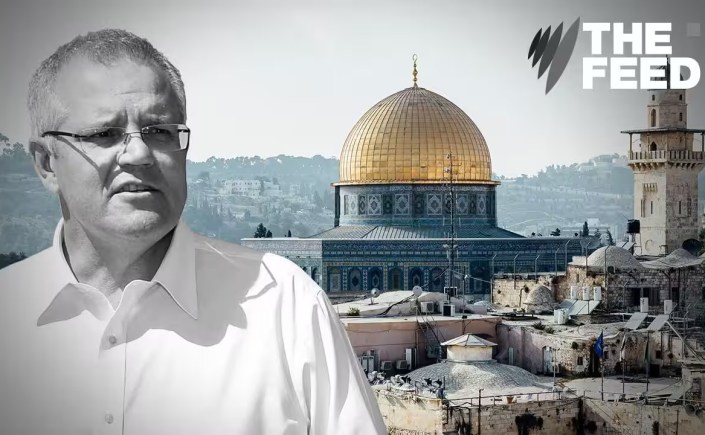
It was entitled: “Keeping Wolves from the Flock: The Case for Good Religion to Fight Anti-Semitism”. It was delivered on International Holocaust Remembrance Day on 27 January 2026 at the Binyaney Ha’uma Conference Center, Jerusalem, Israel. The presenter was former Australian prime Minister Scott Morrison. It was well received by audience, and praised by Israeli prime minister Binyamin Netanyahu. And it quickly reverberated back home.

The venue, the timing, and the company mattered. Israel, in the midst of an ongoing war and under the leadership of a government increasingly isolated internationally, was hardly a neutral stage. The event itself was framed as a moral gathering – a stand against antisemitism at a moment when Jewish communities worldwide feel newly exposed and embattled. Into this charged atmosphere stepped a deposed and disgraced Australian leader, now embarked on an international, largely ecclesiastical speaking circuit, offering prescriptions not for Israel, but for Islam in Australia.

The reaction in Australia followed well-worn grooves. Conservative outlets and commentators – most loudly those aligned with Murdoch media – cast Morrison as a truth-teller, bravely naming uncomfortable realities about radical Islam and standing up for Jewish security against a censorious, “woke” establishment that had been slow to deal with the acknowledged threat of radical Islamism. Progressive commentators, by contrast, focused on the dangers of securitising religion, the selective targeting of Muslims, exacerbating existing Islamophobia, and the symbolic violence of lecturing Australian minorities from abroad. The argument was instantly polarised, less a conversation than a mirror held up to our own media ecosystems and their predictable reflexes.

What was largely missing, however, was sustained attention to the deeper questions the speech inadvertently raised – questions that recur across debates about diversity, cohesion, and authority in plural societies. Who gets to speak about whom, and from where? How does a liberal democracy balance legitimate security concerns with religious freedom and civic trust? When does critique shade into control, and when does concern curdle into performance? And what happens when discussions about coexistence are conducted not face to face, but at altitude, before distant audiences primed for applause?

It is to those questions – rather than to the outrage or applause – that the brief following essay turns.

The politics of posturing 

There is a particular genre of speech that is recognisable before one even reaches the second paragraph. It is delivered abroad, framed as courageous, freighted with moral urgency, and aimed not so much at those ostensibly being addressed as at a wider, watching audience. Scott Morrison’s address in Israel belongs squarely in this genre. It is less a contribution to Australian social cohesion than a performance within a global culture war, delivered from a stage carefully chosen for its symbolism rather than its suitability.

Morrison, now out of office and out in the world, occupies a familiar post-political niche as he treads an international speaking circuit, heavily ecclesiastical in tone and audience, where moral clarity is prized over policy detail and applause over accountability. This matters, because the speech was not made in the Australian Parliament, not to Australian Muslims, not even in Australia. It was made in Israel – at a moment when Benjamin Netanyahu, politically cornered and morally embattled, will accept reassurance and affirmation from almost any quarter. In that sense, the speech served two purposes: it burnished Morrison’s credentials with a transnational conservative audience, and it offered Netanyahu symbolic solidarity. Australia, and Australian Muslims, were almost incidental.

The content of Morrison’s address has been widely rehearsed: calls for nationally consistent standards for Islamic institutions; accreditation and registration of imams; translation of sermons; expanded scrutiny of foreign funding; praise for Middle Eastern states that have “reasserted authority” over religious teaching. None of these ideas, taken in isolation, are wholly unthinkable. Liberal democracies already regulate religion in numerous ways – through education standards, charity law, financial transparency, and criminal statutes relating to incitement and abuse. No faith operates in a vacuum, and Islam is not exempt from the tensions between patriarchal authority and moral absolutism, and the egalitarian instincts of a secular, humanist society like Australia’s.

Nor is it controversial to observe that Islam, like Christianity before it, is engaged in a long, unfinished argument with modernity. Questions of gender, authority, pluralism, sexuality, and the limits of clerical power are not impositions from outside but live debates within Muslim communities themselves (see, in In That Howling Infinite, Islam’s house of many mansions and Educate a girl and you educate a community – exclude her and you impoverish it ). Australian Islam, however, is overwhelmingly benign, pragmatic, and law-abiding – a quiet negotiation between inherited tradition and lived reality, not a breeding ground of medieval zealotry. The men and women who left Australia to fight for ISIS were not summoned by local mosques but seduced by freelancing radicals in unregulated prayer halls algorithmic feeds, online grievance, and a search for meaning in a fractured digital world in which they find no place..

This is where Morrison’s argument begins to fray. Security agencies themselves – including ASIO director Mike Burgess – have been clear: you cannot arrest your way to social cohesion, nor spy your way to less youth radicalisation. The most rapidly evolving threats now emerge from the post-Covid morass of conspiracy theorists, anti-government paranoiacs, white nationalists, and apocalyptic survivalists – movements that often cloak themselves in Christian symbolism without any expectation that Christianity as a whole should be placed under special surveillance. To single out Islam, therefore, is not just analytically weak but politically loaded.

That loading is amplified by Morrison’s own biography. He is not a neutral secularist but an openly proselytising evangelical Christian, steeped in a tradition that would respond angrily to equivalent proposals applied to its own institutions. His political career was marked by secrecy, performative culture-war gestures, and a tendency to govern by symbolic posture rather than deliberative engagement – a style that ultimately saw him removed from office. These things do not invalidate his right to speak, but they do shape how his speech is received in his home country.

Then there is the matter of exemplars. Morrison’s citing of Saudi Arabia, the UAE, Egypt, and Jordan as models of religious regulation is not merely unfortunate; it is disqualifying. These are regimes that suppress women, persecute Christians and heterodox Muslims, criminalise dissent, and weaponise religion as an instrument of authoritarian control. They have form for dealing with Islamists like the Muslim Brotherhood with what the Americans euphemistically call “extreme prejudice”.

To invoke them while speaking the language of freedom of worship is to betray a deep confusion about the difference between liberal regulation and illiberal domination. If the aim is integration, these are strange teachers to cite.

Yet even all this misses the most important point, which is not what Morrison said but how and where he said it.

It is presumptuous to lecture Australians from abroad. It is disrespectful to address Australian Muslims without engaging them directly. And it is incendiary to do so from Israel – a place that is anything but neutral in Muslim political consciousness, and where questions of religion, power, land, and legitimacy are already saturated with pain and contestation. To speak from there is to speak over, not to; to align oneself symbolically before dialogue has even begun. No amount of policy caveating can undo that gesture.

This is where the charge of Islamophobia becomes both understandable and, paradoxically, incomplete. Morrison did not denounce Muslims as such, nor did he advocate exclusion or expulsion. But by singling out Islam, invoking authoritarian models, and delivering his critique from a stage freighted with geopolitical meaning, he helped reinforce the sense that Muslims are a problem to be managed rather than citizens to be engaged. That perception matters, because alienation is not a side effect of radicalisation; it is one of its preconditions.

The reactions to the speech followed predictable lines. British commentator Brendan O’Neill, for example, writing in The Australian, cast Morrison as a brave blasphemer, persecuted by a censorious “Islamophobia industry” – a piece of rhetorical theatre entirely consistent with Spiked’s long-standing contrarian brand and its comfortable alignment with Murdoch culture-war politics. Jacqueline Maley, writing in the Sydney Morning Herald, and the progressive wing of liberal commentary, focused on the dangers of securitisation, surveillance, and selective moral panic. Neither is wrong, exactly, but neither escapes their own political ecosystem.

What is striking is how little the speech had to do with Australia at all. It was not an attempt to build consensus, to consult, or to wrestle with the messy realities of pluralism. It was an attention-seeking intervention by a man no longer accountable to the electorate and yet nostalgic for its attention, speaking to an international audience that rewards moral certainty and civilisational framing. In that sense, the speech says less about Islam than it does about the temptations of post-power relevance.

If there is a lesson here, it is an old one. Social cohesion is not forged by speaking about communities from afar, nor by borrowing the language of security to police belief. It is built, slowly and imperfectly, through proximity, dialogue, and the unglamorous work of trust. Morrison chose distance instead. And in doing so, he turned a necessary conversation into a symbolic skirmish – one that generated headlines, applause, and division, but very little understanding. One that we hope, unrealistically alas, in today’s febrile political climate, will be forgotten sooner rather than later.

Call it concern if you like; politics has another word for speeches that travel so far to say so little at home: posturing.

For more on the Middle East in in That Howling Infinite, see A Middle East Miscellany.
Recent posts on the current state of Australian politics include Same old stone, different rock. What’s in a word?’ Shaping facts to feelings – debating intellectual dishonesty, Moral capture and conditional empathy, and Standing on the high moral ground is hard work!

Shaping facts to feelings – debating intellectual dishonesty

In early November last year, we published The most nihilistic war ever …Sudan’s waking nightmare, a harrowing piece about the atrocities being committed in the West Dharfur region of civil-war torn Sudan. A  friend commented on the article, accusing me of intellectual dishonesty in comparing the international outcry over Gaza to the silence on Sudan. His comment was not the first of similar justifications:

“ … with respect to the lack of outrage, the mainstream media can stir outrage on any topic when its political masters and financial backers want it to. Why has it not done so in this instance? Follow the money is one rule of thumb. I assume it suits the powers that be to let the slaughter continue. I hope more people are inspired to become activists against this dreadful situation, but public opinion tends to follow the narrative manufactured by the media more than impel it. When it comes to pro-Palestinian activism it is the story of a long hard grind of dedicated protestors to get any traction at all against the powerful political and media interests which have supported the Israeli narrative and manufactured global consent for the genocide  of Palestinians over many years. And still, although the tide is gradually turning, the West supports Israel to the hilt and crushes dissent. Using the silence in the media and in the streets over the slaughter in Sudan as an excuse to try and invalidate pro-Palestinian activism is a low blow and intellectually dishonest”.

This response is articulate and impassioned, but it also illustrates precisely the reflexive narrowing of moral vision that the comparison between Gaza and Sudan was meant to illuminate. His argument hinges on a familiar syllogism: that Western media outrage is never organic but always orchestrated (“follow the money”), that silence on Sudan therefore reflects elite indifference rather than public apathy, and that to highlight that silence is somehow to attack or “invalidate” the legitimacy of pro-Palestinian activism. It is a neat, closed circuit – morally reassuring, rhetorically watertight, but intellectually fragile.

In That Howling Infinite quizzed ChatGPT to collate, distill definitions and explanations of intellectual dishonest because we sensed its presence everywhere in the debate, including – uncomfortably – around my own thinking. Not as accusation, but as inquiry. The Gaza war has a peculiar way of forcing moral positions to harden quickly, of rewarding certainty and punishing hesitation, of turning complexity into suspicion. In that climate, asking what intellectual dishonesty actually looks like felt less like an abstract exercise than a necessary act of self-defence.

An ideological  comfort zone

Intellectual dishonesty, then, is the deliberate or unconscious use of argument, rhetoric, or selective reasoning to defend a position one knows – or should know – is incomplete, misleading, or false. It is less about lying outright and more about distorting truth for ideological comfort. It includes cherry-picking evidence, using double standards, appealing to emotion over reason, or refusing to acknowledge valid counterarguments. You could even call it “lying to oneself”, and truth be told, we are all guilty at one time or another.

Regarding the Gaza war, intellectual dishonesty is everywhere, on both sides of the divide, magnified by mainstream and social media’s hunger for moral simplicity and viral outrage. What begins as solidarity curdles into slogan; what starts as empathy ossifies into orthodoxy. And because this conflict sits at the intersection of history, identity, trauma, and power, the temptation to simplify—to choose a side and suspend thinking is especially strong.

I asked the question, then, not to sit in judgement above the fray, but to understand how easily moral seriousness can slip into moral performance, and how even good intentions can narrow rather than enlarge our field of vision.

Intellectual dishonesty is rarely the bald lie. More often it is the careful omission, the selective emphasis, the comfortable narrowing of vision that allows us to remain morally certain while thinking we are being rigorous. It is the use of argument, rhetoric, or evidence not to discover what is true, but to defend what feels right. Cherry-picking, double standards, euphemism, emotional substitution for analysis, the refusal to sit with uncomfortable counter-truth – these are not failures of intelligence so much as failures of discipline. They are the betrayal of thought in service of tribe.

Nowhere is this more visible than in the discourse surrounding Gaza. On all sides, intellectual dishonesty flourishes, amplified by mainstream and social media systems that reward moral clarity over moral accuracy, outrage over comprehension, and certainty over doubt. The war has become not merely a catastrophe but a stage upon which external protagonists perform their own identities, anxieties, and loyalties.

On the pro-Israel side, intellectual dishonesty often takes the form of moral laundering. Hamas’s atrocities – October 7, the hostages, the tunnels, the use of UN personnel and facilities – are rightly invoked, but too often as a solvent that dissolves all subsequent scrutiny. Civilian deaths become “collateral damage,” mass destruction becomes operational necessity, and a stateless, blockaded and exposed population is rhetorically elevated into a symmetrical belligerent confronting one of the most powerful militaries on earth. Euphemisms do heavy lifting: “targeted strikes,” “human shields,” “complex urban environments.” Criticism of Israeli policy is collapsed into antisemitism, not to defend Jewish safety but to foreclose moral argument. What is omitted – the occupation, the blockade, the decades of dispossession and accumulated trauma – is as important as what is said.

On the pro-Palestinian side, dishonesty manifests differently but no less pervasively. Moral outrage hardens into narrative absolutism. Hamas’s crimes are erased, justified, or absorbed into the abstraction of “muqawama”, resistance, or “sumud”, resilience, collapsing the distinction between combatant and civilian. Violence is romanticised, militants transfigured into symbols, their authoritarianism and indifference to Palestinian life quietly excised. Empathy becomes selective: Gazan children are mourned, Israeli families are passed over, or worse, subsumed into theory. History is flattened into a single moment of victimhood, stripped of Arab politics, Islamist extremism, regional failure, and internal Palestinian fracture. The powerful are cast as pure evil, the powerless as pure good, until reality itself becomes an inconvenience.

Mainstream media does not correct this; it accelerates it. Impartiality is performed while distortion is practised. Headlines flatten causality, images are severed from context, asymmetry is neutralised by “both sides” language. Social media perfects the process. Algorithms reward fury, not thought; spectacle, not inquiry. Influencers weaponise empathy itself – choosing which corpses to count, which cities to name, which pictures to publish (sometimes none to fussy about which war they portray), and which griefs to amplify. Moral clarity is produced without moral responsibility.

Beneath all this lies a deeper dishonesty, one that is existential rather than rhetorical. Each side insists its justice is indivisible, when in truth each vision of justice requires the other’s erasure. Gaza becomes less a human tragedy than a mirror onto which Western actors project their unresolved conflicts about empire, identity, guilt, and power. It is here that intellectual dishonesty ceases to be merely argumentative and becomes moral.

This is where the comparison with Sudan – and any forgotten or ignored war in this sad world – becomes instructive and also uncomfortable. When the relative silence surrounding Sudan’s catastrophe is raised, it is often dismissed as “whataboutism” or as an attempt to diminish Palestinian suffering. That response itself reveals the problem. The point is not to weigh body counts or rank atrocities, but to interrogate how empathy is distributed. Why does one horror become the world’s moral touchstone while another, no less vast or humanly devastating, barely registers?

The easy answer – “follow the money,” “manufactured outrage” – “media conspiracy” – “the Jewish Lobby” – is reassuring but incomplete. Western silence on Sudan is less conspiracy than exhaustion. Sudan offers no tidy morality play. No clean colonial narrative. No villains easily costumed for Instagram. Its war is fragmented, internecine, post-ideological: warlords, militias, foreign patrons, gold under rubble. It resists hashtags. Gaza, by contrast, offers clarity, identity, and the comforting architecture of blame. Victims and oppressors are sharply drawn; the script is familiar; moral alignment confers belonging.

In Sudan, millions starve while the gold glitters in the darkness deep beneath their feet. In Gaza, ruins are televised, moralised, and weaponised. Both are human catastrophes. Only one has an audience.

To point this out is not to invalidate solidarity with Gaza. It is to expose the limits of our moral imagination. Empathy that depends on narrative simplicity is not universalism; it is performance. Compassion that requires a script is conditional. If justice is truly the aspiration, it must be capacious enough to grieve Darfur and Khartoum alongside Gaza City, to care even when the cameras turn away.

Bringing it all back home  …

And this brings the argument uncomfortably close to home. Are we too guilty of intellectual dishonesty? To be I honest, yes – probably, at least sometimes. But then, who isn’t? The Gaza war is a moral minefield where even careful minds lose their footing. Passion bends the lens; grief distorts perspective; certainty is seductive. No one who cares deeply escapes the pull of identification.

Endeavouring to see all sides of an argument, age, experience, knowledge, empathy – and a growing impatience with historical illiteracy and intellectual laziness – inevitably shape what we see. A lifetime hatred of antisemitism runs through them as well, a moral watermark that does not fade simply because the world grows louder. These influences are not disclaimers; they are facts. Not excuses, merely coordinates. If an argument is bent  to fit a moral arc, felt more keenly for one set of victims, or wearied of slogans masquerading as history, then yes -we have been partial.

The difference lies in knowing it. Intellectual dishonesty becomes moral failure only when it is unacknowledged, when narrative becomes more important than truth, when the lens is never turned inward. What resists dishonesty is reflexivity: the willingness to ask whether one is being fair, whether one is seduced by one’s own argument, whether omission has crept in disguised as clarity.

So yes – guilty, but aware. Fallible, but striving. He who is without sin, after all, should be cautious about throwing stones, especially from within a glasshouse. Perhaps that is as close as any of us come to honesty: to keep turning the lens back on ourselves, again and again, until the view clears – or at least steadies enough to see by.

And that, is arguably not a failure of honesty but a condition of it. To articulate one’s influences is to refuse the pretence of neutrality, to acknowledge that objectivity is not the absence of bias but the discipline of recognising it. Impatience with ignorance is, at its core, a moral impatience: a refusal to see human tragedy flattened into slogans or history reduced to talking points. The danger, of course, is fatigue – after decades of watching the same horrors recur, empathy can harden into exasperation. But awareness of that tendency is itself a safeguard.

We are participants in the long conversation of conscience – who know that clarity and compassion rarely sit still in the same chair, but who insists they at least keep talking. In an age that prizes certainty above understanding, that may be the most honest posture left: to keep turning the lens back on ourselves,, resisting the comfort of tribe, and refusing to let thought become merely another form of allegiance.

Author’s  Note …

This opinion piece is one of several on the the attitudes of progressives towards the Israel, Palestine and the Gaza war. The first is Moral capture, conditional empathy and the failure of shock, a discussion on why erstwhile liberal, humanistic, progressive people from all walks of life have been caught up in what can be without subtly described as that anti-Israel machinery.Standing on the high moral ground is hard work! discusses the issues of free speech and “cancellation”, and boycotts with regard to the recent self-implosion of the Adelaide Writers’ Festival, one of the country’s oldest and most revered.

There are moments when public argument stops being a search for truth and becomes a test of belonging. Facts are no longer weighed so much as auditioned; empathy is rationed; moral language hardens into a badge system, issued and revoked according to rules everyone seems to know but few are willing to articulate. One learns quickly where the trip-wires are, which sympathies are permitted, which questions are suspect, and how easily tone can outweigh substance.

What interests me here is not the quarrel itself – names, borders, histories—but the habits of mind it exposes. The ease with which conviction can slide into choreography. The way intellectual honesty is praised in the abstract and punished in practice. The curious transformation of empathy from a human reflex into a conditional licence, granted only after the correct declarations have been made.

Across these pieces I circle the same uneasy terrain: the shaping of facts to fit feelings; the capture of moral language by ideological gravity; the performance of righteousness as both shield and weapon. Cultural spaces that once prided themselves on curiosity begin to resemble courts, where innocence and guilt are presumed in advance and the labour lies not in thinking, but in signalling.

This is not an argument against passion, nor a plea for bloodless neutrality. It is, rather, a meditation on how quickly moral seriousness curdles into moral certainty – and how much intellectual work is required to stand on what we like to call the high ground without mistaking altitude for clarity.

The position of In That Howling Infinite with regard to Palestine, israel and the Gaza war is neither declarative nor devotional; it is diagnostic. Inclined – by background, sensibility, and experience – to hold multiple truths in tension, to see, as the song has it, the whole of the moon. It is less interested in arriving at purity than in resisting moral monoculture and the consolations of certainty. That disposition does not claim wisdom; it claims only a refusal to outsource judgment or to accept unanimity as a proxy for truth.

On Zionism, it treats it not as a slogan but as a historical fact with moral weight: the assertion – hard-won, contingent, imperfect – that Jews are entitled to collective political existence on the same terms as other peoples. According to this definition, this blog is Zionist. It is not interested in laundering Israeli policy, still less in romanticising state power, but rejects the sleight of hand by which Israel’s existence is transformed from a political reality into a metaphysical crime. Zionism is not sacred, but its delegitimisation is revealing – because it demands from Jews what is demanded of no other nation: justification for being.

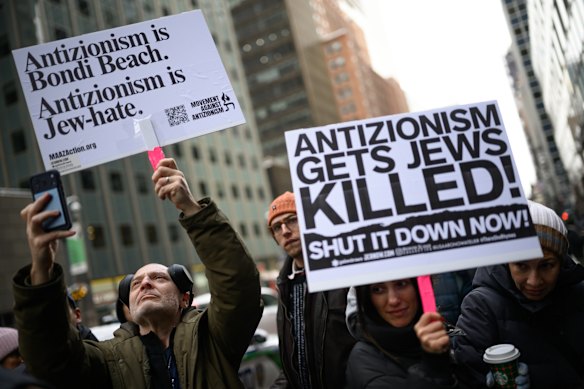
On anti-Zionism, it has been unsparing. It sees it not as “criticism of Israel” (which you regard as both legitimate and necessary) but as a categorical refusal to accept Jewish collective self-determination. What troubles it most is not its anger but its certainty: its moral absolutism, its indifference to history, its willingness to borrow the language of justice to license erasure. It is attentive to how anti-Zionism recycles older antisemitic patterns – collectivisation of guilt, inversion of victimhood, and the portrayal of Jews as uniquely malignant actors – while insisting, with studied innocence, that none of this concerns Jews at all. If not outright antisemitism, the line separating it from anti-Zionism is wafer—thin, and too often crosses over. 

The interest in moral capture is analytical rather than accusatory. It is not arguing that writers, academics, or institutions are malicious; rather, it are argues that they have become intellectually narrowed by the desire to belong to the “right side of history.” Moral capture explains how good intentions curdle into dogma, how solidarity becomes performative, and how the fear of social exile replaces the discipline of thought. It accounts for the strange phenomenon whereby intelligent people outsource their moral judgment to slogans, and experience constraint not as an intolerable injury to the self.

The Adelaide Writers’ Festival affairis seen not primarily about Randa Abdel-Fattah, nor even about free speech. It is a case study in institutional failure and cultural self-deception. The mass withdrawals are viewed not as acts of courage or principle but as gestures of affiliation – ritualised displays of virtue by people largely untouched by the substance of the dispute. What is disturbing is the asymmetry: the speed with which a festival collapsed to defend eliminationist rhetoric, and the silence that greeted the doxxing, intimidation, and quiet cancellation of Jewish writers and artists. Adelaide did not fall because standards were enforced, but because those standards were applied selectively and then disowned at the first sign of reputational discomfort.

Running through all of this is a consistent stance: a resistance to moral theatre, an impatience with historical amnesia, and a belief that intellectual honesty requires limits – on language, on fantasy, and on the indulgent belief that one’s own righteousness exempts one from consequence.

We are not asking culture to choose sides; you are asking it to recover judgment

.See in In That Howling Infinite, A Political World – Thoughts and Themes, and A Middle East Miscellany. and also: This Is What It Looks LikeYou want it darker?” … Gaza and the devil that never went away … , How the jihadi tail wags the leftist dog, The Shoah and America’s Shame – Ken Burns’ sorrowful masterpiece, and Little Sir Hugh – Old England’s Jewish Question

Moral capture and conditional empathy

In This Is What It Looks Like, published very soon after the Bondi Beach massacre, we wrote:

“Facebook fills with empathetic words and memes from politicians, public figures and keyboard activists who spent the past two years condemning Israel in ways that blurred – and often erased – the distinction between Israeli policy and Jewish existence, creating at best, indifference to Jewish fear and, at worst, a permissive climate of hostility toward Jews as such. Today it is all tolerance, inclusivity and unity – and an air of regret and reverence that reeks of guilt.

But not all. Social media has fractured along familiar lines. At one extreme are conspiracy theories — false flags, invented victims, claims the attackers were Israeli soldiers. At the other is denial: what antisemitism? Between them sits a more revealing response. There is genuine shock and horror, even remorse – but also a careful foregrounding of the Syrian-Australian man who intervened, coupled with a quiet erasure of the victims’ Jewishness; a reflexive turn to whataboutism; and a refusal, even now, to relinquish the slogans and moral habits of the past two years. If antisemitism is acknowledged at all, it is ultimately laid at the feet of Israeli prime minister Binyamin Netanyahu.

Why this reticence, we asked, this resistance to reassessment after the Bondi attack? Perhaps it lay less in ideology than in psychology. For some, was there is a simple inability to relinquish prior convictions – positions publicly held, repeatedly performed, and now too entangled with identity to abandon without cost. For others, was it perhaps a deeper reluctance to acknowledge having been misinformed or misdirected, an admission that would require not just intellectual correction but moral self-reckoning? Was it that empath has become selective: extending it fully to Jewish victims would require suspending, even briefly, a framework that collapses Jewish identity into the actions of the Israeli state. And finally, we asked whether many were no longer reasoning freely at all, but are caught inside the machinery – the rhythms of platforms, slogans, group loyalties and algorithmic reinforcement – where reconsideration feels like betrayal and pause feels like capitulation.

Indeed, since October 7, 2023, In That Howling Infinite has pondered why erstwhile liberal, humanistic, progressive people from all walks of life have been caught up in what can be without subtly described as that anti-Israel machinery referred to above in which opposition at a safe distance to what is seen as Netanyahu’s genocidal Gaza war has seen professed anti-Zionism entangled with anti-Semitism.

What we are witnessing is not a fringe radicalisation but a moral capture: people who would once have prided themselves on scepticism, nuance and historical memory now moving in formation, repeating slogans whose lineage they neither examine nor recognise. The machinery works precisely because it flatters their self-image. It offers the intoxication of righteousness without the burden of precision; solidarity without responsibility; protest without consequence.

This is not old-style antisemitism with its crude caricatures and biological myths. It is something more elusive – and therefore more powerful. It presents itself as ethics, as international law, as human rights discourse scrubbed clean of Jewish history. Israel becomes not a state among states but a symbol onto which every colonial sin can be projected. Complexity is treated as evasion; context as complicity. The very habits of mind that once defined liberal humanism – distinction, proportion, tragic awareness – are recoded as moral failure.

And because the animating energy is moral rather than ethnic, many participants genuinely believe themselves immune to antisemitism. They do not hate Jews; they merely deny Jews the one thing liberalism once insisted all peoples possess: the right to historical contingency, to imperfect self-determination, to moral fallibility without metaphysical damnation. That is how an ancient prejudice survives under a modern flag.

What makes this moment particularly dangerous is that the capture extends across institutions that once acted as guide rails and  backstops: universities, cultural organisations, media, NGOs, even parts of the political class. When the liberal centre internalises a narrative, it no longer needs coercion; it polices itself. Silence becomes virtue. Dissent becomes indecency. The boundaries of acceptable speech narrow – not by law, but by moral shaming.

This is why inquiries and commissions feel inadequate, even faintly beside the point. The problem is not that we do not know enough. It is that too many people who should know better have decided – consciously or otherwise – that some falsehoods are useful, some hatreds understandable, some erasures permissible.

History suggests these moments do not end because facts finally win an argument. They end when enough people recover the nerve to say: this is not true, this is not proportionate, this is not who we are. That requires intellectual courage before it requires policy – and at the moment, courage is in shorter supply than outrage.

What, then, do we actually mean by moral capture?

An intellectual box canyon

It describes a condition in which an individual or group becomes psychologically, socially, and culturally enclosed within a moral framework so totalising that it can no longer be revised or questioned without threatening their sense of self. It is best understood not as a theory, still less as a conscious posture, but as a lived and almost tangible condition: a quiet enclosure of mind and conscience in which questioning the framework feels not merely wrong, but personally destabilising. It is not simply ideology or prejudice, but a subtle narrowing of moral imagination—a shaping of what can be felt, what can be said, and ultimately, what can be seen.

Under moral capture, empathy becomes conditional. It travels only so far before it threatens the moral story we have already committed to, the narrative through which we recognise ourselves as good. Judgement is no longer exercised independently but is subordinated to alignment. We begin thinking from conclusions rather than reasoning toward them, measuring the world not against principle but against the positions we have already staked as right. Certain conclusions feel self-evident; certain questions become illegitimate; doubt itself starts to register as moral weakness rather than intellectual honesty.

Positions once held as views harden into identity, reinforced by social approval, public performance, and the feedback loops of online life. People can feel sincere, committed, and righteous even as their capacity to notice contradiction, hold tension, or revise belief steadily diminishes. What is lost is not feeling, but freedom—the freedom to think, to hesitate, and to change one’s mind.

In a phrase, moral capture is an intellectual box canyon: wide at the entrance, reassuringly coherent and morally clear once inside, but increasingly difficult to exit without retracing your steps

Our moral choices, once optional, become invested in our identity. What we once held as a conviction now defines us, fuses with our sense of self, our social belonging, our reputation. And habits reinforce themselves. Ritualised moral performances, applause from peers, and the accelerating feedback of online platforms harden the framework, making reconsideration feel not just difficult, but almost impossible.

In this state, otherwise humane, intelligent people can feel virtuous, committed, and righteous while the breadth of their moral imagination steadily narrows. Certain truths -even the most visible – become unsayable. Empathy grows selective. The unthinkable becomes thinkable, so long as it fits the story our framework allows.

This essay is my attempt to explore moral capture as it happens in real time: to see how it shapes our response to atrocity, how it bends grief and outrage, and why even shock – when filtered through these habits – becomes partial, provisional, and fragile.

Conditional empathy and the failure of shock

In That Howling Infinite did not begin thinking about moral capture because it was looking for a new explanatory framework, nor because it believed itself morally exempt from the currents of the moment. Rather, because in the aftermath of the Bondi atrocity something felt profoundly unsettled – not only tragic, but discordant. The language of grief arrived swiftly and abundantly. Condolences were offered, candles lit, unity invoked. And yet this display sat uneasily alongside two years of rhetoric in which Jewish fear had been minimised, relativised, or quietly absorbed into a moral narrative that treated Israel not as a state among others, but as a singular moral contaminant.

What was disturbing was not the outrage directed at Gaza. The suffering there is real, appalling, and morally unavoidable. Israel’s retaliation has been devastating and, in many instances, disproportionate. Reasonable people can, and must, grapple with that reality. What was troubling was how easily that outrage had slid, over time, into habits of thought that blurred distinctions which once mattered: between state and people, policy and identity, criticism and contempt. The taboo on antisemitism, long assumed to be settled history, began to look less like a moral achievement than a conditional courtesy.

After Bondi, we did not expect a mass moral conversion or  imagine that people who had spent two years publicly performing righteous indignation would suddenly execute a full reversal – a neat return to complexity, restraint and tragic awareness. That would have been unrealistic, perhaps even unfair. What we did expect, and hoped for, was hesitation. A pause. A moment of reassessment. An acknowledgement, however tentative, that something in the moral atmosphere had gone wrong.

Instead, what emerged was something more revealing: grief without revision; empathy carefully bounded; sorrow hedged with qualifications. The familiar “Ah, but…” arrived almost on cue. It was there, in that reflex, that we began to see the outline of a deeper phenomenon – not simple prejudice, not even ideology, but moral capture.

Moral capture occurs when a moral framework that once helped organise reality becomes totalising – so emotionally, socially and symbolically reinforced that it can no longer be revised without threatening the self who holds it. At that point, facts do not merely challenge the framework; they imperil identity. And when identity is at stake, reason quietly steps aside.

One of the clearest signs of moral capture is the collapse of distinctions. Israeli policy becomes Jewish existence. Jewish fear becomes political theatre. Antisemitism becomes a rhetorical device wielded by Benjamin Netanyahu. Violence against Jews becomes, if not justified, then contextualised into moral thinness. Language flattens. Precision feels like evasion. Context is treated as complicity.

This helps explain the strange choreography of response after Bondi. There was genuine shock and sorrow, even remorse. But it was accompanied by careful editorial choices: the foregrounding of a heroic rescuer, the quiet erasure of the victims’ Jewishness, the reflexive turn to whataboutism, the insistence – sometimes whispered, sometimes explicit – that responsibility lay elsewhere. Jewish suffering could be acknowledged only insofar as it did not demand a reckoning with the moral habits of the past two years.

Why this resistance? Part of the answer lies in identity as investment. For many on the modern left, opposition to Israel has not remained a policy position; it has hardened into a moral identity, publicly performed, socially rewarded, and algorithmically amplified. Positions once adopted as expressions of concern or solidarity have become entangled with one’s sense of self -who one is, where one belongs, what one signals to the world. To revise those positions now would involve not merely intellectual correction, but moral self-reckoning: admitting error, acknowledging harm, risking social alienation. That is a price most people instinctively avoid.

Solidarity, under these conditions, mutates into surrender. The capacity to stand with the vulnerable while retaining independent moral judgement is lost. Complexity becomes betrayal. Reassessment becomes cowardice. To pause is to hesitate; to hesitate is to defect. Moral reasoning gives way to moral alignment.

This process is intensified by platforms that act as algorithmic accelerants. Social media does not reward reflection; it rewards repetition with conviction. Moral language becomes compressed into slogans. Outrage is incentivised; nuance is penalised. Over time, people cease reasoning toward conclusions and begin reasoning from them. The machinery does the rest. Group loyalty replaces judgement. Reconsideration feels like capitulation.

In this environment, antisemitism does not need to announce itself. It seeps. It jokes. It chants. It flatters those who believe they are on the right side of history by assuring them that their anger is justice and their certainty courage. The world’s oldest hatred does what it has always done: it waits for permission. That permission is rarely granted all at once. It is granted gradually, rhetorically, respectably.

This is why Bondi did not “break the spell.” Atrocities shock only when the moral framework remains flexible enough to absorb them. Here, the framework was already closed. Violence could be mourned, but not allowed to destabilise the story that preceded it. Empathy could be expressed, but only within boundaries that preserved moral coherence. Jewish fear remained an inconvenience—something to be managed, not centred.

The habituation of moral capture meant that grief was permitted only insofar as it did not demand reassessment. Empathy was bounded, sorrow hedged, and moral recognition carefully staged. Those who might have been shocked into reflection instead performed selective empathy, affirming the gestures of mourning while leaving the architecture of two years of moral habit intact

Throughout this exploration, In That Howling Infinite  asked myself an uncomfortable question: do we lack the empathy and outrage that others so visibly express? Are we insufficiently moved? Insufficiently angry? We do not think so. Though saddened by Gaza and angered by unnecessary suffering, it is appalled by violence against Jews. What differs, perhaps, is not the presence of feeling but the habits through which it is processed. It’s background, sensibility and experience incline it toward holding multiple truths in tension – to see, as the song has it, the whole of the moon. That does not make it wiser, only more resistant to moral monoculture.

Moral capture is powerful precisely because it allows people to remain good in their own eyes while surrendering the disciplines that once made goodness durable. It does not feel like hatred. It feels like justice. It does not announce itself as intolerance. It presents as virtue.

What we have learned on this journey is not that outrage is illegitimate, nor that empathy must be rationed. It is that empathy becomes dangerous when it is conditional; that solidarity curdles when it demands surrender; and that moral frameworks, once weaponised against reconsideration, eventually turn on the very values they claim to defend.

History does not ask whether our intentions were pure. It asks what we normalised, what we tolerated, and what we allowed to be said in our name. Moral capture works hardest to ensure we never ask those questions of ourselves. The task now is not to abandon conviction, but to recover freedom it the freedom to doubt our own righteousness, to let empathy travel where it is inconvenient, and to remember that seeing only half the sky is not the same as moral clarity.

Only then do we begin to see the whole of the moon.

In That Howling Infinite  December 2025

Author’s note …

This opinion piece is one of several on the the attitudes of progressives towards the Israel, Palestine and the Gaza war. Shaping facts to feelings – debating intellectual dishonesty– regarding the Gaza war, intellectual dishonesty is everywhere, on both sides of the divide, magnified by mainstream and social media’s hunger for moral simplicity and viral outrage. Standing on the high moral ground is hard work! discusses the issues of free speech and “cancellation”, and boycotts with regard to the recent self-implosion of the Adelaide Writers’ Festival, one of the country’s oldest and most revered.

There are moments when public argument stops being a search for truth and becomes a test of belonging. Facts are no longer weighed so much as auditioned; empathy is rationed; moral language hardens into a badge system, issued and revoked according to rules everyone seems to know but few are willing to articulate. One learns quickly where the trip-wires are, which sympathies are permitted, which questions are suspect, and how easily tone can outweigh substance.

What interests me here is not the quarrel itself – names, borders, histories—but the habits of mind it exposes. The ease with which conviction can slide into choreography. The way intellectual honesty is praised in the abstract and punished in practice. The curious transformation of empathy from a human reflex into a conditional licence, granted only after the correct declarations have been made.

Across these pieces I circle the same uneasy terrain: the shaping of facts to fit feelings; the capture of moral language by ideological gravity; the performance of righteousness as both shield and weapon. Cultural spaces that once prided themselves on curiosity begin to resemble courts, where innocence and guilt are presumed in advance and the labour lies not in thinking, but in signalling.

This is not an argument against passion, nor a plea for bloodless neutrality. It is, rather, a meditation on how quickly moral seriousness curdles into moral certainty – and how much intellectual work is required to stand on what we like to call the high ground without mistaking altitude for clarity.

The position of In That Howling Infinite with regard to Palestine, israel and the Gaza war is neither declarative nor devotional; it is diagnostic. Inclined – by background, sensibility, and experience – to hold multiple truths in tension, to see, as the song has it, the whole of the moon. It is less interested in arriving at purity than in resisting moral monoculture and the consolations of certainty. That disposition does not claim wisdom; it claims only a refusal to outsource judgment or to accept unanimity as a proxy for truth.

On Zionism, it treats it not as a slogan but as a historical fact with moral weight: the assertion – hard-won, contingent, imperfect – that Jews are entitled to collective political existence on the same terms as other peoples. According to this definition, this blog is Zionist. It is not interested in laundering Israeli policy, still less in romanticising state power, but rejects the sleight of hand by which Israel’s existence is transformed from a political reality into a metaphysical crime. Zionism is not sacred, but its delegitimisation is revealing – because it demands from Jews what is demanded of no other nation: justification for being.

On anti-Zionism, it has been unsparing. It sees it not as “criticism of Israel” (which you regard as both legitimate and necessary) but as a categorical refusal to accept Jewish collective self-determination. What troubles it most is not its anger but its certainty: its moral absolutism, its indifference to history, its willingness to borrow the language of justice to license erasure. It is attentive to how anti-Zionism recycles older antisemitic patterns – collectivisation of guilt, inversion of victimhood, and the portrayal of Jews as uniquely malignant actors – while insisting, with studied innocence, that none of this concerns Jews at all. If not outright antisemitism, the line separating it from anti-Zionism is wafer—thin, and too often crosses over. 

The interest in moral capture is analytical rather than accusatory. It is not arguing that writers, academics, or institutions are malicious; rather, it are argues that they have become intellectually narrowed by the desire to belong to the “right side of history.” Moral capture explains how good intentions curdle into dogma, how solidarity becomes performative, and how the fear of social exile replaces the discipline of thought. It accounts for the strange phenomenon whereby intelligent people outsource their moral judgment to slogans, and experience constraint not as an intolerable injury to the self.

The Adelaide Writers’ Festival affairis seen not primarily about Randa Abdel-Fattah, nor even about free speech. It is a case study in institutional failure and cultural self-deception. The mass withdrawals are viewed not as acts of courage or principle but as gestures of affiliation – ritualised displays of virtue by people largely untouched by the substance of the dispute. What is disturbing is the asymmetry: the speed with which a festival collapsed to defend eliminationist rhetoric, and the silence that greeted the doxxing, intimidation, and quiet cancellation of Jewish writers and artists. Adelaide did not fall because standards were enforced, but because those standards were applied selectively and then disowned at the first sign of reputational discomfort.

Running through all of this is a consistent stance: a resistance to moral theatre, an impatience with historical amnesia, and a belief that intellectual honesty requires limits – on language, on fantasy, and on the indulgent belief that one’s own righteousness exempts one from consequence.

We are not asking culture to choose sides; you are asking it to recover judgment

.See in In That Howling Infinite, A Political World – Thoughts and Themes, and A Middle East Miscellany. and also: This Is What It Looks LikeYou want it darker?” … Gaza and the devil that never went away … , How the jihadi tail wags the leftist dog, The Shoah and America’s Shame – Ken Burns’ sorrowful masterpiece, and Little Sir Hugh – Old England’s Jewish Question

Looking for the “good Jews”

In This Is What It Looks Like, we wrote: “… antisemitism does not arrive announcing itself. It seeps. It jokes. It chants. It flatters those who believe they are on the right side of history, until history arrives and asks what they tolerated in its name”.

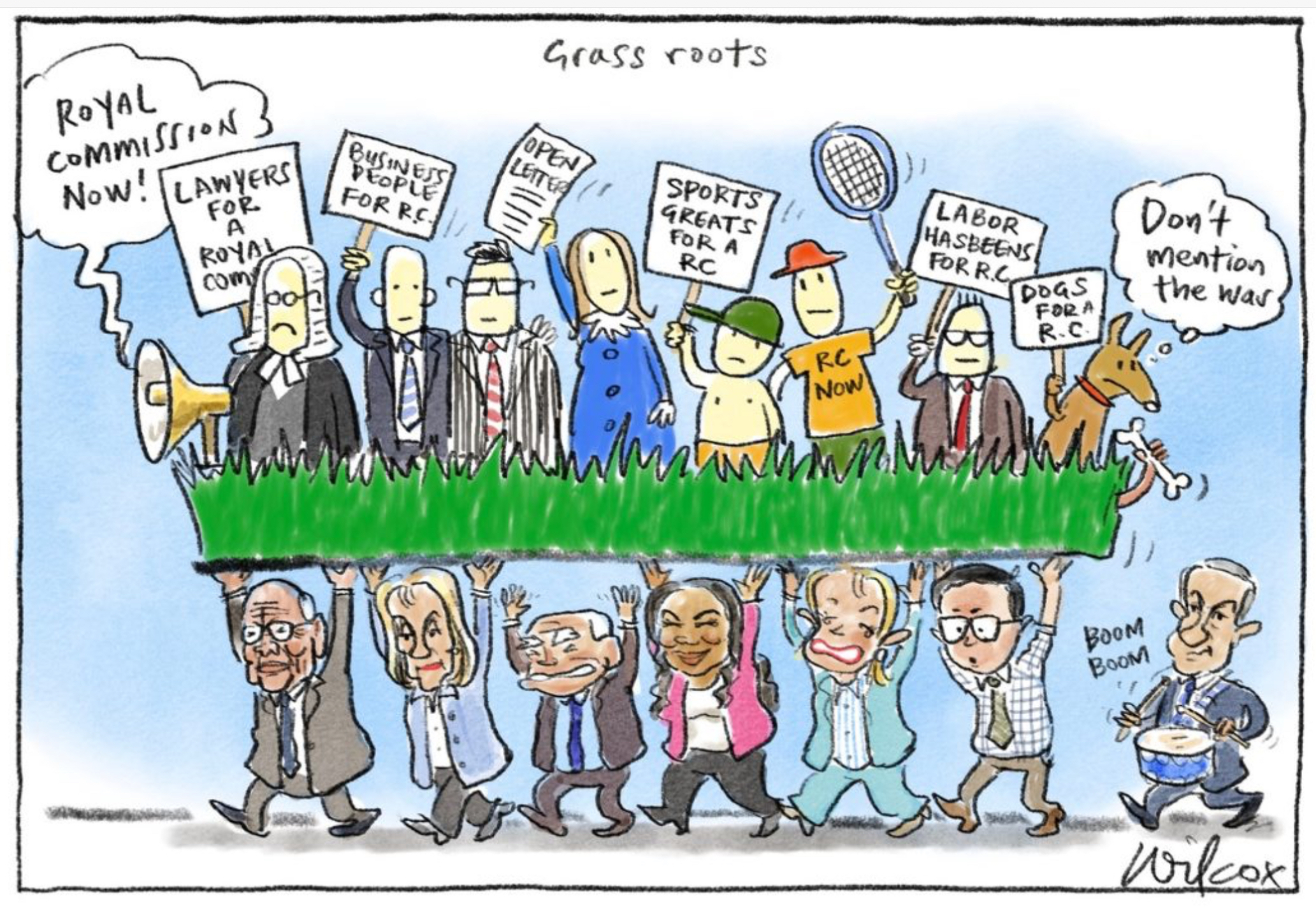
One of those jokes landed, flatly, on January 7 when the otherwise circumspect Age and Sydney Morning Herald published a caricature drawn by the award-winning cartoonist Cathy Wilcox. It presented those calling for a forthcoming royal commission into antisemitism as naïve participants in a hierarchy of manipulation. At the surface were the petitioners themselves; beneath them senior Coalition figures – Sussan Ley, Jacinta Nampijinpa Price, John Howard, David Littleproud – alongside Rupert Murdoch and Jillian Siegel, lawyer, businesswoman and Australia’s Special Envoy to Combat Antisemitism; and behind them all, setting the rhythm, Israel’s prime minister, Benjamin Netanyahu. Each layer marched to a beat not its own.

Cathy Wilcox cartoon, SMH 7 January 2026

Critics argued that the image revived a familiar and corrosive trope: the suggestion of hidden Jewish influence directing political life from the shadows. The cartoon, titled Grass roots, depicts a cluster of foolish-looking figures demanding a royal commission. They are presumably meant to represent the families of the dead, as well as lawyers, judges, business leaders and sporting figures who had urged government action long before the Prime Minister concluded that continued indifference might stain his legacy. When he finally announced a royal commission—expanded, without explanation, to include the elastic phrase “social cohesion”—no journalist paused to ask what that addition was meant to clarify.

In the drawing, a dog stands among these Australians, holding a placard and thinking, “Don’t mention the war.” The grass beneath their feet is supported by a menacing cast: and stock villains of the anti-Zionist imagination. The implication is unmistakable: that the pleas of grieving families and prominent citizens are neither organic nor sincere, but choreographed – another performance conducted from afar.

That implication did not arise in isolation. Across social and mainstream media, many progressives called for Jillian Segal to be removed and her report rejected out of hand. Others elevated Jewish critics of the war, of Zionism, or of Netanyahu as moral exemplars – “good Jews,” “some Jews tell the truth” – as if Jewish legitimacy were contingent on ideological alignment.  Some wrote openly that Jews, “for their numbers,” exercised excessive influence. One circulating meme complained, “We didn’t vote for a Zionist voice”, whilst other posts informed their echo chamber that Chabad Bondi, a branch of the global Jewish outreach organisation, which had organised the Hanukkah gathering on the fateful Sunday evening and also the local commemorations for the victims (and later, the tribute at the Sydney Opera House) was but another tentacle of the sinister and  uber-influential Jewish Lobby. Some of the most incongruous postings have been of ultra Orthodox Jews – Haredim – with signs condemning the Gaza war and Zionism, as if to say these are the authentic, “good” Jews. Some footage actually shows Haredim protesting against the Israeli government’s efforts to conscript exempt yeshiva students into the IDF – but, as they say, every picture tells a story.

Running beneath this was a persistent misconception. Judaism was treated as a religion, detachable and voluntary, rather than as an ethnoreligious identity shaped by lineage, memory and shared fate. Jews were asked not simply to oppose Israeli policy but to renounce their “homeland,” their inheritance, their sense of collective belonging. Census figures were deployed to minimise Jewish presence, overlooking the fact that many Jews, with Germany in the 1930s still in mind, remain reluctant to advertise religious affiliation. Genealogical platforms tell a different story: the number of people who discover Jewish ancestry far exceeds those who publicly profess the faith.

Another factor further clouds understanding. Jews are rarely dogmatically regarded as part of what Australians loosely call our “multicultural” society – a variegated demographic more often reserved for the post–White Australia waves of migration – communities that are visibly non-European or culturally distinct. Jews slipped beneath that radar. Many arrived well before the Second World War, and those who came before and after tended to integrate, to go mainstream, to succeed, and therefore not to stand out.

As a result, Jews were quietly folded into an older Judeo-Christian demographic, grouped alongside Protestants and Catholics as part of the cultural furniture rather than recognised as a minority with a distinct history and vulnerability. In most urban, and even regional settings, many Australians would be unaware that Jewish families live among them at all. At the same time, a surprising number of people carry Jewish ancestry several generations back, or are connected through marriage or descent, without regarding this as identity in any conscious way.

This invisibility cuts both ways. It has allowed Jews to belong without friction, but it has also made Jewishness strangely abstract – easy to misclassify as belief rather than continuity, easy to overlook as lived experience, and easy, when political passions rise, to treat as conditional.

Here the paradox sharpens, particularly among progressives. There is genuine respect for Indigenous Australians’ reverence for history, genealogy and Country: an understanding that identity is inherited as much as chosen, that land carries memory and obligation across generations. Yet the Jewish connection to Zion is denied that same conceptual dignity. What is recognised as ancestral continuity in one case is dismissed in the other as theology, nationalism or ideology.

The inconsistency is telling. Jewish attachment to place is stripped of its historical depth and cultural persistence, judged by standards not applied elsewhere. In that light, the cartoon does more than offend. It gives visual form to a deeper habit of thought: one that sorts Jews into acceptable and unacceptable categories, organic grief and foreign orchestration, legitimate belonging and suspect attachment- depending on who is being asked to explain themselves, and to whom.

All of this helps to explain the dangerous and disturbing upsurge in antisemitism over the past two years and earlier.

The Bondi massacre did not invent anti-Semitism in Australia; it exposed a system already bent, quietly, against seeing it. Two recent articles in The Australian show in complementary ways two faces of the same failure: one structural, one intimate. On the one hand, Professor Timothy Lynch diagnoses the intellectual and institutional blindness that allows hatred to incubate unchecked; on the other, author Lee Kofman shows the personal toll when grief itself is made conditional on passing someone else’s moral purity test. Together, they reveal a society in which moral frameworks have become cages rather than guides.

For decades, Australian multiculturalism has performed a delicate contortion: apologising for its own history while demanding loyalty from newcomers. Original British settlement is framed as a sin; multiethnic immigration is a progressive corrective. The paradox, Lynch notes, is that the very order migrants join is simultaneously denigrated by the leaders they are expected to trust. Within this structure, Jews occupy an uncomfortable space: electorally negligible, culturally visible, historically persecuted, yet paradoxically recoded as white and colonial. Zionism – a project of survival and refug e- is reframed as a form of imperial wrongdoing, while other nationalisms pass without scrutiny. Anti-Semitism, filtered through progressive identity politics, becomes an exception to the very rules designed to prevent harm.

Bondi rendered these abstract asymmetries concrete. The massacre forced recognition that anti-Semitism, once dismissed as campus rhetoric or aestheticised resistance, could and would become lethal. Lynch observes that progressive moral frameworks – micro-aggressions monitored, systemic racism theorised -stop precisely at the Jew. A royal commission, he argues, would not be vindictive; it would be a sober exercise in moral clarity, tracing the cultural and ideological currents that incubated violence. Yet the same cultural institutions that produced those currents remain invested in their own innocence, framing ideas as harmless discourse even as they provide tacit validation for hatred.

Kofman brings this insight down to the level of lived experience. Her grief, initially raw and private, became a public transaction. Condolences were offered, often, with moral caveats: critique Israel just so, moderate outrage, avoid triggering Islamophobia, defer to “Good Jews” as intermediaries for acceptable mourning. Grief, she realised, was conditional: to mourn fully, one had to pass a moral test. She claimed her place among the Bad Jews – those attached to ancestral lands, critical yet loyal, unbowed by external sensibilities. In doing so, she and others began to speak publicly, reclaiming authority over their grief and over the narrative of their own people. The silver lining, Kofman suggests, lies not in filtered approval from outsiders but in the courage of authenticity: listening, amplifying, and insisting on nuance.

Both authors reveal the same systemic dynamic from different angles: moral capture. Identity has become an investment; empathy is asymmetric; ideological frameworks collapse distinctions, judging hate by its source rather than its effect. Lynch shows that structural conditions—campus rhetoric, art institutions, political taboos – render society defenseless against the incubation of lethal prejudice. Kofman shows that these same conditions turn grief into a contested commodity, rationed according to moral convenience. Bondi, in its horror, exposes the cost of these failures. The killers were here, not abroad; the culture that nurtured their hatred was domestic, familiar, and in many cases, ideologically protected.

The lesson is twofold. First, moral frameworks must be able to interrogate themselves without fear: to analyse ideas, ideologies, and cultural norms is not to endorse them. Second, grief, solidarity, and moral recognition cannot be rationed according to convenience or identity politics. True empathy – what Kofman calls listening beyond comfort zones and algorithmic echoes – requires attending to the voices of those most affected, even when they unsettle our assumptions. In other words, the antidote to moral capture is both structural and intimate: rigorous, unflinching public inquiry alongside the personal courage to honor grief unconditionally.

Bondi’s tragedy leaves no simple remedies. But by exposing the moral contradictions of multiculturalism and the conditionality of recognition, Lynch and Kofman give us a framework for reflection: a society that cannot see hate, cannot hear grief, and cannot tolerate nuance is a society poised for repetition. The challenge -and the opportunity – is to recover both: vision and voice, system and sensibility, analysis and empathy.

Chorus of ‘Bad Jews’ finds its voice: My grief is not conditional on your moral purity test

Lee Kofman, The Australian, 3 January 2026
Fifteen people had to die for Jewish grief and fear to finally receive public validation. Picture: AFP

15 people had to die for Jewish grief and fear to finally receive public validation. AFP

The morning after the Bondi terror attack, I was scheduled to appear on a podcast about creativity. Going ahead with it was my way of finding that mythical oil jar which, according to Hanukkah lore, lit the Jewish people’s darkness in their hour of need.

My darkness deepened as I drove to the studio. A phone call with a friend turned into a shattering revelation. Her niece, the same age as my 10-year-old child, was murdered in Bondi. The tragedy that sat heavy in me turned visceral. Still, I drove on. I needed to be around good people. To believe in goodness.

My podcast interlocutor, another Jewish artist, seemed similarly shell-shocked. “I always look for a silver lining,” he said. “I haven’t found it yet, but I’m waiting.”

“Maybe there won’t be silver lining,” I said. The miraculous oil jar was fiction after all … We agreed to disagree, as Jews often do, ending the recording with a silent, long hug.

If only I could be so hopeful. In the days since Bondi, I have mostly felt fury and sadness. For two years, since October 7, 2023, my community has been warning that unchecked Jew-hatred – online, in weekly rallies, in cultural institutions, via the boycotting of Jewish artists, the abuse of Jewish university students and lecturers, and anti-Semitic violence – would lead to bloodshed. We had been proven right. It took 15 dead bodies for people to see what “Globalise the intifada” looks like in practice. Fifteen dead for Jewish grief and fear to finally receive public validation.

Mourners gather in front of tributes laid in memory of victims of the Bondi Beach shooting. Picture: AFP

Mourners gather in front of tributes to victims of the Bondi Beach shooting.  AFP

Validation was coming my way too, at first primarily from people who have supported me throughout the past two years, often at their own peril. I received dozens and dozens of moving messages of love and anguish. Was this my silver lining? Soon others arrived. Still from within my milieu – mostly left-wing, creative, non-Jewish people – but now also from those I hadn’t heard from in a long time. And from those who have contributed to normalising Jew-hatred. In certain circles, I realised, validation came with caveats. It felt as if our mourning became a subject of scrutiny, a suspect thing. Some offered condolences, then detailed the evils of Benjamin Netanyahu or guns, as if either explained (justified?) what happened.

Others, more diplomatic, sent links to videos and articles by those they regard as “Good Jews” – a handful of extreme left, anti-Zionist Jewish public figures and organisations with marginal Jewish followings, whose narratives fit those of some “progressive” milieus and are used by them as shields against accusations of anti-Semitism.

A pro-Palestine rally in Sydney. Picture: NCA NewsWire/ Dylan Robinson

A pro-Palestine rally in Sydney. NCA NewsWire/ Dylan Robinson

(Bad) Jewish community is overreacting again, Good Jews were saying. Anti-Semitism is as much a problem as other types of racism. Worse, (Bad) Jews are politicising the tragedy to curtail freedoms. Because the rallies with Islamist flags, promoting totalitarian political ideologies, and with chants of “all Zionists are terrorists” were peaceful and must continue. The government has done all it could; look how much money has been poured into security. Jewish organisations should hire more guards and stop celebrating events in the open, then all will be fine. Also, we should tone down our grief, to avoid encouraging Islamophobia, Good Jews suggested.

Demonstrators at a pro-Palestine rally in Melbourne CBD. Picture: NCA NewsWire / David Crosling

Demonstrators at a pro-Palestine rally in Melbourne CBD. NCA NewsWire / David Crosling

For those who sent me those later messages, I realised, my grief was conditional. To be entitled to it, I had to pass a moral test: Was I a Good or Bad Jew?

Doubtlessly, I am a Bad one. A Jew who, while opposing the current Israeli government, is deeply connected to my ancestral land, where I lived for 14 years, and to my community in Australia. A Jew unprepared to dilute her grief for somebody else’s sensibilities. A Jew holding the government and many of our cultural institutions accountable for the marginalisation, hatred and violence my people have been enduring in this country over the past two years.

Another message came through. A young journalist sent an Instagram reel in which she spoke about deciding to stop minimising her Jewishness to fit in. She’s normally a gentle person, but her words were bold, her fury palpable. I watched the video several times. I could see she was becoming Bad Jew. A badass Jew.

Lee Kofman. Picture: Aaron Francis / The Australian

Lee Kofman. Aaron Francis / The Australian

Soon, Bad Jews sprang up all over the place. Many who had been (understandably) fearful and quiet spoke publicly for the first time. The usually outspoken ones took things up a notch. I messaged my podcast interlocutor: “You were right. Even Bondi’s tragedy has a silver lining.” The chorus of my people was growing. The Bad Jews had spoken.

Jews are a mere 0.4 per cent of Australia’s population, not all that useful for vote-courting politicians. Unfortunately, we do not possess those powerful, all-reaching tentacles attributed to us. But we’ve always been a people of words, and our hope to survive is embedded in our willingness to use words boldly and authentically.

In recent years, Bad Jews have been pushed out of many public spheres, told it isn’t the time for our voices. (I was told this many times, especially after the publication of Ruptured: Jewish Women in Australia Reflect on Life Post-October 7, which I coedited with Tamar Paluch.) Since the Bondi massacre, however, the media has been more willing to give space to Bad Jews too.

Today I choose to be hopeful. I notice that while some non-Jews put my grief to test, more have asked how they can help. One important thing to do right now is to listen to Jewish voices, and to choose carefully who you learn from and who you amplify. To show true solidarity is to climb out of your comfort zone and algorithms. To listen to those Jews who challenge rather than confirm what you think you know about us. (Are Zionists really terrorists? Are Jews really white?)

After years of the Australian Jewish community being misunderstood and gaslit, light must be shed on our complexities and nuances. Let this be everyone’s silver lining.

This was one of five pieces published in Australian Book Review under the title “After Bondi”. Lee Kofman is the author and editor of nine books, the latest of which are The Writer Laid Bare (2022) and Ruptured (2025).

How multiculturalism chic invites violent anti-Semitism

Timothy Lynch, The Australian, 3 January, 2026

People gathered outside Parliament House in Melbourne in support of the Palestinian people. Picture: NewsWire / Andrew Henshaw

Outside Parliament House, Melbourne,. NewsWire / Andrew Henshaw

The proximate debate over a royal commission into the first mass-casualty terrorist attack on Australian soil is becoming a proxy for a larger conflict over multiculturalism.

Two camps have formed. The first, led de facto by Josh Frydenberg, demands a reckoning on how a fashionable anti-Semitism in our cultural institutions incubated the Akrams’ barbarity.

The second, led reluctantly by Anthony Albanese, who wants it all to be about guns, refuses to admit this ancient hatred has a genesis in modern progressivism. To concede any correlation, let alone a causal relationship, between the two is verboten. The multicultural project remains beyond impeachment.

The unstoppable force of Jewish Australians, post-Bondi, has met the immovable object of left-wing assumptions. The Bondi Beach crisis has exposed the jagged edges of a social experiment we are told is both ineluctable and inevitable.

Immigration as curse and cure

For decades, Australia has been trapped in a series of moral and philosophical contortions. Much of the contemporary left treats original immigration – the arrival of the British 200 years ago – as a cardinal sin. To atone, the modern progressive movement has championed multiethnic immigration as a corrective measure. This has created a paradoxical situation where the nation is required to apologise for its existence at every public event yet simultaneously expects arriving migrants to find loyalty and respect for a system, and its history, that its own leaders appear to despise.

By genuflecting and apologising for our British heritage, we weaken the system that immigrants take such risks to join. We have created a public discourse where the core of the Australian experiment is framed as something shameful, making it harder to assimilate newcomers into a positive notion of what this country represents.

We are living through the failure of the multicultural experiment to produce the social harmony its architects promised. Instead of a seamless integration, we see the exposure of small, vulnerable communities to the power of growing, noisy ones. This would put Jewish Australians at a growing disadvantage – they are electorally negligible – even before the anti-Semitism that makes them guilty by proxy of Israeli “war crimes” is factored in.

Tens of thousands attended the March for Humanity protest over the Sydney Harbour Bridge. Picture: News Corp

Tens of thousands attended the March for Humanity over Sydney Harbour Bridge. News Corp

Factored in they are. Sudanese nationalist sentiment in Australia carries none of the blame for the humanitarian catastrophe that is Sudan today. But Zionism? The success of the cosmopolitan left is to turn Jewish nationalism into a form of colonial oppression.

Asymmetric multiculturalism

The only Middle Eastern state with the gender rights demanded by Australian campus progressives must be “decolonised”. When Israel acts in self-defence it commits “genocide”. Do the rainbow flags flown by our rural councils and art museums cause this? Long bow, that. Do they prevent it? No. Multiculturalism is complicit in the creation of a social order in which anything Western is regarded as suspect and anything non-Western elevated beyond its moral capacity to bear.

This has been called a form of asymmetric multiculturalism: the privileging of some peoples (usually of colour) over others (often whites). The Jews, a Semitic people, as are the Arabs, are less deserving of support because progressives have made them white and Western.

Left-wing activists have had much success convincing their peers that men can be women; we have missed how they have transitioned the Jews, the perennial victims of history, into the agents of colonial whiteness.

A tiny nation peopled mostly by those escaping the Nazi Holocaust, Soviet communism and Muslim anti-Semitism (there is no thriving Jewish minority in any Muslim-Arab state) has become the target rather than the beneficiary of liberal moralising. The profound historical illiteracy of multiculturalism, as taught in our schools and universities, has something to do with this.

None of this mattered very much to Australians until December 14, 2025. Until then, we mostly dismissed campus anti-Semitism as just what students and their lecturers do. Wasn’t the Vietnam War protested in similar terms to Gaza?

Pro-Palestine protesters occupying the Arts Building at Melbourne University. Picture: NewsWire / David Crosling

Pro-Palestine protesters occupythe Arts Building, Melbourne University. NewsWire / David Crosling

We became inured to the Israelophobic propaganda on office windows. The Palestinian flag that flies above the bookshop in Castlemaine, Victoria, flutters still – we just stopped noticing it. Let them play at “fostering a culture of resistance”. These middle-class activists weren’t complicit in the Akrams’ afternoon of resistance, were they? If you watch SBS World News regularly, you will be assured that neo-Nazis are anti-Semitic. I agree. Masked men marching annually at Ballarat mean Jewish Australians ill (and Muslims too). But the differently masked “anti-fascists” marching against Israel every Saturday afternoon? They have nothing at all to do with the creeping violence against Jews.

Protesters during a Pro-Palestine demonstration at Hyde Park in Sydney. Picture: NCA NewsWire / Flavio Brancaleone

Pro-Palestine demonstration,Hyde Park, Sydney. NCA NewsWire / Flavio Brancaleone

I don’t agree with this anymore. Not since Bondi. So-called “anti-racism” has become a prop of multiculturalists. To be anti-racist is to take inadvertent racism as indicative of a more malign form hiding in the wings. Micro-aggressions, left unchecked, will become macro-aggressions. So, police the micro diligently. I buy some of this. But why doesn’t its logic extend to the Jews?

Why do so many of the anti-Israel left refuse to connect the dots between a kippah pulled from a man’s head on a Sydney bus, the firebombing of a Melbourne synagogue and the massacre at Bondi? If the victim of each had been anything other than Jewish, we can imagine the cries of “systemic racism”.

The issue of Aboriginal deaths in custody got its own royal commission in 1987. A Labor prime minister (Bob Hawke) commissioned “a study and report upon the underlying social, cultural and legal issues behind the deaths”. The issue of Jewish deaths at Bondi Beach deserves the equivalent systemic investigation.

The liberty of distance is fading

Geoffrey Blainey argued in The Tyranny of Distance (1966) that the physical peril of emigration from Britain, under sail, meant it was a significantly male activity – leading to a deep sense of “mateship” in our social development. He has been more controversial, but not obviously incorrect, in his claim that “in recent years a small group of people has successfully snatched immigration policy from the public arena and has even placed a taboo on the discussion of vital aspects of immigration”.

The more immune to democratic discourse our immigration policies have become, the likelier an Akram or two will slip in (Sajid Akram entered on a student visa in 1998). This is not an indictment of every Muslim who contributes to the success of their chosen nation. Secular Australia provides a standard of living and a freedom of religion to immigrants, who happen to be Muslim, unmatched in the lands they leave.

Because we are physically isolated, we have been able to posture as pro-refugee and pro-immigrant, knowing how difficult it is for small boats to reach our shores. We watch the British fail to police the English Channel – a body of water that once withstood Nazism but now fails to resist desperate young men in leaky boats – and we feel safe in our demands for an expansively humanitarian entry policy.

But this liberty is a temporary shield. The ecumenical immigration policy championed by the left (in which need, not creed, is the primary consideration) ignores the vital question of how newcomers assimilate into Australian society.

We have reached a situation where our public institutions offer no alternative to a soft multiculturalism that refuses to acknowledge that spiritual and ideological predilections are enduring. We could have acted against Sajid Akram if he held illegal guns; we were powerless to disarm his religious prejudices. His hatred of Israel would have found support in many of our cultural institutions, even if his actions in defence of that hatred have been disowned by them.

The Akrams confirm an unresolved dilemma of multiculturalism: those in antipathy to its values are among its key beneficiaries. The father seems to have done well for himself. The son was born and raised in Australia. As Claire Lehmann argued, his “radicalisation did not occur in a failed state or a war zone. It occurred in southwest Sydney.”

Sajid Akram, one of the Bondi shooters. We were powerless to disarm his religious prejudices. His hatred of Israel would have found support in many of our cultural institutions. Picture: Sky News

This dilemma was not posed by the deadliest terrorist attack in world history. On September 11, 2001, 19 foreigners flew commercial airliners into the centres of US economic and military power. The introversion of Bondi was spared the US after 9/11. It went to war abroad, in search of monsters to destroy. Australia does not have that option. The monsters are here.

But the US congress did call a 9/11 Commission. It remains the most accomplished public inquiry in US history. The clarity of its final report remains unmatched, a model for how a royal commission into the Bondi massacre might convey its findings.

The moral contortions of identity politics

The multicultural exception for Jews is perhaps the most glaring incongruity of our current moment. Because Jewish Australians are successful, they are often excluded from the protections of the left’s moral schema. They find themselves hated by the anti-Semitic right and demonised by a left that views Israel as a proxy for Western civilisation.

This intellectual anti-Semitism prevents us from indicting dogmas that are explicitly engineered against pluralism.

We end up in the absurdity of Queers for Palestine, a campaign group that speaks to the idiocies of a movement that defends jihadists that would throw its members from buildings. Since October 7, 2023, a minority of progressive Australians have determined to eliminate the only nation in the Middle East where LGBTQI+ rights can be exercised; Israel offers sanctuary to those fleeing Arab homophobia.

Queer pro-Palestine activists in Melbourne. Picture: Instagram

Queer pro-Palestine activists in Melbourne.  Instagram

Our public discourse is saturated in identity politics. Bondi highlights this without offering an obvious way to dry ourselves off.

The Prime Minister’s reticence over a royal commission is informed by the harm doctrine so fashionable within identity politics: that the public airing of the hatred that allegedly drove the Akrams would (Albanese said) “provide a platform for the worst voices” of anti-Semitism.

As several commentators have observed, this would be like calling off the Nuremberg trials for fear that Nazi race theory might get an airing, that its survivors would have to relive their trauma.

We cannot prosper post-Bondi with such a do-no-harm approach. If being kind – that banal corollary to so much of our public policy – is the solution, we need to be told how greater kindness and largesse towards the perpetrators of the massacre would have turned them into pliable multiculturalists.

Because we have lost our religious sensibilities – a secularisation championed by so many on the progressive left – we are increasingly denuded of a vocabulary needed to understand sectarian violence. Instead, we believe wrapping men like the Akrams in a fuzzy blanket of kindness will vanish away their tribal enmities.

Anti-Semitism is systemic

In the miserable days since Bondi, it is apparent how we have bifurcated into two distinct interpretations of its cause and meaning. This does not map precisely on to a left-right axis; the growing call for a royal commission is increasingly bipartisan.

One side seeks to move on by dismissing the Akrams as an aberration. Nothing to see here.

The other, whose members have been dismayed by the Australian anti-Semitism that has gone unchecked since Hamas raped and killed its way into and out of southern Israel, now fear something far more deep-seated and systemic in the copycat attack on eastern Sydney.

Traditionally, it has been that first camp that has found large causes in singular events. For a half-century, progressives have told us that curing racism and poverty would end crime. Conservatives demurred: better policing, fixing the broken windows, would deter deeper criminality.

As I observed last week, Bondi continues to prompt a diagnostic inversion: a progressive Labor government fixates on a narrow cause – guns and the access of two bad men to them – while its opponents seek answers in the broader culture, with which only a royal commission could begin to grapple.

Anti-Semitism is the oldest hatred. We need a better understanding of how its modern form has been refracted in the prism of soft multiculturalism and identity politics.

A royal commission is not guaranteed to do this. Ironically, using methodologies favoured by progressives – an appreciation for deep cultural causes – would help us grasp any connection between an intellectual phobia towards Israel and the Akrams’ violence against Jewish Australians.

Timothy J. Lynch is professor of American politics at the University of Melbourne

Standing on the high moral ground is hard work!

The most surprising thing about recent turmoil surrounding the Adelaide Writers Festival – its brief disinvitation of Australian Palestinian academic, author and activist Randa Abdel-Fattah, the rapid apology and reinstatement, the boycotts, denunciations, and counter-accusations – was these events generated so much newsprint, TV, radio, blogs, substacks, podcasts, memes and Facebook posts. It wasn’t because it’s summertime and the slow news weeks between Christmas and Australia Day. After all, there were some remarkable stories making their melancholy rounds: the Iranian bloodshed, Maduro kidnapping, Donald Trump’s Greenland fantasia … But this literary scandal held its own against all of these. 

 It was widely presented as yet another skirmish in the culture wars, a familiar clash between free speech and censorship, principle and power. But to read it that way is to miss what the episode actually illuminated. Beneath the noise lay a deeper unease about how cultural institutions confer legitimacy, how moral certainty now polices intellectual life, and how concepts such as freedom of speech, cancellation, and accountability have been stretched, moralised, and hollowed out by performative outrage. The Adelaide Writers’ Festival affair was not an aberration so much as a stress test – of institutional courage, historical understanding, and a cultural milieu increasingly unused to constraint, yet convinced of its own moral infallibility.

The brief removal of Randa Abdel-Fattah from the 2026 program – followed by an apology, a reinvitation, and institutional retreat – was framed almost instantly as a free-speech scandal, a cancellation, an act of racist silencing. In fact, it was something more revealing and more uncomfortable: a momentary hesitation by a cultural institution about whether platforming is neutral, and a swift lesson in how difficult it has become to impose even minimal constraints on those who speak in the language of moral certainty.

Cultural institutions do not merely host conversations; they legitimise them. To be invited onto a festival program is not simply to be given a microphone but to be publicly endorsed as a credible participant in civic discourse. That endorsement carries responsibilities, both for the institution and for those it platforms. One of them is to ensure that political critique does not slide into eliminationist moralism – particularly when that moralism operates in a social climate where anti-Jewish vilification is no longer theoretical but lived.

The reaction to the Adelaide Festival board’s initial decision was immediate and predictable. Abdel-Fattah accused the board of “stripping” her of humanity and agency. Fellow writers and cultural figures denounced the decision as betrayal, censorship, capitulation to dark forces. Boycotts were announced – 180 authors of all genres fled for the exits – solidarities declared, moral lines drawn. What was striking was not merely the ferocity of the response but its underlying assumption: that any boundary placed around speech—however provisional, however context-specific – was illegitimate by definition.

Their reaction demonstrates how unused some cultural actors have become to any constraint at all.

In fact, much of the subsequent withdrawal by authors – most of whom had never engaged with the specifics of Abdel-Fattah’s record or statements nor adopted a public stance with regard to one of the world’s most intractable conflicts – reflects a convergence of social, psychological, and institutional dynamics rather than principled assessment. This is tangentially corroborated by the ABC suggesting that many of its star presenters – including John Lyons, Laura Tingle and Louise Milligan – withdrew for various reasons and that actual support for Al Fattah was not one of them. However, Lyons has no love for the Israeli government and the occupation, and harbours an intense animus for “the Jewish Lobby” whilst Tingle strained credulity after December 7 when she stated that the atrocity was not Islamic terrorism.

A writer who did not pull out was Peter Goldsworthy, author, poet and general physician. He wrote in The Australian, 30 January 2026:

“Did I boycott this year’s event? Not a chance – too many writers, and too many audience members, and booksellers, had too much to lose. Again, I would have protested before my sessions, which is what I believe the other 180 writers might have been better off doing. I acknowledge they each made a big personal sacrifice, with honourable intentions, whether in the name of free speech, or solidarity with a colleague – and I know that many would have boycotted the 2024 event, too, if they had known that Friedman had effectively been cancelled. I also know that some of them, including several high-­profile names, felt an overwhelming social media pressure to withdraw – and now regret it”.

“Who could blame them?”, he asked. “The lynch mobs of social media are implacable. The Iranian-­Australian writer Shokoofeh Azar wrote in these pages of such pressures applied to her. A supporter of Palestinian rights but an opponent of Hamas, she received revolting threats because she refused to join the boycott. “You should be killed along with the Israelis,” one read.  I hope she is reinvited next year. I hope Abdel-Fattah accepts the invitation that has already been extended to her. I hope more Jewish writers are invited. I hope Tony Abbott is reinvited. And Thomas Friedman. And yes, I hope I am re­invited.”

In contemporary literary culture, silence is read as complicity, and once the loudest voices framed the decision as racist censorship, a moral script snapped into place. Authors who had no prior engagement with the issue were suddenly presented with a binary: signal solidarity or risk suspicion. Pulling out became reputational insurance, a way to declare moral correctness without actually examining the facts. In such moments, gesture substitutes for judgment; moral theatre displaces deliberation.

The same pattern was reinforced by what can only be described as delegated thinking under moral capture. Once a cause is deemed righteous, individuals stop asking what actually happened and start asking what someone like them is supposed to do. The fact that Abdel-Fattah had previously advocated silencing others – the so-called silencing of critics, journalists, and even Jewish voices – was largely irrelevant. The narrative did not permit contradiction. Nor did the historical record: Jewish creatives had been mass-doxxed, their identities and private lives circulated as punishment for wrong beliefs, while the same festival had previously cancelled Thomas Friedman, a liberal American Jewish columnist, without similar outcry. Nor was there much opposition to the ejection of Jewish singer and author Deborah Conway and her partner from the Australian cultural space. Conway wrote in today’s Australian of how in February 2024, “I was eventually apprised of a letter circulating that was demanding Perth Writers Festival drop me from its speakers schedule. Entitled “Perth Festival and Writing WA’s decision to platform Deborah Conway causes suffering for Palestinians: an open letter from Australian writers and artists”, the letter would eventually garner 500 signatures, including Abdel-Fattah’s. To Writing WA’s credit it stood by its decision to book me and tried to ameliorate the pitchfork squad by including more diverse authors in the program. That and a lot of security”.

There was also an element of low-cost virtue in the withdrawals of most of the festival’s invited guests. Pulling out of a festival is a small personal inconvenience but a large symbolic payoff: moral courage performed for peer applause, self-indulgence masquerading as ethical clarity. Complexity, nuance, and historical literacy are optional; alignment, visibility, and performative righteousness are not. Once momentum builds, hesitation or refusal appears as betrayal, and the act of withdrawal is transformed into a statement of principle rather than a reflection of principle.

This is not a defence of state censorship; it is a recognition of institutional reality. No one in this episode was silenced in any meaningful sense. No books were banned, no speech criminalised, no platforms eradicated. What was briefly withdrawn was a single form of institutional endorsement. To describe this as an assault on free speech is to inflate a contingent editorial judgment into a moral catastrophe – and to quietly assert that some voices are entitled to public platforms as a matter of right.

That inflation depends on a broader cultural habit: the conflation of consequence with persecution. “Cancellation” has become a moralised misdescription, collapsing everything from online criticism to contractual decisions into a single melodrama of victimhood. In environments shaped by moral capture, refusal is reimagined as violence, disagreement as erasure, and restraint as dehumanisation. Withdrawal is not reluctant; it is theatrical. Boycott becomes a badge of purity. Moral signalling replaces argument.

The substance of what is being defended matters here. Criticism of Israeli policy – severe, uncompromising, even angry criticism – is not antisemitic in itself. But there is a line between critique and negation, and it is a line that has increasingly been crossed with impunity. Anti-Zionism, in its eliminationist form, does not argue with Israel’s conduct; it denies Jewish collective existence altogether, treating the very fact of a Jewish state as uniquely criminal among the world’s nations.

This distinction is not merely theoretical. Abdel-Fattah’s public record – celebration of October 7, denial or inversion of Jewish suffering, rhetoric of irredeemability, chants of “intifada” involving children – pushes beyond critique into erasure. Language of liberation becomes language of elimination, moralised as justice. “Resistance by any means necessary” is not an analytical position; it is a slogan that sanitises violence while denying responsibility for its consequences.

Here historical illiteracy and political naivety quietly do their work. Concepts such as genocide, apartheid, and colonialism are deployed as totalising metaphors, severed from their historical specificity and redeployed as instruments of moral annihilation. The irony – that Holocaust inversion once central to Soviet anti-Zionism has been seamlessly absorbed into contemporary activist rhetoric – is rarely acknowledged. That this rhetoric positions Jews everywhere as implicated in an illegitimate state is treated not as a problem but as a feature.

All of this unfolds within a broader climate of intimidation and fear. Jewish creatives have been mass-doxxed, their personal details circulated as punishment for wrong beliefs. Jewish students and artists conceal their identities. Synagogues are attacked. And yet, when institutions attempt – tentatively – to draw lines around eliminationist speech, they are accused of racism and cowardice. The harm that prompts boundary-setting is rendered invisible, while the discomfort of those encountering limits is elevated into moral injury.

The inconsistency is instructive. The same Adelaide Writers Festival that briefly balked at hosting Abdel-Fattah had no difficulty cancelling Thomas Friedman, a liberal American Jewish columnist, without comparable anguish or apology. Standing on the high moral ground is evidently easier when the cancellation flows in the culturally approved direction. Accountability, it seems, is only intolerable when it is applied to one’s own side.

This is where freedom of speech, cancellation, and intellectual honesty must be rescued from their rhetorical misuse. Freedom of speech protects expression from coercive suppression; it does not guarantee institutional endorsement. Cancellation is not a synonym for criticism or refusal; it is a narrative deployed to short-circuit scrutiny. And intellectual honesty requires more than fervour – it demands a willingness to distinguish critique from negation, to acknowledge historical complexity, and to accept that one’s own moral universe may contain blind spots.

What the Adelaide affair ultimately exposes is not a failure of liberalism but the strain placed upon it by cultures of moral purity and value signalling. In such cultures, self-indulgence masquerades as courage, self-importance as solidarity, and certainty as virtue. Institutions are pressured to choose between complicity and chaos, knowing that any attempt to impose standards will be met with outrage.

Had the Adelaide Festival held its ground, the resulting mess would not have been a tragedy but a clarification. It would have affirmed that legitimacy is not cost-free, that language has consequences, and that standing on the right side of history requires more than shouting one’s righteousness into the void. If accountability is uncomfortable – if it disrupts festivals, friendships, and reputations – that may be precisely the point.

The alternative is not harmony but habituation: a slow acclimatisation to eliminationist rhetoric wrapped in the language of justice, and an intellectual culture so unused to constraint that it mistakes every limit for oppression. In that light, the mess is not a sign of failure. It is the sound of a moral ecosystem being tested – and, however briefly, resisting capture.

To step back from the drama, the Adelaide affair is less a story about one author or one festival than a mirror held up to the cultural field itself. It reveals how easily moral certainty can ossify into capture, how virtue signalling can masquerade as courage, and how intellectual honesty can be sacrificed to the allure of alignment and applause.

Institutions, in turn, are forced into an ethical calculus: to platform freely is to risk complicity; to refuse is to provoke outrage. Standing on the high moral ground – truly standing, not merely performing – is therefore hard, uncomfortable, and rarely rewarded. Yet that difficulty is precisely its value. If accountability requires a mess, a moment of collective awkwardness and public testing, then enduring it may be the only way to cultivate a cultural ecosystem in which words are not cost-free, principles are not performative, and freedom of speech coexists with responsibility. In other words, the test of courage is not in the applause it earns, but in the restraint, discernment, and historical awareness it demands.

In That Howling Infinite December 2025

Author’s Note…

This opinion piece is one of several on the the attitudes of progressives towards the Israel, Palestine and the Gaza war. The first is Moral capture, conditional empathy and the failure of shock

There are moments when public argument stops being a search for truth and becomes a test of belonging. Facts are no longer weighed so much as auditioned; empathy is rationed; moral language hardens into a badge system, issued and revoked according to rules everyone seems to know but few are willing to articulate. One learns quickly where the trip-wires are, which sympathies are permitted, which questions are suspect, and how easily tone can outweigh substance.

What interests me here is not the quarrel itself – names, borders, histories—but the habits of mind it exposes. The ease with which conviction can slide into choreography. The way intellectual honesty is praised in the abstract and punished in practice. The curious transformation of empathy from a human reflex into a conditional licence, granted only after the correct declarations have been made.

Across these pieces I circle the same uneasy terrain: the shaping of facts to fit feelings; the capture of moral language by ideological gravity; the performance of righteousness as both shield and weapon. Cultural spaces that once prided themselves on curiosity begin to resemble courts, where innocence and guilt are presumed in advance and the labour lies not in thinking, but in signalling.

This is not an argument against passion, nor a plea for bloodless neutrality. It is, rather, a meditation on how quickly moral seriousness curdles into moral certainty – and how much intellectual work is required to stand on what we like to call the high ground without mistaking altitude for clarity.

The position of In That Howling Infinite with regard to Palestine, israel and the Gaza war is neither declarative nor devotional; it is diagnostic. Inclined – by background, sensibility, and experience – to hold multiple truths in tension, to see, as the song has it, the whole of the moon. It is less interested in arriving at purity than in resisting moral monoculture and the consolations of certainty. That disposition does not claim wisdom; it claims only a refusal to outsource judgment or to accept unanimity as a proxy for truth.

On Zionism, it treats it not as a slogan but as a historical fact with moral weight: the assertion – hard-won, contingent, imperfect – that Jews are entitled to collective political existence on the same terms as other peoples. According to this definition, this blog is Zionist. It is not interested in laundering Israeli policy, still less in romanticising state power, but rejects the sleight of hand by which Israel’s existence is transformed from a political reality into a metaphysical crime. Zionism is not sacred, but its delegitimisation is revealing – because it demands from Jews what is demanded of no other nation: justification for being.

On anti-Zionism, it has been unsparing. It sees it not as “criticism of Israel” (which you regard as both legitimate and necessary) but as a categorical refusal to accept Jewish collective self-determination. What troubles it most is not its anger but its certainty: its moral absolutism, its indifference to history, its willingness to borrow the language of justice to license erasure. It is attentive to how anti-Zionism recycles older antisemitic patterns – collectivisation of guilt, inversion of victimhood, and the portrayal of Jews as uniquely malignant actors – while insisting, with studied innocence, that none of this concerns Jews at all. If not outright antisemitism, the line separating it from anti-Zionism is wafer—thin, and too often crosses over. 

The interest in moral capture is analytical rather than accusatory. It is not arguing that writers, academics, or institutions are malicious; rather, it are argues that they have become intellectually narrowed by the desire to belong to the “right side of history.” Moral capture explains how good intentions curdle into dogma, how solidarity becomes performative, and how the fear of social exile replaces the discipline of thought. It accounts for the strange phenomenon whereby intelligent people outsource their moral judgment to slogans, and experience constraint not as an intolerable injury to the self.

The Adelaide Writers’ Festival affairis seen not primarily about Randa Abdel-Fattah, nor even about free speech. It is a case study in institutional failure and cultural self-deception. The mass withdrawals are viewed not as acts of courage or principle but as gestures of affiliation – ritualised displays of virtue by people largely untouched by the substance of the dispute. What is disturbing is the asymmetry: the speed with which a festival collapsed to defend eliminationist rhetoric, and the silence that greeted the doxxing, intimidation, and quiet cancellation of Jewish writers and artists. Adelaide did not fall because standards were enforced, but because those standards were applied selectively and then disowned at the first sign of reputational discomfort.

Running through all of this is a consistent stance: a resistance to moral theatre, an impatience with historical amnesia, and a belief that intellectual honesty requires limits – on language, on fantasy, and on the indulgent belief that one’s own righteousness exempts one from consequence.

We are not asking culture to choose sides; you are asking it to recover judgment

.See in In That Howling Infinite, A Political World – Thoughts and Themes, and A Middle East Miscellany. and also: This Is What It Looks LikeYou want it darker?” … Gaza and the devil that never went away … , How the jihadi tail wags the leftist dog, The Shoah and America’s Shame – Ken Burns’ sorrowful masterpiece, and Little Sir Hugh – Old England’s Jewish Question


The quality of mercy … looking beyond Iran’s ghost republic

The quality of mercy is not strained;
It droppeth as the gentle rain from heaven
Upon the place beneath. It is twice blest;
It blesseth him that gives and him that takes.
William Shakespeare, The Merchant of Venice

Whilst most media commentary focuses on questions like “will it be any different this time?”, “will outside incitement or intervention actually work?” , and “who can or will replace the current regime?”, this article by Unherd’s Us editor Sohrab Ahmari, and the comments thereon go variously beyond, behind, or beneath, to consider the potential, if any, for those famous “bright sunny uplands” that Churchill foresaw at the end of mortal strife. A précis follows, and also, a discussion of past, recent and contemporary efforts to realise the quality of mercy.

Beyond Iran’s Ghost Republic 

What persists, for now, is a ghost regime: a sad remnant of the last of the great modern revolutions that, like some apparition in a haunted house, is condemned to remain at the scene of its own demise …The Islamic Republic clamoured so much for death, sweet and glorious death, it lost sight of the basics of life: bread, water, electricity. Ghosts don’t need such things, but people do
Sohrab Ahmari, Unherd, 8 January 2026

Most media attention on Iran’s latest unrest fixes on the usual coordinates: will this time be any different from 1999, 2009, 2017, or 2022? Will foreign powers, quietly nudging or overtly intervening, succeed where the street protests have failed? And, inevitably, who might step into the vacuum should the current regime falter? These questions, while immediate and superficially urgent, only scratch the surface. Beneath them lies a far subtler and, perhaps, more consequential inquiry: what kind of life, if any, might the Iranian people permit themselves once the machinery of coercion is loosened? Where, if anywhere, are the “bright sunny uplands” that journalists, analysts, and policymakers treat as both metaphorical and material destinations?

The Islamic Republic has already, in practical terms, collapsed into a ghost. Its proxies lie defanged, its currency teeters toward ruin, and the strictures of ideological policing have been quietly suspended in many cities. It clings to slogans, chants, and ceremonial gestures – Death to Israel! Death to the Great Satan! –  long after the infrastructure, credibility, and political capital to back them have evaporated. Ghosts do not need electricity, or potable water, or functioning hospitals, but living people do. And the contrast between the familiar deprivation of Tehran and the gleaming towers, highways, and shopping malls of Istanbul, Dubai, and Riyadh is almost unbearable: the regime sold transcendence and martyrdom, but delivered only rationed life, graft, and perpetual economic anxiety.

Yet a collapse of the state apparatus does not automatically produce moral renewal. This is where both the film It Was Just an Accident and the commentary converge. The plot of Jafar Panahi’s latest work stages a moral test familiar to anyone who has witnessed, read, or lived through the aftermath of institutionalized terror: a man who suffered under the regime confronts a former torturer. The temptation to exact revenge – to allow history’s pain to be paid back in equal or greater measure – is immediate and compelling. Some characters urge restraint, others insist that justice without retribution is an idle abstraction. The film’s tension mirrors a larger societal question: can a people accustomed to cycles of repression, humiliation, and ideological fervour imagine a life beyond revenge, beyond the simple arithmetic of punishment and vengeance?

The comments on Ahmari’s article highlight the same moral and civic dimensions. Several voices underscore a paradox that no headline can capture: the Islamic Republic’s obsession with death and martyrdom was not merely symbolic; it was infrastructurally catastrophic. Water systems were ignored, electricity grids left to decay, the economy warped around fantasies of resistance and martyrdom. Yet, this same absolutist, apocalyptic impulse is not unique to Iran. As some observers wryly note, the West is not immune to ideologies that glorify moral purity and abstract heroism at the expense of lived reality. Certainty, as one commentator put it, often replaces curiosity; neat explanations flatter intelligence and virtue, while obscuring the messy work of sustaining life.

History offers uncomfortably blunt lessons. After the Khmer Rouge, Cambodia did not attempt exhaustive justice; it largely absorbed foot soldiers back into ordinary life, relying on a rough amnesty and the communal refusal of vengeance.   This might be Iran’s imagined future: to survive and flourish, ordinary citizens may need to exercise a similarly imperfect, sometimes clumsy, forgiveness. And yet the impulse to retribution is alive and articulate: Hamid in Panahi’s film embodies the argument that the fanatics who ran the Islamic Republic had no regard for life, and must be repaid in like coin.

Here, we converge on a truth both grim and hopeful: Iran’s fate will not be determined by foreign powers, strikes, or special forces. The country’s reckoning cannot be outsourced. The only way to allow the blood to run dry, to create the possibility –  however tenuous – of “bright sunny uplands,” is through an internal moral negotiation: a willingness to forgive, to rebuild, to live with one another despite the weight of memory and injustice. Forgiveness, in this context, is not an ideal; it is a strategic, civic, and existential necessity. Anything else risks a continuation of cycles that have already brought the country to the nadir described in headlines, film, and commentary alike.

The wider reflection, then, is less about predicting the regime’s fall than understanding the texture of human life that might emerge afterward. If Iranian society cannot cultivate mechanisms for restraint, empathy, and imperfect justice, then the collapse of the ghostly structures of the Islamic Republic will be little more than a ceremonial end to one cycle of totalising politics – ready to be replaced by another. Yet, if these “bright sunny uplands” are glimpsed, they will be the product not of weapons, tweets, or sanctions, but of courage, patience, and the audacious, often maddeningly slow, work of ordinary humans learning to forgive. In that possibility – fragile, improbable, and entirely human –  lies the truer story of Iran, past, present, and perhaps future.

Forgiveness and the Possibility of Civic Renewal

Forgiving is not forgetting; it’s actually remembering –  remembering and not using your right to hit back. It’s a second chance for a new beginning. And the remembering part is particularly important. Especially if you don’t want to repeat what happened.
Attributed to South African Bishop Desmond Tutu

When societies emerge from cycles of repression, violence, and ideological zeal, the first question is often: who will exact justice? Who will punish, and who will pay? Yet history and moral reflection suggest that the question of revenge is only the beginning. More crucial is the question of forgiveness: whether communities traumatized by systemic harm can find a way to release the past, preserve dignity, and allow life to take root. Iran, in the aftermath of decades of ideological extremism, structural neglect, and repeated cycles of protest and repression, faces precisely this moral crossroads.

Desmond Tutu, whose work with South Africa’s Truth and Reconciliation Commission helped a nation emerge from the moral abyss of apartheid, offers a clarifying lens. He reminds us that forgiveness is not weakness, nor a cover-up, nor the erasure of injustice. “To forgive is not just to be altruistic; it is the best form of self-interest,” he said. “If you can find it in yourself to forgive, then you are no longer chained to the perpetrator.” Forgiveness, in this sense, liberates the victim as much as it addresses the harm done. It is a deliberate, often risky act that preserves dignity, confronts wrongdoing honestly, and opens space for a new civic beginning. True reconciliation, Tutu insists, does not soften the truth: “Superficial reconciliation can bring only superficial healing. True reconciliation exposes the awfulness, the abuse, the hurt, the truth.” Forgiving does not mean forgetting; it is remembering without exercising the right to strike back, allowing life to continue without being perpetually tethered to past harm.

Archbishop Desmond Tutu 1931-21

The necessity of forgiveness becomes clearer when we look beyond Iran to societies that have struggled with similar dilemmas. South Africa’s post-apartheid transition, Northern Ireland’s gradual peace after the Troubles, and the painstaking reconciliation efforts in postwar Bosnia demonstrate that societies can arrest cycles of revenge when moral courage is coupled with institutional frameworks. Mechanisms such as truth commissions, negotiated agreements, or cultural rituals allow communities to confront trauma without succumbing to vengeance.

In South Africa, perpetrators were not erased from memory, but acknowledging harm, offering testimony, and sometimes asking for forgiveness created a space in which ordinary life could resume without blood-soaked reprisals. In Northern Ireland, decades of sectarian violence required not only formal accords like the Good Friday Agreement but persistent civic labor, everyday compromises, and the cultivation of mutual recognition across communities. Peace did not arrive because conflict ended; it arrived because people, institutions, and leaders collectively committed to the moral and civic work of restraint, remembrance, and imperfect forgiveness. Bosnia, by contrast, demonstrates how fragile such processes can be: tribunals, localized reconciliation projects, and political compromises made progress possible, but resentment and mistrust lingered for decades.

The lesson is that the labor of forgiveness is painstaking, morally taxing, and never complete; it requires social frameworks, cultural patience, and individual courage.

Other contemporary crises provide a darker counterpoint. Syria, ravaged by civil war, sectarian fragmentation, and foreign intervention, shows how cycles of violence can ossify when forgiveness is absent and survival becomes the primary moral calculus. Gaza and the Palestinian territories, trapped in occupation, blockade, and repeated military incursions, reveal how structural oppression perpetuates the need for revenge, making reconciliation seem both urgent and impossible. Myanmar and Sudan illustrate what happens when accountability fails entirely: persecution, displacement, and entrenched cycles of terror prevent civic life from taking root, leaving ordinary people imprisoned by histories they cannot escape.

In the Iranian context, the challenge is both urgent and intimate. A society habituated to ideological terror and systemic neglect faces a moral crossroads: the temptation of revenge is immediate, visceral, and understandable, but it risks reproducing the very cycles of harm that have brought the country to its present nadir. Panahi’s film It Was Just an Accident dramatizes this dilemma: victims confront their former torturer and wrestle with the question of retribution versus restraint. It is a moral negotiation that mirrors the broader societal question. True recovery cannot be imposed from the outside; no foreign military, sanctions regime, or spectacular intervention can replace the painstaking, often agonizing internal work that forgiveness demands.

Tutu’s reflections provide a moral compass for this work. Forgiveness is neither altruistic fantasy nor moral softening; it is self-liberating, dignity-affirming, and socially generative. “When we see others as the enemy, we risk becoming what we hate. When we oppress others, we end up oppressing ourselves. All of our humanity is dependent upon recognizing the humanity in others.” For Iran, the stakes of this insight are enormous. The collapse of the regime, already a ghost of its former ideological self, creates the space for moral and civic imagination, but it is up to the Iranian people whether that space becomes a playground for revenge or a canvas for rebuilding.

Viewed comparatively, Iran’s predicament is neither unique nor exceptional. Across South Africa, Northern Ireland, Bosnia, Syria, Gaza, Myanmar, and Sudan, we see the same pattern: cycles of violence thrive when forgiveness is absent and collapse is coupled with fear, trauma, and structural weakness. Yet the examples of South Africa and Northern Ireland also offer hope. Even societies deeply scarred by ideology and systemic harm can, through deliberate moral labor, cultivate restraint, empathy, and civic imagination. The “bright sunny uplands” are not gifts of fortune or foreign intervention; they are the product of human choice, moral courage, and the willingness – however faltering and tentative –  to forgive, remember, and begin again.

For Iran, the possibility of civic renewal rests on this moral labor. To forgive is to free oneself from the chains of the past, to preserve human dignity, and to allow ordinary life – bread, water, work, community – to flourish once more. It is difficult, risky, and imperfect work, but it is the only path to a society that can move beyond the cycles of ideological terror, revenge, and ruin. In choosing forgiveness, Iranians do not erase the horrors of the past; they confront them honestly, remember them fully, and, in so doing, claim a future that is no longer dictated by blood, fear, or vengeance.

For more on the Middle East in In That Howling Infinite, see A Middle East Miscellany, Messing with the Mullahs – America’s phoney war? and “Because of …” Iran’s voice of freedom

The cycle of revenge. Iranians must learn to forgive

Iran’s cycle of revenge

A still from the film ‘It was Just an Accident,’ directed by Jafar Panahi. mk2 Films

Sohrab Ahmari, Unherd, 8 January 2026

It’s become a running joke on Iranian social media — screen captures of Western headlines regarding previous popular uprisings in the country that read: “This isn’t like previous protests in Iran.” The message is that this latest tumult spells the end of the Islamic Republic. Except those earlier headlines appeared in 1999, 2009, 2017, 2022. The storms of popular discontent raged and then dissipated, but the regime didn’t budge.

We are told that the current uprising, sparked initially by anger over inflation, is different. But contrary to expectations, we’re unlikely to see a spectacular end to the regime in the manner of the ouster of Ceaușescu or the fall of the Berlin Wall — the 1989 moment whose eternal return liberals the world over yearn for. No, there won’t be a spectacular collapse, because the Islamic Republic of Iran has, in a sense, already fallen.

Its Arab proxies are defanged. Its nuclear program is partially buried under President Trump’s bunker busters. Its currency is reaching Zimbabwean levels. And it has largely given up enforcing its hijab and other Shiite morality norms in many urban centers. A much more likely ending is one in which more nationalist elements within the current regime take over, with or without a little push by outside powers.

What persists, for now, is a ghost regime: a sad remnant of the last of the great modern revolutions that, like some apparition in a haunted house, is condemned to remain at the scene of its own demise, faintly repeating the slogans of its former vitality, wondering if anyone still cares. Death to Israel! Death to the enemies of the jurisconsult! Death to the Great Satan!

The Islamic Republic clamored so much for death, sweet and glorious death, it lost sight of the basics of life: bread, water, electricity. . . . Ghosts don’t need such things, but people do. Especially people who look around at the likes of Turkey, the United Arab Emirates, and Saudi Arabia, and behold gleaming prosperity, rising living standards, normality. Their own lot, meanwhile, is defined by diminished expectations, massive graft, and life and treasure wasted on building an arc of “resistance” against the Jewish state that was destroyed in a matter of months.

Against this haunted backdrop, it’s up to the Iranian people to decide, now, how they want to live together, and with their region and the world. Will they forgive each other? Or repeat the cycle of totalizing politics, repression, and revenge that brought them to their current nadir in the first place? As it happens, Iran’s greatest living director, Jafar Panahi, addresses these questions in his latest film, It Was Just an Accident, which hit the screen in major cities just as the latest unrest began.

A taut thriller in the style of Jean-Pierre Melville, the film tells the story of Vahid (Vahid Mobasseri in a quietly stunning performance), a worker who happens upon, and kidnaps, Eghbal (Ebrahim Azizi), the intelligence officer who’d tortured him when Vahid joined a labor strike over unpaid wages.

Vahid is about to bury Eghbal in the middle of the desert when he’s gripped by doubt. The real Eghbal had lost a leg fighting in the Syrian Civil War. But the man in the shallow grave insists that his prosthetic leg — whose squeaking sound led Vahid to believe he’d found his erstwhile torturer — is a recent addition. What if he’s got the wrong man? What if he’s about to murder an innocent? This simple doubt becomes the driving force of the film’s plot.

Vahid reunites with a fellow prisoner — Salar, a dissident intellectual — who urges him to free Eghbal, or whoever he is. “This business doesn’t have an ending,” Salar warns Vahid. This could mean that Vahid could face real-world consequences. But it also suggests that the blood in Iran will never run dry if people continually seek revenge. Vahid isn’t convinced. He’s lost everything to the regime Eghbal represents, and he’s bent on making him pay.

Salar refuses to help directly, but he introduces Vahid to a photographer, Shiva, who was also imprisoned for her political activities and tortured by Eghbal. Other former prisoners soon join the group. One of them, Hamid (Mohammad Ali Elyasmehr), instantly identifies the man in Vahid’s van as their torturer (by his smell) and thrills at the thought of inflicting suffering and death upon Eghbal.

Others are more hesitant, partly out of the same doubt that initially stays Vahid’s hand, but partly over deeper qualms: Will torturing and murdering a killer improve anything? No, Shiva and others begin to think. But Hamid is adamant, and it’s notable that while the rest of them are professional-class types who’ve landed on their feet, he’s been less fortunate (and, the film suggests, he was something of a loser even before his prison stint).

Thus unfolds the unlikely moral and philosophical debate folded into the film’s thriller script — a debate that confronts many ordinary Iranians opposed to the Islamic regime. Panahi, to his credit, gives Hamid a decent chance to make his case: to wit, the fanatics who run the Islamic Republic have no regard for the lives they ruin, and anything short of a willingness to act politically — in the Schmittian, friend-enemy sense of the term — is just playing around.

But in the end, the other side “wins” the debate. The kidnapped man’s phone rings. It’s his daughter, crying for her father to come home because her pregnant mother is unresponsive. The gang treks over to his house and drives mother and child to the hospital, where the baby is safely delivered. The group even pools cash to tip the nurses, as custom demands.

Only afterward is it revealed that — spoiler alert — the man in the van really is the torturer who’d subjected them to dozens of mock executions; who’d beaten Vahid so badly, he’s developed kidney problems; who threatened to rape the women before killing them (since, under Shariah law, virgins go straight to paradise).

I won’t spoil more of the plot. What matters is that the Hamid temptation — let us torture the former torturers, execute the executioners — is all too real, and it can derail whatever comes next into another national dead-end. No foreign intervention and no Trumpian Delta Force can save Iran from that outcome. It is up to Iranians themselves to forgive each other, and finally permit the blood to run dry.

Sohrab Ahmari is the US editor of UnHerd and the author, most recently, of Tyranny, Inc: How Private Power Crushed American Liberty — and What To Do About I

This Is What It Looks Like

For two years the chant was rehearsed, circulated, aestheticised: “globalise the intifada!”. A resistance moment. A noble liberation struggle, cleansed of consequence. Now that it has arrived not as metaphor but as blood, the same people who normalised the rhetoric – progressive activists, influencers, podcasters, the Greens, the Labor left – present themselves as mourners. Today it is condolences, unity, and prayers.

But you do not get to globalise the intifada and then feign surprise when it turns up.

This did not erupt spontaneously. It was built – patiently, rhetorically – until violence no longer felt aberrant but earned. Shock, at this point, is not innocence; it is evasion.

The Prime Minister calls for unity and convenes the National Security Committee of Cabinet. Necessary, yes – but no longer enough. The problem he faces is credibility. For two years the response to antisemitism has been managerial rather than moral: statements instead of lines, calibration instead of resolve.

The record is plain. Within hours of the October 7 Hamas massacre, and before Israel inflicted its biblical rage upon Gaza, Jews were openly abused outside the Sydney Opera House. Synagogues and childcare centres were firebombed and homes and vehicles vandalised. Hate preachers operated freely. Jewish students and academics were harassed on campus. Jewish artists were doxed and frozen out of cultural life. Antisemitism was rhetorically dissolved by equating it with Islamophobia, converting a specific hatred into a moral blur.

Week after week, marches moved through our cities celebrating “resistance”, praising terrorism, calling for Israel’s elimination, and chanting explicitly for the globalisation of the intifada: violence against Jews, everywhere – for what else could that word mean?  

The Second Intifada (2000–2005) was not a civil-rights uprising or a campaign of mass non-violent resistance. It was a sustained period of armed violence marked by suicide bombings, shootings, lynchings and rocket attacks against Israeli civilians—buses, cafés, nightclubs, markets—alongside heavy Israeli military responses, incursions, assassinations and widespread Palestinian casualties. Over 4,000 people were killed, the majority Palestinian but with a deliberate campaign of mass-casualty attacks on civilians at its core. It ended the Oslo peace process, entrenched mutual radicalisation, and normalised the targeting of civilians as political theatre.

So when activists chant “globalize the intifada,” they are not invoking protest or solidarity in the abstract. They are gesturing – whether knowingly or not – toward the export of that model: decentralised, ideologically justified violence against civilians, transposed from one conflict zone into the wider world. The slogan’s power lies precisely in its ambiguity; its danger lies in what history makes unambiguous.

Step by step, the chant has been normalised.

The year ends with an Islamist terrorist attack at Bondi Beach –  an ordinary, intimate place, place many of us walk, eat, linger. We were in Sydney last weekend, and had we stayed another night, we would very likely have been there ourselves, walking the promenade and then taking refreshment, as is our custom, at the North Bondi RSL, just across the road from the park where the atrocity occurred. Authorities had warned such an incident was probable. They were not speculating; they were reading the climate.

Antisemitism in Australia has risen to levels unseen in living memory – even in small country towns like the one we live near and in Byron Bay, meccas of alternative lifestyles and long-styled as havens of inclusion and wellness. Alongside this rise sits another failure: the government’s inability to confront antisemitism with clarity and force, preferring symbolic gestures and offshore moral posturing while hatred hardened at home.

Now, suddenly, our leaders discover grief. Social media is more revealing. Facebook fills with empathetic words and memes from politicians, public figures and keyboard activists who spent the past two years condemning Israel in ways that blurred – and often erased – the distinction between Israeli policy and Jewish existence, creating at best, indifference to Jewish fear and, at worst, a permissive climate of hostility toward Jews as such. Today it is all tolerance, inclusivity and unity – and an air of regret and reverence that reeks of guilt.

But not all. Social media has fractured along familiar lines. At one extreme are conspiracy theories — false flags, invented victims, claims the attackers were Israeli soldiers. At the other is denial: what antisemitism? Between them sits a more revealing response. There is genuine shock and horror, even remorse – but also a careful foregrounding of the Syrian-Australian man who intervened, coupled with a quiet erasure of the victims’ Jewishness; a reflexive turn to whataboutism; and a refusal, even now, to relinquish the slogans and moral habits of the past two years. If antisemitism is acknowledged at all, it is ultimately laid at the feet of Benjamin Netanyahu.

Why this reticence, this resistance to reassessment after the Bondi attack? Perhaps it lies less in ideology than in psychology. For some, there is a simple inability to relinquish prior convictions- positions publicly held, repeatedly performed, and now too entangled with identity to abandon without cost. For others, perhaps a deeper reluctance to acknowledge having been misinformed or misdirected, an admission that would require not just intellectual correction but moral self-reckoning. Empathy, too, has become selective: extending it fully to Jewish victims would require suspending, even briefly, a framework that collapses Jewish identity into the actions of the Israeli state. And finally, many are no longer reasoning freely at all, but are caught inside the machinery – the rhythms of platforms, slogans, group loyalties and algorithmic reinforcement – where reconsideration feels like betrayal and pause feels like capitulation.

So the question must be asked plainly: can many on the left side of politics, no matter how well-intentioned (and ill-formed) honestly say that nothing they have posted over the past two years contributed, even indirectly, to prejudice against Jewish people? Nothing that helped turn anxiety and empathy into hostility, criticism into contempt?

Australian Jews warned that today’s chant would become tomorrow’s attack. They were told they were exaggerating, weaponising history, crying wolf. Yet despite inquiries, legislation, and repeated arson and vandalism, the ecosystem of hate was allowed to deepen. Two years of weekly protests chanting “From the river to the sea”, “Globalise the intifada” and “Death to the IDF” – calling for the eradication of a nation state and its people – were treated as politics, not incitement. 

In July 2024 the government appointed Jillian Segal, a lawyer and businesswoman, as Australia’s first Special Envoy to Combat Antisemitism (followed soon afterwards by the appointment of Aftab Malik as Special Envoy to Combat Islamophobia). Her report, released a year later, was unambiguous: antisemitism had become “ingrained and normalised” across universities, schools, media and cultural institutions. She called for curriculum reform, university accountability, migration screening, and a serious national effort to explain what antisemitism is and why it corrodes societies.

Five months on, the government is still considering it. It has been under heavy pressure from many quarters to hasten slowly, including from within its own ranks: there were calls from the Labor left, including motions from branches and petitions, for Segal to be sacked and her report shredded.

Mere days after Bondi, the pushback has already begun. Pro-Palestinian platforms – and even some Labor branches and members – have denounced Jillian Segal, her report, and Prime Minister Albanese’s intention to implement its recommendations as an assault on democratic institutions and civil liberties. So, argue that that the Australian government is using the atrocity as a pretext to accelerate its repression of the Palestine movement, and, even, to protect and defend Australia’s complicity in what is viewed as the Gaza genocide. What this framing conspicuously avoids is any reckoning with the antisemitism the report documents-  or with the immediate, practical questions now facing authorities. Among these are the potential for copycat attacks, and what duty of care is owed to the Syrian-Australian man who intervened to stop the attack? Hamas and sections of Middle Eastern media have already branded him a traitor. In this moral economy, even heroism is conditional – and quickly becomes a liability.

The partisan responses have been opportunistically predictable. The Murdoch media accused the government of weakness. The Liberal Party, led by Opposition Leader Sussan Ley, accused Labor of neglect. Pauline Hanson followed, reliably. None of it alters the central fact identified by historian Simon Sebag Montefiore: the taboo on antisemitism has collapsed. Perhaps because Jewish identity is lazily collapsed into Israel. Perhaps because the world’s oldest hatred never disappears; it waits for permission. That permission was granted – gradually, rhetorically, respectably. And antisemitism does not arrive announcing itself. It seeps. It jokes. It chants. It flatters those who believe they are on the right side of history, until history arrives and asks what they tolerated in its name.

This did not come out of nowhere. It arrived exactly as advertised, and this is what it looks like. 

And shock, now, is not a moral position.

Postscript … just saying …

The following is a précis of an opinion piece in the  Sydney Morning Herald on 20 December 2025 by satirist and presenter Josh Szeps entitled “What kind of Australia do we want to be? Let’s stop dodging the hard questions”. It encapsulates succinctly the questions we must ask ourselves. It is no satire: 

In the aftermath of Bondi, everyone has an explanation and a slogan. Blame is flung in all directions – Israel, its critics, Muslims, the prime minister, “the world’s oldest hatred” – and consensus collapses into a hollow refrain: say no to hate. Comforting, yes; clarifying, no. Meanwhile, Jewish Australians now fear public gathering, and Muslim and Palestinian Australians brace for backlash of their own. This is the brittle edge of multiculturalism when the shared glue has weakened.

That glue once went by a plain name: liberal universalism – free speech, equality before the law, scepticism toward dogma, the right to criticise ideas without condemning people. Over the past decade it has been displaced by a politics of identity, grievance management, and performative outrage, leaving us unwilling to ask hard but necessary questions: how to integrate insular communities, how to criticise religious fanaticism without collapsing into bigotry, how to balance pluralism with a shared civic culture. Into that vacuum rush provocateurs, algorithms, and foreign actors only too happy to inflame old hatreds.

The weekly Gaza marches exposed this failure. Slogans like “globalise the intifada” or “from the river to the sea” may sound abstract or benign to some, but to many Jews they carry a very concrete historical threat – especially after October 7. That most marchers may not have grasped the implications is precisely the problem. Chanting borrowed slogans in mass, without curiosity or restraint, is not moral seriousness. Nor is pretending that theocratic, homophobic, antisemitic religious doctrines are merely “cultural differences” compatible with the values that made Australia attractive in the first place.

Multiculturalism survives only if it demands something of everyone: discomfort and openness from the majority; reciprocity, restraint and abandonment of imported feuds from minorities. If liberals won’t defend universal values — plainly, without euphemism or ritual throat-clearing — others, far less liberal, will step in and do it for them.

Here are three particularly resonant paragraphs: 

“Week after week, chunks of our cities were overtaken by protesters carrying signs that had nothing to do with Israeli policies, such as “globalise the intifada” and “by any means necessary”. The ubiquitous “from the river to the sea”, benign-sounding to bystanders, proposes that an Arab state ought to sit on top of all the land of Israel – that Jewish people should live at the pleasure of rulers whose theocratic education would make Australia’s most radical imam look like a Jew-loving hippy. Is such a sentiment just innocent political speech? Or, in the wake of the jihadism on October 7, 2023, could it be understood as a threat to conquer the world’s only Jewish safe space? 

… if you found yourself marching across the Sydney Harbour Bridge chanting slogans you didn’t write, about a complex issue you’re not really across, surrounded by crowds chanting the same thing, which others found intimidating … you may, in fact, not have been elevating the discourse. “Intifada” technically means “uprising”, but in the context of Palestinian resistance it implies exploding buses, drive-by shootings and suicide bombers in cafes. (See: “Second Intifada” in Wikipedia, kids). Presumably, most of the protesters didn’t know this. After last weekend, they do. The Intifada has been globalised …

It’s up to all of us to refresh multiculturalism by tethering it to universal values and admitting that it demands sacrifices all around. It demands that people in the majority make themselves uncomfortable, around unfamiliar languages, faiths, customs and food. And it demands that people in the minority give up dogmatism, grudges and cultural feuds”.

i couldn’t express it better myself …

Josh Szeps, satirist and presenter Sydney Morning Herald 20 December 2025


For more on the Middle East in in That Howling Infinite, see A Middle East Miscellany.

Sydney July 2025 (Getty)

Between heaven and hell … Syria at the Crossroads

There are moments in the Middle East when history suddenly shift gears and takes us all by surprise. Lenin knew the cadence: there are decades, he wrote, where nothing happens; and then, weeks in which decades happen. A year ago, Syria – trapped in the vortex of its civil war for almost fourteen years  and virtually ignored by the rest of the world since October 7 2023 – suddenly leapt into one of those crazy weeks, leaving allies, enemies, and analysts alike blinking in the dust. Even now, a year after the astonishing fall of Damascus, the country sits like Kipling’s Tomlinson at the gates of judgement: not quite damned, not fully redeemed, suspended between heaven and hell.

Sleepers awake …

For years, as The Independent’s Bel Trew observed last December (see Syria. Illusion, delusion and the fall of tyrants) the world forgot about Syria – notwithstanding the courageous efforts of western and Syrian reporters and humanitarian workers who strove in perilous circumstances to bear witness. The civil war had become the background hum of the region, a grim drone many had learned to tune out as Ukraine and Gaza dominated the world stage. The regime of Hafez al Assad, brutal and immovable, bolstered by Russia, Iran and Hezbollah, looked set to endure indefinitely. The jihadi rebel enclave in Idlib, though supported by Türkiye, was dismissed as a besieged hold-out. Even those who professed expertise couldn’t reliably tell you whether the war was still ongoing, who was fighting whom, or what stage the conflict had reached. It was as if the wheels of war had stopped spinning.

Then, over the space of days – eleven, to be precise – the wheels spun again. Hay’at Tahrir al-Sham’s fighters burst from their confined redoubt with a momentum no one expected (including, it seems, themselves), sweeping through Aleppo and racing down the highway to the capital. Analysts reached instinctively for historical parallels: Havana 1959, Saigon 1975, Kabul 2021. Analyst David Kilcullen pointed instead to Timur Kuran’s theory of the “preference cascade”: the sudden collapse of a regime that had mistaken silence for loyalty and compliance for consent. Assad’s security apparatus – omnipresent, omniscient, yet somehow oblivious – realised too late that its soldiers had no stomach left for the fight. The all-powerful giant had feet of clay.

It didn’t help that Iran, Assad’s indispensable patron, had stumbled into the most grievous strategic miscalculation of its post-1979 history. Flush with revolutionary zeal, Tehran had kicked the hornet’s nest in Lebanon, prompting Israel to pivot from Gaza to Hezbollah with stunning force. Suddenly Iran’s expeditionary assets were exhausted, its proxies over-extended, and its clerical leadership exposed as both ageing and isolated. Even the Ayatollah’s conspiratorial refrain – that the fall of Damascus was all a plot by the Great Satan, the Little Satan, and the Sultan in Ankara – couldn’t mask the fact that this was less Zionist cunning than simple imperial overreach. When the rebels came, neither Iran nor Hezbollah, nor Russia, entangled in its Ukrainian quagmire, could ride to the rescue.

But the rebels, too, were surprised. Their mandate from Ankara was modest – expand the borders of their statelet a little, test the regime’s nerve. Instead, they found themselves virtually unopposed on the road to Damascus.  In an Informative article in E-zine Unherd republished below, British writer and investigative journalist Tam Hussein  writes how many of the fighters interpreted the victory as divine intervention – not jihadi zealotry, but a sincere theological attempt to explain the inexplicable. The suddenness of Damascus’s collapse felt, to them, like an echo of Muhammad’s bloodless conquest of Mecca. And in a land where the eschatological imagination has always saturated politics, it didn’t take long before social media brimmed with end-times speculation. Ahmed al Shara’a – formerly Abu Mohammad al-Jolani, with a $10 million American bounty on his head – was seen by some as “the one”, and the precursor of the Mahdi and the foretold end of days.

Yet as Hussein rightly notes, miracles make poor policy. The survival of the new Syrian administration will depend not on prophecy but on governance, and on whether Shara’a, interim president and ex-jihadi turned statesman, can transform a miraculous seizure into a sustainable state.

To his credit, he has avoided the catastrophic purges that helped destroy post-invasion Iraq. He has kept the civil service intact, flirted audaciously with Western diplomacy, and allowed at least the theatrical semblance of elections. He has restored the embassy in London, opened channels to Washington, even  visiting the White House  and played the charm-game with Gulf capitals that only recently readmitted Assad into their fold. As Hussein writes, he has shown political finesse: keeping the constitution, appointing seventy parliamentarians himself, and balancing piety with pragmatism.

But the tightrope is frayed. Sectarian wounds – Druze, Alawite, Sunni, Christian – remain raw and unstitched, with the Latakia massacres now entering their fraught judicial phase, and Israel stirring the Druze pot. Kurdish anxieties simmer: the old “Arab-first” chauvinism must be abandoned if Syria’s patchwork is ever to become a tapestry again. Foreign fighters, once lionised, now loiter between hero and hazard, implicated in sectarian atrocities. Kurds clash with Syrian forces; Turkish troops press deeper into Rojava; Israel remains the unpredictable neighbour bestride the Golan; and Iran, though weakened, is never entirely out of the game. It is not inconceivable that the forces that helped topple Assad could yet turn their sights toward Jerusalem in the belief that prophecy demands it.

And there are darker portents too – those flickering shadows that hint the wind of freedom may be blowing from the wrong quarter. The new government’s early gestures toward Islamisation – the hair-covering admonition, the curriculum purge, the dismissal of women from key posts, the torching of a Christmas tree in Hama – suggest that pro-Russia and anti-western platforms like RT and Mint may have a point when they warn that the leopard has not fully changed its theological spots. Shara’a’s declaration that elections may be four years away, the dissolution of the old constitution, and the folding of all rebel factions into state structures recall less a liberal transition than a consolidation of revolutionary power.

Meanwhile, the country remains a mosaic of mini-wars. In the north, Turkish proxies grind against Kurdish forces in Rojava. In the south, local militias continue to resist HTS’s claim to national authority. In the west, Alawite formations cling to their shrinking redoubts. To the east, Islamic State survivors eye the chaos, waiting for the prison gates to break. And overhead, as ever, the Americans and Israelis fly their competing deterrents, ensuring the war never quite ends.

So: Syria stands at the crossroads. Will Syria’s future be heaven, hell, or merely another circle of the inferno?

Optimism is possible – cautiously so. If the West can avoid its habitual fatalism, if, when sanctions are lifted, investment flows, if Turkey and Israel can be coaxed into tolerable coexistence, if Kurdish autonomy is honoured, if sectarian grievances are handled with equity and not vengeance — then Syria could, in time, become a conservatively stable hub. Shara’a’s Idlib experiment shows he can build an economy under duress.

But the inverse is equally imaginable: a Lebanon-style implosion, a Yugoslav-style partition, or a Gaza-style fortress of permanent mobilisation. As Isreali commentator and contributor to Haaretz Zvi Bar’el wrote a year ago, writes, the warm international “envelope” around Damascus is generous but tentative. Nobody quite knows where Shara’a is heading. They simply assume anyone is better than Assad – the same mistake Syrians once made about the old Ba’athi patriarch Hafez al-Assad himself.

Right now, the future’s not ours to see. Something’s happening, but we don’t know what it is, and anyone with a deep knowledge of the Middle East knows that one must expected the unexpected. The old regional wars – Gaza, Lebanon, the Red Sea, Iran’s Axis of Resistance – though seemingly on hold, have not paused to let Syria breathe. The war in Ukraine grinds into winter, the bizarre Gaza peace plan shuffles on, and there are constant political shifts in Washington. Each of these could rewrite the geopolitical chess board yet again.

Still, as Robert Fisk wrote in the final line of the final book he never lived to promote: all wars come to an end, and that’s where history restarts. Syria is restarting now – painfully, precariously, imprecisely –  but restarting nonetheless.

Whether Syria walks toward heaven or hell remains to be seen. The choice –  as ever in the Levant – will not be its alone.

Syria Today: Walking Through the Wreckage

A year after the Assads fell, Syria still moves through its own ruins – startled by its freedom, and half-afraid of it. The dynasty’s collapse ended the nightmare but did not usher in a dream; it simply exposed, in unforgiving daylight, the damage done over half a century of dictatorship and more than a decade of war. The smashed cities are visible to any passer-by; the deeper wreckage – the traumas, resentments, and debts of blood – is harder to map and harder still to mend.

Sednaya prison’s opened gates remain the sharpest indictment. The men who stumbled out were not just survivors but witnesses, their bodies forcing the nation to acknowledge what many had whispered and few had dared investigate. Yet even this reckoning has not united the country. Sectarian reprisals and atrocities on the coast, more atrocity and calls for Druze autonomy demands in Sweida, tribal restlessness in the south and northwest, Kurdish self-rule in the north, and Alawite fear of collective punishment keep the national psyche taut and divided. Bitterness circulates like a second economy.

The economy, meanwhile, balances on a fraying tightrope. Western aid and investment have brought cranes, reopened highways, and a flicker of commerce, but also inflation that is hollowing out households. Reconstruction glimmers like a desert mirage: real enough to chase, never close enough to touch. Corruption accompanying nepotism and patronage has survived the revolution, and many returnees discover that rebuilding a home now costs more than earning one.

Politically, the country sits in an improvised equilibrium. Al Shara’a rules as both liberator and question mark – trusted by some, tolerated by others, watched by all. His pivot toward Washington, his quiet coordination with US forces, and his break with former comrades offer a new direction, but also a gamble. Around him, sovereignty is nibbled at the edges: Israel digs deeper into Quneitra province; Türkiye tightens its grip in the Kurdish north. Liberation has shifted the map without fully restoring control over it.

So Syria stands on the threshold, like Tomlinson, neither damned nor redeemed, simply called to account. The war is over, but its aftershocks and tremors linger in regional loyalties, local vendettas and regional manoeuvres. The people are free, yet unsure of that freedom’s limits and what it asks of them. And the vast machinery of the state still creaks with old habits and temptation.

And yet – a small, highly qualified yet – Syrians are imagining a future again. Not the predetermined script of dictatorship, nor the fatalism of war, but something open, negotiable, theirs’. For a people long told that nothing changes, the mere possibility of change is its own quiet revolution. Hope is not guaranteed; neither is stability. But the impossible has already happened once, and that alone shifts the horizon.

Postscript: the strange, messianic weather of revolutions

Among the HTS fighters Tam Hussein describes, the astonishingly swift and almost bloodless collapse of Damascus could never be reduced to battlefield arithmetic. After over a decade of stalemate and slaughter, the conquest of Damascus and the fall of Assad felt too abrupt, too neat, too historically implausible to be merely human. And so they reached, perhaps instinctively, for the vocabulary of prophecy that has long circulated in the Levant: the old stories of tyrants toppled in the final days, of a just ruler rising at history’s eleventh hour, of a brief season of peace before a climactic confrontation with “the Romans,” a term that in popular imagination now stretches elastically to include Israel, America, or the West at large.

In this folk-level cosmology – not the carefully parsed doctrine of scholars, but the lived, emotional scripture of men who have lived too long fear, death and loss loss – the victory in Damascus reads like a prophetic epic ballad. When a fighter told Hussein that Syria would enjoy “ten years of peace before the war with Israel,” he was drawing from a hazy amalgam of hadith traditions and battlefield folklore to make sense if the improbable: the idea of a lull before the storm, a breathing space before the world tilts into its final reckoning. It is vernacular eschatology, shaped as much by trauma and longing as by text.

Within that register, the murmurs that Shara’a/Jolani might be “the one” carry an unmistakable Mahdist echo. No fatwas or proclamations like when Da’ish leader Abu Bakr  al-Baghdadi famously declared the caliphate from the minbar of Mosul’s al-Nuri Mosque in 2014; but the emotional charge behind the phrase is unmistakabl: an intuitive reach for a Mahdi-shaped idea of the righteous restorer, the unifier, the man who appears when everything has fallen apart. It’s not that anyone literally thinks Jolani is the Mahdi; it’s that the mood of the moment makes such thoughts feel briefly within arm’s length. A silhouette on the horizon, nothing more.

And here, Syria is not unique. Revolutionary periods everywhere – the Protestant Reformation, the French Revolution, the Russian Revolution and Civil War, the Arab Spring even, have their magical phase — those jittery days when people begin to speak as if the world has cracked open, meaning is pouring through the seams, and events blur into myth. When a regime that seemed immovable collapses in a fortnight, people fall back on stories larger than themselves. Sudden upheaval, long suffering, and the ascent of a charismatic figure combine to crack open the ordinary world. Prophecy offers a narrative frame when history seems to be behaving like fable.

So the eschatological edge in these fighters’ conversations tells us less about doctrine and more about psychology. It’s a very human response: a form of magical thinking that arises when reality becomes too strange to process, a way of giving shape to chaos, of telling themselves that their suffering fits into a larger story. A coping mechanism, if you like –  a mythic vocabulary for a moment when Damascus fell, and the ordinary rules stopped making sense and the earth seemed briefly to tilt on its axis.

See also in In That Howling Infinite, Syria. Illusion, delusion and the fall of tyrants and Cold wind in Damascus – Syria at the crossroads. And  on the subject of messianism in general, see A Messiah is needed – so that he will not come

Will civil war return to Syria?

Its future is in the balance

Tam Hussein, Unherd December 8, 2025

A few months ago in Damascus, I discovered a medieval hospital. The door had been left slightly ajar, and I wandered in with my companion Hassan Idlibi — a rebel fighter and old friend. He hadn’t been in the Old City since the fall of Syria’s capital, exactly a year ago today. “When Damascus fell,” he told me, “we were at our lowest ebb. Even the attack on Aleppo was our last gasp. We wanted to break the stalemate. And then we just pushed and pushed, and we ended up sleeping inside the Umayyad Mosque. It was a miracle.”Idlibi, like many Syrians, did not interpret the taking of Damascus through geopolitics — but as divine intervention. This wasn’t because he was a mindless zealot. Far from it. He is one of the most well-read men I know. But, to his mind, the fall of Damascus was so sudden, so unexpected, that only the miraculous could explain it. The victory, he noted, had been achieved by those who had been motivated by Islam. Help had come from foreign fighters, the mujahideen, who travelled from across the globe to aid their co-religionists. And the campaign had been led by a former jihadi, Ahmed al-Sharaa, now the interim president of Syria. At the time, the old al-Qaeda operative, then known by his nom de guerre, Abu Mohammad al-Jolani, had a $10 million American bounty on his head.

After more than a decade of slaughter, no one had expected the capital to collapse. Assad, then president, had seemed like a stubborn wart: unpleasant but immovable. Jolani’s rebel enclave in the northern city of Idlib looked too small, too besieged, to pose a serious threat — though in fact it was performing better economically than inflation-ravaged Damascus, helped along by a reliable flow of Turkish hard currency. I myself expected the rebels to negotiate. What leverage did they have? Yet this rebel government, roughly the size of Croydon, took over the instruments of state, and since then has avoided stumbling into a new civil war.

The unexpected and largely peaceful victory was attributed to piety, prophecy, steadfastness. Some have even compared the final conquest of Damascus to Muhammad’s bloodless conquest of Mecca in 630. The idea of a “miracle”, here, is not mere rhetoric — it shapes political expectations. Some Syrians, at least based on my social media, think all this makes Sharaa “the one”, with my Facebook messages and WhatsApp chats awash with prophetic readings of the present. One believed Syria would now enjoy 10 years of peace before the war with Israel begins. Perhaps, he suggested, this was the prelude to the end of times. After all, so-called “Greater Syria” — encompassing much of the Levant — plays an important role in the Syrian and indeed Muslim sacral imagination. It is where prophets walked and is the place where many of the end of times narratives will play themselves out.

Yet if the fall of Damascus seemed miraculous to many Syrians, the survival of the new administration will depend less on providence than on governance. Despite his past, Sharaa has so far demonstrated an unexpected level of political finesse. He has kept the constitution, held elections — albeit with 70 seats appointed by himself — and all the while has acted the statesman. He is savvy enough to not mind having President Trump spray his latest fragrance on him in the Oval Office, or Syrian Jewish rabbis blessing him.

Sharaa has made some promising early decisions. By keeping the civil service intact, he has avoided the catastrophic purge that helped destroy post-invasion Iraq. He should continue recruiting highly-educated young Syrians from the diaspora — people familiar with Western administrations and political norms. Even so, the administration still has a tendency to fear scrutiny and behaves as if under siege. It should welcome a regulated free press, which would expose blind spots, not undermine authority. The British press has reported that Jonathan Powell’s Inter Mediate is working with the new government. This should be welcomed rather than criticised — not only for reasons of conflict resolution and soft power, but for its value in statecraft and building institutional capacity.

Sharaa’s priorities for the coming year are clear. The country remains immensely fragile, caught in a regional tug-of-war between Israel and its neighbours, and divided along ethnic and sectarian lines. The situation could easily drift into a reprise of Lebanon’s civil war. Sharaa’s first task is therefore to mend Syria’s sectarian and ethnic fractures with a sense of equity. The trials that began this month over the coastal massacres in Latakia will be an important test of how the country intends to move forward. The Druze and Alawite communities — already bruised by conflict and mistrust — require justice delivered without the language of sectarianism.

Meanwhile, Kurdish anxieties must be addressed by ending the Arab-first ideology of the old regime. Syria has never been a purely Arab country: even its favourite son, Saladin, the builder of that hospital I visited and whose grave in Damascus still draws multitudes, was a Kurd. Last year’s tentative permission for Kurdish new year celebrations (Newroz) suggests that a more pluralist future is possible. Yet it remains unclear how far Kurdish cultural expression will be allowed to develop. Already this month, exchanges of fire between Syrian government forces and Syrian Democratic Forces (SDF) units under Kurdish command show how fragile the situation is.

Perhaps the most difficult balancing act involves the foreign fighters who fought on Sharaa’s side. They carry immense symbolic weight in Syrian society — and are the cause of immense fear in the West. Many are ready to resume normal life, but others still see themselves as Islam’s warriors. Recent clashes in the Idlib countryside involving French foreign fighters reflect anxieties that any rapprochement with the West might see them handed over to their home governments. The image of Sharaa standing beside Trump, receiving a symbolic “anointing” of his new fragrance, alarms them even if such engagement is politically necessary.

Granting these fighters legal status, regularising their papers, integrating some into the national army or demobilising them with stipends and educational opportunities — not unlike the GI Bill for US veterans — could go a long way toward neutralising one of Syria’s most volatile pressures.

Then there is the conundrum of Israel. On this, Sharaa has cultivated deliberate ambiguity. At the United Nations, Syria has repeatedly noted its restraint regarding Israel’s illegal strikes on Syrian territory, yet Sharaa has resisted pressure to join Trump’s flagship Abraham Accords. Signing them now would be political suicide. But ambiguity buys him room to manoeuvre — and time to consolidate the state. The question is how long this can last.

For its part, the West has worked to prevent Syria from sliding into another civil war — one that would inevitably spill over into Europe, potentially replaying the exodus of 2015. With regional partners like Saudi Arabia and Turkey, Western governments have effectively restrained Israeli escalation, aware that renewed instability would eventually reach Jerusalem’s door. It’s not impossible to imagine rebels, having overthrown a “pro-Western stooge” like Sharaa and aided by foreign fighters, actually marching toward Israel, convinced that “the infidels” will never allow them to determine their own future. As they did in Damascus, so too — in their imagination — must they do in Jerusalem.

Thus far Sharaa has governed with surprising openness. He has welcomed Britain’s foreign secretary David Lammy, met American diplomats and General David Petraeus, played basketball with US soldiers, and cooperated in counter-terrorism operations. He has also restored relations with London, with foreign minister Asaad al-Shaibani reopening the Syrian embassy.

If Western governments refuse to work with him because of his Islamist roots, they will share responsibility should Syria fracture again. Sharaa’s past is not erased; he may remain an uncomfortable partner. But what is the alternative? That he be excluded from political life and drift into a Castro- or Maduro-like role on the sidelines? If the Saudi Crown Prince can be brought in from the cold after the Khashoggi murder, then almost anything is possible.

Here I recall a meeting with former Saudi spy chief Turki al-Faisal in his South Kensington apartment after the release of his memoir. Faisal lamented how his advice went unheeded after the Afghan-Soviet war. He had urged the international community to launch something akin to a Marshall Plan — an investment programme to stabilise Afghanistan. Had that happened, the region might not have unravelled. Instead, the country collapsed into years of civil war.

Likewise, fully lifting sanctions on Syria and providing a major investment programme, coupled with training and cultural exchange, could restrain the country’s more radical elements. Reining in Israeli escalation, de-escalating the Druze conflict, and mediating between the SDF and Damascus would all help prevent new wars. On this, the West could also spare itself a future security headache by helping Damascus regularise or demobilise foreign fighters rather than leaving them to drift. This would all help to displace messianism.

What, then, would such investment bring the West, beyond avoiding another gaping wound on its eastern flank? For sure, it will not turn Damascus into another Beirut, a place for foreign journalists to party, nor into a Deano-friendly Dubai. Syria will likely remain socially conservative, more like Muscat in Oman. Given time, however, it could become a commercial hub with a distinct cultural life, just as it has been for much of its epic history. This isn’t mere optimism: Sharaa turned Idlib, once a distant town, into a magnet for Damascenes seeking commercial opportunity. Investment now would bring the West a friendly partner, business prospects and political influence. The choice is stark. With support, Syria could become a kind of West Germany: rebuilt, integrated, and stable. Without it, the country risks becoming a new Jerusalem — a battleground charged with fire and prophecy.

Tam Hussein is an award winning investigative journalist and writer. His work has been recognised by the Royal Television Society Awards.

Cold wind in Damascus … Syria at the crossroads

In December, In That Howling Infinite published Syria. Illusion, delusion and the fall of tyrants, an analysis of the downfall of the Assad dynasty. It observed: “…the immediate future is far from clear. It is axiomatic to say that most commentators who say they understand what is going to happen in the Levant often don’t. To quote B Dylan, something’s happening, and we don’t yet know what it is … Syria now pauses at a crossroads, where both hope for a better future, and skepticism that it will be achieved, are equally warranted. Whether or not the new Syrian regime can succeed is an open question”.

Syria’s political transition is literally a regime change: not simply the switching out of personalities on the throne, but a total philosophical and conceptual reordering of governance. Maybe it’s not the wind of freedom that is blowing through the streets of Damascus.

Russian-oriented media platforms like RT and Mint have been saying for two months now that despite their friendly noises, including pragmatic contacts with western countries like the USA, Britain and France that once treated the Assad regime as a pariah and also regarded Hayat al Tahrir al Shams as a terrorist outfit, and wealthy Gulf states that had only just made up with the old regime, whilst hedging on the thorny issue of relations with Turkey and Israel on the one hand, and former enables of the regime, Russia, Iran and even Hezbollah, on the other, Syria’s new rulers are Islamists at heart and will soon show their true colours.

Maybe they have a point …

In late December, Obaida Arnout, a spokesperson for the Syrian transitional government, said that women’s “biological and physiological nature” rendered them unfit for certain governmental jobs, sparking demonstrations in Damascus and other cities. At a press conference, the new Syrian leader asked a female reporter to cover her hair. There are reports that the new authorities are purging the school curriculum of pre-Islamic history and content deemed contrary to Islamic strictures. Before Christmas, foreign jihadis allied to Hayat al Tahrir al Sham torched a Christmas tree in Hama, leading to protests by Syrian Christians.

Syria’s de facto ruler Ahmed al Shara’a declared that free elections could be four years away, and in late January, seven weeks after he led the rebel offensive that overthrew Bashar al-Assad. he was named president for the “transitional period“. Rebel military commander Hassan Abdul Ghani also announced the cancellation of Syria’s 2012 constitution and the dissolution of the former regime’s parliament, army and security agencies, according to the Sana news agency. As president, Sharaa would form an interim legislative council to help govern until a new constitution was approved, he said. Meanwhile, he added, all rebel groups which opposed Assad in the 13-year civil war would be dissolved and integrated into state institutions.

This may provie difficult if not impossible. in the north, Turkish proxy forces battle with Kurdish forces in semi-autonomous Rojava. in the south, rebel militias oppose the imposition of HTS authority. In the west, Alawite militias who supported the Assads engage in firefights with HTS. In the east, meanwhile, the Americans bombing surviving pockets of Islamic State fighters who may be encouraged by the chaos to stage a jailbreak of tens of thousands of jihadis held in camps guarded by the embattled Kurds.

Maybe it’ll be business as usual in the middle eastern axis of awful. It may be the wind of freedom that is blowing, but then again, maybe not. So far so bad …?

© Paul Hemphill 2025. All rights reserved

For more on the Middle East in in That Howling Infinite, see A Middle East Miscellany.

Women in Damascus celebrate the fall of the Assad regime

Fears Syria is the next Mid-East humanitarian nightmare

To describe the current Syria situation as combustible is consequently an understatement.

To describe the current Syria situation as combustible is consequently an understatement.

No one mourns the wicked, says the song. But, while the end of Bashar al-Assad’s blood-soaked rule is undoubtedly welcome, his overthrow is not likely to solve Syria’s crippling problems.

That Syria’s descent into a murderous civil war was partly triggered by economic factors is clear. Far-reaching land reforms in 1958 and 1962-63 created a vast number of small to very small farms, which accounted for 60 per cent of all agricultural holdings but only 23 per cent of cultivated land. That structure was always precarious; what destroyed it was a trebling in Syria’s population.

With inheritance laws subdividing those holdings as more and more sons survived into adulthood, the marginal farms, which accounted for the bulk of agricultural employment, became completely unviable. Steadily worsening water shortages, culminating in a disastrous drought from 2005 to 2010, then delivered the final blow, precipitating a flight to the cities, particularly from the Sunni areas, that left many rural villages without young men.

But Syria’s heavily regulated, corruption-ridden economy could scarcely absorb the inflow, so more than half of those young men became unemployed, eking out tenuous livelihoods in illegally built complexes on the urban fringes.

People gather to celebrate in Umayyad Square on December 11, 2024 in Damascus, Syria.

People gather to celebrate in Umayyad Square on December 11, 2024

None of that would have provoked the civil war had the rural collapse, and the subsequent rise in poverty, not aggravated deep-seated ethnic and religious conflicts. Exactly like Lebanon and Iraq, the country that gained independence in 1946 was a state without a nation. Nor were there any broadly shared goals or ideas that could shape a unifying national identity.

The extent of the differences became obvious in 1954, when a Sunni-dominated government enacted centralising laws that sparked a Druze revolt. The revolt was quickly suppressed but the inability to define a workable balance between the conflicting groups fuelled six military coups in rapid succession.

It was only in 1966, when the Baath (Resurrection) party seized power, and then in 1970, with the so-called Corrective Revolution, which vested undivided power in Hafez al-Assad, that a degree of stability prevailed. The Baath had secured just 15 per cent of the vote in 1963, the last more or less free election; but, at least initially, it managed to coalesce a viable, if never broad, base of support.

At the heart of that support was the army, whose officer corps, like the Baath, was dominated by Alawites, who replaced the Sunnis decimated in the military purges that followed the coups and countercoups of the previous decade. Complementing that core was a tidal wave of Baathist patronage as sweeping nationalisations in 1964-65 and a 20-fold increase in the size of the public service – enacted in the name of “the scientific Arab way to socialism” – politicised employment decisions.

There is, however, no doubt that the Sunnis, who derived few benefits from that patronage, were left behind, at a time when Islamic fundamentalism was gaining lavish funding from the newly wealthy petro-monarchies. Although a shadowy battle between the regime and the Muslim Brotherhood had raged for some years, the Hama revolt in 1982 proved the key turning point.

Suppressed in a sea of blood, the revolt of Hama’s Sunnis induced Assad to rely even more heavily on a pervasive security apparatus manned by Alawites and controlled by members of his family: of the 12 key officers who ran the military-security complex between 1970 and 1997, seven were linked to Assad by blood or marriage.

That pattern persisted when Bashar al-Assad acceded to the presidency in 2000. By then, however, the transition from “Arab socialism” to an especially degenerate form of crony capitalism had made the cracks in the regime’s foundations ever more glaring.

To begin with, because the Sunni birthrate was much higher than that of the ethnic and religious minorities, the minorities’ share of the Syrian population was a third lower than in 1980, narrowing the regime’s power base, heightening its paranoia and increasing its dependence on outside support (which eventually came from Iran and Russia).

At the same time, the growing concentration of young, unemployed Sunni men in the major towns created an immensely receptive audience for radical imams, who – repeating the Al-Jazeera sermons of Hamas’s spiritual leader, Sheik Youssef al-Qaradawi – denounced the Alawites as “even more defiled than the Jews”.

It is therefore no accident that it was a broadcast by al-Qaradawi, calling, on March 25, 2011, for an uprising to root out the unbelievers, that transformed highly localised demonstrations into a national civil war.

Retracing that civil war’s history would take too long. What matters is that each of its many protagonists sought to create a safe base for its constituency by ruthless ethnic cleansing.

The regime readily accepted – when it did not force – the displacement of some eight million people, mainly Sunnis, out of its area of control. That not only removed potential adversaries; it also allowed the regime, through a special law passed in mid-2018, to expropriate the displaced, reselling their assets (at bargain basement prices) to its Alawite, Christian and Druze supporters. That those minorities, which effected much of the regime’s dirty work, feel threatened by the victims’ return is readily understandable.

Nor was the ethnic cleansing any less brutal in the areas controlled by the regime’s Islamist opponents. In Turkish-controlled Afrin, for example, where Kurds previously comprised 90 per cent of the population, there are virtually no Kurds left, as Turkey’s military has replicated the “demolish and expel” strategy it implemented in Turkish-occupied Cyprus. To make things worse, it has, in what were relatively secular regions, enforced conformity to Islamic precepts to an extent unthinkable in Turkey itself.

Hayat Tahrir al-Sham chief Ahmed al-Sharaa

Hayat Tahrir al-Sham chief Ahmed al-Sharaa

Equally, in Idlib, which is governed by HTS (the Movement for the Liberation of the Levant), Christians, who were treated as dhimmis, have fled, as have any surviving Alawite, Ismaili and Yazidi “heretics”. Ahmed al-Sharaa, who heads HTS, presents himself as a technocratic nation-builder; the reality is that he never abandoned his jihadi outlook, reined in the Islamist fanaticism of HTS’s followers or relaxed the sharia-inspired prohibitions that dominate Idlib’s daily life.

Far from being a model of modernity, Idlib under Sharaa (who has reverted from Abou Mohammed al-Jolani to his original name) closely resembles Gaza under Hamas – an authoritarian, Islamist enclave that survives by diverting humanitarian assistance to fund HTS’s operations. There is every reason to fear Sharaa will try to take Syria down that road, provoking (in a repeat of the Iraqi scenario) a renewed conflict with the former regime’s supporters, as well as with the US-backed Kurds.

To describe the current situation as combustible is consequently an understatement. And it is an understatement too to say that Israel’s precautionary measures, which include strengthening its grip on the Golan Heights, are eminently rational.

Of course, that won’t stop the UN, and Australia with it, condemning the Israeli moves, while staying mum about Turkey’s expansion of its so-called “self-protection zone” in Syria and its indiscriminate bombing of Kurdish villages. But if the Syrian tragedy has a lesson, it is this: in the Arab Middle East, with its deep hatreds, long memories and searing fractures, only sheer power counts. To believe anything else is just a childish fantasy

Syria. Illusion, delusion and the fall of tyrants

So we march to the rhythm of the revolution;
Oh it is our shining hour.
Move to the rhythm of the revolution,
And the revolution’s power.
Run with the rhythm of the revolution,
Storm the palace, seize the crown.
Rise to the rhythm of the revolution,
Shake the system, break it down!
Paul Hemphill, Rhythm of the Revolution

Recent events in the Middle East seem to validate Vladimir Lenin’s aphorism, “there are decades where nothing happens; and there are weeks where decades happen”.

For years” wrote Bel Tru, the Independent’s correspondent in the Levant, a worthy successor to the late Robert Fisk and now retired Patrick Cockburn.East, “the world forgot about Syria. Many believed it was lost in an unsolvable abyss following the collapse of the 2011 revolution into a bloody civil war – made increasingly complex by the intervention of a mess of internal and international actors. Most assumed that the immovable regime of Bashar al-Assad had won, and that nothing would ever change. Few could even tell you if the war was still ongoing, let alone what stage it was at”.

Until Syrian rebel fighters stormed out of their fastness in Idlib province, which had been besieged and contained and for years by government forces and Russian bombers, and in an off sense that too the world by surprise, they took control of Aleppo, Syria’s largest city?

Over the space of a week, it seemed as if the nightmares of the past had come rushing into the present as the current wars in Gaza and Lebanon were pushed to the sidelines.

Iran’s theocratic tyrant Ayatollah Khamenei declared that the rebel offensive that destroyed the 52-year-old Assad dynasty in a mere eleven days was all a foreign plot concocted by the Great Satan and the Little Satan, aided and abetted by the wannabe Sultan of Türkiye (and there might indeed be a kernel of truth in that). In his opinion, it had nothing to do with the fact that the brutal and irredeemably corrupt Syrian regime was rotten to its core and that like the Russian army in 1917, its reluctant conscript soldiers, neglected, poorly paid and hungry, refused to fight for it whilst its commanders ran for their lives. Built to fight Israel and then to subdue Syrians, it had over time ate itself in corruption, neglect and ineptitude. Western radicals of the regressive left will doubtless believe the good ayatollah because that is what they are conditioned to believe rather than learning anything about Syria or the region generally.

if Khamenei could only have removed the mote from his eye, he’d have seen that the fall of Bashar al Assad was the indirect result of the most disastrous series of foreign policy miscalculations since the theocratic regime took power in Tehran in 1979. In the wake of Hamas’s murderous attack on Israel on October 7, 2023, Iran made the fatal error of ordering its proxy Hezbollah in Lebanon to begin a low-level war against northern Israel, lobbing missiles and drones into it almost daily. What Tehran did not calculate was that once Israel had largely destroyed Hamas in Gaza it would turn its guns on to Hezbollah with stunning force. The indirect effect of Iran’s miscalculation was that neither Hezbollah nor Iran was in a position to help Assad repel the rebels when they launched their assault. Iran has now lost its regional ally Syria, in addition to Hezbollah and Hamas, leaving it unusually isolated in the region when its ageing clerical leadership is increasingly unpopular with its own people.

Over the coming weeks and months, commentators, pundits and so-called experts will ruminate on the causes of the fall of one of the Middle East’s most enduring and also, even by the region’s low standards, brutal regime, and on what may or may not happen now.

I republish below two excellent opinion pieces offering some answers to each question respectively. Each in their own way follow the advice of most scholars of the Middle East: expect the unexpected. And whilst most observers admit to having been taken by surprise when Hayat al Tahrir al Sham fell upon Aleppo, including intelligence organizations that ought to have known better, none were perhaps more surprised than the insurgents themselves when only a fortnight ago, they were given the nod by their Turkish patron to endeavour to expand the borders of their statelet and suddenly found themselves on an almost empty highway to Damascus.

Analyst and commentator David McCullen (who has featured prominently on this blog in the past) examines warning signs that may have indicated that all was not well in the Assad kingdom, drawing on on historical parallels to explain why the Bashar al Assad and his longtime all-pervasive and ever-watching security apparatus failed to see the gathering storm unlit it had engulfed them.

He references particularly the political scientist Timur Kuran, the originator of the concept of “preference cascade”: “… under repressive regimes (or ostensibly democratic ones that censor dissent) the gap between public pronouncements and private opinions increases over time, until many individuals dissent from the approved narrative and lose faith in institutions that promote it but remain reluctant to reveal their real views. This “preference falsification” creates a deceptive impression of consensus. It can make regimes believe they have more support than they really do, while convincing dissidents they are all alone so there is no point expressing a contrary opinion. But when an unexpected shock reduces the regime’s power to suppress dissent, people suddenly feel empowered to express their real opinions. They realise these opinions are widely shared and the false consensus evaporates. This can trigger a “preference cascade”, where individuals or institutions suddenly change sides and support for the government collapses overnight”.

Kilcullen concludes: “Given the speed and totality of Assad’s collapse, some observers seem to be assuming that HTS will now, by default, become the dominant player in Syria. On its face, this may seem a reasonable assumption, given what happened in similar situations – Havana 1959, Saigon 1975, Kabul 2021 and so on”. But he cautions that “it would be premature in Syria’s case since the war is very much ongoing. As the northern hemisphere winter closes in and Western allies prepare for a change of administration in Washington, Syria – along with Gaza, Lebanon, the Red Sea, Ukraine, Taiwan and the Korean peninsula – will remain a major flashpoint into the new year”.

Indeed, the immediate future is far from clear. It is axiomatic to say that most commentators who say they understand what is going to happen in the Levant often don’t. To quote B Dylan, something’s happening, and we don’t yet know what it is …

In the second article republished below, Israeli commentator Zvi Bar’el examines possibilities, including the Herculean task of putting the fractured state of Syria back together again. As Australian diplomat David Livingstone wrote in the Sydney Morning Herald on 3 December, “Syria and its conflict is a mosaic of combatants rather than a dichotomy of good versus evil. Loyalties usually reflect a person’s religion or ethnicity. The Sunnis hate the nominally Shiite regime of Assad; Assad himself is the inheritor of atrocities by his father’s regime against the Sunni, including the destruction of Hama and slaughter of many of its inhabitants in 1982; the Kurds want an autonomous homeland; and the Turkmen are no friends to Assad or extremist Sunnis”.

So, where to from here? Syria now pauses at a crossroads, where both hope for a better future, and scepticism that it will be achieved, are equally warranted. Whether or not the new Syrian regime can succeed is an open question.

There is much to be done, with little time and meagre resources to do it. Forces, factions and faiths will now have to be reconciled. The divided country is shattered physically, economically and psychologically. Some 410,000 Syrians are estimated to have been killed in war-related violence up to the end of last year making it the bloodiest conflict of the 21st century to date. The dead will have to counted and accounted for, including tens and tens of thousands lost in the regime’s jails and prisons, and the survivors of rehabilitated. Scores may have to be settled either in blood or in spirit. About half of the country’s pre-war population has either fled abroad or internally displaced. The new government will need to ensure civilians’ safety, enable the return of millions of refugees and internally displaced, and rehabilitate the infrastructure and civil services. But the country is broke, while one economist estimates that the physical damage across the country amounts to $150 billion.

What form will a government take? Does the new administration intend to hold elections? Will HTS leader Ahmed al Shara and his comrades set up a government that will be agreed on by all the communities, factions, militia, and foreign forces? Will the new constitution be Islamic? To this his new prime minister replies, “God willing, but clearly all these details will be discussed in the constitutional process.” When Italian journalist Andrea Nicastro asks him “do I understand correctly when I say you’re ready to make peace with Israel and that you’re hostile to Iran, Hezbollah and Russia?” Al-Bashir thanks him and leaves without answering.

Meanwhile, Arab states, who once spurned Assad’s regime and were tentatively cozying up to him only recently, having invited Syria back into the Arab League. European states are contemplating whether or not to remove HTS from their lists of proscribed terrorist organizations. Assad’s erstwhile backers, Iran and Russia, which in fact controlled large parts of Syria, left Dodge in haste and are now replaced by two new-old occupiers, Israel, and Turkey. One took over the “Syrian Hermon” and a little further – to the condemnation of Arab regimes and the United Nations, the other is completing the occupation of the Kurdish regions in northern Syria.

No love is lost between the two of them, but it seems fate insists on making them meet in war fronts. As Bar’el adds, “… once as partners when they helped Azerbaijan in its war against Armenia and once as enemies in the Gaza front or now on Syrian soil. There’s no knowing, maybe al Shara will be the best man who will get to reconcile between them. Miracles happen, even if under the nose of the best intelligence services in the world, who didn’t know and didn’t evaluate the complete collapse of the Assad regime”. “The warm Arab and international envelope tightening around Damascus”, he writes, “is ready to give him credit although it doesn’t know yet where he’s heading, assuming any leader will be better than Assad. That, by the way, is what the Syrians also believed Assad senior would be when he toppled the rule of General Salah Jedid, only to get a new mass murderer.

Right now, as the old song goes, “the future’s not ours to see …” But we might take hope from the last line of the late Robert Fisk‘s last book, The Night of Power, published posthumously earlier this year: “… all wars come to an end and that’s where history restarts”. 

Author’s note

There have been many stunning pictures published to date of the Syrian revolution, but none that I’ve found as personally poignant as this one. It depicts jubilant Syrians lining the Roman archway that stands at the eastern end of Damascus’ historic Suq al Hamadiyah. When we were last in Syria, in the Spring of 2009, I photographed the arch from inside the darkened Suq (during one of the city’s frequent power cuts) , revealing the impressive remnants of the Roman Temple of Jupiter and the magnificent Omayyad Mosque, the fourth holiest place in Islam (after Mecca, Medina and Al Quds/Jerusalem).

For more on the Middle East in in That Howling Infinite, see A Middle East Miscellany:  

Syrians atop the Roman archway at the end of Damascus’ historic Suq al Hamadiyah

The Suq Al Hamadiyah, Temple of Jupiter and the Umayyad Mosque Mosque. P Hemphill 2009

The Suq Al Hamadiyah, Temple of Jupiter and the Umayyad Mosque Mosque. P Hemphill 2009

Aleppo shock to Hama huge leap forward: triggers in Syria’s 11-day blitz that unravelled Assad

David Kilcullen, The Australian, 13th December 2024

The speed of the regime’s collapse was startling, but it should not have been. Beyond the general dynamics of government collapse, something else was happening.

The regime’s collapse accelerated dramatically after the fall of the central Syrian city of Hama on the evening of Thursday, December 5, Syria time. Picture: Emin Sansar/Anadolu via Getty Images

The regime’s collapse accelerated dramatically after the fall of the central Syrian city of Hama on the evening of Thursday, December 5, Syria time. Picture: Emin Sansar/Anadolu via Getty Images

This was not strictly true: HTS had been biding its time in its stronghold of Idlib province, on Syria’s northwestern border with Turkey, for five years since a ceasefire brokered by Turkish and Russian negotiators in 2020, avoiding direct confrontation with the regime and building its own structure outside state control.

Its parallel government included several ministries and a civil administration, the Syrian Salvation Government, governing a population of four million, the size of Croatia or Panama. Though dominated by HTS, the SSG has been somewhat politically inclusive, and several non-HTS leaders have had key roles in its administration.

It sought to include the independent governance councils that had arisen organically during the early days of the anti-Assad rebellion, and it established local municipal managers to provide essential services across its territory.

HTS’s small combat groups operated like a fast-moving light cavalry force. Picture: Omar Haj Kadour / AFP

HTS’s small combat groups operated like a fast-moving light cavalry force. Picture: Omar Haj Kadour / AFP

American analysts in 2020 assessed the SSG as technocratic, “post-jihadi”, focused on internal stability and non-ideological governance, seeking acceptance from Turkey and the US, and unlikely to become a launch pad for external attacks.

Aaron Zelin – the Western expert most familiar with HTS and the author of an important book on the organisation, The Age of Political Jihadism – has observed that despite still holding extremist beliefs, HTS acts more like a state than a jihadist group.

While the SSG was focusing on social services and economic activity, HTS commanders were investing in advanced military capabilities. Building on experience from before the 2020 ceasefire, HTS organised its forces into small combat groups of 20 to 40 fighters that could mass quickly to swarm a target using several teams, or disperse to avoid enemy airstrikes or artillery.

They were highly mobile, operating like a fast-moving light cavalry force, mounted in a mix of hard and soft-skinned vehicles that included captured armoured vehicles and armed pick-up trucks (known as technicals).

Reconnaissance teams, scouts and snipers moved in civilian cars or on motorcycles. HTS combat groups carried heavy and light weapons including rocket launchers, captured artillery pieces, mortars, recoilless rifles, anti-tank missiles and Soviet-bloc small arms seized from the government or rival resistance groups including Islamic State.

Rebel fighters stand next to the burning gravesite of Syria's late president Hafez al-Assad at his mausoleum in the family's ancestral village of Qardaha. Picture: Aaref Watad / AFP

Rebel fighters stand next to the burning gravesite of Syria’s late president Hafez al-Assad at his mausoleum in the family’s ancestral village of Qardaha. Picture: Aaref Watad / AFP

HTS also used the ceasefire to professionalise itself, studying the wars in Ukraine, Gaza and Lebanon. It established a military academy to educate officers in “military art and science”, and created civil affairs units, humanitarian agencies and a specialised organisation to convince government supporters to defect.

It used drones for reconnaissance, for leaflet drops on regime-controlled areas and as one-way attack munitions to strike targets with explosive warheads. It manufactured weapons and drones, and modified technicals with additional armour. HTS leaders built intelligence networks and command-and-control systems while allegedly also forging relationships with regional intelligence services and special operations forces.

Thus, the strength of HTS was not unexpected in itself. On the other hand, the rapidity of the regime’s collapse – which accelerated dramatically after the fall of the central Syrian city of Hama on the evening of Thursday, December 5, Syria time – was startling. It probably should not have been. Governments, unlike resistance movements, are tightly coupled complex systems that rely on numerous institutions and organisations, all of which must work together for the state to function.

As Joseph Tainter showed in The Collapse of Complex Societies, once co-ordination begins to break down, these interdependent systems unravel, the collapse of each brings down the next, and the entire structure falls apart. For this reason, in a process familiar to practitioners of irregular warfare, resistance groups (which tend to be loosely structured and thus more resilient to chaos) degrade slowly under pressure – and rebound once it is relieved – whereas governments collapse quickly and irrevocably once initial cohesion is lost.

As a team led by Gordon McCormick showed in a seminal 2006 study, governments that are losing to insurgencies reach a tipping point, after which they begin to decay at an accelerating rate. The conflict then seems to speed up and the end “is typically decisive, sudden and often violent”.

This pattern was very noticeable during the fall of the Afghan republic in 2021, for example, which also occurred in an 11-day period. The final Taliban offensive captured every province but one, and took the capital, Kabul, in a series of victories between August 4 and 15, 2021. Many garrisons surrendered, fled without fighting or changed sides.

Initial rebel successes made the regime look weak, allies failed to offer support, the security forces defected and other rebel groups suddenly rose up across the country. Picture: Aaref Watad / AFP

Initial rebel successes made the regime look weak, allies failed to offer support, the security forces defected and other rebel groups suddenly rose up across the country. Picture: Aaref Watad / AFP

To be sure, the Taliban’s final campaign was built on years of coalition-building and insurgent warfare. Similar to HTS, the Taliban relied on patient construction of parallel networks largely illegible to an Afghan state increasingly alienated from, and seen as illegitimate by, its own people.

It also was enabled by a stunningly shortsighted political deal with the US in 2020 and an incompetent US-led withdrawal in 2021. Even so, the collapse of the Kabul government was faster than expected, with president Ashraf Ghani fleeing by helicopter in a manner remarkably similar to Bashar al-Assad’s exit last weekend.

The fall of South Vietnam in 1975 was likewise extraordinarily rapid, occurring in just nine days after the decisive battle of Xuan Loc, with South Vietnam’s last president, Nguyen Van Thieu, fleeing for Taiwan on a military transport plane.

Similarly, Fulgencio Batista’s government in Cuba fell in only five days, between December 28, 1958 – when a rebel column under Che Guevara captured the town of Santa Clara – and the early hours of January 1, 1959, when Batista fled by aircraft to the Dominican Republic. He had announced his resignation to shocked supporters a few hours earlier at a New Year’s Eve party in Havana, starting a scramble for the airport.


In Syria’s case, beyond these general dynamics of government collapse, something else was happening: a military version of what political scientists call a “preference cascade”.

As Timur Kuran, originator of the concept, points out, under repressive regimes (or ostensibly democratic ones that censor dissent) the gap between public pronouncements and private opinions increases over time, until many individuals dissent from the approved narrative and lose faith in institutions that promote it but remain reluctant to reveal their real views. This “preference falsification” creates a deceptive impression of consensus. It can make regimes believe they have more support than they really do, while convincing dissidents they are all alone so there is no point expressing a contrary opinion.

But when an unexpected shock reduces the regime’s power to suppress dissent, people suddenly feel empowered to express their real opinions. They realise these opinions are widely shared and the false consensus evaporates. This can trigger a “preference cascade”, where individuals or institutions suddenly change sides and support for the government collapses overnight.

In particular, the moment when security forces, particularly police, refuse to fire on protesters is often decisive, as seen in the fall of the Suharto government in 1998, the overthrow of Hosni Mubarak in 2011 or the collapse of the East German regime in 1989.

Kuran’s initial work centred on the East European revolutions of 1989, which were unexpected at the time but seemed inevitable in retrospect, something Kuran later came to see as inherent in revolutionary preference cascades.

The most extreme case was the fall of Nicolae Ceausescu in Romania. During a mass rally on December 21, 1989 the dictator suddenly realised, his face on camera registering utter shock, that what he had initially perceived as shouts of support were actually calls for his downfall. When his security ser­vices refused to fire on the protesters, Ceausescu was forced to flee by helicopter. Four days later, he and his wife Elena were dead, executed after a brief military trial.

A woman poses for a photograph with a rebel fighter's gun in Umayyad Square in Damascus. Syria’s population finally felt free to dissent from the dominant narrative. Picture: Chris McGrath/Getty Images

A woman poses for a photograph with a rebel fighter’s gun in Umayyad Square in Damascus. Syria’s population finally felt free to dissent from the dominant narrative. Picture: Chris McGrath/Getty Images

Syria this week was another example of a preference cascade. Initial rebel successes made the regime look weak, allies failed to offer support, the security forces defected and other rebel groups suddenly rose up across the country. Syria’s population – previously reluctant to express anti-regime sentiment for fear of repression or social ostracism – finally felt free to dissent from the dominant narrative. Assad lost control, was forced to flee, and his government collapsed. It is worth briefly recounting the sequence of events.

On November 27, the HTS offensive began with a sudden attack on Aleppo City. The outskirts of Aleppo are only 25km from the HTS stronghold in Idlib, so although the outbreak of violence was a surprise, there was little initial panic. The regime responded with airstrikes and artillery, with Russian warplanes in support.

The first major shock was the fall of Aleppo on November 30, after three days of heavy fighting. As Syria’s second largest city, scene of a bloody urban battle in 2012-16, Aleppo’s sudden collapse was a huge blow to the government. The HTS capture of Aleppo airport, east of the city, denied the regime a key airbase from which to strike the rebels, and cut the highway to northeast Syria. At this point the regime seemed capable of containing HTS, though clearly under pressure, and there was still relatively little panic.

But then on December 4, HTS attacked the city of Hama, which fell on the evening of December 5. This was a huge leap forward – Hama is 140km south of Aleppo down Syria’s main north-south M5 highway, meaning the rebel forces had covered a third of the distance to Damascus in a week. The fall of Hama was another political and psychological blow to Assad’s regime: Hama had never been under rebel control at any time since 2011.

Syrian rebel fighters at the town of Homs, 40km south of Hama, a critically important junction controlling the M5 and the east-west M1 highway that links Damascus and central Syria to the coast, and dominating Syria’s heavily populated central breadbasket. Picture: Aaref Watad / AFP

Syrian rebel fighters at the town of Homs, 40km south of Hama, a critically important junction controlling the M5 and the east-west M1 highway that links Damascus and central Syria to the coast, and dominating Syria’s heavily populated central breadbasket. Picture: Aaref Watad / AFP

The collapse at Hama – and the perception of regime weakness this created – triggered a preference cascade. Immediately, commanders began negotiating with or surrendering to the rebels or evacuating their positions. Also, after Hama’s fall, Iranian forces negotiated safe passage and began withdrawing from Syria, denying the government one of its key allies, further weakening Assad’s credibility, and encouraging yet more supporters to defect.

The regime’s other main ally, Russia, had already retreated to its bases at Khmeimim and Tartous, on Syria’s Mediterranean coast, after losing large amounts of military equipment and a still-unknown number of casualties. The same day, Hezbollah declined to offer material assistance to the Syrian government, given that it was still under Israeli pressure and had taken significant damage in 66 days of conflict.

The town of Homs lay 40km south of Hama – not much closer to Damascus but a critically important junction controlling the M5 and the east-west M1 highway that links Damascus and central Syria to the coast, and dominating Syria’s heavily populated central breadbasket. By early Friday, December 6, HTS combat groups were massing to assault Homs, but the city’s defences collapsed and it fell without a significant fight. By this point, security forces were dispersing, some retreating to Damascus but many fleeing to coastal areas.

The fall of Hama and Homs in quick succession encouraged other rebel groups to pile on, with several now mounting their own offensives against the regime. Uprisings broke out in the southern cities of Daraa and As-Suwayda on Friday and Saturday, December 6 and 7. These were less of a shock than the loss of Hama – Daraa was, after all, the cradle of the revolution in 2011 – but given everything else that was happening, the government simply lacked the forces to suppress them.

Simultaneously, US-backed forces in the far south advanced north from their base at al-Tanf, near the Jordanian border, while US-allied Kurdish troops of the Syrian Democratic Forces attacked in the east, crossing the Euphrates and seizing regime-controlled territory near Deir Ezzour. American aircraft flew airstrikes to support the SDF, which also seized the border post at Bou Kamal, blocking access to Iraqi militias that had been crossing into Syria to support the regime.

By Sunday, the regime had collapsed and the rebels occupied Damascus without a fight. Picture: Louai Beshara / AFP

By this point – last Saturday evening, December 7, Syria time – the government was on its last legs. That night an uprising broke out in Damascus, launched by civilian resistance groups and disaffected military units keen to distance themselves from the regime as the rebels closed in. Government troops began abandoning their posts, changing into civilian clothes, ditching their equipment and disappearing into the night. Large numbers of armoured vehicles, including T-72 tanks, were abandoned in the streets of the capital. Assad had planned to address the nation that evening but did not appear.

Later that night, apparently without asking Assad, the high command of the Syrian armed forces issued an order to all remaining troops to lay down their weapons and disperse. Assad fled about 2am on Sunday, flying out in a Russian transport aircraft. Assad’s prime minister, Mohammed al-Jalali, announced that he was willing to act as caretaker during transition to a provisional government, showing that Syria’s civil government, like the regime’s military forces, had collapsed. Despite initial reports that Assad’s aircraft had been denied entry into Lebanese airspace then shot down over Homs, Russian media reported later on Sunday that he had arrived in Moscow.

By Sunday, the regime had completely collapsed and the rebels, led by HTS commander Ahmed al-Sharaa, formerly known as Abu Mohammed al-Jolani, occupied Damascus without a fight.

The same day, US aircraft mounted dozens of airstrikes across the country, targeting Islamic State or regime forces, while Israeli troops crossed the Golan Heights buffer zone and began advancing towards Damascus. By Monday, despite initially claiming their incursion was limited and temporary, Israeli forces were 25km from Damascus, Israeli politicians had announced the permanent annexation of the Golan, and Israeli aircraft were striking Syrian military bases and sinking Syrian ships at the Latakia naval base.

Israel has denied media reports that its troops have taken control of Syrian territory.
In addition to the Israeli incursion through the Golan, Turkish-backed troops of the Syrian National Army are attacking the SDF across a strip of northern Syria, apparently attempting to create their own buffer zone separating the SDF – which Ankara sees as allied to the Kurdistan Workers Party – from Turkish territory.

The SDF has seized a chunk of eastern Syria, other US-allied rebel groups hold key parts of the south, and Islamic State still has numerous supporters and active cells in the country. Russia still controls its two Syrian bases, while Syria’s ethnic and religious minorities including Christians and Alawites are deeply anxious about the future, despite promises of tolerance from HTS.

Given the speed and totality of Assad’s collapse, some observers seem to be assuming that HTS will now, by default, become the dominant player in Syria. On its face, this may seem a reasonable assumption, given what happened in similar situations – Havana 1959, Saigon 1975, Kabul 2021 and so on.

But it would be premature in Syria’s case since the war is very much ongoing. As the northern hemisphere winter closes in and Western allies prepare for a change of administration in Washington, Syria – along with Gaza, Lebanon, the Red Sea, Ukraine, Taiwan and the Korean peninsula – will remain a major flashpoint into the new year.

David Kilcullen served in the Australian Army from 1985 to 2007 and was a senior counter-insurgency adviser to General David Petraeus in 2007 and 2008, when he helped design and monitor the Iraq War troop surge.

The Most Courted Leader in the Middle East Still Has No State

Arab and European heads of state are lining up to meet Ahmed A-Shara, the leader of the Syrian rebel organizations that ousted Assad, who has returned to his original name and is no longer calling himself al-Golani

Zvi Bar’el, Haaretz ,Dec 13, 2024
After taking control, he hastened to renounce his underground name and resumed his local name, Ahmed A-Shara. He ousted Bashar Assad’s horror regime and started to sprout the first buds of “new Syria,” whose outcome is still hard to fathom. The race for shaking his hand is in full swing.
Qatar is an old friend of A-Shara (one has to practice the name) and during the years of his organization’s existence it supported the militias that made up Hayat Tahrir al-Sham, which he set up on the ruins of Jabhat a-Nusra and it’s also expected to help him rehabilitate his country.

Qatar isn’t alone. In the race to the presidential palace in Damascus the Turkish Foreign Minister Hakan Fidan came first to shake A-Shara’s hand. The foreign ministers of other Arab states, such as Egypt, Saudi Arabia, and the UAE are preparing to land in Damascus in the coming days to personally congratulate the leader of the sister state.

At the same time Biden’s administration is examining the possibility of removing A-Shara and his group from the terrorists’ list while European leaders, headed by Italian Prime Minister Giorgia Meloni, who only two weeks ago spoke of the possibility to normalize their relations with the Assad regime, are already trying to coordinate meetings with the new regime’s leadership.

The irony doesn’t stop there. Iran and Russia, which in fact controlled large parts of Syria, are now replaced by two new-old occupiers, Israel, and Turkey. One took over the “Syrian Hermon “and a little further, the other is completing the occupation of the Kurdish regions in North Syria. No love is lost between the two of them, but it seems fate insists on making them meet in war fronts.

Once as partners when they helped Azerbaijan in its war against Armenia and once as enemies in the Gaza front or now on Syrian soil. There’s no knowing, maybe A-Shara will be the best man who will get to reconcile between them. Miracles happen, even if under the nose of the best intelligence services in the world, who didn’t know and didn’t evaluate the complete collapse of the Assad regime.

The warm Arab and international envelope tightening around Damascus is ready to give him credit although it doesn’t know yet where he’s heading, assuming any leader will be better than Assad. That, by the way, is what the Syrians also believed Assad senior would be when he toppled the rule of General Salah Jedid, only to get a new mass murderer.

The first declarations and interviews of A-Shara and senior officials of his administration sound good and even encouraging. The temporary prime minister, Mohammed al-Bashir, said in an interview to the Italian newspaper Corriere della Sera on Wednesday that at this stage the new administration has three top goals – to ensure the civilians’ safety, to return the refugees and to rehabilitate the infrastructure and civil services.
How to achieve those goals? “It will take time but we’ll get there,” says the former prime minister of the Idlib region’s rescue government under A-Shara’s command and was blasted publicly for the brutal way he ran the rebel province.
Al-Bashir also says the temporary government will serve until the beginning of March, but does not clarify what will happen after that date. Will he manage to draft a new constitution and election law by then? Does the new administration even intend to hold elections, or does he hope within that time to set up a government that will be agreed on by all the communities, factions, militia, and foreign forces?
Will the new constitution be Islamic? To this he replies, “God willing, but clearly all these details will be discussed in the constitutional process.”
Journalist Andrea Nicastro asks him “do I understand correctly when I say you’re ready to make peace with Israel and that you’re hostile to Iran, Hezbollah and Russia?” Al-Bashir thanks him and leaves without answering.
There can be no complaints about a prime minister or organization head who only two weeks ago merely prepared to expand the borders of his control region and suddenly found himself on an empty highway to Damascus, for having no political, economic, or strategic plan and for having to wriggle around ideological and religious issues. A-Shara has more urgent business, for example, an empty state coffer.
If he wants to ensure civilian safety and public services he’ll have to pay wages to thousands of policemen, teachers, judges, garbage contractors, rebuild the crushed electric system, mend roads and traffic lights when not a single dollar, according to al-Bashir, remain in the till.
Head of the Syrian trade bureau said this week Syria will move from a state-controlled economy to a free market economy. This is encouraging but to apply it they will need investors and ensure their investment.
Government ministers, most of them served in the “rescue government” in Idlib, estimate they’d be able to raise funds from Arab countries and mainly the UAE and Turkey, persuade Syrian businesspeople in exile to invest in the homeland and also return to Syria funds that were smuggled out by the Assad regime. But Arab and international aid usually comes with a list of rigid conditions, like demands for a profound economic reform, preserving human rights and minority rights, civilian safety, and no less important a political agenda that is compatible with the donor states’ aspirations.
Syria is not an only child. Soon the donor states will be asked to help to rebuild Lebanon and perhaps later Gaza as well. A conservative estimate sets Syria’s national debt at some $31 billion, $5 billion of them to the IMF and $26 billion to Russia and to Iran.
More realistic estimates cite a debt of more than $30 billion to Iran alone, which invested some $50 billion in the last 14 years.
The oil wells that remained in the Assad regime’s control produced only some 9,000 oil barrels a day, now the new administration can produce oil from the oil fields controlled by the Kurds in the northeast of the state after they retreated from Dir A-Zur, which was reoccupied by the pro-Turkish militias.
But perhaps this will no longer be enough to reinstate the agriculture and food production industry, or to generate millions of workplaces that were lost during the war.
A-Shara portrays himself as “everyone'” leader and his prime minister aspires to set up an administration that represents all the ethnic communities and minorities. But will he gain the cooperation of the Alawite minority, which makes up 10 percent of the population? Will the Kurds in the north give up their aspirations for autonomy?
A large concentration of Alawites resides in the Latakia province on the Mediterranean coast, its people are well armed and afraid that armed militias or the regime itself would want to take revenge on them. Will they agree to disarm?
The Kurds are being pushed out of some of their provinces and only this week retreated from Manjib city west of the Euphrates River, after the Syrian National Army, the large pro-Turkish militia, conquered the city.
This retreat is the outcome of American mediation leaning on a Turkish commitment not to harm Kurdish civilians who leave the city. But Kurds continue to control the regions east of Euphrates, and Turkey wants to keep them away from those too. AT the same time their conduct has made it clear it is ready to cooperate with the A-Shara regime and be an integral part of Syria.

But it’s not clear yet under what terms. Will they want to preserve their provinces’ autonomy, and will the Syrian regime agree, when Turkey operates its military and economic leverages. Will the Kurds even have a bargaining chip left when Trump enters the White House? Trump tried already in 2019 to withdraw U.S. forces from Syria and was blocked by internal and external pressure. Now he may implement his wish with his ally Recep Erdogan.

Syrian commentators have begun to draw a map in which Syria could be a federation divided into autonomous cantons, Kurdish in the north, Sunni-Arab in the center, Alawite in the west and perhaps Druze in the south, a sort of expansion of the Iraqi model where an autonomous Kurdish region exists. The Shi’ites in the south are demanding their own province.
It is doubtful whether this model has a chance of being implemented in Syria but bringing it up in itself shows the explosives in store for the new Syrian regime. This is only a partial list because beyond the various ethnic communities and minorities, A-Shara will have to deal with a population that is mostly Sunni but secular. Will this population toe the line with a radical religious agenda, on which A-Shara was raised and has preached?
So far Syria has conveniently been attached to the “Shi’ite axis though it was an organ of Iran’s Islamic revolution.
But the Alawite faction doesn’t count in Iran as an authentic Shi’ite faction. Hafez Assad himself had to ask his friend, the influential religious leader Moussa al-Sader, to issue a ruling that the Alawite religion is part of the formal “Shi’a” and therefore part of the Islam religion.
This was after a long violent clash he conducted against Sunni and Shi’ite religious leaders who ruled the Alawite faction wasn’t Muslim at all and therefore Assad senior cannot be president, because the constitution stipulated the state’s president had to be Muslim.
A-Shara won’t have that dilemma, but as one who hasn’t concealed his aspiration to set up a religious state, he will have to decide how to settle between the religious vision and the character of the population and the state that hasn’t yet been established

Modern history is built upon exodus and displacement

“We are cursed to live in a time of great historical significance: when future historians look back at 2023, the distinguishing feature of this year will likely be the recurrence of ethnic cleansing on a vast scale”.

Thus wrote Unherd columnist and former war correspondent Aris Roussinos in December. 2023, but he would draw the same conclusion in 2024 and in 2025. He notes that ethnic cleansing is taking place on a vast scale in many parts of the world. Yet, apart from the current outrage at Israel’s war on Hamas in Gaza, turbocharged as it is by unprecedented and arguably one-sided mainstream and social media coverage, international reaction has been muted to the point of indifference. Roussinos’ article is republished below, and the following overview is inspired by and draws on his observations.

The term ethnic cleansing is elusive and politically charged. In an age of endemic conflict, identity politics and competing narratives, it has become a contested and often diluted concept invoked with increasing frequency. Yet, it remains undefined in law. Unlike genocide or war crimes, it has never been codified as a distinct offence under international law, and so its use is contested.

A United Nations Commission of Experts investigating violations during the wars in the former Yugoslavia offered the most widely cited descriptions. In its interim report it defined ethnic cleansing as “rendering an area ethnically homogeneous by using force or intimidation to remove persons of given groups from the area.” In its final report the following year, the Commission elaborated: it is “a purposeful policy designed by one ethnic or religious group to remove by violent and terror-inspiring means the civilian population of another ethnic or religious group from certain geographic areas.” What is clear in these descriptions is that ethnic cleansing is deliberate, systematic, and political in nature.

The Commission also catalogued the methods through which such policies are carried out. They include murder, torture, arbitrary arrest and detention, extrajudicial executions, rape and sexual violence, severe injury to civilians, confinement of populations in ghettos, forcible deportation and displacement, deliberate military attacks or threats of attacks on civilian areas, the use of human shields, the destruction and looting of property, and assaults on hospitals, medical staff and humanitarian organisations such as the Red Cross and Red Crescent. The Commission concluded that these acts could amount to crimes against humanity, war crimes, and in some instances, fall within the meaning of the Genocide Convention.

Many people today use the term ethnic cleansing interchangeably with genocide, since both involve the violent removal and destruction of communities and often lead to similar outcomes of death, displacement, and cultural erasure. Ethnic cleansing, which refers to the forced expulsion of a group from a territory through intimidation, violence, or coercion, frequently overlaps with acts that fall under the 1948 UN Genocide Convention, such as mass killings and the destruction of cultural or religious life. This blurring of concepts reflects not only the moral outrage provoked by such crimes but also frustration at the narrowness of legal categories, which can leave survivors feeling their suffering has been minimized by technical distinctions. Historical cases illustrate how the line between the two has often been perilously thin: the mass deportations and killings of Armenians in 1915, which many scholars and states regard as genocide and even describe as a holocaust – though Türkiye denies it and Israel avoids official recognition for fear of diluting the unique status of the Shoah – the expulsions and massacres of Bosnian Muslims in the 1990s, and the flight of the Rohingya from Myanmar all show how ethnic cleansing has so often carried genocidal dimensions – as is particularly the case today with the war in Gaza which has polarized and politicized ordinary people and activists alike worldwide who have through lack of knowledge or opportunism conflated the two.

Yet it is important to recognize that genocide and ethnic cleansing are not strictly interchangeable. Genocide requires proof of an intent to destroy, in whole or in part, a national, ethnic, racial, or religious group, whereas ethnic cleansing focuses primarily on expulsion, which may or may not involve that deeper intent to annihilate. Ethnic cleansing can amount to genocide when the purpose is to eradicate a group, but not all instances meet this threshold. In public discourse, however, people motivated more by empathy and emotion than by detailed knowledge of history or law are often inclined to conflate the two, since the lived experience of the victims—violence, displacement, and cultural obliteration – appears indistinguishable from destruction itself. More informed observers, by contrast, emphasize legal precision and historical context, recognizing that while the outcomes often overlap, preserving the distinction remains vital for accurate analysis and accountability.

The moral revulsion ethnic cleansing excites is the natural and humane reaction, but historically and also presently, it is not an uncommon phenomenon. For the American sociologist and academic Michael Mann, ethnic cleansing is the natural consequence of modernity, “the dark side of democracy”: a recurring temptation of the modern nation-state. The following sections provided examples from the last thirty years, followed by a survey of instances of ethnic cleansing during the early to mid Twentieth Century. They describe how ethnic cleansing is not only a crime of forced removal and murder but also an assault on identity, memory, and the very visibility of a people.

[The featured picture at the head of this blog post is one of Palestinian artist Ismail Shammout’s striking illustrations of Al Nakba, the dispossession of tens of thousands of Palestinian Arabs during Israel’s war of independence, from In That Howling Infinite’s Visualizing the Palestinian Return – the art of Ismail Shammout]. More of his art is included below]

Expulsion, eradication and exile

The Wars of the Yugoslav Succession in the 1990s – encompassing Croatia, Bosnia, and Kosovo – offer a clear illustration of ethnic cleansing in a modern European context. As Yugoslavia disintegrated, political and military leaders pursued campaigns aimed at creating ethnically homogeneous territories, often through the systematic targeting of civilians. In Bosnia, Serb forces carried out mass killings, forced deportations, rape, and the deliberate destruction of homes, schools, and cultural heritage sites, culminating in the Srebrenica massacre of 1995, in which more than 8,000 Muslim men and boys were killed. In Croatia and Kosovo, similar tactics were deployed: ethnic minorities were expelled, villages razed, and communities terrorised into flight. The International Criminal Tribunal for the former Yugoslavia (ICTY) documented and prosecuted these actions as crimes against humanity and war crimes, establishing that the campaigns were not chaotic consequences of war, but deliberate, coordinated policies of ethnic removal. The tribunal’s rulings provide a legal benchmark for understanding ethnic cleansing as the purposeful removal of populations through violence, intimidation, and coercion, a pattern that recurs across history and geography—from the forced expulsions of Armenians in 1915, to the population exchanges of Greece and Turkey in 1923, to the contemporary displacement of Rohingya, Palestinians, Ukrainians, and Afghans. These cases demonstrate that ethnic cleansing combines physical violence, forced migration, and cultural erasure, often leaving long-term social, political, and demographic scars that endure generations after the immediate conflict.

Sudan has witnessed repeated waves of ethnic cleansing over recent decades, most infamously in Darfur in the early 2000s, when government-backed Arab Janjaweed militias targeted non-Arab communities with systematic violence. Villages were burned, civilians massacred, women subjected to mass rape, and more than 2.5 million people displaced, in what the International Criminal Court later described as crimes against humanity, war crimes, and genocide. The displacement and destruction in Darfur followed earlier campaigns of forced removal during Sudan’s long north–south civil war, where entire communities in the south and Nuba Mountains were uprooted by aerial bombardment, scorched earth tactics, and starvation sieges. Today, ethnic cleansing has returned with devastating intensity: since April 2023, renewed fighting between the Sudanese Armed Forces and the Rapid Support Forces (successors to the Janjaweed) has triggered mass atrocities, including the killing of thousands and the flight of more than 7 million civilians, many across borders into Chad, South Sudan, and Egypt. Reports of targeted massacres against non-Arab groups in West Darfur suggest continuity with earlier campaigns, underscoring how ethnic cleansing in Sudan is not an isolated event but a recurring feature of its violent political landscape.

The Rohingya expulsions in Myanmar provide a stark contemporary example of ethnic cleansing. Since 2017, Myanmar’s military has carried out systematic campaigns of violence, including mass killings, sexual violence, arson, and the destruction of villages, aimed at driving the Rohingya Muslim population from Rakhine State. More than 700,000 Rohingya have fled to neighbouring Bangladesh, creating one of the world’s largest refugee crises. The violence has been accompanied by measures of cultural and social exclusion: denial of citizenship, restrictions on movement, and the erasure of Rohingya identity from official records. The United Nations and international observers have described these actions as ethnic cleansing, noting the deliberate intent to remove an entire ethnic group from a geographic area, while some investigators have determined that elements of the campaign meet the criteria for genocide.

Armenia and its surrounding regions have been scarred by cycles of ethnic cleansing for more than a century. The Armenian genocide of 1915–1916, carried out by the Ottoman Empire, combined forced deportations, massacres, and cultural destruction with the intent of removing Armenians from their ancestral lands in Anatolia. More than a million were killed or died on death marches, and countless others were scattered into diaspora communities across the Middle East, Europe, and the Americas. Later, in the Soviet period, Armenians and Azerbaijanis experienced repeated forced movements, with pogroms and expulsions erupting during times of political instability. Most recently, the 2023 offensive by Azerbaijan in Nagorno-Karabakh resulted in the flight of almost the entire Armenian population of the enclave—around 120,000 people—into Armenia proper, effectively erasing a centuries-old community. These waves of displacement illustrate how ethnic cleansing in Armenia is not confined to the past but has recurred across generations, leaving lasting demographic, cultural, and political consequences for the region.

During the past two years, mass expulsions from neighbouring countries returned large numbers of Afghans to Taliban-run Afghanistan. Pakistan has deported nearly half a million Afghans; Iran has driven out hundreds of thousands more. What is packaged as “repatriation” is, in many cases, forced displacement: exiles who had tenuous livelihoods, access to education, or limited civil freedoms in exile are now returned to a polity where the rights — especially the rights of women and girls — are ruthlessly curtailed. The Taliban’s record on gender is well known: it controls a society where women are barred from education and work, forced into early marriages, and denied even minimal public freedoms. Public-life prohibitions and systematic punishments disproportionately harm women and girls. Returning families are therefore being pushed into what many observers describe as among the worst possible places in the world for women — a profoundly gendered and life-threatening form of displacement.

The erasure of culture and historical memory

Like genocide, ethnic cleansing may not be limited the physical expulsion or eradication of people. It can be political, cultural and geographical, and often works through more insidious forms of erasure.

China’s policies in Xinjiang are an example. It has renamed at least 630 villages in Xinjiang, erasing references to Uyghur culture in what human rights advocates say is a systematic propaganda rebrand designed to stamp out the Muslim minority group’s identity. Human Rights Watch has documented a campaign of renaming thousands of villages across the region, stripping out references to Uyghur religion, history and culture. At least 3,600 names have been altered since 2009, replaced by bland slogans such as “Happiness,” “Unity” and “Harmony.” Such bureaucratic changes appear mundane, but they are part of a systematic project to erase Uyghur identity from the landscape itself.

Ukraine illustrates another, more violent dimension of contemporary ethnic cleansing. Russia is coercively integrating five annexed Ukrainian regions — an area the size of South Korea — into its state and culture. Ukrainian identity is being wiped out through the imposition of Russian schooling and media, while more than a million Russian citizens have been settled illegally into the occupied zones. At the same time, some three million Ukrainians have fled or been forced out. Torture centres have been established, with one UN expert describing their use as “state war policy.” Russian forces have employed sexual violence, disappearances and arbitrary detentions, and carried out massacres. Civilian deaths officially stand at around 10,000, but independent estimates suggest a figure closer to 100,000. Homes and businesses have been seized and redistributed to the cronies of Russian officials and officers. On top of these abuses, thousands of Ukrainian children have been taken from their families and deported into Russia for adoption and assimilation, with the threat that when they reach 18 they will be conscripted into the Russian military. This programme of child transfers has been declared a war crime by international courts, and represents perhaps the most chilling element of the campaign to erase Ukrainian identity across generations. Russian propagandists, including ideologues such as Alexander Dugin, routinely describe Ukrainians as “vermin” to be eliminated — language that many experts say is consistent with genocidal intent.

The long arm of history

Historical precedent is sobering, underscoring how entrenched practices definable as ethnic cleansing are. Some examples follow.

The Armenian genocide of 1915–1916 is a historical example where the term “ethnic cleansing” can be applied alongside, though not identical to, the legal concept of genocide. Ottoman authorities systematically deported, massacred, and starved Armenians from their ancestral homelands in Anatolia, often under the guise of military necessity. Entire villages were emptied, survivors forced on death marches into the Syrian desert, and cultural and religious heritage deliberately destroyed. These actions aimed to remove the Armenian population from the territory of the Ottoman Empire, making the region ethnically and religiously homogeneous, which aligns closely with contemporary definitions of ethnic cleansing. The genocide combined mass killing with forced displacement and cultural erasure, illustrating how ethnic cleansing and genocide can overlap in both intent and method. (See The Fall of the Ottoman Empire and the birth of Türkiye)

The Armenian case also illustrates how recognition of genocide is often bound up not only with history but with contemporary politics. Türkiye continues to deny that the mass deportations and killings of Armenians in 1915 amounted to genocide, framing them instead as wartime relocations within the collapsing Ottoman Empire. Israel, despite wide acknowledgment among its own scholars of the genocidal character of the events, has avoided official recognition, partly out of diplomatic considerations toward Türkiye, once a key regional ally, but also out of concern that equating the Armenian tragedy with the Shoah might dilute the unique historical and moral status attached to the Holocaust in Jewish memory and international discourse. This reluctance is not unique to Israel: several states have long hesitated to employ the term “genocide” for fear of straining relations with Ankara or complicating their own foreign policy priorities. Such debates demonstrate how the line between ethnic cleansing and genocide is not only a matter of legal precision but also of political narrative, with governments and institutions sometimes reluctant to apply the most condemnatory labels even where evidence overwhelmingly supports them.

As the Northern Irish writer Bruce Clark observed in his excellent book Twice A Stranger on the euphemistically termed “population exchanges” between Greece and Turkey exactly a century ago, “Whether we like it or not, those of us who live in Europe or in places influenced by European ideas remain the children of Lausanne,” the 1923 peace treaty, finalizing the dismemberment of the Ottoman Empire after the First World War, which decreed a massive, forced population movement between Turkey and Greece”, and in effect, One and a quarter million Greek Orthodox Christians were removed from Anatolia, the heartland of the new republic of Türkiye, and nearly 400,000 Muslims from Greece, in a process overseen by the Norwegian diplomat Fridtjof Nansen leading a branch of the League of the Nations which would later – perhaps ironically – evolve into today’s UNHCR.

During the Second World War, Soviet Union alone deported half a million Crimean Tatars and tens of thousands of Volga Germans to Siberia. In 1945, the victorious Allied powers oversaw the removal of some 30 million people across Central and Eastern Europe to create ethnically homogeneous states. At Yalta and Potsdam, Britain, the US, and the Soviet Union endorsed the expulsion of 12 million Germans, over 2 million Poles, and hundreds of thousands of Ukrainians, Hungarians, and Finns.

The partition of British India in 1947 produced one of the largest and bloodiest forced migrations in modern history. As the new states of India and Pakistan were created, an estimated 12 to 15 million people crossed borders in both directions – Muslims moving into Pakistan, Hindus and Sikhs into India – in a desperate effort to reach what they hoped would be safer ground. The upheaval was marked by extreme communal violence, massacres, abductions, and sexual assaults. Between 500,000 and 1 million people are thought to have been killed, and millions more were uprooted from ancestral homes they would never see again. The trauma of Partition continues to shape Indian and Pakistani national identities, as well as the politics of South Asia to this day. (See Freedom at Midnight (2): the legacy of partition) and Freedom at Midnight (1): the birth of India and Pakistan

The dismemberment of Mandate Palestine by the new state of Israel, Jordan and Egypt in 1948 brought two simultaneous mass displacements that remain unresolved. During the first Arab–Israeli war more than 700,000 Palestinians fled or were expelled from their homes in what became Israel. Known as the Nakba or “catastrophe,” this created a vast refugee population now numbering in the millions, many still stateless. Jews living in what is now the Old City and East Jerusalem, and the West Bank seized by Jordan were expelled. Jews living across the Arab world in Iraq, Yemen, Egypt, Libya, Syria and elsewhere – faced growing hostility, persecution, and expulsion. Between 1948 and the 1970s, an estimated 800,000 to 1,000,000 Jews left or were forced out, many stripped of property and citizenship. Most resettled in Israel, where their presence profoundly altered the country’s politics and culture. Palestinians and Jews alike endured dispossession, trauma and exile, and both experiences fuel competing narratives of grievance that continue to define the conflict.

Israelis are themselves, for the most part, the product of 20th-century ethnic cleansings, in the Middle East as well as Europe: indeed the descendants of Middle Eastern Jews, like the Security Minister Itamar Ben-Gvir, are the country’s most radical voices on the Palestinian Question. But unlike the Mizrahim,  and displaced of Eastern and south-eastern Europe, the Palestinians have no Israel to go to. There is no Palestinian state waiting to absorb them. Indeed, for Gaza’s population, the vast majority of whom descend from refugees from what is today Israel, Gaza was their place of refuge, and the 1948 Nakba the foundational event in their sense of Palestinian nationhood. For all that ethnic cleansing punctuates modern history, there is no precedent for such a process of double displacement, and the political consequences cannot at this stage be determined. We may assume they will not be good, and an analogue to Europe’s post-war neighbourly relations will not be found.

Conclusion: The Age of Dispossession 

In many historical cases, expulsions, however brutal, were stabilized by the existence of ethnic homelands ready to absorb the displaced. Refugees were incorporated into nationalist projects in Greece and Türkiye, or into newly homogenized states such as Poland and Ukraine, where they became central to the shaping of modern politics. The Karabakh Armenians driven into Armenia may follow this precedent, potentially reshaping the political order of a small and embattled state.

Ethnic cleansing in the twenty-first century, however, combines these older methods with new techniques. Violence, rape, deportation, and massacre continue, but are now accompanied by cultural erasure, bureaucratic renaming, engineered resettlement, propaganda, and the deliberate targeting of children for assimilation. Unlike many twentieth-century precedents, today’s displaced populations often have nowhere safe to go, forced into territories with no protective homeland or into environments of repression, creating open-ended cycles of dispossession. The erasure of identities in Xinjiang, the coercive integration of Ukrainian territories, the expulsion of Rohingyas and Afghans, the depopulation of Karabakh, and the looming threat of Gaza – where Palestinians face the looming threat of another mass displacement, echoing the 1948 Nakba – collectively demonstrate that ethnic cleansing is not a relic of the past.

It remains a recurring feature of our age – modern history is indeed built upon exodus and displacement – and its human cost is profound and incalculable.

© Paul Hemphill 2024,2025. All rights reserved

Nagoorno Karabakh

Postscript … Al Nakba, a case study in dispossesion

In the late nineteenth and early twentieth centuries, European Jews came to a land that was already inhabited by another, different people. Over two decades, they forced the guarantor power out by terrorism and took the land by conquest, expelling most of  its original inhabitants by force. They have sowed their share of wind, too. Both sides want all the land for themselves.

Al Nakba, is the Arabic name for the “catastrophe” that befell the Arab inhabitants of Mandate Palestine during the war that was fought between Arabs and Jews in 1947-1948, resulting in the expulsion of upwards of 700,000 Arab Palestinians. That it happened is incontrovertible. But the facts, even those that are attested to by all reputable politicians and academic authorities, including Israelis, have long been subject to doubt and distortion by all sides of what has since been called “The Middle East Conflict” – notwithstanding that there have been conflicts in the Middle East more devastating and bloodier in terms of destruction and mortality including in Lebanon, Iraq, Syria, Algeria, Libya, and Sudan.

I do not to intend here to retell the history of Al Nakba. There many accounts available in print including those by Arab and Israeli authors, and in film, particularly an excellent documentary broadcast by Al Jazeera in May 2013 and repeated often?

June 17th, 2018, I wrote about it in a Facebook post:

Al Nakba did not begin in 1948. Its origins lie over two centuries ago….


So begins this award-winning series from Al Jazeera, a detailed and comprehensive account of al Nakba, the establishment of the State of Israel in 1948 and the dispossession and expulsion of the Palestinians who lived within its borders.

It is a well-balanced narrative, with remarkable footage, that will not please the ardent partisans of both sides who prefer their story of 1948 to be black and white.

Revisionist Israeli historians Ilan Pappe, Avi Shlaim, and Teddy Katz describe the ruthless and relentless military operations to clear and cleanse “Ha’aretz”, the land, of its Arab inhabitants and their history, whilst Palestinian historians tell the story from the Palestinian perspective, describing the critical failings of Palestinian’s political leaders and neighbouring Arab governments. Elderly Palestinians who were forced into exile and to camps in Jordan and Lebanon tell their sad stories of starvation and poverty, violence and death, and of terrible sadness, homesickness and longing that the passing years and old age have never diminished.

“When I left my homeland, I was a child. Now, I’m an old man. So are my children. But did we move forward? Where is our patriotism? Patriotism is about the pockets of our current leaders. They build high buildings and go to fancy banquets. They pay thousands for their children’s weddings”. Refugee Hosni Samadaa.

“We’re repeating the same mistakes. Before 1948 the Palestinian National Movement was split on the basis of rival families. Today, it is split into different parties over ideology, jurisdiction and self-interests. We didn’t learn our lesson. We were led by large, feudal landowners. Today, we are led by the bourgeoisie. Before 1948, we were incapable of facing reality. Today, we are just as inept. Before 1948, people chose the wrong leadership. And today, we are following the wrong leaders”. Researcher Yusuf Hijazi.

https://www.aljazeera.com/program/featured-documentaries/2013/5/29/al-nakba

I republish below Roussinos’ article in full, also a brief but comprehensive account about Al Nakba by economist and commentator Henry Ergas.

al Nakba, Ismail Shammout

al Nakba, Ismail Shammout

The truth about the ethnic cleansing in Gaza – modern Europe was built on exodus and displacement

Aris Roussinos, Unherd, December 18 2023

We are cursed to live in a time of great historical significance: when future historians look back at 2023, the distinguishing feature of this year will likely be the recurrence of ethnic cleansing on a vast scale. In just the past few months, Pakistan has deported nearly half a million Afghan migrants, while Azerbaijan has forced 120,000 Armenians — the statelet’s entire population — from newly-conquered Karabakh, both to broad international indifference. As the UNHCR has warned, the forced expulsion — that is, the ethnic cleansing — of Gaza’s Palestinian population is now the most likely outcome of the current war.

With no prospect of Palestinians and Israelis living together peaceably, anything short of absolute military victory unacceptable to both the Israeli government and its voters, but no meaningful plan for who will rule the uninhabitable ruins of post-war Gaza, the only realistic solution to the Palestinian problem, for Israel, is the total removal of the Palestinians. As Israel’s former Interior Minister has declared: “We need to take advantage of the destruction to tell the countries that each of them should take a quota, it can be 20,000 or 50,000. We need all two million to leave. That’s the solution for Gaza.”

Israeli officials have not been shy in promoting this outcome to a war, according to the President Isaac Herzog, for which “an entire nation… is responsible”. Israel’s agriculture minister Avi Dichter has asserted that “We are now rolling out the Gaza Nakba,” adding for emphasis that the result of the war will be “Gaza Nakba 2023. That’s how it’ll end.”Israel’s Intelligence Ministry has published a “concept paper” proposing the expulsion of Gaza’s entire population to the Sinai desert, and Israeli diplomats have been trying to win international support for this idea. According to the Israeli press, Israeli officials have sought American backing for a different plan to distribute Gaza’s population between Egypt, Turkey, Iraq and Yemen, tying American aid to these countries’ willingness to accept the refugees. In a Wall Street Journal opinion piece, two Israeli lawmakers have instead urged Western countries — particularly Europe — to host Gaza’s population, asserting that: “The international community has a moral imperative—and an opportunity—to demonstrate compassion [and] help the people of Gaza move toward a more prosperous future.” The outcome for Gaza’s Palestinians does not appear to be in doubt: what remains to be haggled over is their final location.

The only actor that can prevent the ethnic cleansing of Gaza is the United States, and for domestic political reasons it is disinclined to do so. While the Biden administration declaresit does not support “any forced relocation of Palestinians outside of the Gaza Strip”, it is not taking any action to prevent it. If the expulsion of Gaza’s 2.3 million population comes to pass, the result will be the most significant instance of ethnic cleansing in a generation, which will define Biden’s presidency for future historians. Yet outrage over such events is selective. It is not entirely true, as some Middle Eastern commentators claim, that Western complicity in the looming ethnic cleansing of Gaza highlights a lesser interest in Arab or Muslim lives: the Armenian case highlights that eastern Christians also barely flicker on the world’s moral radar.

This week’s awarding of the right to host next year’s COP29 climate conference to Azerbaijan, just a few months after its ethnic cleansing of Karabakh, reminds us that the supposed international taboo on the practice does not, in reality, exist. When ethnic cleansing is permissible, and when it is a war crime, depends, it seems, on who is doing it, and to whom. Azerbaijan is oil-rich, useful to Europe, and able to buy favourable Western coverage; Armenia is poor, weak and friendless in the world. Similarly, the extinction of much of the Christian population of the Middle East as a result of the chaos following the Iraq War won very little international attention or sympathy: communities which survived in their ancient homelands from Late Antiquity, riding out the passage of Arab, Mamluk, Ottoman and European imperial rule, did not survive the American empire.

Yet while the moral revulsion such events excite is the natural and humane reaction, ethnic cleansing is less rare an event than the crusading military response to its Nineties occurrence in the Balkans may make us think. For the sociologist Michael Mann, ethnic cleansing is the natural consequence of modernity, “the dark side of democracy”. As the Northern Irish writer Bruce Clark observed in his excellent book Twice A Stranger on the euphemistically termed “population exchanges” between Greece and Turkey exactly a century ago, “Whether we like it or not, those of us who live in Europe or in places influenced by European ideas remain the children of Lausanne,” the 1923 peace treaty “which decreed a massive, forced population movement between Turkey and Greece”. One and a quarter million Greek Orthodox Christians were removed from Anatolia, and nearly 400,000 Muslims from Greece, in a process overseen by the Norwegian diplomat Fridtjof Nansen leading a branch of the League of the Nations which would later — perhaps ironically — evolve into today’s UNHCR.

It was a cruel process, wrenching peoples from ancestral homelands in which they had lived for centuries, even millennia— and by the end of it half a million people were unaccounted for, presumably dead. Yet it was viewed as a great diplomatic triumph of the age, perhaps with good reason: without meaningful minorities on each side of each others’ borders to stoke tensions, Greece and Turkey have not fought a war in a century. Indeed, as late as 1993, the Realist IR scholar John Mearsheimer could propose a “Balkan Population Exchange commission” for the former Yugoslavia explicitly modelled on the 1923 precedent, asserting that “populations would have to be moved in order to create homogeneous states” and “the international community should oversee and subsidize this population exchange”. For the younger Mearsheimer, ethnic cleansing was the only viable solution to Yugoslavia’s bloody and overlapping ethnic map: “Transfer is a fact. The only question is whether it will be organized, as envisioned by partition, or left to the murderous methods of the ethnic cleansers.” Thirty years later, however, Mearsheimercondemns Israel’s planned expulsions from Gaza outright.

There is a dark irony here: the forced expulsion of peoples is an affront to liberal European values, yet it is rarely acknowledged that our modern, hitherto peaceful and prosperous Europe is built on the foundation of ethnic cleansing. Perhaps the ramifications of such a truth are too stark to bear, yet it is nevertheless the case that the peaceable post-1945 order depended on mass expulsions for its stability. Using the 1923 exchange as their explicit model, the victorious allies oversaw the forced removal of 30 million people from their homes in Central and Eastern Europe towards newly homogeneous ethnic homelands they had never seen. At the Yalta and Potsdam conferences, Britain, the United States and the Soviet Union settled upon the expulsion of 12 million Germans, more than 2 million Poles and hundreds of thousands of Ukrainians, Hungarians and Finns from their ancestral homes.

As Churchill declared in Parliament in 1944, “expulsion is the method that, so far as we have been able to see, will be the most satisfactory and lasting. There will be no mixture of populations to cause endless trouble, as has been in the case of Alsace-Lorraine. A clean sweep will be made.” Only two years later, once the Cold War had begun and the Soviet Union and its vassal Poland become a rival, did Churchill fulminate against the “enormous and wrongful inroads upon Germany, and mass expulsions of millions of Germans on a scale grievous and undreamed of” by “the Russian-dominated Polish Government”. In ethnic cleansing, as in so many other things, political context is the final arbiter of morality.

But as a result, Germany has never since unsettled Europe with revanchist dreams; both Poland and Western Ukraine became, for the first time in their histories, ethnically homogenous entities. As the Ukrainian-Canadian historian Orest Subtelny has observed, the forced separation of Poles and Ukrainians, once locked in bitter ethnic conflict against each other, has led to today’s amicable relationship: “It seems that the segregation of the two peoples was a necessary precondition for the development of a mutually beneficial relationship between them. Apparently the old adage that ‘good fences make for good neighbors’ has been proven true once more.” That we have forgotten the vast scale of the forced expulsions which established Europe’s peaceful post-war order is, in a strange way, a testament to their success.

Yet what made the mass expulsions following the First and Second World Wars broadly successful was that those expelled at least had ethnic homelands to receive them. In Greece and Turkey, the refugees fully adopted the ethnic nationalism of their new countries, in Greece providing the bedrock of later republican sympathies, and in Turkey the core support for both secular Kemalist nationalism and occasional bouts of military rule. In the newly-homogenous Poland and Ukraine, refugees shorn of their previous local roots and at times ambiguous ethnic identities fully adopted in recompense a self-identification with their new nation-states which has helped define these countries’ modern politics. The 120,000 Karabakh refugees will likely become a political bloc in tiny Armenia, affecting the country’s future political order in ways yet hard to discern.

Israelis are themselves, for the most part, the product of 20th-century ethnic cleansings, in the Middle East as well as Europe: indeed the descendants of Middle Eastern Jews, like the Security Minister Itamar Ben-Gvir, are the country’s most radical voices on the Palestinian Question. But the Palestinians, like the ethnic French narrator of Houellebecq’s Submission, have no Israel to go to. Unlike the 20th century displaced of Eastern and south-eastern Europe, there is no Palestinian state waiting to absorb them. Indeed, for Gaza’s population, the vast majority of whom descend from refugees from what is today Israel, Gaza was their place of refuge, and the 1948 Nakba the foundational event in their sense of Palestinian nationhood. For all that ethnic cleansing punctuates modern history, there is no precedent for such a process of double displacement, and the political consequences can not at this stage be determined. We may assume they will not be good, and an analogue to Europe’s post-war neighbourly relations will not be found.

Egypt’s disinclination to host two million Gazan refugees is not merely a matter of solidarity, but also self-preservation: flows of embittered Palestinian refugees helped destabilise both Lebanon, where their presence set off the country’s bloody ethnic civil war, and Jordan, where they make up the demographic majority. It is doubtful too, given the recent tenor of its politics, that Europe will be eager to receive them, no matter how humanitarian the language with which Israeli officials couch their planned expulsion. Rendered stateless, driven from their homes and brutalised by war, Gaza’s refugees remain unwanted by the world, perhaps destined to become, as the Jews once were, a diaspora people forever at the mercy of suspicious hosts.

A terrible injustice for the Palestinians, their ethnic cleansing may yet provide Israel with a measure of security, even as it erodes the American sympathy on which the country’s existence depends. The broader question, perhaps, is whether or not the looming extinction of Palestinian life in Gaza, like the expulsion of Karabakh’s Armenians, heralds the beginning of a new era of ethnic cleansing, or merely the settling of the West’s unfinished accounts. Like the movements which bloodily reshaped Central Europe, Israel’s very existence is after all a product of the same nationalist intellectual ferment of fin-de-siècle Vienna. In 1923, while acknowledging its necessity, the British Foreign Secretary Lord Curzon called the Greco-Turkish population exchange “a thoroughly bad and vicious [idea] for which the world would pay a heavy penalty for a hundred years to come”. Exactly a century later, Gaza’s Palestinians look destined to become the final victims of Europe’s long and painful 20th century

Nakba, where Palestinian victim mythology began

‘Nakba Day’ was commemorated this week with even more vehemence than usual. The greatest tragedy is that the Palestinian people who fled remain frozen in time.

The Australian, 18th May 2024

Pro-Palestinian protesters hold banners and flags as they listen to speakers at a rally held to mark the anniversary of the ‘Nakba’ or ‘catastrophe’ of 1948, in Sydney on Wednesday. Picture: David Gray/AFP

Protestors at a Sydney rally to mark the anniversary of the ‘Nakba’. David Gray/AFP

On Wednesday, “Nakba Day” was commemorated around the world with even more vehemence than usual as outpourings of hatred against Israel, sprinkled with ample doses of anti-Semitism, issued from screaming crowds.

What was entirely missing was any historical perspective on the Nakba – that is, the displacement, mainly through voluntary flight, of Palestinians from mandatory Palestine. Stripped out of its broader context, the event was invested with a uniqueness that distorts the processes that caused it and its contemporary significance.

It is, to begin with, important to understand that the displacement of Palestinians was only one facet of the sweeping population movements caused by the collapse of the great European land empires. At the heart of that process was the unravelling of the Ottoman Empire, which started with the Greek war of independence in 1821 and accelerated during subsequent decades.

As the empire teetered, religious conflicts exploded, forcing entire communities to leave. Following the Crimean War of 1854-56, earlier flows of Muslims out of Russia and its border territories became a flood, with as many as 900,000 people fleeing the Caucasus and Crimea regions for Ottoman territory. The successive Balkan wars and then World War I gave that flood torrential force as more than two million people left or were expelled from their ancestral homes and sought refuge among their co-religionists.

The transfers reshaped the population geography of the entire Middle East, with domino effects that affected virtually every one of the region’s ethnic and religious groups.

The formation of new nation-states out of what had been the Ottoman Empire then led to further rearrangements, with many of those states passing highly restrictive nationality laws in an attempt to secure ethnic and religious homogeneity.

Nothing more starkly symbolised that quest for homogeneity than the Convention Concerning the Exchange of Greek and Turkish Populations signed on January 30, 1923. This was the first agreement that made movement mandatory: with only a few exceptions, all the Christians living in the newly established Turkish state were to be deported to Greece, while all of Greece’s Muslims were to be deported to Turkey. The agreement, reached under the auspices of the League of Nations, also specified that the populations being transferred would lose their original nationality along with any right to return, instead being resettled in the new homeland.

Underlying the transfer was the conviction, articulated by French prime minister (and foreign minister) Raymond Poincare, that “the mixture of populations of different races and religions has been the main cause of troubles and of war”, and that the “unmixing of peoples” would “remove one of the greatest menaces to peace”.

That the forced population transfers, which affected about 1.5 million people, imposed enormous suffering is beyond doubt. But they were generally viewed as a success. Despite considerable difficulties, the transferred populations became integrated into the fabric of the recipient communities – at least partly because they had no other option. At the same time, relations between Turkey and Greece improved immensely, with the Ankara Agreements of 1930 inaugurating a long period of relative stability.

The result was to give large-scale, permanent population movements, planned or unplanned, a marked degree of legitimacy.

Thus, the formation of what became the Irish Republic was accompanied by the flight of Protestants to England and Northern Ireland, eventually more than halving, into an insignificant minority, the Protestant share of the Irish state’s population; that was viewed as easing the tensions that had so embittered the Irish civil war.

It is therefore unsurprising that further “unmixing” was seen by the allies in World War II as vital to ensuring peace in the post-war world. In a statement later echoed by Franklin Roosevelt, Winston Churchill made this explicit in 1944, telling the House of Commons he was “not alarmed by the prospect of the disentanglement of populations, nor even by these large transferences, which are more possible in modern conditions than they ever were before”.

The immediate effect, endorsed as part of the Potsdam Agreements and implemented as soon as the war ended, was the brutal expulsion from central and eastern Europe of 12 million ethnic Germans whose families had lived in those regions for centuries. Stripped of their nationality and possessions, then forcibly deported to a war-devastated Germany, the refugees – who received very little by way of assistance – gradually merged into German society, though the scars took decades to heal.

Even more traumatic was the movement in 1947 of 18 million people between India and the newly formed state of Pakistan.

As Indian novelist Alok Bhalla put it, India’s declaration of independence triggered the subcontinent’s sudden descent into “a bestial world of hatred, rage, self-interest and frenzy”, with Lord Ismay, who witnessed the process, later writing that “the frontier between India and Pakistan was to see more tragedy than any frontier conceived before or since”. Yet in the subcontinent too, and especially in India, the integration of refugees proceeded to the point where little now separates their descendants from those of the native born.

All that formed the context in which the planned partition of Palestine was to occur. The 1937 Peel Commission, which initially proposed partition, had recommended a mandatory population exchange but the entire issue was ignored in UN Resolution 181 that was supposed to govern the creation of the two new states.

When a majority of the UN General Assembly endorsed that resolution on November 29, 1947, the major Zionist forces reluctantly accepted the proposed partition, despite it being vastly unfavourable to them. But the Arab states not only rejected the plan, they launched what the Arab League described as “a war of extermination” whose aim was to “erase (Palestine’s Jewish population) from the face of the earth”. Nor did the fighting give any reason to doubt that was the Arabs’ goal.

At least until late May 1948, Jewish prisoners were invariably slaughtered. In one instance, 77 Jewish civilians were burned alive after a medical convey was captured; in another, soldiers who had surrendered were castrated before being shot; in yet another, death came by public decapitation. And even after the Arab armies declared they would abide by the Geneva Convention, Jewish prisoners were regularly murdered on the spot.

While those atrocities continued a longstanding pattern of barbarism, they also reflected the conviction that unrestrained terror would “push the Jews into the sea”, as Izzedin Shawa, who represented the Arab High Committee, put it.

Arabs flee in 1948 ahead of the ‘war of extermination’ against Israel. Picture: History/Universal Images Group via Getty Images
Arabs flee in 1948 ahead of the ‘war of extermination’ against Israel.
History/Universal Images Group via Getty Images

A crucial element of that strategy was to use civilian militias in the territory’s 450 Arab villages to ambush, encircle and destroy Jewish forces, as they did in the conflict’s first three months.

It was to reduce that risk that the Haganah – the predecessor of the Israel Defence Force – adopted the Dalet plan in March 1948 that ordered the evacuation of those “hostile” Arab villages, notably in the surrounds of Jerusalem, that posed a direct threat of encirclement. The implementation of its criteria for clearing villages was inevitably imperfect, but the Dalet plan neither sought nor was the primary cause of the massive outflow of Arab refugees that was well under way before it came into effect.

Nor was the scale of the outflow much influenced by the massacres committed by Irgun and Lehi – small Jewish militias that had broken away from the Haganah – which did not loom large in a prolonged, extremely violent, conflict that also displaced a very high proportion of the Jewish population.

Rather, three factors were mainly involved. First, the Muslim authorities, led by the rector of Cairo’s Al Azhar Mosque, instructed the faithful to “temporarily leave the territory, so that our warriors can freely undertake their task of extermination”.

Second, believing that the war would be short-lived and that they could soon return without having to incur its risks, the Arab elites fled immediately, leaving the Arab population leaderless, disoriented and demoralised, especially once the Jewish forces gained the upper hand.

Third and last, as Benny Morris, a harsh critic of Israel, stresses in his widely cited study of the Palestinian exodus, “knowing what the Arabs had done to the Jews, the Arabs were terrified the Jews would, once they could, do it to them”.

Seen in that perspective, the exodus was little different from the fear-ridden flights of civilians discussed above. There was, however, one immensely significant difference: having precipitated the creation of a pool of 700,000 Palestinian refugees, the Arab states refused to absorb them.

Rather, they used their clout in the UN to establish the UN Relief and Works Agency for Palestine Refugees, which became a bloated, grant-funded bureaucracy whose survival depended on endlessly perpetuating the Palestinians’ refugee status.

In entrenching the problem, the UN was merely doing the bidding of the Arab states, which increasingly relied on the issue of Palestine to convert popular anger at their abject failures into rage against Israel and the West. Terminally corrupt, manifestly incapable of economic and social development, the Arab kleptocracies elevated Jew-hatred into the opium of the people – and empowered the Islamist fanaticism that has wreaked so much harm worldwide.

Nor did it end there. Fanning the flames of anti-Semitism, the Arab states proceeded to expel, or force the departure of, 800,000 Jews who had lived in the Arab lands for millennia, taking away their nationality, expropriating their assets and forbidding them from ever returning to the place of their birth. Those Jews were, however painfully, integrated into Israel; the Palestinian refugees, in contrast, remained isolated, subsisting mainly on welfare, rejected by countries that claimed to be their greatest friends. Thus was born the myth of the Nakba.

That vast population movements have inflicted enormous costs on those who have been ousted from their homes is undeniable. Nor have the tragedies ended: without a murmur from the Arab states, 400,000 Palestinians were expelled from Kuwait after the first Gulf War, in retaliation for the Palestine Liberation Organisation’s support of Saddam Hussein. More recently, Myanmar has expelled 1.2 million Rohingya.

But the greatest tragedy associated with the plight of the Palestinians is not the loss of a homeland; over the past century, that has been the fate of tens of millions. Rather, it is the refusal to look forward rather than always looking back, an attitude encapsulated in the slogan “from the river to the sea”.

That has suited the Arab leaders, but it has condemned ordinary Palestinians to endless misery and perpetual war. Until that changes, the future will be a constant repetition of a blood-soaked past