Same old stone, different rock. What’s in a word?

We condemn explicit anti-semitism but tolerate coded forms

The arrest of Brendan Koschel, a speaker at the Sydney’s anti-immigration March for Australia on Australia Day who described Jews as “the greatest enemy to this nation” was rightly condemned. Such statements are plainly antisemitic and sit outside the bounds of legitimate political expression. Few would argue otherwise. The speed and clarity of the response reflect a broadly shared moral consensus: explicit hatred of Jews is unacceptable and dangerous.

What is less settled is how society responds when similar animus appears in more indirect, politically coded forms. The case invites a broader examination of consistency – of whether antisemitism is being judged by its substance or merely by the vocabulary through which it is expressed.

There is no question that Palestinians have endured profound and ongoing suffering. The devastation in Gaza, mass civilian death, displacement, and the long history of occupation and statelessness demand serious moral attention. Anger, grief, and protest in response to these realities are understandable, and often justified. Acknowledging Palestinian suffering is not a concession; it is a moral necessity.

Yet since October 7, this moral urgency has unfolded alongside a striking rise in hostility directed at Jews well beyond the scope of political critique. Synagogues and Jewish schools have been vandalised. Jewish businesses have been targeted for boycotts based on ownership rather than conduct. Individuals have been harassed, doxed, or pressured to publicly renounce Israel as a condition of social or professional acceptance. These acts are widely acknowledged as regrettable, but they are often treated as peripheral to the movement that surrounds them, rather than as evidence of a deeper moral asymmetry.

That asymmetry becomes clearer when language is examined more closely. Explicit statements condemning “Jews” as a collective are swiftly identified as racist and, in some cases, criminal. By contrast, sweeping denunciations of “Zionists” are frequently treated as legitimate political speech, even when they rely on imagery of disease, conspiracy, or collective guilt.

This distinction matters because “Zionist” is not an abstract or neutral category. In practice, it commonly refers to Jews who support the existence of a Jewish homeland – a position held by a substantial majority of Jewish people in Australia. Surveys consistently indicate that around 80 per cent of Australian Jews identify, in some form, as Zionist. As a result, hostility directed at “Zionists” often functions as hostility toward Jews as a group, translated into a more socially acceptable register. For more on this, see below, “Looking for the good Jews”.

Those who use such rhetoric often insist that they oppose only an ideology, not a people. That claim deserves to be taken seriously. Criticism of Israel – of its government, its military conduct, and its laws – is legitimate and necessary. Opposition to Zionism as a political project is not, in itself, antisemitic. Jewish political opinion is diverse, and many Jews themselves are critical of Zionism in some or all its forms. Israelis are themselves politically divided

The problem arises when this distinction collapses in practice. When Zionists are described as uniquely evil, conspiratorial, or beyond moral consideration, the language begins to mirror longstanding antisemitic tropes. The shift is not always conscious or malicious, but it is real. What would be immediately recognised as hate speech if applied to Jews directly is often defended when routed through political terminology.

This pattern is reinforced by the dynamics of contemporary public discourse. Slogans such as “from the river to the sea,” “globalize the intifada,” and “death to the IDF” circulate widely, in part because they are rhetorically efficient and algorithmically rewarded. They compress history into chant, complexity into certainty. Yet these slogans are also widely heard—by Jews and Israelis—as eliminationist in implication. They gesture toward the disappearance of Israel, invoke campaigns associated with violence against civilians, or endorse the killing of a collective. Comparable language directed at other groups would not be treated as permissible political speech.

Here again, the double standard is evident. A far-right speaker who names Jews directly is prosecuted and publicly shunned. More educated or progressive actors, using different language to express closely related ideas, face little scrutiny. In some cultural and institutional spaces, their rhetoric is actively celebrated.

This uneven moral landscape is sustained by a broader condition of moral capture. In activist environments shaped by social media, intensity is rewarded, hesitation penalised. Historical complexity gives way to moral theatre; political literacy is displaced by symbolic alignment. Once captured, movements become resistant to self-critique. Harm that flows from their rhetoric—such as the intimidation of Jews with no connection to Israeli policy—is reframed as incidental, or simply ignored.

The result is not the elimination of antisemitism, but its adaptation. It becomes more fluent, more respectable, more compatible with prevailing moral fashions. Speech-policing approaches that focus on the crudest expressions may satisfy the desire to be seen to act, but they leave this refined version largely untouched.

The Koschel case thus illustrates a deeper problem. By punishing explicit hatred while tolerating its coded forms, society draws a moral line based on style rather than substance. Prejudice is not challenged; it is merely taught to speak a different language.

A society genuinely committed to opposing antisemitism would need to confront both its vulgar and its sophisticated manifestations. That means applying the same moral standards to hatred expressed from a rally stage and to hatred embedded in politically sanctioned rhetoric. Without that consistency, condemnation becomes selective—and antisemitism endures, renamed but intact.

Coda: On Consistency

What ultimately emerges from this discussion is not a dispute about free speech or political passion, but a question of moral consistency. Antisemitism is widely condemned when it appears in its most explicit and vulgar forms. When it reappears in coded, politicised, or culturally fashionable language, it is often reclassified as critique and exempted from scrutiny.

This distinction rests on vocabulary rather than substance. Hatred expressed without euphemism is punished; hatred expressed through politically approved categories is tolerated, and at times endorsed. The result is not a reduction in prejudice, but its translation into more socially acceptable forms.

Such selectivity undermines the very principles it claims to defend. If collective blame, dehumanisation, and eliminationist implication are wrong, they are wrong regardless of the speaker’s ideology or the language used to convey them. Moral seriousness requires applying the same standards across contexts, rather than adjusting them to fit cultural or political comfort.

A society that confronts antisemitism only when it is crude teaches a damaging lesson: that prejudice is unacceptable only when it is unsophisticated. In doing so, it leaves itself vulnerable to the more durable and corrosive versions—those that pass as conscience, activism, or moral clarity.

Consistency is not censorship. It is the refusal to let hatred rebrand itself as virtue.

Looking for the “good Jews”

An extract from Moral capture, conditional empathy and the failure of shock

In This Is What It Looks Like, we wrote: “… antisemitism does not arrive announcing itself. It seeps. It jokes. It chants. It flatters those who believe they are on the right side of history, until history arrives and asks what they tolerated in its name”.

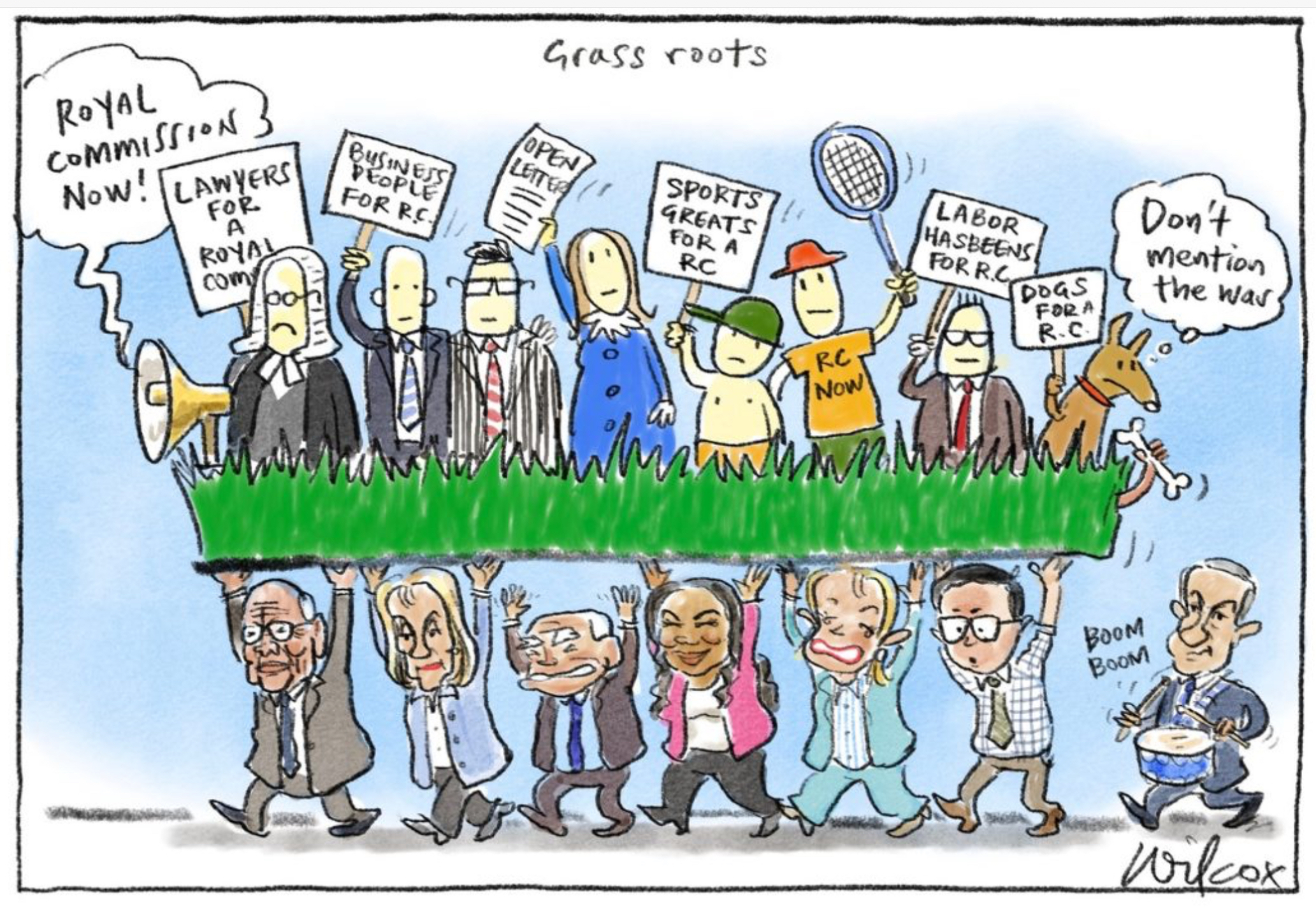
One of those jokes landed, flatly, on January 7 when the otherwise circumspect Age and Sydney Morning Herald published a caricature drawn by the award-winning cartoonist Cathy Wilcox. It presented those calling for a forthcoming royal commission into antisemitism as naïve participants in a hierarchy of manipulation. At the surface were the petitioners themselves; beneath them senior Coalition figures – Sussan Ley, Jacinta Nampijinpa Price, John Howard, David Littleproud – alongside Rupert Murdoch and Jillian Siegel, lawyer, businesswoman and Australia’s Special Envoy to Combat Antisemitism; and behind them all, setting the rhythm, Israel’s prime minister, Benjamin Netanyahu. Each layer marched to a beat not its own.

Cathy Wilcox cartoon, SMH 7 January 2026

Critics argued that the image revived a familiar and corrosive trope: the suggestion of hidden Jewish influence directing political life from the shadows. The cartoon, titled Grass roots, depicts a cluster of foolish-looking figures demanding a royal commission. They are presumably meant to represent the families of the dead, as well as lawyers, judges, business leaders and sporting figures who had urged government action long before the Prime Minister concluded that continued indifference might stain his legacy. When he finally announced a royal commission—expanded, without explanation, to include the elastic phrase “social cohesion”—no journalist paused to ask what that addition was meant to clarify.

In the drawing, a dog stands among these Australians, holding a placard and thinking, “Don’t mention the war.” The grass beneath their feet is supported by a menacing cast: and stock villains of the anti-Zionist imagination. The implication is unmistakable: that the pleas of grieving families and prominent citizens are neither organic nor sincere, but choreographed – another performance conducted from afar.

That implication did not arise in isolation. Across social and mainstream media, many progressives called for Jillian Segal to be removed and her report rejected out of hand. Others elevated Jewish critics of the war, of Zionism, or of Netanyahu as moral exemplars – “good Jews,” “some Jews tell the truth” – as if Jewish legitimacy were contingent on ideological alignment.  Some wrote openly that Jews, “for their numbers,” exercised excessive influence. One circulating meme complained, “We didn’t vote for a Zionist voice”, whilst other posts informed their echo chamber that Chabad Bondi, a branch of the global Jewish outreach organisation, which had organised the Hanukkah gathering on the fateful Sunday evening and also the local commemorations for the victims (and later, the tribute at the Sydney Opera House) was but another tentacle of the sinister and  uber-influential Jewish Lobby. Some of the most incongruous postings have been of ultra Orthodox Jews – Haredim – with signs condemning the Gaza war and Zionism, as if to say these are the authentic, “good” Jews. Some footage actually shows Haredim protesting against the Israeli government’s efforts to conscript exempt yeshiva students into the IDF – but, as they say, every picture tells a story.

Running beneath this was a persistent misconception. Judaism was treated as a religion, detachable and voluntary, rather than as an ethnoreligious identity shaped by lineage, memory and shared fate. Jews were asked not simply to oppose Israeli policy but to renounce their “homeland,” their inheritance, their sense of collective belonging. Census figures were deployed to minimise Jewish presence, overlooking the fact that many Jews, with Germany in the 1930s still in mind, remain reluctant to advertise religious affiliation. Genealogical platforms tell a different story: the number of people who discover Jewish ancestry far exceeds those who publicly profess the faith.

Another factor further clouds understanding. Jews are rarely dogmatically regarded as part of what Australians loosely call our “multicultural” society – a variegated demographic more often reserved for the post–White Australia waves of migration – communities that are visibly non-European or culturally distinct. Jews slipped beneath that radar. Many arrived well before the Second World War, and those who came before and after tended to integrate, to go mainstream, to succeed, and therefore not to stand out.

As a result, Jews were quietly folded into an older Judeo-Christian demographic, grouped alongside Protestants and Catholics as part of the cultural furniture rather than recognised as a minority with a distinct history and vulnerability. In most urban, and even regional settings, many Australians would be unaware that Jewish families live among them at all. At the same time, a surprising number of people carry Jewish ancestry several generations back, or are connected through marriage or descent, without regarding this as identity in any conscious way.

This invisibility cuts both ways. It has allowed Jews to belong without friction, but it has also made Jewishness strangely abstract – easy to misclassify as belief rather than continuity, easy to overlook as lived experience, and easy, when political passions rise, to treat as conditional.

Here the paradox sharpens, particularly among progressives. There is genuine respect for Indigenous Australians’ reverence for history, genealogy and Country: an understanding that identity is inherited as much as chosen, that land carries memory and obligation across generations. Yet the Jewish connection to Zion is denied that same conceptual dignity. What is recognised as ancestral continuity in one case is dismissed in the other as theology, nationalism or ideology.

The inconsistency is telling. Jewish attachment to place is stripped of its historical depth and cultural persistence, judged by standards not applied elsewhere. In that light, the cartoon does more than offend. It gives visual form to a deeper habit of thought: one that sorts Jews into acceptable and unacceptable categories, organic grief and foreign orchestration, legitimate belonging and suspect attachment- depending on who is being asked to explain themselves, and to whom.

All of this helps to explain the dangerous and disturbing upsurge in antisemitism over the past two years and earlier.

The Bondi massacre did not invent anti-Semitism in Australia; it exposed a system already bent, quietly, against seeing it. Two recent articles in The Australian show in complementary ways two faces of the same failure: one structural, one intimate. On the one hand, Professor Timothy Lynch diagnoses the intellectual and institutional blindness that allows hatred to incubate unchecked; on the other, author Lee Kofman shows the personal toll when grief itself is made conditional on passing someone else’s moral purity test. Together, they reveal a society in which moral frameworks have become cages rather than guides.

For decades, Australian multiculturalism has performed a delicate contortion: apologising for its own history while demanding loyalty from newcomers. Original British settlement is framed as a sin; multiethnic immigration is a progressive corrective. The paradox, Lynch notes, is that the very order migrants join is simultaneously denigrated by the leaders they are expected to trust. Within this structure, Jews occupy an uncomfortable space: electorally negligible, culturally visible, historically persecuted, yet paradoxically recoded as white and colonial. Zionism – a project of survival and refuge – is reframed as a form of imperial wrongdoing, while other nationalisms pass without scrutiny. Anti-Semitism, filtered through progressive identity politics, becomes an exception to the very rules designed to prevent harm.

Bondi rendered these abstract asymmetries concrete. The massacre forced recognition that anti-Semitism, once dismissed as campus rhetoric or aestheticised resistance, could and would become lethal.

Author’s note …

This opinion piece is one of several on the attitudes of progressives towards the Israel, Palestine and the Gaza war.

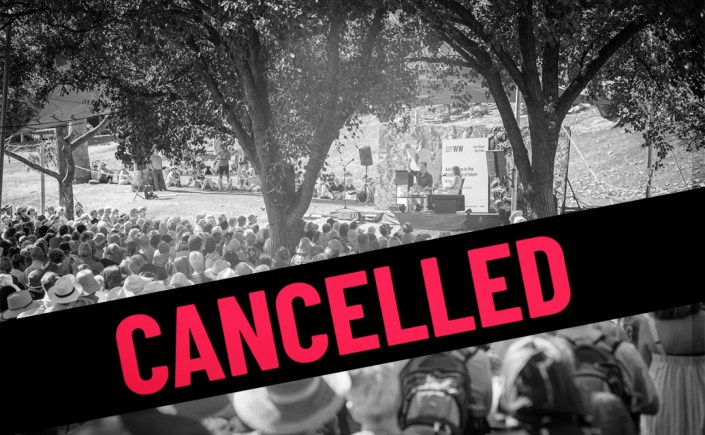
The first is Moral capture, conditional empathy and the failure of shock, a discussion on why erstwhile liberal, humanistic, progressive people from all walks of life have been caught up in what can be without subtly described as that anti-Israel machinery Shaping facts to feelings – debating intellectual dishonesty– regarding the Gaza war, intellectual dishonesty is everywhere, on both sides of the divide, magnified by mainstream and social media’s hunger for moral simplicity and viral outrage. Standing on the high moral ground is hard work! discusses the issues of free speech and “cancellation”, and boycotts with regard to the recent self-implosion of the Adelaide Writers’ Festival, one of the country’s oldest and most revered.

There are moments when public argument stops being a search for truth and becomes a test of belonging. Facts are no longer weighed so much as auditioned; empathy is rationed; moral language hardens into a badge system, issued and revoked according to rules everyone seems to know but few are willing to articulate. One learns quickly where the trip-wires are, which sympathies are permitted, which questions are suspect, and how easily tone can outweigh substance.

What interests me here is not the quarrel itself – names, borders, histories—but the habits of mind it exposes. The ease with which conviction can slide into choreography. The way intellectual honesty is praised in the abstract and punished in practice. The curious transformation of empathy from a human reflex into a conditional licence, granted only after the correct declarations have been made.

Across these pieces I circle the same uneasy terrain: the shaping of facts to fit feelings; the capture of moral language by ideological gravity; the performance of righteousness as both shield and weapon. Cultural spaces that once prided themselves on curiosity begin to resemble courts, where innocence and guilt are presumed in advance and the labour lies not in thinking, but in signalling.

This is not an argument against passion, nor a plea for bloodless neutrality. It is, rather, a meditation on how quickly moral seriousness curdles into moral certainty – and how much intellectual work is required to stand on what we like to call the high ground without mistaking altitude for clarity.

The position of In That Howling Infinite with regard to Palestine, Israel and the Gaza war is neither declarative nor devotional; it is diagnostic. Inclined – by background, sensibility, and experience – to hold multiple truths in tension, to see, as the song has it, the whole of the moon. It is less interested in arriving at purity than in resisting moral monoculture and the consolations of certainty. That disposition does not claim wisdom; it claims only a refusal to outsource judgment or to accept unanimity as a proxy for truth.

On Zionism, it treats it not as a slogan but as a historical fact with moral weight: the assertion – hard-won, contingent, imperfect – that Jews are entitled to collective political existence on the same terms as other peoples. According to this definition, this blog is Zionist. It is not interested in laundering Israeli policy, still less in romanticising state power, but rejects the sleight of hand by which Israel’s existence is transformed from a political reality into a metaphysical crime. Zionism is not sacred, but its delegitimisation is revealing – because it demands from Jews what is demanded of no other nation: justification for being.

On anti-Zionism, it has been unsparing. It sees it not as “criticism of Israel” (which you regard as both legitimate and necessary) but as a categorical refusal to accept Jewish collective self-determination. What troubles it most is not its anger but its certainty: its moral absolutism, its indifference to history, its willingness to borrow the language of justice to license erasure. It is attentive to how anti-Zionism recycles older antisemitic patterns – collectivisation of guilt, inversion of victimhood, and the portrayal of Jews as uniquely malignant actors – while insisting, with studied innocence, that none of this concerns Jews at all. If not outright antisemitism, the line separating it from anti-Zionism is wafer—thin, and too often crosses over.

The interest in moral capture is analytical rather than accusatory. It is not arguing that writers, academics, or institutions are malicious; rather, it argues that they have become intellectually narrowed by the desire to belong to the “right side of history.” Moral capture explains how good intentions curdle into dogma, how solidarity becomes performative, and how the fear of social exile replaces the discipline of thought. It accounts for the strange phenomenon whereby intelligent people outsource their moral judgment to slogans, and experience constraint not as an intolerable injury to the self.

The Adelaide Writers’ Festival affair iss seen not primarily about Randa Abdel-Fattah, nor even about free speech. It is a case study in institutional failure and cultural self-deception. The mass withdrawals are viewed not as acts of courage or principle but as gestures of affiliation – ritualised displays of virtue by people largely untouched by the substance of the dispute. What is disturbing is the asymmetry: the speed with which a festival collapsed to defend eliminationist rhetoric, and the silence that greeted the doxxing, intimidation, and quiet cancellation of Jewish writers and artists. Adelaide did not fall because standards were enforced, but because those standards were applied selectively and then disowned at the first sign of reputational discomfort.

Running through all of this is a consistent stance: a resistance to moral theatre, an impatience with historical amnesia, and a belief that intellectual honesty requires limits – on language, on fantasy, and on the indulgent belief that one’s own righteousness exempts one from consequence.

We are not asking culture to choose sides; you are asking it to recover judgment

.See in In That Howling Infinite, A Political World – Thoughts and Themes, and A Middle East Miscellany. and also: This Is What It Looks Like“You want it darker?” … Gaza and the devil that never went away … , How the jihadi tail wags the leftist dog, The Shoah and America’s ShameKen Burns’ sorrowful masterpiece, and Little Sir Hugh – Old England’s Jewish Question

Shaping facts to feelings – debating intellectual dishonesty

In early November last year, we published The most nihilistic war ever …Sudan’s waking nightmare, a harrowing piece about the atrocities being committed in the West Dharfur region of civil-war torn Sudan. A  friend commented on the article, accusing me of intellectual dishonesty in comparing the international outcry over Gaza to the silence on Sudan. His comment was not the first of similar justifications:

“ … with respect to the lack of outrage, the mainstream media can stir outrage on any topic when its political masters and financial backers want it to. Why has it not done so in this instance? Follow the money is one rule of thumb. I assume it suits the powers that be to let the slaughter continue. I hope more people are inspired to become activists against this dreadful situation, but public opinion tends to follow the narrative manufactured by the media more than impel it. When it comes to pro-Palestinian activism it is the story of a long hard grind of dedicated protestors to get any traction at all against the powerful political and media interests which have supported the Israeli narrative and manufactured global consent for the genocide  of Palestinians over many years. And still, although the tide is gradually turning, the West supports Israel to the hilt and crushes dissent. Using the silence in the media and in the streets over the slaughter in Sudan as an excuse to try and invalidate pro-Palestinian activism is a low blow and intellectually dishonest”.

This response is articulate and impassioned, but it also illustrates precisely the reflexive narrowing of moral vision that the comparison between Gaza and Sudan was meant to illuminate. His argument hinges on a familiar syllogism: that Western media outrage is never organic but always orchestrated (“follow the money”), that silence on Sudan therefore reflects elite indifference rather than public apathy, and that to highlight that silence is somehow to attack or “invalidate” the legitimacy of pro-Palestinian activism. It is a neat, closed circuit – morally reassuring, rhetorically watertight, but intellectually fragile.

In That Howling Infinite quizzed ChatGPT to collate, distill definitions and explanations of intellectual dishonest because we sensed its presence everywhere in the debate, including – uncomfortably – around my own thinking. Not as accusation, but as inquiry. The Gaza war has a peculiar way of forcing moral positions to harden quickly, of rewarding certainty and punishing hesitation, of turning complexity into suspicion. In that climate, asking what intellectual dishonesty actually looks like felt less like an abstract exercise than a necessary act of self-defence.

An ideological  comfort zone

Intellectual dishonesty, then, is the deliberate or unconscious use of argument, rhetoric, or selective reasoning to defend a position one knows – or should know – is incomplete, misleading, or false. It is less about lying outright and more about distorting truth for ideological comfort. It includes cherry-picking evidence, using double standards, appealing to emotion over reason, or refusing to acknowledge valid counterarguments. You could even call it “lying to oneself”, and truth be told, we are all guilty at one time or another.

Regarding the Gaza war, intellectual dishonesty is everywhere, on both sides of the divide, magnified by mainstream and social media’s hunger for moral simplicity and viral outrage. What begins as solidarity curdles into slogan; what starts as empathy ossifies into orthodoxy. And because this conflict sits at the intersection of history, identity, trauma, and power, the temptation to simplify—to choose a side and suspend thinking is especially strong.

I asked the question, then, not to sit in judgement above the fray, but to understand how easily moral seriousness can slip into moral performance, and how even good intentions can narrow rather than enlarge our field of vision.

Intellectual dishonesty is rarely the bald lie. More often it is the careful omission, the selective emphasis, the comfortable narrowing of vision that allows us to remain morally certain while thinking we are being rigorous. It is the use of argument, rhetoric, or evidence not to discover what is true, but to defend what feels right. Cherry-picking, double standards, euphemism, emotional substitution for analysis, the refusal to sit with uncomfortable counter-truth – these are not failures of intelligence so much as failures of discipline. They are the betrayal of thought in service of tribe.

Nowhere is this more visible than in the discourse surrounding Gaza. On all sides, intellectual dishonesty flourishes, amplified by mainstream and social media systems that reward moral clarity over moral accuracy, outrage over comprehension, and certainty over doubt. The war has become not merely a catastrophe but a stage upon which external protagonists perform their own identities, anxieties, and loyalties.

On the pro-Israel side, intellectual dishonesty often takes the form of moral laundering. Hamas’s atrocities – October 7, the hostages, the tunnels, the use of UN personnel and facilities – are rightly invoked, but too often as a solvent that dissolves all subsequent scrutiny. Civilian deaths become “collateral damage,” mass destruction becomes operational necessity, and a stateless, blockaded and exposed population is rhetorically elevated into a symmetrical belligerent confronting one of the most powerful militaries on earth. Euphemisms do heavy lifting: “targeted strikes,” “human shields,” “complex urban environments.” Criticism of Israeli policy is collapsed into antisemitism, not to defend Jewish safety but to foreclose moral argument. What is omitted – the occupation, the blockade, the decades of dispossession and accumulated trauma – is as important as what is said.

On the pro-Palestinian side, dishonesty manifests differently but no less pervasively. Moral outrage hardens into narrative absolutism. Hamas’s crimes are erased, justified, or absorbed into the abstraction of “muqawama”, resistance, or “sumud”, resilience, collapsing the distinction between combatant and civilian. Violence is romanticised, militants transfigured into symbols, their authoritarianism and indifference to Palestinian life quietly excised. Empathy becomes selective: Gazan children are mourned, Israeli families are passed over, or worse, subsumed into theory. History is flattened into a single moment of victimhood, stripped of Arab politics, Islamist extremism, regional failure, and internal Palestinian fracture. The powerful are cast as pure evil, the powerless as pure good, until reality itself becomes an inconvenience.

Mainstream media does not correct this; it accelerates it. Impartiality is performed while distortion is practised. Headlines flatten causality, images are severed from context, asymmetry is neutralised by “both sides” language. Social media perfects the process. Algorithms reward fury, not thought; spectacle, not inquiry. Influencers weaponise empathy itself – choosing which corpses to count, which cities to name, which pictures to publish (sometimes none to fussy about which war they portray), and which griefs to amplify. Moral clarity is produced without moral responsibility.

Beneath all this lies a deeper dishonesty, one that is existential rather than rhetorical. Each side insists its justice is indivisible, when in truth each vision of justice requires the other’s erasure. Gaza becomes less a human tragedy than a mirror onto which Western actors project their unresolved conflicts about empire, identity, guilt, and power. It is here that intellectual dishonesty ceases to be merely argumentative and becomes moral.

This is where the comparison with Sudan – and any forgotten or ignored war in this sad world – becomes instructive and also uncomfortable. When the relative silence surrounding Sudan’s catastrophe is raised, it is often dismissed as “whataboutism” or as an attempt to diminish Palestinian suffering. That response itself reveals the problem. The point is not to weigh body counts or rank atrocities, but to interrogate how empathy is distributed. Why does one horror become the world’s moral touchstone while another, no less vast or humanly devastating, barely registers?

The easy answer – “follow the money,” “manufactured outrage” – “media conspiracy” – “the Jewish Lobby” – is reassuring but incomplete. Western silence on Sudan is less conspiracy than exhaustion. Sudan offers no tidy morality play. No clean colonial narrative. No villains easily costumed for Instagram. Its war is fragmented, internecine, post-ideological: warlords, militias, foreign patrons, gold under rubble. It resists hashtags. Gaza, by contrast, offers clarity, identity, and the comforting architecture of blame. Victims and oppressors are sharply drawn; the script is familiar; moral alignment confers belonging.

In Sudan, millions starve while the gold glitters in the darkness deep beneath their feet. In Gaza, ruins are televised, moralised, and weaponised. Both are human catastrophes. Only one has an audience.

To point this out is not to invalidate solidarity with Gaza. It is to expose the limits of our moral imagination. Empathy that depends on narrative simplicity is not universalism; it is performance. Compassion that requires a script is conditional. If justice is truly the aspiration, it must be capacious enough to grieve Darfur and Khartoum alongside Gaza City, to care even when the cameras turn away.

Bringing it all back home  …

And this brings the argument uncomfortably close to home. Are we too guilty of intellectual dishonesty? To be I honest, yes – probably, at least sometimes. But then, who isn’t? The Gaza war is a moral minefield where even careful minds lose their footing. Passion bends the lens; grief distorts perspective; certainty is seductive. No one who cares deeply escapes the pull of identification.

Endeavouring to see all sides of an argument, age, experience, knowledge, empathy – and a growing impatience with historical illiteracy and intellectual laziness – inevitably shape what we see. A lifetime hatred of antisemitism runs through them as well, a moral watermark that does not fade simply because the world grows louder. These influences are not disclaimers; they are facts. Not excuses, merely coordinates. If an argument is bent  to fit a moral arc, felt more keenly for one set of victims, or wearied of slogans masquerading as history, then yes -we have been partial.

The difference lies in knowing it. Intellectual dishonesty becomes moral failure only when it is unacknowledged, when narrative becomes more important than truth, when the lens is never turned inward. What resists dishonesty is reflexivity: the willingness to ask whether one is being fair, whether one is seduced by one’s own argument, whether omission has crept in disguised as clarity.

So yes – guilty, but aware. Fallible, but striving. He who is without sin, after all, should be cautious about throwing stones, especially from within a glasshouse. Perhaps that is as close as any of us come to honesty: to keep turning the lens back on ourselves, again and again, until the view clears – or at least steadies enough to see by.

And that, is arguably not a failure of honesty but a condition of it. To articulate one’s influences is to refuse the pretence of neutrality, to acknowledge that objectivity is not the absence of bias but the discipline of recognising it. Impatience with ignorance is, at its core, a moral impatience: a refusal to see human tragedy flattened into slogans or history reduced to talking points. The danger, of course, is fatigue – after decades of watching the same horrors recur, empathy can harden into exasperation. But awareness of that tendency is itself a safeguard.

We are participants in the long conversation of conscience – who know that clarity and compassion rarely sit still in the same chair, but who insists they at least keep talking. In an age that prizes certainty above understanding, that may be the most honest posture left: to keep turning the lens back on ourselves,, resisting the comfort of tribe, and refusing to let thought become merely another form of allegiance.

Author’s  Note …

This opinion piece is one of several on the the attitudes of progressives towards the Israel, Palestine and the Gaza war. The first is Moral capture, conditional empathy and the failure of shock, a discussion on why erstwhile liberal, humanistic, progressive people from all walks of life have been caught up in what can be without subtly described as that anti-Israel machinery.Standing on the high moral ground is hard work! discusses the issues of free speech and “cancellation”, and boycotts with regard to the recent self-implosion of the Adelaide Writers’ Festival, one of the country’s oldest and most revered.

There are moments when public argument stops being a search for truth and becomes a test of belonging. Facts are no longer weighed so much as auditioned; empathy is rationed; moral language hardens into a badge system, issued and revoked according to rules everyone seems to know but few are willing to articulate. One learns quickly where the trip-wires are, which sympathies are permitted, which questions are suspect, and how easily tone can outweigh substance.

What interests me here is not the quarrel itself – names, borders, histories—but the habits of mind it exposes. The ease with which conviction can slide into choreography. The way intellectual honesty is praised in the abstract and punished in practice. The curious transformation of empathy from a human reflex into a conditional licence, granted only after the correct declarations have been made.

Across these pieces I circle the same uneasy terrain: the shaping of facts to fit feelings; the capture of moral language by ideological gravity; the performance of righteousness as both shield and weapon. Cultural spaces that once prided themselves on curiosity begin to resemble courts, where innocence and guilt are presumed in advance and the labour lies not in thinking, but in signalling.

This is not an argument against passion, nor a plea for bloodless neutrality. It is, rather, a meditation on how quickly moral seriousness curdles into moral certainty – and how much intellectual work is required to stand on what we like to call the high ground without mistaking altitude for clarity.

The position of In That Howling Infinite with regard to Palestine, israel and the Gaza war is neither declarative nor devotional; it is diagnostic. Inclined – by background, sensibility, and experience – to hold multiple truths in tension, to see, as the song has it, the whole of the moon. It is less interested in arriving at purity than in resisting moral monoculture and the consolations of certainty. That disposition does not claim wisdom; it claims only a refusal to outsource judgment or to accept unanimity as a proxy for truth.

On Zionism, it treats it not as a slogan but as a historical fact with moral weight: the assertion – hard-won, contingent, imperfect – that Jews are entitled to collective political existence on the same terms as other peoples. According to this definition, this blog is Zionist. It is not interested in laundering Israeli policy, still less in romanticising state power, but rejects the sleight of hand by which Israel’s existence is transformed from a political reality into a metaphysical crime. Zionism is not sacred, but its delegitimisation is revealing – because it demands from Jews what is demanded of no other nation: justification for being.

On anti-Zionism, it has been unsparing. It sees it not as “criticism of Israel” (which you regard as both legitimate and necessary) but as a categorical refusal to accept Jewish collective self-determination. What troubles it most is not its anger but its certainty: its moral absolutism, its indifference to history, its willingness to borrow the language of justice to license erasure. It is attentive to how anti-Zionism recycles older antisemitic patterns – collectivisation of guilt, inversion of victimhood, and the portrayal of Jews as uniquely malignant actors – while insisting, with studied innocence, that none of this concerns Jews at all. If not outright antisemitism, the line separating it from anti-Zionism is wafer—thin, and too often crosses over. 

The interest in moral capture is analytical rather than accusatory. It is not arguing that writers, academics, or institutions are malicious; rather, it are argues that they have become intellectually narrowed by the desire to belong to the “right side of history.” Moral capture explains how good intentions curdle into dogma, how solidarity becomes performative, and how the fear of social exile replaces the discipline of thought. It accounts for the strange phenomenon whereby intelligent people outsource their moral judgment to slogans, and experience constraint not as an intolerable injury to the self.

The Adelaide Writers’ Festival affairis seen not primarily about Randa Abdel-Fattah, nor even about free speech. It is a case study in institutional failure and cultural self-deception. The mass withdrawals are viewed not as acts of courage or principle but as gestures of affiliation – ritualised displays of virtue by people largely untouched by the substance of the dispute. What is disturbing is the asymmetry: the speed with which a festival collapsed to defend eliminationist rhetoric, and the silence that greeted the doxxing, intimidation, and quiet cancellation of Jewish writers and artists. Adelaide did not fall because standards were enforced, but because those standards were applied selectively and then disowned at the first sign of reputational discomfort.

Running through all of this is a consistent stance: a resistance to moral theatre, an impatience with historical amnesia, and a belief that intellectual honesty requires limits – on language, on fantasy, and on the indulgent belief that one’s own righteousness exempts one from consequence.

We are not asking culture to choose sides; you are asking it to recover judgment

.See in In That Howling Infinite, A Political World – Thoughts and Themes, and A Middle East Miscellany. and also: This Is What It Looks LikeYou want it darker?” … Gaza and the devil that never went away … , How the jihadi tail wags the leftist dog, The Shoah and America’s Shame – Ken Burns’ sorrowful masterpiece, and Little Sir Hugh – Old England’s Jewish Question

Moral capture and conditional empathy

In This Is What It Looks Like, published very soon after the Bondi Beach massacre, we wrote:

“Facebook fills with empathetic words and memes from politicians, public figures and keyboard activists who spent the past two years condemning Israel in ways that blurred – and often erased – the distinction between Israeli policy and Jewish existence, creating at best, indifference to Jewish fear and, at worst, a permissive climate of hostility toward Jews as such. Today it is all tolerance, inclusivity and unity – and an air of regret and reverence that reeks of guilt.

But not all. Social media has fractured along familiar lines. At one extreme are conspiracy theories — false flags, invented victims, claims the attackers were Israeli soldiers. At the other is denial: what antisemitism? Between them sits a more revealing response. There is genuine shock and horror, even remorse – but also a careful foregrounding of the Syrian-Australian man who intervened, coupled with a quiet erasure of the victims’ Jewishness; a reflexive turn to whataboutism; and a refusal, even now, to relinquish the slogans and moral habits of the past two years. If antisemitism is acknowledged at all, it is ultimately laid at the feet of Israeli prime minister Binyamin Netanyahu.

Why this reticence, we asked, this resistance to reassessment after the Bondi attack? Perhaps it lay less in ideology than in psychology. For some, was there is a simple inability to relinquish prior convictions – positions publicly held, repeatedly performed, and now too entangled with identity to abandon without cost. For others, was it perhaps a deeper reluctance to acknowledge having been misinformed or misdirected, an admission that would require not just intellectual correction but moral self-reckoning? Was it that empath has become selective: extending it fully to Jewish victims would require suspending, even briefly, a framework that collapses Jewish identity into the actions of the Israeli state. And finally, we asked whether many were no longer reasoning freely at all, but are caught inside the machinery – the rhythms of platforms, slogans, group loyalties and algorithmic reinforcement – where reconsideration feels like betrayal and pause feels like capitulation.

Indeed, since October 7, 2023, In That Howling Infinite has pondered why erstwhile liberal, humanistic, progressive people from all walks of life have been caught up in what can be without subtly described as that anti-Israel machinery referred to above in which opposition at a safe distance to what is seen as Netanyahu’s genocidal Gaza war has seen professed anti-Zionism entangled with anti-Semitism.

What we are witnessing is not a fringe radicalisation but a moral capture: people who would once have prided themselves on scepticism, nuance and historical memory now moving in formation, repeating slogans whose lineage they neither examine nor recognise. The machinery works precisely because it flatters their self-image. It offers the intoxication of righteousness without the burden of precision; solidarity without responsibility; protest without consequence.

This is not old-style antisemitism with its crude caricatures and biological myths. It is something more elusive – and therefore more powerful. It presents itself as ethics, as international law, as human rights discourse scrubbed clean of Jewish history. Israel becomes not a state among states but a symbol onto which every colonial sin can be projected. Complexity is treated as evasion; context as complicity. The very habits of mind that once defined liberal humanism – distinction, proportion, tragic awareness – are recoded as moral failure.

And because the animating energy is moral rather than ethnic, many participants genuinely believe themselves immune to antisemitism. They do not hate Jews; they merely deny Jews the one thing liberalism once insisted all peoples possess: the right to historical contingency, to imperfect self-determination, to moral fallibility without metaphysical damnation. That is how an ancient prejudice survives under a modern flag.

What makes this moment particularly dangerous is that the capture extends across institutions that once acted as guide rails and  backstops: universities, cultural organisations, media, NGOs, even parts of the political class. When the liberal centre internalises a narrative, it no longer needs coercion; it polices itself. Silence becomes virtue. Dissent becomes indecency. The boundaries of acceptable speech narrow – not by law, but by moral shaming.

This is why inquiries and commissions feel inadequate, even faintly beside the point. The problem is not that we do not know enough. It is that too many people who should know better have decided – consciously or otherwise – that some falsehoods are useful, some hatreds understandable, some erasures permissible.

History suggests these moments do not end because facts finally win an argument. They end when enough people recover the nerve to say: this is not true, this is not proportionate, this is not who we are. That requires intellectual courage before it requires policy – and at the moment, courage is in shorter supply than outrage.

What, then, do we actually mean by moral capture?
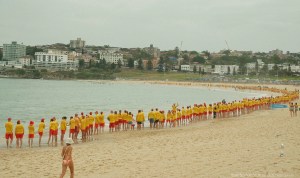
An intellectual box canyon

It describes a condition in which an individual or group becomes psychologically, socially, and culturally enclosed within a moral framework so totalising that it can no longer be revised or questioned without threatening their sense of self. It is best understood not as a theory, still less as a conscious posture, but as a lived and almost tangible condition: a quiet enclosure of mind and conscience in which questioning the framework feels not merely wrong, but personally destabilising. It is not simply ideology or prejudice, but a subtle narrowing of moral imagination—a shaping of what can be felt, what can be said, and ultimately, what can be seen.

Under moral capture, empathy becomes conditional. It travels only so far before it threatens the moral story we have already committed to, the narrative through which we recognise ourselves as good. Judgement is no longer exercised independently but is subordinated to alignment. We begin thinking from conclusions rather than reasoning toward them, measuring the world not against principle but against the positions we have already staked as right. Certain conclusions feel self-evident; certain questions become illegitimate; doubt itself starts to register as moral weakness rather than intellectual honesty.

Positions once held as views harden into identity, reinforced by social approval, public performance, and the feedback loops of online life. People can feel sincere, committed, and righteous even as their capacity to notice contradiction, hold tension, or revise belief steadily diminishes. What is lost is not feeling, but freedom—the freedom to think, to hesitate, and to change one’s mind.

In a phrase, moral capture is an intellectual box canyon: wide at the entrance, reassuringly coherent and morally clear once inside, but increasingly difficult to exit without retracing your steps

Our moral choices, once optional, become invested in our identity. What we once held as a conviction now defines us, fuses with our sense of self, our social belonging, our reputation. And habits reinforce themselves. Ritualised moral performances, applause from peers, and the accelerating feedback of online platforms harden the framework, making reconsideration feel not just difficult, but almost impossible.

In this state, otherwise humane, intelligent people can feel virtuous, committed, and righteous while the breadth of their moral imagination steadily narrows. Certain truths -even the most visible – become unsayable. Empathy grows selective. The unthinkable becomes thinkable, so long as it fits the story our framework allows.

This essay is my attempt to explore moral capture as it happens in real time: to see how it shapes our response to atrocity, how it bends grief and outrage, and why even shock – when filtered through these habits – becomes partial, provisional, and fragile.

Conditional empathy and the failure of shock

In That Howling Infinite did not begin thinking about moral capture because it was looking for a new explanatory framework, nor because it believed itself morally exempt from the currents of the moment. Rather, because in the aftermath of the Bondi atrocity something felt profoundly unsettled – not only tragic, but discordant. The language of grief arrived swiftly and abundantly. Condolences were offered, candles lit, unity invoked. And yet this display sat uneasily alongside two years of rhetoric in which Jewish fear had been minimised, relativised, or quietly absorbed into a moral narrative that treated Israel not as a state among others, but as a singular moral contaminant.

What was disturbing was not the outrage directed at Gaza. The suffering there is real, appalling, and morally unavoidable. Israel’s retaliation has been devastating and, in many instances, disproportionate. Reasonable people can, and must, grapple with that reality. What was troubling was how easily that outrage had slid, over time, into habits of thought that blurred distinctions which once mattered: between state and people, policy and identity, criticism and contempt. The taboo on antisemitism, long assumed to be settled history, began to look less like a moral achievement than a conditional courtesy.

After Bondi, we did not expect a mass moral conversion or  imagine that people who had spent two years publicly performing righteous indignation would suddenly execute a full reversal – a neat return to complexity, restraint and tragic awareness. That would have been unrealistic, perhaps even unfair. What we did expect, and hoped for, was hesitation. A pause. A moment of reassessment. An acknowledgement, however tentative, that something in the moral atmosphere had gone wrong.

Instead, what emerged was something more revealing: grief without revision; empathy carefully bounded; sorrow hedged with qualifications. The familiar “Ah, but…” arrived almost on cue. It was there, in that reflex, that we began to see the outline of a deeper phenomenon – not simple prejudice, not even ideology, but moral capture.

Moral capture occurs when a moral framework that once helped organise reality becomes totalising – so emotionally, socially and symbolically reinforced that it can no longer be revised without threatening the self who holds it. At that point, facts do not merely challenge the framework; they imperil identity. And when identity is at stake, reason quietly steps aside.

One of the clearest signs of moral capture is the collapse of distinctions. Israeli policy becomes Jewish existence. Jewish fear becomes political theatre. Antisemitism becomes a rhetorical device wielded by Benjamin Netanyahu. Violence against Jews becomes, if not justified, then contextualised into moral thinness. Language flattens. Precision feels like evasion. Context is treated as complicity.

This helps explain the strange choreography of response after Bondi. There was genuine shock and sorrow, even remorse. But it was accompanied by careful editorial choices: the foregrounding of a heroic rescuer, the quiet erasure of the victims’ Jewishness, the reflexive turn to whataboutism, the insistence – sometimes whispered, sometimes explicit – that responsibility lay elsewhere. Jewish suffering could be acknowledged only insofar as it did not demand a reckoning with the moral habits of the past two years.

Why this resistance? Part of the answer lies in identity as investment. For many on the modern left, opposition to Israel has not remained a policy position; it has hardened into a moral identity, publicly performed, socially rewarded, and algorithmically amplified. Positions once adopted as expressions of concern or solidarity have become entangled with one’s sense of self -who one is, where one belongs, what one signals to the world. To revise those positions now would involve not merely intellectual correction, but moral self-reckoning: admitting error, acknowledging harm, risking social alienation. That is a price most people instinctively avoid.

Solidarity, under these conditions, mutates into surrender. The capacity to stand with the vulnerable while retaining independent moral judgement is lost. Complexity becomes betrayal. Reassessment becomes cowardice. To pause is to hesitate; to hesitate is to defect. Moral reasoning gives way to moral alignment.

This process is intensified by platforms that act as algorithmic accelerants. Social media does not reward reflection; it rewards repetition with conviction. Moral language becomes compressed into slogans. Outrage is incentivised; nuance is penalised. Over time, people cease reasoning toward conclusions and begin reasoning from them. The machinery does the rest. Group loyalty replaces judgement. Reconsideration feels like capitulation.

In this environment, antisemitism does not need to announce itself. It seeps. It jokes. It chants. It flatters those who believe they are on the right side of history by assuring them that their anger is justice and their certainty courage. The world’s oldest hatred does what it has always done: it waits for permission. That permission is rarely granted all at once. It is granted gradually, rhetorically, respectably.

This is why Bondi did not “break the spell.” Atrocities shock only when the moral framework remains flexible enough to absorb them. Here, the framework was already closed. Violence could be mourned, but not allowed to destabilise the story that preceded it. Empathy could be expressed, but only within boundaries that preserved moral coherence. Jewish fear remained an inconvenience—something to be managed, not centred.

The habituation of moral capture meant that grief was permitted only insofar as it did not demand reassessment. Empathy was bounded, sorrow hedged, and moral recognition carefully staged. Those who might have been shocked into reflection instead performed selective empathy, affirming the gestures of mourning while leaving the architecture of two years of moral habit intact

Throughout this exploration, In That Howling Infinite  asked myself an uncomfortable question: do we lack the empathy and outrage that others so visibly express? Are we insufficiently moved? Insufficiently angry? We do not think so. Though saddened by Gaza and angered by unnecessary suffering, it is appalled by violence against Jews. What differs, perhaps, is not the presence of feeling but the habits through which it is processed. It’s background, sensibility and experience incline it toward holding multiple truths in tension – to see, as the song has it, the whole of the moon. That does not make it wiser, only more resistant to moral monoculture.

Moral capture is powerful precisely because it allows people to remain good in their own eyes while surrendering the disciplines that once made goodness durable. It does not feel like hatred. It feels like justice. It does not announce itself as intolerance. It presents as virtue.

What we have learned on this journey is not that outrage is illegitimate, nor that empathy must be rationed. It is that empathy becomes dangerous when it is conditional; that solidarity curdles when it demands surrender; and that moral frameworks, once weaponised against reconsideration, eventually turn on the very values they claim to defend.

History does not ask whether our intentions were pure. It asks what we normalised, what we tolerated, and what we allowed to be said in our name. Moral capture works hardest to ensure we never ask those questions of ourselves. The task now is not to abandon conviction, but to recover freedom it the freedom to doubt our own righteousness, to let empathy travel where it is inconvenient, and to remember that seeing only half the sky is not the same as moral clarity.

Only then do we begin to see the whole of the moon.

In That Howling Infinite  December 2025

Author’s note …

This opinion piece is one of several on the the attitudes of progressives towards the Israel, Palestine and the Gaza war. Shaping facts to feelings – debating intellectual dishonesty– regarding the Gaza war, intellectual dishonesty is everywhere, on both sides of the divide, magnified by mainstream and social media’s hunger for moral simplicity and viral outrage. Standing on the high moral ground is hard work! discusses the issues of free speech and “cancellation”, and boycotts with regard to the recent self-implosion of the Adelaide Writers’ Festival, one of the country’s oldest and most revered.

There are moments when public argument stops being a search for truth and becomes a test of belonging. Facts are no longer weighed so much as auditioned; empathy is rationed; moral language hardens into a badge system, issued and revoked according to rules everyone seems to know but few are willing to articulate. One learns quickly where the trip-wires are, which sympathies are permitted, which questions are suspect, and how easily tone can outweigh substance.

What interests me here is not the quarrel itself – names, borders, histories—but the habits of mind it exposes. The ease with which conviction can slide into choreography. The way intellectual honesty is praised in the abstract and punished in practice. The curious transformation of empathy from a human reflex into a conditional licence, granted only after the correct declarations have been made.

Across these pieces I circle the same uneasy terrain: the shaping of facts to fit feelings; the capture of moral language by ideological gravity; the performance of righteousness as both shield and weapon. Cultural spaces that once prided themselves on curiosity begin to resemble courts, where innocence and guilt are presumed in advance and the labour lies not in thinking, but in signalling.

This is not an argument against passion, nor a plea for bloodless neutrality. It is, rather, a meditation on how quickly moral seriousness curdles into moral certainty – and how much intellectual work is required to stand on what we like to call the high ground without mistaking altitude for clarity.

The position of In That Howling Infinite with regard to Palestine, israel and the Gaza war is neither declarative nor devotional; it is diagnostic. Inclined – by background, sensibility, and experience – to hold multiple truths in tension, to see, as the song has it, the whole of the moon. It is less interested in arriving at purity than in resisting moral monoculture and the consolations of certainty. That disposition does not claim wisdom; it claims only a refusal to outsource judgment or to accept unanimity as a proxy for truth.

On Zionism, it treats it not as a slogan but as a historical fact with moral weight: the assertion – hard-won, contingent, imperfect – that Jews are entitled to collective political existence on the same terms as other peoples. According to this definition, this blog is Zionist. It is not interested in laundering Israeli policy, still less in romanticising state power, but rejects the sleight of hand by which Israel’s existence is transformed from a political reality into a metaphysical crime. Zionism is not sacred, but its delegitimisation is revealing – because it demands from Jews what is demanded of no other nation: justification for being.

On anti-Zionism, it has been unsparing. It sees it not as “criticism of Israel” (which you regard as both legitimate and necessary) but as a categorical refusal to accept Jewish collective self-determination. What troubles it most is not its anger but its certainty: its moral absolutism, its indifference to history, its willingness to borrow the language of justice to license erasure. It is attentive to how anti-Zionism recycles older antisemitic patterns – collectivisation of guilt, inversion of victimhood, and the portrayal of Jews as uniquely malignant actors – while insisting, with studied innocence, that none of this concerns Jews at all. If not outright antisemitism, the line separating it from anti-Zionism is wafer—thin, and too often crosses over. 

The interest in moral capture is analytical rather than accusatory. It is not arguing that writers, academics, or institutions are malicious; rather, it are argues that they have become intellectually narrowed by the desire to belong to the “right side of history.” Moral capture explains how good intentions curdle into dogma, how solidarity becomes performative, and how the fear of social exile replaces the discipline of thought. It accounts for the strange phenomenon whereby intelligent people outsource their moral judgment to slogans, and experience constraint not as an intolerable injury to the self.

The Adelaide Writers’ Festival affairis seen not primarily about Randa Abdel-Fattah, nor even about free speech. It is a case study in institutional failure and cultural self-deception. The mass withdrawals are viewed not as acts of courage or principle but as gestures of affiliation – ritualised displays of virtue by people largely untouched by the substance of the dispute. What is disturbing is the asymmetry: the speed with which a festival collapsed to defend eliminationist rhetoric, and the silence that greeted the doxxing, intimidation, and quiet cancellation of Jewish writers and artists. Adelaide did not fall because standards were enforced, but because those standards were applied selectively and then disowned at the first sign of reputational discomfort.

Running through all of this is a consistent stance: a resistance to moral theatre, an impatience with historical amnesia, and a belief that intellectual honesty requires limits – on language, on fantasy, and on the indulgent belief that one’s own righteousness exempts one from consequence.

We are not asking culture to choose sides; you are asking it to recover judgment

.See in In That Howling Infinite, A Political World – Thoughts and Themes, and A Middle East Miscellany. and also: This Is What It Looks LikeYou want it darker?” … Gaza and the devil that never went away … , How the jihadi tail wags the leftist dog, The Shoah and America’s Shame – Ken Burns’ sorrowful masterpiece, and Little Sir Hugh – Old England’s Jewish Question

Looking for the “good Jews”

In This Is What It Looks Like, we wrote: “… antisemitism does not arrive announcing itself. It seeps. It jokes. It chants. It flatters those who believe they are on the right side of history, until history arrives and asks what they tolerated in its name”.

One of those jokes landed, flatly, on January 7 when the otherwise circumspect Age and Sydney Morning Herald published a caricature drawn by the award-winning cartoonist Cathy Wilcox. It presented those calling for a forthcoming royal commission into antisemitism as naïve participants in a hierarchy of manipulation. At the surface were the petitioners themselves; beneath them senior Coalition figures – Sussan Ley, Jacinta Nampijinpa Price, John Howard, David Littleproud – alongside Rupert Murdoch and Jillian Siegel, lawyer, businesswoman and Australia’s Special Envoy to Combat Antisemitism; and behind them all, setting the rhythm, Israel’s prime minister, Benjamin Netanyahu. Each layer marched to a beat not its own.
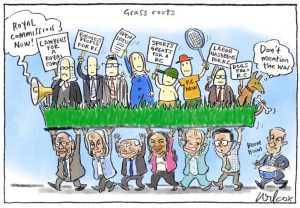
Cathy Wilcox cartoon, SMH 7 January 2026

Critics argued that the image revived a familiar and corrosive trope: the suggestion of hidden Jewish influence directing political life from the shadows. The cartoon, titled Grass roots, depicts a cluster of foolish-looking figures demanding a royal commission. They are presumably meant to represent the families of the dead, as well as lawyers, judges, business leaders and sporting figures who had urged government action long before the Prime Minister concluded that continued indifference might stain his legacy. When he finally announced a royal commission—expanded, without explanation, to include the elastic phrase “social cohesion”—no journalist paused to ask what that addition was meant to clarify.

In the drawing, a dog stands among these Australians, holding a placard and thinking, “Don’t mention the war.” The grass beneath their feet is supported by a menacing cast: and stock villains of the anti-Zionist imagination. The implication is unmistakable: that the pleas of grieving families and prominent citizens are neither organic nor sincere, but choreographed – another performance conducted from afar.

That implication did not arise in isolation. Across social and mainstream media, many progressives called for Jillian Segal to be removed and her report rejected out of hand. Others elevated Jewish critics of the war, of Zionism, or of Netanyahu as moral exemplars – “good Jews,” “some Jews tell the truth” – as if Jewish legitimacy were contingent on ideological alignment.  Some wrote openly that Jews, “for their numbers,” exercised excessive influence. One circulating meme complained, “We didn’t vote for a Zionist voice”, whilst other posts informed their echo chamber that Chabad Bondi, a branch of the global Jewish outreach organisation, which had organised the Hanukkah gathering on the fateful Sunday evening and also the local commemorations for the victims (and later, the tribute at the Sydney Opera House) was but another tentacle of the sinister and  uber-influential Jewish Lobby. Some of the most incongruous postings have been of ultra Orthodox Jews – Haredim – with signs condemning the Gaza war and Zionism, as if to say these are the authentic, “good” Jews. Some footage actually shows Haredim protesting against the Israeli government’s efforts to conscript exempt yeshiva students into the IDF – but, as they say, every picture tells a story.

Running beneath this was a persistent misconception. Judaism was treated as a religion, detachable and voluntary, rather than as an ethnoreligious identity shaped by lineage, memory and shared fate. Jews were asked not simply to oppose Israeli policy but to renounce their “homeland,” their inheritance, their sense of collective belonging. Census figures were deployed to minimise Jewish presence, overlooking the fact that many Jews, with Germany in the 1930s still in mind, remain reluctant to advertise religious affiliation. Genealogical platforms tell a different story: the number of people who discover Jewish ancestry far exceeds those who publicly profess the faith.

Another factor further clouds understanding. Jews are rarely dogmatically regarded as part of what Australians loosely call our “multicultural” society – a variegated demographic more often reserved for the post–White Australia waves of migration – communities that are visibly non-European or culturally distinct. Jews slipped beneath that radar. Many arrived well before the Second World War, and those who came before and after tended to integrate, to go mainstream, to succeed, and therefore not to stand out.

As a result, Jews were quietly folded into an older Judeo-Christian demographic, grouped alongside Protestants and Catholics as part of the cultural furniture rather than recognised as a minority with a distinct history and vulnerability. In most urban, and even regional settings, many Australians would be unaware that Jewish families live among them at all. At the same time, a surprising number of people carry Jewish ancestry several generations back, or are connected through marriage or descent, without regarding this as identity in any conscious way.

This invisibility cuts both ways. It has allowed Jews to belong without friction, but it has also made Jewishness strangely abstract – easy to misclassify as belief rather than continuity, easy to overlook as lived experience, and easy, when political passions rise, to treat as conditional.

Here the paradox sharpens, particularly among progressives. There is genuine respect for Indigenous Australians’ reverence for history, genealogy and Country: an understanding that identity is inherited as much as chosen, that land carries memory and obligation across generations. Yet the Jewish connection to Zion is denied that same conceptual dignity. What is recognised as ancestral continuity in one case is dismissed in the other as theology, nationalism or ideology.

The inconsistency is telling. Jewish attachment to place is stripped of its historical depth and cultural persistence, judged by standards not applied elsewhere. In that light, the cartoon does more than offend. It gives visual form to a deeper habit of thought: one that sorts Jews into acceptable and unacceptable categories, organic grief and foreign orchestration, legitimate belonging and suspect attachment- depending on who is being asked to explain themselves, and to whom.

All of this helps to explain the dangerous and disturbing upsurge in antisemitism over the past two years and earlier.

The Bondi massacre did not invent anti-Semitism in Australia; it exposed a system already bent, quietly, against seeing it. Two recent articles in The Australian show in complementary ways two faces of the same failure: one structural, one intimate. On the one hand, Professor Timothy Lynch diagnoses the intellectual and institutional blindness that allows hatred to incubate unchecked; on the other, author Lee Kofman shows the personal toll when grief itself is made conditional on passing someone else’s moral purity test. Together, they reveal a society in which moral frameworks have become cages rather than guides.

For decades, Australian multiculturalism has performed a delicate contortion: apologising for its own history while demanding loyalty from newcomers. Original British settlement is framed as a sin; multiethnic immigration is a progressive corrective. The paradox, Lynch notes, is that the very order migrants join is simultaneously denigrated by the leaders they are expected to trust. Within this structure, Jews occupy an uncomfortable space: electorally negligible, culturally visible, historically persecuted, yet paradoxically recoded as white and colonial. Zionism – a project of survival and refug e- is reframed as a form of imperial wrongdoing, while other nationalisms pass without scrutiny. Anti-Semitism, filtered through progressive identity politics, becomes an exception to the very rules designed to prevent harm.

Bondi rendered these abstract asymmetries concrete. The massacre forced recognition that anti-Semitism, once dismissed as campus rhetoric or aestheticised resistance, could and would become lethal. Lynch observes that progressive moral frameworks – micro-aggressions monitored, systemic racism theorised -stop precisely at the Jew. A royal commission, he argues, would not be vindictive; it would be a sober exercise in moral clarity, tracing the cultural and ideological currents that incubated violence. Yet the same cultural institutions that produced those currents remain invested in their own innocence, framing ideas as harmless discourse even as they provide tacit validation for hatred.

Kofman brings this insight down to the level of lived experience. Her grief, initially raw and private, became a public transaction. Condolences were offered, often, with moral caveats: critique Israel just so, moderate outrage, avoid triggering Islamophobia, defer to “Good Jews” as intermediaries for acceptable mourning. Grief, she realised, was conditional: to mourn fully, one had to pass a moral test. She claimed her place among the Bad Jews – those attached to ancestral lands, critical yet loyal, unbowed by external sensibilities. In doing so, she and others began to speak publicly, reclaiming authority over their grief and over the narrative of their own people. The silver lining, Kofman suggests, lies not in filtered approval from outsiders but in the courage of authenticity: listening, amplifying, and insisting on nuance.

Both authors reveal the same systemic dynamic from different angles: moral capture. Identity has become an investment; empathy is asymmetric; ideological frameworks collapse distinctions, judging hate by its source rather than its effect. Lynch shows that structural conditions—campus rhetoric, art institutions, political taboos – render society defenseless against the incubation of lethal prejudice. Kofman shows that these same conditions turn grief into a contested commodity, rationed according to moral convenience. Bondi, in its horror, exposes the cost of these failures. The killers were here, not abroad; the culture that nurtured their hatred was domestic, familiar, and in many cases, ideologically protected.

The lesson is twofold. First, moral frameworks must be able to interrogate themselves without fear: to analyse ideas, ideologies, and cultural norms is not to endorse them. Second, grief, solidarity, and moral recognition cannot be rationed according to convenience or identity politics. True empathy – what Kofman calls listening beyond comfort zones and algorithmic echoes – requires attending to the voices of those most affected, even when they unsettle our assumptions. In other words, the antidote to moral capture is both structural and intimate: rigorous, unflinching public inquiry alongside the personal courage to honor grief unconditionally.

Bondi’s tragedy leaves no simple remedies. But by exposing the moral contradictions of multiculturalism and the conditionality of recognition, Lynch and Kofman give us a framework for reflection: a society that cannot see hate, cannot hear grief, and cannot tolerate nuance is a society poised for repetition. The challenge -and the opportunity – is to recover both: vision and voice, system and sensibility, analysis and empathy.

Chorus of ‘Bad Jews’ finds its voice: My grief is not conditional on your moral purity test

Lee Kofman, The Australian, 3 January 2026
Fifteen people had to die for Jewish grief and fear to finally receive public validation. Picture: AFP

15 people had to die for Jewish grief and fear to finally receive public validation. AFP

The morning after the Bondi terror attack, I was scheduled to appear on a podcast about creativity. Going ahead with it was my way of finding that mythical oil jar which, according to Hanukkah lore, lit the Jewish people’s darkness in their hour of need.

My darkness deepened as I drove to the studio. A phone call with a friend turned into a shattering revelation. Her niece, the same age as my 10-year-old child, was murdered in Bondi. The tragedy that sat heavy in me turned visceral. Still, I drove on. I needed to be around good people. To believe in goodness.

My podcast interlocutor, another Jewish artist, seemed similarly shell-shocked. “I always look for a silver lining,” he said. “I haven’t found it yet, but I’m waiting.”

“Maybe there won’t be silver lining,” I said. The miraculous oil jar was fiction after all … We agreed to disagree, as Jews often do, ending the recording with a silent, long hug.

If only I could be so hopeful. In the days since Bondi, I have mostly felt fury and sadness. For two years, since October 7, 2023, my community has been warning that unchecked Jew-hatred – online, in weekly rallies, in cultural institutions, via the boycotting of Jewish artists, the abuse of Jewish university students and lecturers, and anti-Semitic violence – would lead to bloodshed. We had been proven right. It took 15 dead bodies for people to see what “Globalise the intifada” looks like in practice. Fifteen dead for Jewish grief and fear to finally receive public validation.

Mourners gather in front of tributes laid in memory of victims of the Bondi Beach shooting. Picture: AFP

Mourners gather in front of tributes to victims of the Bondi Beach shooting.  AFP

Validation was coming my way too, at first primarily from people who have supported me throughout the past two years, often at their own peril. I received dozens and dozens of moving messages of love and anguish. Was this my silver lining? Soon others arrived. Still from within my milieu – mostly left-wing, creative, non-Jewish people – but now also from those I hadn’t heard from in a long time. And from those who have contributed to normalising Jew-hatred. In certain circles, I realised, validation came with caveats. It felt as if our mourning became a subject of scrutiny, a suspect thing. Some offered condolences, then detailed the evils of Benjamin Netanyahu or guns, as if either explained (justified?) what happened.

Others, more diplomatic, sent links to videos and articles by those they regard as “Good Jews” – a handful of extreme left, anti-Zionist Jewish public figures and organisations with marginal Jewish followings, whose narratives fit those of some “progressive” milieus and are used by them as shields against accusations of anti-Semitism.

A pro-Palestine rally in Sydney. Picture: NCA NewsWire/ Dylan Robinson

A pro-Palestine rally in Sydney. NCA NewsWire/ Dylan Robinson

(Bad) Jewish community is overreacting again, Good Jews were saying. Anti-Semitism is as much a problem as other types of racism. Worse, (Bad) Jews are politicising the tragedy to curtail freedoms. Because the rallies with Islamist flags, promoting totalitarian political ideologies, and with chants of “all Zionists are terrorists” were peaceful and must continue. The government has done all it could; look how much money has been poured into security. Jewish organisations should hire more guards and stop celebrating events in the open, then all will be fine. Also, we should tone down our grief, to avoid encouraging Islamophobia, Good Jews suggested.

Demonstrators at a pro-Palestine rally in Melbourne CBD. Picture: NCA NewsWire / David Crosling

Demonstrators at a pro-Palestine rally in Melbourne CBD. NCA NewsWire / David Crosling

For those who sent me those later messages, I realised, my grief was conditional. To be entitled to it, I had to pass a moral test: Was I a Good or Bad Jew?

Doubtlessly, I am a Bad one. A Jew who, while opposing the current Israeli government, is deeply connected to my ancestral land, where I lived for 14 years, and to my community in Australia. A Jew unprepared to dilute her grief for somebody else’s sensibilities. A Jew holding the government and many of our cultural institutions accountable for the marginalisation, hatred and violence my people have been enduring in this country over the past two years.

Another message came through. A young journalist sent an Instagram reel in which she spoke about deciding to stop minimising her Jewishness to fit in. She’s normally a gentle person, but her words were bold, her fury palpable. I watched the video several times. I could see she was becoming Bad Jew. A badass Jew.

Lee Kofman. Picture: Aaron Francis / The Australian

Lee Kofman. Aaron Francis / The Australian

Soon, Bad Jews sprang up all over the place. Many who had been (understandably) fearful and quiet spoke publicly for the first time. The usually outspoken ones took things up a notch. I messaged my podcast interlocutor: “You were right. Even Bondi’s tragedy has a silver lining.” The chorus of my people was growing. The Bad Jews had spoken.

Jews are a mere 0.4 per cent of Australia’s population, not all that useful for vote-courting politicians. Unfortunately, we do not possess those powerful, all-reaching tentacles attributed to us. But we’ve always been a people of words, and our hope to survive is embedded in our willingness to use words boldly and authentically.

In recent years, Bad Jews have been pushed out of many public spheres, told it isn’t the time for our voices. (I was told this many times, especially after the publication of Ruptured: Jewish Women in Australia Reflect on Life Post-October 7, which I coedited with Tamar Paluch.) Since the Bondi massacre, however, the media has been more willing to give space to Bad Jews too.

Today I choose to be hopeful. I notice that while some non-Jews put my grief to test, more have asked how they can help. One important thing to do right now is to listen to Jewish voices, and to choose carefully who you learn from and who you amplify. To show true solidarity is to climb out of your comfort zone and algorithms. To listen to those Jews who challenge rather than confirm what you think you know about us. (Are Zionists really terrorists? Are Jews really white?)

After years of the Australian Jewish community being misunderstood and gaslit, light must be shed on our complexities and nuances. Let this be everyone’s silver lining.

This was one of five pieces published in Australian Book Review under the title “After Bondi”. Lee Kofman is the author and editor of nine books, the latest of which are The Writer Laid Bare (2022) and Ruptured (2025).

How multiculturalism chic invites violent anti-Semitism

Timothy Lynch, The Australian, 3 January, 2026

People gathered outside Parliament House in Melbourne in support of the Palestinian people. Picture: NewsWire / Andrew Henshaw

Outside Parliament House, Melbourne,. NewsWire / Andrew Henshaw

The proximate debate over a royal commission into the first mass-casualty terrorist attack on Australian soil is becoming a proxy for a larger conflict over multiculturalism.

Two camps have formed. The first, led de facto by Josh Frydenberg, demands a reckoning on how a fashionable anti-Semitism in our cultural institutions incubated the Akrams’ barbarity.

The second, led reluctantly by Anthony Albanese, who wants it all to be about guns, refuses to admit this ancient hatred has a genesis in modern progressivism. To concede any correlation, let alone a causal relationship, between the two is verboten. The multicultural project remains beyond impeachment.

The unstoppable force of Jewish Australians, post-Bondi, has met the immovable object of left-wing assumptions. The Bondi Beach crisis has exposed the jagged edges of a social experiment we are told is both ineluctable and inevitable.

Immigration as curse and cure

For decades, Australia has been trapped in a series of moral and philosophical contortions. Much of the contemporary left treats original immigration – the arrival of the British 200 years ago – as a cardinal sin. To atone, the modern progressive movement has championed multiethnic immigration as a corrective measure. This has created a paradoxical situation where the nation is required to apologise for its existence at every public event yet simultaneously expects arriving migrants to find loyalty and respect for a system, and its history, that its own leaders appear to despise.

By genuflecting and apologising for our British heritage, we weaken the system that immigrants take such risks to join. We have created a public discourse where the core of the Australian experiment is framed as something shameful, making it harder to assimilate newcomers into a positive notion of what this country represents.

We are living through the failure of the multicultural experiment to produce the social harmony its architects promised. Instead of a seamless integration, we see the exposure of small, vulnerable communities to the power of growing, noisy ones. This would put Jewish Australians at a growing disadvantage – they are electorally negligible – even before the anti-Semitism that makes them guilty by proxy of Israeli “war crimes” is factored in.

Tens of thousands attended the March for Humanity protest over the Sydney Harbour Bridge. Picture: News Corp

Tens of thousands attended the March for Humanity over Sydney Harbour Bridge. News Corp

Factored in they are. Sudanese nationalist sentiment in Australia carries none of the blame for the humanitarian catastrophe that is Sudan today. But Zionism? The success of the cosmopolitan left is to turn Jewish nationalism into a form of colonial oppression.

Asymmetric multiculturalism

The only Middle Eastern state with the gender rights demanded by Australian campus progressives must be “decolonised”. When Israel acts in self-defence it commits “genocide”. Do the rainbow flags flown by our rural councils and art museums cause this? Long bow, that. Do they prevent it? No. Multiculturalism is complicit in the creation of a social order in which anything Western is regarded as suspect and anything non-Western elevated beyond its moral capacity to bear.

This has been called a form of asymmetric multiculturalism: the privileging of some peoples (usually of colour) over others (often whites). The Jews, a Semitic people, as are the Arabs, are less deserving of support because progressives have made them white and Western.

Left-wing activists have had much success convincing their peers that men can be women; we have missed how they have transitioned the Jews, the perennial victims of history, into the agents of colonial whiteness.

A tiny nation peopled mostly by those escaping the Nazi Holocaust, Soviet communism and Muslim anti-Semitism (there is no thriving Jewish minority in any Muslim-Arab state) has become the target rather than the beneficiary of liberal moralising. The profound historical illiteracy of multiculturalism, as taught in our schools and universities, has something to do with this.

None of this mattered very much to Australians until December 14, 2025. Until then, we mostly dismissed campus anti-Semitism as just what students and their lecturers do. Wasn’t the Vietnam War protested in similar terms to Gaza?

Pro-Palestine protesters occupying the Arts Building at Melbourne University. Picture: NewsWire / David Crosling

Pro-Palestine protesters occupythe Arts Building, Melbourne University. NewsWire / David Crosling

We became inured to the Israelophobic propaganda on office windows. The Palestinian flag that flies above the bookshop in Castlemaine, Victoria, flutters still – we just stopped noticing it. Let them play at “fostering a culture of resistance”. These middle-class activists weren’t complicit in the Akrams’ afternoon of resistance, were they? If you watch SBS World News regularly, you will be assured that neo-Nazis are anti-Semitic. I agree. Masked men marching annually at Ballarat mean Jewish Australians ill (and Muslims too). But the differently masked “anti-fascists” marching against Israel every Saturday afternoon? They have nothing at all to do with the creeping violence against Jews.

Protesters during a Pro-Palestine demonstration at Hyde Park in Sydney. Picture: NCA NewsWire / Flavio Brancaleone

Pro-Palestine demonstration,Hyde Park, Sydney. NCA NewsWire / Flavio Brancaleone

I don’t agree with this anymore. Not since Bondi. So-called “anti-racism” has become a prop of multiculturalists. To be anti-racist is to take inadvertent racism as indicative of a more malign form hiding in the wings. Micro-aggressions, left unchecked, will become macro-aggressions. So, police the micro diligently. I buy some of this. But why doesn’t its logic extend to the Jews?

Why do so many of the anti-Israel left refuse to connect the dots between a kippah pulled from a man’s head on a Sydney bus, the firebombing of a Melbourne synagogue and the massacre at Bondi? If the victim of each had been anything other than Jewish, we can imagine the cries of “systemic racism”.

The issue of Aboriginal deaths in custody got its own royal commission in 1987. A Labor prime minister (Bob Hawke) commissioned “a study and report upon the underlying social, cultural and legal issues behind the deaths”. The issue of Jewish deaths at Bondi Beach deserves the equivalent systemic investigation.

The liberty of distance is fading

Geoffrey Blainey argued in The Tyranny of Distance (1966) that the physical peril of emigration from Britain, under sail, meant it was a significantly male activity – leading to a deep sense of “mateship” in our social development. He has been more controversial, but not obviously incorrect, in his claim that “in recent years a small group of people has successfully snatched immigration policy from the public arena and has even placed a taboo on the discussion of vital aspects of immigration”.

The more immune to democratic discourse our immigration policies have become, the likelier an Akram or two will slip in (Sajid Akram entered on a student visa in 1998). This is not an indictment of every Muslim who contributes to the success of their chosen nation. Secular Australia provides a standard of living and a freedom of religion to immigrants, who happen to be Muslim, unmatched in the lands they leave.

Because we are physically isolated, we have been able to posture as pro-refugee and pro-immigrant, knowing how difficult it is for small boats to reach our shores. We watch the British fail to police the English Channel – a body of water that once withstood Nazism but now fails to resist desperate young men in leaky boats – and we feel safe in our demands for an expansively humanitarian entry policy.

But this liberty is a temporary shield. The ecumenical immigration policy championed by the left (in which need, not creed, is the primary consideration) ignores the vital question of how newcomers assimilate into Australian society.

We have reached a situation where our public institutions offer no alternative to a soft multiculturalism that refuses to acknowledge that spiritual and ideological predilections are enduring. We could have acted against Sajid Akram if he held illegal guns; we were powerless to disarm his religious prejudices. His hatred of Israel would have found support in many of our cultural institutions, even if his actions in defence of that hatred have been disowned by them.

The Akrams confirm an unresolved dilemma of multiculturalism: those in antipathy to its values are among its key beneficiaries. The father seems to have done well for himself. The son was born and raised in Australia. As Claire Lehmann argued, his “radicalisation did not occur in a failed state or a war zone. It occurred in southwest Sydney.”

Sajid Akram, one of the Bondi shooters. We were powerless to disarm his religious prejudices. His hatred of Israel would have found support in many of our cultural institutions. Picture: Sky News

This dilemma was not posed by the deadliest terrorist attack in world history. On September 11, 2001, 19 foreigners flew commercial airliners into the centres of US economic and military power. The introversion of Bondi was spared the US after 9/11. It went to war abroad, in search of monsters to destroy. Australia does not have that option. The monsters are here.

But the US congress did call a 9/11 Commission. It remains the most accomplished public inquiry in US history. The clarity of its final report remains unmatched, a model for how a royal commission into the Bondi massacre might convey its findings.

The moral contortions of identity politics

The multicultural exception for Jews is perhaps the most glaring incongruity of our current moment. Because Jewish Australians are successful, they are often excluded from the protections of the left’s moral schema. They find themselves hated by the anti-Semitic right and demonised by a left that views Israel as a proxy for Western civilisation.

This intellectual anti-Semitism prevents us from indicting dogmas that are explicitly engineered against pluralism.

We end up in the absurdity of Queers for Palestine, a campaign group that speaks to the idiocies of a movement that defends jihadists that would throw its members from buildings. Since October 7, 2023, a minority of progressive Australians have determined to eliminate the only nation in the Middle East where LGBTQI+ rights can be exercised; Israel offers sanctuary to those fleeing Arab homophobia.

Queer pro-Palestine activists in Melbourne. Picture: Instagram

Queer pro-Palestine activists in Melbourne.  Instagram

Our public discourse is saturated in identity politics. Bondi highlights this without offering an obvious way to dry ourselves off.

The Prime Minister’s reticence over a royal commission is informed by the harm doctrine so fashionable within identity politics: that the public airing of the hatred that allegedly drove the Akrams would (Albanese said) “provide a platform for the worst voices” of anti-Semitism.

As several commentators have observed, this would be like calling off the Nuremberg trials for fear that Nazi race theory might get an airing, that its survivors would have to relive their trauma.

We cannot prosper post-Bondi with such a do-no-harm approach. If being kind – that banal corollary to so much of our public policy – is the solution, we need to be told how greater kindness and largesse towards the perpetrators of the massacre would have turned them into pliable multiculturalists.

Because we have lost our religious sensibilities – a secularisation championed by so many on the progressive left – we are increasingly denuded of a vocabulary needed to understand sectarian violence. Instead, we believe wrapping men like the Akrams in a fuzzy blanket of kindness will vanish away their tribal enmities.

Anti-Semitism is systemic

In the miserable days since Bondi, it is apparent how we have bifurcated into two distinct interpretations of its cause and meaning. This does not map precisely on to a left-right axis; the growing call for a royal commission is increasingly bipartisan.

One side seeks to move on by dismissing the Akrams as an aberration. Nothing to see here.

The other, whose members have been dismayed by the Australian anti-Semitism that has gone unchecked since Hamas raped and killed its way into and out of southern Israel, now fear something far more deep-seated and systemic in the copycat attack on eastern Sydney.

Traditionally, it has been that first camp that has found large causes in singular events. For a half-century, progressives have told us that curing racism and poverty would end crime. Conservatives demurred: better policing, fixing the broken windows, would deter deeper criminality.

As I observed last week, Bondi continues to prompt a diagnostic inversion: a progressive Labor government fixates on a narrow cause – guns and the access of two bad men to them – while its opponents seek answers in the broader culture, with which only a royal commission could begin to grapple.

Anti-Semitism is the oldest hatred. We need a better understanding of how its modern form has been refracted in the prism of soft multiculturalism and identity politics.

A royal commission is not guaranteed to do this. Ironically, using methodologies favoured by progressives – an appreciation for deep cultural causes – would help us grasp any connection between an intellectual phobia towards Israel and the Akrams’ violence against Jewish Australians.

Timothy J. Lynch is professor of American politics at the University of Melbourne
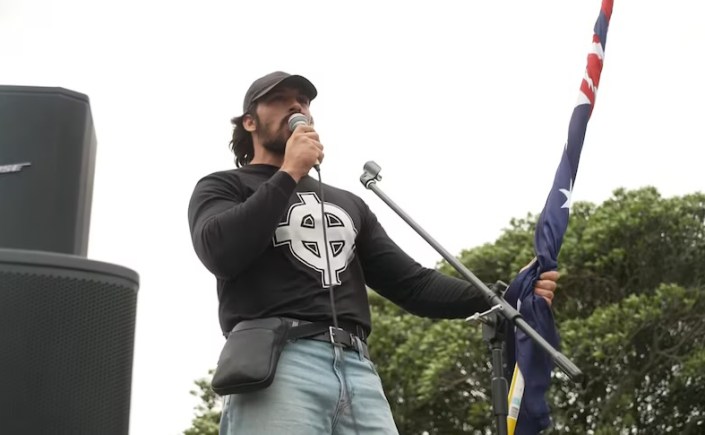
Standing on the high moral ground is hard work!

The most surprising thing about recent turmoil surrounding the Adelaide Writers Festival – its brief disinvitation of Australian Palestinian academic, author and activist Randa Abdel-Fattah, the rapid apology and reinstatement, the boycotts, denunciations, and counter-accusations – was these events generated so much newsprint, TV, radio, blogs, substacks, podcasts, memes and Facebook posts. It wasn’t because it’s summertime and the slow news weeks between Christmas and Australia Day. After all, there were some remarkable stories making their melancholy rounds: the Iranian bloodshed, Maduro kidnapping, Donald Trump’s Greenland fantasia … But this literary scandal held its own against all of these. 

 It was widely presented as yet another skirmish in the culture wars, a familiar clash between free speech and censorship, principle and power. But to read it that way is to miss what the episode actually illuminated. Beneath the noise lay a deeper unease about how cultural institutions confer legitimacy, how moral certainty now polices intellectual life, and how concepts such as freedom of speech, cancellation, and accountability have been stretched, moralised, and hollowed out by performative outrage. The Adelaide Writers’ Festival affair was not an aberration so much as a stress test – of institutional courage, historical understanding, and a cultural milieu increasingly unused to constraint, yet convinced of its own moral infallibility.

The brief removal of Randa Abdel-Fattah from the 2026 program – followed by an apology, a reinvitation, and institutional retreat – was framed almost instantly as a free-speech scandal, a cancellation, an act of racist silencing. In fact, it was something more revealing and more uncomfortable: a momentary hesitation by a cultural institution about whether platforming is neutral, and a swift lesson in how difficult it has become to impose even minimal constraints on those who speak in the language of moral certainty.

Cultural institutions do not merely host conversations; they legitimise them. To be invited onto a festival program is not simply to be given a microphone but to be publicly endorsed as a credible participant in civic discourse. That endorsement carries responsibilities, both for the institution and for those it platforms. One of them is to ensure that political critique does not slide into eliminationist moralism – particularly when that moralism operates in a social climate where anti-Jewish vilification is no longer theoretical but lived.

The reaction to the Adelaide Festival board’s initial decision was immediate and predictable. Abdel-Fattah accused the board of “stripping” her of humanity and agency. Fellow writers and cultural figures denounced the decision as betrayal, censorship, capitulation to dark forces. Boycotts were announced – 180 authors of all genres fled for the exits – solidarities declared, moral lines drawn. What was striking was not merely the ferocity of the response but its underlying assumption: that any boundary placed around speech—however provisional, however context-specific – was illegitimate by definition.

Their reaction demonstrates how unused some cultural actors have become to any constraint at all.

In fact, much of the subsequent withdrawal by authors – most of whom had never engaged with the specifics of Abdel-Fattah’s record or statements nor adopted a public stance with regard to one of the world’s most intractable conflicts – reflects a convergence of social, psychological, and institutional dynamics rather than principled assessment. This is tangentially corroborated by the ABC suggesting that many of its star presenters – including John Lyons, Laura Tingle and Louise Milligan – withdrew for various reasons and that actual support for Al Fattah was not one of them. However, Lyons has no love for the Israeli government and the occupation, and harbours an intense animus for “the Jewish Lobby” whilst Tingle strained credulity after December 7 when she stated that the atrocity was not Islamic terrorism.

A writer who did not pull out was Peter Goldsworthy, author, poet and general physician. He wrote in The Australian, 30 January 2026:

“Did I boycott this year’s event? Not a chance – too many writers, and too many audience members, and booksellers, had too much to lose. Again, I would have protested before my sessions, which is what I believe the other 180 writers might have been better off doing. I acknowledge they each made a big personal sacrifice, with honourable intentions, whether in the name of free speech, or solidarity with a colleague – and I know that many would have boycotted the 2024 event, too, if they had known that Friedman had effectively been cancelled. I also know that some of them, including several high-­profile names, felt an overwhelming social media pressure to withdraw – and now regret it”.

“Who could blame them?”, he asked. “The lynch mobs of social media are implacable. The Iranian-­Australian writer Shokoofeh Azar wrote in these pages of such pressures applied to her. A supporter of Palestinian rights but an opponent of Hamas, she received revolting threats because she refused to join the boycott. “You should be killed along with the Israelis,” one read.  I hope she is reinvited next year. I hope Abdel-Fattah accepts the invitation that has already been extended to her. I hope more Jewish writers are invited. I hope Tony Abbott is reinvited. And Thomas Friedman. And yes, I hope I am re­invited.”

In contemporary literary culture, silence is read as complicity, and once the loudest voices framed the decision as racist censorship, a moral script snapped into place. Authors who had no prior engagement with the issue were suddenly presented with a binary: signal solidarity or risk suspicion. Pulling out became reputational insurance, a way to declare moral correctness without actually examining the facts. In such moments, gesture substitutes for judgment; moral theatre displaces deliberation.

The same pattern was reinforced by what can only be described as delegated thinking under moral capture. Once a cause is deemed righteous, individuals stop asking what actually happened and start asking what someone like them is supposed to do. The fact that Abdel-Fattah had previously advocated silencing others – the so-called silencing of critics, journalists, and even Jewish voices – was largely irrelevant. The narrative did not permit contradiction. Nor did the historical record: Jewish creatives had been mass-doxxed, their identities and private lives circulated as punishment for wrong beliefs, while the same festival had previously cancelled Thomas Friedman, a liberal American Jewish columnist, without similar outcry. Nor was there much opposition to the ejection of Jewish singer and author Deborah Conway and her partner from the Australian cultural space. Conway wrote in today’s Australian of how in February 2024, “I was eventually apprised of a letter circulating that was demanding Perth Writers Festival drop me from its speakers schedule. Entitled “Perth Festival and Writing WA’s decision to platform Deborah Conway causes suffering for Palestinians: an open letter from Australian writers and artists”, the letter would eventually garner 500 signatures, including Abdel-Fattah’s. To Writing WA’s credit it stood by its decision to book me and tried to ameliorate the pitchfork squad by including more diverse authors in the program. That and a lot of security”.

There was also an element of low-cost virtue in the withdrawals of most of the festival’s invited guests. Pulling out of a festival is a small personal inconvenience but a large symbolic payoff: moral courage performed for peer applause, self-indulgence masquerading as ethical clarity. Complexity, nuance, and historical literacy are optional; alignment, visibility, and performative righteousness are not. Once momentum builds, hesitation or refusal appears as betrayal, and the act of withdrawal is transformed into a statement of principle rather than a reflection of principle.

This is not a defence of state censorship; it is a recognition of institutional reality. No one in this episode was silenced in any meaningful sense. No books were banned, no speech criminalised, no platforms eradicated. What was briefly withdrawn was a single form of institutional endorsement. To describe this as an assault on free speech is to inflate a contingent editorial judgment into a moral catastrophe – and to quietly assert that some voices are entitled to public platforms as a matter of right.

That inflation depends on a broader cultural habit: the conflation of consequence with persecution. “Cancellation” has become a moralised misdescription, collapsing everything from online criticism to contractual decisions into a single melodrama of victimhood. In environments shaped by moral capture, refusal is reimagined as violence, disagreement as erasure, and restraint as dehumanisation. Withdrawal is not reluctant; it is theatrical. Boycott becomes a badge of purity. Moral signalling replaces argument.

The substance of what is being defended matters here. Criticism of Israeli policy – severe, uncompromising, even angry criticism – is not antisemitic in itself. But there is a line between critique and negation, and it is a line that has increasingly been crossed with impunity. Anti-Zionism, in its eliminationist form, does not argue with Israel’s conduct; it denies Jewish collective existence altogether, treating the very fact of a Jewish state as uniquely criminal among the world’s nations.

This distinction is not merely theoretical. Abdel-Fattah’s public record – celebration of October 7, denial or inversion of Jewish suffering, rhetoric of irredeemability, chants of “intifada” involving children – pushes beyond critique into erasure. Language of liberation becomes language of elimination, moralised as justice. “Resistance by any means necessary” is not an analytical position; it is a slogan that sanitises violence while denying responsibility for its consequences.

Here historical illiteracy and political naivety quietly do their work. Concepts such as genocide, apartheid, and colonialism are deployed as totalising metaphors, severed from their historical specificity and redeployed as instruments of moral annihilation. The irony – that Holocaust inversion once central to Soviet anti-Zionism has been seamlessly absorbed into contemporary activist rhetoric – is rarely acknowledged. That this rhetoric positions Jews everywhere as implicated in an illegitimate state is treated not as a problem but as a feature.

All of this unfolds within a broader climate of intimidation and fear. Jewish creatives have been mass-doxxed, their personal details circulated as punishment for wrong beliefs. Jewish students and artists conceal their identities. Synagogues are attacked. And yet, when institutions attempt – tentatively – to draw lines around eliminationist speech, they are accused of racism and cowardice. The harm that prompts boundary-setting is rendered invisible, while the discomfort of those encountering limits is elevated into moral injury.

The inconsistency is instructive. The same Adelaide Writers Festival that briefly balked at hosting Abdel-Fattah had no difficulty cancelling Thomas Friedman, a liberal American Jewish columnist, without comparable anguish or apology. Standing on the high moral ground is evidently easier when the cancellation flows in the culturally approved direction. Accountability, it seems, is only intolerable when it is applied to one’s own side.

This is where freedom of speech, cancellation, and intellectual honesty must be rescued from their rhetorical misuse. Freedom of speech protects expression from coercive suppression; it does not guarantee institutional endorsement. Cancellation is not a synonym for criticism or refusal; it is a narrative deployed to short-circuit scrutiny. And intellectual honesty requires more than fervour – it demands a willingness to distinguish critique from negation, to acknowledge historical complexity, and to accept that one’s own moral universe may contain blind spots.

What the Adelaide affair ultimately exposes is not a failure of liberalism but the strain placed upon it by cultures of moral purity and value signalling. In such cultures, self-indulgence masquerades as courage, self-importance as solidarity, and certainty as virtue. Institutions are pressured to choose between complicity and chaos, knowing that any attempt to impose standards will be met with outrage.

Had the Adelaide Festival held its ground, the resulting mess would not have been a tragedy but a clarification. It would have affirmed that legitimacy is not cost-free, that language has consequences, and that standing on the right side of history requires more than shouting one’s righteousness into the void. If accountability is uncomfortable – if it disrupts festivals, friendships, and reputations – that may be precisely the point.

The alternative is not harmony but habituation: a slow acclimatisation to eliminationist rhetoric wrapped in the language of justice, and an intellectual culture so unused to constraint that it mistakes every limit for oppression. In that light, the mess is not a sign of failure. It is the sound of a moral ecosystem being tested – and, however briefly, resisting capture.

To step back from the drama, the Adelaide affair is less a story about one author or one festival than a mirror held up to the cultural field itself. It reveals how easily moral certainty can ossify into capture, how virtue signalling can masquerade as courage, and how intellectual honesty can be sacrificed to the allure of alignment and applause.

Institutions, in turn, are forced into an ethical calculus: to platform freely is to risk complicity; to refuse is to provoke outrage. Standing on the high moral ground – truly standing, not merely performing – is therefore hard, uncomfortable, and rarely rewarded. Yet that difficulty is precisely its value. If accountability requires a mess, a moment of collective awkwardness and public testing, then enduring it may be the only way to cultivate a cultural ecosystem in which words are not cost-free, principles are not performative, and freedom of speech coexists with responsibility. In other words, the test of courage is not in the applause it earns, but in the restraint, discernment, and historical awareness it demands.

In That Howling Infinite December 2025

Author’s Note…

This opinion piece is one of several on the the attitudes of progressives towards the Israel, Palestine and the Gaza war. The first is Moral capture, conditional empathy and the failure of shock

There are moments when public argument stops being a search for truth and becomes a test of belonging. Facts are no longer weighed so much as auditioned; empathy is rationed; moral language hardens into a badge system, issued and revoked according to rules everyone seems to know but few are willing to articulate. One learns quickly where the trip-wires are, which sympathies are permitted, which questions are suspect, and how easily tone can outweigh substance.

What interests me here is not the quarrel itself – names, borders, histories—but the habits of mind it exposes. The ease with which conviction can slide into choreography. The way intellectual honesty is praised in the abstract and punished in practice. The curious transformation of empathy from a human reflex into a conditional licence, granted only after the correct declarations have been made.

Across these pieces I circle the same uneasy terrain: the shaping of facts to fit feelings; the capture of moral language by ideological gravity; the performance of righteousness as both shield and weapon. Cultural spaces that once prided themselves on curiosity begin to resemble courts, where innocence and guilt are presumed in advance and the labour lies not in thinking, but in signalling.

This is not an argument against passion, nor a plea for bloodless neutrality. It is, rather, a meditation on how quickly moral seriousness curdles into moral certainty – and how much intellectual work is required to stand on what we like to call the high ground without mistaking altitude for clarity.

The position of In That Howling Infinite with regard to Palestine, israel and the Gaza war is neither declarative nor devotional; it is diagnostic. Inclined – by background, sensibility, and experience – to hold multiple truths in tension, to see, as the song has it, the whole of the moon. It is less interested in arriving at purity than in resisting moral monoculture and the consolations of certainty. That disposition does not claim wisdom; it claims only a refusal to outsource judgment or to accept unanimity as a proxy for truth.

On Zionism, it treats it not as a slogan but as a historical fact with moral weight: the assertion – hard-won, contingent, imperfect – that Jews are entitled to collective political existence on the same terms as other peoples. According to this definition, this blog is Zionist. It is not interested in laundering Israeli policy, still less in romanticising state power, but rejects the sleight of hand by which Israel’s existence is transformed from a political reality into a metaphysical crime. Zionism is not sacred, but its delegitimisation is revealing – because it demands from Jews what is demanded of no other nation: justification for being.

On anti-Zionism, it has been unsparing. It sees it not as “criticism of Israel” (which you regard as both legitimate and necessary) but as a categorical refusal to accept Jewish collective self-determination. What troubles it most is not its anger but its certainty: its moral absolutism, its indifference to history, its willingness to borrow the language of justice to license erasure. It is attentive to how anti-Zionism recycles older antisemitic patterns – collectivisation of guilt, inversion of victimhood, and the portrayal of Jews as uniquely malignant actors – while insisting, with studied innocence, that none of this concerns Jews at all. If not outright antisemitism, the line separating it from anti-Zionism is wafer—thin, and too often crosses over. 

The interest in moral capture is analytical rather than accusatory. It is not arguing that writers, academics, or institutions are malicious; rather, it are argues that they have become intellectually narrowed by the desire to belong to the “right side of history.” Moral capture explains how good intentions curdle into dogma, how solidarity becomes performative, and how the fear of social exile replaces the discipline of thought. It accounts for the strange phenomenon whereby intelligent people outsource their moral judgment to slogans, and experience constraint not as an intolerable injury to the self.

The Adelaide Writers’ Festival affairis seen not primarily about Randa Abdel-Fattah, nor even about free speech. It is a case study in institutional failure and cultural self-deception. The mass withdrawals are viewed not as acts of courage or principle but as gestures of affiliation – ritualised displays of virtue by people largely untouched by the substance of the dispute. What is disturbing is the asymmetry: the speed with which a festival collapsed to defend eliminationist rhetoric, and the silence that greeted the doxxing, intimidation, and quiet cancellation of Jewish writers and artists. Adelaide did not fall because standards were enforced, but because those standards were applied selectively and then disowned at the first sign of reputational discomfort.

Running through all of this is a consistent stance: a resistance to moral theatre, an impatience with historical amnesia, and a belief that intellectual honesty requires limits – on language, on fantasy, and on the indulgent belief that one’s own righteousness exempts one from consequence.

We are not asking culture to choose sides; you are asking it to recover judgment

.See in In That Howling Infinite, A Political World – Thoughts and Themes, and A Middle East Miscellany. and also: This Is What It Looks LikeYou want it darker?” … Gaza and the devil that never went away … , How the jihadi tail wags the leftist dog, The Shoah and America’s Shame – Ken Burns’ sorrowful masterpiece, and Little Sir Hugh – Old England’s Jewish Question


The quality of mercy … looking beyond Iran’s ghost republic

The quality of mercy is not strained;
It droppeth as the gentle rain from heaven
Upon the place beneath. It is twice blest;
It blesseth him that gives and him that takes.
William Shakespeare, The Merchant of Venice

Whilst most media commentary focuses on questions like “will it be any different this time?”, “will outside incitement or intervention actually work?” , and “who can or will replace the current regime?”, this article by Unherd’s Us editor Sohrab Ahmari, and the comments thereon go variously beyond, behind, or beneath, to consider the potential, if any, for those famous “bright sunny uplands” that Churchill foresaw at the end of mortal strife. A précis follows, and also, a discussion of past, recent and contemporary efforts to realise the quality of mercy.

Beyond Iran’s Ghost Republic 

What persists, for now, is a ghost regime: a sad remnant of the last of the great modern revolutions that, like some apparition in a haunted house, is condemned to remain at the scene of its own demise …The Islamic Republic clamoured so much for death, sweet and glorious death, it lost sight of the basics of life: bread, water, electricity. Ghosts don’t need such things, but people do
Sohrab Ahmari, Unherd, 8 January 2026

Most media attention on Iran’s latest unrest fixes on the usual coordinates: will this time be any different from 1999, 2009, 2017, or 2022? Will foreign powers, quietly nudging or overtly intervening, succeed where the street protests have failed? And, inevitably, who might step into the vacuum should the current regime falter? These questions, while immediate and superficially urgent, only scratch the surface. Beneath them lies a far subtler and, perhaps, more consequential inquiry: what kind of life, if any, might the Iranian people permit themselves once the machinery of coercion is loosened? Where, if anywhere, are the “bright sunny uplands” that journalists, analysts, and policymakers treat as both metaphorical and material destinations?

The Islamic Republic has already, in practical terms, collapsed into a ghost. Its proxies lie defanged, its currency teeters toward ruin, and the strictures of ideological policing have been quietly suspended in many cities. It clings to slogans, chants, and ceremonial gestures – Death to Israel! Death to the Great Satan! –  long after the infrastructure, credibility, and political capital to back them have evaporated. Ghosts do not need electricity, or potable water, or functioning hospitals, but living people do. And the contrast between the familiar deprivation of Tehran and the gleaming towers, highways, and shopping malls of Istanbul, Dubai, and Riyadh is almost unbearable: the regime sold transcendence and martyrdom, but delivered only rationed life, graft, and perpetual economic anxiety.

Yet a collapse of the state apparatus does not automatically produce moral renewal. This is where both the film It Was Just an Accident and the commentary converge. The plot of Jafar Panahi’s latest work stages a moral test familiar to anyone who has witnessed, read, or lived through the aftermath of institutionalized terror: a man who suffered under the regime confronts a former torturer. The temptation to exact revenge – to allow history’s pain to be paid back in equal or greater measure – is immediate and compelling. Some characters urge restraint, others insist that justice without retribution is an idle abstraction. The film’s tension mirrors a larger societal question: can a people accustomed to cycles of repression, humiliation, and ideological fervour imagine a life beyond revenge, beyond the simple arithmetic of punishment and vengeance?

The comments on Ahmari’s article highlight the same moral and civic dimensions. Several voices underscore a paradox that no headline can capture: the Islamic Republic’s obsession with death and martyrdom was not merely symbolic; it was infrastructurally catastrophic. Water systems were ignored, electricity grids left to decay, the economy warped around fantasies of resistance and martyrdom. Yet, this same absolutist, apocalyptic impulse is not unique to Iran. As some observers wryly note, the West is not immune to ideologies that glorify moral purity and abstract heroism at the expense of lived reality. Certainty, as one commentator put it, often replaces curiosity; neat explanations flatter intelligence and virtue, while obscuring the messy work of sustaining life.

History offers uncomfortably blunt lessons. After the Khmer Rouge, Cambodia did not attempt exhaustive justice; it largely absorbed foot soldiers back into ordinary life, relying on a rough amnesty and the communal refusal of vengeance.   This might be Iran’s imagined future: to survive and flourish, ordinary citizens may need to exercise a similarly imperfect, sometimes clumsy, forgiveness. And yet the impulse to retribution is alive and articulate: Hamid in Panahi’s film embodies the argument that the fanatics who ran the Islamic Republic had no regard for life, and must be repaid in like coin.

Here, we converge on a truth both grim and hopeful: Iran’s fate will not be determined by foreign powers, strikes, or special forces. The country’s reckoning cannot be outsourced. The only way to allow the blood to run dry, to create the possibility –  however tenuous – of “bright sunny uplands,” is through an internal moral negotiation: a willingness to forgive, to rebuild, to live with one another despite the weight of memory and injustice. Forgiveness, in this context, is not an ideal; it is a strategic, civic, and existential necessity. Anything else risks a continuation of cycles that have already brought the country to the nadir described in headlines, film, and commentary alike.

The wider reflection, then, is less about predicting the regime’s fall than understanding the texture of human life that might emerge afterward. If Iranian society cannot cultivate mechanisms for restraint, empathy, and imperfect justice, then the collapse of the ghostly structures of the Islamic Republic will be little more than a ceremonial end to one cycle of totalising politics – ready to be replaced by another. Yet, if these “bright sunny uplands” are glimpsed, they will be the product not of weapons, tweets, or sanctions, but of courage, patience, and the audacious, often maddeningly slow, work of ordinary humans learning to forgive. In that possibility – fragile, improbable, and entirely human –  lies the truer story of Iran, past, present, and perhaps future.

Forgiveness and the Possibility of Civic Renewal

Forgiving is not forgetting; it’s actually remembering –  remembering and not using your right to hit back. It’s a second chance for a new beginning. And the remembering part is particularly important. Especially if you don’t want to repeat what happened.
Attributed to South African Bishop Desmond Tutu

When societies emerge from cycles of repression, violence, and ideological zeal, the first question is often: who will exact justice? Who will punish, and who will pay? Yet history and moral reflection suggest that the question of revenge is only the beginning. More crucial is the question of forgiveness: whether communities traumatized by systemic harm can find a way to release the past, preserve dignity, and allow life to take root. Iran, in the aftermath of decades of ideological extremism, structural neglect, and repeated cycles of protest and repression, faces precisely this moral crossroads.

Desmond Tutu, whose work with South Africa’s Truth and Reconciliation Commission helped a nation emerge from the moral abyss of apartheid, offers a clarifying lens. He reminds us that forgiveness is not weakness, nor a cover-up, nor the erasure of injustice. “To forgive is not just to be altruistic; it is the best form of self-interest,” he said. “If you can find it in yourself to forgive, then you are no longer chained to the perpetrator.” Forgiveness, in this sense, liberates the victim as much as it addresses the harm done. It is a deliberate, often risky act that preserves dignity, confronts wrongdoing honestly, and opens space for a new civic beginning. True reconciliation, Tutu insists, does not soften the truth: “Superficial reconciliation can bring only superficial healing. True reconciliation exposes the awfulness, the abuse, the hurt, the truth.” Forgiving does not mean forgetting; it is remembering without exercising the right to strike back, allowing life to continue without being perpetually tethered to past harm.

Archbishop Desmond Tutu 1931-21

The necessity of forgiveness becomes clearer when we look beyond Iran to societies that have struggled with similar dilemmas. South Africa’s post-apartheid transition, Northern Ireland’s gradual peace after the Troubles, and the painstaking reconciliation efforts in postwar Bosnia demonstrate that societies can arrest cycles of revenge when moral courage is coupled with institutional frameworks. Mechanisms such as truth commissions, negotiated agreements, or cultural rituals allow communities to confront trauma without succumbing to vengeance.

In South Africa, perpetrators were not erased from memory, but acknowledging harm, offering testimony, and sometimes asking for forgiveness created a space in which ordinary life could resume without blood-soaked reprisals. In Northern Ireland, decades of sectarian violence required not only formal accords like the Good Friday Agreement but persistent civic labor, everyday compromises, and the cultivation of mutual recognition across communities. Peace did not arrive because conflict ended; it arrived because people, institutions, and leaders collectively committed to the moral and civic work of restraint, remembrance, and imperfect forgiveness. Bosnia, by contrast, demonstrates how fragile such processes can be: tribunals, localized reconciliation projects, and political compromises made progress possible, but resentment and mistrust lingered for decades.

The lesson is that the labor of forgiveness is painstaking, morally taxing, and never complete; it requires social frameworks, cultural patience, and individual courage.

Other contemporary crises provide a darker counterpoint. Syria, ravaged by civil war, sectarian fragmentation, and foreign intervention, shows how cycles of violence can ossify when forgiveness is absent and survival becomes the primary moral calculus. Gaza and the Palestinian territories, trapped in occupation, blockade, and repeated military incursions, reveal how structural oppression perpetuates the need for revenge, making reconciliation seem both urgent and impossible. Myanmar and Sudan illustrate what happens when accountability fails entirely: persecution, displacement, and entrenched cycles of terror prevent civic life from taking root, leaving ordinary people imprisoned by histories they cannot escape.

In the Iranian context, the challenge is both urgent and intimate. A society habituated to ideological terror and systemic neglect faces a moral crossroads: the temptation of revenge is immediate, visceral, and understandable, but it risks reproducing the very cycles of harm that have brought the country to its present nadir. Panahi’s film It Was Just an Accident dramatizes this dilemma: victims confront their former torturer and wrestle with the question of retribution versus restraint. It is a moral negotiation that mirrors the broader societal question. True recovery cannot be imposed from the outside; no foreign military, sanctions regime, or spectacular intervention can replace the painstaking, often agonizing internal work that forgiveness demands.

Tutu’s reflections provide a moral compass for this work. Forgiveness is neither altruistic fantasy nor moral softening; it is self-liberating, dignity-affirming, and socially generative. “When we see others as the enemy, we risk becoming what we hate. When we oppress others, we end up oppressing ourselves. All of our humanity is dependent upon recognizing the humanity in others.” For Iran, the stakes of this insight are enormous. The collapse of the regime, already a ghost of its former ideological self, creates the space for moral and civic imagination, but it is up to the Iranian people whether that space becomes a playground for revenge or a canvas for rebuilding.

Viewed comparatively, Iran’s predicament is neither unique nor exceptional. Across South Africa, Northern Ireland, Bosnia, Syria, Gaza, Myanmar, and Sudan, we see the same pattern: cycles of violence thrive when forgiveness is absent and collapse is coupled with fear, trauma, and structural weakness. Yet the examples of South Africa and Northern Ireland also offer hope. Even societies deeply scarred by ideology and systemic harm can, through deliberate moral labor, cultivate restraint, empathy, and civic imagination. The “bright sunny uplands” are not gifts of fortune or foreign intervention; they are the product of human choice, moral courage, and the willingness – however faltering and tentative –  to forgive, remember, and begin again.

For Iran, the possibility of civic renewal rests on this moral labor. To forgive is to free oneself from the chains of the past, to preserve human dignity, and to allow ordinary life – bread, water, work, community – to flourish once more. It is difficult, risky, and imperfect work, but it is the only path to a society that can move beyond the cycles of ideological terror, revenge, and ruin. In choosing forgiveness, Iranians do not erase the horrors of the past; they confront them honestly, remember them fully, and, in so doing, claim a future that is no longer dictated by blood, fear, or vengeance.

For more on the Middle East in In That Howling Infinite, see A Middle East Miscellany, Messing with the Mullahs – America’s phoney war? and “Because of …” Iran’s voice of freedom

The cycle of revenge. Iranians must learn to forgive

Iran’s cycle of revenge

A still from the film ‘It was Just an Accident,’ directed by Jafar Panahi. mk2 Films

Sohrab Ahmari, Unherd, 8 January 2026

It’s become a running joke on Iranian social media — screen captures of Western headlines regarding previous popular uprisings in the country that read: “This isn’t like previous protests in Iran.” The message is that this latest tumult spells the end of the Islamic Republic. Except those earlier headlines appeared in 1999, 2009, 2017, 2022. The storms of popular discontent raged and then dissipated, but the regime didn’t budge.

We are told that the current uprising, sparked initially by anger over inflation, is different. But contrary to expectations, we’re unlikely to see a spectacular end to the regime in the manner of the ouster of Ceaușescu or the fall of the Berlin Wall — the 1989 moment whose eternal return liberals the world over yearn for. No, there won’t be a spectacular collapse, because the Islamic Republic of Iran has, in a sense, already fallen.

Its Arab proxies are defanged. Its nuclear program is partially buried under President Trump’s bunker busters. Its currency is reaching Zimbabwean levels. And it has largely given up enforcing its hijab and other Shiite morality norms in many urban centers. A much more likely ending is one in which more nationalist elements within the current regime take over, with or without a little push by outside powers.

What persists, for now, is a ghost regime: a sad remnant of the last of the great modern revolutions that, like some apparition in a haunted house, is condemned to remain at the scene of its own demise, faintly repeating the slogans of its former vitality, wondering if anyone still cares. Death to Israel! Death to the enemies of the jurisconsult! Death to the Great Satan!

The Islamic Republic clamored so much for death, sweet and glorious death, it lost sight of the basics of life: bread, water, electricity. . . . Ghosts don’t need such things, but people do. Especially people who look around at the likes of Turkey, the United Arab Emirates, and Saudi Arabia, and behold gleaming prosperity, rising living standards, normality. Their own lot, meanwhile, is defined by diminished expectations, massive graft, and life and treasure wasted on building an arc of “resistance” against the Jewish state that was destroyed in a matter of months.

Against this haunted backdrop, it’s up to the Iranian people to decide, now, how they want to live together, and with their region and the world. Will they forgive each other? Or repeat the cycle of totalizing politics, repression, and revenge that brought them to their current nadir in the first place? As it happens, Iran’s greatest living director, Jafar Panahi, addresses these questions in his latest film, It Was Just an Accident, which hit the screen in major cities just as the latest unrest began.

A taut thriller in the style of Jean-Pierre Melville, the film tells the story of Vahid (Vahid Mobasseri in a quietly stunning performance), a worker who happens upon, and kidnaps, Eghbal (Ebrahim Azizi), the intelligence officer who’d tortured him when Vahid joined a labor strike over unpaid wages.

Vahid is about to bury Eghbal in the middle of the desert when he’s gripped by doubt. The real Eghbal had lost a leg fighting in the Syrian Civil War. But the man in the shallow grave insists that his prosthetic leg — whose squeaking sound led Vahid to believe he’d found his erstwhile torturer — is a recent addition. What if he’s got the wrong man? What if he’s about to murder an innocent? This simple doubt becomes the driving force of the film’s plot.

Vahid reunites with a fellow prisoner — Salar, a dissident intellectual — who urges him to free Eghbal, or whoever he is. “This business doesn’t have an ending,” Salar warns Vahid. This could mean that Vahid could face real-world consequences. But it also suggests that the blood in Iran will never run dry if people continually seek revenge. Vahid isn’t convinced. He’s lost everything to the regime Eghbal represents, and he’s bent on making him pay.

Salar refuses to help directly, but he introduces Vahid to a photographer, Shiva, who was also imprisoned for her political activities and tortured by Eghbal. Other former prisoners soon join the group. One of them, Hamid (Mohammad Ali Elyasmehr), instantly identifies the man in Vahid’s van as their torturer (by his smell) and thrills at the thought of inflicting suffering and death upon Eghbal.

Others are more hesitant, partly out of the same doubt that initially stays Vahid’s hand, but partly over deeper qualms: Will torturing and murdering a killer improve anything? No, Shiva and others begin to think. But Hamid is adamant, and it’s notable that while the rest of them are professional-class types who’ve landed on their feet, he’s been less fortunate (and, the film suggests, he was something of a loser even before his prison stint).

Thus unfolds the unlikely moral and philosophical debate folded into the film’s thriller script — a debate that confronts many ordinary Iranians opposed to the Islamic regime. Panahi, to his credit, gives Hamid a decent chance to make his case: to wit, the fanatics who run the Islamic Republic have no regard for the lives they ruin, and anything short of a willingness to act politically — in the Schmittian, friend-enemy sense of the term — is just playing around.

But in the end, the other side “wins” the debate. The kidnapped man’s phone rings. It’s his daughter, crying for her father to come home because her pregnant mother is unresponsive. The gang treks over to his house and drives mother and child to the hospital, where the baby is safely delivered. The group even pools cash to tip the nurses, as custom demands.

Only afterward is it revealed that — spoiler alert — the man in the van really is the torturer who’d subjected them to dozens of mock executions; who’d beaten Vahid so badly, he’s developed kidney problems; who threatened to rape the women before killing them (since, under Shariah law, virgins go straight to paradise).

I won’t spoil more of the plot. What matters is that the Hamid temptation — let us torture the former torturers, execute the executioners — is all too real, and it can derail whatever comes next into another national dead-end. No foreign intervention and no Trumpian Delta Force can save Iran from that outcome. It is up to Iranians themselves to forgive each other, and finally permit the blood to run dry.

Sohrab Ahmari is the US editor of UnHerd and the author, most recently, of Tyranny, Inc: How Private Power Crushed American Liberty — and What To Do About I

Trump, Venezuela, and the Dog that caught the car

Seems like I been down this way before
Is there any truth in that, señor?
Bob Dylan, Señor (Tales of Yankee Power)

In That Howling Infinite’s recent interest in Venezuela is less about Venezuela itself than about a familiar American habit resurfacing in a new theatre. We have seen this pattern before – in Iraq, in Afghanistan, in Libya – each intervention launched with confident rhetoric, elastic legal reasoning, and the quietly held belief that regimes, once struck, will obligingly collapse into something better. The names change; the logic does not. Venezuela now feels like the latest rehearsal space for a drama that has not yet finished running elsewhere.

This is where the US’ old Monroe Doctrine returns, not as doctrine so much as reflex. A Monroe Redux: stripped of 19th-century solemnity, repurposed for a world of drones, covert action, and press-conference deterrence. The Western Hemisphere is once again imagined as a special moral jurisdiction, even as the Middle East – long the cockpit of American intervention – appears exhausted, over-militarized, and politically unrewarding. Latin America, by contrast, offers proximity, asymmetry, and deniability. The geography has changed; the instincts have not.

This preoccupation also intersects with a longstanding fascination with the lessons of historian Barbara Tuchman’s acclaimed The March of Folly. Tuchman’s insight was not that governments lack information, but that they persist in policies demonstrably failing by their own stated objectives. Vietnam, later memorably described as “chaos without a compass,” remains the archetype: motion mistaken for strategy, escalation substituting for purpose. Iraq was folly recast as liberation; Afghanistan, folly prolonged as nation-building; Libya, folly laundered through humanitarian language. Iran hovers perpetually as folly-in-waiting, the regime-change itch that never quite gets scratched, yet never entirely disappears.

Viewed through this lens, Venezuela appears less as an isolated crisis than as a familiar historical rhyme. A little bombing here, a little bluster there; symbolic strikes presented as prudence, restraint marketed as strategy. It is not yet tragedy—history rarely announces itself so obligingly – but it carries the unmistakable scent of policies drifting, of a compass quietly returned to the drawer.

Tuchman’s opus is often misread as a study of stupidity. It is nothing of the sort. She was writing about persistence – about the peculiar ability of governments to continue down a path long after its internal logic has collapsed, armed with information but imprisoned by momentum. Vietnam was not born of ignorance but of escalation mistaken for purpose. Reading the accounts of Trump’s Venezuelan operation – no longer merely a “dock strike” but a full-blooded decapitation raid – one hears that same low, familiar hum: motion without destination, force without horizon.

A leap in the dark 

Everyone knew something like this was coming. Few expected it to be so clean. A president seized, command structures stunned, Caracas rattled just enough to demonstrate omnipotence without visibly levelling the city. From a tactical standpoint, it was impressive – the sort of operation that flatters planners and tempts presidents into believing that history, this time, might behave itself. But history rarely does. Leadership can be removed; regimes, less so. Chavismo survived Chávez’s death and Maduro’s long decay. Movements, unlike men, do not collapse neatly when the head is severed. They mutate. They harden. They endure.

This is where the metaphor shifts and darkens. The United States now looks less like a chess grandmaster and more like the proverbial dog that finally caught the car – triumphant, panting, and unsure what to do next. Decapitation creates ownership. Once you have removed the figurehead, ambiguity evaporates. The question is no longer whether Washington is intervening, but what exactly it intends to build, sustain, or suppress in the vacuum it has helped create.

A week ago, US action might have been interpreted as calibrated escalation: signalling without war, pressure without conquest, violence as message rather than mission. That logic may have held when the strike was offshore, symbolic, plausibly deniable as a prelude rather than a crossing. It is harder to sustain once the president of a sovereign state has been bundled onto a ship and flown north in handcuffs. Symbolism has consequences. At some point, signalling becomes authorship.

The deeper assumption underlying both phases – the demonstrative strike and the decapitation raid – is the same one that has haunted American foreign policy for decades: that limited, spectacular violence produces rational political outcomes. That elites defect under pressure rather than close ranks. That populations blame their rulers rather than the foreign power violating their sovereignty. That humiliation weakens movements rather than mythologising them. This faith survived Iraq, limped through Afghanistan, and still stalks Washington like an unkillable ghost.

What reads in Washington as restraint reads elsewhere as undeclared war. What Beltway strategists describe as “calibrated” looks, from Caracas – or Beijing, Moscow, Tehran, each of whom have form – like arbitrariness dressed up as doctrine. In his most recent foreign policy forays, Trump has fired missiles into Nigeria and sent special forces into Venezuela. He cannot wield enough influence to get his way with major powers, so he targets smaller ones. The White House spins this as a demonstration of American strength, but those who rule in Moscow and Beijing will not be fooled. Nor should anyone else. Whilst ostensibly demonstrating American strength, it also highlights its weakness. Today it is Venezuela; tomorrow it might be somewhere else entirely. The pattern is not coherence but surprise. Power exercised as theatre.

Trump’s foreign policy has always oscillated between maximalist rhetoric and minimalist follow-through. He threatens fire and fury, then settles for a crater and a press conference. He speaks the language of conquest while practising the art of nuisance. Yet Venezuela marks a subtle shift. This is no longer nuisance alone. By removing Maduro, Trump has crossed from menace into management, whether he wants the responsibility or not. Chaos, once unleashed, has a habit of demanding supervision.

The international reaction follows a script so familiar it almost performs itself. International law is solemnly invoked by states that otherwise treat it as optional décor. Yanqui imperialism is dusted off and waved aloft. Blood for oil, regime change, darkest chapters, dangerous precedents –  all the old tropes re-emerge, not because they are always wrong, but because they are always available. France, China, Russia, the EU condemn the breach while sidestepping the harder question: what is to be done now that a criminalised, hollowed-out regime has been removed not by its people, but by force?

Latin America splits along its habitual fault lines. Argentina’s Milei cheers liberty’s advance. Brazil’s Lula warns, with weary accuracy, that violence justified as justice tends to metastasise into instability. Neighbouring Colombia braces for refugees. Cuba mutters “state terrorism.” The region remembers – perhaps too well – that external interventions rarely end where their authors imagine.

What is most striking, though, is how little this seems to disturb the American political bloodstream. The legal basis for seizing a foreign head of state is treated as a technicality. Congressional war powers hover faintly in the background. The risk of retaliation, miscalculation, or long-term entanglement is acknowledged, then politely ignored. The old muscle memory of American power keeps flexing, long after the strategic rationale has atrophied.

And so Tuchman returns, not as a moralist but as a diagnostician. Folly is not recklessness; it is normalisation. It is the steady acceptance of contradiction as policy. Trump’s Venezuela adventure now embodies this perfectly: escalation without ownership, ownership without vision, action without explanation. Each move can be defended in isolation. Together, they form a strategy that cannot quite say what it is for.

Hovering over all of this – absurdly, yet tellingly – is the mirage of the Nobel Peace Prize so coveted by President Trump. The prize is not awarded for the mere absence of war, but for the construction of peace: treaties, frameworks, institutions that reduce violence rather than rebrand it. Bombing here, abducting there, tearing up agreements while demanding credit for not starting new wars is not peace-making; it is anti-diplomacy. Peace defined negatively, as something that has not yet collapsed.

One imagines the Nobel Committee reading this Venezuelan episode with a raised eyebrow: sovereignty breached as messaging, escalation choreographed like a reality-show arc, regime change gestured at but not owned. Peace prizes are not usually awarded for keeping one’s options open.

In the end, Trump’s Venezuelan jiggery-pokery is fascinating for the same reason Vietnam remains endlessly analysed. It shows how great powers drift — not because they are blind, but because they cannot quite decide what they are looking for. Chaos without a compass is not the absence of movement. It is movement mistaken for purpose. And history, as Tuchman patiently reminds us, is unforgiving toward those who confuse the two.

Wrong way, go back? 

Soon after the American militarily impressive operation, The Atlantic published an cautionary opinion piece by staff writer Colin Friedersdorf arguing that Trump has effectively launched a regime-change war against Venezuela without constitutional authority, democratic consent, or a plausible plan for what comes next. The core charge is not primarily strategic incompetence but constitutional betrayal.

He contrasts Trump’s actions with past presidents who, whatever their later failures, at least sought congressional authorisation before waging major wars. Roosevelt after Pearl Harbor and George W. Bush before Afghanistan and Iraq are invoked not as moral exemplars but as constitutional ones: they recognised that the power to initiate war belongs to Congress, and that legitimacy flows—however imperfectly—from public consent. Trump, by contrast, has dispensed with permission altogether.

Friedersdorf dismisses the administration’s legal justifications as threadbare. Labeling Maduro a “narcoterrorist” or pointing to a US indictment does not, he argues, amount to lawful grounds for war against a sovereign state. These are prosecutorial claims masquerading as casus belli, not a substitute for authorisation under domestic or international law.

Strategically, the article warns that toppling Maduro would be the easy part. Venezuela is already riddled with armed groups, including Colombian militants who use its territory as a base for smuggling and mining. Removing the regime risks unleashing forces that would not “go quietly,” echoing Iraq and Libya more than any clean counter-narcotics success.

Friedersdorf argues that Trump is uniquely unfitted for a regime-change war for several interlocking reasons, combining personal disposition, governance style, and historical patterns of behaviour. Unlike previous presidents who sought congressional authorisation—Roosevelt after Pearl Harbor, George W. Bush before Afghanistan and Iraq – Trump bypassed the Constitution entirely. For Friedersdorf, this is not merely a procedural violation; it signals a reckless disregard for the legal and democratic frameworks that constrain American war-making, a disregard which has tangible consequences when planning complex military operations overseas.

Second, Trump’s track record of self-interest and transactional politics undermines confidence in his strategic judgment. Friedersdorf points to a “lifelong pattern” in which Trump has pursued personal, familial, or financial gain, sometimes at the expense of institutional norms or public welfare. A regime-change war in a resource-rich country like Venezuela, Friedersdorf suggests, is exactly the kind of environment in which such temptations could manifest: the conflation of national interest with personal enrichment. Unlike professional soldiers or presidents with experience in foreign policy and national security, Trump’s incentives are highly idiosyncratic, making the outcomes of a war unpredictable and potentially self-serving.

Third, Friedersdorf questions Trump’s capacity for sustained leadership and operational management in a conflict that, by its nature, requires patience, coordination, and political nuance. Toppling Maduro may be “easy” in the sense of a tactical strike, but the aftermath – stabilising Venezuela, managing humanitarian fallout, and navigating regional politics – requires sustained commitment. Friedersdorf doubts that Trump possesses the temperament, patience, or skill to oversee such a complex and prolonged effort. The concern is that he could declare victory prematurely, mismanage occupation or transition, or escalate in ways that deepen instability rather than resolve it.

Finally, Friedersdorf critiques the political myopia and disregard for public opinion in Trump’s approach. Polls reportedly showed a majority of Americans opposed to military intervention in Venezuela, yet Trump proceeded unilaterally. In Friedersdorf’s assessment, this combination—constitutional bypass, personal opportunism, lack of leadership discipline, and political insensitivity—makes Trump not just ill-prepared, but dangerously mismatched to the responsibilities of a regime-change war, with risks to both American legitimacy and Venezuelan stability.

In short, Friedersdorf sees Trump as uniquely unfit because the personal, constitutional, and strategic factors that would constrain a conventional president are either absent or inverted in him, making a complex foreign intervention unusually perilous. And, even if the intervention were to improve Venezuelans’ lives – a possibility Friedersdorf does not dismiss outright – it would still represent a violation of American democratic norms.

The concluding warning is blunt: by choosing war despite public opposition and without congressional approval, Trump has shown contempt for both the Constitution and the electorate. If Congress does not assert its authority now, Friedersdorf fears this episode will become precedent – another step toward endless wars of choice launched by executive whim, not collective decision.

In short, the article frames Venezuela not merely as a foreign-policy gamble, but as a constitutional crisis in miniature – one that exposes how fragile America’s war-making restraints have become when a president decides they are inconvenient.

What happens now?

Everyone knew something like this was coming; perhaps fewer expected it to be executed with such clinical speed. The pre-dawn abduction of Nicolás Maduro by US forces is less a surprise than a punctuation mark — a moment where long-signalled intent finally hardened into action. A foreign head of state removed in two hours. Mission theatrically accomplished. Endgame conspicuously absent.

It is challenging, but not impossible, for American forces to amass massive military hardware, materiel and personnel offshore, bombard a small neighbour and send special forces into its capital. It is much harder for an American president to control what happens in the aftermath. This explains why global leaders are so cautious about this operation. No major European leaders have endorsed the use of force to bring down the Venezuelan government.

The real test for Trump is what comes next. He has been rightly critical of the US invasion of Iraq, and his MAGA movement favours “America First” rather than “regime change” overseas, but now he pursues a regime change of his own, with only a vague assurance that he and his lieutenants will run Venezuela for an unspecified time. The objective has a strategic element, in trying to slow the flow of drugs into America, but most of it is nakedly commercial. While other presidents might not have said this out loud, Trump is direct: he wants US control of the Venezuelan oil fields, with US oil companies investing and making money, so that oil production will increase.

In an opinion piece published in the Sydney Morning Hearal on 5th June, Robert Muggah, co-founder of the Igarapé Institute think tank and a fellow at Princeton University, usefully lays out five post-Maduro scenarios, though what binds them is not optimism but ambiguity. The first – Trump declares victory and walks away – would be the most American of outcomes: maximum disruption, minimum follow-through. Chavismo, minus its latest avatar, shuffles on; Washington expends enormous leverage only to abandon it; the refugees keep coming. The dog catches the car, looks briefly triumphant, and then isn’t quite sure what to do next.

The second scenario – a popular uprising washing away Chavismo – flatters liberal intuition but ignores institutional rot. Venezuela’s civic muscle has atrophied after years of repression, criminalisation, and mass emigration. Armed colectivos remain invested in chaos. What sounds like democratic renewal risks becoming a weak interim regime, punctuated by violence, oil-sector infighting, and amnesty wars.

Scenario three is the familiar regime-change fantasy: escalate, sanction, manage an election, install a friendly opposition figure, promise reconstruction. The problem, as ever, is legitimacy. A government midwifed too visibly by Washington inherits the original sin of imperial sponsorship. Chavismo’s anti-imperial narrative – long threadbare –  would suddenly acquire fresh oxygen, while external actors queue up to meddle by proxy. Another low-grade insurgency beckons.

The fourth option – US custodianship – is the one Trump has effectively name-checked: trusteeship without the label. Stabilise the bureaucracy, revive oil production, choreograph elections, dangle sanctions relief, keep troops nearby “just in case”. It is administratively coherent and politically radioactive. It risks converting a crisis of governance into a crisis of sovereignty, hardening nationalist resistance and validating the very mythology the intervention claims to dismantle.

Which leaves the fifth, and perhaps most honest, outcome: managed instability. No clean victory, no decisive collapse. A weakened Chavista elite, a divided opposition, fragmented security actors, and a US that calibrates pressure without appetite for occupation. A low-boil conflict, indefinitely deferred resolution, limbo as policy.

Hovering over all this is Monroe Doctrine 2.0 – a message not just to Caracas but to Havana, Managua, Bogotá, Panama, even further afield. This was less about Maduro than about signalling who gets to set terms in the hemisphere, and who doesn’t. A muscular reminder that alignment matters, and misalignment carries costs.

For Venezuelans themselves, the prognosis is bleakly familiar: another external intervention, another promise of order, another season of uncertainty. The screw tightens, the rhetoric soars, the moral justifications proliferate – and ordinary people remain suspended between liberation narratives and lived precarity.

History suggests this is not an ending but a prologue. The question, as always, is whether anyone involved is genuinely prepared to live with the consequences of what they’ve just begun.

See also in In That Howling InfiniteTales of Yankee Power … at play in America’s backyard, Tales of Yankee power … Why Venezuela, and why now?, Marco Rubio’s Venezuelan bargain and the original  Tales of Yankee Power

Caveat emptor

It is worth recalling, in this context, what ultimately happened to Muammar Gaddafi and Saddam Hussein – two leaders who, in different ways, became objects of Western fixation and regime-change temptation. Saddam was toppled by overwhelming force, hunted down, tried under a hastily constructed legal order, and hanged; the state he ruled collapsed with him, unleashing sectarian violence and regional instability that still reverberate. Gaddafi, having abandoned his weapons programmes in the hope of rehabilitation, was nevertheless pursued once the opportunity arose, cornered during a NATO-backed intervention, and killed by a mob in a Libyan drainage culvert. Libya followed him into fragmentation, militia rule, and proxy warfare.

In neither case did the removal of the strongman deliver the orderly political transformation that had been implicitly promised. What followed was not liberal democracy but vacuum – power without legitimacy, violence without direction. These episodes linger in the strategic memory not merely as moral tales but as practical ones: regime change is easy to threaten, harder to execute, and almost impossible to control once unleashed.


Muammar Gadaffi and Saddam Hussein in captivity