People with only a passing acquaintance with Latin American history and politics have been asking, with genuine puzzlement, “why Venezuela? And why now?” The question is reasonable enough, but the coverage has been thin – particularly here in Australia – where Venezuela tends to appear only as a shorthand for failure or excess, rarely as a site of serious American political investment.
In That Howling Infinite recently provided several reasonably comprehensive explanations in Tales of Yankee power … Why Venezuela, and why now? But what has been largely absent from this and from other discussions is the role being played by former senator and now Secretary of State Marco Rubio. That absence, as we shall see below, is striking.
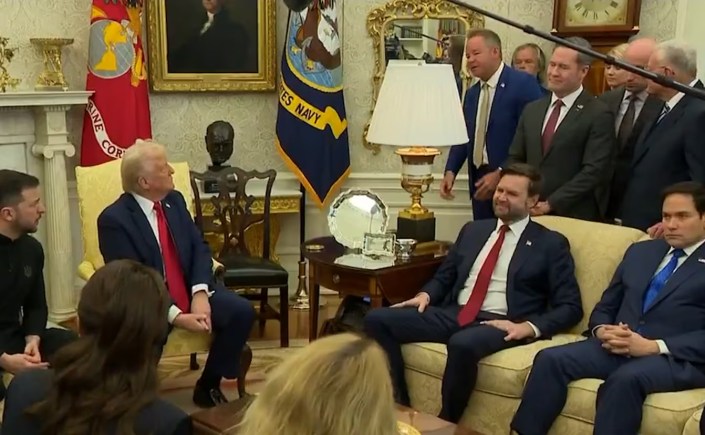
The Rubio connection surfaced explicitly in American author and commentator Fareed Zakaria’s latest Global Public Square broadcast on CNN, and once raised, it proved difficult to ignore. Rubio’s place in the MAGA-verse is, after all, an incongruous one. This is the same seasoned, disciplined, and electorally successful politician whom Donald Trump once ridiculed in the 2016 campaign as “Lil’ Marco,” a moment of theatrical humiliation that seemed, at the time, politically terminal. And yet here he is, back in the room and back at the table, standing stiffly beside Trump and self- styled “Secretary of War” Pete Hegseth in press conferences, Oval Office set-pieces, and cabinet gatherings, his discomfort almost palpable.
Watching those scenes, it is hard not to suspect a transaction. Not in the crude sense of quid pro quo, but in the quieter, more human register of political survival: the price one pays to remain relevant, to retain influence, to draw at least one clear moral boundary in an administration otherwise defined by improvisation and loyalty tests. It was this that set me thinking that Venezuela – by way of Cuba – may be Rubio’s price. The policy domain where he is allowed conviction, where memory still outranks expediency, and where supporting Trump does not feel, at least to himself, like surrender.
Intrigued by Zakaria’s brief “take” on Marco Rubio and Venezuela, I asked Chat GPT to sift through reportage in American media and other sources and come up with a more detailed story. That story follows.
See also in In That Howling Infinite, Tales of Yankee Power … at play in America’s backyard, Tales of Yankee power … Why Venezuela, and why now? and the original Tales of Yankee Power
Marco Rubio and the Politics of Memory
To understand Rubio’s Venezuela policy, it helps to stop thinking in terms of strategy alone and start thinking in terms of inheritance. This is not a story that begins in Caracas or Washington, but in Havana – or rather, in the Havana that survives only in memory: confiscated houses, interrupted childhoods, unfinished arguments passed down like heirlooms. Rubio speaks not just to voters, but to ghosts. And those ghosts have opinions.
For Rubio, socialism is not a theory, nor even a failed experiment. It is a family trauma, translated into politics. This matters because it explains both the intensity and the rigidity of his stance on Venezuela, and why compromise there feels not merely imprudent, but immoral. Venezuela matters because it looks like the past refusing to stay past.
The Cuban exile community in Miami has long provided American politics with a particular moral grammar: clarity over ambiguity, punishment over accommodation, endurance over negotiation. In this worldview, regimes do not soften; they calcify. Time is not neutral; it is the enemy. The lesson of Cuba is that hesitation becomes permanence. Rubio absorbed this lesson early, intuitively, and it has shaped his political ascent.
As Venezuela slid into authoritarian collapse in the 2010s, it became the perfect successor to Cuba as both warning and weapon. Unlike Havana, Caracas was still in motion. It had elections – imperfect, manipulable, but legible enough to serve as staging grounds for hope. It had oil, which meant leverage. And it had an opposition that could be imagined, at least briefly, as viable. Venezuela became Cuba-with-oil, a second chance to get history right.
Rubio seized that opportunity. He framed Venezuela not merely as a foreign policy challenge, but as Exhibit A in a broader moral argument about socialism, populism, and American decline. In doing so, he also performed a useful domestic alchemy: fusing Cuban-, Venezuelan-, and Nicaraguan-American experiences into a single narrative of victimhood and resistance. Florida’s exile communities became not distinct histories, but a shared cautionary tale.
This was not incidental to Rubio’s rise; it was central to it. Venezuela allowed him to marry personal biography to national rhetoric, foreign policy to electoral arithmetic. Hardline sanctions, regime-change language, and moral absolutism were not just positions – they were signals of fidelity to memory.
The Juan Guaidó episode in 2019 marked the high-water line of this approach. Rubio was among the loudest advocates of the belief that pressure, recognition, and a sufficiently confident declaration of inevitability would cause the Maduro regime to collapse. When it didn’t – when the military held, the opposition fractured, and the regime adapted – the failure did not soften conviction. It hardened it. In exile politics, failure is rarely read as miscalculation; more often it is read as insufficient resolve.
What has changed since is not Rubio’s worldview, but the world around it.
Venezuela has survived. Sanctions leaked. New patrons appeared. The regime learned how to manage scarcity and repression simultaneously. And the multipolar order – China, Russia, Iran – provided insulation that Cuba in the 1960s never had. The Cuban model, once a warning, began to look uncomfortably like a blueprint.
Enter Trump—again.
Rubio’s return to proximity with Trumpian power has been visibly uneasy. The discomfort is not theatrical; it is structural. Rubio is not a natural Trumpist. He believes in alliances, institutions, and the moral language of American leadership – however threadbare those concepts have become. Standing beside Trump and figures like Pete Hegseth in pressers and cabinet gatherings, Rubio often looks less like a disciple than a negotiated presence.
Which is why Venezuela matters now in a different way.
It is plausible – compelling, even – to read Rubio’s Venezuela focus as the price of admission. His moral compensation. The policy space he is allowed to dominate in exchange for supporting, or at least tolerating, other Trump policies that clearly sit uneasily with him. Give me Latin America, the bargain seems to say. Let me draw the line there.
Trump accepts this because it costs him little and gains him Florida. Rubio accepts it because Venezuela is the one issue where compromise feels like apostasy. It is his redemptive exception – the place where he can still be unbending, certain, and righteous, even as he swallows his discomfort elsewhere.
The result is a Venezuela policy overdetermined by symbolism. Sanctions become not just tools, but acts of remembrance. Engagement becomes not diplomacy, but forgetting. The ghosts hover constantly, reminding, accusing, insisting that this time must be different.
And yet the irony persists. Rubio’s politics of memory assumes that time favours pressure – that authoritarian regimes crack if held long enough. Venezuela suggests the opposite: that time favours adaptation. Survival is no longer failure; it is proof of concept. The past is not repeating itself exactly – it is mutating.
Which leaves Rubio caught between conviction and context. His stance is principled in its own terms, emotionally coherent, politically intelligible. But it struggles with a world in which pressure still matters, yet no longer decides outcomes.
Venezuela, in this telling, is not just a country. It is a memory test. A moral rehearsal. A stand-in for an argument with history that never quite concluded. Rubio stays in the room, visibly uneasy, because Venezuela allows him to believe that proximity to power has not dissolved purpose.
Whether that bargain helps Venezuela is uncertain. But as an explanation for Rubio himself – for his rigidity, his discomfort, his persistence – it is as close as politics gets to biography. And in exile politics, biography is destiny.
And here the circle closes.
Rubio believes Venezuela matters because it looks like the past refusing to stay past. But by treating it primarily as a moral inheritance rather than a living, adaptive system, he risks replaying the very tragedy exile politics warns against: mistaking endurance for fragility, and time for an ally.
So yes – read this as a bargain.
Rubio stays, visibly uneasy, because Venezuela is his line in the sand. His proof to himself that proximity to power has not dissolved conviction. It is the policy space where he can still speak to ghosts – and hear them answer back.
Whether that bargain produces better outcomes for Venezuela is another question entirely. But as a political arrangement, it is elegant, durable, and profoundly human.
Sources and References
Primary reporting & analysis
- Fareed Zakaria, GPS / Global Public Square segments on Venezuela and US foreign policy (CNN, 2024–2025)
- The New York Times, Marco Rubio and U.S. Venezuela Policy (various reports, 2019–2024)
- The Washington Post, coverage of the Guaidó recognition and sanctions regime
- Reuters, U.S. sanctions policy and Venezuela negotiations (ongoing reporting)
Cuba–Venezuela nexus
- Julia E. Sweig, Cuba: What Everyone Needs to Know (Oxford University Press)
- William LeoGrande & Peter Kornbluh, Back Channel to Cuba (University of North Carolina Press)
- International Crisis Group reports on Venezuela–Cuba security cooperation
Exile politics & Florida
- Javier Corrales & Michael Penfold, Dragon in the Tropics (Brookings Institution Press)
- Pew Research Center, Cuban-American and Venezuelan-American political attitudes
- Politico, Florida, Rubio, and Latin America policy analyses
Sanctions & authoritarian adaptation
- Adam Tooze, essays on sanctions and multipolarity
- Brookings Institution, Why sanctions fail (and sometimes work)
- Carnegie Endowment for International Peace, Venezuela sanctions assessments
 In That Howling Infinite
[…] In the above overview, In That Howling Infinite has provides several reasonably comprehensive explanations for what is happening today in Venezuela and the Caribbean. But what has been largely absent from this and from other discussions is the role being played by former senator and now Secretary of State Marco Rubio. That absence, as we shall see below, is striking. We have endeavored to address this in a companion piece to this post entitled Marco Rubio’s Venezuelan bargain […]
[…] Power … at play in America’s backyard, Tales of Yankee power … Why Venezuela, and why now?,Marco Rubio’s Venezuelan bargain and the original Tales of Yankee […]