
This siege will endure until the besiegers
feel like the besieged
that anger is an emotion like any other …
This siege will endure until we are truly persuaded
into choosing a harmless slavery, but
in total freedom! …
This siege will endure
till the gods on Olympus
rewrite the Iliad.
From State of Siege (Halat Hisar), Mahmoud Darwish
(written during the siege of Ramallah during the a second Intifada)
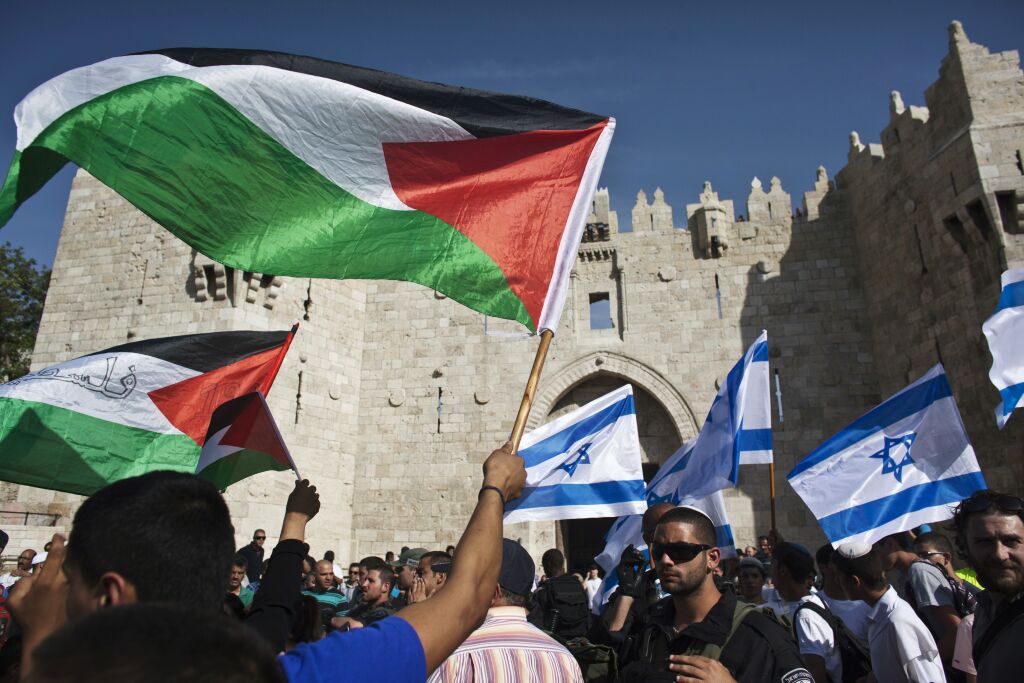
Palestinian protesters wave Palestinian flags as Israelis carrying Israeli flags walk past in front of the Damascus Gate on Jerusalem Day May 8, 2013.
The recognition of a Palestinian state by France, the United Kingdom, Australia, Canada, Belgium, and several other Western governments – formally declared during last week’s United Nations General Assembly in New York – represents one of the most dramatic diplomatic shifts in the century-old Israeli–Palestinian conflict. For decades, these countries insisted that recognition should only follow a negotiated settlement; now, frustrated by years of deadlock and the devastation of Israel’s war in Gaza, they have acted first, framing their decisions as a last-ditch effort to keep the two-state solution alive. The UN gathering produced an unusually forceful declaration – backed by 142 states – calling for a Gaza ceasefire, the release of Israeli hostages, the disarmament and exclusion of Hamas from governance, and the revival of a political process to end the conflict. Western leaders presented recognition as both a moral imperative and a strategic gambit, an attempt to restore international credibility and reassert that partition remains the only viable path to peace.
Yet this surge of recognition comes at a moment when the two-state vision appears more remote than ever. Polls show declining public support among both Israelis and Palestinians, while settlement expansion, political radicalisation, and Israel’s ongoing military campaign in Gaza have driven trust to historic lows. Politicians who once championed peace through partition have lost influence, replaced by hardliners on both sides. What was once a widely shared aspiration now looks to many like a vanishing mirage, sustained more by international declarations than by political will in Jerusalem or Ramallah.
Reactions have been immediate and polarising. Israel and the United States condemned the move, warning it rewards Hamas and undermines direct negotiations. Prime Minister Benjamin Netanyahu vowed retaliatory measures, including possible annexation of West Bank territory, while Washington reiterated that Palestinian statehood must come only through talks with Israel. In mainstream outlets, editorials split sharply: European newspapers hailed a “historic corrective,” while Israeli and American commentators decried a dangerous precedent. On social media the divide was even starker—Palestinian activists celebrated a long-awaited acknowledgment of their national rights, while Israeli supporters accused the recognising states of legitimising terror. For all the headlines, however, the recognition remains more a statement of intent than a change in reality, arriving as trust between Israelis and Palestinians sinks to historic lows and settlement expansion continues to make a viable Palestinian state harder to imagine.
Under current circumstances, a fully functioning Palestinian state remains highly unlikely. Recognition by Western governments is largely symbolic, intended to signal international support for Palestinian sovereignty and to pressure Israel and the Palestinian Authority (PA) toward a political settlement. Yet symbolism alone cannot overcome the deep structural, political, and demographic barriers that make the two-state solution increasingly remote.
On the Israeli side, settlement expansion, military control of the West Bank, and political resistance to Palestinian sovereignty—including outright annexation proposals—have steadily eroded the territorial and administrative conditions for a viable state. On the Palestinian side, political fragmentation between the PA in the West Bank and Hamas in Gaza undermines unified governance, while internal challenges like corruption, weak institutions, and social unrest limit the PA’s capacity to meet the benchmarks Western nations have set for recognition.
Moreover, public support for partition is dwindling. Recent polls show that only a minority of Israelis and Palestinians believe two states are feasible, and many consider the idea politically dead. Without a major shift—whether through renewed negotiations, dramatic political reform, or outside pressure strong enough to alter incentives—recognition will remain largely symbolic, and a functioning Palestinian state may exist only as a legal or diplomatic concept, not a lived reality.
In short, while international recognition keeps the idea of Palestinian sovereignty alive and serves as a moral and political signal, the practical hurdles remain immense, and the prospect of a fully independent, self-governing Palestinian state in the near future is extremely uncertain.
The question in the title of this post reflects, therefore, deep pessimism about the trajectory of the Israeli–Palestinian conflict. Whether it proves true depends on historical choices, demographic pressures, and international leverage. Some key questions – about past rejections, public opinion, and the viability of alternative models – may help clarify the issue.

Banksy on The Wall. Qalandia Checkpoint. Paul Hemphill 2016
Introduction
We have put up many flags,
They have put up many flags.
To make us think that they’re happy.
To make them think that we’re happy.
Yehuda Amichai, Jerusalem (1967)
The question of Palestinian statehood has long been a central, yet persistently unresolved, issue in the Israeli Palestinian conflict. Despite decades of negotiations, UN resolutions, and international advocacy, the prospect of an independent and contiguous Palestinian state remains increasingly uncertain. Recent polling by the Palestinian Center for Policy and Survey Research (PCPSR) underscores this pessimism, revealing declining Palestinian confidence in the viability of a two-state solution, alongside growing, if limited, support for alternative arrangements such as a one-state framework. On the Israeli side, public opinion and political realities similarly constrain the feasibility of a negotiated two-state outcome.
This essay examines why Palestinian statehood has repeatedly stalled by tracing historical rejections, exploring the political calculus of Israeli governments, and analyzing the attitudes of the populations most directly affected. It further situates these trends within broader debates over one-state solutions, contrasting the visions advanced by Islamist movements with those advocated by external pro-Palestinian activists. Finally, it considers whether international actors possess the capacity to impose a two-state settlement—or whether the region is moving inexorably toward a de facto one-state reality. By integrating historical, political, and sociological perspectives, this essay interrogates the enduring question: Will there ever be a Palestinian state?
How many times have Palestinians rejected a two-state plan and why?
It depends on what you count as “Palestinian” and what you count as a “plan.” If you include rejections by Arab leadership that represented Palestinians, there are several high-visibility rejections: 1937 (Peel Commission), 1947 (UN Partition), and repeated rejections of negotiated offers since 1948 at moments when Arab/Pan-Arab leadership or Palestinian negotiators declined particular proposals. In the post-Oslo era, the most often-cited episodes are 2000 (Camp David), 2001 (Taba talks continuation), 2008 (Olmert-Abbas negotiations), and 2014 (Kerry process/Framework). Each episode is complex; brief summaries and why each side says “no” follow.
Major moments commonly cited as Palestinian rejections
- 1937 — Peel Commission partition
- Who: Arab leadership in Palestine (not a unified Palestinian state actor).
- Why rejected: Partition into a small Jewish state and much larger Arab state was unacceptable to Arab leaders who opposed ceding any part of Palestine to Zionism; nationalist rejection of foreign partition and the loss of Arab majority claims.
- 1947 — UN Partition Plan (Resolution 181, 29 Nov 1947)
- Who: Palestinian Arab leadership and Arab states (the Palestinian national leadership at that time did not accept the plan).
- Why rejected: Arabs objected to partitioning what they considered an indivisible homeland and to giving a Jewish state sovereignty on a significant portion of territory despite Jews being a demographic minority overall; they also rejected the principle of partition imposed by an international body without their consent.
- 1960s–1970s — Various Arab/Palestinian rejections of recognition/compromise proposals
- The PLO until the late 1980s largely rejected any acceptance of Israel’s right to exist; that changed with the 1988 Palestinian Declaration of Independence and recognition of UN resolutions by the PLO leadership.
- 2000 — Camp David / Clinton parameters (June–July 2000)
- Who: Yasser Arafat / Palestinian Authority.
- Why contested: Israeli PM Ehud Barak (and Clinton afterward) contend that Arafat rejected a generous territorial offer; Palestinians argue the offer fell far short on key issues (East Jerusalem — sovereignty over Haram/Al-Aqsa, control of borders and refugees, the territorial contiguity and viability of a state, and security arrangements) and that the proposal was either vague or unacceptable. Historians disagree on whether a “final offer” was made and whether it would have satisfied minimal Palestinian demands.
- 2001 — Taba talks (January 2001)
- The Taba talks were a continuation and some considered them the closest both sides got; no agreement was reached. Palestinians argue that Taba showed convergence on several issues but the Israeli election and political changes interrupted progress.
- 2008 — Olmert-Abbas negotiations
- Israeli PM Ehud Olmert reportedly offered (per Israeli and some Western accounts) withdrawal from about 92–94% of the West Bank plus land swaps and shared sovereignty arrangements in parts of East Jerusalem. Mahmoud Abbas did not accept a final text. Abbas’s camp argued the offer’s details, implementation guarantees, refugee return limitations, and settlement blocs left core Palestinian demands unmet. There is no published final offer; discussions again are disputed.
- 2014 — Kerry framework and subsequent collapse
- Palestinians declined to extend negotiations without a settlement freeze and other conditions; Palestinians viewed the framework as biased and insufficient on refugees and Jerusalem.
Why these rejections happened
- Substance: Many Palestinian leaders judged concrete offers to be inadequate on core issues: sovereignty in East Jerusalem (temple/mosque precincts), Palestinian refugees’ right of return, borders and territorial contiguity, and control of airspace/borders/security.
- Political calculus: Domestic politics (fear of being seen as conceding rights), weak bargaining positions, and absence of credible enforcement/implementation guarantees made leaders reluctant to sign.
- Distrust: Deep distrust of Israeli commitments, Israeli settlement expansion during negotiations, and lack of effective international enforcement or credible security guarantees.
- Representativeness: At times Palestinian negotiators argued they lacked the ability to implement or guarantee an agreement (e.g., Gaza under Hamas), or that they were negotiating under duress.
Bottom line: There have been multiple moments when Palestinian leadership(s) have rejected proposals — often because the offers were judged insufficient on core national issues or because of political and practical constraints. But nearly every such “rejection” is contested by the other side as either a missed opportunity or an offer that Palestinian leaders politically could not accept.
How many times has Israel rejected a two-state plan and why?
Short answer: Israel (as a political community and through its governments) has both accepted and rejected different proposals at different times. Key moments often cited where Israeli leaders or governments rejected proposals (or did not accept international proposals) include 1937 (some Jewish leadership rejected aspects of Peel), 1947 (the Jewish Agency accepted UN Partition but some revision and fighting followed), 2000 (Palestinians argue Israel’s offers were insufficient), 2001–2008 there were Israeli governments that resisted large territorial concessions. Important Israeli rejections — and the reasons — follow.
Notable episodes where Israel or Israeli leaders declined offers or conditions for a two-state outcome
- 1937 — Peel Commission
- The Jewish Agency expressed conditional acceptance of partition as a basis for negotiation but was not fully satisfied; the plan’s specifics were debated.
- 1947 — UN Partition
- The Jewish Agency accepted partition; Arab states rejected it; Israel declared independence in the portions allocated and fought the ensuing war. (So this is not an Israeli rejection of two-state per se.)
- Post-1967 & Camp David 2000 / Clinton parameters
- Israeli leaders (or later Israeli governments) disputed aspects of proposed deals. At Camp David 2000, Barak’s government offered major territorial concessions by prior historical standards; Israelis argue that Palestinians rejected an extraordinary offer. Critics of Israel point out that Israeli offers conditioned Palestinian sovereignty in ways Israel could control (security) and left large settlement blocs under Israeli sovereignty.
- 2001–2009 — Ehud Barak / Ariel Sharon / Ehud Olmert periods
- Sharon initiated the Gaza disengagement (2005) but opposed a full withdrawal from the West Bank; his government and successors resisted a full evacuation of major settlement blocs.
- Olmert’s 2008 overtures were significant but were not ultimately accepted or codified.
- Since ~2009 (Netanyahu era)
- Many Israeli governments have signalled they will not accept a full withdrawal to pre-1967 lines, and have expanded settlements, hardening positions against a contiguous Palestinian state unless extreme security arrangements are guaranteed. In practice, Israeli political coalitions, especially on the right, have rejected core elements (e.g., full Palestinian sovereignty in certain areas).
Reasons for Israeli rejections or hesitations
- Security concerns: Fear that withdrawal would create a security vacuum exploited by hostile armed groups.
- Settler politics: Domestic political influence of settlers and right-wing parties opposing evacuation of settlements.
- Historical/religious claims: Parts of the political spectrum see Judea and Samaria (the West Bank) as part of historic Israel.
- Political survival: Israeli leaders often face domestic political costs for major concessions; coalitions are fragile.
Bottom line: Israel’s governments have sometimes proposed or accepted frameworks for Palestinian statehood under constrained terms; other Israeli governments have rejected offers requiring large territorial concessions or uncompromising security arrangements. Like the Palestinian side, Israeli “rejections” must be read in context: offers can be partial, conditional, or politically impossible to implement domestically.
Do either Israelis or Palestinians still want a two-state solution?
The Palestinian Center for Policy and Survey Research (PCPSR) provides the clearest window into Palestinian opinion:
- Two-state support: Only ~28–32% of Palestinians now favor a two-state solution, down from over 50% in the mid-2000s.
- One-state with equal rights: Roughly 22–25% favor a single democratic state; this rises slightly when respondents are told two states are impossible.
- Pessimism: Over 70% believe settlement growth has killed the two-state option. A majority say armed struggle is more effective than negotiations.
Israeli surveys (Israel Democracy Institute, Pew, Tel Aviv University) show a similar downward trend, with Jewish Israeli support for two states hovering around 35–40%, but falling into the 20s among younger or right-wing voters.
Both publics are increasingly skeptical of the feasibility of two states, even if many still prefer it in principle. Broad support for the abstract idea of two states has existed among both populations at various times, but support has declined and become more conditional over the last two decades. Both Israeli and Palestinian public opinion polls show support varies widely with question wording, recent violence, perceived viability of a partner, and whether core issues (Jerusalem, refugees, settlements) are addressed.
Key patterns (up to mid-2024)
- Conditional support vs. abstract support: Many people in both societies will say they support “two states” in the abstract, but support drops when respondents are asked about painful tradeoffs (land swaps, recognition of the right of return, security concessions, evacuation of settlements). Surveys often show a gap between general approval of the concept and willingness to accept concrete sacrifices.
- Effect of violence and leadership: During periods of intense violence, support for compromise falls on both sides. Leadership statements (or rhetoric) shape public opinion.
- Younger cohorts and pessimism: Younger Palestinians, having lived under occupation or blockade longer, sometimes favour more maximalist or different solutions (including resistance). Among Israelis, security anxieties and right-wing shifts have reduced unconditional support for two states in certain segments.
- Poll organizations show divergence: Israeli pollsters (e.g., Israel Democracy Institute, Pew) and Palestinian pollsters (e.g., Palestinian Center for Policy and Survey Research — PCPSR) report fluctuating majorities for two states depending on question phrasing, but the overall trend over the 2010s–early 2020s was eroding confidence in the two-state model’s feasibility and in the partner’s reliability.
At times in the 1990s and early 2000s, a clear majority on both sides expressed conditional support for two states; by the 2010s and early 2020s large minorities in both societies expressed doubts or favoured alternatives. Exact percentages vary by year and question — I can pull specific polls if you want up-to-date figures.
Many Israelis and many Palestinians say, in the abstract, they prefer two states — but support is fragile, conditional, and diminished compared with earlier decades. The decline is driven by mutual distrust, settlement facts on the ground, political fragmentation, and repeated failed negotiations.
Can outsiders impose a two-state solution? If so, how?
Outsiders can influence or attempt to impose a two-state solution, but implementation without substantial local buy-in is extremely difficult and likely unstable. Historical precedents show outsiders can set up or recognize states (e.g., Kosovo, East Timor) with international backing, but those required either UN administration, the use of force, or broad international consensus — and even then they faced resistance and long consolidation phases.
Mechanisms by which outsiders might “impose” a solution
- Diplomatic pressure and incentives
- Major powers (U.S., EU, Arab states) can use carrots (economic aid, normalization deals, trade) and sticks (sanctions, withdrawal of support) to coerce or incentivize concessions. The Abraham Accords showed how outside actors can reshape incentives (normalization in exchange for compromise). But carrots/sticks are more effective when targeted and when the recipient has internal political capacity to implement concessions.
- International legal/UN mechanisms
- The UN can pass resolutions, create trusteeship or transitional administrations, or deploy peacekeepers/administrators (as in East Timor or Kosovo). For a Palestinian state, a Security Council resolution could, in theory, recognize statehood or authorize an international regime — but that requires consensus or at least absence of a veto by a permanent member.
- Military enforcement
- Occupation by external forces or an international enforcement presence can impose borders and security arrangements. This is politically explosive, expensive, and requires long-term commitment. Examples: NATO in Kosovo, UN forces in some post-conflict zones. Such imposition risks insurgency and long occupation costs.
- Mass recognition and normalization
- Rapid and widespread recognition of a Palestinian state by many countries (plus economic packages and border control mechanisms) could create facts on the ground. Recognition alone doesn’t change control of territory — but combined with sanctions or withholding of recognition from Israel for non-compliance it could shift incentives.
- Conditional statehood linked to enforceable obligations
- An externally brokered treaty that includes concrete verification, timelines, demilitarization, security guarantees, economic support, and enforcement mechanisms (e.g., international police, monitoring) could make implementation more feasible — but enforcement is the hard part.
Why imposing a solution is difficult in practice
- Lack of sustained international consensus: A credible imposition requires a coalition willing to act and sustain the costs. The U.S. is a key player and historically has shielded Israel from many pressures. Without U.S. backing, coercive international action is unlikely.
- Domestic politics on both sides: Israeli domestic politics, Palestinian fragmentation (Fatah vs Hamas), and other local actors can block externally imposed deals.
- Settlements and facts on the ground: Settlements, infrastructure, and demographic realities mean that any externally imposed borders would have to resolve complex property and population arrangements; uprooting settlers or re-settling people invites fierce resistance.
- Legitimacy problem: Solutions imposed from the outside without local consent lack legitimacy and are vulnerable to non-compliance, civil unrest, or insurgency.
Real-world precedents and lessons
- East Timor (1999–2002): International administration (UN transitional administration and international security) helped shepherd independence. It required decisive international intervention and long stabilization.
- Kosovo (1999–2008): NATO intervention and UN/Kosovo institutions created de facto independence later recognized by many states, but not by all — and the status remains contested.
- West Bank/Gaza: Repeated attempts at externally mediated agreements (Oslo, Madrid, Roadmap) depended on local buy-in and fell apart when trust or enforcement mechanisms failed.
Bottom line: Outsiders can create the conditions for a two-state solution or enforce aspects of it, but any durable solution requires substantial local agreement, credible enforcement mechanisms, and international willingness to bear political, economic, and — where necessary — military costs. Imposition without legitimacy is likely to fail or to produce an unstable, contested outcome.
What is the level of support for a one-state solution?
Short answer: Support for an explicitly framed one-state solution (a single binational democratic state) is a minority position among both populations overall, but it has grown as pessimism about two states increases — especially among Palestinians and among some left-leaning Israelis. Conversely, many Israelis who favour “one state” imagine it as one state with Jewish predominance or annexation with unequal rights (which Palestinians and many observers call an apartheid outcome), not a binational liberal democracy.
Patterns and nuances of a Unitary Democratic State
- Among Palestinians: As two-state prospects dim and as decades of occupation/fragmentation continue, a meaningful minority (and at times a plurality in some polls) support a single democratic state with equal rights. Support rises when polls ask about full equality and citizenship for Palestinians. But Palestinians are divided: some prefer independent statehood, others prefer a meaningful right of return, and others prefer a one-state solution that guarantees rights.
- Among Israelis: Support for a one-state democratic alternative that would likely end Jewish political majority is low among Jewish Israelis. Some Israeli Arabs and left-wing Jews are more favorable. There is also a separate current that supports de facto annexation (one political unit but with unequal rights), which many analysts call a one-state reality but not a democratic one.
- Internationally and intellectually: The one-state idea has grown as a topic in academic and activist circles, especially where two-state prospects look unviable. But it remains controversial and politically unlikely given demographics, identity politics, and political institutions.
One-state support is rising in certain segments (particularly among Palestinians frustrated with the two-state impasse and among some international activists) but remains a contested minority position overall. What people mean by “one state” varies — equal-rights binational democracy vs. annexation with inequality — and that difference matters enormously.
The Islamist Conception of One State
Movements such as Hamas envision an Islamic polity over all of historic Palestine, often framed in religious terms that deny the legitimacy of a Jewish state.
- Feasibility: Near zero. Israel would resist militarily; international actors (including most Arab states) would not back a religiously defined state achieved by force.
- Effect on negotiations: Hamas’s maximalism hardens Israeli security fears and undermines Palestinian diplomatic leverage.
External Pro-Palestinian Activists Conception of One State
A growing cohort of academics, NGOs, and diaspora activists advocate a single secular democratic state with equal rights as the only moral response to settlement entrenchment.
- Feasibility: Low. It requires Israeli Jewish consent to end the Jewish state, which current polling shows is overwhelmingly opposed.
- Strategic impact: By reframing the conflict as a civil-rights struggle rather than a territorial dispute, it increases international pressure on Israel and could shift discourse toward rights-based sanctions (as in the anti-apartheid movement).
Conclusion
The title of this essay could have been “There will never be a Palestinian state” insofar as this captures the bleak trajectory of current policies and events: entrenched Israeli control, Palestinian political weakness, waning international leverage notwithstanding the level of international outrage and or sure in the wake of October 7 2023 and the deadly and destructive war that followed it, and the impact of this upon Israeli and Palestinian politics and public opinion.
Yet history cautions against absolutes. States have emerged from long occupations (East Timor, South Sudan), and shifting demographics or geopolitical shocks can reorder seemingly permanent realities.
But the prospect is plausible given current trends and present circumstances (settlement expansion, declining public confidence, regional normalization without a Palestinian settlement, volatile domestic politics on both sides, and an ongoing war). But it is not a historical certainty. Much depends on choices: Israeli policy (settlements, annexation or not), Palestinian unity and political strategy, international willingness to apply sustained pressure or to provide credible guarantees, and unpredictable shocks (regional deals, major political shifts, or crises) that could alter incentives.
Poll data from PCPSR confirm what political realities already suggest: belief in two states is collapsing on both sides, while alternative visions—whether Islamist or liberal democratic—remain politically unviable. Israel’s settlement expansion and right-wing coalitions make partition ever harder. Palestinian divisions and weak leadership undermine bargaining capacity. International actors lack the will or leverage to impose a settlement.
If present trends continue, a sovereign, contiguous Palestinian state appears unlikely in the near term; whether that equates to never remains a political, not metaphysical, judgment. The likely “solution” is probably not a negotiated peace but a de facto one-state reality of unequal rights, whether acknowledged or not. That outcome may endure for decades, but history cautions against declaring anything permanent. Demographic change, geopolitical shocks, or transformative leadership could still open pathways that today appear closed.
Key Source: Palestinian Center for Policy and Survey Research (PCPSR), Public Opinion Poll No. 90
See also, in In That Howling Infinite, Middle East Miscellany, Lebensraum Redux – Hamas’ promise of the hereafter, Al Aqsa Flood and the Hamas holy war. Is an Israeli-Palestinian confederation possible? and Visualizing the Palestinian Return – the art of Ismail Shammout
 In That Howling Infinite