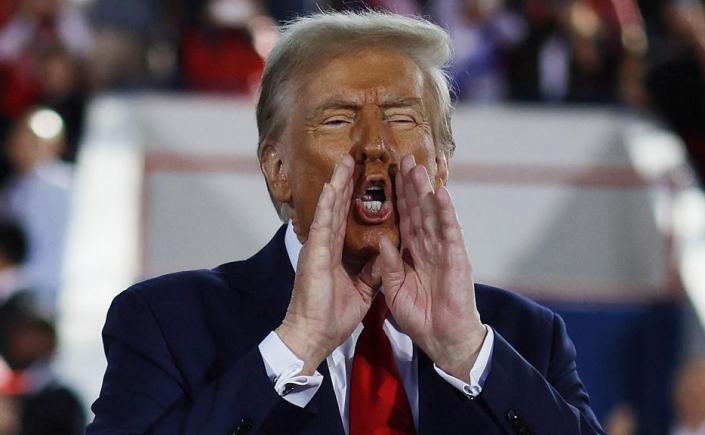
If I ruled the world
Every day would be the first day of Spring
Every heart would have a new song to sing
And we’d sing of the joy every morning would bring
If I ruled the world
Every man would be as free as a bird
Every voice would be a voice to be heard
Take my word, we would treasure each day that occurred
My world would be a beautiful place
Where we would weave such wonderful dreams
My world would wear a smile on its face
Like the man in the moon has when the moon beams
Leslie Bricusse and Cyril Ornadel
On his inauguration on January 20 2025, US President Donald Trump declared to the American people, “My fellow citizens, the golden age of America begins right now.”
Pundits and partisans right across the political spectrum, both at home and overseas, agree that Donald John Trump’s second presidential term is probably the most consequential since Franklin Delano Roosevelt. That is perhaps the only thing that they can agree on.
After 100 days in office, he is in command, testing the limits of executive power, resetting political and cultural perceptions and expectations, and reframing America’s role in the worked. But it would seem to many that having arguably declared war on America and the world, he is veering out of control.
There is almost no part of American society which has not felt the blizzard of change from the day he was sworn in. In a stand-over style that is more mob boss than head of state, he has forged a new American imperialism to project what he perceives as US interests, secure strategic assets and rebuild American economic self-sufficiency. The global trading system that has been in place for 75 years has been crippled, if not destroyed, and economists and stock markets surmise that the US economy is on the verge of crashing. America is no longer the leader of the free world because the world is no longer following America, but rather, is taking evasive action. Trump has united the people of most countries around the world around their political leadership, and yet he has not united America and Americans.
In a recent opinion piece in the Sydney Morning Herald, Bruce Wolpe, a senior fellow at the University of Sydney’s United States Studies Centre and former Congressional staffer, wrote a concise overview of Trump’s tumultuous first 100 Days. I have borrowed from it to write the following précis.
Trump is not governing by legislating but by an unprecedented exercise of executive power. He has signed fewer bills into law than any recent modern president while his 100 executive orders have triggered a tidal wave of new policies to change what the government can and cannot do. His political style of is marked by decrees coupled with complete domination of the airwaves for several hours each day, from greeting world leaders in the Oval Office to his televised cabinet meetings. For Trump, it is all streaming, all the time.as he remarked in the prime-time public takedown of the Ukrainian president in the Ovak Office, this it makes for “good television”.
On foreign policy, Trump promised groundbreaking early success on the world stage. But he has to date failed to end the wars in Ukraine and Gaza, come close to a nuclear deal with Iran , or settling the dozens of trade wars he launched against his allies. Instead, there are constant reversals in tactics and rhetoric. He has decoupled America from the wider world with ramifications which will be felt for many years, if not decades. He has treated allies like adversaries, withdrawn America from numerous global institutions and treaties, erected daunting tariff barriers on all US trading partners and slashed US foreign aid and the State Department, terminating foreign aid, vaccines and food programme. The cumulative effect has been to gravely weaken America’s ability to wield soft power at a time when China and Russia are rushing to fill the vacuum.
Aided and abetted by billionaire Elon Musk, the world’s richest man, Trump unleashed Project 2025’s sledgehammer to the bureaucracy with overriding acts of Congress to dismantle agencies and programmes, mass firings, loyalty oaths, and the seizure of databases. And, as he promised on the campaign trail, Trump is exacting vengeance on his enemies. He has called on judges who have ruled against him to be impeached. He has blacklisted law firms that worked with Democrats, or else shook them down for millions of dollars of free work. In a speech at the Department of Justice, Trump said his enemies were “scum”, that the cases brought against him were “bullshit”, that the judges who ruled against him were corrupt, his prosecutors were deranged, and that those who came after him should be imprisoned. In a war against the nation’s most prestigious universities, he is demanding their leftist woke elitism be expunged, or else research dollars and tax-free status will be eliminated. Meanwhile, he continues to target the media as the enemy of the people. The Associated Press has been excluded from presidential events; the Voice of America has been shut down; and Trump has asked the regulator to cancel the broadcast license of CBS whilst moving to defund public media’s NPR and PBS.
The Democrats in Washington meanwhile are adrift and effectively leaderless. With control of the House and the Senate, Trump dominates everything in the capital. The force, speed and scope of his administration’s actions are so intense that the Democrats cannot respond effectively. Its not as if everyone has been taken by surprise. If they had been paying attention, this is exactly what Trump and his team said they would do. It is the scale of this revolution that has put everyone into a spin. It is a time of everything happening everywhere all at once – in accordance with the MAGA mantra of “move fast and break things”.
But, say optimists, the pushback is coming. Every weekend, people are flooding the streets in cities across the country. That movement is growing. If all that Trump and his administration have let loose comes into full force but does not deliver the American miracle he promised – with recession, inflation, and chaos taking hold across the land – the midterm elections next year could be a turning point. The Democrats are in striking distance of retaking control of Congress. If so, Trump’s power may be checked and his golden age may be stillborn. And yet, nothing about Trump is certain. His approval ratings might now be at a historical low, but he has been wrongly written off many times before.
So, how did it come to this?
As the authors of the long but excellent opinion piece in The Atlantic published below explains, Donald Trump’s Second Coming began four years ago and took meticulous planning.
That’s right, it’s come to this
Yes, it’s come to this
And wasn’t it a long way down?
Wasn’t it a strange way down?
L Cohen, Dress Rehearsal Rag
Postscript: a bad case of imperial purple …
The story goes that Roman Emperor and stoic “philosopher king” Marcus Aurelius engaged a slave to follow him as he walked around Rome; his only job, whenever his master was praised, was to whisper in his ear, “Remember, you are just a man, you are just a man”. Washington, meanwhile, is starting to resemble some of the more excruciating scenes from the BBC’s iconic sword and sandals series I Claudius.
A recent artilce in The New Yorker wrote:
‘Brazen transaction mixed with humbling obeisance is hardly unknown in Washington … In Trump’s Washington, the imperative has never been plainer: if you want to get ahead or stay out of trouble, praise the President as much as he praises himself … The gestures of servility come from all over. At a Cabinet meeting not long ago, Trump’s secretaries took turns: “Your vision is a turning point and inflection point in American history” (Brooke Rollins, Agriculture); “You were overwhelmingly elected by the biggest majority—Americans want you to be President” (Pam Bondi, Attorney General); “What you’re doing now is a great service to our country, but ultimately to the world” (Marco Rubio, State) … At a hearing of the House Committee on Natural Resources, where a dozen or so members were discussing the Gulf of America Act of 2025, sponsored by Marjorie Taylor Greene. Democrat congressman Jared Huffman said: “This is remarkable new stuff in this committee, just bootlicking sycophancy of the highest order,” he said. (Not long after the hearing, Huffman suggested an amendment to rename Earth “Planet Trump”.’
Other Trump articles in In That Howling Infinite: Deconstructing Donald – translating Trumpspeak; Trumps second coming … a new American Revolution?; Trump’s revolution … he can destroy, but he cannot create

Heaven’s above! David Rowe
‘I RUN THE COUNTRY AND THE WORLD’
Donald Trump believes he’s invincible. But the cracks are beginning to show.
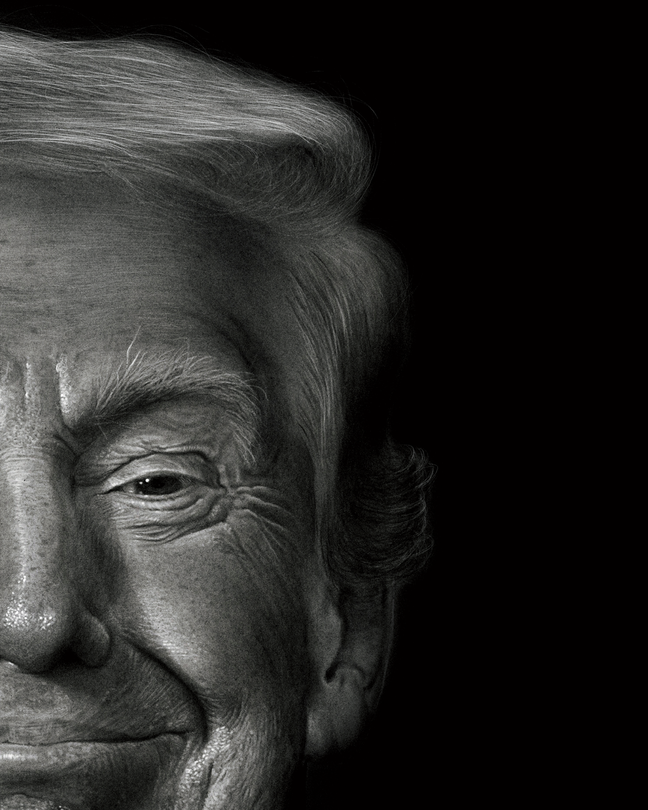
In ordinary times, reporters seeking an on-the-record encounter with the commander in chief first write an elaborate proposal. The proposal details the goals of the interview, the broad areas of concern, and the many reasons the president must, for his own good, talk to these particular reporters and not other, perfectly adequate but still lesser reporters. This pitch is then sent to White House officials. If the universe bends favorably, negotiations ensue. If the staff feel reasonably confident that the interview will somehow help their cause, they will ask the president—with trepidation, at times—to sit for the interview. Sometimes, the president will agree.
Such is what happened recently to us. We went through this process in the course of reporting the story you are reading. We made our pitch, which went like this: President Donald Trump, by virtue of winning a second term and so dramatically reshaping the country and the world, can now be considered the most consequential American leader of the 21st century, and we want to describe, in detail, how this came to be. Just four years ago, after the violent insurrection he fomented, Trump appeared to be finished. Social-media companies had banned or suspended him, and he had been repudiated by corporate donors. Republicans had denounced him, and the country was moving on to the fresh start of Joe Biden’s presidency. Then came further blows—the indictments, the civil judgments, and the endless disavowals by people who once worked for him.
Trump agreed to see us. We were tentatively promised a meeting and a photo shoot—likely in the Oval Office, though possibly the Lincoln Bedroom. But then, as is so often the case with this White House, everything went sideways.
The week our interview was supposed to occur, Trump posted a vituperative message on Truth Social, attacking us by name. “Ashley Parker is not capable of doing a fair and unbiased interview. She is a Radical Left Lunatic, and has been as terrible as is possible for as long as I have known her,” he wrote. “To this date, she doesn’t even know that I won the Presidency THREE times.” (That last sentence is true—Ashley Parker does not know that Trump won the presidency three times.) “Likewise, Michael Scherer has never written a fair story about me, only negative, and virtually always LIES.”
Apparently, as word of our meeting spread through Trump’s inner circle, someone had reminded him of some of the things we (specifically Ashley) had said and written that he didn’t like. We still don’t know who it was—but we immediately understood the consequences: no photo shoot, no tour of the newly redecorated Oval Office or the Lincoln Bedroom, and definitely no interview.
But we’ve both covered Trump long enough to know that his first word is rarely his final one. So at 10:45 on a Saturday morning in late March, we called him on his cellphone. (Don’t ask how we got his number. All we can say is that the White House staff have imperfect control over Trump’s personal communication devices.) The president was at the country club he owns in Bedminster, New Jersey. The number that flashed on his screen was an unfamiliar one, but he answered anyway. “Who’s calling?” he asked.
Despite his attacks on us a few days earlier, the president, evidently feeling buoyed by a week of successes, was eager to talk about his accomplishments. As we spoke, the sounds of another conversation, perhaps from a television, hummed in the background.
The president seemed exhilarated by everything he had managed to do in the first two months of his second term: He had begun a purge of diversity efforts from the federal government; granted clemency to nearly 1,600 supporterswho had participated in the invasion of the U.S. Capitol on January 6, 2021, including those caught beating police officers on camera; and signed 98 executive orders and counting (26 of them on his first day in office). He had fired independent regulators; gutted entire agencies; laid off great swaths of the federal workforce; and invoked 18th-century wartime powers to use against a criminal gang from Venezuela. He had adjusted tariffs like a DJ spinning knobs in the booth, upsetting the rhythms of global trade and inducing vertigo in the financial markets. He had raged at the leader of Ukraine, a democratic ally repelling an imperialist invasion, for not being “thankful”—and praised the leader of the invading country, Russia, as “very smart,” reversing in an instant 80 years of U.S. foreign-policy doctrine, and prompting the countries of NATO to prepare for their own defense, without the protective umbrella of American power, for the first time since 1945.

Donald Trump after being sworn in as president for his second term in the Rotunda of the United States Capitol (Shawn Thew / Reuters)
He had empowered one of his top political donors, Elon Musk, the richest man in the world, to slice away at the federal government and take control of its operating systems. He had disemboweled ethics and anti-corruption architecture installed after Watergate, and had declared that he, not the attorney general, was the nation’s chief law-enforcement officer. He had revoked Secret Service protection and security clearances from political opponents, including some facing Iranian death threats for carrying out actions Trump himself had ordered in his first term. He had announced plans to pave over part of the Rose Garden, and he had redecorated the Oval Office—gold trim and gold trophies and gold frames to go with an array of past presidential portraits, making the room look like a Palm Beach approximation of an 18th-century royal court.
Old foes were pleading for his grace. Meta—whose founder, Mark Zuckerberg, had become an enthusiastic supplicant—had paid $25 million to settle a civil lawsuit with Trump that many experts believed was meritless. Amazon’s founder, Jeff Bezos, the owner of The Washington Post, announced that he was banning his opinion writers from holding certain opinions—and then joined Trump for dinner the same night at the White House.
“He’s 100 percent. He’s been great,” the president told us, referring to Bezos. “Zuckerberg’s been great.”
We asked Trump why he thought the billionaire class was prostrating itself before him.
“It’s just a higher level of respect. I don’t know,” Trump said. “Maybe they didn’t know me at the beginning, and they know me now.”
“I mean, you saw yesterday with the law firm,” he said. He was referring to Paul, Weiss, Rifkind, Wharton & Garrison, one of the nation’s most prestigious firms, whose leader had come to the Oval Office days earlier to beg for relief from an executive order that could have crippled its business. Trump had issued the order at least partially because a former partner at the firm had in 2021 gone to work for the Manhattan District Attorney’s Office, where he was part of an investigation of the Trump Organization’s business practices. Also that week, an Ivy League institution, threatened with the cancellation of $400 million in federal funding, had agreed to overhaul its Middle Eastern–studies programs at the Trump administration’s request, while also acceding to other significant demands. “You saw yesterday with Columbia University. What do you think of the law firm? Were you shocked at that?” Trump asked us.
As ever, Trump was on the hunt for a deal. If he liked the story we wrote, he said, he might even speak with us again.
“Tell the people at The Atlantic, if they’d write good stories and truthful stories, the magazine would be hot,” he said. Perhaps the magazine can risk forgoing hotness, he suggested, because it is owned by Laurene Powell Jobs, which buffers it, he implied, from commercial imperatives. But that doesn’t guarantee anything, he warned. “You know at some point, they give up,” he said, referring to media owners generally and—we suspected—Bezos specifically. “At some point they say, No más, no más.” He laughed quietly.
Media owners weren’t the only ones on his mind. He also seemed to be referring to law firms, universities, broadcast networks, tech titans, artists, research scientists, military commanders, civil servants, moderate Republicans—all the people and institutions he expected to eventually, inevitably, submit to his will.
We asked the president if his second term felt different from his first. He said it did. “The first time, I had two things to do—run the country and survive; I had all these crooked guys,” he said. “And the second time, I run the country and the world.”
For weeks, we’d been hearing from both inside and outside the White House that the president was having more fun than he’d had in his first term. “The first time, the first weeks, it was just ‘Let’s blow this place up,’ ” Brian Ballard, a lobbyist and an ally of the president’s, had told us. “This time, he’s blowing it up with a twinkle in his eye.”
When we put this observation to Trump over the phone, he agreed. “I’m having a lot of fun, considering what I do,” he said. “You know, what I do is such serious stuff.”
EXILE
that trump now finds himself once again in a position to blow things up is astonishing, considering the depth of his fall. So much has happened so fast that the improbability of his comeback gets obscured. Perhaps no one in American history has had a political resurrection as remarkable as Donald Trump’s.
In the waning days of his first term, his approval rating stood at a pallid 34 percent. A few weeks earlier, he had watched on television while an insurrection he incited overran the Capitol; polls showed that a clear majority of Americans believed he bore responsibility for the attack. The House of Representatives had just impeached him for the second time—making him the only president to ever achieve that ignominy. And although the Senate failed to reach the two-thirds majority required for conviction, seven Republican senators voted to convict—the most members of a president’s own party to vote for an impeachment conviction in history.
Twitter and Facebook, his favorite social-media platforms, had banned or effectively silenced him, along with Instagram and YouTube. To try to reestablish direct connection with his followers, he would launch a blog, “From the Desk of Donald J. Trump.” But it gained little traction and was abandoned within weeks.
Major corporations announced that they were cutting off political contributions to officials who had supported Trump’s election lies. Deutsche Bank and Signature Bank decided to stop doing business with Trump and his companies. Perhaps most painful to the president, the PGA of America yanked its scheduled 2022 championship tournament from Trump’s Bedminster golf course. Former members of his own Cabinet and staff—people he had hired—would declare him, or had already declared him, “a moron” (Rex Tillerson, secretary of state), “more dangerous than anyone could ever imagine” (James Mattis, secretary of defense), “the most flawed person I have ever met” (John Kelly, chief of staff), and “a laughing fool” (John Bolton, national security adviser). And now longtime allies were abandoning him. Kevin McCarthy, the Republican House minority leader, had discussed pushing Trump to resign from office. On the evening of the insurrection, Senator Lindsey Graham, a compass reliably magnetized toward wherever power in the Republican Party lies, pointed away from Trump for the first time in four years. “Count me out,” Graham had declared on the Senate floor. “Enough is enough.” Rupert Murdoch, then the chairman of Fox Corporation, sent an email to a former Fox Broadcasting executive in which he declared, “We want to make Trump a non person.” Coming from Murdoch himself, the former Trump adviser Steve Bannon told us recently, “that’s a papal bull.”
On the morning of Joe Biden’s inauguration, Trump was a dozen miles southeast of the festivities, at Joint Base Andrews, preparing to depart for Florida. (Trump was the first president since Andrew Johnson, in 1869, to boycott the swearing-in of his successor.) Standing before a modest crowd, his dark overcoat a meager bulwark against the cold, the soon-to-be-former president cut a diminished figure.
Just before boarding Air Force One for the final time, to head to Mar-a-Lago, Trump spoke to those gathered to bid him farewell. “We will be back in some form,” he said, a notably modest framing from such a formerly oversize figure.
Few believed him. It didn’t even sound like he believed it himself. The Trump era was over.
Almost as soon as Trump arrived at his gilded Elba, he began plotting his return. He missed the press pool—the gaggle of reporters that tails every president—and once tried to summon it, only to be told that no such pool still existed. But it would turn out that the lack of attention in those first months—and the lack of access to social-media platforms—was a blessing. Enforced obscurity gave him the time and clarity he needed to plan his comeback.
To understand how Trump rose from the political dead, and how he set himself up to wield power in his second term, we spoke with dozens of top advisers, senior aides, allies, adversaries, and confidants. Many who talked with us did so only on the condition of anonymity, in order to be more candid or to avoid angering the president. The story they told us revealed that Trump’s time in the political wilderness is crucial to understanding the way he’s exercising power now.
He had been in Palm Beach a week when an opportunity presented itself. Trump heard that Kevin McCarthy would be in South Florida for fundraisers. Though the two men had clashed after the Capitol riot, Trump invited McCarthy to Mar-a-Lago. Even before the meeting happened, news of it leaked to The New York Times, shaking the political universe: Were Republican leaders, who had seemed so intent on purging Trump, embracing him again? When Trump and McCarthy met in person, the former president asked the minority leader who had tipped off the Times.

“I know who leaked it—you did,” McCarthy replied, multiple people briefed on the exchange told us.
“It’s good for both of us,” Trump shot back.
Both men were right. McCarthy had already concluded that the path back to Republican control of the House in the 2022 midterms—and his own path to the speakership—required a unified party, one that included Trump and his MAGA base. After the meeting, each man separately released the same photo: the two of them grinning amid the ostentatious splendor of Mar-a-Lago. Trump had taken his first step toward political redemption.
It is a truism that Trump has never felt governed by the traditional rules of politics. And he has always been convinced of his own genius, his pure gut instincts. But never more so than today. The past four years have turned him into a Nietzschean cliché. Banishment, multiple indictments, a 34-count felony conviction, repeated brushes with assassins—all have combined to convince him that he is impervious to challenges that would destroy others. Those years also strengthened in him the salesman’s instinct that he can bend reality to his will—turn facts into “fake news,” make the inconceivable not just conceivable but actual, transform the Gulf of Mexico into the Gulf of America, make people believe what he’s selling in defiance of what they see with their own eyes. This is the core lesson that Trump and his acolytes internalized from the 2020 election and January 6. The real-estate mogul who branded buildings with his name everywhere from Turkey to Uruguay, who sold the “world’s greatest steaks” and the “finest” wine and “fantastic” mattresses, had mastered the alchemy of perception. Reality, to Trump, is fungible. While reporting on Trump over the past four years, we were repeatedly struck that, in failing to drive a stake directly through his heart, all of the would-be vampire slayers—Democrats, Never Trumpers, Republican-primary opponents, prosecutors, judges, media critics—only strengthened him. Which brings us to a second lesson: Trump and his team realized that they could behave with near impunity by embracing controversies and scandals that would have taken down just about any other president—as long as they showed no weakness.
Even now, Trump—who described himself to us as “a very positive thinker”—struggles to admit that his return to power was a comeback. To concede that he’d had to come back would be to admit that he had fallen in the first place.
Early in our reporting for this article, we asked the Trump loyalist and former Breitbart News editor Raheem Kassam to explain how the president had been able to bend the country, and the world, to his will. Over a meal of oysters brûlées, duck confit, and fries cooked in beef tallow at Butterworth’s, the new MAGA haunt on Capitol Hill, he responded crudely, if vividly. “He didn’t bend them to his will,” Kassam said. “He bent them over.”
he had almost been destroyed before. After a real-estate downturn in the early 1990s, Trump found himself on the brink of financial ruin. His near bankruptcy and recovery led to his 1997 book, The Art of the Comeback. For his political advisers in exile, this book became essential reading.
The first pages list Trump’s “Top Ten Comeback Tips.” When we met one of his advisers recently, this person recounted from memory some of the rules on the list. “Rule 1 is: Play golf,” this adviser told us. “Rule 9 is: Get even.” (Rule 10, “Always have a prenuptial agreement,” seemed less applicable to politics.)
To stage a comeback, Trump would need the right staff. He had realized, in his exile, that at nearly every turn in his first term, someone on his own team—Reince Priebus, John Kelly, James Mattis, Bill Barr, Gary Cohn—had blocked him. He needed smart people who would figure out how to let him do everything that he wanted to do, in whatever way he wanted to do it. His first key hire was a political operative who had impressed the former president with her retrospective analysis of the 2020 election. Biden had won the election that year by flipping back into the Democratic column five key states—Arizona, Georgia, Michigan, Pennsylvania, and Wisconsin (along with a lone congressional district in Nebraska). One of the few bright spots for Trump in 2020 had been Florida, where he had increased his winning margin from 2016. What, Trump began asking his allies after the election, had he done right in Florida that he hadn’t done in the rest of the country?
The answer, in large part, boiled down to Susie Wiles, who had run Trump’s 2016 and 2020 campaigns in the state. Wiles, the daughter of the legendary NFL announcer Pat Summerall, is an experienced campaign operative (she was a scheduler for Ronald Reagan’s 1980 presidential campaign), who over the past three decades had developed deep Florida ties. After every campaign she runs, Wiles writes an “after action” report, documenting what worked and what didn’t. Over dinner with Trump on the patio at Mar-a-Lago in early 2021, she delivered “the Florida memo.” Soon after, he hired her to run his political operation, which eventually became his 2024 campaign.
Wiles saw that one thing that had held Trump back in 2020 was that he had not finished taking over the Republican Party during his first term. Part of Trump’s leverage had been his ability to endorse in Republican primaries—influence he was eager to reprise. “When I endorse somebody, they win,” Trump told us on the phone. “But even when I endorse them in the general election, mostly they win. It’s important.” (Now when Trump calls to pressure a fellow Republican about an issue or a vote, they are almost always grateful for his past support, or feel that they owe their seat to him.)
The Wiles process for evaluating potential endorsees—which she undertook with James Blair, now a deputy chief of staff in the White House, and Brian Jack, now a congressman representing Georgia—involved researching how they had spoken about Trump in the past. “The basic thing was their loyalty and their political viability,” one adviser told us. “So we were looking for things like: So, what did they say on J6? What did they say during the Access Hollywood tapes? What is their voting record with us?” Trump was building a coalition of loyalists, something he hadn’t sufficiently done during the first term.
Wiles had plenty of experience managing men with big personalities. But colleagues say a key reason she’s been successful working with Trump (she is now his White House chief of staff) is that she never tries to manage him. She does not imagine that she can control him, as some former top advisers attempted, and she tends not to offer advice unless specifically asked. Her primary role, as she sees it, is to set up processes to help ensure Trump’s success, and then to execute his directives, whatever they may be.
At first, Trump’s banishment from the big social-media platforms, along with mainstream media outlets’ reluctance—including Fox News’s—to give him much coverage, seemed potentially devastating. But Trump turned to the far-right platforms and activists still welcoming him. Taylor Budowich—now a White House deputy chief of staff—worked with MAGA influencers to evade the Twitter and Facebook bans: They would print out pro-Trump social-media posts; Budowich would have Trump sign the paper with his Sharpie, and then mail the signed post back to the influencer; almost invariably, the influencer would then post the signed missive, flexing their access and building their audience—while simultaneously amplifying Trump’s voice. At the same time, a video ecosystem grew up around Trump, with streaming platforms such as Right Side Broadcasting Network stepping in to cover his events when cable networks would not.
Trump, meanwhile, continued to promote the lie that he’d won the 2020 election, and that January 6 was just an ordinary Wednesday. Normal political logic suggested that this was a bad strategy. But his shamelessness, as ever, remained a strength. By repeating something frequently enough, he could slowly make it feel true, at least for his supporters.
Not long ago, we sat in Steve Bannon’s Capitol Hill rowhouse, where he records his War Room podcast, pressing him on Trump’s refusal to accept the results of the 2020 election, and his denial of what transpired on January 6. “Our reality is that we won” and that January 6 was a “fedsurrection,” Bannon said, referring to the conspiracy theory that FBI agents had incited the crowd on the Ellipse that day.
But this reality, we pointed out to Bannon, is simply not true.
“BE READY!”
the first televised hearing of the House select committee on January 6 was scheduled for the beginning of June 2022, and it was sure to be a spectacle that reminded viewers of the horror of the insurrection and emphasized the former president’s culpability. Trump’s team at Mar-a-Lago was desperate to distract attention from the hearing. At one point, someone proposed a brazen gambit: Trump could announce his 2024 bid for the presidency just minutes before the hearing gaveled in.
Trump’s response was telling. “I’m not ready for this,” he said. “We’re not ready for this right now.”
“That was the first moment of, like, ‘Okay, he’s not just thinking about it; he’s seriously thinking about how he wants to do it,’ ” one of his advisers told us. “He’s not going to just use it as a stunt to make a moment. He wants to win.”
Before long, Trump began emphasizing behind the scenes that he was serious. “Be ready,” he would repeat to people who had served with him the first time around. “Be ready! Be ready! We’re coming back! Be ready!”
Still, when Trump did launch his campaign, in November 2022, it did not get off to an auspicious start. Even his most fiercely supportive advisers concede that the announcement, in the form of an hour-long speech at Mar-a-Lago, was a dud.
Surprisingly few political reporters from major outlets were in attendance; it was as though the mainstream media still didn’t believe that Trump could be a viable candidate again. Worse, some members of Trump’s own family hadn’t bothered to show up. As the speech dragged on, even Fox News cut away, switching to what Bannon called “a C-level panel,” before returning for the final few minutes.
The campaign struggled to gain traction. Trump’s longtime pollster Tony Fabrizio told us that even months later, into early 2023, getting donors to attend the first big super-PAC event “was like pulling teeth.” And although Trump was now a declared presidential candidate, his team said it was still having trouble getting him booked even on shows such as Fox & Friends.
The first turning point, several advisers told us, came in February 2023. A Norfolk Southern train carrying hazardous chemicals derailed in East Palestine, Ohio, near the Pennsylvania border, spewing toxic material. Sitting in the West Palm Beach campaign headquarters one day, Trump’s team watched Joe Biden’s press secretary struggle to answer a question about the president’s plans for outreach to East Palestine. Soon after, Susie Wiles received a call from Trump’s oldest son, Don Jr., saying that his father ought to just show up there himself. When Wiles brought the suggestion to Trump, in the living room of Mar-a-Lago, his response was unequivocal: “That’s a great idea,” he enthused. “When can we go?”
Trump’s visit to East Palestine—and the footage of him buying McDonald’s for the first responders—had a potent effect. “It just reminded everyone that people still like this guy,” one adviser told us. “He’s still a draw.” Nearly two years later, Trump’s visit continued to resonate. “People are living their lives and they don’t delve that easily into policy,” a woman across the border in the swing state of Pennsylvania told our colleague George Packer before the election last fall. “All they know is that Trump was here buying everyone McDonald’s” and that Biden hadn’t visited for more than a year.
The halting start to the campaign kept Trump off the radar, giving his team time to plan. Former Trump advisers had used their years out of power to set up their own groups—America First Legal, America First Policy Institute, Center for Renewing America—to prepare for a second Trump administration.
“The people who were the true believers knew Trump was going to run again and win,” Caroline Wren, a former top Trump fundraiser, told us, adding that Trump’s policy loyalists “sat there and prepared executive orders for four years.”
The time out of the spotlight also allowed the team to build a new election strategy. By now, Trump had alienated a significant share of the voting public, and he was polling lower among some demographic groups than in previous elections. The conventional wisdom was that the criminal investigations and legal proceedings then under way would only increase that alienation. His campaign directors decided that the best tactic was to turn this problem into a strength. Chris LaCivita, who was a co–campaign manager alongside Susie Wiles and a military veteran wounded in the Gulf War in 1991, took to exhorting younger staffers with a Marine slogan: “Embrace the suck.”
The impulse to let Trump be Trump, so contrary to the instincts of much of the first-term staff, was laid out in a memo that James Blair and Tim Saler, the campaign’s lead data expert, sent to Wiles in early 2024. This became known around the campaign as the “gender memo.” “Instead of saying, ‘Look, we did two points worse with white suburban women between 2016 and 2020’ and ‘How do we get those points back?,’ what if we did it the other way?” an adviser familiar with the memo told us. “What if we said, ‘We gained eight points with non-college-educated men. What if we won them by 12?’ ”

The strategy had the benefit of letting Trump be the version of himself that appealed to those men. In a moment when the Democratic Party often felt like an amalgamation of East Coast elitists, niggling scolds, and far-left activists, Trump appeared to offer judgment-free populism to a populace sick of being judged.
Trump’s own view, we were told, was more self-referential: “Why would I distance myself from my people? They love me.”
“IT MADE ME STRONGER”
on friday, may 31, 2024, the day after Trump was convicted of 34 felony charges in a New York City courtroom, the treasurer at Make America Great Again Inc., the main super PAC supporting the former president, called his boss, Taylor Budowich, with good news. A large wire transfer was incoming—a record $15 million. The call set off an internal scramble, because the bank needed the donor’s name to approve the transfer, and nobody knew who it was.
Shortly thereafter, the treasurer called back. “I’m so sorry,” he told Budowich. “I misheard him. It’s not $15 million—it’s $50 million.”
“Don’t be sorry!” Budowich said. (The donation was eventually traced to Timothy Mellon, an heir to the Mellon banking fortune.)
The Democrats assumed that Trump’s legal issues would politically neuter him. “A convicted felon is now seeking the office of the presidency,” Biden would say. But all the scandals and controversies that would have sunk a different candidate became background static. “The thing about the court cases is there were too many of them, and this is one of Trump’s superpowers—he never just breaks the law a little bit; he does it all over the place,” Sarah Longwell, a formerly Republican, anti-MAGA political strategist who regularly conducts focus groups, told us. “And as a result, there were so many court cases that it was just white noise to voters. They couldn’t tell them apart.”
The Democratic base remained outraged. Trump’s base continued to believe his claims that all the criminal investigations and January 6 hearings constituted a “witch hunt.” But for the sliver of voters who would actually decide the election, the Democratic argument that Trump was a threat to democracy was too far removed from their more urgent concerns about grocery prices. As time passed and Trump continued to rewrite history to turn insurrectionists into “patriots,” the events of January 6 receded into abstraction for many of these voters.
“If you said, ‘What’s J6?,’ it’s like, ‘What is that? Bingo? Are you playing Battleship?’ ” the adviser familiar with the gender memo told us, describing what the campaign’s voter research had found.
For Trump’s base, the cases were energizing, and they put his Republican-primary opponents in the difficult position of having to defend Trump against “lawfare” or risk being seen as supporting the Democrats’ position. So even while campaigning against him for the nomination, they were in effect campaigning for him.
During his 2016 campaign, Trump had ignored the traditional fundraising circuit, which increased donor skepticism of him. But during his time in the wilderness, he began to enjoy raising money. He asked advisers to schedule more call time for him with top donors. He wrote personal notes, and he regularly invited wealthy supporters and potential donors to dine with him at Mar-a-Lago. He judged generosity not by the size of the check, his allies told us, but by the size of the check relative to the donor’s net worth. He liked pressuring donors to bet on him—and watching them squirm if they hedged. Sometimes he was blunt, invoking the specter of a President Kamala Harris taking their wealth.
(“If I’m not president, you’re fucked,” he would tell a roomful of oil executives at Mar-a-Lago after the election. “Look at your profit-and-loss statements. You realize what would have happened to you if she was president? What’s wrong with you?”)
The Supreme Court decision in July 2024 regarding a legal challenge to the federal prosecution of Trump for interfering in the 2020 election gave Trump and his allies further momentum. Trump v. United States addressed the question of legal liability for a president, but Trump’s allies focused on how the Court described the presidency itself, suggesting that all the powers of the executive branch were imbued in the personage. “Unlike anyone else,” the Court wrote, “the President is a branch of government.” That the prosecution of Trump both revivified his candidacy and then gave him more executive power in his second term remains a stinging irony for Democrats.
When we talked with Trump, we asked him if he thought the criminal prosecutions had made him stronger. “Shockingly, yes,” he said. “Normally, it would knock you out. You wouldn’t even live for the next day. You know, you’d announce your resignation, and you’d go back and ‘fight for your name,’ like everybody says—you know, ‘fight for your name, go back to your family.’ ”
He paused. “Yeah, it made me stronger, made me a lot stronger.”
In the final months of the campaign, Democratic strategists working for Vice President Harris focused on seven swing states. Trump, by contrast, told aides that he wanted to put resources into picking up voters even in states he was already certain to win.
“We don’t want anyone to know—it’s a surprise—but I think we might win the popular vote,” Trump would say to his advisers. “We have got to run up the score.”
During breaks between events, his team would place calls to groups of voters in red states and put him on the line. “This is your favorite president, Donald Trump,” he’d say, before launching into brief remarks. They would make calls from the motorcade, from the campaign plane, as many as 10 a day. In this way, working around the old mass media, Trump reached thousands of voters directly.
“If there was someone in America in some state, still awake, Donald Trump would find a way to get to them,” Chris LaCivita told us.
In 2016, Trump had been so frustrated about losing the popular vote to Hillary Clinton that he’d falsely asserted, “I won the popular vote if you deduct the millions of people who voted illegally.” Eight years later, he didn’t have to pretend. As Election Night gave way to dawn in Palm Beach, Trump basked in the comprehensiveness of his victory—all seven swing states, and a strong showing in the popular-vote tally, which he ultimately won. Several aides got calls from him around 4 a.m. “You won’t believe it,” Trump crowed, according to one. “I’ve already had 20 world leaders call me. They all want to kiss my ass.”
Some time later, Trump addressed a gathering of supporters in the living room at Mar-a-Lago. During his first term people would say, “Yeah, he won, but he doesn’t have a mandate, ” Trump told the crowd. “Now they can’t say it anymore.”
people who worked with Trump in his first term used to play a parlor game of sorts. What would happen, they wondered, if they, the human guardrails, weren’t there to correct the president’s errors, to explain to him all the things he did not know or understand, to talk him out of or slow-walk his most destructive impulses?
During his first term, he faced resistance and obstruction from all over the government: from the courts and from the Democrats, but also from Republicans in the House and Senate, who at times treated him like a floundering student. The contempt was mutual. “Paul Ryan was a stupid person,” Trump told us in March, referring to the former Republican speaker of the House. “And Mitch, Mitch wasn’t much better,” Trump said of Mitch McConnell, the former Senate Republican leader and, lately, the epicenter of GOP resistance to Trump, such as it is. But some of the most crucial pushback came from within the executive branch. At times, his chief of staff and his White House counsel declined to carry out his orders. Trump had been apoplectic when “his” Justice Department, under Jeff Sessions and Rod Rosenstein, opened an independent-counsel investigation into whether the Russians had influenced the 2016 election and whether the Trump campaign had colluded with them.
This time would be different, because he’d learned from experience. “When I did it before, I never did it, you know?” he told us. “I didn’t know people in Washington.”
On January 15, at 8 p.m., five days before the inauguration, Trump sent out an incendiary post on Truth Social. In it, he described the sorts of people his incoming administration would not be hiring—a list that included anyone who had ever worked for, in his words, “Americans for No Prosperity (headed by Charles Koch), ‘Dumb as a Rock’ John Bolton, ‘Birdbrain’ Nikki Haley, Mike Pence, disloyal Warmongerers Dick Cheney, and his Psycho daughter, Liz,” and anyone “suffering from Trump Derangement Syndrome.” For those staffing Trump’s second term, the missive was doctrine: This time, loyalty would be absolute.
In 2016, few experienced Republicans had been involved in Trump’s campaign, so the pool of presumptive loyalists to draw from was small. His incoming team also used key transition picks—Cabinet secretaries, West Wing advisers—to reassure a still-skeptical Republican Party that Trump was one of them. This produced a dysfunctional dichotomy in which Reince Priebus, a mild-mannered traditional Republican from Wisconsin, and Steve Bannon, a revolutionary hell-bent on dismantling the administrative state, shared top billing in the West Wing. The competing camps—the MAGA fire-breathers, the establishment swamp creatures, “Javanka” and the globalists—leaked relentlessly to the media and tried to knife one another. A miasma of chaos surrounded Trump, and impaired the administration’s ability to carry out its policy agenda.
But by 2024, Trump had effectively consumed the party, and he had no need to recruit traditional Republicans, if any even remained. Cliff Sims, who during Trump’s first term had served as a communications aide in the White House before going to work for the director of national intelligence, helped the transition team manage hiring for the second term. The formula for staffing the administration wasn’t hard this time, Sims told us: “Don’t hire anyone who wasn’t committed to the agenda last time.”
“I knew that Stephen Miller would ultimately run the policy operation, with immigration as a top priority,” Sims told us, referring to Trump’s senior domestic-policy adviser, who is, famously, an immigration hard-liner. “So I just asked him, ‘Who do you want? Who should prepare DHS? Who should prepare ICE? Who are the rock stars from your team? Let’s get them all rolling.’ ” Same, too, with trade. Sims called Jamieson Greer, who had served as the chief of staff to the U.S. trade representative in Trump’s first term before taking over the role himself this time around. He asked Greer who Trump’s pro-tariff “killers on trade” were. “And he’s like, ‘I’ve been sitting here hoping someone would call about this; I’ve already got a list ready,’ ” Sims told us.
Because the transition hiring for the second term harvested a uniformly loyalist crop of staffers, getting things done the way Trump wants became easier. In the first term, executive orders designed by the MAGA faction were sometimes rushed through without proper legal vetting, in an attempt to prevent a warring faction from killing the directive, someone familiar with this process told us—which made them vulnerable to court challenges. This time around, the process for generating the orders is more disciplined.
Trump’s aides and advisers also now understood the hydraulics of the government better. They’d learned, for instance, that immigration policy was not contained solely within the Department of Homeland Security, and that to curb the flow of immigrants across the southern border, they also needed to install loyalists in crucial roles at the Department of Health and Human Services. When it came to the Bureau of Western Hemisphere Affairs at the State Department, they now knew they needed MAGA diehards in key roles. This kind of knowledge would now be applied to thousands of hires across dozens of agencies.
When his cabinet nominees hit trouble in the Senate, Trump and his team were determined to test their new power. “It was ‘You’ll eat your breakfast and you’ll like it,’ ” a veteran Republican operative told us. The first major test came during the former Fox News host Pete Hegseth’s quest for confirmation as defense secretary.
Senator Joni Ernst of Iowa, a Republican, was skeptical about Hegseth’s qualifications. Ernst is the first female combat veteran to serve in the Senate; Hegseth had previously said that women should not serve in combat roles. Ernst is also a sexual-assault survivor; Hegseth has been accused of sexual assault and other misconduct, including alcohol abuse. (Hegseth has denied the accusations.) But when Ernst publicly signaled that she might not be able to support the nomination, Trump’s allies leaped into action. On private text chains, they talked about how failing to win confirmation for Hegseth was untenable. The consensus was clear: Because Matt Gaetz had already had to withdraw as Trump’s pick for attorney general, if they lost another major nominee, there would be blood in the water. Even the most controversial—Hegseth, Tulsi Gabbard, Robert F. Kennedy Jr., Kash Patel—needed to be muscled through.

Trump and his team saw the confirmation of their most controversial Cabinet nominees—Robert F. Kennedy Jr., Pete Hegseth, Tulsi Gabbard—as a chance to flex their power over the Republican Party. (Photo-illustration by Paul Spella. Sources: Rebecca Noble / Getty; Anna Moneymaker / Getty; Philip Yabut / Getty; Print Collector / Getty.)
They decided to make an example of Ernst, as a warning to other senators about what to expect if they stepped out of line. An op‑ed implicitly excoriating her appeared on Breitbart News ; Bannon and the gang on his War Room podcast hammered her relentlessly; and the powerful young conservative activist Charlie Kirk and his Turning Point USA team threatened to send resources to Iowa to oppose her reelection in 2026. Ernst’s effort to “end Pete Hegseth,” Kirk posted on X in early December, “is a direct attempt to undermine the President and his voters. Pete Hegseth is the redline. If you vote against him, primaries will ensue.”
Trump’s team knew that once the most prominent MAGA figures began their onslaught, second-tier influencers would follow. Ernst called around to Trump allies, begging them to stop the attacks. But they wouldn’t relent; she voted to confirm Hegseth.
Bill Cassidy, a Republican senator and physician from Louisiana, also briefly found himself in the hot seat as he struggled with his confirmation vote on Kennedy, a vaccine critic who has misstated scientific findings, to lead the nation’s top health agency. (Cassidy was also viewed as a problem by Trump supporters because he’d voted to convict the president for his role in the January 6 insurrection.)
Cassidy ultimately supported Kennedy’s nomination, though he maintained that the vote had nothing to do with his own reelection prospects in 2026. Afterward, in the course of general conversations about the midterms, Cassidy’s team sought Trump’s support in his upcoming GOP primary. Trump told an aide to relay to Cassidy: “I’ll think about it.” (A Trump adviser told us that, for the moment, the president and Cassidy have reached “an uneasy détente.”)
Business leaders fell more quickly in line. After the election, they descended on Mar-a-Lago.
At dinner with Silicon Valley moguls, Trump would sometimes play “Justice for All”—a song by the J6 Prison Choir that features men imprisoned for their actions on January 6 singing “The Star-Spangled Banner,” interspersed with Trump reciting the Pledge of Allegiance. One Trump adviser gleefully recounted how confused the tech billionaires appeared when “Justice for All” started, looking around for cues before inevitably rising and putting their hands over their hearts.
“The troll is strong,” the adviser told us.
The Thursday before the inauguration, a friend of Trump’s was sitting with him at Mar-a-Lago when the once and future president held up his phone to show off his recent-call log.
“Look who called in the past hour,” Trump boasted, then scrolled through a list that included Jeff Bezos, Elon Musk, Mark Zuckerberg, and Tiger Woods. Apart from Woods, all were former Trump critics who, eight years earlier, had tried to keep their distance.
SHOCK AND AWE
the start of a new presidency is a famously harried and jury-rigged affair. But Trump and his team had spent his time out of office preparing for his return. Longwell, the anti-MAGA strategist, told us—echoing something our colleague David Frum had warned about four years ago—that watching Trump’s second-term team attack the federal bureaucracy was like watching “the velociraptors who have figured out how to work the doorknobs.” Day one of the second term, the product of weeks of meticulous planning, was all about—in the Trump team’s words—“shock and awe.” “We did all the immigration and border executive orders,” an adviser told us. “If we just left it at that, all the stories would have been about what bad people we are—we’re kicking people out of this country. But then right after he signed those border executive orders, bam: the J6 pardons.” The adviser explained that, along with Trump’s multiple speeches that day and inaugural balls that evening, this meant “the media had to choose what to cover. It’s either the J6 pardons or the immigration executive orders.” This convulsion of activity, the adviser told us, was all “planned”—designed to overwhelm.
“We have everyone kind of in the barrel, like everyone’s on the spin cycle, just getting whipped around, and that’s advantageous for us,” another adviser told us.
In his first term, Trump had floated the idea of buying Greenland—speaking of it almost offhandedly as a potentially intriguing if unusual real-estate acquisition. But now, even before taking office again, he had suggested that Canada should be America’s 51st state, threatened to reclaim the Panama Canal, and vowed to gain control of Greenland—“one way or the other,” as he would later put it. He followed this during his inaugural address by invoking “manifest destiny,” the 19th-century idea that the United States has a divinely ordained right to control North America.
“This time it’s ‘Hey, fuck you, Greenland’s ours,’ ” Bannon told us.
He added that many of the things that, in his first term, Trump had floated as provocations or trollings or idle musings are now things the president realizes he can actually do. “These are all doable,” Bannon told us. “When you’ve come back from such long odds, you clearly feel, ‘I can do anything.’ ”
In his first term, Trump and his team had not done certain things—fired key bureaucrats, upended certain alliances, overhauled various initiatives—because, as one former adviser told us, “we thought they were red-hot.
“And then you touch it,” the former adviser continued, “and you realize it’s actually not that hot.” This may be the key insight of Trump’s second term. The first time around, aides were constantly warning him that the stove was too hot. This time, no one is even telling him not to touch the stove.
Tradition holds that artists honored with lifetime-achievement awards at the Kennedy Center meet with the sitting president. During Trump’s first term, some of the most prominent artists refused to do so. He, in turn, didn’t attend a single performance there.
“I didn’t really get to go the first time, because I was always getting impeached or some bullshit, and I could never enjoy a show,” Trump said, according to an adviser familiar with the comments. But as planning for the second inauguration got under way, someone mentioned the possibility of holding an event there, impelling Trump to muse aloud about naming himself chairman of the Kennedy Center, a position that had long been held by the philanthropist and Carlyle Group founder David Rubenstein. Trump ordered, “Call David Rubenstein and tell him he’s fired.”

Overnight, Trump’s cultural remit went from queuing oldies on his iPad on the patio of Mar-a-Lago to being chairman of the Kennedy Center, one of the nation’s premier arts institutions. (Chip Somodevilla / Getty)
Some of Trump’s advisers have learned to operate by an unofficial rule: They make sure to do things after he says them twice. This is a necessary and important rule because, as one adviser explained, “he says a lot of shit.” So the second time Trump mentioned wanting to take over the Kennedy Center, his aides got to work, and in early February, Trump fired most of the board and named himself chairman. His cultural remit had gone overnight from entertaining his aides by playing oldies on his iPad on the patio of Mar-a-Lago to being chairman of the board of one of the nation’s premier arts institutions.
One of the most chaotic departures from convention has been Elon Musk’s prominent role in the administration. The disruption Musk has unleashed through DOGE, putting swaths of government “into the wood chipper,” as he described it, has tended to obscure the fact that the richest man in the world, who is one of Trump’s biggest financial donors, is attending Cabinet meetings while continuing to run his private businesses, which benefit from billions of dollars in federal contracts. The conflicts of interest here run fathoms deep. But Trump has confidently normalized all of it, even going so far as to conduct an infomercial for Tesla on the White House grounds.
In previous presidencies, Musk’s role in the administration would have been a scandal that dominated the media and congressional hearings for months. In Trump’s second term, this—by design—gets drowned out by everything else.
So, too, does Trump’s complete departure from convention regarding the Justice Department, which has historically had some independence from the president. In April, Trump ordered the DOJ to investigate Chris Krebs, who in Trump’s first term ran the Cybersecurity and Infrastructure Security Agency, which declared the 2020 election secure and Biden the legitimate winner. Trump, in short, wanted to prosecute Krebs for accepting reality. He has also made clear that he wants the attorney general to protect his supporters, including Musk, whose Tesla dealerships and charging stations have been targeted by vandals. “When I see things going on like what they’re doing to Elon, that’s terrible,” Trump told us. “That’s a terrible thing. That’s terrorism.”
Trump boasted to us of Musk’s private business successes as if they were his own. One of Musk’s companies, SpaceX, had just helped to retrieve astronauts who had been marooned for months on the International Space Station. “They don’t come out of there at some point, you know, the bones start to break down,” Trump said.
Trump marveled at the media’s coverage of the splashdown. “They said, ‘And the rocket’s coming down in the Gulf of America.’ They didn’t make a big deal. They didn’t say Trump named it,” he told us. “It was like it was old hat. And it’s been the Gulf of Mexico for hundreds of years, literally hundreds of years. The Gulf of Mexico, before our country was formed. It’s been a long time. And that’s good.”
“THAT IS NOT WHAT THEY SIGNED UP FOR”
for all of trump’s success in dominating the political sphere, Democrats have grown more optimistic that his political fortunes may be changing. Senator Elissa Slotkin of Michigan, who gave the Democratic rebuttal to Trump’s address to Congress in early March, told us that some of her constituents say their votes for Trump were born of despair. “They’ll say to me, ‘Look, it’s like I’m a Stage 4 cancer patient. My life has been getting worse, from my grandfather to my father, from my father to me, and my kids are going to do worse than me, so I need experimental chemo. Trump is my experimental chemo. It may hurt like hell. It may not work at all. But I’m at the end of my rope, and I’ll try anything.’ ”
We asked her whether now, several months into the second Trump administration, her constituents think the chemo is working. “I can’t tell you how many Trump voters have said to me, like, ‘Look, I voted for him to make the economy work. I did not vote for all of this craziness, and I certainly didn’t vote, for instance, for cuts to the VA,’ ” Slotkin said. “That is not what they signed up for.”
But in nearly every conversation we had with various Trump advisers, they told us that delivering on what people had voted for was in fact essential to holding the House and the Senate in the 2026 midterms. Trump himself has his eyes on a larger, long-term political realignment. “It’s a much different party,” he told us. “I got 38 percent of the male Black vote. Nobody knew that was possible. That’s a lot. I got 56 percent of Hispanics. How about that one? Every county along the Texas border is Hispanic. I won every one of them.” Though every single number he cited was wrong, the general thrust of his observation was correct.
Delivering on Trump’s campaign promises, his advisers told us, was the key not only to securing his legacy but to transforming the MAGA base into Republican voters for decades to come. (This project—persuading MAGA supporters to vote for Republicans even when Trump is not on the ballot—is a “central theme” of this presidency, one adviser repeatedly told us.) During the campaign and then the transition, Trump’s aides kept a shared document that meticulously cataloged and updated his promises for what he would do on day one, as well as what he’d promised to do more generally. The advisers we spoke with said that voters had absolutely known what they were asking for when they pulled the lever for Trump—and Trump’s team was determined to deliver.
But this is where the now nationally ingrained tendency to take Trump seriously but not literally may have created a disconnect between what Trump’s supporters thought they were voting for and what they are now getting, even among his most committed base. Over the years, Trump said many things that never came to fruition. Or he spoke with such hyperbole that everyone substantially discounted the reality of what he was ostensibly committing to. Or the policy implications of what he said would get obscured in the cloud of his ruminations about shark attacks and electrocutions and Hannibal Lecter—allowing voters to focus on what they liked and to ignore the riskier, more worrisome aspects of his promises. So although it’s true that Trump is delivering on commitments to impose tariffs, cut government waste, and aggressively deport immigrants, many of his voters are only now beginning to realize the effect these policies will have on their daily lives.
Several months into his second chance, the blitzkrieg of the early days continues—but it seems to be meeting more substantial resistance. Federal courts are once again blocking—or at least trying to block—Trump plans that flout the Constitution or stretch legal reasoning. The repeated rollouts and rollbacks and re-rollouts of his tariff measures have pushed the world toward an economic breaking point. (Even in the best-case scenario, any renaissance of the U.S. industrial base remains a long way off.) The Federal Reserve recently adjusted short-term-inflation projections higher, and GDP projections are getting lower. Financial analysts say the odds of a recession have risen significantly. The stock market just had its worst quarter in three years. When we talked with him in March, Trump had told us that Vladimir Putin “is going to be fine” in the Ukraine peace negotiations—but Putin has thwarted Trump’s promise of a quick deal. (“I’m trying to save a lot of lives in the world,” Trump told us. “You know, Ukraine and Russia—it’s not our lives, but it could end up in a Third World War.”)
The Signalgate fiasco appalled even a majority of Republicans. (Here Trump has so far stuck to his second-term policy of conceding essentially nothing, of never admitting weakness or a lie. To date, no one has been fired over Signalgate—though advisers we spoke with privately predicted that National Security Adviser Michael Waltz, who inadvertently added The Atlantic’s editor in chief to the attack-planning chain, would exit the administration by the end of the year, if not much sooner.) Mass anti-Trump protests, notably absent during the first two months of this term, have become more frequent, including in red states.
Even as Trump continually seeks to expand his presidential powers, he at times seems to acknowledge that they have limits. In our March conversation, he seemed frustrated at the notion that a court might try to curb his ability to deport anyone he wanted, however he wanted. Yet when we asked if he would go so far as to actively disregard a judicial order, his answer suggested that he understood the Constitution would not allow that. “I think the judge is horrible,” he said, referring to James Boasberg, the federal-district-court judge who had tried to stop deportations of Venezuelan migrants to El Salvador. But Trump then referenced the Supreme Court’s more congenial opinion in Trump v. United States, which had given him immunity from criminal prosecution for anything he does as part of his core “official” duties as president. “But I’ve had a lot of horrible judges, and I won on appeal, right? I got immunity on appeal,” he said. He told us that the Court is “going to do what’s right” when reviewing his expansive use of executive power, and he spoke with uncharacteristic charity about the Court’s Democratic appointees. “I see them at the State of the Union, things that I do, and I think they’re very good people,” he said.
When questioned, Trump has sought to evade direct responsibility for individual deportations by his administration, legal challenges to which are wending their way through the courts.
“You know, I’m not involved in that. I have many people, many layers of people that do that,” Trump told us when we asked if he was worried that he may have mistakenly deported innocent people. “I would say they are all extremely tough, dangerous people. I would say that. And, don’t forget, they came in the country illegally.”
Trump’s advisers argue that, overall, the shock-and-awe approach is working. “Think about everything that’s happened immediately on immigration,” Cliff Sims told us. “Oh, we’re just going to ship gang members to a prison in El Salvador? ‘Sure.’ We’re going to send Tom Homan”—Trump’s border czar—“to kick down the door of every criminal illegally in the country? ‘Have at it.’ It is the ultimate example of the ruthless efficiency of Trump 2.0.”
We asked Trump about the portraits on the walls of the Oval Office. Who, we wondered, had a legacy that he himself might like to have? “Ronald Reagan, I like in terms of style. But he was not good on trade—terrible on trade,” Trump replied. We pointed out that Reagan was also far more welcoming of immigrants. “Well, the toughest one in immigration was Eisenhower, believe it or not,” Trump said. “He was tough, and he just didn’t want people to come in illegally, like, you know, me. Well, I’m great on trade.”
Trump has also started talking publicly about running for a third term, which the Twenty-Second Amendment clearly prohibits. This started as joking comments with advisers—before making them, he would sometimes teasingly instruct the sober-minded Wiles, “Susie, close your ears”—but now seems to have become more serious. MAGA acolytes outside the administration have said they’ve been investigating ways of getting around the Twenty-Second Amendment, and an adviser acknowledged that if Trump thought a third term could somehow be made feasible, he would likely consider it.
We asked Trump about a rumor we’d heard that he had tasked his Justice Department with looking into the legality of his running again in 2028. He said he hadn’t, but then seemed to leave open the possibility. Was this the rare democratic norm he was unwilling to shatter? “That would be a big shattering, wouldn’t it?” he mused, laughing. “Well, maybe I’m just trying to shatter.” He noted, twice, that his supporters regularly shout for him to seek a third term, but concluded, “It’s not something that I’m looking to do. And I think it would be a very hard thing to do.” But not, it appears, a hard thing to profit from: The Trump Organization is now selling “Trump 2028” hats.
As a final question during our conversation in March, we asked the president whether he had concerns that his successor will follow his precedent and directly steer the powers of the presidency against his opponents, something he had accused Biden of doing against him. Wasn’t he laying the groundwork for an endless cycle of tit-for-tat retribution?
“Oh, I don’t know. I’ve already gone through it,” the president told us. “I got indicted five different times by five different scumbags, and they’re all looking for jobs now, so it’s one of those things. Who would have thought, right? It’s been pretty amazing.”
Three weeks after our initial phone call, the political complexion of the moment seemed to have shifted rather dramatically, and we wondered if that had changed Trump’s thinking. So we called the president’s cellphone, hoping to ask some follow-up questions. He didn’t answer. We left a voicemail.
That night, Saturday, April 12, Trump traveled from Mar-a-Lago to Miami to watch the mixed-martial-arts spectacle of UFC 314. He entered the arena like a conquering general, surrounded by a coterie of Cabinet secretaries and other high-level advisers and officials. The cheers from the adoring fans were uproarious. After some of the fights, the winner would rush to the side of the ring where Trump was sitting, to demonstrate fealty.
When the fights were over, well after midnight, Trump’s motorcade headed back to Air Force One, at the Miami airport. The next morning, one of us awoke to find that, at 1:28 a.m., the president had called, just as the pool report showed he was getting back in his motorcade. He hadn’t left a message. Had he been calling to ask if we’d seen what had transpired—the display of obeisance from these gladiators, and from his base? Or was this merely a late-night pocket dial? His team declined to clarify.
We made another appeal for an in-person interview. Later that day, an aide told us Trump was denying our request. But the rejection came with a message from the president—a message, Trump specified, only for Michael, not Ashley, with whom he was still annoyed. If the article we were working on really told the remarkable story of how he had come back from the political dead, “maybe The Atlantic will survive after all.” As is often the case with Trump, his business advice could also be interpreted as a kind of a threat.
The president had one last message for us. “What can be said?” Trump had instructed his aide to tell us. “I won the election in a landslide, and there isn’t anyone who can say anything about that. What can they write about?”
We thought we’d finished our story. But for Trump, negotiation is a perpetual state, and nine days later, he reversed himself again. We were asked to report to the Oval Office on the afternoon of April 24 for the interview we had first requested two months earlier. Trump also invited the editor in chief of this magazine, Jeffrey Goldberg, whom he had recently attacked as a “total sleazebag,” to join the meeting. Then, hours before we arrived, the president announced the interview to the world.
“I am doing this interview out of curiosity,” he wrote on Truth Social, “and as a competition with myself, just to see if it’s possible for The Atlantic to be ‘truthful.’ ” Goldberg, he added falsely, was a writer of “many fictional stories about me.” (Several White House aides, upon reading the message, joked about playing a prank on National Security Adviser Michael Waltz, the official who had accidentally added Goldberg to the Signal chat. “Tell Waltz to go into the Oval,” they dared one another, “but don’t tell him who’s in there.”)
“This will be very, very interesting,” Trump said, by way of greeting us as we approached the Resolute Desk. “You think Biden would do this? I don’t think so.”
In private, Trump often plays against the bombastic persona he projects in larger settings—at rallies, on television, on social media. He was launching a charm offensive, directed mainly at Goldberg. There was none of the name-calling or hostility he regularly levels at our magazine. He boasted about the 24-karat gold leaf he’d had imported from Palm Beach to decorate the Oval Office. “The question is: Do I do a chandelier?” he asked. “Beautiful crystal chandelier, top of the line.”
When we mentioned the turmoil at the Pentagon, including recent reporting that Pete Hegseth had installed a makeup room in the building, the president smiled. “I think he’s gonna get it together,” Trump said of Hegseth. “I had a talk with him, a positive talk, but I had a talk with him.” Trump also said that Waltz was “fine” despite being “beat up” by accidentally adding Goldberg to the Signal chat. What had Trump told his staff after the controversy? “Maybe don’t use Signal, okay?”
He spoke of his opposition with earnest befuddlement, if not actual pity. “I think that the Democrats have lost their confidence in the truest sense,” he said. “I don’t think they know what they’re doing. I think they have no leader. You know, if you ask me now, I know a lot about the Democrat Party, right? I can’t tell you who their leader is. I can’t tell you that I see anybody on the horizon.”
Trump pushed back on the notion, popular among some Wall Street analysts, that financial turmoil—plummeting markets, the threat of a recession, a weakened dollar—would cause him to roll back his tariff policies. “It always affects you a little bit,” he said, but there’s no red line, no “certain number” at which he would feel compelled to change course.
We asked about the concern that his administration was pushing the country toward authoritarianism, where politicians use the power of their office to punish their enemies for speaking their minds, as Trump was attempting to do to Chris Krebs, Harvard, law firms, universities, and news outlets. He did not answer the question directly, but instead talked about how he’d been wronged.
We pressed further, again bringing up his efforts to deport undocumented immigrants without due process. What would happen, we asked, if his administration accidentally got the wrong person—a legal resident, or even an American citizen? “Let me tell you that nothing will ever be perfect in this world,” he said.
Near the end of the interview, we asked Trump why, given that he’s now definitively won a second term, he can’t just let go of the claim that he won the 2020 election.
The president told us it would “be easier” for him to just accept our assertion. But he couldn’t. “I’m a very honest person, and I believe it with all my heart,” he said. “And I believe it with fact—you know, more important than heart. I believe it with fact.”
“I’d like to say that that is reality,” Trump said. “Probably I do create some things, but I didn’t create that.”
Never mind that the votes had been counted, the court cases concluded. He was still trying to shift perceptions, make a sale, bend the world to his will.
This article appears in the June 2025 print edition with the headline “Donald Trump Is Enjoying This.”







 In That Howling Infinite