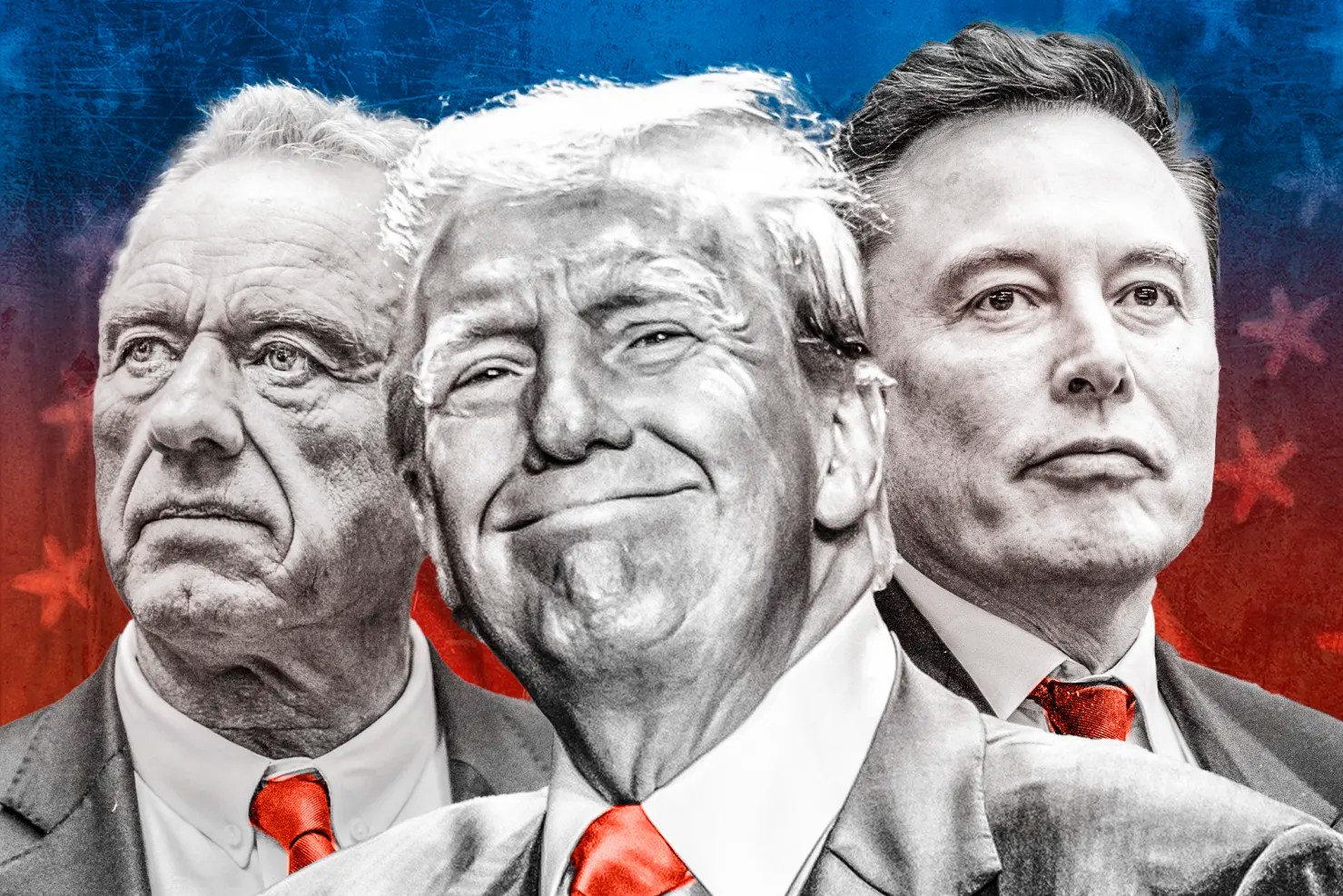
“Let’s turn Gaza into Mar-a-Lago!” Changing the game …

Ah, you loved me as a loser, but now you’re worried that I just might win
You know the way to stop me, but you don’t have the discipline
How many nights I prayed for this, to let my work begin
First we take Manhattan, then we take Berlin

L Cohen

The second coming is certainly interesting. President Donald Trump doing everything he said he’d do – in spades.

His proposal for the reconstruction of the destroyed enclave of Gaza is, as Israeli president Benjamin Netanyahu says, out of the box. It looks like a case of “you guys have had years to sort this out for yourselves! Now let a very stable genius and the greatest nation in the universe to have a go”.

But is it an imperial tantrum or an actual initiative? As Israeli commentator Alon Pinkas states in the article republished below, it is incomprehensible, impractical, illogical, unviable – and illegal. He writes:

“So what does Trump want? Distraction. He thrives in the chaos and constant distractions he creates … Trump is a preeminent agent of chaos. That’s a trademark he has always paraded, boastfully and defiantly. As he said he would, he is actively generating and promoting chaos in America, discord within alliances, and is out to undermine the world order. Agents of chaos sow chaos. It’s that simple. They instill discordance, confusion, controversy and uncertainty. That’s a modus operandi, not a tailored policy or crisis management technique. Agents of chaos and anarchy are by definition out to disrupt the status quo by floating outrageous ideas, based on a simple principle: Everyone viscerally understands the status quo has exhausted its usefulness, more-of-the-same doesn’t work anymore”.

Juxtaposed to this article, we also republish an opinion piece by British broadcaster and journalist Jonathan Sacerdoti. He reckons that Trump’s proposal is at once breathtaking and groundbreaking. I’d like to have some of what he is smoking! But then again, maybe not …

Trump said in the Oval Office that he wants Palestinians to leave Gaza, and that ideally they would not return to the war-torn region. But the ambitious plan is not about to be implemented. Gazans, who survived 15 months of punishing attacks by Israel, largely don’t want to live in exile, and Trump isn’t going to send US troops to push almost 2 million people out of the Strip. Nor will Egypt and Jordan go along with it, despite Trump’s confidence that their reliance on US aid and military support gives him enough leverage to push them to take in massive numbers of Gazan refugees. For both countries, Trump’s proposal crosses red lines.

It is all probably a ploy to “change the game”, and perhaps, to strong arm the wealthy Gulf Arabs into financing Gaza’s reconstruction – though not a dollar will be offered by anyone until Hamas is out of the picture. As for Jordan and Egypt taking the ejected population, they both depend on US economic and military aid, so there’d be heavy Trumpian pressure on them too, though neither are keen to offer the Gazans a home: from past experience, they have no desire to import potential security threats from thousands of exiled jihadis and their families and hundreds of thousands of traumatized and angry refugees.

So, while in all likelihood, the plan will not happen, it will shake up the region nonetheless.

Meanwhile, the world justifiably hyperventilates in reaction to Donald Trump’s statement that the United States will “own” a Gaza Strip that has been ethnically cleansed of Palestinians”. Indeed. The left is hysterically outraged and the right hysterically jubilant. There is ignorance on all sides of the land and its people, their history and culture, needs and aspirations, their resilience and determination to have and to hold.

How people, especially in Gaza, can be so glibly reduced to chattels with no history, no identity, no connection to their land. At least no connection as deep as Trump’s connection to real estate. The two property tycoons are advancing the American Dream for Palestinians – nice big houses, well-paying jobs, upward financial mobility – not the Palestinian dream, which is to return home. They are also selling the renovator’s dream for Gaza: a knock-down-rebuild.

For all his talk about his and others’ “humanitarian hearts”, he probably gives little thought to them as human beings – he asks the world to reframe the rubble of Gaza as a real estate opportunity. He has neither empathy for a people nor an understanding of history and probably sees no personal need nor desire for either. He does not get the power and importance of blood and soil, of religious faith, and a people’s attachment to their homeland, be they Arabs or Israelis. Nor does he understand nor care that to many Arabs and Israelis, this, the modern world’s most intractable conflict, is both existential and sacred. For them, it is much, much more than a real estate deal, but part of their lives and their identity. It does not have a monetary value. See the Qatari carton below, hi ‘ashya’ la tushtaraa.

But never mind that. As republican congresswoman and MAGA acolyte Nancy Mace said in support of Trump’s proposal, “let’s turn Gaza into Mar-a-Largo!”

See also in In That Howling Infinite, Trumps second coming … a new American Revolution? and A Middle East Miscellany.

هي أشياء لا تشترى hi ‘ashya’ la tushtaraa Some things are not for sale. Qatari cartoon

Impractical, Incomprehensible, Illegal: Trump Traps Netanyahu and Sows Chaos With U.S. Takeover Plan for Gaza

Trump’s plan for the Gaza Strip that includes the relocation of 2 million Palestinians is not logical or viable. Whether it’s an imperialist tantrum or an actual ‘out of the box’ initiative, there is really no way to endorse, refute or examine it

Alon Pinkas Feb 5, 2025
Ah, you loved me as a loser, but now you’re worried that I just might win
You know the way to stop me, but you don’t have the discipline
How many nights I prayed for this, to let my work begin
First we take Manhattan, then we take Berlin

Leonard  Cohen

You have to admire the noble attempts to instantly try and make sense of something U.S. President Donald Trump says one day, only to furiously rebuke and deride him the next. Oh wow, the sheer creativity and sublime “out of the box” innovation of proposing to relocate over 2 million Gazans and then “take over Gaza.” Genius.

Makes sense, right? Of course it does, because Gaza truly is uninhabitable. Oh no, but it’s not practical or viable. In fact, it’s incomprehensible.

So what does Trump want? Distraction. He thrives in the chaos and constant distractions he creates. Did he not impose 25 percent tariffs on Canada and Mexico, and then grant them a 30-day extension since they promised they would do the things they are already doing?

Trump is a preeminent agent of chaos. That’s a trademark he has always paraded, boastfully and defiantly. As he said he would, he is actively generating and promoting chaos in America, discord within alliances, and is out to undermine the world order.

Agents of chaos sow chaos. It’s that simple. They instill discordance, confusion, controversy and uncertainty. That’s a modus operandi, not a tailored policy or crisis management technique. Agents of chaos and anarchy are by definition out to disrupt the status quo by floating outrageous ideas, based on a simple principle: Everyone viscerally understands the status quo has exhausted its usefulness, more-of-the-same doesn’t work anymore.

As for the Israeli-Palestinian issue, the endless, irrelevant and incoherent mumbling about “the two-state solution” is just an exercise in futility. Trump only said what many are thinking, right?

Yet still, you might have missed three critical points in Tuesday’s reality TV sitcomin the East Room of the White House. First, until the United States “takes over Gaza,” the cease-fire and stage two of the hostage release agreement need to continue – otherwise how will the Americans take over Gaza?

Second, the United States is applying “maximum pressure” on Iran to compel it to engage in a new nuclear deal. So, no U.S. war in Iran for the time being.

Third, what happened to the “Saudi-Israeli normalization” process?

After Trump returned to power, initially it was all about annexing Canada and turning it into the 51st state. Then came the renaming of the Gulf of Mexico to the Gulf of America. Then came the audacious proposal to purchase Greenland from Denmark – and now the United States wants to take over Gaza and turn it into a Riviera.

Who is Mar-a-Gaza for?

That’s not a bad harvest for two weeks by the “America First” president of a superpower that has always prided itself on being “a reluctant empire.” Are these imperialist tantrums, common-sense truisms aimed at provoking and stirring emotions, a coherent plan? Or are they just outlandish and left-field comments with a life expectancy of several days at best? It could very well be all of the above.

The realtor-in-chief came up with an amazingly simple idea: empty the Gaza Strip so that reconstruction can begin. This real-estate development process evolved throughout Tuesday. First Trump called it a “demolition site,” repeating things he said a few days earlier about how the devastated-to-rubble Strip was uninhabitable. Then his aides said Gaza effectively required 15 years and billions of dollars for reconstruction, so the Palestinians would have no alternative but to move out. That makes sense when you come from real estate.

By noon, Gaza was a “hellhole,” which means that 2 million Palestinians must quickly move to Egypt and Jordan – who, according to Trump, will agree to accept them.

By late afternoon in the White House, Trump was proclaiming that America will take over and turn Gaza into “the Riviera of the Middle East.” But if the Palestinians are relocated, who will this Mar-a-Gaza be built for? Ah, that’s easy according to Trump: “Palestinians, mostly,” though it would also be “an international, unbelievable place.” So maybe Greenlanders fed up with the cold, or Canadians who want an NHL expansion team in Rafah.

Even if you’re not instinctively dismissive of or resistant to Trump’s idea, the total lack of details and specificity make it impossible to endorse or repudiate.

There is no reference to legal matters: By what power and authority can the United States take over Gaza? Logistics: How do you relocate 2 million people, most of whom may not want to leave? Political: Who will manage this process? Financial: Who will fund this monumental undertaking? Regional: Most Arab countries have already vehemently rejected the idea.

Beyond the intuitive inclination to deride the concept, there is really no way to endorse, refute or examine its feasibility. So here’s the bottom line: Do not try to find logic, coherence or patterns. Just wait a few weeks. It may all change.

What Netanyahu did not get 

Throughout his career, Benjamin Netanyahu always followed the sage advice of Yogi Berra: “When you come to a fork in the road, take it.” Years of solipsism, manipulation, deceit, duplicity, confabulation, interpolation and retraction, all woven into a modus operandi that provided him with success.

The indecision-maker would always come up with a speech, delivered with a tormented face and melodramatic baritone, describing the excruciating dilemmas he faced before making no decision. But not making a decision is a decision in and of itself, and he was good at it. Now Trump, for better or worse, is making decisions for him.

Netanyahu’s jig is up. He was nothing more than a prop in the Trump White House show. Trump upended the playing field on Gaza, Iran and everything else. It may not be sustainable, but as of today Netanyahu has to play by Trump’s rules.

Before going to Washington and after his meeting with Trump, he was presented with a fork in the road, a binary choice: desert the hostages, resume a goalless war and save his government in the immediate time frame. Or adhere to the cease-fire agreement he signed, move on to stage two and risk losing his ruling coalition.

Sometimes, making contradictory promises and giving inconsistent assurances is impossible to square. Now Netanyahu will try to market a mirage, according to which he was in on Trump’s plans. Maybe he was.
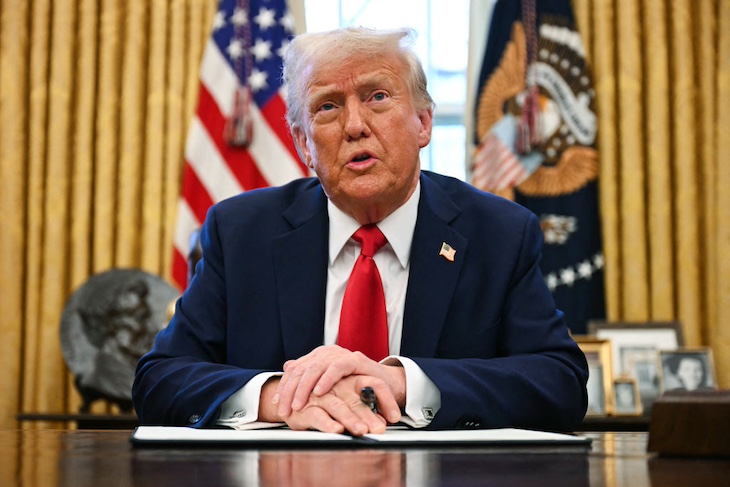
How does that change the future of Israeli-Palestinian relations? It doesn’t. Can he now annex the West Bank? He cannot. Does it add stability and predictability to relations with the United States? It doesn’t.
So what did Netanyahu get out of his Washington trip? A few days reprieve for his coalition, during which he can persuade them that Trump proved he’ll allow Israel to resume the war. And did Trump do that? No

The audacity of Trump’s Gaza plan

The Spectator, February 2025

Some moments in history demand recognition, not just for their weight in the present but for the seismic shifts they herald. The Trump-Netanyahu press conference was one such moment – not a perfunctory diplomatic exercise, nor a routine reaffirmation of alliance, but an unambiguous declaration of intent. It was a disruption of long-entrenched, failed orthodoxies and the unveiling of a vision that dares to reimagine the Middle East in starkly different terms.

For decades, world leaders have clung to exhausted formulas – peace processes built on illusion, agreements predicated on fantasy, and a wilful refusal to acknowledge the fundamental realities of Palestinian rejectionism and terror. That era is now over. Standing together, the President of the United States and the Prime Minister of Israel made it unmistakably clear: they are not here to mollify, to equivocate, or to perpetuate the cycles of appeasement that have long defined western diplomacy towards the Arab-Israeli conflict. They are here to reset the board entirely.

Amid the declarations that emerged from this historic moment, one stood above all: Trump’s unequivocal statement that the goal is not to reform Gaza, not to manage it, but to remove its population entirely. No more illusions of Palestinian self-rule, no more diplomatic contortions to accommodate an irredeemable status quo. Trump’s is not another failed experiment in Palestinian self-rule – but a move to dismantle the population that carried out the most brutal attack on Jews since the Holocaust and to relocate them elsewhere.

The gravity of this pronouncement cannot be overstated. As Israeli commentator Amit Segal astutely observed, had the hard-right politician Itamar Ben-Gvir proposed such a policy as part of coalition negotiations merely two years ago, it would have ignited an international firestorm. Yet here it was, calmly, deliberately articulated as the official position of the most powerful nation on Earth.

Nor was this an offhand remark – no Trumpian improvisation to be explained away later. The president read from prepared notes, delivering the statement with the deliberation and gravity of a policy long in the making. This was not casual hyperbole, nor an idle provocation; it was a calculated, official pronouncement. It was an act of political theatre designed to break the bubble of denial and intransigence.

But that was only the beginning. Alongside this, Donald Trump laid out an unambiguous multi-part framework: no to a Palestinian state. The old paradigm, a fixture of failed diplomatic orthodoxy, is now irrelevant – a fantasy proven ever more unworkable each time it has been forced into action. Yes to an enduring peace with Saudi Arabia – without Palestinian preconditions. The old linkage between Arab-Israeli normalisation and Palestinian statehood is gone, though the Saudis swiftly denied this. Yes to permanently ending Hamas and ensuring Gaza can never again pose a threat. The destruction will be total. There will be no ‘rebuilding’ for Hamas to rule over, only American led efforts. Yes to stopping Iran’s nuclear ambitions – by any means necessary. Iran will be weakened, its regional reach crushed.

This is not a strategy of containment, nor an effort to sustain the perpetual diplomatic holding pattern that has defined western policy for decades. It is a vision of finality – an approach that seeks not to manage conflict but to bring it to a decisive and irreversible conclusion. If Obama was awarded the Nobel Peace Prize less than eight months into his presidency, Trump must surely be worthy just three weeks into his.

Trump’s ability to impose his will upon seemingly intractable situations is no accident. He understands that power is not merely about policy but about the mastery of organised chaos – the capacity to disrupt, to destabilise, and in doing so, to force a new reality into being. He has demonstrated time and again that resistance to his demands – whether from allies or adversaries – eventually bends to his will. Just ask Mexico, Canada, or the growing list of others. The question, therefore, is not whether this plan is feasible. The question is how long it will take before the world accepts that it is already in motion. Trump’s pronouncement is the emperor’s new clothes of Middle Eastern geopolitics: a reality that exists the moment he dares to name it.

Trump is set now to meet with Egypt’s President and Jordan’s King – two leaders whose cooperation will be critical in reshaping Gaza’s fate. These are not symbolic meetings. They show the seriousness of his intent, and are part of a rapidly unfolding strategy. If past is prologue, their initial resistance will give way to accommodation.

Meanwhile, Netanyahu stood beside Trump not as a mere ally but as a statesman fully aligned with the vision before them. He was not a leader reacting to a surprise American policy shift, but the co-architect of a new regional order. Together, these two men have already upended decades of Middle Eastern diplomacy with the Abraham Accords. What they now propose is even more ambitious.

Furthermore, by means of yet another executive order, Trump gave a forceful rejection of longstanding UN biases against Israel, removing financial and diplomatic support from institutions that have systematically worked against Israel’s legitimacy on the world stage. He cut all US funding to UNRWA, citing its infiltration by designated terrorist groups and the involvement of its employees in the 7 October attack. This move effectively ends American financial support for an agency long accused of fostering anti-Israel narratives and aiding Palestinian terrorism. The order also withdraws the United States from the UN Human Rights Council (UNHRC), halting American participation in a body that has consistently shielded human rights abusers while disproportionately targeting Israel. In addition, the US will conduct a review of its membership of UNESCO, withholding its share of funding and assessing the body’s history of anti-Israel bias, including its efforts to erase Jewish historical ties to significant sites like the Temple Mount and the Western Wall.

Trump’s vision will terrify those who have grown comfortable with the status quo. It will unsettle those who prefer diplomatic inertia to hard truths. And it will enrage those who have built careers, reputations, and fortunes upon the perpetuation of the unsolvable. But what he and Netanyahu propose is not reckless; it is reality-based. It acknowledges the unspeakable truth that policymakers have long whispered but never dared articulate: that Gaza, under its current governance and population, is a failed experiment that cannot be salvaged.

Ever the salesman, Trump frames this all as an opportunity for Gazans to build peaceful, prosperous lives – just somewhere else. Many will recoil at the audacity of this proposition. But is it not more audacious to continue pretending that Palestinian self-rule in Gaza can exist without terror, that this small strip of land under continued Palestinian rule can be anything other than a launchpad for perpetual war?

History will remember this moment not merely for what was said, but for what it signified: the point at which two leaders, long derided by their critics, once again proved that their vision is neither naïve nor impractical, but bold, comprehensive and daring.

Jonathan Sacerdoti (born 1980) is a British broadcaster, journalist, and TV producer. Born in London, his father was a Holocaust survivor, and his grandfather had been an Italian Rabbi.
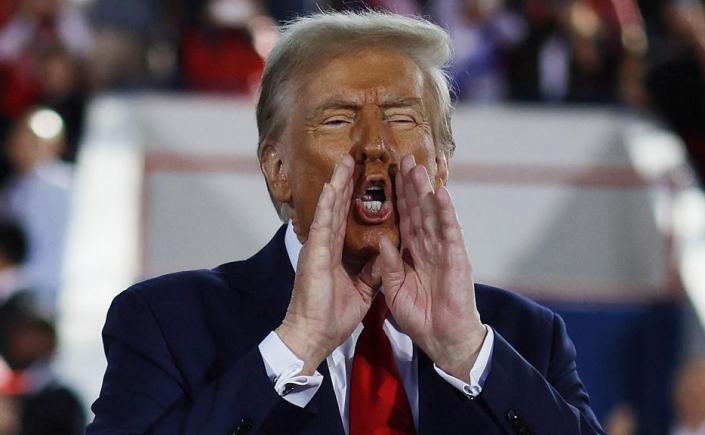
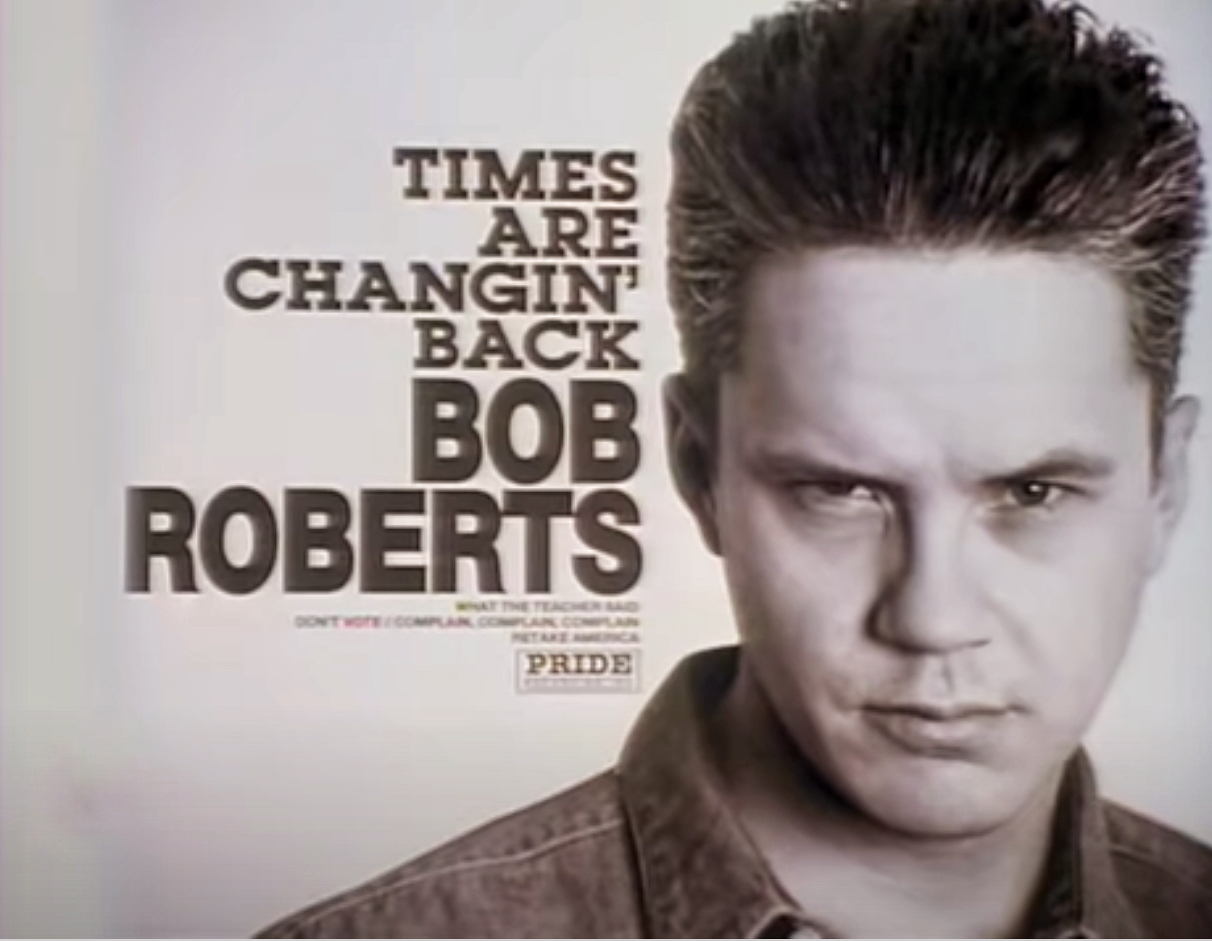
Trumps second coming … a new American Revolution?

America is in a mess. We need someone to clean it up. And his name is …”

So run the opening titles of Tim Robbin’s’ 1992 satire Bob Roberts. In a dark case of life imitating art, the story of a Wall Street millionaire who begins his political career as a reactionary folk singer foreshadows the rise of a uniquely American autocrat who channels the pain and anger of millions who feel that they’ve been left behind. The eponymous Bob Roberts is portrayed as a rightwing Bob Dylan, right down to a parody of the famous Subterranean Homesick Blues story boards to the iconoclastic song Times are a’changin’ … Back. Read a 2020 retrospective of this prescient film HERE. [From In That Howling Infinite‘s Deconstructing Donald – translating Trumpspeak]

Fast track to the present day as second coming began with a barnstorming inaugural address:

“ … the United States will once again consider itself a growing nation, one that increases our wealth, expands our territory, builds our cities, raises our expectations and carries our flag into new and beautiful horizons [and] will pursue our Manifest Destiny into the stars, launching American astronauts to plant the Stars and Stripes on the planet Mars”.

In a pugnacious declaration of American exceptionalism and, dare we say it, Magafest Destiny, he said: “Nothing will stand in our way because we are Americans, the future is ours, and our Golden Age has just begun.”

His first press conference followed shortly afterwards as he signed off on a plethora of executive orders and bantered with the assembled Fourth Estate. Apart from his customary vindictiveness, grievance-driven musings and hyperbole, he was clearly in good humour, folksy even. We were, against our better instincts, bemused, amused, entertained even.

Whatever comes next – and the hectic events of the last fortnight have provided many clues. Along with the name “Gulf of Mexico”, it’s out with the old and in with the new. Tech billionaire Elon Musk has moved into the White House as the new power behind the throne; the purge of public servants and the deportation of illegal migrants have begun; foreign aid is suspended; and “woke” programmes and pronouns are cactus. Panama and Greenland are on the president’s shopping list, and the trade wars are now on: “This will be the golden age of America,” Trump posted on his Truth Social account. “Will there be some pain? Yes, maybe (and maybe not!) But we will make America great again, and it will all be worth the price that must be paid.”

America made its choice – most, for quite understandable reasons that have little to do with populism, racism, fascism or in fact any of the other “isms’ that are tossed about like confetti at a wedding – and must live with it.

Meanwhile there’s predictable faux panic on the left, in Australia and elsewhere, as armchair and keyboard warriors whinge from the sidelines with the same old discussions, the same old articles, serviced by the same bias-confirming algorithms, denigrate and demean America and Americans, and endeavour to tar our own ostensibly “trumpian” conservatives with the same tired brush. Countless social media memes and comments about American stupidity illustrate how out of touch, self-righteous, arrogant and morally “superior” many of the so-called “left” have become. But while they may derive some vicarious satisfaction from their predictable put-downs, they are just pissing in the wind.

America made its choice – most, for quite understandable reasons that have little to do with populism, racism, fascism or in fact any of the other “isms’ that are tossed about like confetti at a wedding – and must live with it. The march to the “right side of history” has turned out just to be to the right. And there’s nothing we can about it. As a Facebook friend commented recently, ” … it’s like watching the Titanic sail away knowing it’s going to sink, but the details of where and when are unknown. But it keeps our old brains active”.

It’s not that people are unaware of Trump’s faults. They harbour no illusions that he will behave any better this time around. They know he will never change; he is erratic, unhinged and foments chaos; he is arrogant, has no sense of history, and is completely transactional. He never apologises, recants or retreats. He never expresses regret for his actions. When under attack for scandalous behaviour or abuse of power, Trump has one playbook: deny, denounce, discredit, defame.

Even dyed-in-the-wool conservatives acknowledge this. Former Australian attorney general George Brandis wrote in the Sydney Morning Herald on 18 November:

“… the sheer weirdness of Donald Trump himself: narcissistic, vulgar, bombastic, mendacious, idiosyncratic, outrageous; while at the same time flamboyant, mesmerising and on occasions very funny. He broke every rule, told every lie, did the unthinkable, said the unsayable and still came up … (you complete the pun). The epic unconventionality of Trump’s campaign dramatised a result that would probably have been the same had the Republican candidate been less unorthodox. For that reason, the outcome is fertile ground for over-interpretation and exaggeration”.

Commentators and author Troy Branston wrote in The Australian, on 9th November 2024: “It’ll be a wild four years with Trump back in power. He remains a despicable and disgusting man devoid of integrity and ethical values, is boorish, moronic, and unstable, and I fear, by a narrow margin, Americans have made the wrong decision. But it a decision that they must live with we must accept”.

We are on the threshold of a consequential four years. Like it or not, we are in interesting times.

© Paul Hemphill 2025. All rights reserved

On other matters American in In That Howling Infinite, see My Country ’tis of thee

From time to time, I republish articles by News Ltd commentators that I believe are worth sharing with those who cannot scale the News paywall – and those who, out of misguided principle, refuse to read articles by its more erudite and eloquent contributors. This, by The Australian’s Greg Sheridan, is one of those.

We published a similar piece exactly six years ago at the commencement of Trump’s first term:The Ricochet of Trump’s Counter-revolution. Back then, we were unsure what the next three years would bring. This time around, we probably have a good idea, and it’s likely to be a wild ride for America and also the world.

I find it hard to tell you, ’cause I find it hard to take
When people run in circles, it’s a very very mad world


Trump remakes America with a revolution in common sense

Boom. Boom. Boom. The second presidency of Donald Trump burst like a clap of thunder across the whole American nation, across the whole world.

Here is the Donald in unimagined glory, the victor of all he surveys, not just embarking on the latest unbelievable chapter in a completely unbelievable American life, from reality TV to the White House, via porn star dalliances, assassin’s bullets and politicised felony convictions that voters rightly ignored, but promising the very reinvention, the historic renewal, of America itself.

It’s a scene with biblical resonance.

But is Trump a modern Moses leading his people into the promised land? Or is he the Apocalypse? It’s too early to tell, but the blizzard of activity in Trump’s first few days demonstrates he is changing America, probably fundamentally. As with all things Trump, there will be good and bad, courageous and cringeworthy, inspiring and implausible.

The unifying theme is America first, American power and destiny, the revolution of common sense, the bonfire of woke vanities, the immola­tion of the influence of the Western left-liberal elite with its increasing­ly out-of-touch values, nonsensical culture and ineffective policies.

The dangers are manifold: that Trump goes too far; that his administration is ill-disciplined if not incoherent; that the opposition in the courts and Democrat-controlled states frustrates his program; that he ignores the law; that he confuses personal profit with public policy; that America’s adversaries, wise to Trump this time, less intimidated by his bluster, refuse him the deals he wants, the deals he needs; that the meanness inherent in parts of Trump’s program becomes exaggerated or dominant; that he encompasses some monumental blunder.

But the promise is also manifold: that Trump unleashes the entrepreneurial spirits of the American economy; that the US military streaks ahead of the rest, providing unassailable deterrence; that the US sets up a huge lead in artificial intelligence and other areas of hi-tech; that America leads the West out of the debilitating ideologies of self-hatred and identity politics that grip the Western academy; that race is delegitimised as a central feature of Western politics and culture; that inflation is slayed; that bureaucracy is tamed, government spending reduced; that dereg­ulation liberates business and slashes costs.

The frisson of danger that always accompanies Trump is palpable. It’s tied up not only with Trump’s personality but with his essential modus operandi. Everything is psycho-drama. Everything is a deal. So everything is unpredictable. Positions that seem solid, change in a minute, sacrificed as leverage in a deal. Strategic unpredictability can be an asset in negotiation, but as former diplomat Peter Varghese has argued, strategic unpredictability can easily become strategic unreliability.

To take one relatively minor example, Trump’s Vice-President, JD Vance, a few days before the inauguration, said any of the January 6, 2021, rioters who had attacked police wouldn’t be pardoned. Then Trump pardoned them anyway, saying they’d been in jail long enough. Vance surely had spoken to Trump before he made his public comments. Trump presumably was undecided until the last minute, characteristically. He certainly wasn’t fussed about embarrassing Vance.

US Secretary of State Marco Rubio and his wife Jeanette arrive to speak to employees at the State Department in Washington. Picture: AFP

US Secretary of State Marco Rubio and his wife Jeanette AFP

Still, stepping back from the sheer volume and speed of action in the first days, you can see that Trump’s election, notwithstanding the new/old President’s many foibles, represents a characteristic American response to perceived decline and stagnation. The old left liberal orthodoxy that was strangling America, its economy and its society, just as it’s strangling Europe and even Australia, just wasn’t working. Everyone could see that except left-liberal ideologues. Crime. Homelessness. Skyrocketing energy prices. Uncontrolled illegal immigration. These things were a mess.

No nation suffers paradigm paralysis less willingly than the US. If things really aren’t working, its voters have a visceral reaction: throw the bums out! And if the next lot don’t work, throw them out too.

Often the US has looked permanently crippled by its internal difficulties – after the civil war in the 19th century, or the savage internal polarisation over Vietnam in the 1960s, or the stagflation of the ’70s. But every time, America comes roaring back.

Is it roaring back now? America certainly has profound social problems – drug abuse, especially fentanyl, gun violence, homelessness, inner-city crime, obesity. Ruinous inflation. But never forget the incredible American achievement.

Psychologist Jordan Peterson claimed recently that by the end of 2024, the poorest US state, Mississippi, was richer than the richest province of social democratic Canada, after a decade of enlightened left-liberal incompetence and ideological posturing from Prime Minister Justin Trudeau. The poorest American state enjoys a higher per capita income than Britain or France. The US is about $US30,000 ($47,700) richer per head than Canada, about twice as rich per capita as the EU. Even when America is doing poorly, it’s doing better than almost everybody else. Nonetheless, America has dangerously lost much of its manufacturing industry. In today’s militarily fraught environment, that’s dangerous.

A homeless encampment in San Francisco. Picture: Getty Images

A homeless encampment in San Francisco. Getty Images

But the modern world was still made in America – from Silicon Valley to Hollywood, from Pulitzer prizes to nation-shifting podcasts, from the internet to space travel. So while left-liberal formulas are failing, Trump inherits an America still possessed of profound strengths. Nonetheless, he’s going to change its direction and, if he can, its character. He’s attacking every issue with frightening energy.

His first week was political shock and awe: dozens of presidential executive orders; two states of emergency, energy and the southern border; two big international withdrawals, from the Paris climate accords and the World Health Organisation; a string of important appointments; a half-trillion-dollar AI investment announcement; the establishment of a new agency, the Department of Government Efficiency, to slash government spending; and the greatest repudiation of racial preferences by abolishing every program of the federal US government implementing or promoting diversity, equity and inclusion initiatives.

Trump gave us real actions in a dizzy range of policy areas. These include: the economy, including tariffs, energy policy, climate change, tax cuts, deregulation; foreign policy, including China, Russia, Israel and the Middle East; immigration, especially the southern border; and every aspect of identity politics, to promote “a colourblind society based on merit”.

It’s a cultural revolution, perhaps as Tesla boss and Trump bestie Elon Musk, head of DOGE, claimed, “a fork in the road of human civilisation”.

There will be plenty of resistance, even if Democrats rightly feel like idiots at the moment, demoralised at their loss, stunned at the people’s rejection, humiliated that the majority did not regard Trump in anything like the lurid light that Democrats had painted for eight years.

Nonetheless, although Trump’s victory was clear, it was relatively narrow. Trump got 77.3 million votes to Kamala Harris’s 75 million. That’s good but not landslide territory. He won 49.8 per cent of a relatively low turnout to Harris’s 48.3 per cent. Trump didn’t win a majority of the popular vote as George W. Bush did in 2004.

The result was, in the prescient phrase of former Trump campaign manager and adviser Kellyanne Conway, a “narrow landslide”.

Trump won all the battleground states, but narrowly. If Harris had won Pennsylvania, Michigan and Wisconsin, she would be president. She lost those states respectively by 120,000, 80,000 and 29,000. So if just 115,000 votes in three key states, out of a total of more than 155 million votes cast, had gone the other way, the Trump revolution would be just one of the ghostly ifs of history.

None of this diminishes Trump’s victory. Given everything thrown against him, it was a magnificent triumph. But America is still a 50-50 nation. Trump will need to score successes that affect people’s lives to cement his political revolution. Just as conservatives were energised by Joe Biden’s appalling presidency, radical activists will be motivated to oppose Trump. Though not just yet, perhaps.

What do Trump’s early actions tell us about how he’ll govern? Stylistically, they’re revealing. This will be a personalised presidency where all big policy issues are deals, supervised by the President.

Some specific policies are clear. Trump will secure US borders. The American people want that. He says he will deport people who are in the US illegally. That’s more than 12 million people. He can’t physically deport that many. But he can deport a lot if he wants to.

Barack Obama, liberal hero, deported hundreds of thousands of people every year. That’s what it means to enter the US illegally. You don’t have the right to be there. If Trump concentrates on illegal immigrants who have committed serious crimes, and the more than a million who have been ordered to be deported but have not actually been removed, that’s likely to maintain strong support.

US Customs and Border Protection officers. Picture: AFP

US Customs and Border Protection officers. AFP

For the moment, Trump has stopped all refugee arrivals. That surely must be temporary. Attempting to end automatic citizenship for babies born in the US appears unconstitutional. The constitutional amendment was first introduced to allow slaves and ex-slaves to become citizens. That will be fought legally.

Energy policy is clear. Trump withdrew from the Paris Agreement, ended federal mandates for electric vehicles and reversed every one of Biden’s multitudinous executive orders restricting fossil fuel exploration and exploitation. During the election, Harris did not campaign on climate change at all. This issue could be gone for the left.

Most politicians try to sniff the breeze. Some politicians make the weather. Trump is doing this, perhaps literally and figuratively, on climate change and energy. His administration will promote the use of every source of energy – oil, gas, coal, nuclear, wind, solar – everything altogether all at once. There will be a lot of legal battles but the direction is clear. And the US taxpayer won’t contribute a dime to green energy funds.

There are only a couple of nations formally outside the Paris Agreement. But Trump’s action demolishes global climate plans as they exist and demonstrates the extreme folly of the Albanese government bankrupting our economy to pursue the fantasy chimera of net zero.

Most developed nations have substantially deindustrialised because of crazy net-zero targets and the consequent spiralling costs of energy. This week’s Spectator magazine contains a mournful essay outlining the process in Britain. A recently returned European diplomat observes to me that climate action and green energy policies have damaged German industry more than the Royal Air Force did in World War II.

Trump won’t let this happen in America. Further, the big greenhouse gas emitters, whose emissions are growing most strongly, are not developed economies but nations such as China, India, Indonesia and so on. These nations are part of the Paris accords but don’t face any serious burdens under them. They use every source of energy they can.

The border between the US and Mexico as seen in El Paso, Texas. Picture: AFP

The US Mexico border at El Paso, Texas. AFP

With the US effectively joining them, it’s the failing economies of Europe, and not much better performing Australia, that look out of touch with reality and committed to self-destruction. Anthony Albanese and Peter Dutton are both right to say Australia can’t exit Paris like the US has done. This would be to become a target. It should instead do what so many do: stay notionally in Paris but maintain the economy anyway with traditional energy sources. And it should embrace nuclear.

Trump wants to cut taxes and attract foreign investment into the US. None of this foreign investment will hesitate for a nano-second because of ethical concerns about climate. Trump will face his greatest opposition in the courts, from some Democrat states such as California; and, if Republicans lose congress in two years, from congress as well.

On tariffs, Trump is still a mystery. He says punitive tariffs may begin against Canada and Mexico in a week or two. He’s unhappy that they let too many people, and too much fentanyl, cross into the US. Such tariffs would devastate Mexico and Canada. The slight delay seems to be an invitation to their governments to make him an offer he can’t refuse.

He has delayed the giant tariffs he was planning on China even further. Though Trump said he would impose such tariffs, it’s clear they were always essentially a bargaining ploy. He’s open to deals.

Trump offered actions and indications of direction on the Middle East, Russia and China. The actions are unified by Trump’s deal-making and by his America first predilections, but they can’t be connected by coherent policy otherwise.

On the Middle East, he forced a welcome ceasefire between Israel and Hamas in Gaza. If Hamas comes back to dominate Gaza, Trump will likely back Israel if it decides it must resume military action.

Trump and Russia's President Vladimir Putin in 2018. Picture: AFP

Trump and Russia’s President Vladimir Putin in 2018. AFP

On Russia, Trump wants a deal. However bad it is in principle, in that Ukraine should not have had to give up any territory, in reality the shape of the deal is obvious. Russia gets to keep the Ukrainian territory it has already conquered and Ukraine gets genuine security guarantees – if not NATO membership, perhaps the presence of British and French troops on its soil.

Trump began by hectoring Russia’s Vladimir Putin, saying he was destroying Russia and waging a ridiculous war. He threatened more sanctions if Putin didn’t make a deal. That seems a hollow threat but Trump’s deals typically begin with a lot of bluster. Trump wants this deal very badly.

On China, Trump has sent mixed and confusing signals. His decision to save TikTok is extremely perplexing. Congress passed legislation to force TikTok to sever its connection with its Chinese owner, ByteDance, or cease operations in the US. Trump has delayed enforcement of this law, and that in itself seems highly dubious legally. Trump also says he would accept a deal in which the US, whether government or private companies, owned 50 per cent of TikTok. But that would still be in breach of the law, which Trump himself called for way back in 2020, and would not stop China from harvesting all the user data from TikTok.

As a result of Trump’s stay of execution, TikTok has been lavishing praise on him. That’s pretty dubious from every point of view.

Trump has appointed genuine and profound China hawks such as new Secretary of State Marco Rubio and Elbridge Colby, the new Under Secretary of Defence for Policy at the Pentagon. But he also has appointed business-as-usual types to Treasury. Similarly, he has talked of wanting to visit China soon, which would seem unlikely if he’s levying punishing tariffs. The best you can say is that China policy is a movable feast, likely to harden over the course of Trump’s presidency, as it did during his first term.

Trump wants to renovate, modernise and expand American power. He’s greatly drawn to tariffs and economic sanctions as his “hard” power tools of choice. He’s pro-business, pro-hi tech, pro-patriotic and in alliance with many good forces in US society. And of course, he has his dark side and his share of very bad hangers-on.

History has often used much worse men than this to conduct necessary national renovations. Trump is planning to reinvent himself and reinvent America. The world awaits the reinvention.

Cold wind in Damascus … Syria at the crossroads

In December, In That Howling Infinite published Syria. Illusion, delusion and the fall of tyrants, an analysis of the downfall of the Assad dynasty. It observed: “…the immediate future is far from clear. It is axiomatic to say that most commentators who say they understand what is going to happen in the Levant often don’t. To quote B Dylan, something’s happening, and we don’t yet know what it is … Syria now pauses at a crossroads, where both hope for a better future, and skepticism that it will be achieved, are equally warranted. Whether or not the new Syrian regime can succeed is an open question”.

Syria’s political transition is literally a regime change: not simply the switching out of personalities on the throne, but a total philosophical and conceptual reordering of governance. Maybe it’s not the wind of freedom that is blowing through the streets of Damascus.

Russian-oriented media platforms like RT and Mint have been saying for two months now that despite their friendly noises, including pragmatic contacts with western countries like the USA, Britain and France that once treated the Assad regime as a pariah and also regarded Hayat al Tahrir al Shams as a terrorist outfit, and wealthy Gulf states that had only just made up with the old regime, whilst hedging on the thorny issue of relations with Turkey and Israel on the one hand, and former enables of the regime, Russia, Iran and even Hezbollah, on the other, Syria’s new rulers are Islamists at heart and will soon show their true colours.

Maybe they have a point …

In late December, Obaida Arnout, a spokesperson for the Syrian transitional government, said that women’s “biological and physiological nature” rendered them unfit for certain governmental jobs, sparking demonstrations in Damascus and other cities. At a press conference, the new Syrian leader asked a female reporter to cover her hair. There are reports that the new authorities are purging the school curriculum of pre-Islamic history and content deemed contrary to Islamic strictures. Before Christmas, foreign jihadis allied to Hayat al Tahrir al Sham torched a Christmas tree in Hama, leading to protests by Syrian Christians.

Syria’s de facto ruler Ahmed al Shara’a declared that free elections could be four years away, and in late January, seven weeks after he led the rebel offensive that overthrew Bashar al-Assad. he was named president for the “transitional period“. Rebel military commander Hassan Abdul Ghani also announced the cancellation of Syria’s 2012 constitution and the dissolution of the former regime’s parliament, army and security agencies, according to the Sana news agency. As president, Sharaa would form an interim legislative council to help govern until a new constitution was approved, he said. Meanwhile, he added, all rebel groups which opposed Assad in the 13-year civil war would be dissolved and integrated into state institutions.

This may provie difficult if not impossible. in the north, Turkish proxy forces battle with Kurdish forces in semi-autonomous Rojava. in the south, rebel militias oppose the imposition of HTS authority. In the west, Alawite militias who supported the Assads engage in firefights with HTS. In the east, meanwhile, the Americans bombing surviving pockets of Islamic State fighters who may be encouraged by the chaos to stage a jailbreak of tens of thousands of jihadis held in camps guarded by the embattled Kurds.

Maybe it’ll be business as usual in the middle eastern axis of awful. It may be the wind of freedom that is blowing, but then again, maybe not. So far so bad …?

© Paul Hemphill 2025. All rights reserved

For more on the Middle East in in That Howling Infinite, see A Middle East Miscellany.

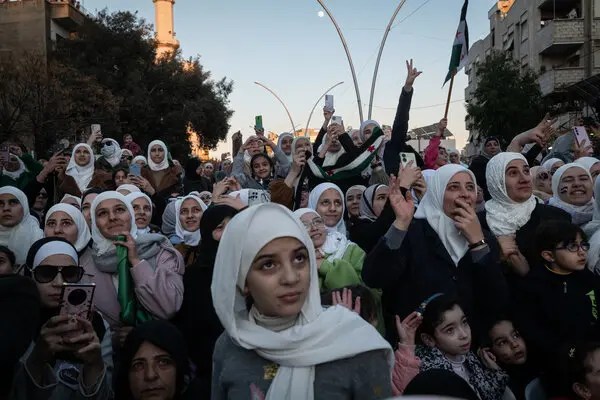
Women in Damascus celebrate the fall of the Assad regime

Fears Syria is the next Mid-East humanitarian nightmare

To describe the current Syria situation as combustible is consequently an understatement.

To describe the current Syria situation as combustible is consequently an understatement.

No one mourns the wicked, says the song. But, while the end of Bashar al-Assad’s blood-soaked rule is undoubtedly welcome, his overthrow is not likely to solve Syria’s crippling problems.

That Syria’s descent into a murderous civil war was partly triggered by economic factors is clear. Far-reaching land reforms in 1958 and 1962-63 created a vast number of small to very small farms, which accounted for 60 per cent of all agricultural holdings but only 23 per cent of cultivated land. That structure was always precarious; what destroyed it was a trebling in Syria’s population.

With inheritance laws subdividing those holdings as more and more sons survived into adulthood, the marginal farms, which accounted for the bulk of agricultural employment, became completely unviable. Steadily worsening water shortages, culminating in a disastrous drought from 2005 to 2010, then delivered the final blow, precipitating a flight to the cities, particularly from the Sunni areas, that left many rural villages without young men.

But Syria’s heavily regulated, corruption-ridden economy could scarcely absorb the inflow, so more than half of those young men became unemployed, eking out tenuous livelihoods in illegally built complexes on the urban fringes.

People gather to celebrate in Umayyad Square on December 11, 2024 in Damascus, Syria.

People gather to celebrate in Umayyad Square on December 11, 2024

None of that would have provoked the civil war had the rural collapse, and the subsequent rise in poverty, not aggravated deep-seated ethnic and religious conflicts. Exactly like Lebanon and Iraq, the country that gained independence in 1946 was a state without a nation. Nor were there any broadly shared goals or ideas that could shape a unifying national identity.

The extent of the differences became obvious in 1954, when a Sunni-dominated government enacted centralising laws that sparked a Druze revolt. The revolt was quickly suppressed but the inability to define a workable balance between the conflicting groups fuelled six military coups in rapid succession.

It was only in 1966, when the Baath (Resurrection) party seized power, and then in 1970, with the so-called Corrective Revolution, which vested undivided power in Hafez al-Assad, that a degree of stability prevailed. The Baath had secured just 15 per cent of the vote in 1963, the last more or less free election; but, at least initially, it managed to coalesce a viable, if never broad, base of support.

At the heart of that support was the army, whose officer corps, like the Baath, was dominated by Alawites, who replaced the Sunnis decimated in the military purges that followed the coups and countercoups of the previous decade. Complementing that core was a tidal wave of Baathist patronage as sweeping nationalisations in 1964-65 and a 20-fold increase in the size of the public service – enacted in the name of “the scientific Arab way to socialism” – politicised employment decisions.

There is, however, no doubt that the Sunnis, who derived few benefits from that patronage, were left behind, at a time when Islamic fundamentalism was gaining lavish funding from the newly wealthy petro-monarchies. Although a shadowy battle between the regime and the Muslim Brotherhood had raged for some years, the Hama revolt in 1982 proved the key turning point.

Suppressed in a sea of blood, the revolt of Hama’s Sunnis induced Assad to rely even more heavily on a pervasive security apparatus manned by Alawites and controlled by members of his family: of the 12 key officers who ran the military-security complex between 1970 and 1997, seven were linked to Assad by blood or marriage.

That pattern persisted when Bashar al-Assad acceded to the presidency in 2000. By then, however, the transition from “Arab socialism” to an especially degenerate form of crony capitalism had made the cracks in the regime’s foundations ever more glaring.

To begin with, because the Sunni birthrate was much higher than that of the ethnic and religious minorities, the minorities’ share of the Syrian population was a third lower than in 1980, narrowing the regime’s power base, heightening its paranoia and increasing its dependence on outside support (which eventually came from Iran and Russia).

At the same time, the growing concentration of young, unemployed Sunni men in the major towns created an immensely receptive audience for radical imams, who – repeating the Al-Jazeera sermons of Hamas’s spiritual leader, Sheik Youssef al-Qaradawi – denounced the Alawites as “even more defiled than the Jews”.

It is therefore no accident that it was a broadcast by al-Qaradawi, calling, on March 25, 2011, for an uprising to root out the unbelievers, that transformed highly localised demonstrations into a national civil war.

Retracing that civil war’s history would take too long. What matters is that each of its many protagonists sought to create a safe base for its constituency by ruthless ethnic cleansing.

The regime readily accepted – when it did not force – the displacement of some eight million people, mainly Sunnis, out of its area of control. That not only removed potential adversaries; it also allowed the regime, through a special law passed in mid-2018, to expropriate the displaced, reselling their assets (at bargain basement prices) to its Alawite, Christian and Druze supporters. That those minorities, which effected much of the regime’s dirty work, feel threatened by the victims’ return is readily understandable.

Nor was the ethnic cleansing any less brutal in the areas controlled by the regime’s Islamist opponents. In Turkish-controlled Afrin, for example, where Kurds previously comprised 90 per cent of the population, there are virtually no Kurds left, as Turkey’s military has replicated the “demolish and expel” strategy it implemented in Turkish-occupied Cyprus. To make things worse, it has, in what were relatively secular regions, enforced conformity to Islamic precepts to an extent unthinkable in Turkey itself.

Hayat Tahrir al-Sham chief Ahmed al-Sharaa

Hayat Tahrir al-Sham chief Ahmed al-Sharaa

Equally, in Idlib, which is governed by HTS (the Movement for the Liberation of the Levant), Christians, who were treated as dhimmis, have fled, as have any surviving Alawite, Ismaili and Yazidi “heretics”. Ahmed al-Sharaa, who heads HTS, presents himself as a technocratic nation-builder; the reality is that he never abandoned his jihadi outlook, reined in the Islamist fanaticism of HTS’s followers or relaxed the sharia-inspired prohibitions that dominate Idlib’s daily life.

Far from being a model of modernity, Idlib under Sharaa (who has reverted from Abou Mohammed al-Jolani to his original name) closely resembles Gaza under Hamas – an authoritarian, Islamist enclave that survives by diverting humanitarian assistance to fund HTS’s operations. There is every reason to fear Sharaa will try to take Syria down that road, provoking (in a repeat of the Iraqi scenario) a renewed conflict with the former regime’s supporters, as well as with the US-backed Kurds.

To describe the current situation as combustible is consequently an understatement. And it is an understatement too to say that Israel’s precautionary measures, which include strengthening its grip on the Golan Heights, are eminently rational.

Of course, that won’t stop the UN, and Australia with it, condemning the Israeli moves, while staying mum about Turkey’s expansion of its so-called “self-protection zone” in Syria and its indiscriminate bombing of Kurdish villages. But if the Syrian tragedy has a lesson, it is this: in the Arab Middle East, with its deep hatreds, long memories and searing fractures, only sheer power counts. To believe anything else is just a childish fantasy