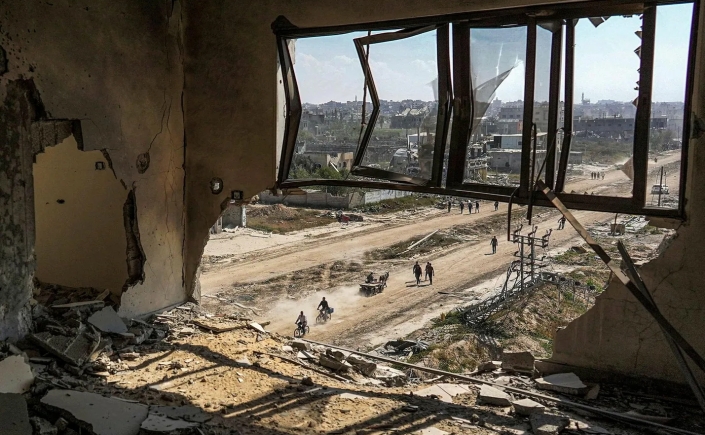
The Gaza war – there are no winners in a wasteland

The Gaza quagmire is a forever war without winners but with the ceasefire yet to go into effect, if indeed it actually happens, Hamas and its supporters are already declaring victory. As the ceasefire was announced, senior Hamas leader Khalil al-Hayya responded by praising the October 7 massacre as a major achievement that would be taught with pride to future generations of Palestinians. He went on to say that the next step is to rid Jerusalem of all Jews. In Gaza, fighters are openly displaying weapons and firing off “Happy shots” into the air accompanied by the takbirs of cheering onlookers. There are celebrations in the West Bank and in Teheran and Kabul whilst social media resounds with triumphalism by Muslims and western progressives alike. Critics argue that as the deal doesn’t require Hamas to be dismantled. this “victory” sets Gaza and Hamas up for the next war.

Commentator Armin Rosen wrote in Unherd on 18 January:

“Hamas’s reaction to the ceasefire agreement, with its leaders celebrating amid devastation, raises fundamental questions about the meaning of victory. Are wars still won by the usual measures of blood and territory, or is victory now more notional and slippery, a condition existing in the mind above all? Given the sheer scale of destruction over the past year, it seems crass for either side to claim victory. And as one Israeli official told me in early 2024: “You have won when no one has to ask whether you have won or not.”

An end to the war is a long way off and a long-term peace agreement of any kind between Israel and the Palestinians remains a hope and a dream, and in this long and bitter conflict hopes and dreams have so often ended in nightmares. The prospective ceasefire will bring relief and also, grief, to both Israelis and Palestinians, but a large majority of each, in their post-October 7 world, see the conflict as a zero-sum game with no end to it except victory for their side.

If this is a victory, we’d hate to see what defeat looked like.

We republish below an appraisal of the circumstances that have produced the prospective ceasefire at this particular stage in the present conflict and including the realities of multiple battlefields and the wider regional and global events that have compelled it.

© Paul Hemphill 2025. All rights reserved

For more on the Middle East in in That Howling Infinite, see A Middle East Miscellany:  


The battlefield reality behind the Gaza ceasefire

For its part, Israel is victorious on the battlefield – and recognition of that probably accounts for the willingness on both sides to negotiate a ceasefire.

For its part, Israel is victorious on the battlefield – and recognition of that probably accounts for the willingness on both sides to negotiate a ceasefire.

Politicians in Washington are indulging in a certain amount of unseemly grandstanding about who deserves credit for the Gaza ceasefire, provisionally agreed in Qatar this week and announced on Thursday. Outgoing US President Joe Biden boasts of his patient diplomacy through 15 months of war. President-elect Donald Trump touts his threat of “all hell to pay” if Hamas does not free its hostages before his inauguration on Monday (Tuesday AEDT), and the role his newly appointed envoy, Steve Witkoff, played in clinching the agreement.

Israel Prime Minister Benjamin Netanyahu meets US President-elect Donald Trump's Mideast envoy Steve Witkoff at his office in Jerusalem.

Netanyahu meets US President-elect Donald Trump’s Mideast envoy Steve Witkof

These claims are, of course, exaggerated and wildly premature. This is a complex three-stage ceasefire agreement, only the first stage of which has been approved, and whose implementation will be extraordinarily contentious and difficult. The political pointscoring also obscures the military facts on the ground that drove the deal, which resulted less from deft diplomacy than from brutal battlefield reality.

That reality is obvious if we consider that only two of the principals who were in office when the war began will be alive still and in power when any ceasefire takes effect: Israel’s Prime Minister Benjamin Netanyahu and Yemen’s Ansarallah (Houthi) leader Abdul-Malik al-Houthi.

Hamas military commander Yayha Sinwar has been killed, wounded by an airstrike then finished off, live on social media, by an Israeli first-person-view drone in October. His counterpart, Hamas political chief Ismail Haniyeh, also is dead, assassinated by Israel in Tehran in July.

Slain Hamas military commander Yayha Sinwar. Picture: AFP

Slain Hamas military commander Yayha Sinwar. AFP

Many other senior Hamas commanders are dead, as is Hassan Nasrallah, head of Hezbollah, killed in an airstrike that collapsed his headquarters last September.

Nasrallah’s successor, Hashem Safieddine, died days later in another Israeli strike, along with Hezbollah’s intelligence chief, Hussein Hazimah. Dozens of other Hezbollah leaders were killed, thousands wounded and Iran’s ambassador to Lebanon, Mojtaba Amini, blinded in an earlier Israeli covert operation that concealed explosives in pagers and radio transceivers.

Syrian President Bashar al-Assad, a Hezbollah partner and Iranian ally, was overthrown last month and is exiled in Moscow. Iranian president Ebrahim Raisi, a crucial Hamas and Hezbollah sponsor and Assad’s principal backer, died in a helicopter crash last May. Several Iranian Islamic Revolutionary Guards Corps generals – advisers to Hamas, Hezbollah, the Houthis and the Syrian regime – also have been killed. These include the IRGC’s commander in Syria, Razi Mousavi, killed in an airstrike in Damascus shortly after the war began. Iran’s senior adviser to Hezbollah, Abbas Nilforoushan, died in the same strike that killed Nasrallah.

This decapitation of Iranian, Syrian, Hezbollah and Hamas leadership reflects the broader beating that Israel – with extensive non-combat assistance from the US – has dealt its regional adversaries.

Syria’s army evaporated when Assad fled; its navy was sunk at its moorings by Israeli jets and its air force destroyed on its runways in the days after the regime fell. Hezbollah lost thousands, killed and wounded in its two-month war with Israel in 2024, while expending a significant portion of its missile arsenal, to lesser effect than many analysts (including me) expected before the war.

Hamas started the war with its own extensive rocket arsenal and perhaps 40,000 fighters at its disposal between its own military wing, the al-Qassam Brigades, and allies such as Palestinian Islamic Jihad. At least half these fighters have been killed and others scattered or forced underground.

The Gaza Strip is de-urbanised, depopulated and extensively damaged, whole settlements bombed and bulldozed, and millions of civilians displaced to makeshift camps in horrific conditions. It is claimed up to 50,000 Gazans have been killed in the conflict and many times more wounded.

Large areas of Lebanon – especially in the southern region, in Beirut and in Hezbollah strongholds of the Bekaa Valley – have been extensively damaged in Israeli airstrikes. Syria’s cities were battered by more than a decade of war but the final campaign inflicted even further damage.

The exception to this picture is Yemen’s Houthi movement. The Houthis entered the war in late 2023 with a campaign against commercial shipping in the Bab el-Mandab Strait, a chokepoint that carried, before the conflict, 13 per cent of total ship traffic. Their stated intent was to pressure Israel and Israel-friendly nations by holding ships and trade routes at risk until a ceasefire was agreed and Israeli troops withdrew from Gaza. Using aerial drones, missiles, uncrewed surface vessels, armed speedboats and helicopters, the Houthis succeeded in reducing shipping through the strait, costing billions of dollars, disrupting supply chains and damaging more than 87 ships while sinking two and capturing one.

Houthi supporters raise their machine guns during an anti-US and Israel rally in Sanaa, Yemen, in November. Picture: AP

Houthi supporters rally in Sanaa, Yemen, in November. AP

Despite two naval taskforces – one US-led and one assembled by the EU – deploying to protect commercial shipping in the strait, along with extensive airstrikes and a blockade against Yemen’s port of Hudaydah, the Houthis continue their campaign. Their reaction to the news of this week’s tentative ceasefire, so far, has been to threaten that they will resume their efforts if the deal collapses while in fact persisting in their attacks. Iran’s proxies in Yemen remain defiant even as Iran and the others in its self-styled Axis of Resistance are on the back foot.

For its part, Israel is victorious on the battlefield – and recognition of that, rather than fancy footwork by Western diplomats, probably accounts for the willingness on both sides to negotiate a ceasefire. Indeed, it’s possible Israel’s main motivation for a ceasefire arose from the combination of clear battlefield victory close to home along with equally clear inability to suppress the Houthis, who continue launching long-range missiles against Tel Aviv. Benjamin Netanyahu is personally triumphant, albeit facing political and legal challenges.

None of this assuages the pain of Israeli families whose loved ones were massacred in the initial attacks or have been held by Hamas since October 2023. As few as 20 of the roughly 250 hostages taken at the outset of the war may remain alive, though it is almost impossible to say. In Israel, about 980 civilians and an equal number of military personnel have been killed, more than 13,000 wounded and up to a 500,000 displaced from their homes because of ground attacks at the start of the conflict and rocket and missile attacks since then.

Israel also faces difficult decisions, even if the ceasefire is confirmed and broadly holds. Hamas can survive with largely uncontested control over Gazans; there were no significant incidents of anti-Hamas unrest in Gaza at any time during the war. In the displaced persons camps and ruined cities of the Gaza Strip, Hamas maintains political authority. It also has sufficient military potential – at least 10,000 fighters still at large – to maintain the fight in the form of a guerrilla campaign or terrorist activity. Permanent Israeli occupation of Gaza would face an insurgency, while full Israeli withdrawal risks resurgence of conventional capability on the part of Hamas. And Israeli forces are still heavily committed in Lebanon, the Golan and the West Bank, with no immediate end to these deployments in sight.

All of which is to say that, even if this week’s ceasefire does indeed stick, what comes next will be the hardest thing. We can only hope the region’s innocent civilian populations – in Israeli, Palestinian, Lebanese, Syrian and Yemeni territory – receive some measure of relief, however temporary. Who, if anyone, gets the credit for a ceasefire matters far less than the possibility that one may finally be at hand.

David Kilcullen served in the Australian Army from 1985 to 2007. He was a senior counter-insurgency adviser to General David Petraeus in Iraq in 2007-08, followed by special adviser for counter-insurgency to secretary of state Condoleezza Rice. He is the author of six books including most recently The Dragons and the Snakes: How the Rest Learned to Fight the West and The Ledger: Accounting for Failure in Afghanistan.

The way we were … reevaluating The Lucky Country sixty years on

When I first arrived in Australia in April 1978, I was keen to know more about the country I had unexpectedly migrated to – as a matter of fact, apart from what I’d learned from my then-wife, who was a Sydneysider, I knew very little. Donald Horne’s The Lucky Country was highly recommended. And yet, the Australia Horne described therein did not seem like the country I was about to call home. It was a critique of “the way we were” – the somnolent fifties and sixties that preceded its publication – a society and a culture that ceased to be relevant in the decades that followed. As author and columnist Nick Bryant writes in a reevaluation republished below: “Just as the title has been misappropriated – it was meant sardonically.  its subtitle has been mislaid: Australia in the Sixties. Though many insights proved prescient and perennial, Horne was describing a different land”.

Indeed, the book had appeared as the Australia Horne described and condemned had already begun to change. An imperceptible social revolution had already been pushing against the rigid morality of the war-time generation. The comforting but constraining ties of the traditional family, religious observance and community obligation which were regarded as unreasonably oppressive by his generation and many in the one before it, were breaking down, to be replaced in the seventies by a more open, more travelled and and inquisitive society and a paternal and benevolent social welfare state which provided free healthcare and for a generation of Australians, free tertiary education – from which I, once naturalised, benefitted. Much if this change was not all that recognisable  at the time – transformations of this kind are mostly visible only with the benefit of hindsight.

The Lucky Country nevertheless continues to dominate the intellectual landscape; but 60 years after its publication, and as Bryant notes, it’s one that Australia mistakenly takes too seriously.

In a piece I wrote five years ago, How the “Lucky Country” lost its mojo. I quoted author and onetime publisher Steve Harris:

“Many who use the terms “lucky country” or “tyranny of distance” have probably not even read the books or understand their original context or meaning. If they read the books today, they might see that almost every form of our personal, community, national and global interests still involve “distance” as much as ever, and that notions of “the lucky country” ­remain ironic. ” The result, he laments, is a re-run of issues revisited but not ­resolved, opportunities not seized, and challenges not confronted … it is no surprise that the distance ­between word and deed on so many fronts, and so often, has created its own climate change, one of a collective vacuum or vacuousness. An environment where it is too easy to become disinterested, or be distracted by, or attracted to, those offering an “answer”, even if it is often more volume, ideology, self-interest, simplicity, hype and nonsense than validity, ideas, public­ interest, substance, hope and common sense. A 24/7 connected world where we drown in words and information but thirst for bona fide truth, knowledge and understanding, and more disconnectedness and disengagement”.

We republish below two retrospectives we’ll worth reading, one written from a conservative perspective, the other, by Bryant, from a relatively progressive viewpoint (there are some great pictures too). Both agree however that it is a book that can be read in a slightly or very different way by each generation, always having something new to say. As columnist Henry Ergas notes therein: “For all of its shortcuts and grievous errors, its insights still dazzle, no matter how often they are read or reread. So does its freshness, its sense of humour and perhaps most of all, its eager hopefulness and sense of aspiration”.

© Paul Hemphill 2025. All rights reserved

Sixty years on from Donald Horne’s instant classic, has The Lucky Country run out of luck?

Has a nation of gamblers with a disdain for ‘theory’ ridden its luck for too long?

“Join the Lucky Ones” ran the front-page headline of The Australian on Tuesday, December 1, 1964. Starting the next day, readers could enjoy “the first big instalment of Donald Horne’s controversial new book The Lucky Country”, which was being published that week.

Horne had a long association with Frank Packer and Australian Consolidated Press, but in a publishing coup Rupert Murdoch’s new national newspaper had secured exclusive rights for “the most candid, controversial book of the year”.

The Australian had begun life less than six months previously as a daring experiment, the first nationally circulated newspaper in a country beginning to fizz with a sense of expanding possibilities yet faced with new, sometimes daunting prospects in a dramatically changing world.

Horne’s much-anticipated “witty and irreverent study of Australians and their way of life” couldn’t have found a stage better suited to its bold approach or for the questions it was firing, at point-blank range, into the national conversation.

Australians were reintroduced to themselves in the weeks that followed as a people who “hate discussion and ‘theory’ but can step quickly out of the way if events are about to smack them in the face”.

Join the Lucky Ones: Page 11 from The Australian newspaper on December 2, 1964 featuring an extract of Donald Horne's 'The Lucky Country'

The Australian newspaper on December 2, 1964 featured an extract of ‘The Lucky Country’

They found out that “to understand Australian concepts of enjoyment one must understand that in Australia there is a battle between puritanism and a kind of paganism and that the latter is beginning to win”. Competitive sport, they were now given to understand, had all the qualities of “a ruthless, quasi-military operation”, making it “one of the disciplinary sides of Australian life”.

As for mateship, it reflected “a socially homosexual side to Australian male life” that involved “prolonged displays of toughness” in pubs, where men “stand around bars asserting their masculinity with such intensity that you half expect them to unzip their flies”.

Perhaps most arresting was the argument that went with the title’s assertion. Australian life, combining scepticism and “delight in improvisation”, had resulted in dependence on a type of gambler’s luck.

As circumstances shifted, Australians’ “saving characteristic, ‘the gambler’s coolness’ ”, had helped them to “change course quickly, even at the last moment”.

But the aim of those swerves had always been to “seek a quick easy way out”. Now that strategy needed to be reconsidered.

Abrupt changes

The Lucky Country packed many punches – and they landed at the perfect moment.

The tremendous post-war growth of an educated and engaged public had been evident since the mid-1950s as new magazines proliferated and the market for Australian books expanded more prodigiously than at any other time in the century.

Coupled with that were global shifts even more dramatic and described in The Australian’s first editorial, which spelled out both the paper’s vision and the challenges the nation faced.

Since the end of World War II all the major European empires had ceded or lost control of the lands and people to Australia’s immediate north. As British, Dutch and French imperial power in Southeast Asia collapsed, new nations – including Indonesia, Malaysia and Vietnam – were born and ancient ones, such as Burma and Thailand, reshaped. Behind them lay “the brooding power and intelligence of the new China, a land with whose people’s desires and plans our own future is deeply entwined”.

All the way with LBJ: The first Australian visit by a US President. United States President Lyndon B Johnson greets the crowd in Swanston Street, Melbourne. Picture: Ken Wheeler

The first Australian visit by a US President. United States President Lyndon B Johnson greets the crowd in Swanston Street, Melbourne. Ken Wheeler

These abrupt changes coincided with Britain trying to join the European Common Market, making it clear that wherever the United Kingdom saw its future, it was not primarily with the Commonwealth.

Losing the blanket of certainty that Australia’s close relationship with Britain had long provided was a blow. But, The Australian insisted, it could prove “a salutary shock”, as it helped us realise “that now, as never before in our history, we stand alone”.

Collection of snapshots

The Lucky Country’s impact was immediate and all-pervasive. Despite some scathing reviews (one confidently predicted the book would have been forgotten by the next football season), it flew off the shelves. Its initial print run of 18,000 sold out in nine days and the pace showed no sign of flagging.

In 1965 it sold another 40,000 copies before repeating the feat in 1966, a staying power beyond its publisher’s wildest dreams.

One of the books that truly defined the decade, it entrenched itself in the national consciousness in a way similar to Geoffrey Blainey’s The Tyranny of Distance, published two years later, another title that instantly entered the national lexicon.

Blainey’s deeply researched work, which reflected his training as a historian, was tightly argued. In contrast, even Horne admitted that his book was “a collection of snapshots of Australia”. An assemblage of ideas and insights that had been amassing for a decade, Horne thought it was part of the book’s success, handing readers a host of opinionated pages of observation and commentary.

Donald Horne at home: the author constantly fretted that his seminal book’s title had been misunderstood and misused.

Donald Horne at home

More than the loose structure, though, the book’s style was crucial to its impact. That style came from Horne’s long spell as a journalist, editor and advertising man.

Horne had a keen understanding of what readers wanted to know and talk about. He had spent years honing his approach, addressing Australia’s burgeoning magazine and newspaper readers, and recognised their hunger for a new type of journalism that The Australian sought to embody: urbane, expository, intelligent, sparky, informed.

And if it worked for magazines and papers, why not for a serious – if chronically irreverent – book about who we were and how we now lived?

The Lucky Country introduced this sharp change in tone to Australia in the 1960s, marking it as ineradicably as David Williamson’s plays would do. The content matched the tone, too, aggressively insisting that the way we lived had changed so abruptly that the nation could no longer be served by the standard-issue ideas.

The national mythology, populated by bush legend figures (shearers, bushrangers, drovers) and grizzled Anzacs, had no relevance to daily reality.

Australians were urbanites and suburbanites, and increasingly so: from 1947 to 1966 the percentage of Australian living in cities leapt from 68 per cent to 83 per cent.

Misappropriated and misunderstood

Horne’s coup was to bridge this gap between myth and reality. Certainly to his mind The Lucky Country’s success came from the fact it captured Australia as Australians experienced it, not through the fake lenses of a glorified past.

It was, Horne claimed, the first book to reflect “the suburban nature of the lives of most Australians without jeering at them”. What really cut through, however, was the book’s underlying thesis.

Despite its gadfly-like style, the book worked off a set of powerful assumptions that constituted a strong, even startling, argument.

Horne would complain ever after that its title had been misappropriated and misunderstood. But it is hard to deny that the title itself made the argument palpably clear.

Earlier exercises in self-reflection generally portrayed Australia’s journey to nationhood as a process of maturation. Nurtured under the shelter of Britain’s wing, foresight, hard work and inspired guidance had allowed the infant nation to grow into a strapping adult, capable of standing on its own feet.

Horne knocked that narrative for six. Australia’s prosperity and stability were not, he argued, the result of increasing national maturity, much less diligence and determination. They were due to sheer good fortune. To make things worse, it was a good fortune the country didn’t deserve – or know how to use.

The problem wasn’t the bulk of ordinary Australians, who weren’t a bad lot. It was “the people on top”. Our leaders and elites were second-rate provincial mediocrities who had got stuck in a groove some 50 or 60 years earlier and never budged out of it, even as one generation passed to another and still another.

Premature senility

Thanks to them, the nation was in a time warp, living out a fantasy that bore no relation to its realities – or its challenges.

The proper national metaphor, in Horne’s eyes, was not a maturational shift from boisterous youth to fully fledged adulthood; it was a leap from childhood to premature senility. Without “a radical overthrow and destruction of the prevailing attitudes of most of the nation’s masters” the decades to come would likely witness “a general demoralisation; the nation may become run down, old-fashioned, puzzled, and resentful”.

The radical overthrow and destruction of Australia’s outmoded approach, and the subsequent renewal, could, Horne speculated, possibly come through the rising generation. He was drawn to generational explanations of change, citing Walter Bagehot’s comment that “generally one generation succeeds another almost silently.

But sometimes there is an abrupt change. In that case the affairs of the country are apt to alter much, for good or for evil; sometimes it is ruined, sometimes it becomes more successful, but it hardly ever stays as it was.”

Modern classic: Cover of The Lucky Country, featuring the painting of the same title by Albert Tucker. Picture: Supplied

The Lucky Country, featuring the painting of the same title by Albert Tucker

Generational change had salvaged the national project before. The great Australian initiative, when Britain and other outside models of development had been energetically rejected, had emerged in the decades at the turn of the 20th century. This was when a nationalism of mateship represented “the general egalitarian position” that, flecked with Irish anti-English hostility, had formed an explicit contrast to an England of wealth and privilege. To those who had experienced that earlier time, “this present pause would be unbelievable”.

Robert Menzies epitomised everything that had gone wrong. He had absorbed too much of the pro-British obsequiousness of the post-World War I world, notably “the ceremonial clinging to Britain” that was “part of the delusional structure of the people who were running Australia”.

Unable to escape that delusional structure’s grip, subsequent generations had fallen into Menzies’ stride rather than broken it. And while Menzies’ leading rival, Arthur Calwell, could not be accused of being unduly pro-British, he was no better able “to recognise and dramatise the new strategic environment of Australia”.

Fresh start

As a result, “the nation that saw itself in terms of unique hope for a better way of life is becoming reactionary – or its masters are – addicted to the old, conformist” ways of doing things. The inability to cope with change meant the “momentum towards concepts of independent nationhood has slowed down, or stopped”.

There were, however, inklings of a fresh start. Although “still full of mystery”, the generation born during and immediately after the war “seems fresher”. Who knew, “it may be the generation that changes Australia”.

Expressing the egalitarian pragmatism that Horne identified as the quintessential philosophy of the national consciousness, the baby boomers would be socially progressive, tertiary-educated, technocratic pagans and managerially gifted hedonists. As they gained control, the better qualities of the Australian people, sprawling and sunburnt on the nation’s beaches, would finally be able to express themselves unencumbered by the tired leftovers of a bygone era.

Exactly how this revolution would occur was left unclear.

Bathers at Bronte Beach, Sydney, 1964, from John William's new book Line Zero: Photo-reportage 1958-2003. Picture: Supplied

Bathers at Bronte Beach, Sydney, 1964, John William’s Line Zero: Photo-reportage 1958-2003

Horne’s career had to this point been on the political right. He was still editor of Quadrant whenThe Lucky Country came out, a vigorous anti-communist who had run as a Conservative in an English election while living there in the 1950s.

In some ways, he might still have been a conservative – for example, in his identification of the ideals of egalitarianism and fraternity as the essence of a national culture that needed to be preserved.

What is certain, however, is that by the time of The Lucky Country, Horne was no conservator. His conservativism was what he now described as being of the “radical”, even “anarchist”, variety. Enormous social and political renovation was the order of the day and the book’s task, Horne said, was “to produce ideas that may prompt action at some later time” – but that would need a change agent only the future would disclose.

Whitlam the messiah

Given that sense of anticipation, it is unsurprising that Horne drank the Gough Whitlam Kool-Aid deeply and early. When Whitlam replaced Calwell as ALP leader, Horne declared that he “seemed to understand that not only the Labor Party but Australia as a whole needed a psychological reorientation, a new tone and style to make it adaptable in the modern world”.

In April 1973, less than six months after the federal election that brought “the ludicrous Menzies era” to a close, Horne predicted that Whitlam could easily become Australia’s greatest prime minister. Until then, it had begun to seem “as if our sense of nationality was going to remain rather grisly: a fairly second-rate European-type society cutting itself off from its environment and from the mainstreams of the age, trying to keep up its spirits by boasting about its material success, its mines and its quarries”.

Now he predicted a new national anthem within 12 months and a republic within 10 years. The eternal “tomorrow” of utopian political vision had suddenly become, as it were, Monday morning – and Whitlam was its messiah.

Inevitably, having soared to such heights, the deflation when the curtains fell on the new dawn was all the more traumatic. It exploded into visceral anger in the book Horne wrote immediately after the 1975 dismissal.

Whitlam, Horne said in Death of the Lucky Country, had been doubly “assassinated” – once by the governor-general, then again “by his defeat in an illegitimately called election, done in by strong and powerful enemies”.

In Gough we trust: Horne remained incandescent with rage long after the end of the Whitlam experiment. PIcture: Sunday Telegraph

Gough and singer Little Pattie. Sunday Telegraph


Donald Horne, centre, with union leader John Halfpenny, left, and authors Patrick White (right) and Frank Hardy in the background, leading the singing of Advance Australia Fair at Sydney Town Hall in 1976. They were “maintaining the rage” over the dismissal of prime minister Gough Whitlam one year earlier.. Kevin Berry

The elites had had their revenge. Public violence, Horne suggested, would be an entirely understandable response. Horne’s own response was unending, incandescent, outrage.

Mingled with bitterness, that outrage pervades everything Horne wrote after Whitlam’s ignominious end: largely second-rate works that have faded from memory. He had, it turned out, only one book in him – but it was, nonetheless, a book of immense importance, not least because of its tough-minded approach to Asia and its adamant rejection of non-alignment as a bastardised form of neutralism.

To say that is not to ignore the paradox that underpins the book. Horne’s discussion in The Lucky Country of Australia’s British inheritance was rich and nuanced. But as the years passed Britishness became a birth flaw to be denounced with ever greater ferocity.

Yet for all of Horne’s strident nationalism, The Lucky Country is redolent, if not derivative, of the Britain of the mid to late ’50s.

During his stint in Britain, Horne had fully absorbed the new concept of “the establishment”, coined by London columnist Henry Fairlie in 1955 to describe not simply the individuals who held and exerted political power but the whole network of institutions, practices and attitudes through which those in or near power maintained their ascen­dancy.

By 1960, denouncing the dead hand and crippling impact of a musty, hidebound elite had become the stock in trade of an emerging class of British com­mentators.

Horne brilliantly transposed that leitmotiv to Australia, just as he transposed those commentators’ biting tone and the advertising-influenced writing style of the new American journalism.

A front page story pointing readers to an extract from Donald Horne's 'The Lucky Country' to be published in the Australian; the next day, on December 2, 1964.

A front-page story pointing readers to an extract ‘The Lucky Country’ published in the Australian; the next day, on December 2, 1964.

But jingles are no substitute for deep analysis – and The Lucky Country’s marvellous hits come amid some disastrous misses.

No miss weighs more greatly, or has had more deleterious consequences, than Horne’s easy, airy dismissal of the extraordinary economic advance Australia had experienced since the ’40s. To describe that achievement as due to blind luck is simply absurd.

It was, in fact, achieved in the face of a world economy profoundly and increasingly adverse to primary exporters, who had to deal with plunging commodity prices, as well as the relatively slow growth, and chronic balance of payments problems, of Britain, which was still Australia’s crucial export market.

That Australia managed to not merely cope with that environment but grow rapidly was no gift of nature: it reflected the remarkable adjustment capability of its primary exporters, who, as well as turning to Asia’s emerging markets, reduced their costs more rapidly than prices were falling.

And it was the adaptiveness of its primary exporters, along with the entrepreneurship of towering giants such as Lang Hancock and Arvi Parbo, that set the foundations for the mining booms Horne derided as just due to luck.

Party’s over: Bronte Beach, Boxing Day 2024. Picture: NewsWire / Flavio Brancaleone

Party’s over: Bronte Beach, Boxing Day 2024. Picture: NewsWire / Flavio Brancaleone

The belief that Australia’s prosperity was the result of good fortune rather than entrepreneurship and aspiration became one of the left’s key illusions. It framed Whitlam’s disastrous economic policies, which assumed the Australian economy was “indestructible”; it has recurred in recent years as successive Labor governments have dismissed mining, low-cost energy and agriculture as mere residues of earlier ages. The blind luck thesis had a natural appeal to the new elites who, in the decades after Whitlam’s fall, committed themselves to the fundamental remaking of Australia.

So did the overestimate of the merits of technocratic bureaucracy and the underestimate of the merits of Australian traditions that permeates Horne’s work. In that respect, Horne was right: the baby boomer generation changed Australia. And it was armed with the Whitlam-Horne vision that its leading scions became the new establishment.

By the late ’80s this new order had almost entirely replaced Horne’s reviled old second-rate elites, taking the commanding heights of cultural institutions and regulatory bodies, as well as dominating acceptable political discourse.

Undoubtedly a classic

Under first the boomers, and then their children’s generation, the longstanding policies, prac­tices, norms and pronouns that had framed Australian life were upended, reversed, junked, repudiated.

In 1964, Horne declared that ordinary Australian people were not the problem: the elites were. Sixty years later that seems truer than at any other time in Australian history, but the elites in question are those whom Horne heralded and championed.

The great irony, though, is that the ordinary suburban Australians Horne brought to the forefront of national conversation have proven the immovable bulwark against which those new elites have collided, as they repeatedly rejected the new establishment’s wishes and projects.

Horne himself may not have appreciated this irony. But he can claim the credit for foretelling the two great protagonists in the national drama that continues to play itself out in the public square.

In the end, it is the hallmark of a classic that it is a book that can be read in a slightly or very different way by each generation, always having something new to say. Set against that test, The Lucky Country is undoubtedly a classic.

For all of its shortcuts and grievous errors, its insights still dazzle, no matter how often they are read or reread. So does its freshness, its sense of humour and perhaps most of all, its eager hopefulness and sense of aspiration.

On this joint birthday of The Lucky Country and of the newspaper that, 60 years ago, launched its career, renewing that spirit remains a task worthy of giants.

Henry Ergas is a columnist with The Australian. Alex McDermott is an independent historian.

Australia’s fortune was never dumb luck 

Nick Bryant, Sydney Morning Herald, 20 December 2024
Sixty summers ago, thousands of Australians were devouring a book published in the lead-up to Christmas which became an instant Aussie classic. Unveiled in December 1964, Donald Horne’s masterwork, The Lucky Country, soon became postwar Australia’s most intellectually influential book. When I first came to live here almost 20 years ago, I consumed it in one gulp, flying, fittingly enough, from Sydney to Perth. Nothing I had ever read so brilliantly encapsulated the vast and confounding continent down below.

Not only did his polemic meet the moment – its first print run sold out in less than a fortnight – in many ways it stood the test of time. Just consider the opening riff, which finds Horne, whisky in hand, on the terrace of a hotel in Hong Kong, considering the regional implications of China: “Australia’s problem is that it now exists in a new and dangerous power situation and its people and policies are not properly re-oriented towards the fact.” He could be describing this very instant.

If Horne had received royalties for every time his most quotable line was re-quoted – “Australia is a lucky country run mainly by second-rate people who share its luck” – his bank balance would have rivalled his analytical clout. But other Horneian bon mots were also worthy of repetition. “Many of the nation’s affairs are conducted by racketeers of the mediocre,” he wrote, in another skewering putdown. No wonder the book remains such a literary landmark.

Yet while the prose was scintillating and the thinking of the highest order, Horne had not produced a biblical text: sacred words by which we should continue to live our national intellectual life, a work that was doctrinal and everlasting.

Like his long-forgotten subtitle, the words Horne penned after his famous political sledge also need rescuing from obscurity. Not only were politicians second-rate, he said, but the country “lives on other people’s ideas”. In other words, it was second-hand. As he explained in the mid-1970s, “I had in my mind the idea of Australia as a derived society … In the lucky style, we have never ‘earned’ our democracy. We simply went along with some British habits”.

At first glance, Canberra seemed to prove this aphorism. The chambers of the old Parliament House looked like a loving recreation of the Palace of Westminster. But study more closely the history of Australian democracy, and a different story emerges. Rather than being slavishly imitative, Australia has a long history of democratic innovation. It pioneered the secret ballot, female enfranchisement, preferential voting and another essential safeguard against modern-day polarisation: compulsory voting. The history of Australia’s democracy is as much singular as derivative. It speaks of Australian exceptionalism and subverts Horne’s overarching thesis that the country was lazily derivative.

Even more problematic than Horne’s original thesis is the bastardised version of his thesis, which sees Australia as being unusually lucky because it was essentially a mine and paddock with glorious views. “I didn’t mean that it had a lot of material resources,” Horne was at pains to point out in the mid-70s. Yet, it’s precisely this interpretation that continues to exert such a vice-like grip on national thinking. What makes this false rendition so crippling and self-belittling is that it underestimates the extent to which Australia has made its own luck.

For much of the past half-century, however, that is precisely what has happened. The reform era of the Hawke, Keating and Howard years created an Australian model, blending government regulation, free enterprise and social welfare provisions such as Medicare, which underpinned decades of uninterpreted economic growth. Australia survived both the 1997 Asian financial crisis and the dot com recession at the turn of the century before the resources boom kicked in. Other countries have tried to decipher the success of the “wonder Down Under” economy, which is based as much on smart policy settings, such as the Four Pillar banking structure, as coal and iron ore.

In a complete upending of Horne’s thesis, Britain has regularly pilfered Australian ideas – from Tony Blair mimicking Hawke and Keating’s “Third Way” to the Conservatives replicating Howard’s “Pacific Solution”. The Albanese government’s social media ban for children below the age of 16 is being closely monitored by other countries. Whether it’s bans on cigarette advertising or forcing tech giants to pay news organisations for access to their journalism, Australia is looked upon globally as a laboratory of reform. The historian Geoffrey Blainey was onto something when he described Australia as “one of the most experimental, and one of the most exceptionalist, countries in the history of the modern world”.

For sure, Australia can too easily succumb to the influence of others. The Trumpification of Australian conservative politics offers a timely case in point. But this is not a country, as Horne put it 60 years ago, that simply “lives off other people’s ideas”. Far from it. Indeed, as well as the 60th anniversary of Horne’s opus, this month marks the 50th anniversary of the groundbreaking work that made solar a viable source of renewable energy. It was pioneered at the University of NSW by one of Australia’s unsung heroes, Professor Martin Green.

The Lucky Country is not the only book from that era that has shaped Australia’s modern-day sense of itself. Published two years later, Geoffrey Blainey’s The Tyranny of Distance reinforced the sense of geographic remoteness and geopolitical irrelevance. These two precepts have become increasingly obsolete, as the locus of the world has shifted from the Atlantic to the Indo-Pacific, but also proven surprisingly obdurate.

Cultural-cringe thinking, that “disease of the Australian mind” identified by A. A. Phillips in his 1950 Meanjin essay, also feels redundant. Far more significant a force is Australia’s cultural clout, as demonstrated this year by the First Nations artist Archie Moore, who became the first Australian to win the coveted Golden Lion award at the Venice Biennale.

Another overly influential work, Robin Boyd’s The Australian Ugliness, which was published in 1960, also feels outdated at a time when local architects are winning such global acclaim with their emphatically Australian aesthetic. The 2024 World Building of the Year, for example, is a public school in Sydney’s inner city designed by the local firm FJC Studio.

Too much of Australia’s postwar intellectual architecture relies on design work from a bygone age. The problem, moreover, is compounded by mutual reinforcement. Lucky Country thinking, Tyranny of Distance thinking and Cultural Cringe thinking have created a superstructure of national self-deprecation.

The good news is that applying a wrecking ball to this kind of antique thinking creates a knock-on effect. Pillars start collapsing on each other. Edifices crumble. Consider this passage penned 20 years ago by Clive James: “When my generation of expatriates went sailing to adventure, most of us believed that what we were leaving behind was a political backwater. In fact, it was one of the most highly developed liberal democracies on Earth, a fitting framework for the cultural expansion that has since made it the envy of nations many times its size.”

As James shows here, when you demolish one shibboleth – the idea that the polity is second rate – others come tumbling down.

Australia’s self-belittling streak has its uses. It requires a leap of imagination to see a Trump-like demagogue ever emerging here, given the enduring power of the tall-poppy syndrome and the scything down of puffed-up poseurs who take themselves too seriously.

The problem is that tall-poppy thinking is too often applied to the country as a whole. That, I would suggest, is a product of how Horne’s The Lucky Country still dominates the intellectual landscape. It is a brilliant book, but 60 years after its publication, it’s one that Australia mistakenly takes too seriously.

Donald Horne, centre, with union leader John Halfpenny, left, and authors Patrick White (right) and Frank Hardy in the background, leading the singing of Advance Australia Fair at Sydney Town Hall in 1976. They were “maintaining the rage” over the dismissal of prime minister Gough Whitlam one year earlier.Kevin Berry

Nick Bryant, a former BBC Washington correspondent, is the author of The Forever War: America’s Unending Conflict with Itself.